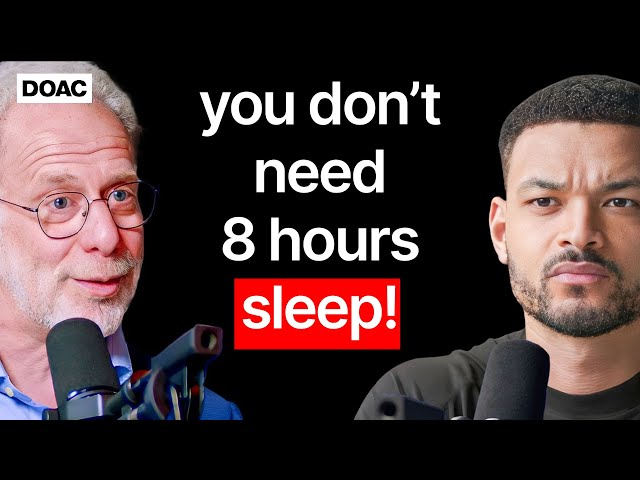
Harvard Professor: REVEALING The 7 Big LIES About Exercise, Sleep, Running, Cancer & Sugar!!!
Watch on YouTubeVideo summary
Harvard Professor Daniel Lieberman, an evolutionary biologist and author of *Exercised*, challenges conventional wisdom regarding health by applying principles from evolutionary medicine to modern lifestyle issues. He argues that many prevalent beliefs about exercise are myths rooted in a misunderstanding of human evolution; specifically, humans evolved to be highly physically active for survival tasks like hunting and gathering rather than engaging in leisurely gym workouts or running purely for fitness. Lieberman highlights the concept of "mismatch diseases," conditions like plantar fasciitis caused by modern environments that our bodies are not adapted to handle without specific countermeasures such as strengthening foot muscles, rather than relying solely on symptomatic treatments like orthotics. He emphasizes that while we evolved to live about 20 years past reproductive age and act as grandparents in many cultures, the modern Western concept of retirement leads to a dangerous decline in activity levels, accelerating physiological senescence or aging through disuse. The discussion debunks several specific health myths, particularly concerning sleep duration and sedentary behavior. Lieberman points out that the recommendation for eight hours of sleep is largely an artifact of the Industrial Revolution; data from hunter-gatherer populations who lack modern distractions like phones and TVs show they typically sleep six to seven hours with optimal outcomes, suggesting a U-shaped curve where roughly seven hours is ideal rather than more. Similarly, he addresses the slogan "sitting is the new smoking," explaining that while prolonged uninterrupted sitting is harmful, animals including hunter-gatherers sit frequently throughout their day. The key distinction lies in interrupted sitting—getting up every ten to fifteen minutes—which activates cellular mechanisms and lowers blood sugar levels effectively turning on the body's metabolic engine without needing constant movement. Regarding weight loss and diet, Lieberman clarifies that while physical activity is crucial for preventing weight regain after a diet, it is not an efficient tool for rapid fat loss due to caloric compensation; one would need to run vast distances to burn off high-calorie foods like cheeseburgers. He cites studies involving Boston police officers who maintained their weight loss only by continuing exercise habits even when returning to poor dietary choices, contrasting this with participants in shows like *The Biggest Loser* who largely regained lost weight once the intense regimen ended. Furthermore, he notes that hunter-gatherers can consume high amounts of sugar and honey because they expend significant energy daily walking 10 to 18,000 steps; however, modern humans do not need to replicate this extreme volume as health benefits plateau well before reaching those levels, making a goal of around 7,000 to 8,000 steps sufficient for most. Lieberman also explores the social and psychological dimensions necessary to sustain an active lifestyle in a world designed for convenience. He introduces the unique case of Björn Borg's sports company in Sweden, where employees are required to exercise every Friday as part of their work culture, demonstrating that making activity mandatory or socially rewarding can be effective. The professor advocates against shaming individuals who do not meet arbitrary fitness standards and instead promotes compassion and social accountability, such as running with friends or using commitment contracts like StickK.com to enforce habits through financial penalties. Ultimately, he suggests redesigning society by nudging people toward healthy choices—such as taxing sugar rather than banning it—and fostering communities where play, dancing, and group activities make physical activity a natural, enjoyable part of daily life that counters the decline in social institutions.
Read the full video transcript
A lot of people exercise because they
believe it will help them to lose fat.
One of the biggest debates on the
planet. What advice have you got for me?
So, this is not a well-known fact, but
Daniel Lieberman, he studies and teaches
how humans are supposed to live.
Author and professor at Harvard
University
exercise
disease sleep, nutrition
He has the answers on all of those
things that most of us care about.
We evolved to be very physically active,
working in the fields, hunting,
gathering, but now we live in a world
where
only 50% of Americans ever exercise. And
the rest of the world is headed our way.
cancers depression, anxiety can
attribute that to less physical
activity.
In fact, women who get 150 minutes of
physical activity a week have a 30 to
50% lower breast cancer risks.
And it's crazy, right? Problem is that
we spend 3% of our medical budget on
prevention. And yet 75% of the time the
disease is a preventable disease. It's a
completely backward, stupid system. When
you started writing this book about
exercise, was there any instant changes
that you implemented into your own life?
strength training The more I study the
importance of doing weights, especially
as you age, the more I started kicking
myself for being lazy about that. When
people retire, they become less active.
They tend to lose muscle, and then that
starts off a vicious cycle.
So, would you say we shouldn't retire?
Well, it's a very modern Western
concept, and yes, we do pay a price for
it. So, how does one go from having a
negative opinion towards exercise to
becoming an exerciser? As an
evolutionary biologist, there are
multiple ways of doing that. So,
Daniel,
what are some of the biggest myths
within exercise? Gosh, there are so
many. One of the most common, of course,
is
Daniel Lieberman, he's been to every
corner of the world visiting native
tribes to understand how humans are
supposed to live. And now he has the
answers on all of those things that most
of us care about on sleep, nutrition,
exercise, disease. You know, on disease,
he says that 74% of them can be
prevented. And he knows how to prevent
them. Aging, running, are we born to
run? He tells me this story of a CEO
that forces his employees to exercise
and the impact that that's had on that
company. And he talks about how as
humans, we've evolved to either use it
or lose it.
So, maybe maybe retirement is a really
bad idea for many of us.
One of the most thought-provoking,
pivotal conversations I've had on the
show. You're really going to take a lot
from this one.
And I suspect after listening you'll
probably start running, too.
For exercise or from some of the
decisions you've spent your life making.
Daniel, your work is so so incredibly
impressive
reaches such an incredible depth
charters new territory
and it's been
an unbelievable
clearly very passion-driven career you
had. So, my first question for you is,
why are you doing this?
Um
it's a good question. Um I am you know,
I started off being obsessed by human
evolution. I ever since I was a kid, I
was really interested in human
evolution, and for I spent much of my
early career working on skulls and heads
and why they are the way they are.
And then I kind of got involved in
public health and issues of health and
disease kind of through the back door. I
sort of slowly shifted my research
trajectory towards studying the
evolution of running and then the
evolution of physical activity
and its relationship to health and
disease, and and I've become part of a
movement that's often known as
evolutionary medicine, which is how to
apply evolutionary theory and data to
issues of health and disease.
Evolutionary medicine, I've never heard
that term before, but I love it.
Where has your
work on evolutionary medicine, let's
call it, where has that taken you? Where
where has it taken you to learn, to
research, to study?
You know, so much of what we think about
in terms of health and disease comes
from a tiny fragment of the world's
population. Almost entirely, like 90% of
all the medical information comes from
people from the United States
Canada
Europe and Australia. So, in order to to
study how bodies really work and how our
bodies evolved to be you have to leave
uh places like Boston, where I live and
go to places like Africa or Mexico or
wherever to look at at at other
populations and look at how those
populations are transitioning to to
lifestyles like mine. And so, uh we've
been working in Kenya um
for the last 15 years or so, um and I've
traveled some other parts of the world
as well, India you know, to kind of
collect some data, but uh but mostly in
mostly in Africa. After doing all of
this work and after taking in all of
this information, how has it shifted
your perspective on
running, exercise more broadly? What
Have there been any sort of significant
cognitive perception changes, you know,
Yeah, um
I actually had a I mean, it doesn't
happen very often, but I had kind of an
epiphany moment um
when I was working in Mexico. We were
collecting data on the Tarahumara, very
also famous for their long-distance
running.
And uh there was this elderly guy, he's
about 70-something years old, and he's
famous for his distance running, and I
was asking him how he trained, and I had
asked this question of a whole bunch of
other people, and the translator I was
working with was always struggling to
ask that question, because it turns out
there's no word for training in in that
language. The concept of training
doesn't exist. So,
so so she was trying to explain to this
guy what my question was. Um and I could
even with a translator, I could figure
out just from his tone of voice, he was
like, why would anybody run if you
didn't have to?
And I suddenly realized, yeah, of
course, exercise
is a very weird thing, right? If you're
if you're a farmer and you're working
super hard every day in the fields
without machines and whatever, or if
you're a hunter-gatherer and you're
walking, you know, you know, 5 to 10
miles a day and digging and throwing,
you know, doing all kinds of hard work,
and you're barely getting enough enough
food
why on earth would you go for a needless
5-mile run in the morning? I mean, it's
crazy, right?
The most viewed videos of yours
and the most viewed moments in those
videos
address one question. Do you Do you have
any idea what it might be?
No, actually. The biggest myths in
exercise.
Right. And I think you actually pointed
out one there with the um insight you
got in Mexico.
The way we exercise, going to gyms,
practicing, is the natural or human, but
evidently it's
it's a consequence of the privilege of
our lives and the comfort we have of not
having to seek out our our dinner every
day. What are some of the other biggest
um myths with within exercise that um
you've come across in writing this book?
Gosh, there are so many. I had to
actually limit limit it to 10. So, I
think um if you want to understand
physical activity and exercise, you also
have to understand inactivity. And I
think one of the biggest myths out there
is that you need 8 hours of sleep a
night. Um and that sitting is the new
smoking, you know, that that basically
And I if you if you think about those
two different myths
uh why is it that we're constantly told
to sleep more and to sit less?
Actually, it's kind of seems a little
contradictory to me, right? And it turns
out that um uh that let's take sitting
first. So, um
you know, there are all these uh you
know, these slogans like sitting is the
new smoking, and it's really bad for
you, and you know, every time you sit in
your chair, you lose 2 hours of your
life, and you whatever. Uh turns out
that um all animals sit, right? My dog
sits, um cows sit, chickens sit, every
animal sits. And hunter-gatherers also
sit. In fact, if you uh some of my
students actually put sensors on
hunter-gatherers, and uh when when we're
doing some research in farmers as well.
But they sit just as much as Westerners.
Um
uh so, sitting is there's nothing
special about being uh about today's
life. It's sitting It's It's that we sit
all day long and don't do anything when
we're not sitting, right? So, if you uh
and furthermore, the the big distance
difference is not so much how much we
sit, but how how we sit. So, turns out
that people who um
if you get up every once in a while,
right? Interrupted sitting is actually
much more healthy than non-interrupted
sitting
for the same amount of time. So, in
other words, two people might In in the
West, people sit for an average about 40
minutes at a at about. Whereas
hunter-gatherers, for example, or
farmers in Africa, where we work get up
every about 10, 15 minutes. And when you
do that, you actually it's like turning
on the engine of your car. You don't
even drive it around the block. You're
you're you're you're um you're turning
on all kinds of cellular mechanisms. You
lower blood sugar levels. You You all
kinds of genes get activated. And it
turns out that that is by far the most
important um uh way to way to sit. So,
just get up every once in a while. Just
pee frequently, make a cup of tea, you
know, pet your dog. Whatever. Thinking
when I'm on planes and I've got a long
flight, I just I always sit in the
aisle, right? So, I can get up a lot.
Always. Ah.
And um What about sleep, then? So, sleep
is another interesting one. So, this
idea that, you know, um that you need 8
hours of sleep
has been around for a long time. It's
been around basically since the
Industrial Revolution. Um but um if you
actually So, so, colleagues in my field,
so in evolutionary medicine, have put
sensors on people who don't have
have all the things that we're told have
destroyed sleep. it. We're told that TV
and lights and and uh you know, our
phones and all these things are are
preventing us from sleeping, you know,
Edison destroyed sleep, right? Uh so,
so, when you put sensors on people who
don't have any electricity, they don't
have TVs, and they don't have phones,
and they don't have have have any of
these gadgetry, right? Electric They
turns out they sleep like 6 to 7 hours a
night. Um and um they uh they don't nap.
Um so, this idea that natural human
beings sleep 8 hours a night is just is
just nonsense. It's just not true. And
furthermore, when you start looking at
the data 7 hours, if you actually look
at if you graph sort of how many hours a
night you sleep on the x-axis and sort
of uh you know, some outcome like
cardiovascular disease or just how how
likely you are to die
it's kind of a U-shaped curve. So,
people who don't get much sleep are are
in trouble.
Um but the bottom of that curve is
pretty much always about 7 hours.
So, people actually do better if they
sleep 7 hours rather than 8 hours. And
yet we're told that if you don't sleep 8
hours, there's something wrong, right?
Oh, so you can oversleep.
Well, yeah. I mean there's also some
complexity to this, too, because of
course people who are ill might be
sleeping more. And so there's some
there's some biases that creep into the
how you analyze the data. But but
basically it turns out that seven is for
most people optimal, but there's a lot
of variation, right? Never You know,
teenagers sleep more, older people sleep
less. It's complicated. One of the
things that
popular in culture as well as this idea
of doing 10,000 steps a day. Yeah, now
that's fun. You know, that started
because of a Japanese pedometer
pedometer. Um so but right before the
the Olympics were in Tokyo in the in the
'60s, uh they had invented the pedometer
and they were in sitting in a boardroom
and they were discussing what to call
the pedometer and they picked out of
just out of the blue they picked 10,000
steps because that's apparently an
auspicious number.
And it sounded about right. There was no
science behind it.
Interestingly, it turns out it's pretty
good. Um if you actually if you look at
at steps per day
and health outcomes,
um your average hunter-gatherer um
walks between 10 to 18,000 steps.
Depends on male, female, etc.
And and if you look at steps per day and
and outcomes, um um
at around 7 to 8,000 steps the curve
kind of bottoms out, right? There's
doesn't seem to be a huge advantage to
taking more than that per day in terms
of you know, large epidemiological
studies. So,
turns out to be not that bad a goal, but
it's not a there's no
it's not a perfect number like a lot of
things, right? It's just a kind of a
it's a reasonable it's a reasonable goal
to shoot for.
When you um
when you started writing this this book
about exercise and running and all these
subject matters, was there any
instant changes or any real lasting
changes that you implemented into your
own life from everything you'd learned?
I I think about that all the time with
this podcast. I'll have a guest on. I
have these many eureka and then
something will stick. So I'm I'm
wondering having studied all all of
these people all around the world and
looked at their bodies and exercise and
physical exertion,
what have you taken into your own life
that has stuck?
I would say that I've become more
serious about doing some strength
training. You know, I've I've always
loved
walking and running and you know,
endurance kinds of activities and I've
always sort of hated doing weights, you
know. I just don't like it. And I'm I'm
I'm I'm a wimp, you know. I'm not a very
well I'm I'm not a very strong person.
And you know, people tend to do what
they like, right? You get reinforcement
from it. And uh the more I study the
importance of resistance training and
the more I study the importance of doing
weights, especially as you age,
um the more I've uh
the more I I started kicking myself for
for being a being lazy about that. So
now I try to do a good two strength
workouts out of every week at least. And
uh
and take it more seriously because
especially as you age,
loss of muscle mass can be really
debilitating. There's a
um the technical term for that is
sarcopenia. Sarco is is the Greek word
for muscle and penia is loss, so muscle
loss. So as people get older, they tend
to lose muscle and when you do that, you
become frail and you lose functional
capacity and then that starts off a
vicious cycle, right? Once that happens,
then you're less likely to be physically
active and then of course when you're
less physically active, your muscles
begin to waste away more and uh it's
very debilitating. So I think as we get
older and I'm getting older, it's more
and more important, you know, to to kind
of incorporate that. So I think that's
the one thing that I've I've taken to
heart. Yeah, from what you said there,
it sounds like
not doing resistance training, not doing
not lifting weights as you age almost
accelerates aging and in any sort of
superficial sense, but but it also in a
physiological sense, you're
you're increasing the speed of aging.
Yeah, I'm not sure if I'd think about it
that way, but it I think I I kind of
reverse it slightly, which is that
you know, aging is just
the clock ticking on, right? There's
nothing we can do about age, but
senescence is the way the way our bodies
degrade as we get older.
And what physical activity does, perhaps
maybe the most important thing about
physical activity,
is that it slows senescence, especially
for certain organs and systems. And
there are different kinds of physical
activities. So there's endurance
physical activities, you know, like
running, walking, etc., swimming. And
then strength or resistance physical
activities and they have different kinds
of ways in which they slow various
properties of senescence, which we, you
know, colloquially call aging. And all
of them are important. And I think one
of the things that's really interesting
about humans, in fact, I think it may be
the most important thing about this book
and you asked about myths earlier. The
most important myth, I think, by far, is
this idea that as you get older, it's
normal to be less active. And that is
just not true. Um we evolved to be
grandparents. We evolved to live with
one thing that's most interesting about
humans, maybe, is that we evolved to
live about 20 years or so after we stop
reproducing. No other animal does that
except except orcas, maybe killer
whales. But with the exception of killer
whales, humans have this really weird
life history. We we we evolved to be
grandparents. But grandparents in the
old days weren't, you know,
retiring to Florida or I don't know what
they what they do in England or
whatever, go to Mallorca or whatever and
you know, kick up their heels and play
golf or whatever with carts.
Grandparents in the in the olden days,
right? Or in in many cultures still
today, are working, right? They're
working in the fields, they're hunting,
they're gathering, they're getting food
for their children and their
grandchildren, they're helping with
child care. And that physical activity
is, you know, that's what their job is,
to be physically active. But in turn,
that physical activity turns on an
amazing suite of of of physiological
processes that counter aging. Turns on
repair and maintenance processes that
not only keep our muscles strong, but
also keep our DNA from accruing
mutations, keep our mitochondria numbers
high, keep um keep our the cells in our
brain from accumulating gunk uh so that
prevents Alzheimer's and other forms of
dementia. I mean, for almost for every
system of the body, physical activity
has has benefits that slow the aging
process. And so when you stop doing it,
you accelerate and that's the way in
which you it
you perceive it as accelerating aging.
But really it's the absence of physical
activity, which lets aging run amok. In
your first book in 2013, The Story of
the Human Body,
in chapter 12 you said um
you used this phrase, you use it or lose
it, basically. We we evolved to use or
lose our bodies. And I was sat with um
someone recently and I was trying to
figure out why it appears that when
people retire or the other instance I've
seen is when their their elderly partner
passes away, it appears as if they don't
live much longer. Yeah, it's kind of
like kind of folklore or something that
once you retire,
your days are kind of numbered. Yeah.
Yeah. And I I was trying to figure out
the evolutionary reason for that, but it
sounds like that's kind of what you've
explained there. Well, I mean, I think
part of that is um is is depression,
right? Um
um when you lose a partner, I mean,
grief and depression, your cortisol
levels go up, your immune system goes
down. I mean, you know, it's it's it's
really tough on your body.
I mean, psychosocial stress plays a
serious physiological toll.
But but also, as you just pointed out,
when people retire, they become less
active. And that that loss of activity
has enormous effects on every aspect of
our our our of our of our body. I mean,
and our brain and our minds. I mean,
physical activity is important not just
for physical health, but also vital for
mental health. And um I think a lot of
the problems that uh a lot of mental
health issues we have today, depression,
anxiety, uh
some of them, you know, to some extent,
uh we can attribute that to loss to less
physical activity. And as people age,
becoming less physically active, again,
makes them much more vulnerable to a
wide suite of diseases.
So would you say we shouldn't retire?
Well, or if you do retire, I mean,
retiring is a again, another modern
weird thing, right? Nobody retired in
the past. I mean, if you're a farmer,
it's like a subsistence farmer in name
it, any place, right? It's not like
suddenly you hit 65 and all of a sudden,
you no longer have to work in the
fields. You work in the fields until
you're, you know, until you're dead,
right? And hunter-gatherers don't
retire. They they continue to be
physically active until until they die,
right? Or until they get too sick. So
it's a very modern Western concept um
and um and yes, we do pay a price for
it. But you of course can replace,
you know, work that you do with with
with challenging, rewarding, fun things
to do. The important thing is just not
to not to stop being physically active.
One of my favorite studies ever
published, without a doubt, um is is a
is a study done by a guy named Ralph
Paffenbarger. He realized that uh places
like Harvard are fantastic for studying
aging
because um Harvard, like other private
universities, never lets go of their
alumni.
So, until you the day you die, they're
asking you for money on a regular basis.
And and so they're um um
and so he he got the alumni association,
the Harvard Development Office, to let
him follow a series of Harvard alumni
from several years and keep asking them
in questions about their physical
activity levels and also their diet and
whether they smoked and stuff like that.
And then he tracked them for 25, 30
years.
And what he found was that the alumni,
we after corrected for every factor you
could think of,
that as you as the alumni got older, the
effect of physical activity on their
health outcomes was bigger and bigger.
So, alumni who were in their 20s, 30s,
and 40s, for example, who were were
exercising four, five times a week, they
had about 20% lower death rates.
By the time they they got to their 60s
and 70s, the alumni who were exercising
more had 50% lower death rates. So as
you get older,
so what and this has been replicated
again many times, but what he showed was
that as you get older, exercise becomes
more, not less, important for
maintaining your health.
Been thinking a lot about this cuz I was
I was saying to Jack, my dad is 60-ish,
but he's very, very out of shape. Very,
very out of shape. And I was in um I was
in Indonesia and I was with my
girlfriend and we went and we were going
white water water rafting. So, we had to
go down this really big hill.
And with all these stairs, it was like
300 m of stairs. And I remember of just
thinking, my my dad wouldn't be able to
do this at his age at 60. And I want to
be able to go down those stairs when I'm
his age because at the bottom of there
was a fun activity with someone I loved.
And to think that I'll get to a point in
my life where
not so far away in the grand scheme of
things um where I won't be able to go up
or down some stairs because I'm 60
um because of my sort of genetic
predisposition as I saw it was quite was
quite sad. But having heard you say
that, it's really feels much more like a
choice than it is genetics. Yeah, well,
we have this expression in my field,
which is that genes load the gun and
environment pulls the trigger, right?
Some of us have genetic predispositions
towards being, you know, more likely to
get diabetes or heart disease or this or
that or the other. But
our great, great, great grandparents
in different environments weren't
getting these diseases or they were
getting them at much, much, much lower
frequencies. It's not because they were
dying earlier. It's because these
diseases were more less common. So
I think we too often blame our genes for
uh many of these these these diseases um
or many of these health problems. Um and
it's I'm not in any way denying the role
of genetics is but that environment is
way more important and we have control
over our environment to some extent. And
so if you want to reduce your risk of
cardiovascular disease, reduce your risk
of diabetes, reduce your risk of
Alzheimer's, dementia
you you exercise isn't a magic bullet.
It's not going to prevent you from
getting those diseases completely, but
it lowers your risk
uh quite, quite, quite substantially.
And we know why, too. I mean, we have an
immense amount of data on why that's the
case. Um uh for every single one of
these diseases, we understand the
mechanisms by which physical activity
has uh you know, important mechanistic
effects on on these diseases. So, it's
there's epidemiological data, there's
mechanistic data, there's personal data.
The problem is that it's hard to do,
right? It's it takes willpower to um
overcome the the the the inertia of of
of of doing what's completely normal,
which is wanting to take it easy, right?
I was I was just, you know, I just flew
yesterday from Denver to Boston.
And in the and the in the in the airport
you know, there are these escalators
right next to the stairway, right? Mhm.
And and and and um the escalator and the
stair it wasn't a huge stair.
Everybody's lining up to take the
escalator. And like the stairs are
totally free. So, I
being me, I of course I can't I'm not
allowed to take the escalator unless,
you know, I have to, right? So, I I ran
up the stairs, but you know, it's but
those people taking the escalators,
nothing wrong with them. There's they're
not lazy. It's just an instinct, right?
It's an instinct to take to take it easy
when you can, right? Because when and we
now live in a world where everybody can
do that, right? Because we have
escalators and and lifts and cars and
shopping carts and all these wonderful
devices
to make our lives easier. And now you
have to overcome this fundamental basic
instinct to take it easy in order to be
physically active. And that's basically
what exercise is.
And so
and and furthermore, if you're out of if
you're unfit and you're not really, you
know, exercising isn't any fun, right?
It's it's it's it's unpleasant. You, you
know, you sweat, you get hot, and you
get cranky, and you know, um and and
it's not that rewarding
uh until you get fit. And so uh people
hate it, right? Um and and then we blame
them for being lazy. But they're
actually just being
they're just being normal. And I think
we need to have more compassion towards
towards people who struggle to exercise.
Quick one before we get back to this
episode, just give me 30 seconds of your
time.
Two things I wanted to say. The first
thing is a huge thank you for listening
and tuning into the show week after
week. Means the world to all of us and
this really is a dream that we
absolutely never had and couldn't have
imagined getting to this place.
But secondly, it's a dream where we feel
like we're only just getting started.
And if you enjoy what we do here, please
join the 24% of people who watch this
channel regularly and have hit that
subscribe button.
Means more than I can say. And if you
hit that subscribe button, here's a
promise I'm going to make to you. I'm
going to do everything in my power to
make this show as good as I can now and
into the future. We're going to deliver
the guests that you want me to speak to
and we're going to continue to keep
doing all of the things you love about
this show.
Thank you. Thank you so much. Back to
the episode. This basic instinct to take
it easy
are we evolved to be lazy take escalator
riders? Well, I wouldn't use the word
lazy, but we are evolved to take it
easy, to to rest whenever possible,
right? So, we've now got ourselves into
a bit of a comfort crisis here because
everything has in our lives is
optimizing us for convenience and ease.
Right, right. And well, it's also it's
it sells, right? I mean, comfort I mean
I mean, who prefers to sit in economy as
opposed to business class, right?
Nobody, right? Comfort's nice, right?
Who prefers shoes that are
uncomfortable, right? We we we, you
know, comfort's
comfort's, you know, we we love comfort,
right? But since when is comfort
necessarily better for you, right? I
mean, are comfortable shoes actually
better for you than going barefoot or
the comfortable chair is better for you
than or taking the the lift better for
you than taking the stairs?
the short term or at least it appears to
be today. Right. Yes, because we often
value the short-term benefit over the
long-term cost, right? Um that's, you
know, hyperbolic discounting is the
technical term for that. But but um so
we, you know, we live in a world where
where we we we, you know, we pay extra
for for comfort or we and we'll we'll
prefer it. But um but now we also live
in a world where we have to now go out
of our way to be physically active
because it's no longer necessary. And so
again, I'll go back to my original
statement, which is that people evolved
to be physically active for two reasons
and two reasons only. When it's
necessary or rewarding. When we don't
make it necessary, we need to figure out
ways to make it rewarding. And and
that's hard. It's very hard.
Making it rewarding. So, one way that
you might make something rewarding is by
looking at the stick. And then the other
side is maybe the carrot. But just
looking at the stick then, you were
going through a series of diseases a
second ago, Alzheimer's, um high blood
pressure, all of these kinds of things,
cardiovascular diseases. I almost think
we've come to
assume that these are inevitabilities of
life. Yeah. We'll get cancer. Yeah. One
of us will get Yeah. Someone in here is
going to get Alzheimer's. And that's the
way we live. So, we're we're we're
preparing to medicate when that day
comes.
That's right. I get God forbid diagnosed
with something. That's absolutely right.
In fact, that's what medical students
today are taught, right? If you go to
medical school today
you're taught that as people get older,
their blood pressure goes up. I can tell
you that's just not true. It's in the
Western world where people are
physically inactive and eat crap diets
that their blood pressure tends to go
up. But there are plenty of people
I'm actually one of them, right? Who
don't have high blood pressure as they
age. And guess
what's the best way to prevent getting
high blood pressure as you age? It's um
you know, I sound like a broken record,
but we have this idea that as you get
older, yes, you're going to you're and
we're lucky, right? You know, because we
don't die from smallpox when we're 30.
We're lucky to get cancer when we're 60,
right? What we've done is we've confused
diseases that are more common with aging
with age being a cause of those diseases
in the first place. And they're not
inevitable inevitable diseases. Um and
many of them are preventable. And and
the problem is that in our society we
we don't value prevention very much. We
we may talk about it, but we don't
really put our money where our mouth is,
right? In the US, which is arguably one
of the worst health care systems is the
worst health care system among the
industrialized Western world.
We spend approximately
3% of our budget our medical budget on
prevention. And yet when people walk
into a doctor's office, 75% of the time
the disease is according to the Center
for Disease Control a preventable
disease. So, we essentially spend
nothing to prevent diseases that
overwhelm our system and cause enormous
amounts of misery. It's a completely
backward, stupid system. And so and and
the good news is it's not that hard to
prevent a lot of these things. Um um it
takes willpower and um takes education
and it takes access to to good quality
food and whatever. Um but um uh so in in
one sense, it's very depressing. On the
other hand, the optimist in me says, you
know, we really can do something. And
people even if without even if they're
not wealthy or whatever, I mean, there
are simple things that everybody can do
to improve their health outcomes.
These diseases we we encounter today as
we age and just generally in our
society, when you look at
hunter-gatherer hunter-gatherer
communities or you look at certain
tribes around the world, maybe in Africa
do you see the same
um
the same types of diseases in the same
um
occurrence level of occurrence? Or is
there some diseases which just don't
like I'm wondering if like if cuz you
know, cancer seems to be so popular for
as as disease and Alzheimer's and these
kinds of things. So, I wonder, has that
always been the case throughout human
history? And is that the case in other
parts of the world? Uh such a good
question. So, first of all, some of
these some of these diseases are really
hard to to measure in non-Western
populations because we don't have the
diagnostic tools. So, nobody really
knows how common cancer is in in in a
lot of parts of the world, right?
There's just no the data don't exist.
That said, when you make estimates and
you do look at the studies that are out
there and even if you look in in in
historical records in in places like
Europe where people have been keeping
track of this, there's no question that
cancer rates have been rising and that
cancer rates are much, much more common
in the Western world. There's a strong
association between cancer and wealth.
And that's because cancer is basically a
disease of energy, right? When your
cells cuz cancer is basically natural
selection gone awry in the body. It's
when cells start competing with each
other
um in ways that that cause it basically
and and start, you know, going, you
know, multiplying and dividing out of
control, right? It's a kind of natural
selection. And what is it that those
cells are doing? They're competing for
energy. And when you have more energy
like when you're eating more and being
less physically active
you can you basically feed those cells.
So,
um so cancer so a high levels of insulin
insulin is highly
uh related to to cancer. High insulin
levels are are carcinogenic. Um high
levels of of body of of energy you cause
women for example to increase the the
amount of estrogen and progesterone that
they produce. Men produce more
testosterone. These are and these are
these are
hormones that um of course are for good
for reproduction, but they're but again,
we have we evolved to be to have as many
babies as possible, right? But that
doesn't mean that translates into
health, right? So, more estrogen, more
progesterone increases risks of say
breast cancer. More testosterone
increases the risk of prostate cancer.
So, if you look at most diseases, right?
People are more physically active, they
have lower levels of estrogen,
progesterone, testosterone. They have
lower levels of insulin. They have lower
levels of blood sugar. All of these
depress cancer rates. And on average,
people who are physically active have
much lower rates of almost every single
kind of cancer that you can think of.
Women who walk 150, you know, get 150
minutes of physical activity a week
have on average
about 30 to 50% lower lifetime breast
cancer risks than people who are
sedentary.
And yet for some reason, this is not a
well-known fact.
Um and we under we have we have
epidemiological data. We have
mechanistic data. We understand how and
why it works. And yet and yet how often
do you hear about cancer prevention? We
talk about treating cancer, which is all
important. If I get cancer, I would like
it treated, too. Thank you very much.
But why don't we spend more energy and
activity and and and have more education
about how to prevent cancers in the
first place?
Physical act I mean I've never had that
before. So, that's that's really helped
me um
to add more value to exercise in my
mind. You're talking there about insulin
levels and how that has there's
a link between your insulin levels and
your chances of getting cancer.
Sugar.
Glucose.
Inflammation.
Bad.
Yeah, I mean I mean look, if you want to
you want to take like the three things
you should, you know, if you really care
about your health, don't smoke, right?
That's kind of obvious. I think
everybody knows that.
Get some exercise. I don't think you
need me to tell you that, right? And and
cut down on sugar and foods that are
high in sugar and low in fiber, right?
That you know, what we call high
glycemic foods. Those are the foods that
elevate your your your your blood
glucose levels. Your your insulin levels
shoot up. And insulin insulin, the basic
function of insulin is is is it's it's
what we call an anab- anabolic hormone.
It's its job is to is to store energy.
Glucose.
Glucose, but also fat. Okay. All right.
Okay. So, ins- ins- what insulin does is
to get energy into cells. So, it's like
a taxi.
It's like an Uber. It's like a taxi,
yeah. Well, I mean it it's not a tac-
it's like a it's telling other cells to
do that. So, insulin for example binds
to other cells that are the actual
taxis. So, it's like it's like calling
the Uber, I would say maybe, right? Um
and um and insulin is is, you know, it's
the funda- So, when you when you eat
food, insulin levels go up because its
job is to store that energy. And when
you exercise, insulin levels go down
because because you want to then use
that energy, right? So
so uh so
when cells get more energy, they're more
prone to going out of control,
basically. And and and and inflammation
is caused by
basically by getting you store so much
fat in your cells that those fat cells
start to swell. And when those start to
swell, like anything, right? They start
to rupture. They get damaged. And that
damage attracts the immune system and
the immune system gets turned on and
that causes inflammation. So, so too
much adiposity, too much fat, you know,
overswollen fat cells
is the is a primary cause of systemic
inflammation. And inflammation is like
the slow burn in our bodies that causes
widespread damage to pretty much
everything you can think of. And it
turns out that So, the two ways to deal
with inflammation are one to prevent it,
right? So, don't eat foods that are
pro-inflammatory.
Like?
Anything with a lot of sugar, basically,
right? That I mean that you know, the
sugar is highly inflammatory.
Um or trans fats are highly
inflammatory.
But also, turns out many people don't
know this, but you also want to turn
down your immune system, right? You want
to turn the dial down. And
I don't know, I'll just give you one
guess what it is that does that.
Exercise. Exercise. And the and and and
the way it does that is that when you
when you're physically active, you're
using your muscle cells. It turns out
muscles are also an endocrine organ.
Your muscles are producing a molecule
called interleukin-6, IL-6 that in low
levels is pro-inflammatory, but at high
levels, it's actually anti-inflammatory.
It turns down inflammation. And your
muscles because a third of your body is
muscle, right? When you go for a run or
or swim or bike ride or whatever you're
producing a ton of this stuff and it
turns down levels of inflammation. So,
people who are physically active, even
if they're overweight are actually
controlling and regulating their
inflammation. And we never evolved to
regulate inflammation because in this
way because we never evolved to be
physically inactive. Until recently,
nobody was physically inactive until
they unless they were dying, right? So,
so we never evolved an alternative
mechanism to regulate inflammation other
than physical activity.
And we didn't live in a world with this
much sugar. We never lived in a I mean,
it's astonishing. You you pay more money
for foods today that have less sugar
added.
Right? I mean, that's just ridiculous,
right? Cuz it's so cheap. And sugar is
you know, we love everybody loves sugar.
I mean, I've um I've gone hunting with
um hunter-gatherers, you know, you know,
foraging hunter-gatherers.
And um
and I can tell you that they're honey
addicts, right? I mean, I've gone out
with these guys and they go from
you know, if if they if they fail in
their hunt like by 10 or 11, if you
haven't killed an animal, you know,
that's it for the day, right? And then
it come it turns from being a hunting
expedition to a
honey collecting expedition. And they'll
go from hive to hive to hive
get smoke, burn out the bees
and just gorge themselves on more honey
than I could possibly imagine to eat.
Except these are lean
physically active hunter-gatherers and
they they handle it just fine. Um
but it's you know, it's the it's the
Paleolithic equivalent of, you know,
eating Mars bars all day long.
But they've been out doing physical
activity for how long? Yeah, I mean, the
average day is about 15 km of of walking
with some running, you know. So, so so
they're you know, they can they can they
can cope with it. How many hours is
that?
Oh, that's two to three hours, probably.
Okay, so from that I have garnered that
I need to do 15 km a day
for two to three hours every day.
Well, remember, it's not a prescription,
right? So, that's that kind of like the
paleo fantasy sort of naturalistic
fantasy that if you live like a
hunter-gatherer, somehow your your your
world will be perfect, right?
That's basically what the paleo diet is
sort of all about, right? And that's not
true, either.
Yes, you need to be physically active,
but it turns out that a certain amount
you know, if you're any any physical
activity is better than none, right? And
if you look at the kind of any curve of
any output, any health health health
health outcome like
how many years you live or whether
you're likely to get cancer or heart
disease or whatever, you know, any
little physical activity, your curve
starts to fall quickly, right? Your your
likelihood of cardiovascular disease
starts Just, you know, a few minutes a
day of exercise has big benefits. But
eventually that curve flattens out,
right? And it flattens out well before
the hunter-gatherer level. So, you don't
need to be a hunter-gatherer in terms of
physical activity to get the benefits.
This is a I've asked a few people this
question. I don't think everyone's
anyone's really answered it. Um but I
suspect you might be able to. If if you
were responsible for redesigning the
nature
of our modern world to make it more
matched and less mismatched
what are some of the first things you
would do to help society benefit in
terms of our happiness and our health?
I I think about this all the time. I
think cuz we we we don't seem to be
turning around. We seem to be hurtling
in a direction kind of unconsciously
towards artificial intelligence and
moving less and being more sed-
sedentary and taking pills more to fix
everything.
Lonelier than ever before.
And I got you know, if we were to
redesign it, blank canvas
piece of paper
It's a tough question because
um
we've essentially given
ourselves what we want.
Right? Um I can go into a supermarket
and
I mean, I can do something that's
unimaginable until recently. I can have
I can I can have basically anything I I
can eat better than the king of France,
you know, a few generations ago. I can I
I can I mean, here we're I can New York
I there's like every cuisine possibly
available to me. I I don't ever have to
climb the stairs. I can take elevators.
I mean, we've we've we've we've made our
world
so convenient and comfortable
um and yet there are consequences to the
many of the things that we crave and
want.
So
in a ideal world, you don't want to
you don't want to
rem- I mean, you have to you have to
honor
and respect people's
um um desires, right? I'm not a I I
don't believe in in in preventing people
from taking the elevator, right? Or or
forcing them to you know eat eat whole
grain bread as opposed to white bread,
right?
But if you banned white bread and you
banned elevators other than for those
people that need it for accessibility
reasons, etc.
They would do better. Over the long
term, they would be healthier and
happier. They would. Right. So, the it's
really a a balancing act between between
um
um respecting people's liberties and
choices and educating them and helping
them. So, in my world, I would I would
do more to nudge people, right? Um I
would instead of banning sugar, I would
tax it more.
Um instead of um
uh
pushing
uh all kinds of foods on people, I would
push I mean, why don't we why don't we
advertise
healthy foods the way we advertise
unhealthy foods, right? I mean, when's
the last time you saw an ad for just how
amazingly healthy asparagus was, right?
But that doesn't get the part of my
brain
going, does it? No, it doesn't, but um
but we could do more to to nudge and
encourage and help people, right? You
don't have to like ban sugar and
cookies, right? Uh the way some people
but but but simply promote um and help
people
help themselves, right? Most people want
to eat healthier food. Most people want
to exercise. Um but they live in a world
where it's hard to do it and they live
in a world where um there are very few
incentives. I would make it such that
healthy food would be as as inexpensive
as as unhealthy food.
And make sure that that people had
incentives and and make it also fun to
be physically active. Like for example,
um
every I mean, who doesn't like to dance,
right? Every culture in the world has
dancing, right? Dancing is a form of of
of physical activity.
It's social, it's fun, it's engaging.
Why don't we have uh have Why doesn't
every every town in America sponsor
dancing?
Right?
Um you know, it would probably do an
enormous amount for people's physical
health and their mental health. I mean,
we could do that I mean, that's just one
example, right? So, I would I would um I
would I would I would and and why is it
that uh in medical schools doctors don't
learn about I mean, they don't they
don't study nutrition and they don't
don't study exercise and they don't
learn um because that's because in our
medical system is designed to treat
people after they get sick rather than
prevent people from getting sick. So, so
we need to we you know, reverse how we
fund health care, right? And so, schools
of public health are these kind of
little marginalized places where you
know, where where great ideas go to die,
right? And and medical schools where all
the money is, right? And doctors aren't
taught to to deal to to to I mean, there
are entire fields of medicine that don't
have the word preventive associated with
them. I mean, have you ever heard of
preventive orthodontics or preventive
you know, optometry or preventive you
know, the preventive orthopedics. I
mean, it just doesn't exist, right? So,
we we could do a lot more um and and
have enormous benefits. Chapter 11 of
this book, you talk about someone who
has taken their own approach to getting
people moving and exercising
um in their own business. That was the
Björn Borg company. I love that. Björn
Borg company. Can you tell me about that
that company? Yeah, so I was um
so I was I was curious about this idea
of how to get how to help people be more
physically active, right? And again,
you know, my my fundamental hypothesis
is that we evolved to be physically
active either when it's necessary or
rewarding.
And so, I was curious if there was any
any companies in the world that have
made physical activity necessary. In
other words, what if we force people to
be physically active? And I found one so
far. I think there's only one company in
the world that I know of. Maybe there's
some others, but this is the only one
I've ever found so far. And it's the
Björn Borg sports company in Sweden
where the CEO of the company is this
crazy sort of exercise addict and he um
he requires every member of the company
to to exercise. They have sports hour
every Friday at 11:00 o'clock.
So, I actually um when I when I was like
searching around and I was thinking, you
know, I like working on the book, I
actually, you know, I got I I thought I
found a an article about them and I, you
know, I clicked on the on the company
website.
And you know how most companies have a
little contact us? Mhm. So, I I clicked
on the contact us and I wrote a little
note saying, you know, "Dear Björn Borg
company, I'm a I'm a researcher and
evolutionary biologist. I'm interested
in exercise and I'm and I'm fascinated
by how your company um requires people
to exercise. Can I learn more?"
And the next morning, there was a an
email from the CEO of the company
saying, "Why don't you come and visit
us?" So,
so I hopped on a plane uh a few a few
months later, went to Sweden and they
they let me He was so nice. He just let
me just go anywhere in the company. And
I I went to sports hour and I I talked
to to employees throughout the company
and it was fascinating. I mean, um a lot
of the employees of the company
um first of all, a bunch of people
apparently left the company when he took
over as CEO and required this. But it
doesn't matter who you are. You could be
working in the mail room, you could be
the CEO, you could be on a visiting
board member. Whoever you are, if you're
there on Friday, you have to go exercise
with them. And they have this pretty
serious kind of exercise thing. And
apparently, some people quit. Um but um
but but pretty much everybody else said,
"You know, it's actually a pretty damn
good thing." Do you agree with that
approach? Well, yes and no. Um every
university in the world used to require
and every school, right? Supposedly
requires exercise, right? I'm sure you
had physical exercise you know, physical
some kind of phys ed required in your
school.
Those standards are slipping around the
world and more and more kids are doing
less and less in school.
Uh universities were are no exception.
It used to be that all universities
required some degree of physical
education. Uh mine was no exception. In
fact, Harvard was a leader in that back
in the, you know, 100 something years
ago.
And over the uh since basically the
1970s, that's basically disappeared.
Although most students, if you ask them,
they think, "Yeah, it's actually a
pretty good idea."
So, I don't know. Maybe we can bring
back exercise as a And and the thing is
that if you get used to it, right? When
you're young, you're more likely to
do it when you're older, right? Cuz you
set Those are the that's the age in
which your habits become
become
well, your habits become your habits,
right? And so, at there's a certain age
where where if you can keep keep
get that making it make it a habit,
you're probably more likely to continue
doing it for the rest of your life. We
kind of see it as overreaching, don't
we? I was thinking about if I was to
announce one of my companies that
everyone is now required to exercise, it
would seem like like tremendous
overreach. If I announced that everyone
is required to read a certain book,
they'd do it and it'd be fine. And it
might be seen as a positive thing,
right? Might be a representation of our
values that we are learners and we're
innovators and we keep, you know,
nourishing our brains. But if you turned
around to your team and said, "Listen,
we're all required to you're all
required to go for a run every day or
something." People would it just feels
personal. Like that's not the
responsibility of an organization to
tell me
to go
exercise.
But we have we have company, you know,
retreats. I mean, we do all kinds of
stuff where people are required to do
it. So, I don't know. I challenge you.
Try it. What we do and what we've always
done, we even do it with this team. The
Drive CEO team is about 30 people. So,
we have a fitness channel in the company
um Slack channel, the communication
channel that we use.
And in that channel um and we did this
at my previous company as well where we
would
enable and facilitate. So, we we
someone started a women's football team.
So, we enabled it and promoted it.
Someone started a men's football team,
so we enabled it and promoted it. And
this this also applies to non-physical
sort of exercise related clubs like
someone starts a reading club and we
enabled it and promoted it. Um and we
also paid for it. If they need to if
they need new kits, for example, when
the women's football team needed wanted
to have their own uniforms, we paid for
it because we saw a huge value in terms
of staff retention, connection,
community and all those things that
actually lead up to staff retention
if we could have more social clubs
outside of the office. You know, if
you're thinking about leaving a job,
there's a number of things you weigh up,
the pay, the job, whatever. But you also
weigh up how the community, like the
group of people I love and how much they
bring to my life. And I actually think
in the remote working world, um it's
something that CEOs and leaders have
really not paid enough attention to that
if they really want to retain their team
members, they should have them together
as much as they can even outside of the
office bonding in a world where screens
are on the rise and pubs are on the
decline and social activities and
churches are on the decline, there's
less sort of
uh institutions that connect us
socially, work has a big opportunity to
do to do that. So, one of my big things
that's always in my head is like how can
I get the team members of my companies
to hang out more and and a multiplier to
that is how can I get them to hang out
more and move their bodies more cuz then
they'll feel better. Right. Well, well,
think about it. It's play, Play, yeah,
exactly. And I mean, and play is what is
another thing we evolved to do, right?
What kids play and we're one of the few
species that plays as adults, right? And
what is play? Play is a way in which you
you you learn cooperation, you you you
build community, um but you also move
your body, right?
In the first chapter of your book, you
say that you went to visit the Native
American tribe and I'm going to try and
perhaps pronounce this, the Tarahumara.
Tarahumara. And they're famous for their
long running. Yes. What did you learn
about running from them?
Well, it's you know, they have been
famous for well over 100 years. I mean,
many uh people have gone to study the
Tarahumara and and have commented on
their amazing ability to run.
But what I I really learned from them is
that um uh for them, physical activity
is spiritual. Um
you know, there's this book Born to Run
that uh that describes their their
running and
calls them a hidden tribe of super super
athletes. They're not hidden and they're
not super athletes. Um and um and the
one thing that the book missed was that
the the main impetus for the for the for
the running they do these famous
long-distance races is that it's a form
of prayer.
Um it's really very beautiful. Um and um
and it's it's a metaphor for for life
and and and it's also an an opportunity
to bet and sports and all that. It's all
wrapped into one.
And and what I've learned was that this
actually used to be
almost universal among Native American
populations, right? Native American
tribes. Everybody had long-distance
races and ball games and and all they
were all had a spiritual element. It's
just that
they've they've retained their
traditions because they're in a very
remote
part of of Mexico that's essentially
inaccessible. We all used to do this.
All uh humans used to do this. And in
fact, if you think it if you look around
the world, every population has this
tradition of endurance endurance events.
Some of the subject matter you talk
about in your book, but also outside of
your book is is how
we used to run
um in terms of, you know, I was at the
foot doctor.
What's it called? I I don't know what
they're called. Orthopedic Podiatrist.
That's what I said. Podiatrist.
What did I say?
But I went to the podiatrist the other
day because I
I got this
What's it called when your
in a point out on my foot. This part of
my foot here started to get lots of
pain. Every
Plantar fasciitis.
That's it. Plantar fasciitis. I started
to get some plantar fasciitis.
And it was just this ongoing pain.
And they prescribed me some insoles. I
stood on a couple of machines, some soft
stuff, and they measured my foot and
took this scan of it and said, "Right,
basically you're standing wrong.
Um your arch is a bit too flat. Take
these insoles and wear them in all of
your shoes." And I just I always think
in these moments when someone prescribes
me something that's not natural, I go,
"Why? Like
where did I go wrong?"
And I think that's the key question.
Where did I go wrong? Who lied to me?
To the point now that at 30 years old, I
have these bloody insoles that I have to
put in all my shoes. Because presumably
that's not natural. Presumably my my
ancestors don't have bloody insoles.
Yeah.
So,
plantar fasciitis is what I would call a
mismatch disease, right? A disease
that's more common or more severe
because our bodies are inadequately
adapted to modern environments. And in
your case, and as as is the case with a
lot of people, you have a weak foot. So,
so we you know, you you look like you go
to the gym. Looks like you're pretty fit
person, right? I'll make a bet you you
strengthen pretty much every muscle
group in your body except your feet,
right? No comment. Right?
Well, but we don't, right? And one of
the reasons is because we we encase our
feet in stiff-soled shoes that are very
comfortable. And and the reason the
shoes are comfortable is that your your
foot muscles have to do less work when
you're you're using those shoes, right?
We have shoes that are stiff soles,
they have arch supports, right? And your
your foot has four layers of muscles in
them. And those muscles are supporting
your arch. And at the bottom of those
four layers of muscles is this layer of
connective tissue, the plantar fascia.
And the problem with the plantar fascia
is that if it stretches too much, it
like anything else, right? It gets
inflamed.
But it's got almost no vascularization,
right? So, it has it's very hard for it
to repair itself when it gets inflamed.
To prevent plantar plantar fasciitis,
the best way to preventing it is having
a strong foot. A strong foot is a
healthy foot. So, the way to way to
treat the disease
in the long term is to strengthen your
foot. But if you want to just alleviate
the symptoms, that's what your
podiatrist did by giving you an insole,
right? It's basically
preventing your muscle your arch from
collapsing as much, making it more
comfortable so your your plantar fascia
gets stressed less, and so it can kind
of
um alleviate that that that that that
stretching and hence the pain, right?
So, that's a typical example of what I
call disevolution. It's what
what happens when you treat the symptoms
of a mismatch disease rather than their
causes or preventing their causes. So,
podiatrists are a bit like drug pushers
in that sense, right? Because they're
they're essentially
putting your foot in a cast, right? And
then and for the rest of your life, you
kind of have to keep using them unless
you strengthen your feet. So, I So, So,
there's nothing wrong with those, you
know, treating the symptoms. I mean,
pain is no fun. So, wear the insoles,
right? To kind of, you know, alleviate
the pain, but also work on strengthening
your foot, and I think you'll find that
the plantar fasciitis will will
disappear and never come back. So, the
plantar fasciitis fasciitis um has now
healed
after about a month of wearing the
insole. Um I no longer have the insoles
um with me here in
New York, and I don't have them in any
of my shoes because I've also taken a
bit of time off um running on my feet. I
was playing a lot of football.
So, now I'm at a point where I can go to
the preventable stage, prevent it
happening again. And you said to
strengthen my foot. How does one
strengthen their foot?
Good question. So, there are some
exercises. Um they're kind of foot
doming exercises and things like that.
But they're they're, you know, I can
send you some links to videos showing
you some good foot strengthening
exercises. So, that's one way to do it.
Um but the other way is to wear more
minimal shoes. Um to wear shoes that
aren't stiff-soled, that don't have arch
arch supports. Go barefoot a lot, right?
Um and those that will naturally
strengthen the muscles in your foot cuz
you'll have to use those muscles. So,
you ever gone for like a long walk or
run on a beach, right? And afterwards,
your your feet are kind of tired. Mhm.
Right? The reason your feet are tired is
because you're now working on a
compliant surface, right? It's not
stiff. So, your muscles having to work
more
to stiffen your foot to push you
forward, right? Jack, could you go grab
my the black shoe out of my bag? I just
want to show him something. So, um so,
wearing shoes that aren't as stiff-soled
when they don't have a arch supports
will slowly strengthen your feet. But,
and this is a huge but, if you do too
much too fast, you will your plantar
fasciitis will come roaring back and
you'll hate me. You'll like you'll never
forgive me because um
Yeah, there's a Vivo barefoot. Um yeah,
I I wear the same shoes.
Oh, you you've got the same shoes on.
Um great shoes. Yeah, those are
wonderful shoes. Those are those are the
those are the exactly the kind of shoes
that will help strengthen your feet.
These are fairly a new addition in my
life. Yeah, they and they feel really
strange cuz you can kind of feel the
floor. Yeah, it's exactly what you've
described is
Yeah. But but you you can transition. If
you have weak feet, which I'm going to
guessing you do, you if you go if you
suddenly that's the only shoe you wear
all the time,
you'll probably regret it, right? So, so
slowly slowly slowly increase the
percentage of time that just like
anything else, right? If you if you like
suddenly decide to lift, you know, huge
weights that you can't lift before,
you'll hurt yourself, right? The same
thing is with your feet. So, so slowly
it does it, but you if you do it
gradually and slowly and carefully, you
can build up strength in your foot and
and you'll
and you'll be a happier happier person.
And this is this goes back to everything
else you've said about how choosing
comfort, choosing to have a nice
supportive shoe has actually just kind
of deferred a problem off into the
future for me. It's the same with diet.
It's the same with avoiding and being
sedentary and and all these other things
where when you choose the easy road in
the short term, which is this wonderful
cushioned shoe I've chosen, the muscle
hasn't built up in my foot, and I've
paid the price. Correct. So, I need to
again choose discomfort more in the
short term, go up the stairs,
run barefoot to avoid the late the
consequences later down the line. Yeah,
I mean, I don't think you have to run
barefoot, but
though it can be fun, but um
um but yeah, I mean, and I can think of
plenty of other examples. Um
We love comfort, but comfort's not
necessarily good for us.
When you um when you look at these
tribes, are they
Do you know who Liver King is?
Huge massive muscles, talks about
ancestral living. Um
What do our hunter-gatherer ancestors
look like in terms of that?
Not like him. No? Okay.
I mean, look, think about it. Muscle is
really expensive, right? It's actually a
super expensive tissue. Uh about a third
of our body is muscle, and it's using up
about about you know, a fifth or more of
the calories that we're expending,
right? Uh just just sitting there, not
even using them, right? They're they're
very costly tissues, right? And so, if
you have more muscle than you need,
you're basically
adding to your your cost of of living,
right? And if you're if you're a
hunter-gatherer or even a subsistence
farmer living on the margin of food
security,
having more muscle than you need is
actually deleterious, right? Remember,
the only thing that natural selection
cares about is how many offspring you
have who survive and reproduce. Doesn't
care if you're strong or healthy or nice
or loved or, you know, fun or whatever.
It only cares about whether you have
grandchildren. That's it, right? That's
the cold calculus of selection. My brain
is going if I have big muscles,
I'll have more romantic opportunities,
and I'll have grandchildren. Well, only
up to a certain point, right? And I
don't So, if more muscles if if they
attract the opposite sex and and make
them want to reproduce with you, yes,
that could be a benefit.
Um I'm not so sure how much women are
attracted to the Liver King, but um um
and that's not something I even want to
know the answer to, but um and certainly
shouldn't ask him, but um
um
um but but there's a reason we have use
it or lose it, which you mentioned
earlier, right? Because
when we need
when we increase our demand, we increase
our capacity, right? When you go to the
gym and you work out, right? You build
muscle, but if you stop using those
muscles, you lose it. And that's an
adaptation, right? Because you don't
want to spend extra energy on muscles
you're not using, right? So, you want
enough but not too much. You want to be
economical with muscle mass, right? Um
and so, uh if you look at the data um
from hunter-gatherers, and people have
done that. They've done grip strength
tests, etc., and all kinds of other fun
things with it. Like mini Olympics. I
mean, we've done this, too. Um People
are reasonably strong, but they're not
super strong. And they're not they're
not buff and built and bulked and all
that sort of stuff. They've got enough
muscle to do what they need to do, but
no more.
And the reason why people find muscle
attractive anyway is because it's a
evolutionary signal, isn't it, of
uh reproductive value and resources,
maybe, and your ability to go out and Do
you know what I mean? Why why does why
does a woman, for example, find a man
with muscles or in good shape attractive
in 2023 when we're not hunting for
gazelle?
Well, I'm not a I'm not a I'm not a
psychologist or a or so, I'm not sure if
I'm qualified to answer that, but I
could I could venture the guess that
obviously, if you're trying to if, you
know, we pair bond as a species, and we
have been for for of years probably.
You want to pair bond with somebody
who's going to because we also have of
cooperation and food sharing, right? You
want to prepare bond with somebody who's
going to be able to you know bring home
the bacon literally and figuratively,
right? But but bringing home the bacon
does not mean looking like Arnold
Schwarzenegger at least back in the day
Arnold Schwarzenegger back in the day,
right? Being bringing home the bacon
back in the day meant being
a persistent hunter being able to run
long distances and being moderately
strong. So they looked more like a
marathoner or or a football player than
they did a
weightlifter, right? So it's conceivable
it's conceivable that someone who is
really really big is actually
um less attractive because they wouldn't
have been able to hunt and run and hunt
as well as someone who was a little bit
Yeah, you also have to you have to feed
what they you have to feed them more,
too. Yeah.
And that's a you know those are precious
calories. So I'm going to guess that uh
I look if you look in in in non-Western
populations
you don't see physiques like that. This
is a this is a privilege of people who
are able to go to gyms and
and you know eat you know
you know whey powder shakes and all that
kind of stuff to kind of build their
crazy muscle mass, but it's not
something that our ancestors were able
to do on a regular basis. That's for
sure.
A quick word on Huel. As you know
they're a sponsor of this podcast and
I'm an investor in the company. One of
the things I've never really explained
is how I came to have a relationship
with Huel. One day in the office many
years ago a guy walked past called
Michael and he was wearing a Huel
t-shirt and I was really compelled by
the logo. I just thought from a a design
aesthetic point of view it was really
interesting and I asked him what that
word meant and why he was wearing that
t-shirt and he said this is brand called
Huel and they make food that is
nutritionally complete and very very
convenient and has the planet in mind
and he the next day dropped off a little
bottle of Huel on my desk and from that
day onwards I completely got it because
I'm someone that cares tremendously
about having a nutritionally complete
diet but sometimes because of the way my
life is that falls by the wayside. So if
there was a really convenient reliable
trustworthy way for me to be
nutritionally complete in an affordable
way I was all ears especially if it's a
way that is conscious of the planet.
Give it a chance. Give it a shot. Let me
know what you think.
There's another myth that I you bust
which I thought was really interesting
cuz I think I know a lot of people that
have used this as a as a reason not to
run. They say it's really bad for your
knees. Oh man, that gets me so mad,
right? I mean I hear this from doctors
all the time, right? Oh yeah, running is
bad for your knees. Now it is true
that knee injuries are the most common
running injuries. Um um
but
arthritis which is really what they're
usually talking about um it's absolutely
definitively not true that running
increases rates of knee cartilage damage
and arthritis. So arthritis is caused by
cartilage wearing away in a joint,
right? And it's it's a it's a myth that
that running actually increases
cartilage damage. If you have arthritis
running is excruciating and problematic,
but if you don't have it running
actually
if anything may be slightly preventive
um because
cartilage joints like everything else
benefits from being used, right? And so
physical activity actually helps promote
strong and healthy joints. We used to
think that it just caused them to wear
away, but actually you know like cars
you're wearing away at their tires, but
now we know that actually physical
activity promotes
repair mechanisms in cartilage just as
it does in other tissues in the body.
And um um
and of course the other thing about
running is that I think a lot of people
run incorrectly today. So
so that's why we started studying
barefoot running millions of you know a
long a few a bunch of few decades ago is
because if humans have been running for
millions of years most of that time we
were running barefoot. So I'm kind of
curious how did people run before shoes
and what we learned was that today shoes
have these cushioned heels
that enable you to essentially run the
way you walk, right? You land on your
heel.
And everybody who's barefoot sometimes
lands on their heel, but people who are
barefoot often
more often than not land on the ball of
their foot and then they'll let their
heel down. It's called a forefoot strike
or a midfoot strike.
And when you do that we worked out the
biomechanics of that and published a
paper on the cover of nature showing
that when you do that you actually
prevent your foot from crashing into the
ground causing a what's called an impact
peak collisional force. You run lightly
and gently. So if you were to take your
shoes off and run up
Lexington Avenue here
I guarantee you you would not be landing
on your heels within a few steps you'd
start landing on the ball of your foot
because it hurts less.
And so that's how we evolved to run. You
we evolved to run in a cushion in a way
that that doesn't involve
you know
slamming into the ground with every
step.
And the and that that causes less
force around your knee.
Um the trade-off though cuz nothing
comes for free everything has trade-offs
is that it's harder on your ankles.
Your calf muscles and your Achilles have
to do now a lot more work to let your
heel down.
And so people who switch from
heel striking to forefoot striking often
have Achilles tendon problems. They get
calf muscle problems. If they don't do
it properly they'll get if their foot
muscles aren't strong enough they'll get
all kinds of foot problems, right? So
you can't just suddenly become a
barefoot runner and start forefoot
striking. If you're going to switch you
have to switch gradually and slowly and
build up strength and learn to do it
properly. Another thing people do is
they tend to run like a ballerina high
up on their toes. That's really hard on
your ankles and your calves. So you got
to do it properly, but if you but it can
have enormous and so and we know again
if you run that way this puts much less
force on your knees and again knees are
where people get injured the most. So I
think a lot of knee injuries come from
um
from the way in which we run.
So would you recommend
if you can to run more
barefoot especially if you have those
kind of shoes we just
discussed?
Well, I think what matters is how you
run not what's on your feet, so I would
say a barefoot style How do I learn to
run in a new way though?
Well, I mean there's some tricks. So one
of them is
first of all I don't know how you run so
I so maybe maybe you already run just
fine.
But
a barefoot style tends to be
a high stride rate or high stride
frequency. So
90 strides per minute or 180 steps per
minute roughly.
You know um
170 to 180 steps a minute is about
right.
Um
relatively short strides so you're not
throwing your leg out. And to me the
most important thing is not what we call
over striding. You ask any coach on the
planet they'll say over striding is bad.
Over striding is when you throw your leg
out way in front of you when you land
and that leg is a stiff leg.
So that a stiff leg means more force,
right? Um and and
and it's harder on your knees.
Um and so if you and so a good runner
lands
uh with their with their shank with
their tibia vertical. So their ankle is
below their knee. When you do that
pretty much everything will work out
properly, right? Um
it'll mean that you won't land hard on
your heel. It'll mean that your your leg
will be acting like a excellent spring.
You won't be producing a lot of breaking
force.
Um it's a it's a it's to me I think the
most important skill in running is not
to over stride. Um and um so I actually
tell me so don't worry about how you're
going to hit the ground.
Just worry about your over stride. If
you solve your over stride you're more
likely to run well.
What do you think some
What's the best kind of sort of
cardiovascular exercise for the
promotion of good health?
And cuz I've been doing some CrossFit
stuff. I've been doing some hit
workouts.
I've been trying not to run because I've
had a few injuries. I'm trying not to
run as much cuz it seems to be a little
bit more impact than if I'm bullshitting
myself there, but um so I've been doing
some like hit workouts every for 30
minutes a day when I leave here.
You do hit you hit hit hit works every
single day?
Pretty much every day at the moment. We
track it with a group of friends we
have. There's 10 of us in the WhatsApp
group. Whoever's last whoever does the
least workouts every month is evicted
and there's a raffle so there was a
raffle yesterday on the 1st. Was it the
1st yesterday? Yeah, for a new member
and we do that every month and we've
done it for 3 and 1/2 years. That's
great.
I've been in there I was the first ever
member so I've been in there for 3 and
1/2 years.
Well, I think you know I mean the most
the best exercise the one you like
doing.
Yeah. But is there one that's like
better you know like the You know I
think you got to mix it up. There is no
one perfect exercise, right? I mean I
think what you do it sounds actually
pretty good, right? You got a mixture of
of of you know low slow intensity some
some high intensity. You want to have
some strength training. You want to have
some cardio. I mean we never evolved to
do one thing and our bodies are too
complex to benefit from just one thing.
Uh mixing it up is is the obvious way to
go, right? I think the bedrock for any
kind of physical I mean you ask anybody,
right? Cardio is the bedrock of of of of
of of exercise, right? It it promotes
the most health benefits, right? It's
good for your good you know you're
burning energy. It's good for your
cardiovascular system. It's good for
controlling inflammation, but but but
there are different kinds of cardio in
high intensity versus low intensity and
there's also strength training, right?
Which is also you know important. So you
know there's no
you know look we tried to medicalize
exercise, right? It's like a like
there's a proper dose, right? You know
take this pill
this many milligrams this many times per
week, right?
Exercise
it doesn't work that way. There is no
there is no optimal dose. Everybody's
different. Depends on are you more
worried about heart disease or
Alzheimer's or diabetes or depression or
you know are you previously injured? Are
you fit? Are you unfit? There is it's
impossible to prescribe exercise in this
kind of medicalized way. It doesn't
work. A lot of people exercise because
they believe it will help them to lose
fat.
Uh one of the biggest debates on the
planet. It has been a huge debate even
on this podcast. I've had multiple
people come and say a whole range of
things about weight loss and cardio. And
I'm kind of I don't know what to believe
anymore.
Well, anybody who wasn't confused
doesn't understand what's going on,
right? You know, it's um
it's sad that there's such a debate um
but um
but that's how science works, right? So,
um
as you know, I wrote about that in in
this book um
part of the
explanation for the debate is that
again,
what dose are you analyzing and what
population in what kind of context,
right? So, the pretty much every major
health organization in the world
recommends that you get 150 minutes per
week of physical activity. That's kind
of like the benchmark. That's what the
you know, the WHA WHO, the World Health
Organization considers the the division
between being sedentary versus active.
So, and and a lot of people are unfit
and overweight and struggling to be
physically active have struggled to get
150 minutes a week, right? So, a lot of
studies
prescribe 150 minutes a week of
exercise, walking for example, a
moderate intensity physical activity.
And then look at the effects on weight
loss. And guess what? When you when you
walk 150 minutes a week, which is what?
20 minutes a day of walking, which is
about a mile, a mile a day,
you're not going to lose much weight.
You're basically burning about 50
calories a day doing that, right? That's
a
piddling amount of calories compared to
drinking a glass of orange juice, right?
So, so surprise surprise, those kinds of
studies show that
those doses of physical activity are not
very effective for weight loss.
However, plenty of rigorous controlled
studies that look at higher doses of
physical activity, 300 minutes a week or
more, find that they are effective in
losing for helping people lose weight,
but not fast and not large quantities.
So, you're never going to lose a lot of
weight really fast by exercising.
It's just not going to happen. Because,
you know, a cheeseburger has what, you
know, 800, 900 calories. You have to
run,
you know, 15 km to lose that to to burn
the same number of calories. You're
going to be hungry afterwards, too. So,
you're going to make some of that back.
You have compensation.
So, so physical activity is a is
actually there's just no way around it.
You have to be a flat-earther not to
argue this way. But there you know,
there physical activity can help you
lose weight, but it's not going to help
you lose a lot of weight fast and not at
the low doses that often are prescribed.
But the one thing that we do agree on,
and I think this is would not be
controversial, is that physical activity
is really important for helping people
prevent themselves from gaining weight
or after a diet from regaining weight.
And there are many, many studies which
show this. One of my favorite was a
study that was done in in Boston on
policemen. You know, policemen are kind
of have a reputation for, you know,
having too many donuts and being
overweight, right? And Boston is no
exception. So, they did this great study
at at at Boston University, right across
the across the river,
where they got a bunch of policemen on a
diet,
a really severe diet. The policemen all
lost weight, but some of the policemen
were were had to diet and exercise, some
just dieted alone. And as you might
imagine, the ones who dieted
plus exercise lost a little bit more
weight, not a lot, just a little.
But and then they tracked them for
months afterwards because most people
after a diet, their weight comes just
crashing back, right?
The policemen who kept exercising even
after the diet was over and they went
back to eating whatever the hell they
wanted, donuts, whatever, they're the
ones who kept the weight off. But the
ones who didn't exercise, whoosh,
the weight came crashing back. Another
good example would be the Have you ever
seen the TV show The Biggest Loser? Uh,
yes, where they where people go and lose
weight. Yeah, so that so this crazy
show, right? These people, you know,
this is like totally unhealthy. They
were confined to a ranch in Malibu and
these guy these people lost ridiculous
amounts of weight. Guy named um Kevin
Hall at the National Institute of Health
studied them for for for years
afterwards and looked at and most of
them regained a lot of the weight that
they lost. And there was one person on
the show who did not.
And that was the person who kept
exercising, right? And that's you know,
just yet more one one data point, but
there's a lots and lots of evidence to
show that physical activity, what its
other important benefit when it comes to
weight is is preventing weight gain or
weight regain. When we talk about
dieting, we talk about exercise or diet,
exercise or diet. Like why is it an or?
I mean, why isn't it exercise and diet?
Diet is of course the bedrock for weight
loss, but exercise also plays an
important role and should be part of the
mix.
On the um police example and the biggest
loser example, I
can relate in the sense that when I
exercise,
when I go through the the moments of my
life where I'm most committed to
exercise, I'm also most committed to my
diet. Yeah. Because I if I go to the
gym, I will not then leave the gym
and have a donut or a pizza. Absolutely
not. It seems like wasting the effort.
So, if you look at the sort of
correlation between the moments in my
life where I eat healthiest, they're
also the moments in my life where I'm
most most focused on the gym. And I
noticed there was a couple of months
ago, had a bit of a motivation slump.
Managed to stay in our little WhatsApp
group, but
coasted down the bottom of the
leaderboard for a bit for a couple of
months on end just like surviving every
month by one. Um and
through those moments, my motivation in
the gym had gone down and my diet had
gone down. The minute I managed to get
in the gym and do a big workout,
the same day my diet came back.
Yeah, of course, right? And they covary,
right? And and that's one of the reasons
why when people do big studies of of,
you know, what you know, you can look at
what what what people die of, right?
What's on the death certificate, you
know, cancer, heart disease, whatever,
heart attack. Um and then you look at
what caused the cancer, what caused
heart disease. When people try to do
that, it's almost impossible to separate
diet and exercise because people who
tend to eat better also tend to exercise
more. They're both in our modern
upside-down, topsy-turvy world, they're
both markers of privilege. People who
have money to go to the gym also have
money to buy healthy foods. And um um um
you know, about their physical activity
also tend to care about their diet. So,
so
at that level, they're very hard to
separate. However, if you're studying a
particular component of a system in a
randomized controlled trial in a lab,
you can separate them out. And so, we
know that they have independent and also
interactive effects.
What is the um the most important thing
we haven't talked about, Daniel? I think
the most important thing is that we need
to be compassionate towards each other.
I mean, there's so much shaming and
blaming and prescriptions and you know,
um um you know,
the reason I entitled the book Exercised
is that people we make people feel
exercised about exercise. We make them
feel
uncomfortable and
un- confident and shamed and and you
know, here you and I are having this
conversation, but I can tell that you
you take you know, you're you're I mean,
I know I've listened to enough of your
podcast, you care about your your health
and you care about diet, you care about
exercise. And people may look at you and
think, "Gosh, I wish I was like him, but
I it's just not me, you know, I can't
I'm not I'm not there, right?" And they
may feel put off by our conversation.
And I think that so often these
discussions make people feel feel bad
about about what they're doing. And I
and I and I and I and I think that what
we need to emphasize is that if you put
a you know, if you put a chocolate cake
and an apple in front of me here, I
would want to eat the chocolate cake.
And I would I might eat the apple only
because you're there. But if you weren't
there, I would eat the chocolate cake,
right? And and and when I'm in the in
the in my building at in at Harvard,
my office is on the fifth floor of this
old Victorian building. Every single day
I want to take the elevator. And the
only reason I take the stairs is that if
anybody catches me in the elevator, I'll
be a hypocrite.
It's not that I don't want to take the
elevator. I do want to take the
elevator, right? I guess you guys say
lift, right? Um and and and we make
people feel bad for taking the elevator,
right? Um they shouldn't feel bad. It's
an instinct. And so, I think we have to
figure out ways to help people
without shaming them and without blaming
them and without without bragging and
whatever, make you know, you know,
talking about, you know, the marathon
they ran or this, that, or the other.
Make them feel um
less uncomfortable about the topic and
realize that you don't have to swim the
English Channel or run a marathon or,
you know, join your WhatsApp group and
do crazy hit workouts every day. By the
way, you don't need to do hit workouts
every day to get the benefit. Um um
instead, just, you know, taking the
stairs in your building every day. You
know, anything is better than nothing.
And and you'll get benefits from that.
And I hope that that's the message that
needs to get out, right? Anything is
better than nothing. And if you can get
started on that on that on that pathway,
then it'll it'll eventually become
self-rewarding. And and that and that
leads me to the other topic that we
didn't talk about, which is that the
reward system of physical activity. You
know, you and I, if we go for like I'm
I'm really looking forward to my run
tomorrow morning in the park. I love
running Central Park. It's one of the
best places in the world to run, right?
A fantastic view from the top and it's
just gorgeous, right?
Um but when I run Central Park tomorrow,
I'm going to get a big dopamine hit. I'm
going to my body is going to produce all
this
dopamine, which is the molecule that
says, "Do that again," right? It's a
reward. Gamblers get dopamine hits,
right? Um people eat chocolate cake get
a dopamine hit hit, right? But if I were
unfit and overweight,
I wouldn't get that dopamine hit.
And so, when people start exercising,
they don't get the reward that people
who are fit and and custom to doing it
get. And then they're made to feel bad
like, "You didn't enjoy your run around
Central Park?" Well, it takes months if
not years before you actually get that
reward. Really? Yeah, because because uh
just like being overweight um causes you
to become insensitive to insulin, you
become insensitive insensitive to all
kinds of other hormones and
neurotransmitters and dopamine is one of
them. So so it it's not an instant like
benefit, right? It's hard. And so we
need to be compassionate again towards
people who are struggling to become fit
and struggling to get their reward. And
also if you're overweight and you run
around Central Park, it's like like if I
were carrying weights and running around
Central Park, it'd be much harder,
right?
It's you know it's it's challenging and
so we once you get a you know into that
state, it's hard to get back to the
state of activity. And so we we need as
a as a society to to to help those folks
rather than judge them.
Those folks that are struggling and I
was one of those folks that were
struggling for many many years. I would
say to myself every year um
pretty much all of my adult life that
this was going to be the year that I'd
get fit. I tried all of these various
different you know
fad exercise things, buy all this stuff.
I announced in 2017 that I was going to
work out every single day.
And that lasted for 6 months and then I
yo-yoed back out of that. It never stuck
with me until 2020
and that's I've been exercising
6 days a week since 2020, 82% of days.
And um
I reflect and try and diagnose how I
went from someone who
what was it that changed?
And if I can figure out what it was that
changed at the most fundamental level in
my mindset or my attitude or my life or
whatever it was then I can help other
people figure out that too or at least
give them more sound advice or at least
be more empathetic, whatever's required
to help them. You know, and I have a
platform here where I speak about
exercise a lot in these things. So
what's your suspicion? What's your
suspicion on what it is that makes
people go from
being you know maybe having a um
a negative opinion towards exercise or
their ability to be disciplined with it
to
becoming an exerciser.
Do you know? I have
this is a question that obsesses me. In
fact, we have a big project right now, a
big grant to actually study this
right now um because I
the more I study it, the more I think
it's social.
The more I think that um
um again, I think people are physically
active I in our modern world exercise
for two reasons. One, it's necessary or
rewarding. And what makes it rewarding
for most people is the social aspect.
And that social aspect can take many
dimensions. It can be
running with a group of friends and you
know
you might want to go on the
a mile but your friends convince you to
to run another mile, right? And you end
up running 2 miles, right? Or you're
feeling bad and crappy and you're you
know your friends help you do it. Or I'm
I'm running buddy, right? And I often
you know meet meet friends for early
morning runs and I can tell you that the
evening before it seems like a great
idea to meet Aaron at 6:00 a.m. on the
corner of Mass Ave and Linnaean.
The next morning at 6:00 a.m.
I want to stay in bed with my wife, you
know, I don't want to I don't want to
meet this nasty smelly guy, you know, at
6:00 a.m. in the cold and dark. But I I
agreed to meet him and out I go, right?
And I'm usually glad I did it
afterwards. Or um
you know, we can go on there other
social ways in which which but or
dancing, right? I mean nobody thinks of
dancing as exercise but it's exercise,
right?
So that's one important social dimension
and the other one though is
accountability.
Um
I describe in the book I'm there's a
there's a a friend of mine in San
Francisco who was struggling to to to
exercise.
So she signed up for a a program. It's
this company called stick.com. I don't
know if you've run across it where it's
a commitment contract where you send
like $1,000 to them and they keep it in
a bank account. They probably invest it
and make a lot of money on that too.
course. But
you set up a referee and and you agree
that I'm going to not smoke or this or
that or the other or in this case
exercise and if you don't do it
and your referee is you know what you
know keeping track of what you do
um you get to choose something negative.
So in her case, her husband is her
referee and if she doesn't walk I can't
remember what by the every day she has
to walk a certain number of miles, her
husband will will tell her
and and or tell the website and it'll
send $50 to the NRA that week. Oh my
god. And she hates the NRA with a
burning passion. What is the NRA? I
don't know what it
Rifle Association. They're the they're
the people who are trying to prevent gun
control legislation in the United States
and they have effectively prevented gun
control legislation in the United States
which is now kills more children than
cars in the United States. So if she
doesn't exercise she sorry, she doesn't
do it then then then money goes to this
organization that she hates. So this is
this is a stick if there ever was one as
opposed to a carrot. And I don't think
she's every time I see her ask her you
know have you have you kept up the
walking? She says oh no, the NRA isn't
getting a penny. Right? So for her it's
been very effective. So it's she's made
a commitment contract that that stings,
right? That really hurts. Now I don't I
think that might be a little on the
extreme side and I wouldn't actually
recommend that to everybody. But but
she's accountable, right? She's made
herself accountable in some ways and I
think um
people can find ways to make themselves
accountable to a friend
a loved one, a parent, you know
priest, who knows what, right? Um you
might um or or hire trainer. That's I
mean that's kind of what a trainer does,
makes you accountable, right? And I
think so so those are again social ways
to help people be more physically
active. So I think there are multiple
ways of doing that and I suspect that is
going to be
the most effective sort of set of tools
that will help people. One thing I
actually do is the on the screen saver
of my phone, it has something that
really inspires me. So I see it every
day and it's that reminder for me which
reinforces my
my why across my life. It's actually my
my home screen on my iPhone is actually
a bit of a mood board for me.
We have a closing tradition on this
podcast where the last guest leaves a
question for the next guest not knowing
who they're going to leave it for.
And I don't get to see it until I open
the book. Um the question is what is one
aspect or feature of your life that
causes you the most friction
/discomfort and how can you change or
fix it?
I would say
um
it's my
tendency to compare myself to others.
Um
uh I you know
you know life is short, life is
precious. We're all experiments of one
and uh
when I think about when I when I when I
engage in that oh so-and-so has such and
such um that's um that's a really bad
habit. That's a really bad trait. It
never leads anywhere good. It only leads
towards either either I think about how
I have more of something than somebody
else that leads to um
uh I think uh
unhealthy
um feelings of pride or feelings of
jealousy um you know so-and-so has this
award or such and such and and uh that's
um that's kind of pernicious. So I think
that's a
bad habit that I uh
I work hard to to overcome.
Because it changes your expectations of
yourself and that change takes steals
happiness. It steals happiness, yeah.
It steals happiness.
Thank you for the work you do, Daniel.
Very important, very very important and
increasingly important I think um when
we look at the
the health outcomes especially here in
the United States of people. I mean you
actually share a number of them in the
book which I didn't didn't we didn't
really go into but they're just
horrifying. Yeah. It's scary out there.
Especially as it relates relates to
exercise. Um
There was one in particular that I wrote
down because it horrified me.
I can't remember it was just all the
stats around the the current health care
epidemic.
Only 50% of Americans ever exercise,
ever. Really? Ever? Ever.
And only 20% meet those very minimal
World Health Organization standards.
We're a we're a we're a we're a nation
of couch potatoes.
And the rest of the world is headed our
way.
But not if they get this book.
Because it it I think it is a real
perspective changer and it's a real
eye-opener and it's a necessary one. So
thank you so much for writing it. You're
fantastic at what you do. And I'm I'm
I'm now a huge fan of your work after
delving in deeper and deeper and deeper.
Um so I can't wait to see what you do
next. Well, thank you. And I recommend
everyone to go get this book Exercised
because um
yeah, I thought I knew a lot about
exercise but I but from reading that and
having that window into hunter-gatherer
ancestors and tribes and other cultures,
it really that whole idea of a mismatch
life, how mismatched my life is in so
many fundamental ways from diet to
exercise to socializing. Um
and these kind of books help to
realign. Well, thank you. Although it it
seems that you're doing a pretty good
job.
Trying, you know. I think we're so far
from being human though that there's
still a long way to go for all of us. So
thank you, Daniel.
Quick one. As you know, Airbnb are a
sponsor of this podcast and I was
actually in an Airbnb last weekend when
me and my friends had a reunion in New
York. And it's from staying in Airbnbs
over the years that led me to start
hosting my own place. I know friends of
mine who actually Airbnb their own place
in order to pay for the Airbnb they use
when they're away on holiday which is
pretty smart. And maybe you stayed in an
Airbnb before and thought this is
actually pretty doable. Maybe my place
could be an Airbnb. It could be as
simple as starting with a spare room or
your entire place. You could be sitting
on an Airbnb and not even know it.
Whether you could use some extra money
to cover your bills or something a
little bit more fun, your home might be
worth more than you think and you can
find out how much it's worth at
airbnb.co.uk/host. Check it out. Find
out how much your home is worth and let
me know what Find out how much your home
is worth and let me know what you think.
Oh.