Video summary
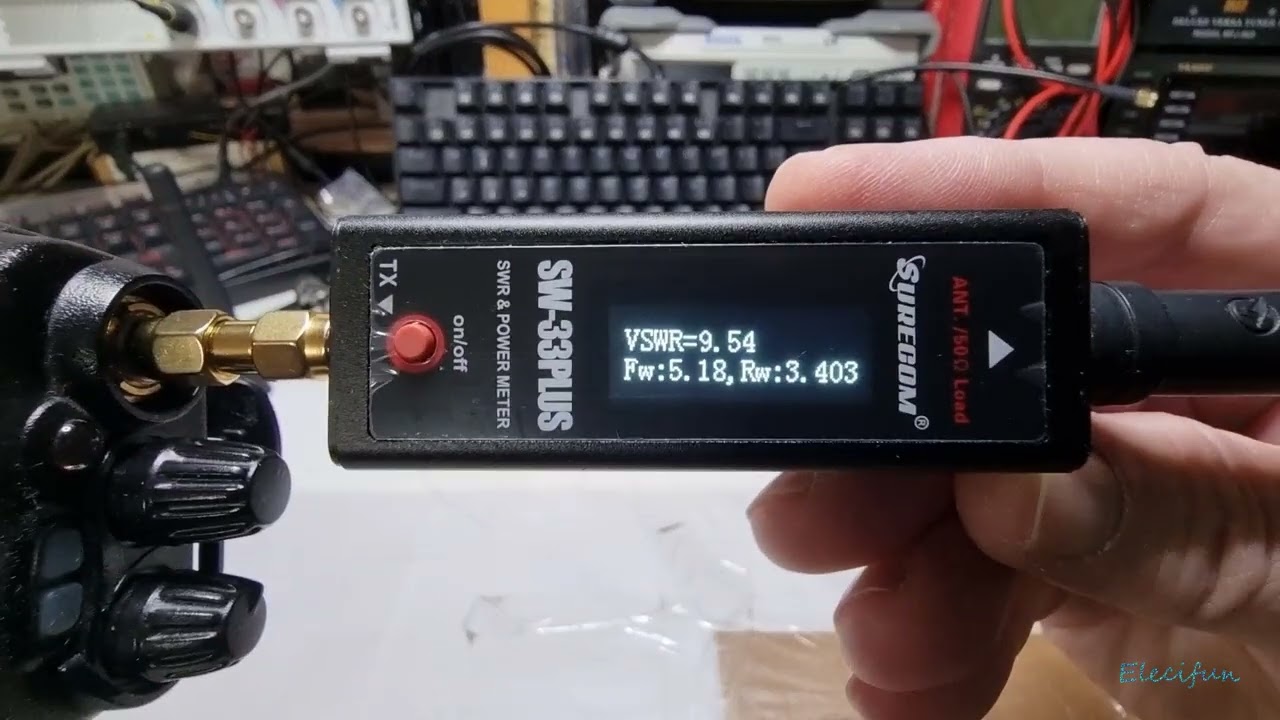
In this video vlog, the host conducts a comprehensive field test of various mobile antennas using an antenna analyzer to measure Voltage Standing Wave Ratio (VSWR), forward power output, and reflected watts. The primary goal is to evaluate how different models perform on both 2-meter and 70-centimeter frequencies under consistent environmental conditions within his bedroom, ensuring that no metal objects interfere with the readings. He begins by testing a known good antenna which shows acceptable performance before moving on to inspect antennas included with Baofeng radios, noting immediately that many of these stock units exhibit poor VSWR values, often exceeding 4:1 or even reaching nearly 9:1, indicating they are essentially dummy loads rather than functional communication devices.
The host proceeds to compare multiple antenna types, including telescopic models and those from brands like Diamond (or replicas) and ARBury, highlighting significant inconsistencies in performance between units of the same type. He observes that while some antennas show marginal improvement when fully extended telescopically, many still fail to meet the standard requirement for a VSWR under 2:1 on either frequency band. Specific examples include an antenna claiming good 70cm performance but failing miserably with high reflection values in reality, whereas another unit performs adequately on 2 meters while struggling significantly on the lower frequency. The tests reveal that visual appearance or brand claims do not always correlate with actual transmission efficiency, as evidenced by units showing very low forward wattage and dangerously high reverse power readings.
Throughout the evaluation, the host emphasizes the importance of understanding these metrics for effective radio operation, explaining that a higher VSWR indicates poor impedance matching which can lead to signal loss or potential damage to the transmitter over time. He concludes that while some of the tested antennas offer decent performance on specific bands like 2 meters with near-perfect SWR readings and minimal reflection, most of the cheaper or stock options are not suitable for serious use without modification or replacement. The video serves as a cautionary guide against relying solely on manufacturer specifications or visual inspection, urging viewers to verify antenna quality through practical testing before purchase or installation, while also teasing future videos that will utilize more advanced equipment like a Tiny SA and attenuators for further receive sensitivity and spurious emission tests.
Read the full video transcript
[music]
Hello everybody and welcome back to my
vlog uh to my channel here.
Today we're going to test some antennas.
And we're going to use my trusty little
Woos on here.
And we're going to use this Shurecom
um antenna.
Oh, wrong way around. Um antenna tester.
So, it tests for BWR and it also tests
the the power output. I think I've got
the right connector on here. Yep.
Okay,
let's get this all connected up. And the
um they're both fully charged.
The antenna
taster and the books on.
[snorts]
Let's just get that sweet up. It's a
little bit hard when you got these two
connectors cuz one seems to
Go around. There we go. Let's get this
so it
in front of us.
Oh, one up a lava. All right. So,
and we're going to test our antennas.
Um,
basically just doing exactly the same
test doing it here. So, all antennas
will be exposed to whatever environment
um this is. Whether it's good for them
or whether it's not good for them,
they're all going to get the same type
of exposure.
Now, first of all, I'm going to test one
that I know is pretty good for 2 m.
I'm going to screw this on here.
>> [snorts]
>> And
it says there we go.
Just hold the power down this turn it
on.
So as we can see here, look, we got VWR
voltage standing wave ratio or reflected
voltage
forward watts and the return watts. We
are on
different. Oh,
okay. So, let's um
let's get out of that. Let's go um let's
go. In actual fact, we'll just change
analytics. Oh, there. Go here. All
right, that'll do.
Even though we could probably do this
with uh
144500
145
four five 0 No
me
one four five
00 0.
All right.
Now we'll do on the same one for all the
two meters.
[cough]
[clears throat] Excuse my cough. It just
won't leave me alone. So, if we do a
hold that down just for a few seconds
and we can see here, actually, we can
change the way that is. And you can see
there we have a VWR 1.59.
forward. The wattage is 5.95 W and the
return wattage is 0305.
So, that's not too bad. That's not a bad
antenna. Now, we're going to do the same
thing.
We're just going to um
set up. So, we have
uh [groaning] this one, which is going
to change this to uh
four. Oh, no. That's on channel.
Let's get out of the channel thing.
So, we go four 33.
Um,
well, we go 435. Actually,
I don't think for this test it's really
going to hurt if I if I transmit there,
but it just puts me right in the middle
between 43 um
um 430
and 440.
So, I'm going to go uh
500 there. No, we won't. We'll just go 0
0.
All right. So now we're going to be
using the 70 cm part of this antenna. So
if I key it up, I'll key it up like
this. Take the measurement
and then we'll look at that. And as you
can see, like I said, for the 2 m is not
too bad.
So we got a VWR of 4.52,
a forward wattage of 5.25, 25 and a
reflected of 2.135.
All right. So, that's that's not very
good. Right.
That's not very good. So, uh we'll come
back down to this one.
We'll put a different antenna on. This
is the one that comes with the Wukson
radio. You get two with the Wukson
radio. And as you can see on there, it
says Woops on. And there's another one
that comes with the Volkswagen radio and
I'm pretty sure it's this one, but this
one is a complete not a dummy load.
This one doesn't work at all as I would
hope it would work,
but we'll have a little look.
All right. So, we'll just leave it on
the um the 70 cm
>> [snorts]
>> um frequency. I'll hold it the same way.
Oh, that's on um that sorry, that's um
transmitted on 2 m. So, the 145 and
there, as you can see, we've got a VWR
of 4.13
forward output power. This is set to
high, by the way. 2.39 and reverse of
0.888.
Not very good. Um,
so we haven't got a very good, you know,
that's just not working very well at
all. So, let's just go to the um 435
and we'll try it again. Now, I'll just
hold it exactly the same way.
Just give it a few seconds to
And as you can see on this one, we got a
VWR.
My goodness, my eyes. A VWR of 9.54,
a forward power of 5.18 watt, and a
reverse power of
3.4
um
03.
Again, that's not very good at all. I
mean, this is just to me, this is a
dummy load. It's not really worth using
on the radio at all.
All right, let's look at um So, we got a
couple of these. I need to get another
couple now.
Got a couple of these. Got to get
another couple. Now, interesting.
These came in the same batch.
these antennas. And although the
performance does differ, it does differ
when it's telescopically extended.
Um the VWR really doesn't change
>> [snorts]
>> um at all. There's a slight but we're
not going to bother with it, okay?
Because it's not really um not really
worth it to this. So again on 70 cm,
hold it the same way.
Give it a few seconds just to grab a
decent reading.
And there you can see we got VWR 4.3
uh forward 4.979
and uh reverse uh 1.855.
Now if I it's not the greatest
environment for doing this, but we do it
just just for the sake of it.
And you'll see with it telescopically
extended, it does perform a little bit
better, but it's not, you know, it's not
really that much difference. So, let's
switch over to the um 2 m.
I'll try it again with it down. Hold it
the same way
[snorts]
on 2 m. cuz I mean that's not so bad.
1.87
for the VWR.
The forward vol uh forward wattage is
3.89 and reverse is 0.356.
Do it on the extended.
Hold it the same way.
And there you can see. I'm just going to
pull that out the way again. No, it
doesn't matter. We've taken the
measurement. And now you can see, look,
it's um
yeah, it's it's not very good there.
Remarkably low. It says it's got a
forward wattage of 7.67. So, in order
for me to
We're just going to look at this again
because I I don't think this is actually
correct.
All right. So, that's 375. That's with
the antenna closed.
And now,
wow. Okay. Wow. It's saying 3.93.
So interesting.
Not quite sure how it comes up those
numbers as the output of this. I'll do
it in another video. I'll measure it on
a tiny SA the output wattage um from
these radios. I got a couple of these
quang shanks as well to measure. We'll
do that in another video, but just for
now to keep it all the same. Um,
yeah, we're doing this like this. So,
that's that one antenna. Like I say,
there was a couple of these that came
together.
And, uh, this is another one.
Telescopic. They came together.
And we'll do the the same thing. Excuse
[cough and clears throat]
my cough.
Start on the uh 2 meter. As you can see,
look, we're on the 2 meter there. So, we
start there.
And this time round on 2 m. We got 4.2
forward voltage. It's a forward wattage
2.58 and a reverse of 976.
extend it just for the
I'm just going to put that back in
there. We taking the measurement and as
you can see uh 4.25 2.58 forward and a
reverse of.98.
So even though these uh antennas are uh
let's just flick that across there are
the same. They've got different
uh they're showing different readings.
So, let's just do this like we did
before.
And now we have a VWR of 11.4
forward 3.71
reversed
2.615. And if I extend it,
do that again. We'll put it in. Now,
we've taken the measurement.
And as you can see, there's not a great
deal of difference there. So, two the
same antennas, but very different in
respects of how they perform.
Um, given the,
you know, given the the test that we're
doing.
What's going on here?
Let's make sure that's nice and tight.
All right. So, uh, now we'll try this
one.
Um there's three of these are the same.
Now these actual antennas came with
um the back qu shanks. They came with
these.
All right. And there's three of them.
That's different.
Um and I seem to have lost one. All
right. Well, but this is a different
one.
I'm not quite sure what that came with,
but
uh we'll test it. So, this now is on the
uh 70 cm. Hold it the same way.
And we got a VWR of 5.37.
See, not good at all. You want to be
under two. Really two and under. Um
forward 3.97 volts. Um reverse 1.867.
That's not extendable. So, we'll go and
um we go to 145. It's a 2 m band. And
hold it the same way. Do the test.
Okay.
Now, there you can see VWR of 1.07
and forward of 3.53
and the reverse of uh 0.003.
So,
the better the VSS SWR, the less reverse
there is.
All right,
let's [clears throat] take that off.
Now, we got a
couple of
We got this diamond.
Um, this is bought from eBay. It cost
about4 or5.
And if you were to buy one of these or a
genuine diamond, I don't know if this is
genuine or not, but if you were to buy
one from a store, proper store, cost you
more like 22, it's probably about 25 26
bucks. So, we're still on 2 m. So, we'll
give that Oh, let's do it. Hold it the
same way.
Uh, so as you can see there, VWR 4.21
forward 2.15. Now,
I'm going to have to look at this in a
different light, I think. No, it's
pretty much showing exactly the same
there. All right. I just had a thought
go through my head, but I can just throw
that away. Um, so let's switch over to
the um 70 cm.
I'll do it the same way.
And as you can see 4.98
forward 4.46
and the reversed 1 one.977.
Okay. So that's with what I don't think.
It's not very heavy. It's um I don't
think it's a real diamond antenna. This
is an Abri.
You've probably seen this make quite a
few times and if I remember rightly,
this did do better than the diamond. So,
this is still on 70 cm. I'm just going
to hold it the same way.
And VSWR look 6.24. Not very good.
Forward 3.43,
reverse 1.794.
Not um doesn't it still a lot of trust
does it? But let's see what it's like on
2 m. Hold that the same way.
And on 2 m it performs or claims to
perform better 2.58
for VWR and forward 5.25 or reverse
1.026.
So that does sort of look better than
the um
than the um so-called diamond. Now these
uh this is a um 805s
AR805S
and I thought because um this is an 805S
as well.
Oh, there's another one there.
And we still got that one and that one
to do, haven't we? Um, so let's do it
again. Hold it here. [snorts]
And this is on 2 m. So 2.39
forward 4.23
reverse
711.
And if we switch to
70s, do the same thing
again. You know, it's it's saying it's
good for 70 cm, but uh 5.98 is not very
good, is it? Forward 3.40,
reverse 1.733.
Um, yeah. So, that's uh we'll just break
up that. Now, this is a another
this is a AR 806
Arbury.
[cough]
And again, it's one of these little tiny
antennas which do look quite good on the
radios, but they don't, you know, seem
to perform as well as the bigger ones,
which is height is might and all that
sort of stuff. So, let's give this a
little uh
All right. And again, on this one, it's
quite similar news, isn't it? 5.58 for
VWR, which is not really usable. I
wouldn't use one. 3.98. and uh reverse
forward 3.98 and the reverse wattage
1.928.
Um let's go on to the 2 m band. Give it
a go on there.
And again, you know, not much better
there really. 4.03
forward 2.54
and a reverse of88.
We're seeing that number already today,
haven't we?
All right, let's try another one of
these um
antennas that come that come with the
quang shang
the quang.
And uh we stick on 2 m hold it the same
way
VSWR 2.13 forward two 2.88
and the reverse 0.4 445.
We try it on the 2 m um 70 cm even hold
it the same way.
Uh we got a 5.48
forward 3.91
reverse 1.867.
Now it could be argued that if I did
this outside there could be different
results and that's true. No matter what
environment I move into probably going
to throw out different results. Um, but
I've done this, you know, in even in my
bedroom. And results are pretty much the
same. There's nothing even metal in my
bedroom.
It's all uh
it's all wood and stuff in there,
bedding and clothes and things. There's
nothing metal. So, all right, let's uh
leave it on um 77s and we'll look at uh
this one, which is I don't know where it
came from, but let's uh key it up
anyway.
>> [snorts and cough]
>> Oh, sorry about that. Let's key it up
anyway. Hold it the same. Um, so on the
70 cm, we got a 5.87, 4.27 forward and
reverse 2.147.
Uh, VW 5.87 is not very good at all
really, is it?
And on 2 mters, hold it the same way.
Now 2 mters, look, it looks okay.
Um, VSWR of um 1 to 01
01 uh 1 to 1.01
reflective wattage look nothing. And the
forward wattage is actually what the
output of this radio is about 5.12 watt.
So that's a nice for 2 meters.
This is uh yeah this is nice for 2
meters but not very good on the 70
cmters. Quite a lot better for the 2 m
what they are for the 70 cm.
I just wanted to do something different
there. So we we did this other antenna
didn't we get that out of the way. If we
didn't well it's gone. And uh so the
final Abri again this is the same thing.
the AR uh 8005S
[snorts]
uh 2 m first. Hold it the same way.
And there we go. 2.31.
Yeah, you know, 3.56 out. It's on 2 m as
well. 0.559 reflected.
And uh yeah, so
that's better than the other one. I
think I can't quite remember. You have
to look back on the video to have a
look. Um, so on 70 cm, let's hold it the
same. Put some power in. Boom. And we
get a return of 6.33
of VSWR. Forward 3.37, reverse 1.782
watts. [snorts]
Uh, I think they're watts. Anyway,
forward reverse. I don't know why you
put that W there. It wasn't just out of
curiosity. If I do this,
yeah, sometimes I'll try and see if the
numbers are any different depending on
what you've got being calculated there,
but it's all pretty much the same, isn't
it?
It's just a different way of looking at
it like that. So, there you go. There's
just a little run through of uh these
antennas and
um and how they seem like they perform.
Like I say, you know, I've tried turning
around on my chair, so I'm away from
this. I've tried sitting in my bedroom
on my bed, so there's nothing metal
around me or anything like that. It's
pretty much the same. So, I've just done
it here uh to show you, but you get a
bit of an idea. You get a bit of an idea
of uh what this looks like. this little
shcom. Not how not sure how good it is
compared to other things. Just going to
turn it off so I don't key by accident.
Um but uh we're going to do more. We're
going to do more tests. I've got a mini
um one of the latest tiny SAS. Um
so and we've got attenuators now. And we
can do things like receive test uh to
see how well um
you know how low we can go uh for re
reception. We can do power and we can do
sperious emissions and they will come on
the next videos. So anyway, if you got
this far, thanks very much for watching
guys. If you liked it, if it was helpful
to you in any sort of way, give us a
thumbs up, drop a comment. Um maybe you
might want to see other antennas uh bits
and pieces. I might be able to pick them
up and do tests on them special.
[snorts] And uh yeah, I'll catch you in
the next one. Bye for now.