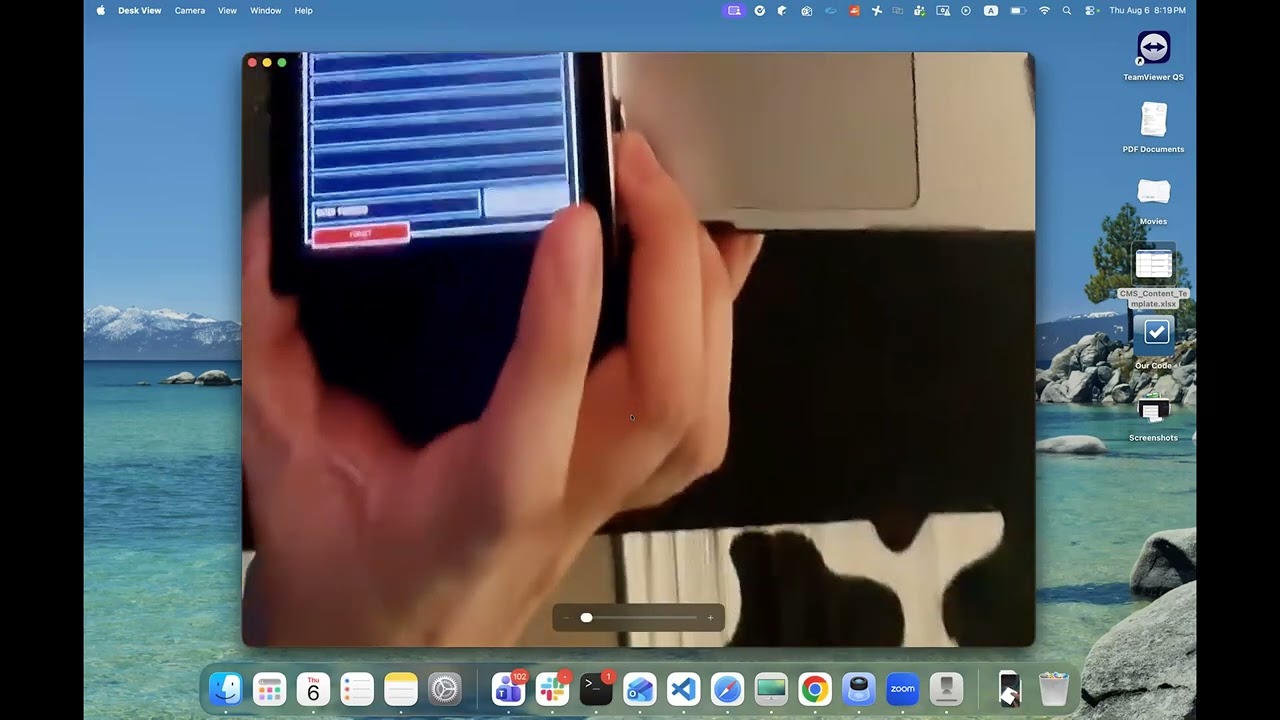
Hacking a Smart Home Panel into a Bluetooth Trackpad - Hackware August 2026
Watch on YouTubeVideo summary
The video features a software engineer who identifies as an "AI prompter" demonstrating how to repurpose a cheap smart home panel into a functional Bluetooth trackpad and remote control. Originally designed for simple home automation tasks like displaying sensor data or acting as a media player, the device runs on an ESP32 microcontroller with 16 MB of flash memory and 8 MB of RAM. While these specifications seem robust at first glance, the presenter discovered that running resource-intensive graphics libraries like LVGL causes significant performance issues, including screen shifting and crashes when attempting to add features such as Bluetooth connectivity or complex animations due to limited available memory.
To overcome these hardware limitations, the creator adopted a minimalist approach by rendering the user interface natively in C rather than relying on heavy graphical frameworks, effectively removing all unnecessary animations to conserve system resources. The final firmware supports multiple applications running simultaneously, including a debug tool for testing touch inputs, a Bluetooth remote specifically designed to turn pages while reading manga with one's feet, and a full-featured trackpad that enables scrolling, tapping, right-clicking via two-finger gestures, and mouse movement. Additionally, the setup includes a "mouse jiggler" utility intended to keep computers awake when running AI models on battery power without being plugged into an external charger.
The project also involves significant physical customization, with the presenter 3D printing a custom enclosure that houses a rechargeable PS3 controller-style battery and connects layers using M2 bolts for durability. Although the original board has limited GPIO pins available directly from its surface, the design exposes additional soldering points on the underside of the PCB to allow users to attach external sensors or buttons in future iterations. The presenter emphasizes that while many hobbyists have hacked these panels into various forms like home servers mirroring web pages or upgraded UIs for media playback, their specific use case focuses on leveraging the device's built-in battery and speaker output to create a versatile input peripheral without needing constant power from a wall outlet.
Read the full video transcript
Okay. Hi everyone. Uh I'm
>> Hello. Hello. Yeah. Hi everyone. I'm
Tang. You can call me 10. Like the
number 10 is my surname. Uh yeah, I
maybe a year ago I would call myself a
senior software engineer, but recently
I'm more like just a AI prompter. So it
is what it is. uh maybe one day I'll be
out of a job and I need to go a bit more
into hardware which is why I'm here to
put myself into the space so that you
all remember about this guy who can do
software and also do hardware. Uh yeah
so uh kind of the same idea of what Kim
was talking about with the clicker. I
also wanted to do something to uh but my
use case was quite different. Uh, I do
the I wash the dishes at home and when
I'm washing the dishes and I'm reading
manga, I'm like, "Ah, I wish I could use
my toe to
the so I was looking into doing some
Bluetooth page IDs. So, uh, HID human
interface devices. Uh, and nowadays with
ESP32, it's like way easy to just make
your own. Uh, but I find that I wanted
something with a touchcreen. I wanted
something that uh, you know, it's easy
to program. Uh so which is why I found
this smart home panel. So this uh yeah
so this smart home panel is uh is ESP up
to 32 running under the hood. Um is
under this Gishian brand but I'm sure
you can find a lot is on AliExpress.
It's about 25 to 30 S dollars roughly
about there. Uh the one thing that is
not super good about this device is that
it doesn't have a lot of GPIO pins. So
the the expos pins there are only three
and then you can of course use the
serial. Uh so there is Bluetooth and
then there's a separate serial which is
RXDX from this row or you can also uh
hydrate it from this here. Uh the other
quite good thing that I decided to
choose this board was also because uh
there is a inbuilt battery which uh
battery u check using the JSP I think
it's 2.0 maybe 1.5 I'm not really sure.
Um but there a JST connectors which very
good you can find those easily
available. Um there's also speaker
output. Um yeah and there are I believe
uh at least six unused pins that are not
really connected to any tracer. So if
you want to do some soldering of the
actual board itself, you could. And
yeah, it includes a charging circuit by
itself. Uh yeah.
So
uh it's about 4 in. These are the specs
that they put on their website. Um it's
got quite a bit of memory. Uh it's a 16
does it say here? Uh yeah 16 MB flash
and uh 8 MBS RAM which is pretty good.
Um what I realized uh during this
project is that uh this while very good
for a lot of use cases maybe isn't that
good for uh running a 480 by 480p uh L
LVGL uh which is a light and versatile
graphics uh library. Uh turns out it's
not as light as I would like.
So uh this is the schematics that I
found online. Um there's a lot of people
who do a home automation actually have
already hacked a lot of other things on
this. Um so I am probably not the best
person to ask about the actual hardware
seeing as I'm an official uh uh AI
prompter. Um yeah and these are some of
the other stuff that I found while I was
just looking around at what things have
done. So uh this person has done uh this
is oh just basically a screen that gives
the update of the sensors in the same
room. Um yeah they connect I think I
believe he connect to it using uh
because there's not a lot of processing
left after rendering the screen. Uh he
actually connects it to a home server.
Home server serves a web page. The web
page uh renders uh you just basically
mirroring what the web page is serving
and then he has the speaker to do the
output. Uh he has actually access some
of the additional sensors to it. Uh one
thing this bot does have a onboard
temperature sensor I believe. Uh but
it's not good because it's on the bot
and the bot heats up. So the calibration
not that great. You can calibrate it but
calibration not great. So, uh a lot of
people I find they actually just hijack
the pins and they attach external
sensors. Um this is uh this is somebody
just upgraded the UI and this is I I
decided to showcase this project because
it's actually on a light switch panel
which is what it was used for. That's
the size uh form factor of it. Um, yeah.
So, it's the the the the
pre-installed uh uh firmware. It's kind
of um this is a nicer more complicated.
I'm not sure if it's nicer. It is a
little bit uglier, but it has more
functions on it. And then, uh this
person did a home media player and they
do have their GitHub project there. You
can have to uh control your speakers
within the same uh Wi-Fi uh system. Um
>> yeah. And I think this is one of the
better uh user interface I've seen out
of this uh device.
And uh this was okay. So this was the
first version of my uh my firmware. So I
basically just overrode it. I did the
LVGL. I managed to get the swiping
functions working. Um but yeah, the
problem was that uh once I started
adding any additional functionality like
trying to connect to Bluetooth and all
that, it just crashed uh or the the the
graphics just started shifting. Uh, I
didn't really know why. I sent an AI to
go and pro the memory and it was running
out of memory. Maybe it was because the
firmware itself was not very efficient.
>> I don't know. I'm just a
>> I think I know.
>> Okay. I'm just official AI prompter. So
that's what
>> for justify.
>> Yeah, I know. I know it was for ESP.
He's he's the master here.
which is why I didn't I didn't want to
talk too much about how much about ESV.
[laughter]
Um yeah, so I'm going to give a live
demo now which is uh always great to do
at a talk. Um let's view
>> how long it took them to build. Uh okay.
I didn't research that hard. But uh
generally I believe the the the the cost
for the board itself should be around 25
plus. You add additional sensors $12 uh
for the speakers. I I have seen some
kits that come with the speakers
provided. But it's basically anything
with a three watt speakers should be uh
more than enough to to to be run off
this.
Uh okay. So desk view. So this is the
device right now and
uh so I have decided to just natively
render the thing. Oops, upside down. Oh,
it actually corrects it for me. Nice.
So I've uh I decided to render I I
believe that uh just rendering it
natively just maybe gives it a little
bit more character than the LVGL stuff.
Um and I did annoyingly add a slip
function.
So not slipping. Uh, I removed all
animation because I got paranoid about
the amount of memory that was left.
And now let's turn on my Bluetooth on
this side. And I have uh currently I
currently have three apps. Uh the so the
first one, okay, four apps. The first
one is basically just a debug for me to
debug the touchcreen. And
then
the second one, oops.
The second one is a Bluetooth remote
which uh is what I use to move the page
of my manga when I'm reading. Um the
third one is basically a trackpad. And
the fourth one is a mouse jiggler
because uh caffeinate on Mac OS it stops
your Mac from sleeping when you're
running AI only if you are plugged into
a power source. So you still kind of
want to have a mouse mouse jiggler when
you want to have your AI running on
battery. So let's buy a new device and
then I'll do the Bluetooth trackpad
because that's the most impressive one.
So,
pair match pair. And then once we open
the trackpad, we now have uh Yeah. So,
not sure if you can see that there's the
mouse on the other side.
>> And yeah, you can still do your tab. Uh
you should be able to do scrolling if I
remember
if I did it properly. Um
okay, there's no scroll. view.
Okay, this is not long enough to scroll.
Fantastic. Um, yeah. Okay. Yeah, you can
scroll, can tap, uh, you can right
click, which is a two-finger tap. And
yeah, basically that's about it. Uh, I
expected Chinme to come and talk also
because I think he was talking about
similar hardware. So, I thought this was
kind of a a thing we could do together,
but uh, he's not here today. Um, and
I've run out of things to talk about.
So,
>> oh yeah, I need to be barefoot to do
that, unfortunately.
>> Yeah. Uh, I can talk a bit about the
enclosure I I 3D printed, I guess, uh,
just in line with the 3D printing talk
that we had. So, uh, the way I like to
do it generally when I slice the things,
I like to do things by layers. So, you
can see I ran out of this filament, this
gray filament halfway through and then,
uh, and then I had to switch to a white
one. Uh, generally I like to connect
things by M2 bolts and nuts. I have
little slots that I put inside here for
me to slide in a a nut. Then I can bolt
in a M2 uh M2 bolt. Uh, let's see if you
can see the boat behind the battery
here. Yeah. So then then you can use
both and nuts to connect multiple layers
of things together. Um, generally this
is just for the for the battery. I
intend to be able to use a GPIO here. So
I exposed it. Um, so next time I can add
additional buttons or sensors if I want
to. Uh, yeah, I think I've run out of
things to talk about.
Uh, any questions?
>> Uler
for the extra
do that
as a as a professional AI prompter.
>> [laughter]
>> Uh so so at first I did it with uh L I
did it on Aru uh via the Arduino uh
ecosystem and I did it on uh with uh
LVGL. Um I I asked the AI to do the
research. He gave me LVGL and that was
what I used. Um eventually I wanted to
squeeze out as much performance as
possible. So I switched to uh just
programming in C. Um and then it just
flash. I think it still uses that uh
Arduino ecosystem. It's just that it's
all on the command line. uh my friend
and yeah I just asked it to I just asked
AI to write um if you're writing if I
can recommend writing uh software that
is reliable um recently I've been doing
uh what's called uh open spec so I write
the specifications and then the the AI
will actually uh go through iterations
based on the specifications the
proposals and all that so it's way more
consistent uh for for proper projects
when you are doing software uh as a as a
professional AI prompter.
>> Which AI do you need?
>> Uh, currently I'm subscribing to Codex.
Uh, but at at work I actually use CL.
Um, so it's it's pretty much the same
process. I don't I don't particularly uh
because at work I don't have to care
about the tokens. So I just go crazy
with the I don't bother to to to do this
open stack uh things to save tokens. Um
yeah. which say you both don't have to
carry to
>> uh I work I work for Agoda. So you can
you can just go crazy with the tokens
when you are if you are employed by
>> Yeah. Uh we we recently set a limit on
$500 for for uh for Frontier models. So
I cannot spam opus anymore. Um I don't
have access to Fable. Uh but I can use
Sonet as much as I want. I think I think
the hard limit now is like $10,000 which
I I can't even use Finnish. Yeah.
>> Where's the place again?
>> Uh, I work at Agod like the travel.
>> Is it the one I see on YouTube?
I generated.
>> Yeah, I hate that so much. Like that's
my employer. But man, I wish I wish we
paid actual artist, you know, but uh I
am just but a professional AI prompter.
Yeah.
>> So, how much of this history
is the thing that you actually get when
you buy the panel? Because originally I
thought the gray part is what you get,
but then you said the gray part is
>> you get you get up to up to here. This
this uh this silver part. Uh so that's
the panel and
>> Okay. So the panel itself is like count
like that.
>> Yeah. Yeah. It does have a back panel,
but actually the GPIO pins uh the this
not pins, but the the sockets for the
pins do stick out quite a bit, which is
why I built that first layer so that it
sits flat on my desk.
>> Okay.
>> Yeah. And then after that, I needed some
space to to put the battery. Um so yeah,
I just went with a regular I believe
this uh is a PS3 controller battery. Um
it comes with a with a protection
circuit as talked about last uh talk. So
always use batteries with protection.
That's what I got from the last song.
[laughter]
>> Yeah.
[laughter]
>> Yep. Uh, anything else otherwise? Thank
you.