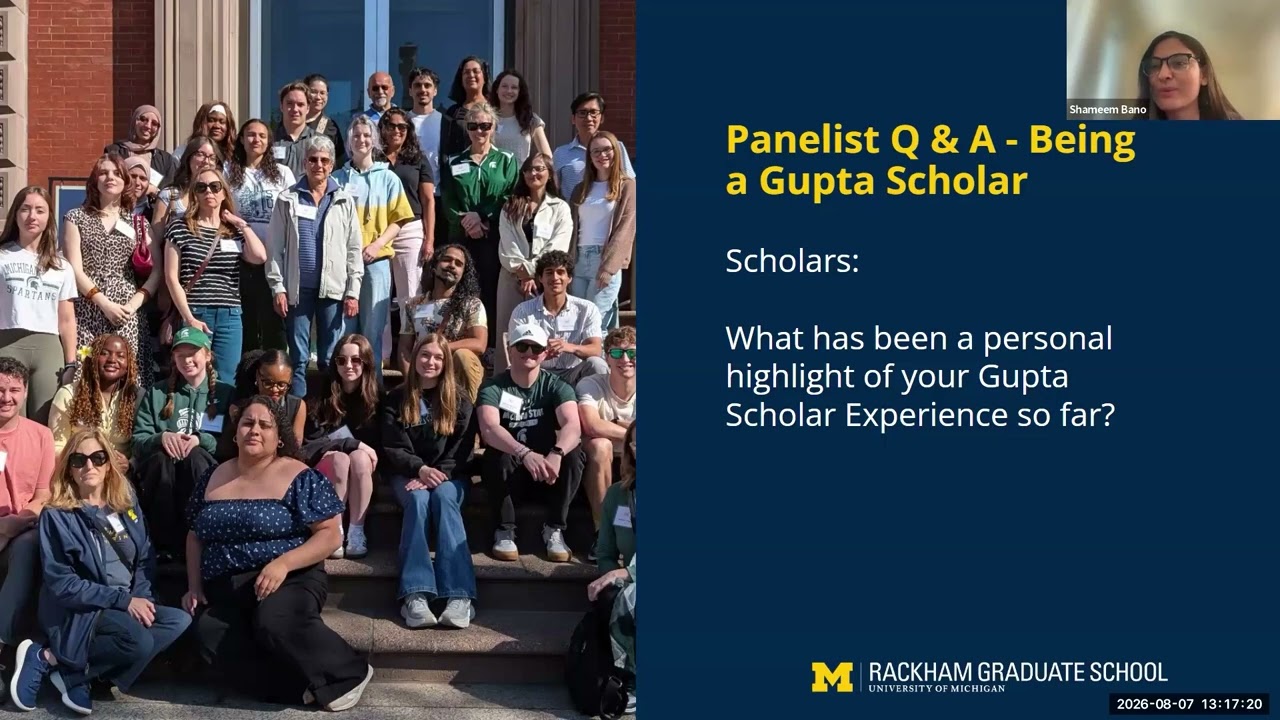
Gupta Values Scholars Application Workshop, August 7, 2026
Watch on YouTubeVideo summary
The Gupta Values Scholars program, established by the private nonprofit Gupta Family Foundation in 2017, is dedicated to fostering a community grounded in integrity, human dignity, and excellence rather than simply providing financial aid. Founded by Shashikanand (Shashi) and Margaret Gupta, who built their technology services business on these principles to compete with industry giants like IBM, the scholarship aims to help scholars view living by these values as a "superpower." Since its inception, the foundation has awarded $10,000 scholarships to twenty-nine Rackham scholars across various universities. The program offers two mandatory connection opportunities: an October dinner in Ann Arbor attended by the founders and university leadership, followed by a spring weekend retreat in Washington DC where scholars from Michigan State University, Northern Virginia Community College, and other institutions gather together.
Applicants are strongly encouraged to craft essays that focus on a single clear thesis demonstrating how they embody core values under pressure, using specific examples of challenges, choices, costs, and outcomes rather than merely listing achievements or relying solely on metrics like GPA and publications. Reviewers emphasize the importance of "showing don't tell" by making their logic accessible to reviewers from diverse fields while avoiding trauma narratives as a primary focus. When selecting recommenders, candidates should choose individuals who know their character best regarding values, noting that these do not need to be faculty advisors or University of Michigan affiliates if better options exist early in graduate studies; applicants are advised to contact them well in advance, ideally one month prior. The program has also intentionally expanded its applicant pool this year to include first-year PhD candidates and those currently enrolled in April, though students graduating by December remain ineligible for the award.
Administrative details regarding the application process confirm that all materials must be submitted via the Rackham site with a strict deadline of September 4th at midnight. Organizers have clarified that while they will not use automated screening tools or AI-generated content to filter applications, generic artificial intelligence writing fails to resonate because personal stories are essential for success in this competitive environment. A missing letter of recommendation prompt will be distributed separately if needed, and all questions from the Q&A session compiled by the Rackham FF team will be shared via email shortly after the workshop concludes. The event concluded with confirmation that five new scholars will be awarded this year due to one scholar graduating, reinforcing the program's commitment to maintaining a vibrant community of individuals dedicated to public purpose across disciplines.
Read the full video transcript
Hello everyone. Sorry. Um, so Jane's
Zoom crashed and she will be right back
and I think she is back. Okay, Jane's
back.
>> Hi everyone. I'm so sorry. My uh my
internet here at home uh vanished so I
apologize. Um Miriam, what section are
we on?
>> I was just saying that your Zoom crashed
so we can pick up right where you left
off.
>> Great. All right, let me just share my
screen and we'll get back to it. Thank
you all for your patience. All right.
Uh, well, thank you everybody. So, uh,
we'll just talk I was just going to tell
you all about our agenda for today. Um,
we'll introduce you to our panelists.
We'll tell you more about the
scholarship. We'll walk you through the
application process and talk about how
to submit a standout application. We'll
tell you more about the GBS weekend in
Washington DC. And then we'll finish
with Q&A and next steps. So, I'd like to
introduce you to our panelists next.
Uh from the RACKOM side, I'm thrilled to
welcome Ethan Brammer, assistant dean,
who will be speaking about the
application review and sharing more
about what makes a compelling
application. On the scholar side, we
have Dian Long, uh who's con concluded
two years as a Gupta values scholar, and
Shamim Bano, who's a returning Gupta
values scholar this year. Uh they'll
show more about the application process
and the experience of being a Gupta
values scholar. So, thank you all for
being here today.
Uh next I'll share a little background
about the scholarship. The Gupta value
scholarship was established in 2017 and
has had 29 Rackom scholars awarded so
far. It was established by the Gupta
family foundation which is a private
nonprofit foundation headquartered in
Virginia. I'm excited to say we have a
special message from the Gupta
themselves which uh we'll take a moment
to hear from them directly.
>> Hello, I am Shashikan Gupta
>> and I'm Margaret Gupta.
We understand that you're considering
applying for a good value scholarship.
So the we thought we would take a little
time and tell you about the scholarship
because it is unique.
It's more than a check in the mail or a
deposit in your bank account. We want to
get to know you and for you to know us
and we want you to deeply appreciate the
values on which the scholarship is built
so that you can take them forward in
your lives and careers. So, how do we do
this? We come to the campus in the fall
to spend an evening with you. Then each
spring, all of the scholars from the
University of Michigan as well as the
other campuses come to DC
to spend a weekend with us. A weekend of
ex exploration, discussion and
reflection on what living by the values
of integrity, human dignity and
excellence means in real life. Talking
about real life, let us share our
journey with you.
Shashi and I started our technology
services business as a social
experiment.
We wanted to see if a business built on
values could thrive in a world that was
driven largely by greed.
So we built our company on the same
three values, integrity, human dignity
and excellence.
And it did thrive. What we found was
that contrary to common belief, these
values in fact gave us a strong
competitive edge.
Customers trusted us to do the right
thing, deliver an excellent product and
develop a deeper relationship with us
than is usual in transactional business.
Because of this, we were able to win
business against large companies like
IBM and Capgeemini in competitive
procurements.
>> In 2016, we decided to bring this
message to young people like you. Living
a valuesdriven life is a superpower, not
a hindrance. as the current social ethos
would have you think
and the changes in our country since
then have served to highlight the
importance of ethics for each individual
and society as a whole. We hope that you
will let us join you in your life
journey to reinforce these principles.
We invite you to apply for the Gupta
Value Scholarship and join us in an
exciting journey. We look forward to
seeing you in Ann Arbor in the fall and
DC in the spring.
>> Hello.
>> Wonderful. Uh so thank you so much to
Margaret and Shashi for share sharing
your story with us today.
Uh so our next story our next question
is about why become a Gupta scholar. So
uh first you'll be uh becoming a Gupta
scholar means you're joining an esteemed
group of scholars across all disciplines
and multiple universities. The support
extends beyond the financial support and
into meaningful experiences that last
beyond the year from your fellow
scholars to the Gupta family foundation
themselves. Being a part of this group
will add connections, missiondriven
work, and the chance to make a
difference.
We're also excited to announce that this
year the award has increased to $10,000
per scholar. Uh this will be awarded in
April after participating in the
Washington DC weekend. The scholarship
is eligible for an additional year
renewal which means you could opt to
participate in the program with these
awards and these events for a second
year if you so so choose.
As a Gupta Values Scholar, you'd be
asked to attend two connection
opportunities with the Guptas. This
includes a dinner on October 22nd here
at Rackom which will be attended by
Margaret and Shashi and by Rackom Dean
Mike Solomon. The second is a weekend in
Washington DC with the Gupta Family
Foundation, your fellow Rackom scholars
and scholars from MSU and Northern
Virginia Community College. This year's
trip will be April 9th to 11th, 2027.
Now, I'd love to hear more from our uh
scholars.
uh what has been a highlight of your
experience as a Gupta value scholar? Uh
we'll start with Deianne and then we'll
hear from Shamim. Uh Dian, would you
like to kick us off?
>> Uh thank you Jen and hello everyone. Uh
my name is Dang Lun. I am a PhD
candidate in communication and media and
uh I used to be a journalist. Actually
uh I spoke as a palist last year and I
also talk about the highlight of being a
good scholar last year but I still have
something to say about it this year. So
you can tell how um so many things I
have to talk about the being a good
scholar. So in in a nutshell the
scholarship helped me reconnect my
academic work with the values that
shaped my earlier career which is
journalism.
What I mean is when you when you are in
rasool you can be very focused on things
like deadlines, publications and what
comes next in your life. So the
scholarship gave me a reason to step
back and ask a more basic question. What
kind of scholar I want do I want to
become and whom should my work serve?
So the financial support obviously
matters for sure of 75 uh 7,500
obviously matters but for me the bigger
value was being part of a community that
connect uh my academic work with
integrity and public purpose and here is
how I experience it. So before my
business as I told you I was a
researchers and a journalist. So I spent
years reporting on and researching on
powerful political and commercial
interest. Those experience repeatedly
forced me to decide what integrity
actually meant when there were so many
personal risk involved. So with the when
I started writing down the Gupta
application, it makes me reconnect those
choices to the researchers I was
becoming. So over the past two years or
three years, the scholarship has kept
that connection visible.
So the bottom line is it does remind me
that academic success does matter most
when it remains connected to the values
and the public purpose that I committed
to serving. That's the key highlight of
being a good scholar that I was able to
recognize over the past three years.
Thank you.
>> Thank you Deian. Uh Shamim, why don't
you um tell us a bit more as well?
>> Um sure. Uh I'm Shamim Vanu and I'm a
dual degree student at C's and at RAS.
Um my personal highlight of Gupta Val
scholarship experience so far has been
an opportunity to meet um with a diverse
group of scholars from other
universities and backgrounds and the
field of study during our trip in
Washington DC. we get to meet each other
and other than that like spending this
weekend with the fellow scholars allowed
me to build a meaningful connection
learn from different perspectives and
become part of a a community which is
united by a shared commitment to service
and making a positive change in the
society.
um throughout our community services
during the weekend in Washington DC and
the team discussions and conversations
around different social issues at the
dinner with the family. I was able to
reflect more deeply on my own
responsibility as a future leader and as
a member of the society. Um other than
that like visiting historical sites in
the Washington DC while engaging with
other scholars who share a passions for
service community service and which was
a very meaningful and memorable
experience for me and the weekend
further uh strengthened my belief in the
importance of leading with integrity
staying connected to your deep uh values
and your root values. Where are you
coming from?
and treating every person with
integrity, making friends and using my
education and opportunity to create a
meaningful um positive impact and change
in the community we live and we serve.
So that was a highlight from this
experience.
>> Yeah.
>> Thank you so much. I mean um wonderful.
So now that you have an idea of um
of what it means to be a Gupta value
scholar, I'll talk about the logistics
of applying. So any RACKOM graduate
student in good academic standing is
eligible. You'll need to be an active
student in the fall and winter semesters
of the year that you're applying.
Awardies will be selected through their
application materials. recipients have
demonstrated integrity in the face of
challenges, a commitment to human
dignity and a dedication to excellence
in all they do inside and outside the
academy.
The Gupta value scholarship application
consists of three main components: a
personal essay, a recommendation letter,
and your CV. The essay prompt is
designed to let you showcase how you've
demonstrated the core values in your
life and work. Be sure to follow the
prompt closely and be specific in your
responses. You'll also need a
recommendation letter and an updated CV.
Your recommendation letter should come
from someone familiar with your work,
such as a faculty adviser, a professor,
or a professional supervisor. I suggest
making a plan to ask as soon as
possible. You'll want to give your
recommener plenty of time to write a
thoughtful and compelling letter. If you
have a question about recommenders, you
can email rackom ffyouish.edu
edu for more specific advice and Miriam
will add that email address to the chat.
In terms of other advice, make sure you
share the prompt with your recommener so
they know what the reviewing committee
will be looking for. You should consider
how your essay and your recommendation
letter will fit together. What could
your recommener tell us that would add
depth to your essay? Maybe illuminate
another side of your application. You
may want to share details about the
essay and specifically name what aspects
of your work or academic interests you'd
like the recommener to speak to. If you
work far enough ahead, you could even
share your essay with your recommener to
help them write the recommendation.
Next, let's hear from our scholars
again. I'd love to hear more about how
you approach your essay and then what
advice would you give regarding the
recommendation letter? How did you guide
your recommener in terms of writing a
strong letter? Uh Shamine, would you
like to begin and then we'll hear from
Dian?
>> Sure. Um so I approached my essay um as
like a reflection of my journey, the
values that shaped me and the purpose
that continues to guide my work. So um I
wanted to share my um share not only
like academics and professional
experience but also like a very personal
experiences uh that shaped my commitment
to education, service and creating
opportunities for other what I did in
past. So I am basically an international
student and I traveled a lot in
different cities across Pakistan and as
well as like in US and living home at a
very young age to pursue education
taught me the um transformative
power of learning and importance of
using opportunities to uplift other um
yeah so uh my education journey um from
Pakistan to Michigan has like
strengthened my belief that education is
not only part of the personal growth. So
I edit all these stuff in my
application. I made it like very
personal uh not very um professional or
because they have their CV obviously. So
and through like I focused more on the
invol involvement in the community
initiatives like I am running a small
student welfare organization for
underprivileged kids in uh remote
regions in Pakistan. So I included that
and um I learned the importance of like
I aided the importance of compassion,
collaboration and services. I wanted my
essay to reflect how these experiences
shape my commitment to addressing social
challenges and creating meaningful
impact and um I edited my personal
story. uh and also I I did my academic
interest in sustainability and the
development and my broader goal of
working towards more equitable and
inclusive societies through businesses.
Um so I wanted my readers to understand
not just that I have what I have
accomplished so far what are like my
degrees or my achievements so far but I
also was more um inclined toward the
commitment to serving others and aiding
how how we at the important values of
like integrity human dignity and
excellence that guided our journey. So
my approach was more of like making it
more personal that they know us as a
person not as somebody um like a
recommendation letter for a a job or
something like that. So for the
recommendation letter I approached my
recommendation letter by choosing my
faculty advisor at CES because uh he has
closely followed my academic journey and
progress and growth throughout the
journey in the University of Michigan.
So I emailed him like few days before
the deadline. I reached out to him and
requested a meeting to discuss the Gupta
value scholarship in detail, its
missions and why it's important like why
this opportunity is like meaningful to
me. So during our conversation I shared
my education journey, my future
inspirations, my previous community work
and commitment to using education as
tool to create a positive change. Um, so
I wanted to give him enough time to
thoroughly like reflect on my
conversation and write a letter that
generally represent me as a person. So
since he already was familiar with my
progress and work, so I think his
recommendation letter play a like role
in this uh application. Yeah,
>> thank you Shim. Uh, Deian, um, how about
you? what did you how did you approach
your essay and how did you guide your
recommener in terms of writing a strong
letter?
>> Okay. Uh so I am sure that when you are
here and you have planned to apply for
the Gupta scholarship you have already
have great stories about your own
integrity to to tell. So the key the two
key questions you need to be able to
answer is why me and why now? Why should
uh uh I get the GPU scholarship and why
now? So I'm sure that you have raised
stories to tell the the question is how
to put that story in uh 1,500 words in
the most coherent and concise manner. So
my advice the first one is and the u
thorough advice is uh build one clear
through light build one clear thesis for
your own essays and make the job of the
reviewer easy. What I mean by that is
before starting writing your application
uh before writing your essay ask
yourself if the reviewer remembers only
one thing about me after reading this
essay what should it be that is your
true lie that is your thesis. So then
put yourself in the shoes of the
reviewers. Put yourselves in the
situation of the reviewers because
reviewers should not have the background
that you are having. So they you
shouldn't make them have to figure out
what why your story demonstrates
integrity, human dignity or excellence.
Make the logic obvious and visible. So
try to follow this logic. uh what
happened what was a stack what choice
did you make what did it cost and what
does it reveal about you about your
integrity so here we use the show but uh
show don't tell principle don't just
announce your values don't just say that
I value integrity show real examples
show the moment when those values were
actually tested and again the principle
of putting yourselves in the shoes of
the reviewers is very important here.
Always try to make it obvious to
understand because something that is
very um obvious in your field might not
uh quite so for a reviewer who comes
from another discipline. So make it
obvious and accessible to the reviewers.
And here is how I did it for my essay.
So as uh with a career in journalism and
um research my own through line my own
thesis was essentially integrity under
pressure. So that's the my that's the
through line I was trying to show in my
essay. So I used different episodes from
journalism but they all demonstrated the
same pattern. there was pressure for me
to back away from something I thought
matter but I had to make a choice and
that choice involved some professional
risk. So I used many examples uh in my
essay and they were different but they
were on doing the same argumentative
work. They all boil down to one single
central argument that I didn't back away
from pressure.
So just to sum up uh if it's any helpful
for your essay choose one through life
choose one pieces then make the
reviewer's job easy. Show your
challenge, your choice, the cost and
what it reveals about you and your
integrity. That's about the essay for
the recommendation error. I have to say
that you are much more lucky than us in
the previous cycles because if I'm uh if
I'm right for this uh application cycle,
you are able to choose a recommener who
doesn't need to be your advisor, right?
So they could come from other field. So
my point is it's very important to
choose someone who understand your
integrity best. So it doesn't need to
come from your advisor because I could
see from the questions already that uh
you just entering your first year at uh
image here. So your advisor might not
understand your integrity too well. Till
you are free to choose someone who you
think would understand how integity.
So choose the right person is very
important. And uh the second uh point is
uh very realistic. Everyone is busy with
their own life. So don't assume that
they uh they remember about the deadline
for your letter. So reach out to them
early if possible. uh what I did uh when
I applied for this scholarship is to
reach out to my advisor one month in
advance and one he agreed to write a
letter uh remind him two weeks before
the deadline and one week before the
deadline and three days before the
deadline that's what I did and it's uh
not a crime to do so and actually they
would appreciate that because everyone
is busy with their own life so try to re
make sure that your recommener remembers
about the the deadline and just don't
choose the reme the recommener just
because of the name it but because of
how they understand you well enough to
write a meaningful letter about
yourself.
>> Thank you Deian and um yes I'm going to
just concur what Deian said about um
your recommener does not need to be a
faculty adviser. So, anyone who maybe
attended last year or who's applied in
previous years might have seen that, but
we expanded the um sort of official
people we suggested as recommenders
because we recognize that plenty of our
applicants are just starting their
graduate school experience and uh we
want to open it up. So, um they may not
if you don't have a relationship with
your faculty adviser yet, that's okay.
and just um yeah, as Deianne and Shim
both talked about, think about someone
that knows your journey and can really
speak to um speak to you and and your
experience. So um thank you both for um
sharing more. So uh next we're going to
hear from Ephram who's one of our um
application reviewers.
Uh so uh Ephram, can you tell us um more
about what you're looking for from the
reviewer side? Um, so how do you define
the values that are central to the essay
and what kinds of things have resonated
with you in the past?
>> Yeah, thank you Jane and thank you
everybody um for attending this really
important workshop and your interest in
the Gupta Valley scholarship. Um, I feel
like Shamim and Den pretty much covered
everything and I'm going to be repeating
a lot of what they said. we have
brilliant students and obviously they've
been successful at um successfully
navigating you know this scholarship. Um
I I think it's important just to remind
everyone that this isn't kind of your
straightforward academic scholarship,
right? There really is something
different starting from the video,
right? This really is a different kind
of experience. And this isn't to say
getting $10,000 for getting a 4.0 you
know, and having many publications isn't
a valuable award and isn't important,
but that's not what this is, right? And
so, as a reviewer, um, that's kind of
the spirit that we bring into it. This
really is a special kind of opportunity
to uh work with some incredible mentors
in the Guptas and be a part of a really
important and supportive community of
Gupta scholars all built around three
really important values, right? And so,
um, as much as you need to be excellent
in the classroom and in your research,
um, what we really look for most are
these stories about integrity and human
dignity and excellence in ways that
maybe transcend or go beyond may include
your academic achievements, but kind of
transcend what you're doing in the
classroom. And so as a reviewer, I I
think parse out
and what they mean to us um differently.
And so when we look at integrity,
um, we're looking at you to clearly
describe a challenging situation or
number of situations
that have relevant ethical
considerations
and reflection
about your own personal uh, values and
how you a overcame them um, in the
moment or over time. And so this is
about you.
This is about you and how you have acted
and the actions that you've taken, the
decisions that you've made. Um, so you
know, good example, uh, strip from the
headlines, think about Dion and other
journalists like somebody broke the
story on Infantino and FIFA
and somebody could could have made the
decision not to, right? So integrity is
like, am I going to break this story
that is going to make a lot of people's
lives difficult but has a real ethical
component to it, right? Like this is
something that a lot of people care
about, right? And there's something
that's unethical going on here and by me
revealing something that's going on in
the background that's a little bit
shady, like that has some personal risk
to it, right? it it's not like these
aren't powerful people that can't do
something if you reveal their secret,
right? And so that's kind of showing a
personal integrity.
Uh
we do see essays that talk about like I
was tempted to cheat but I decided not
to cheat, right? Um and so that shows
some personal integrity of course, but
um we really are looking at like larger
challenges, right? So I was in a lab and
we had a time pressure and um somebody
in the lab wanted to falsify data and
there's been a big federal grant and I
just said no like we can't falsify data
to meet our publishing deadlines or
grant federal deadlines, right? It's
just it's unethical, right? That that's
higher than like I you know the person
next to me in the class showed me the
answers and I decided to look the other
way, right? And so showing real
integrity in the face of real you know
high stakes challenges um despite you
know some potential for um you know
consequences for you personally. human
dignity
it is about your decisions and it is
about your decision making but it's
about your decision- making with regard
to others.
So we're interested in the examples of
where you have sort of um put others
people's interests first
right and you really value and have
compassion and empathy for others. So
again, not to lean too heavily on um ide
and the journalism analogy, but it it's
pretty easy to build off of. Um so, you
know, in the case of the FIFA
journalist, like it's great to write
about sports and I'm sure you have a
great platform and I'm sure a lot of
people, you know, will read your
articles and and listen to what you have
to say about sports.
But I think as a reviewer we might be a
little bit more interested in the
journalist who decided to write about
poverty around the world, right? Or um
that might resonate a little bit more
strongly or somebody who um you know at
even challenges to their own personal
career decides that they really want to
write about climate change,
right? because climate change is
important and you know it's a really
important social factor that for
whatever reason politically the pendulum
swings uh from time to time one way to
the next but climate change affects
billions of people on this planet and
I'm going to show personal integrity to
write about that but it's also connected
to you know my compassion my love for
other people right and their um health
and well-being and so um That's kind of
the differentiating factor when we look
at integrity. It's about your personal
decisions. Human dignity is about how
you serve or honor or show compassion
and empathy to others. Um and then
excellence. Um and then again I would
encourage you there's kind of a breadth
of examples and a depth of examples. So
if you have um just one example that
example should have tremendous depth
right um I think you know generally if
you have two or three examples that's
probably best like in when you're
talking about integrity human dignity
and excellence um but it's okay if you
have one really great example um and you
have one really great story to share
kind of I mean like if you connect
personally around one really good
example. Um, but I would lean towards
um, something like two or three really
solid um, examples to kind of show your
personal integrity as well as your
compassion for others um, in terms of
human dignity. And then excellence,
we do have your CVs and we do have your
transcripts, but still highlighting a
couple things that are important about
your academic achievements doesn't hurt,
right? And especially if you can tie it
all together, right? Um so if if I was
sticking with the journalism analogy,
if I wrote as a journalist um about
climate change in a corporate newspaper,
that's not going to really like that. Um
or your um sponsors,
you know, the people who buy your ads
aren't going to really like that. Um,
but I do it because it's the right thing
to do for the planet and for people who
live on it. Um, and oh, by the way, I
won the Pulitzer Prize.
Like, don't forget to mention you won
the Pulitzer Prize, right?
Um, like show excellence, right, in all
the different ways um that you can,
including the academics. Like don't
assume that we're going to pull out your
favorite things about your academic
achievements and accomplish from your
CV. Like tell us you have an opportunity
to write that into your essay and
highlight it yourself. And so um
excellence definitely beyond the
classroom um but also in the classroom
and in the lab, right? And so um again
what resonates with us both I think
Shamine uh said it and and Deion did as
well. It really is the personal story
because this is about joining a
community and engaging with others
around shared values.
>> Thank you so much, Ethram. Uh,
now you may have touched on this, but
anything else you want to mention that
applicants should try to avoid beyond
what you've said so far?
>> Yeah. Um, a couple things that I'd
avoid. Um, so I would avoid letting the
CV speak for itself, right? I'd avoid
letting the the um transcript speak for
itself. It wouldn't be the top thing
that I'd highlight, right? Because we do
have that. Um,
the other thing about letters of
recommendation,
um, we got some questions in the chat.
As John had noted, um if you're a first
semester student, you are by definition
in good academic standing because you
haven't done anything yet not to be in
good academic standing, right? So yes,
you are in good academic standing and it
makes the letter a little bit difficult
as has been mentioned, right? Because
you may not know your advisor very well
yet. you may not even have established
depending on what program you are, you
may not have even had an advisor
permanently assigned to you yet, right?
So, um even if you have a really good
relationship with your academic advisor,
they still might not know all the
amazing things that you do outside their
lab or their research group, right? And
so again, focusing on somebody who knows
you with regard to these values,
right? Somebody who can really speak to
your sense of integrity and your sense
of human dignity and your uh your
achievements and your excellence both in
the class, the lab and beyond, right? So
somebody who knows how much amazing
community service that you've done or
you know um so uh that's kind of a
special letter writer right um and so
choose your letter writer very carefully
um have good conversations with them.
The last thing I would just kind of lift
up is um be careful of the trauma
narrative as well. like we are not
asking you to write a trauma narrative
and you won't be selected because your
experience was the most traumatic,
right? And so we don't in any way want
to resurface harm that you've
experienced. Like there's ways that you
can write very powerful stories that
connect with the reviewers that don't
necessarily reveal deeply personal
details that you really don't want to
share with people or is not in your
personal self-interest and and your own
health and well-being to share, right?
And so I'd also just kind of avoid
uh sharing traumatic events um because
you can demonstrate integrity and human
dignity um without necessarily sharing
those kind of personal details.
>> Thank you so much, Ethram. Uh so next,
now that you've got a good idea of what
it takes to submit a stellar
application, I want to share a little
more detail about the weekend in
Washington DC since this is such a key
memorable part of this experience.
The um trip to Washington DC includes
lots of time with your fellow scholars
as well as sightseeing and connections
with public figures. The trip has a
theme every year which the speakers and
activities are based on. Last year's
theme was healthcare in America. There's
usually a service project. So, for
example, last year the group went to
Cornerstone's food bank. And then there
are also sessions with public figures
like politicians or leaders in their
field. There's also um time for
sightseeing including monuments and
museums. And all of this with plenty of
time to build connections with the other
scholars and discuss these meaningful
themes.
So, I would love to hear from our
panelists. again. Um, our attendees here
know a little more about the trip. Um,
so scholars, um, are there any
highlights from this weekend in your
experience that you'd like to share with
us? Um, Dian, would you like to go
first?
>> Uh, okay. Uh, so the first obvious thing
is that it's this great that uh to get
in to DC at weekends for free. You have
great food, you have great hotel. And uh
one more plus thing is uh when you are
notified that you get the scholarship in
October, I think you won't get your
money after your DC trip. So you you
have something to look forward to during
that trip too as well. But uh aside from
all that uh I mean when you get to meet
a group of press corners from other
schools from the Michigan State from uh
another school in Virginia
um which I spent a lot of time with
people um that uh I mean that brought
together scholars working on very
different problems. So that promps me to
explain why my work matters in the most
or ordinary and accessible language. So
that it reminds me of that interity and
public services can look very different
across disciplines. And when I got to
meet different young scholars from other
school, I kept being inspired by their
uh by by their zeal to continue to
contribute to a good cause to rally
behind a good cause and that gave me
hope and optimism at a time when we feel
so uncertain. So it was very rewarding
when you get to know new people, young
people who are always inspiring to your
work and your life.
>> Thank you Dian Shamine. What about you?
>> Yeah. So in the weekend like one of the
favorite parts was learning about the
values and journey behind the family
themselves like their commitment to
support underserved communities and
creating opportunities for those who
need the most during the dinner the last
it was the last night in DC DC and they
showed us how like they help like
special kids creating crafts and now
they are selling it and started earning
and they're feeling like their value,
they're involved. So their dedication to
like giving back to the society reminded
me that success is like not only
measured by personal achievements but
also by the way we contribute to the
well-being of the others. So it was like
a kind of very uh inspirational and
motivational and a sign of like hope for
the future like so that dinner and the
discussion we had the last discussion
that was like my favorite part of the
weekend because um it was like very
emotional and inspirational and it was
kind of like hope for the future that
yeah we can play our role as future
leaders and can create impact in
somebody else's life. Yeah.
Thank you so much, Shamim. It's
wonderful. Uh, so next we'll do a little
more Q&A. So, um, we've got a little bit
of time. Um, I think Miriam's going to
share some questions. I wanted to start
with one that I saw once or twice in the
Q&A about um, conflicts with the dinner
in October specifically. So, um, if you
have a conflict with the dinner in
October, that's not a reason you should
not apply. So, we're never going to not
award it to you because of that
conflict. We've had some outofstate
scholars who do a Zoom with the Guptas
instead. So, you know, being able to
knowing that you'll be able to attend in
DC is really important, but the the
dinner um you know, definitely don't
feel like you cannot apply because uh
you're out of state in the fall semester
or something like that. We'll uh we'll
find a way to make that work. So, I
wanted to start there because I'd saw
I'd seen a couple questions related to
that. Um, Miriam, are there any other
questions that you're seeing that we
should address out loud? I know there's
a lot in the chat. Um, so Vara has a
question. How has being part of the GVS
community impacted your personal growth?
>> Great. Uh, Shamim or Dian, would either
one of you like to speak on that?
I think I uh explained it a bit that it
was for me it was like a very emotional
uh inspirational and motivational kind
of uh we can because uh we could like
actually see how the family they
themselves like created impact in others
life. So it was kind of reflection for
us that like now that we have some
opportunities we are maybe like
privileged to like a lot of people like
we have some um opportunities and we
have skills and we have the knowledge
that a lot of people don't have. So we
can like in one way or other way can
help others and make their lives have
like easy or guide them. So I think that
was like the favorite part and uh a
motivation and a personal reflection for
me. Yeah.
>> Thank you. Anything you want to add to?
>> Uh not much because I mostly agree with
what uh Shaman has uh said. Uh what I
would add is that uh when I got to
listen to different speakers uh during
my two years, I mean the way they spoke
and um the way they turn their stories
gave me a lot of uh um good uh lessons
on how I should articulate uh again what
I'm doing to
ordinary audience. try to use the
language that everyone would understand
because actually to be honest there were
good speakers but they were also not so
good speakers who who failed to
articulate what they were doing in the
best way possible. So I I learned not
only from the best but I also learned
from what I should have done better. So
that's I mean help me a lot during my
career as someone who work in
communication too.
Great. Um, let's see. Any other
questions that you can see in the chat
that you think we should um address out
loud, Miriam? Uh, we'll send out
>> there were a few questions about the um
recommendation letter. Um, so if you
just want to speak to that.
>> Yeah. Yeah. So I think you know what um
our scholars and what Ethram uh you know
emphasize is I think just hold that sort
of someone who can um uh speak to the
values and it doesn't have to
necessarily have to be a U of M
connected person. It's more important
that they are connected to you and that
they have a relationship with you and uh
can sort of know you in a way that that
illuminates beyond your essay and and um
really highlights you. So, don't feel
like you have to use a faculty adviser
or a U of M professor, especially if
you've only, um, just joined our, uh, U
of M community. So,
um, what else?
Um, and then I think the rest of the
questions are deadline, which I
answered. So, the deadline is September
4th, and we will have the website
updated soon with all of that
information.
>> Yeah. So, I'm sorry if it said the wrong
date. We'll make sure that that gets
updated. But yeah, it is September 4th,
so um hold on to that. Um we'll have
five new scholars this year. So, uh last
year one of our scholars, uh graduated
and so um he's off doing other things,
so he won't be returning. So, this year
we'll get to award for five new
students. Um
>> I do have a new question um from Kiara.
How do you think the GVS shaped your
path moving forward through your
graduate career?
Great.
Shamim or Dian any of you would you like
to speak on that?
>> Um yeah I mean uh for the financial part
like 10,000 is like a good amount you
can use it as like a stipen as well. U
yeah like pretty much I think we covered
it the values this is not like any other
typical scholarship application. This is
like uh I feel like it was very
different from what other applications I
did last year. So you have to focus on
more being of like how can you um relate
your work uh towards these three core
values they have and how can you as a
human can create impact in somebody
else's life. I think I'm repeating a lot
of these points but yeah more or less
it's like that. So uh and and you get to
know the family as well and they're
really welcoming. They welcome us to
their house and they arrange a very nice
like dinner and we get to know each
other and it was a social event as well.
So I think these and other than that we
get a chance to do a food rescue
empowerment like there was another uh
activity that we did with like uh packed
food for school kids and we wrote like
small notes on all of these uh packages
and everything felt like a very uh
personal touch. So I think like you can
have a very good opportunity to have a
good weekend in DC and reflect on how
you are as a person. So I would take it
as that way. So yeah.
>> Uh okay. Uh I want to be honest here
because I think it would be a bit of a
stress to say that uh this scholarship
alone would play a key role in shpping
the path the path of my career. But uh
because there are only there are many
other factors that also play a role in
shaping the path of my career. But one
thing I cannot deny here is that when
you get the scholarship, you are able to
get to know so many people from
different disciplines and for your
career when
it's the most important to continue to
widen your networking to get to know
more people and you have a good resource
when you get to know those people. So
you will never know what kind of um
opportunities or chance those people
would bring to you in in the near
future. So keep networking, widening
your network and burn no bridge. So
that's the most important thing that the
scholarship has uh given me so far.
That's the key takeaway here.
>> Thank you. Um great 150. It's 155. Um,
so we'll wrap up soon. Miriam, do you
think there's any other questions that
you've seen come through that we should
talk about out loud?
>> So, I have two questions in the chat,
uh, or in the Q&A. Uh, are there any
particular fields or focuses of work
that the Guptas prioritize?
>> Um, so the Guptas, uh, so the Guptas
don't make selections. Um, so it's our
RACKOM reviewers that make the
selections. And, um, I'd say the answer
is no. There's no particular field or um
discipline you need to come from. It's
it's um I've seen scholars from all
sorts of disciplines.
Um uh Ethram, yes, why don't you go?
>> Yeah, I think you're absolutely right,
Jane. I think um you know, again, this
is really about the values and the
values transcend these uh disciplinary
um distinctions. And so whether you're
in the arts, humanities, or a STEM
field, humanistic social sciences or
quantitative sci social sciences, you
can talk about your integrity and you
can talk to your about your commitment
to human dignity. Um it's not a criteria
that we consider um like in terms of
what discipline you are. Um but uh we do
we are aware and we would showing
integrity on our own end um like to see
a diversity of fields and disciplines
represented but we don't make decisions
based on that right like we want this to
be an opportunity available to everybody
from any field.
>> Great question. Thank you uh for your
response Eth. Anything else um in our
last minute or two?
>> Yes, I still have some questions. I
think they're both related to resources
and um I'll answer these. So, you
mentioned briefly that you expanded the
suggestions for recommendation letter
sources. Can you direct to where these
suggestions can be found? And then the
other question is, can we get a link
where we can find these prompts for the
essay and the letter of recommendations?
And all of that for both those questions
will be sent in the email. Correct.
>> Yep.
>> All Yeah.
>> Yes. Absolutely.
And that brings me to my uh
housekeeping. So uh the link there um
brings you to the rack the Gupta page on
the rackom site and from there you can
click the um apply button which goes to
the ramp portal and so the prompt for
the essay is there. Uh details on the
reviewers is there. Um so everything you
need should be there as well as we'll
send all this out so you have it that
way as well. Um, as we mentioned,
applications are due September 4th by
midnight. Um,
anything else that we want to
touch on?
>> Um, so somebody planning on using AI to
reduce application. Willers be screening
for AR AI use to ensure a fair process?
>> It's a good question. Ether point I
guess I don't think
but I'll let you
>> intersects with two different areas that
I'm doing work. So um the question is
will we be screening for AI like I can
tell you we will not like apply some
market AI screening tool to the pool of
applications right like we're not
investing in doing that I can also tell
you that if you try to use AI to write
this essay it probably isn't going to
resonate because AI tends to spit out
very generic language, right? Um, and
that if you've heard anything from our
panelists today, it really is about your
personal story. And you write your
personal story best. You write your
So, I think that actually answers
another question that we have. Is
creative writing encouraged or better to
keep a more academic professional tone?
Um, so as Erum just mentioned, uh,
personal is best. And then another
question we have, approximately what
percentage of your previous Scoopa
scholars have been newly incoming
graduate students?
I don't know that we have that data. Um,
I was sort of just wondering about that.
Um, I think I think it's not a huge
percentage, but I don't think that is
because of you being a newly
professional, you know, it's more just
like the people who've been at the
university longer just have more chances
to apply and things like that. So, um,
and also the change from using a faculty
adviser to a more wider pool was
deliberate this year to encourage, um,
more students that are sort of just
starting here to, um, take advantage of
this opportunity. So um
>> uh if it any helpful uh I applied when I
just finished my first year of my PhD so
a bit early but I still got it. So just
to just so you know. Yep.
>> Yeah. And I think one or two of our
scholars last year were first year
students. So um certainly they can come
you know any any stage that you're in is
grand. um as long as you're not if
you're graduating in December then as we
talked about that's that makes you sort
of ineligible. You have to be a student
in April. So
>> um
>> in the interest of transparency just
like your program and your field of
study like we know as reviewers
um whether you're first year student or
fifth year student.
Yeah.
All right. Um, the prompt for the uh
letter of recommendation seems to not be
in the link provided. Can you help with
that? Yes, we will make sure we get that
sent out. Um, all right. So, let's see.
It's 2011, so I want to try to wrap up.
Um, if you have any other questions, um,
let's see. If you are in the last year
of your masters, can you still apply?
So, if you're graduating in winter
semester, so like April 29th or whatever
it ends up being this year, then yes.
But if you're graduating in December of
this year, then you're not eligible. Um,
okay. We'll make sure that we send out
all of the um Q&A questions. And if
anyone does have anything else, please
email me um or our Rackom FF team. So um
I want to thank our panelists and um
thank you all for attending and we're
really excited to um see your
applications and um hope uh we hear from
you. So, thank you so much everyone.
>> Thank you and good luck.