Video summary
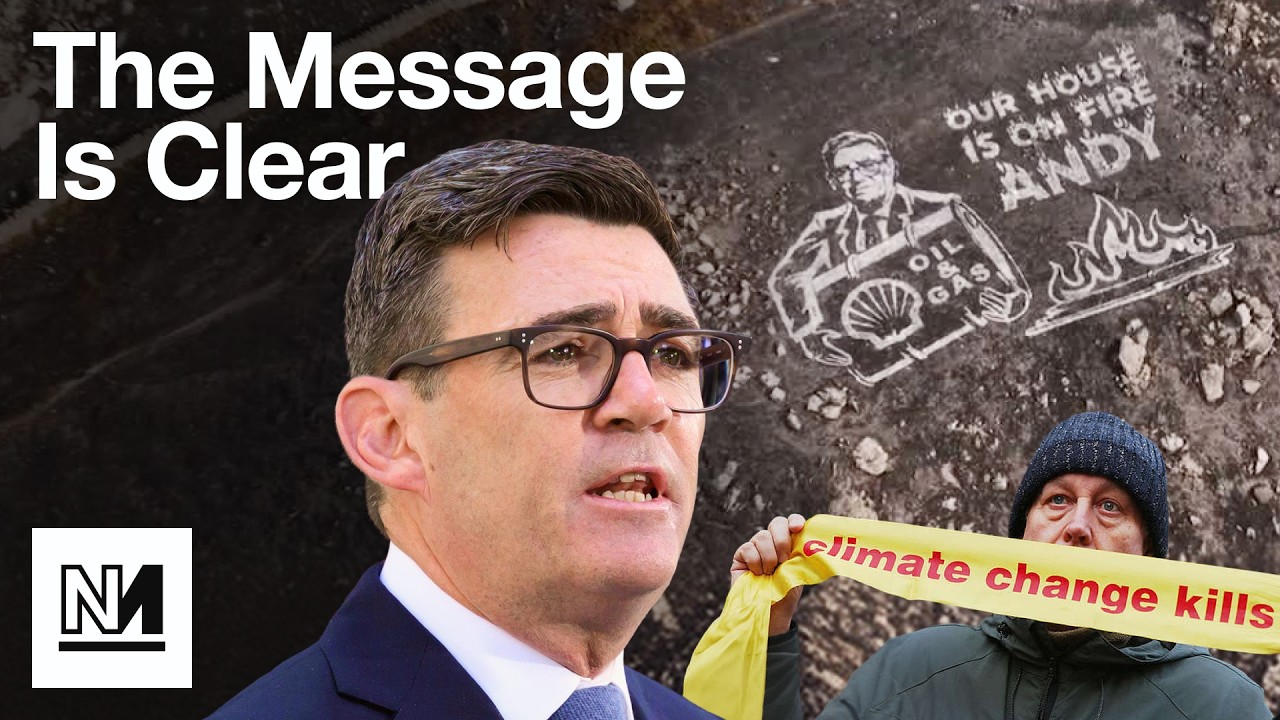
The video transcript addresses the severe wildfires that have ravaged Britain during an unusually hot and dry summer, causing extensive destruction to heaths, woodlands, and homes in areas like North Wales. In the aftermath of these fires, a mural was painted overnight on the blackened landscape by Greenpeace activists. The artwork depicted Prime Minister Andy Burnham pouring oil from a barrel bearing the Shell logo into a fire, accompanied by the message, "Our house is on fire, Andy." This act was intended to challenge the political system and highlight the link between continued fossil fuel drilling and the climate emergency driving these disasters. However, the reaction from local residents was one of profound anger and grief, as they felt the gesture disrespected a landscape that had been deeply loved and devastated by nature's fury.
Local resident Ellie Evans expressed her distress, stating that the mural added insult to injury during a time when the community was trying to process their loss. She criticized Greenpeace for painting over soil and rocks that are millions of years old, arguing that an organization claiming to protect the environment should not deface such ancient geological features. While Greenpeace defended their actions by claiming they used water-based paint on an area where all living vegetation had already been burned away, residents feared the hillside would be trampled by tourists seeking to see the graffiti. The tension highlighted a clash between the urgency of climate activism and the immediate emotional needs of a community mourning the destruction of their home environment.
The discussion further explores the broader implications of short-term political stunts versus long-term ecological stewardship, questioning whether such protests are justified when they occur on land that holds deep sentimental value for locals. The hosts debate the economic arguments for oil drilling against the catastrophic costs of climate change, noting that the potential revenue from a few jobs or tax dollars pales in comparison to the billions lost through fire damage, rising food prices, and ecological collapse. There is also a reflection on how modern political culture has shifted away from the traditional conservative value of preserving green and pleasant land for future generations toward a narrow market logic that treats nature merely as an externality rather than a custodial responsibility with inherent rights.
Ultimately, the segment concludes by acknowledging the frustration felt by residents while recognizing the necessity of drastic measures in the face of a failing political response to climate change. The hosts note that the story gained significant media attention specifically because villagers took action to remove the mural, suggesting that without such resistance, the incident might have gone unnoticed. The conversation ends with a note of cautious optimism regarding legal proceedings against other activists, where a judge ruled out a terror connection in a separate case involving criminal damage, indicating a potential shift in how direct actions are perceived legally. The overarching message remains that while the methods of protest may be contentious, the root cause—the lack of government action on climate change—remains the most critical national security issue facing the country.
Read the full video transcript
Over these unusually hot and dry summer
months, wildfires have blazed across
Britain, destroying acres of heaths,
moors, woodlands, and even homes. We
don't yet know how much wildlife has
been destroyed in those fires and what
the impact will be on next year's
breeding cycles. It's been devastating
to watch, and it's left few in doubt of
the climate emergency that's facing us.
Last month, Connie in North Wales fell
victim to such a blaze with 230 acres of
mountain grasslands destroyed and 36
residents required to evacuate their
homes after the flames came perilously
close to destroying properties. North
Wales Fire and Rescue Services declared
a major incident with more than 70
firefighters required to bring the
inferno under control. And the
devastation that it left behind is
shocking. This footage was posted online
by a trail runner showing the extent of
the damage with the earth and rocks
blackened as far as the eye can see.
Little in the way of vegetation survived
the flames and it's hard to see how much
wildlife could have either. Residents
have since moved back into the village,
though they're now surrounded by scenes
of devastation. And some of them were
pretty upset when a mural appeared
overnight on the blackened earth
depicting Prime Minister Andy Burnham
tipping a barrel emlazed with a Shell
logo and the words oil and gas towards a
blazing fire. It also says, "Our house
is on fire, Andy." And it's not small
either. It measures over a thousand
square meters in size. Ellie Evans, a
local resident who who'd been forced to
evacuate, said this about her reaction
to the mural. I can't remember having
been so angry and upset all at once. It
was so disrespectful to the landscapes.
It was also an intrusion into local
grief, which is how we felt when we came
back home to see the mountains so
utterly changed. It added insult to
injury. I couldn't understand how an
organization that wants to protect the
environment can graffiti the earth and
stain rocks which are millions of years
old. Evans also said this about how
urgently she felt she needed to act. I
knew I wouldn't be able to sleep that
night unless we acted that evening. We
were concerned a lot of people would
want to go up the mountain to see the
graffiti and the hillside would get
trashed. They had painted over soil.
They painted over rocks too, completely
staining them. The ground was so porous
that it was unlikely to wash off easily.
Now the mural mural rather was painted
by Greenpeace who've responded to the
criticism saying this. We took great
care to minimize our impact on the land.
The artwork was temporary by design,
created with a water-based paint, often
used on sports turf and safe for grass,
plants, and soil. It was applied to an
area where the fire had already burned
away all living vegetation, leaving just
rocks and ash. We wanted to challenge
the system that caused this damage and
send a vital message to the prime
minister. The science shows that more
oil and gas drilling means more
communities left to cope with the
devastation brought by heat, droughts,
and wildfires. Helena, I think it's an
interesting sort of quandry here about
um the kind of political protest that
Greenpeace was making um over you know
what you might think of as the charred
remains of a landscape that was really
dear to the people who who lived in it
and probably for you know many of them
in that in that village uh a landscape
that we were really deeply familiar with
that you know was constantly in in in
view. Um,
do you think anyone's acted badly here?
>> I mean, I can understand the point of
view of the person uh from Connie, the
resident, when she said that it was kind
of adding insult to injury, right?
They're having to deal with the fact
that their local area literally went up
in flames and having someone come along
and then use it for what is a political
stunt, whether you agree with the stunt
or not. Again, it can seem like it is
maybe you could have waited a little bit
if you were going to do something like
this. Not directly impacting and
directly um again, you know, getting in
the way whilst they were trying to again
grieve over this land that had being
destroyed. But at the end of the day,
right, at the end of the day, the
tension comes to the fact that well, if
we'd have not bothered, if we'd have
sorry, if we'd stopped actually having
the approach to or the lackluster
approach to climate change at some point
before now, I guess globally, as well as
in the UK, we might have been able to
prevent the level of hot weather that
we'd seen that allowed wildfires like
this to become so widespread, not just
in in Wales, but across the country,
across the United Kingdom. We've seen
wildfires all over the place and it
seems to me that the discussion here
seems to be very similar between what
was had around like um insulate Britain
and just oil when they were doing
protests that were you know
significantly more disruptive. it wasn't
just kind of adding insult to injury on
what is a burned landscape, right? Like
I I understand, you know, these uh if
the paint wasn't done correctly, it
might have not been easy to get rid of,
but I trust Greenpeace when they say
that they were careful to make sure that
it's something that could wash off cuz
it it is a burnt area. I I hate to be
how should I put this? I hate to be kind
of um glib over this, but once it's been
burnt down, I hardly think that an
additional amount of paint is going to
be a really huge difference on the
long-term impact on what's happening in
this particular area, but drastic times
call for drastic measures. That's what
Just thought, that's what Insulate
Britain thought. And when we're looking
at the wildfires and we look at the
level to which that not only are we
seeing the problems in terms of of the
increase in global temperatures, we'll
see even more concerns when we get a if
we get a cold winter, which looks like
we might do this year when the
insulation of houses would have kept
bills low for loads of people, right? So
all the people who are slow marching or
gluing themselves to the roads or indeed
be annoying local residents post
wildfire, they'll the the ultimate
vindication comes down on the side of
the fact well these actions are
necessary because the government will
not act and no party politically has
acted far enough to be able to stop the
potential for further climate change
down the road. I think Ollie Dogmore was
correct in our New Statesman podcast
when he said that I think that
continuing oil and gas drilling in the
North Sea is an extreme position. is an
extreme position to take when we know
it's not compatible with trying to stay
within a 1.5 degrees C of global
warming. Right? We're going to see more
than that just next year as we were
discussing earlier in the show because
of the warming effects of the super El
Nino alongside anthropogenic climate
change all at the same time. And that
will have effects globally and we'll
have all of the negative externalities
magnified in next year. We'll see. Well,
next you will see what all these
negative externalities will look like in
reality and people will have to grasp
the fact that well paint on some burnt
wildfire. It's kind of frustrating.
People slow marching in the middle of
the street. That's quite annoying.
People conspiring to commit public
mutants as a crime. But at the end of
the day, the biggest problem that we
face as a country, the biggest national
security problem we face as a country is
going to be the the negative
externalities of climate change.
>> Yeah. One thing I will say about this
story which is you know I I do I do have
you know like I have immense sympathy
for the the for the people um of Connie
because you know they have lost
the the the kind of the environment that
they that they know and that they and
that they they they love and which is
incredibly beautiful that's been taken
away by uh climate change by um in by
the these intense um weather weather
events and weather weather cycles. And I
can see that, you know, if you love
something so much, to see it lying
destroyed and then for someone to sort
of in a way sort of sacrilegiously put
something on it is really upsetting. Um,
and I agree with you that actually some
of the the urgency of the situation
requires that actually, you know, some
of these feelings might need to be it
might be legitimate to set them aside in
order to make a point. But actually, I
don't think this would have been a story
at all if the villagers hadn't gone out
and removed the the mural because I
didn't see any reporting of it until it
would actually been it had been the case
that the villagers were like, "No, no,
we we we" and it's not all of them. It's
really it's two people who are who are
who who have been spoken to. But when
they said, "Actually, we don't want
this. This is an affront." Then it
became a story because the media love
stories about people hating uh climate
activism. Um and I'm not saying that
these people do hate climate climate
activism. They may actually be climate
activists themselves. They just were
really offended by uh the nature, the
fact that the mural was um painted over,
you know, the remains of something that
they loved really really dearly. But I
think the fact that they yeah went out
and cleaned it meant that this has been
reported and seen by many many more
people. And I think a lot of people will
think actually like the urgency of the
situation sort of justifies it
especially since it was time to be
revealed on this last day of
consultation for Rosebank which as you
put it as a kind of extreme position
right further drilling there. Another
thing I think is interesting too there
was I think it was an article in the
Telegraph that I was reading that was
just I think maybe it was Tim Stanley
correct me if I'm wrong who was decrying
a lack of kind of conservative concern
for the environment. Like if there's one
thing that you know the conservatives
love cuz they keep opposing building
houses because of it is the green and
pleasant land. And I'm sorry first of
all it's not particularly green and
present if it's brown and arid which of
course is the reason why we had the
wildfires in the first place because of
the the baking hot temperatures and the
drought and the lack of rainfall causing
all of these places to dry out and then
become uh then to go brown as they did
in the way they did in terms of the uh
the vegetation. But on top of this, it's
also not green and pleasant land if it's
on fire. I will point that out as well.
And so whilst I understand why, you
know, the the misplaced economic
concerns for wanting to drill for for
oil in the North Sea, I understand the
justification people make for it, even
if I think the justification is wrong.
But I'm you have to look inside and see,
well, what's the the long-term problem
here? Will the short-term gains of
drilling oil and gas in the North Sea
like small amount of tax revenue that
seems to be most of it or was it 25 jobs
that are supposed to be being created
for the extra drilling at Jack Door? I'm
not saying that getting jobs good union
jobs potentially for people in the
prochemical sector is a bad thing.
Clearly it isn't. Clearly extra extra
tax revenue is also a good thing. How
much money is that say? How much money
is that going to generate? How much
revenue is that generating? How many
jobs is that generating compared to how
many how much revenue and how much the
economy and how many jobs will be
destroyed by climate change by things
being on fire by continual um problems
with the economy in terms of increased
food prices or the increase in
all of the economic negative
externalities that are going to be
caused by climate change.
>> Yeah. And you don't even have I mean
like the e economic externalities are
very important but they're ones that
impact you know human beings. There's
also a lot of other creatures that live
in live live live in our country um who
have a right to to not be burned alive
um when fires blaze out of control to be
able to have breeding cycles themselves
which aren't interrupted by the
destruction of nests or them having to
move to other places or to be in a state
where you know they can't get get the
food required to sort of give them
sufficient nutrition for the next time
around. I mean, you know, I think I've,
you know, I agree with all the all of
all of the economic arguments, but I
also think I'm very sympathetic to
people who live out in the in the
country as I as I, you know, like as I
have periods in in my life and where
where it's it's, you know, like those
are things that you can really care
about as well. And
>> that's a really interesting conversation
I was having with Natalie Bennett, the
um I'm a Green Party member of the House
of Lords, and there's a proposal for a a
bill for the rights of nature, right?
When you look in terms of how we deal
with how we do statecraftraft, right?
When you have this kind of single brain
market logic dictating how you view the
country where people have values, labor
and capital has value, but the nature
that you're impacting is an is only
treated as an externality rather than an
actual thing with its own rights that
can be taken into account in the
decisions that we make when we are
engaging in statecraftraft. Really
interesting conversation that we had
there. And I think that's an important
point, right? Like all of these things
that we are supposed to be the
custodians of as a society. All of the
different ecosystems that we are a part
of and that we are impacting for our own
actions, those things take a second seat
as you pointed just out there. Even
myself saying, well, think about the
economy, think about this, think about
that. Right. Well, the actual nature
itself is something that's going to be
impacted and that should be the primary
focus when it comes to how we deal with
ecological collapse, which again will be
one of the potential things that comes
down from climate change. even just
future wildfires as we're seeing has
burned through in the new forest like
loads of ancient woodland which we have
very little left right one of the big
concerns about HS2 is the destruction of
ancient woodland now a huge amount of
ancient woodland is just gone in the new
forest is tragic
>> yeah that idea of custodianship
um of all kinds is sort of so alien to
the way that politicians is politics is
practiced in democracies these days I
mean I don't know if it was ever the
case that politicians cared about what
what happened after their term ended or
if there was a sort of sense that
actually policy decisions, economic
decisions, environmental decisions
should be with an eye to you know the
longer term whether it's for you know
future generations or whether it's for
nature itself but I just feel like I
never see that now at all and it whether
it means you know more drilling for
short-term economic benefit the building
of data centers um on green belt land um
for you know potentially quite
short-term economic benefit but maybe
longer term we don't really know I
suppose is um and oh I had another one I
was going to think about. Oh, you know,
just sort of the the the erosion of
centuries old traditions of and
understandings of how justice works for
short-term political gains and reactions
to groups.
>> It shouldn't be you thought of, I think,
as necessarily a conservative kind of
point of view to want to be able to
protect nature and to conserve what we
have in that's kind of the the clues
from the name. But that had always been
historically. I think I think it is a
kind of a new development. There's a
really great thing Pete Robon said which
is that in the past like even toy
politicians we disagreed with them but
they felt they had a role to be able to
pass down a better country to who came
after them right and that's just kind of
gone from conservative thought to this
really narrow market logic centered kind
of cultural neoliberalism which means
that everything is a price everything is
a value and when there's no price and
there's no value on the the the ecology
of this country the the nature systems
of this country or indeed just broadly
just broadly the nature of this country
then that drops out of their thinking
and I think Tim Stanley I believe it was
Tim Stanley in the article was correctly
I think absolutely correct it should be
a conservative well I mean it should be
I think universal in politics but if you
believe in conservatism you should take
this stuff really seriously
>> okay I think we're going to come uh to
the end of the show now but before we go
I I wanted to just leave you with a uh a
little bit of good news um five um
Palestine Action activists um who who
were found guilty of of criminal damage
um for spray painting and splintering
the windows of a a Bclay's Bank in
Burnley. Uh there was a tri there was a
hearing today for where a judge was
going to decide whether a terror
connection would be found in this case.
Uh there isn't one. He's decided that
there is no terror connection. That
means that although you know they've yet
to be sentenced that will be happening
in early September, they won't face
heightened sentences that come with
terror connection. they won't face 15
years of registering after they've
finished whatever their sentences happen
to be. It may not even be custodial
sentences. We don't know. Um so that is
that is some good news that um this
habit of um associating direct
actionists uh with terror for
uh you know criminal damage. I'm not
saying criminal damage isn't serious
serious. I just don't think anyone
seriously believes it's terrorism. Uh it
looks like maybe that at least in this
one case has hit a speed bump. Helena,
thank you so much for joining me
tonight.
>> It's been an absolute pleasure. And
everyone at home, remember to check out
11:00 a.m. tomorrow for that interview
with Eli Cohen and Iron Last. Looks very
very very good.
>> Yeah, I think it's super interesting. I
think you'll all enjoy it. Uh thank you
everyone for tuning in. Uh after you've
watched the the interview tomorrow,
remember to come back on Monday for
another live stream from 6 p.m. For now,
you've been watching Navar Media. Good
night, everyone.