Greenland: What next? Reflections from a research station in South Greenland - Prof Lise Autogena
Watch on YouTubeVideo summary
Professor Lise Autogena, a Danish artist and professor who established the NASA International Research Station in South Greenland, approaches the region's future through an artistic lens that prioritizes community engagement over traditional scientific extraction. She frames her work as that of a guest observer from a former colonial nation, highlighting how collaborative art projects involving stock market visualization and maritime soundscapes can help communities process complex data and historical trauma. This perspective is crucial in Greenland, where approximately 89% of the population is Inuit and the territory remains financially dependent on Denmark despite its self-governing status; Autogena points out that this history has contributed to high suicide rates and social dysfunction among younger generations who have been forced into urbanization.
The central tension driving her research involves the conflict between economic independence through mining and environmental sustainability, specifically regarding uranium prospecting at sites like Kvanefjeld near Narsaq which could provide rare earth elements for US defense but pose severe risks to local ecosystems and food security. Autogena details how growing resistance from women sheep farmers eventually led to a political shift in 2021 that banned uranium prospecting under Prime Minister Múte Bourup Egede, demonstrating the power of community-led monitoring and knowledge repatriation fostered by her station. However, she warns that geopolitical tensions are escalating as entities like the Trump administration seek to bypass local opposition for national security interests, potentially weaponizing disputes between Denmark and Greenland while threatening to replace one colonial power with another unless indigenous rights are respected.
Beyond mining controversies, Autogena addresses a complex array of challenges including climate change impacts such as warmer summers causing mosquito issues and unreliable winter travel due to melting ice that disrupts farming communities reliant on boats. She clarifies misconceptions about foreign acquisition efforts by explaining that locals hold usage rather than ownership rights, making cultural practices like collecting red stones from specific mountains incompatible with temporary mining licenses, while also noting the reality of US military bases at airports like Kangerlussuaq and Narsaq alongside Danish naval patrols. The station itself operates under difficult conditions without basic amenities like a bath yet remains dedicated to urgent nation-building studies that connect Indigenous populations across Canada and the US through UN forums on rights, balancing scientific goals with ongoing workshops for local schools and elders.
Ultimately, Autogena's work illustrates how her research station serves as a vital platform for giving voice to residents who have historically been silenced in decision-making processes regarding their land and resources. While fishing remains the primary export facing labor shortages that hinder expansion, the region stands at a crossroads where new sea routes from melting ice could become disputed territories before Greenland achieves full nationhood. Her musical projects mourning lost folk horns further reflect on maritime history loss, reinforcing the need for transparent approaches that honor cultural heritage and environmental resilience rather than succumbing to extractive models. The event concluded with society presenting her an award-winning glass paperweight commemorating their 224-year history, symbolizing a commitment to preserving these values against external pressures while fostering peaceful coexistence despite global instability.
Read the full video transcript
Now,
tonight's speaker,
Lisa Ottoa,
is a Danish artist who established a
small research station in Greenland,
where she has a deeply where she has
deeply embedded herself in the life,
history, and social economy of the
country. She's currently a professor of
crossdisciplinary art at Sheffield
Hullam University
and she received the National Lifelong
Honory Award from the Danish Art
Foundation recently.
Today I'm delighted to be able to
welcome her to speak to us about her
work on issues of colonialism, climate
change, mineral mining, cultural
history,
working with local communities, and the
threats from powerful forces in the USA.
All informed through her years of
collaborative artistic projects in
Greenland.
Lisa
Hello everyone. Everyone, can you hear
me?
Before I start, I'd just like to say
that um please remember that I am an
artist. I'm not a bi biologist. I'm not
a an expert on Greenland and um
um I am not um a historian.
I just wanted to say that and I wanted
to say that what is really really
important when talking about Greenland
is to know that in Greenland there is a
saying nothing about us without us. So
to some extent it is problematic for me
to stand stand here today and talk about
Greenland without being a Greenlandic
citizen. And it is important um that
some questions are asked to Greenlandic
people uh rather than to people who are
visitors from outside like me who is
from Denmark, a previously colonial
nation. And it's just very important to
listen to the things I'm saying from
this perspective because I am a guest in
Greenland.
I have lost my heart to Greenland, but
I'm not I'm not an Inuit. I'm not from
this country.
So, this is just very important to say.
Um, but thank you so much for inviting
me. I feel very honored and um it's a
lot of people to talk to. Um, uh, and
everybody seems so friendly here in
Glasgow. I haven't really been here
before. Um, so thanks for for welcoming
me.
Um,
I as um as you said Tony a Danish artist
and academic and I live and work between
the UK, Denmark and Greenland, but I
live in London.
In 2020, I established NASA
International Research Station in South
Greenland.
And I believe that this is the region
which is the main focus for Trump's
interest in Greenland.
In my talk, I will focus on the work
I've been doing in Greenland for the
past 10 years also in the context of the
recent events. But first, I think I also
give you some context of my work as an
artist.
I work as a professor of
cross-disciplinary arts at Sheff Helm
University. And over the last many
years, my work has involved
collaborations across science,
engineering, finance, as well as
communities.
I often work in in partnership with
artist programmer Joshua Portway, and
many of our projects have evolved and
developed over many years.
See if this works.
Nope.
It does work.
Maybe it has disconnected.
Superman.
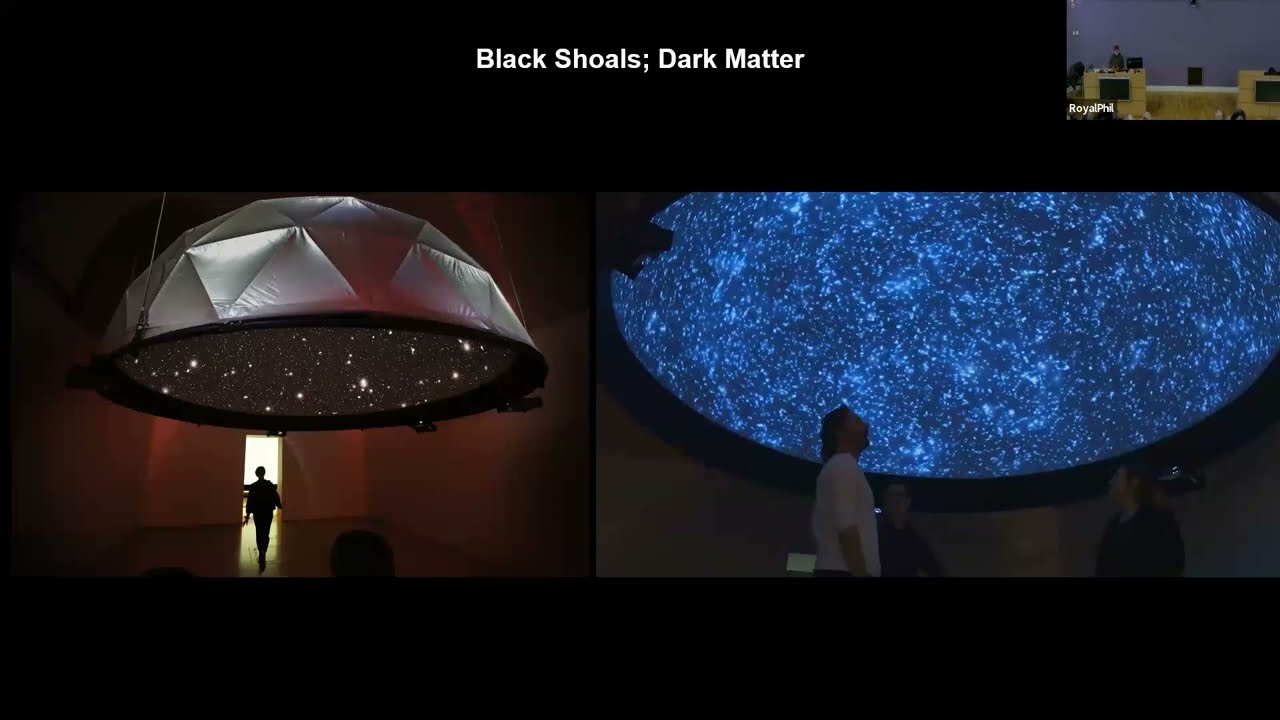
One such project uh was black show stock
market planetarium that was first
exhibited at Britain uh in 2000. This
was a projected planetarium that was
also a live visualization of the world's
stock markets. It was running on a
massive live data feed directly from the
world's biggest stock exchanges.
To get access to so much valuable data
requires CIA clearance as we were
essentially running a live stock
exchange from the take gallery.
This, believe it or not, is the stock
market in galaxy form. Every star is a
company. Every flash is a trade in that
company's stocks.
>> When you just see a small flash like
that, that's probably 10 million pounds
has changed hands.
>> Tell me about these wiggly creatures
that are crawling around the sky. Um
those are
artificial life forms that live in the
sky with the stars and they feed from
the light um generated by the trading.
These creatures evolve over the course
of the exhibition, getting better at
finding those light sources and feeding
off the brightest trades.
>> So it's just before 2:30 UK time, which
is just before 9:30 New York time. And
is that when the stock exchange opens?
Yep. The stock. You'll see when the New
York Stock Exchange opens. You can't
miss it.
>> I have to say, just before the New York
Stock Exchange opens, the creatures look
as if they're getting really
>> They really do. Yes. I think Yeah. Whoa.
>> Oh, wow.
Ding. Ladies and gentlemen,
>> the name black shs referred to shs of
fish that follow each other. But it also
refers to what was called the black and
schles formula. A mathematical formula
invented for forecasting trading on the
financial markets. At the time it was
seen as a faultless solution to the risk
of trading but it nearly brought down
the financial markets as it failed to
incorporate human behavior.
We have also worked for many years on
projects that have explored climate
forecasting, most recently in
collaboration with the European Center
for Medium-range weather forecasts here
in the UK, which is actually part of the
European Commission. It delivers live
weather data to governments worldwide.
This is an ocean observatory we created
in a floodthreatened region of Denmark a
couple of years ago. It visualizes the
life wave dynamics for constantly
shifting locations in the oceans
surrounding Denmark.
In my work as an artist, I have often
worked with communities.
I established a research organization in
the Freetown Christiania in Copenhagen
where I lived when I was a teenager
which has functioned as a critical
learning site for many years reflecting
on what can be learned from the social
urban experimentia and Copenhagen and I
was involved in founding what is called
Hermitage Moorings uh the first
cooperative harbor on the tempames in
London which is home to a community of
50 people who live on ex
historic ex cargo carrying vessels and
sailing ships which is where I live
today.
In 2013 I developed this project at Suda
Lighthouse
near Newcastle where I worked with the
maritime community between the mouth of
the riverine and Sunderland.
The project explored the loss of
identity and history still lingering in
the region since Margaret Thatcher ended
the maritime industry here.
These sentiments were explored through
sound as Trinity House turned off the
sound of the lighthouse folk horns
across the UK's maritime landscape. A
huge loss of an important immaterial
cultural heritage.
Furhorn recreum was a recrim for this
sound. A musical composition performed
by 50 ships on the North Sea, three
brass bands on land and the suit of
folk.
The music was commissioned by the
composer Orlando Goff.
It took place in a dramatic maritime
landscape where the most shipwrecks in
the UK can be found.
Each ship functioned as an instrument in
the orchestra. here positioned in
maritime orchestral positions at sea.
We developed a technology uh that
allowed the folk horns of ships miles
out at sea to arrive in time with
instruments on land, taking into account
the physical distance and atmospheric
conditions of the sound traveling.
Together with the Lighthouse Folk Horn,
this unlikely orchestra performed a
piece of music across land and sea that
brought the community together in a
powerful historical celebration.
All
right.
That's just um a little section of a
50-minute piece of music.
I first came to Kalashit Nunat,
Greenland in 2015 to take part in the
yearly sheep farmers gathering in South
Greenland as you do. I was involved in a
research project called nuclear culture
where researchers from arts and culture
in the UK attempted to engage the
nuclear industry in a wider public
conversation.
I had become very interested in a
democratic process involved in
establishing a proposed uranium mine in
South Greenland and for many months I
had been writing with a sheep farmer
from the region who was very concerned
about the mine.
Greenland is a vast land area that
stretches the length of the northern tip
of Norway to Africa where there are only
about 57,000 people living here in
settlements dotted along the coastline
coastline.
Everything else is ice. There are no
roads connecting the settlements.
Traffic is by boat, helicopter or
airplane.
This lack of infrastructure makes it
incredibly difficult and expensive to
develop and sustain Greenland.
Private ownership of land does not exist
in Greenland as the land is considered a
commons.
There are only about 56,000
people living in the country. Well, to
cor correct what I've said before around
89.5%
of Greenland's inhabitants are Inuit.
The average Greenlander has 75%
Inwood ancestry and 25% European
ancestry tracing about half of their
paternal DNA to Danish male ancestors.
The population identify as either Kalash
lit from West Greenland to Numid from
East Greenland or Inuot people from the
Tula district in northern Greenland.
around 11% of the population is Danish
and these numbers may be a little bit
outdated.
While each region features its own
district language and dialect, most
people master kalash lut Greenlandic
language as well as Danish, although
younger generations have started to
prefer English to Danish.
As you probably know, Greenland is a
self-governing country within the Danish
realm. And although Denmark has adopted
the UN declaration on the rights of
indigenous peoples, Greenland's
population continue to face serious
challenges deriving from the
colonization of by Denmark.
The desire for independence in Greenland
is a national priority and there is an
ongoing process to define and plan for
the future as an independent nation.
However, the country is financially
dependent on a Danish subsidy and the
prospect of full independence
independence is therefore complex.
These pro prospects have also been
interrupted by Trump's attempt to take
over Greenland which has brought Denmark
and Greenland into a close temporary
embrace.
It is a slightly awkward embrace as
Greenland and Denmark is in the middle
of an intense decolonization process.
This is a very traumatic process for
many Greenlanders to go through and the
Danish population has only really
started to understand itself as a
colonizing nation.
The past years have therefore been a
very vulnerable and angerfilled period
between Den Greenland and Denmark as
traumas are coming to the surface and
relived. It is and it is in the middle
of this process that Trump has found his
moment of interference
fueling traumas and fears of a new wave
of colonialism
during the rapid urbanization in the 70s
and 80s. Many many Inuit were forcibly
moved from traditional community-based
hunting lifestyles to modern isolated
urban settings without adequate support
systems. and many experienced a complete
loss of identity.
As a result, Greenland's suicide rate is
among the world's highest and there are
severe issues with alcohol abuse,
depression, poverty, and dysfunction in
many households, which stems from
intergenerational trauma from being a
colonized population.
These are pages in a book that was
published about five years ago by the
Greenlandic Children's Organization,
Mio, an organization which was
established to address considerable
child abuse and child neglect in
Greenland.
Each page of this book is a shocking
testament to the intergenerational
mental health impacts the population is
dealing with that was caused by
decisions made by Denmark many years
ago.
The legacy of colonization and forced
displacements into cities has created
this huge negative spiral of trauma
passed down through generations.
The book was made for children to teach
them about their rights and what they
should be able to expect from grown-ups.
And these are the chapter headings. Dear
children in all of Greenland, you have
the right to grow up without alcohol,
violence, and abuse. You have the right
to grow up with love. You have the right
to be the way you are. Also, if you are
different from others, you have the
right to speak the language you want to
speak and that you find the e easiest to
express yourself in. You have the right
to have feelings and to express your
feelings. You're precious just the way
you are.
This is a powerful artwork called Edno
aesthetic straight jacket made by the
Greenlandic artist Julia Ill Harden.
Greenland has of course also become the
place where scientists and geologists
from all over the world flock to
understand the enormous changes taking
place with the changing climate and the
receding ice.
um that will also eventually provide
access to new territories.
This is an old geologist hut I visited
at the foot of the mountain range called
Kangliner near the town of Nasac in
South Greenland.
This has now become the site of the 10
breeze where earth mine which is a which
is a focus for Trump's interest in
Greenland.
The controlling rights were recently
acquired by the US.
Tenbre is expect exceptionally rich in
disposium and turbium that are essential
for high performance magnets used in
military jets, drones and EV motors.
China currently dominates this market
making tenre a high priority asset for
US EU defense interests.
The mine is also expected to produce
significant amounts of saconium,
hapneium and tantelum. I hope I'm saying
this names right. which are critical for
aerospace and electronics.
Mining have been seen by many in
Greenland as the only viable way towards
financial independence from Denmark.
However, big investments from foreign
mining companies is also a serious
threat to the fragile Arctic ecosystems
and to the long-term planning of an
environmentally sustainable future.
The Greenlandic population is deeply
connected and dependent on the natural
environment and many are concerned that
foreign mining could replace one form of
colonization with another. This could be
what we are witnessing now.
The perception and anchoring of these
global issues from a local perspective
is therefore extremely important.
On the other side of the town of Nasak
is another even more controversial
mountain range. This is the Quanfield
mining area which is thought to contain
the world's second largest deposits of
rare earth oxides.
It contains substantial sodium fluoride
deposits and is thought to be one of the
largest multi-element deposits of its
kind in the world. but is also thought
to be one of the world's largest
deposits of uranium which has made it
center of a dispute for many years. It
is a mountain that has divided
Greenland.
This area of South Greenland is an area
of particular mining interest and huge
geographical areas have been allocated
for potential exploration.
This is highly controversial as this is
also known as Greenland's food producing
region scattered with sheep farms and
green fields.
It is a UNESCO cultural heritage region
of stunning beauty with ruins that date
back to when the Norse population
settled here to farm.
Greenlanders are now farming the same
landscapes and these farms that are
proudly passed on from generation to
generation.
In the 1950s, a Danish nuclear physicist
Nil Spore who worked on the Manhattan
project believed that uranium from the
Cranefield Mountain should support a
nuclear power program in Denmark.
An experimental tunnel was dug into the
mountain and large quantities of uranium
or were transported to a research
facility called RSU in Denmark where
it's now polluting the groundwater.
In 1981, the political climate in
Denmark and Greenland had turned against
uranium mining and the door to the mine
was welded locked and closed and today
it looks like the door to Mordor.
However, in 2013, Greenland's Semood
government parliament voted narrowly to
repeal the ban on uranium.
The Australian company Greenland
Minerals and Energy, which is now called
Energy Transition Minerals, has owned
the rights to the Quennifil mines since
2007. And following the the repeal on
uranium mining, they started the process
of gaining mining permissions, making
promises of jobs and infrastructure
investment in the NASA community. At a
time of severe unemployment,
China also acquired whites in the mine.
The Australian and Chinese-owned mining
company planned to build an open pit
mine, uranium mine, and also rail earth
mine.
This was extremely controversial as it
would risk the spread of radioactive
dust to the nearby town of Nasac and the
surrounding farming region. But despite
of huge concerns, the Greenlandic
authorities approved the Australian
mining company's environmental report.
This is a view of the NASA's waste
disposal dump which can be seen in front
of this of the mountain range. The
country is struggling to manage its
waste and it has a considerable
environmental impact. Environmental
issues such as this makes it very hard
to see how the waste from a massive
foreign mining project can be
effectively monitored in Greenland at
this moment in time.
When Joshua Portway and I arrived in
NASA in 2015, we started to conduct
interviews with local sheep farmers,
residents in NASA, and politicians to
understand the stakeholder engagement
involved in the decision-making process
of the Queenilm mine. We documented a
unique cultural landscape of sheep farms
that have been passed down through
generations. the strong connection with
nature and desire for self-sufficiency
through farming, fishing, and hunting.
Testimonials from the local residents
exposed the growing conflict between
progress, tradition, and Greenlandic
culture and identity that surrounded the
Cranefield mine. It was difficult for
the community to articulate and platform
their fears and concerns about the
mining operation and therefore hard to
be heard in the decision-making process.
On one side were those who saw the mine
as the only way out of independence
and for the community to prosper again
and for Greenland to gain independence.
And on the other hand, there were those
who saw the mining companies as a new
colonial power and feared not only that
they would destroy the traditional
farming culture, but that they would
also
uh be cons but they were also concerned
with the health risks of the mining and
the lack of government transparency in
the in the process of granting
permissions to the mining company.
Therefore,
quick.
This was Peter Henson, a school teacher
and traditional drum dancer from Nasak
who has now passed away.
It became clear that the silencing of
conflicts in Greenlandic society was
also a ma major issue. Disagreements
were avoided rather than confronted and
resolved and the result was a buildup of
sustained fear and depression in the
community. These issues had a real
impact on mental health and also on the
inclusive and democratic decision making
in Greenland.
It
feist
you.
These were the voices of Mayan Pavas who
has very much become the spokesperson
against the Quit Quafilm mine and the
other voice was the previous minister of
mining in Greenland.
In the end, we produced a short film
calleduit
using documentary film making as an
artistic and ethnographic tool.
The film documented the failure of the
government stakeholder consultation in
developing an an inclusive and informed
mining consultation process. And it
highlighted the community's
vulnerability in struggling to
understand the potential risks of a
major planned mining operation with no
resources and little scientific
literacy.
In NASA, people felt that the film
represented their voices and many people
felt that it was the first time that
their opinions were listened to and
communicated.
The film is now permanently installed in
NASA Museum and it was exhibited in
museums around the world in the years
that followed.
In 2018, a seminar was organized around
a film at Ilisu Matusafik, the
University of Greenland, which is an
amazing building, much bigger than you
can see here. The audience were heads of
political parties, government
politicians, scientists, geologists,
stakeholders, and the quifilm mine, and
a panel of experts that responded to the
questions raised by the film.
Many felt that it was the first time
many of these controversial
controversial issues had been discussed
publicly and it was discussed why the
issue of the mine had been silenced
nationally for so many years.
The film raised a lot of questions about
the failure of stakeholder involvement
and democracy in Greenland and it opened
up for a different approach to the
failed stakeholder process.
The film was also invited to Window Rock
in the Navajo Nation. the indigenous
reservation in Arizona and New Mexico
where a formal message from NASA
residents was delivered.
There are over 500 abandoned uranium
mines on the Navajo reservation along
with approximately
1100 associated waste sites and severe
pollution of the groundwater a situation
which is deeply shocking. This is Leona
Morgan, a prominent Navajo anti-uranium
activist who subsequently voiced her
concern about uranium mining in
Greenland's national newspaper.
>> Dealt with so many issues from the
beginning of the Manhattan project to
the testing of the Trinity bomb, the
uranium mining that I mentioned. As
indigenous peoples, we see this as
another form of colonialism and a form
of racism.
It's a very similar story all across the
world because the uranium mining happens
um the majority of the time on
indigenous lands and so I know people in
Saskatchewan, Australia, Mongolia and
DRC and other places um that have really
been impacted by uranium mining. And
it's a very similar story of poor worker
conditions, um, lack of education of
the, you know, the health risks, um, and
low pay. And this is what nuclear
colonialism is. It's it's all of those
things and, and taking our lands, um,
contaminating our water, desecrating our
sacred sites, and damaging our genetic
future.
In the year that followed, the political
landscape changed radically in
Greenland. The resisting resistance to
the mining of quifil gained traction
locally, nationally as well as
internationally where particularly the
voices of the women sheep farmers were
influential.
In 2021, the issue of mining and
environmental protection had become the
biggest issue in the election, the
national election, and led to the
overturn of government. A vocal critic
of the Quenifel mine, Muti Beail, became
the new prime minister for Greenland. He
had grown up in Nasak overlooking Quifel
and several anti-mining activists from
Nasac were part of this new government
including Mayanabasen.
In 2021, the new Greenlandic Parliament
passed the so-called uranium act. The
act creates a ban against the
prospecting, exploration and
exploitation of uranium. This became the
death sentence for the quaneril mine.
The mining company subsequently
delivered a claim for compensation of
11.5 billion for lost revenue, an amount
that Greenland will not be able to pay
if the case is lost. And the court case
is still ongoing today. But during the
last weeks, in this few last weeks, the
mining company seems to be weaponizing
the tensions between the US and Denmark
to bypass a stalemate on the ground in
NASA by aligning themselves with the US
administration's aggressive posture.
They recently appointed Bailout
Partners, a powerful US lobbying firm
with deep ties to the Trump
administration and are attempting to
position Craneell as part of the
solution to the US national security
problem.
For many years, the Kanesuit Quanifel
Mountain has been a symbol for the
complex decisions about the future that
Greenland was facing. But now, the
population may see the decision power
removed.
In 1999,
what? Sorry, 2019.
I always get confused with those years.
Just after the election
that changed everything, I bought this
tiny house that looks out towards the
quil mountain and I named it Nasak
International Research Station. In
short, NAS.
It's a bit comical. doesn't really look
like an international research station.
I know NAS was established as a
nonprofit community organization with a
board of directors mainly from NASA and
a long list of expert advisers from the
science and culture community in
Greenland as well as local knowledge
holders.
Establishing NASA International Resource
Station was also a statement about the
importance of NASA at a time when local
residents felt overlooked and forgotten.
following years of mining dispute. But
this initiative was also an attempt to
address a need for a de decolonized
community-based approach to
environmental research and resilience
building in Greenland.
The idea was to create a platform to
facilitate environmental monitoring,
especially community monitoring of a
region where mining extraction may pose
a real risk in the future.
The aim was also that this could be a
platform for gen generating
environmental baseline data that could
be used as evidence against any future
pollution of the area. But beyond
generating data, the idea was also that
monitoring activities could generate
agency, environmental knowledge, build
scientific literacy, ability to give
voice to concerns and provide access for
the community to expert knowledge.
It was also to generate knowledge
repatriation.
International research in Greenland has
historically been ex extractive with
researchers flying in and out and the
knowledge generated in the region taken
away and only shared in in international
science publications
by anchoring the science in NASA and
creating a platform for sharing it. The
idea was that the knowledge that was
generated would be returned to the local
community and to build an evolving
knowledge archive that could hold
immense educational and cultural value.
NASA is located at the very heart of
some of Greenland's biggest development
questions. It's a region where climate
change, self-sufficiency, and food
security overlap with resource
extraction and geopolitics.
It is a landscape of history, geology,
farming and tourism. And the community
here is navigating important debates
about audity, sovereignity, and what a
sustainable future could look like. So,
NASA really serves as a microcosm of the
complex challenges facing Greenland's
future.
It is also home to Greenland's only food
college in Wheelie. Apart from teaching
traditional knowledge about Greenland,
Green Greenland's natural food
resources, whether farmed, hunted,
collected, or fished, it also has a
sheep farming school and an experimental
island where plants are grown and are
tested in the constantly changing Arctic
island climate.
This was a fermentation workshop um
between local residents and Samantha
Brown, a PhD candidate from Oregon. Her
research explored increasing use of
traditional Inuit foods, especially
fermented seal blubber from South
Greenland in European fine dining.
The project explored the complexity of
food sovereignity, colonialism, and the
tensions between celebrating and
appropriating indigenous food ways.
NASA International Research Station
immediately became an international
research station and for the past five
years it has redefined what a research
station in Greenland can be.
The research station has hosted a long
list of research projects ranging from
climate research, ecosystem studies to
social science, community health and
food security as well as artistic
practices exploring identity, indigenous
knowledge and environmental stewardship.
These are projects that have engaged
with local community priorities while
also contributing contributing to wider
global discussions.
The main focus has been how visiting
researchers can contribute to the local
community. How the global and the local
can coexist. How we can educate, give
voice and generate knowledge exchange.
Researchers pay for their stay at NAS
and provide free education to the
community. They hire local residents and
the income generated by their stay at
NAS only benefits the local community.
Community leaders lead on the
coordination of the projects and how
they meaningfully can be embedded in the
community in schools, youth centers, old
people's homes, etc.
The arts have played a vital role in
bringing people together around
important questions. We co-established
the Nordic Alliance of Artist Residences
on climate action together with artist
residences in in the Nordic countries
including Scotland
which has allowed us to commission
artists, designers and writers and
produce a series of discussion podcasts.
This one is with Greenlandic filmmaker
Eno Jansen and community psychologist
Peter Bellina from University of
Greenland who explored what the idea of
progress means in a Greenlandic context.
And these are some of the artists
research projects we have hosted.
The Danish artist Eleanor Hin Migkelson,
a descendant from a famous Greenlandic
explorer and Nia Abson, a Greenlandic
artist, worked with a school in Nasac
and created a visual cultural exchange
between school children in NASA and
Lucon in the UK.
Their work with the children was
exhibited at the World Geographic
Society in London along with their own
research in NASA.
These uh striking images by Nia Aberson
represent the world view of the ancient
Inuit, their beliefs, mythological
figures and where these ideas are
located in the landscapes.
The Inouit like most indigenous peoples
were animists. Everything is animated
and humans can communicate directly with
the forces of nature in a shamanistic
three-part world.
Young people in NASA in particular have
benefited socially, culturally, and
educationally from the many activities
generated by the research station. Here,
a US-based art science research team
that studied climate change impacts on
on aquatic ecosystems in the area
created workshops where young and elders
taught each other to study local aquatic
organisms through microscopes.
This was a French artist, Minui, working
with local residents in NASA and a
French team of anthropologists
undertaking a comparable study of two
coastal communities in Canada and
Greenland. In this workshop, they used
plants and water from all the different
water sources in the region to visualize
the landscape.
Last year we hosted the nomadic hub of
Arctic Art Education, a nomadic camp of
20 mainly Greenlandic and Sammy artists,
researchers and educators that work with
school teachers, students and old people
on ways of integrating pedagoguy,
culture and indigenous perspectives and
a week of art workshops that involved
most people in the town.
For the past three years, NAS has been
the headquarters of the Swiss Polar
Institute's flagship science program,
which is called Green Fjord, Greenlandic
Fjord Ecosystems in a changing climate,
social, cultural, and environmental
interactions.
It brought together six research groups
focused on ocean, soil, biodiversity,
croosphere, atmosphere, and human.
The project involved more than 50
researchers and international re
research organizations.
NAS was involved in designing how the
project could be could be implemented
and shared using the research station in
the middle of NASA as its headquarters.
They didn't all live there.
Research teams lived with residents in
NASA. Local residents were employed as
research assistants, translators and
skippers. and school teachers worked
together with the scientists to involve
students in the research.
This year, residents from NASA were
invited to Switzerland to help evaluate
the three years of research and explore
how it could benefit the community.
The research station was during the
three years fitted out with atmospheric
monitoring equipment, proper community-f
facing laboratories, and most days of
weather balloon provided a performative
and visual presence above NASA as it
rose and lowered on the hill next to the
research station, involving the
community in the many atmospheric
monitoring workshops and giving a name
to the balloon. Hundreds hundreds of
names which read like a long poem.
During this years a long list of
community science workshops has taken
place at NAS and in the schools across
the region.
This is a queer sphere workshop team
during the NASA science week we
organized last year with a 3D model of
the local glacia which was a focus area
in the school.
In the last two years, we have invited
teachers and young people from NASA to
take part in research expeditions aboard
two different research vessels where
they have been guided and taught by the
scientists. They have studied the
carving front of a tidal glacia, fuel
dynamics, nutrient concentrations, air
compositions at the interface of the
ocean terminating glacia, the effects of
iceberg carving on meltwater plumes, and
collected information on animals living
in different environments.
Some of these children have never
previously been away from NASA.
NASA International Research Station is a
project that has explored in what ways
such a tiny place in a very very remote
location can become an important place
for the rest of the world to learn from.
As an artist researcher, I have been
interested in the strategic power of
visual scaling. The tininess of the
research station has been inspiring to
me as it stands in contrast with the
international scale of its stated
ambition.
It is perhaps a visual cheekiness in
insisting that a remote and
insignificant place can also be mighty
and global.
I have started to develop twinning
projects with institutions of much
higher prominence to explore this
further
and in collaboration with cultural
attaches from the Danish foreign office,
environmental scientists and local
residents in NASA, I have started to
develop a tiny container laboratory, a
small traveling meeting space that will
connect the community of NASA with
indigenous communities around the world
where collaborations, learning and
cultural exchange might be empowering.
This is an artwork by an important
Greenlandic artist uh who is not with us
anymore called Pia A. This small box is
a camera obscurer or pinhole camera that
she built in Copenhagen in 1990 and
transported to Nasak where she placed it
on the side of her now demolished
childhood home at Nugasu Point.
While sitting inside the camera, she
could see the same view that she would
see from her windows as a child. And
using the pinhole camera, she could
merge her naked body with her childhood
landscape. From this little box, she
produced powerful works using the books
as a tool for mental decolonization,
reclaiming the right to narrate her own
history.
This is a finally an image that always
looks to me like the beating heart of
the Kuanosuid Quenifil mountain. It is
the extremely fluorescent effect of the
red tuktopit stone that can only be
found in Quenifil.
Tuktopis tuktopit means the blood of the
reindeer.
I believe that the region of Nasak and
South Greenland is a huge part of the
underlying impetus for the Trump and
administration's attempt to take over
Greenland.
This is of course primarily driven by
the region's concentration of rare earth
elements and other critical minerals
essential for defense technology and the
green energy transition which has been
monopolized by China.
Individuals and entities close closely
tied to the Trump administration
have actually been positioning
themselves to control South Greenland's
resources over the last years.
This week, the Trump associate Drew Horn
announced plans to build a data center
in Greenland that will be many times
bigger than the world's biggest data
center. He is partnering on a range of
projects with the with Greenlandic
businessman who represents the
Cranefield mining company that is
currently suing Greenland to gain access
to the mine.
This mining company is now distancing
itself from its Chinese investors to
position itself in the US for political
investments.
the US commerce secretary
Howard Lutnik I think who's also
mentioned in the in the recent news um
previously led cancer Fitzgerald which
is a major investor in critical metals
corp
this company owns the ten breeze project
near Nazak one of the world's largest
rare earth deposits
other investors behind critical metals
corp have significant overlap with those
investors behind Trump Media.
In mid 2025, the US Export Import Bank
issued a letter of interest for for a
$120 million loan to fund the Ten Breeze
mine.
Former high-ranking Trump Organization
employees including Drew Horn, George
Soral, and Keith Schiller, have business
interest in Greenmet, a company focused
on developing North American critical
mineral supply chains that include
Greenland Greenlandic assets.
And the US government is reportedly in
talks with the company Amarok in South
Greenland regarding potential
investments in gold, copper, geranium,
and gallium mining.
What I have also read uh which I don't
know of course is true is that
apparently a range of Silicon Valley
tech investors had has begun promoting
Greenland as a site for a so-called
freedom city, a libertarian utopia with
minimal corporate regulation.
They have envisioned transforming
transforming Greenland into a supposed
startup paradise for Silicon Valley
obsessions. Building the island into a
hub for art artificial intelligence,
autonomous vehicles, space launches,
micronuclear reactors, and highspeed
rail.
Involved in this is apparently Ken
Howry, a former venture capitalist who
co-founded PayPal alongside Teal and
Musk. He was recently appointed by Trump
as America's newest ambassador to
Denmark, specifically to lead Trump's
takeover of Greenland.
On this sad note, I will end this talk.
>> Okay, time for questions. Can I start,
Lisa, by asking, what on earth does
fermented seal blubber taste like?
>> I have no idea.
Wonderful.
Who wants to ask a question?
Quiet.
Yes, there gentlemen. Okay, you next.
And there's a chat behind him.
What is beyond's main export?
>> The main oak main export is by a huge
amount fish. Fish is the main income for
Greenland. Fish export.
>> Is it processed or is it just frozen?
>> I think it's mainly exported to Denmark
for processing. Yeah.
that
>> very much. You mentioned several
international programs that give
concessions by gave them those
concessions. Was it the greeners or the
dates?
Um when um when a mining company is
given um uh is granted uh the right to
mine um they need to they have the
problem that they need to gain the
investment in order to make the mine
happen. And um it is not really it's not
really possible um for for anyone else
to kind of stop investors that that are
controversial. But of course if there is
a controversial investor it can become
an issue in the in the process of the
mining being granted.
Um so um companies that have a history
of corruption for example would would be
um I think there would be a process um
that would be quite critical about the
risk involved for Greenland in granting
um permissions to that to that company.
Denmark has had has owned Greenlander
for many years and has not developed the
economy there. If you compare Greenland
to the north of Alaska, which was taken
over by America 120 or so years ago, um
there at the time of takeover of Alaska,
it was equally as barren as Greenland at
the north. The north of Alaska was the
same as Greenland. So I mean Denmark has
had many years to develop Greenland and
treat the Greenlanders better. There's
not even a decent hospital there, I'm
told. So why why are the Greenlanders so
concerned about having an improved
standard of living possibly if Trump was
to take over? Because the country no the
country as it stands is a barren
wasteland. The people are struggling.
Nobody there wants to live there at the
moment. People are not coming in. If the
economy was developed it could be like
Alaska.
Um I think that most Greenlanders are
aware of how indigenous populations have
been treated in by the US. It's not that
is not a success story. Um
I I agree with you that um that um a lot
more could have happened in Greenland
and there's a lot that could be
criticized about the ways in which
Denmark has been involved in in
Greenland. There's a long terrible
history that is just starting to be
addressed. But um
as Danish citizens, Greenlanders get
free health care and free schools and
you don't get that in the US. Um and
also I it is certainly my impression
that most Greenlanders
are completely in love for their own
country and don't want to go anywhere
else. Although getting getting older in
in Greenland is difficult. there's um
although you have the same rights to
health care as in Denmark, many older
people in in Greenland choose to move to
Denmark to get old and that is because a
lot of provision in Greenland needs to
be improved.
Um as I mentioned before, there is a lot
of issues to do with the infrastructure
of Greenland which makes everything
incredibly expensive to develop.
two on the right. One bit one.
Hello. Yes. What proportion of people
get fishing jobs in Greenland? I mean
huge massive industry are who are the
companies that control fishing in
Denmark or sorry Greenland. Who controls
the fishing in Greenland? because
obviously it's a huge industry that the
population don't seem to be getting any
benefit from.
>> Uh it is controlled from Greenland. Uh
there is criticism of um and I don't
know to what extent this criticism is
true. I don't it's not my specialtity
but there is criticism from Greenland
about Denmark making profits on on the
Greenlandic fishing industry that is not
recognized in in terms of what is
returned financially. Um so at the
moment there is a lot of kind of
questioning about Denmark's profits when
it comes to to Greenland but the fishing
industry is is controlled by Greenland.
Most areas are controlled by Greenland
apart from foreign policy and defense.
But increasingly so, especially in the
recent year with the with the whole
process of um sort of attempts at a
reconciliation to do with a lot of
issues uh that have come through the
colonial times that is being worked
through in painful ways at the moment.
Um
um these these are things that are
discussed a lot at the moment and um
Greenland at the moment is very much
involved in in foreign affairs and
completely equal to Denmark at the
moment in engaging with the talks with
the Americans and in talks about their
future. It's a it's is a very uh Denmark
is um supporting Greenland in in in in
that they need to make their own
decisions about their future. This is
not for Denmark to make a decision
about. It's for Greenland.
>> Good evening and thank you very much for
a very interesting talk uh coming across
quite uh depressingly.
However, I recognize these issues as
having happened
uh frequently if not continuously all
around the world.
I was wondering what research is being
done by Greenland to develop strategies
to avoid the disastrous outcomes
elsewhere.
>> So, excuse me. Did you uh did you mean
um research done in Greenland about
places elsewhere or about their own
elsewhere? Um
the University of Greenland is is an is
an incredibly interesting place. In
fact, it's the most interesting
university I have ever experienced. And
that is of course because um everything
that is studied here has a direct
relevance to the building of a new
nation and everybody who's there is um
really needed and in because there are
so few in the society. So, so everything
that is studied there is really tends to
be quite urgent and extremely important.
And of course, um there is a lot of
connections to other indigenous um
populations particularly uh init um in
Canada and the US. uh and those
connections are really really close and
there is uh through the United Nations
indigenous forums really strong forums
that have grown increasingly strong in
getting their rights heard. So, um there
is a very very uh connected and um
informed
uh research going on in in Greenland
about other places and also about their
own issues and and and um possible
um
possible ways forward.
here.
Thank you for such an interesting talk.
It was really fascinating. Um, one of
the things I wanted to ask is, as I
understand it, one of Trump's reasons
for wanting to take over Greenland is to
offset the risk of invasion from Russia.
Now is there any evidence that Russia is
actually has actually got those
intentions?
>> It is not my understanding that such a
risk has been identified as that
anything has changed dramatically in the
last years. Uh in fact this region has
been priding itself in its in its
peaceful coexistence
um with the with the Russian invasion of
Ukraine. this relationship kind of
became
um messed up in that the uh collaborate
the collaborative platforms that existed
between Inuit in um in in in
Russia and um and Russia as a
neighboring country um that ceased to
exist. They had to be excluded from this
collaborative forums. But up until the
invasion of Ukraine, this was an
incredibly successful perhaps the most
successful kind of um intergovernment
platform um in in the world in the ways
that it uh that those collaborations and
peaceful coexistence was taking place.
There are um issues to do with nuclear
submarines
um from Russia moving around waters. Um
there is nuclear issues but there's
nothing that has changed uh as I
understand it uh from what I read
dramatically in in that would that would
um provide evidence for such a claim.
Not as I've understood it. Is possible
that I have missed information?
>> Would Canada not be a more obvious and
certainly more trustworthy partner for
Greenland?
>> I suppose I suppose Canada Canada has
just opened um um a consulate in uh
Greenland in the last few days.
Um
and um
Carney from Canada has uh has been
incredibly vocal in his support for
Greenland. Of course, Carney is and and
Canada can Canada is in this kind of
similar position as Greenland. Um so um
there is a shared interest in in not
being taken over by by Trump but there
is very close relationships between um
uh Canadian Inuit nations and um and
Greenland. And when the consulate, you
know, opened here a few days ago, there
was a huge delegation of all the Inuit
uh leaders in Canada that also came with
um came over to the opening.
Did you mention global warming?
Because if all that ice melted,
we'd be swimming, wouldn't we?
>> Sorry, say that again.
>> But global warming.
>> Yeah.
>> Did you mention that in your talk?
Because there's a lot of ice to melt in
Greenland.
>> Yeah.
Yeah. Global warming is very vis
visible. And in fact, at the moment,
it's warmer in in NASA than it is in
Denmark.
Uh thank you very much Lisa for the
interesting talk. You mentioned near the
beginning that uh in Greenland the local
population has no real concept of land
ownership.
with the retreating ice, of course, more
land must be coming available. And I
just wondered how that works. And and
Trump's idea of buying Greenland, a
country where nobody feels they own the
land. I I just wonder how this is
culturally even going to be possible.
>> It's a good question. Um I wondered that
too. I'm sure Trump doesn't even know
that. He doesn't really know anything
about Greenland. He's not particularly
interested, I don't think. Um when I um
when I bought my house, which became the
research station, um I went to the local
council and I went to the map of the
region and I drew a little square where
I was going to be. And um I didn't
necessarily have to do that only because
I thought I might make a little terrace.
But all I had to do was making a little
square with a with a pencil. And that's
how it works. But you you have a right
to use the the land, but you don't own
it. So in Greenland, you will notice
that it it looks if you look at it from
a a drone image um from above, you will
see what looks like an ant nest of paths
that weave in and out houses because
people choose the path path they want
also through next to other people's
houses. So there's a whole different
concept of moving across the land. Um
to to get um the rights to a mine, you
have a similar kind of right of use with
your license. And I suppose the this is
something that is very discussed in
Greenland that um when you have a mining
facility, you block out other people's
use of that land and that is very
controversial in Greenland. So with the
Kuos Kenfield mountain um the right to
go to that mountain is such a cultural
um embedded way of living in that land
and go up and find those extraordinary
red ruby like stones for jewelry at the
tuk pit. um in collecting those special
plants that you can only get up in that
area or so to the thought of an area
like that being closed off for the
population is very controversial.
So mining is still although there has
been old mines but the this kind of
mines as as closed areas because there
might be be um problematic health risks
involved is is a new new thing and I'm
not sure how people will react to that.
Of course, a mining license gives you a
certain amount of time access to that
place. So, it's not that you own it
forever.
>> I asked about the the main export. You
said fishing.
Did they did could they have a place on
Greenland that processes the fish as
well and give more people employment or
or there not enough of the population
there to do that?
>> I think there is some processing places
to be honest I'm not feeling completely
informed of it but I know that a lot of
fish is is um exported to Denmark for
further further processing. Um but I
don't know to to what extent some I'm
sure some extent of processing happens
in in Greenland. There is a lot of um I
mean things like that. Yes, it should be
possible. I'm not quite sure why it
hasn't happened. Yeah,
>> I completely agree with you.
>> Um it is very difficult to find labor.
It is an issue in Greenland. Yeah.
Got a question there.
Um I believe the the Chinese and the
Russians have a icebreaking fleet
already
established whereas America and Europe
don't and the event of
uh the sea the ice melting and there
there's going to be uh ships using these
passageways.
Do the do the Greenlanders have any
control over the use of in the future
the those seaways
>> new seaways open
>> new seaways. Um,
I think
I think the kind of the claiming of
territories, the claiming of of areas
that passages that opens up will be a
really um disputed issue. I don't I
don't know if it's been resolved or or
who will have the the right through it.
I mean, I think it's um I don't think I
haven't I don't remember it being
discussed as something that Greenland
would have the right to decide,
especially because Greenland itself is
not a a nation yet.
>> Swing along a left
Is Iceland
not relevant because it has no
indigenous inhabitants?
I I mean, I wondered how Iceland fitted
in with Greenland's image of itself.
>> Iceland also was a colony of Denmark. Um
and um Iceland and Greenland enjoy a
really close relationship. Uh they have
a lot of there's a lot of um business
between Iceland and Greenland and it's a
very close close relationship
culturally. There's also the sheep
farming. So many um sheep farmers in
Greenland go to Iceland to to study
green far uh sheep farming and to to
work there.
Um also in terms of fishing I believe so
it is a really close relationship.
>> Right. Have you got any questions?
>> There's one right at the back.
>> So my question is about climate change.
I'm assuming that when the ice melts,
there'll be more like land available for
pastoral activities, but there'll be
more like extreme weather events.
What is the popular sentiment about
climate change and the future in
Greenland?
>> It's complicated. Um some people are um
finding it very exciting
partly because um um if you're farming
for example there might be new things
you can grow. So there is new new plants
that grow that grow there and uh but on
the other hand for farming it's also
really problematic because the farms are
located in very isolated places and the
only way they can um in the in the
summertime they use little boats. They
even transport their horses on tiny
little motorboats. So you see a horse
head sticking out of a really really
small boat. It's just very funny.
Anyway, but um in the winter they get
completely boxed in. They can't have any
um impact to the outside world because
the ice is becoming um irrational. So so
say you can't rely on the ice for
driving on. So they can't just drive
across the ice. So it becomes very
problematic in the winter periods for
for the farmers.
Um, so there is aspects of tourism that
becomes easier, but there's also aspects
of tourism that becomes more complex
because the weather becomes an issue.
And to be honest, to fly to Greenland um
is is difficult. You have to be prepared
to get stranded somewhere for a week,
for example. Um, you have to be a Zen
Buddhist. you have to um you can't
expect that everything goes as planned.
So, so that makes it difficult in terms
of tourism.
So, it's complex.
Hello. You you've almost just answered
my question because what I was going to
say was just about all your photos were
taken in marvelous sunshine, but I'm I'm
guessing it's not like that at all. and
the winters are longer and darker than
they are here in Glasgow. So,
how much is the difference between
winter and summer for the people who
live there?
>> Um,
I haven't I'm embarrassed to say I've
only been there very little in the
winter and it hasn't been terribly cold
when I've been there. Um but um the
winter is supposed to be very bright
because of the snow and u many people
appreciate the winter. The summer um in
the south can be very warm in in the 20s
centigrades really warm. Um huge
mosquitoes
means they're slower though.
Um the um when it's not always nice
weather, but in the south it's
surprisingly often nice weather. When
it's cloudy, the clouds are so low that
you don't want to take any pictures
unless for
for particular dramatic situations and
clouds, but it's a kind of repressive uh
bad weather. Um the light is the most
extraordinary thing and in the summer
but also in the winter light is
otherworldly and um yeah you just find
yourself taking pictures all the time.
>> Thank you for talk for your talk. It was
very interesting. Um, one question,
uh, you didn't mention was a military
presence in the in Greenland. Um, where
are the bases? I'm assuming there are a
number of bases in Greenland. Um, who
are they controlled by and is there any
relationship between the local people
and th and those bases?
Um there's until
everything went um upside down some
weeks ago. Is it? It feels like a long
time ago now, but it was I don't know
when Trump started again on all this.
It's not actually a very long time ago.
So until that time there was only the um
American bases um uh which has I think
several hundred American um soldiers but
that is quite an isolated place um and
um I think you have to get permission to
go there.
Uh the airports in Greenland have um
traditionally been um military airports.
So, Kangaloo Suak was American military
airport and that has traditionally been
the place that connected um soldiers to
that American military base. Um but
Kangaluak has kind of sort of is
supposed to cease existing as an airport
because a new airport has been built in
um Nuke.
Um, in the south the Americans built
another airport called Naswak and that
has been the entrance to South Greenland
with international flights, but that is
also supposed to cease existing as a new
airport is built in a nearby big town.
Unfortunately, the new airports are not
very um reliable.
Um I think um there was a reason why the
Americans built the airports where they
built them because they made it possible
to land um in difficult weather and um
the new airports are um might cause a
huge infrastructure problems. So there's
a lot of fear around that. Certainly for
Nuk airport it has caused huge losses
for um Greenland
um with this airport there. Um
so there isn't any other military bases
but um there is a military Danish
presence of uh navies the Danish navy
that travels around the coast and then
there's the famous um um dog slay patrol
that Trump refers to which is actually a
very
incredible um group of people that that
uh travel across the inland device to
very remote locations and um it's not
something to be um dismissed really. But
at the moment there's um there's
military presence everywhere I think in
in Greenland from from European
countries. Also the UK has just
announced that the UK is going to join
in uh to to um to be a watch military
watch in Greenland.
So there will be a lot of military now
and I'm not sure where this new military
bases will be will be.
Um this is partly a comment relating to
a question earlier in which Greenland
was described as a desolate wasteland.
People have said the same about much of
Scotland.
Uh and if we allow that extractive
approach to the natural world to govern
how we treat our land, we really will
end up with an absolutely desolate
wasteland once everything has been taken
and the people are left behind to deal
with it.
Is this working? Um, I wanted to thank
you for an amazing presentation, but I
wanted to move away from the political
discussion. And I wanted to ask you
about your own work and particularly
well lots of things but I that that um
concert
uh that was to sort of um mourn Trfalga
house that was amazing. How on earth did
you come up with the idea?
>> You mean the folklor and recquum?
>> Yes. Yeah. I thought it was remarkable.
>> Yeah. that really made me want to become
a musician.
But um um it was because I just by
coincidence realized that uh the folk
horns were being closed off turned off
by um Trinity House but they didn't
actually people were not informed. So
when I talked to people on the on the
coast who remembered the sounds of the
folklororn because each folk horn has
its own sound.
Not many people know that I think but
that sound uh reverberates with that
particular landscape and creates a
completely unique um
uh yeah sound that is totally embedded
with that particular landscape. And of
course when we grow up next to um a
coast to that sound that becomes your
memory from your childhood and it's a
very deep uh thing and that really was
um um there was so many overlaps with
that region and the loss of the of its
maritime history and that kind of sense
of sense of loss I felt with a lot of
people there. But I already um you
probably gathered that I like chips and
um I have spent many years um uh
building a big ship and building a
harbor in London and um and I've been I
am very interested in um the kind of um
maritime history in terms of people
um living um underwater ways. So it kind
of came from all that.
>> All are very interesting. We have an
island the west coast of Scotland called
Elsa Craig
where curling stones come from and on
this east each side of that island there
are huge Victorian volcorns which were
steam powered which have not been used
for a long while but they're still
there.
Okay, the last question as we have for
the wrap up. Anybody got a final
question?
Do do you actually live in the NASDAQ
International Research Station or is
that like just a house that you own? And
what do we have to do to apply to come
visit and do some research there?
>> That's a really good question. You're
all welcome.
Imagine
the whole society traveling on England.
You could you could you could hire a
ship.
Um
um well um I don't live there but I live
there when no one is there. Um uh I I um
at the moment we don't uh we don't have
a bath. So so people have to go to the
sports center down the hill. So, at the
moment, I'm trying to build a shower
there. So, if any of you are really good
at building showers, you're extra
welcome.
But um um
to to apply basically um uh you just
send an email uh with a project idea and
um what we look at is um to what extent
that idea will be um um relevant for the
community and to what extent it engages
with the it engages with the community.
There is also um many sciences to go
there. example, we've got a lot of uh um
research into the Arctic char
um uh and that is is a massive research
project apparently goes on for 20 years.
I've never heard about such a long
funded research project but um there is
a limit to how much you can talk with
the community about the Arctic char for
20 years. Uh so so you know everything
is um it depends on the projects to to
what extent um it makes sense to engage
with the community. Um
yeah
>> well um this been a wonderful talk. You
can see how much interest we all have
and it's a story that's
really continuing day by day. And when
you when we were talking earlier uh by
email, you said um you you couldn't send
the slides in advance because things
were changing day by day.
Now I know that one of your artist
interests is glass and you that was what
you won an award for. So we have made
for you
a very special paper weight.
Here are the instruct. You get
instructions
what to do with the paper weight and
this is from the society commemorating
our 224
years existence.
>> Wow.
>> Thank you very much.
>> Thank you so much.