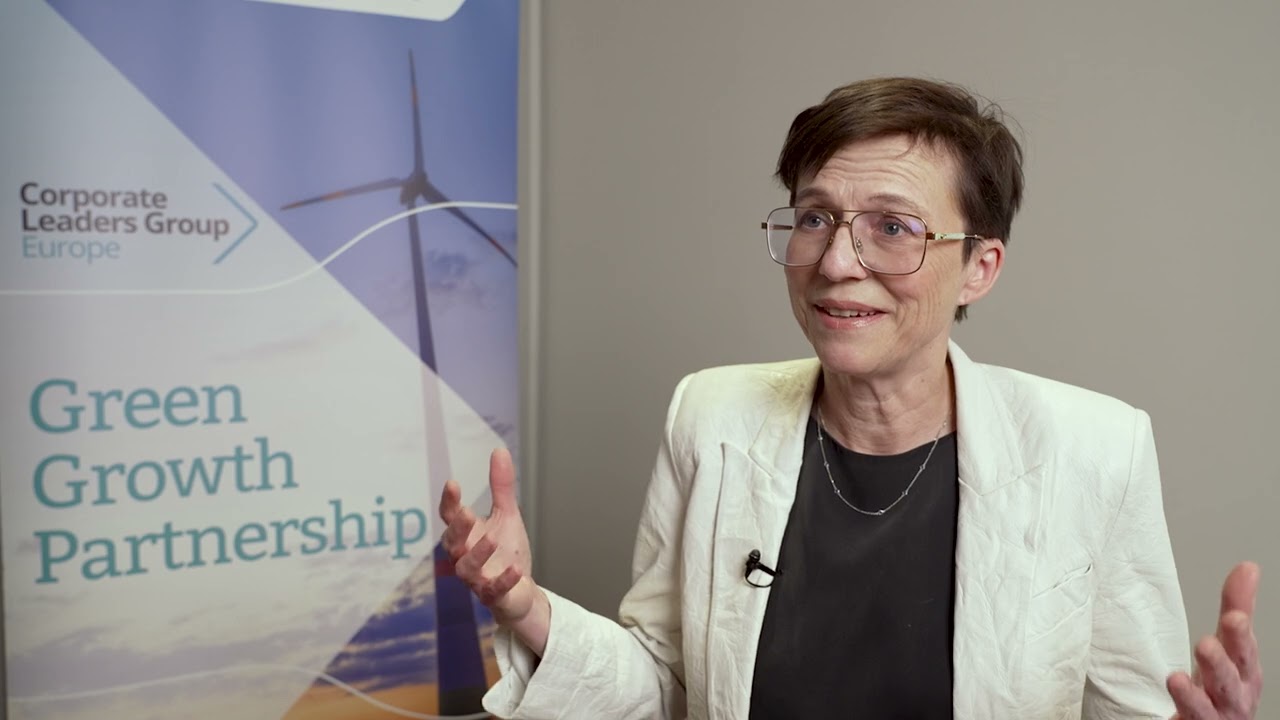
Green Growth Summit 2026: Helena Norrman, Executive Vice President, SSAB
Watch on YouTubeVideo summary
Helena Norrman, Executive Vice President of SSAB, asserts that there is no inherent trade-off between sustainability and competitiveness within the steel industry. The company is currently investing over five billion euros to transform its production assets in Sweden, a move designed to simultaneously enhance market competitiveness and achieve fossil-free operations. This transformation relies heavily on a stable, predictable, and strong policy framework at the European level, with the existing Emissions Trading System (ETS) serving as an effective foundation for future climate policies. Norrman emphasizes that regulatory predictability is crucial for large-scale investments, noting that while investors can tolerate market or technological uncertainties, they struggle significantly with unpredictable rules of the game.
The strategic investment plan involves two distinct sites in Sweden, each targeting different aspects of modernization and decarbonization. In Oxelösund, the company is replacing its current blast furnace with an electric arc furnace to focus primarily on decarbonization efforts. Meanwhile, a major project in Luleå in northern Sweden involves constructing a completely new steel mill utilizing advanced technology that is both fossil-free and capable of producing more sophisticated products for customers. This dual approach ensures that SSAB achieves three critical goals at once: deep decarbonization, product leadership, and improved cost efficiency. By electrifying their processes, the company aims to reduce dependency on imported fossil fuels and secure access to clean energy at acceptable prices within Europe.
Access to affordable, fossil-free electricity is identified as a decisive factor for the viability of the European steel industry's transformation. Norrman points out that many European steel companies face significant hurdles in going fossil-free because they lack access to green energy at reasonable costs. In contrast, SSAB benefits from having production facilities only in Sweden and Finland, two nations with established access to competitively priced renewable energy. This geographical advantage provides a strong starting point for the Nordic steel sector, allowing it to lead the transformation while highlighting that widespread availability of such energy across all European member states is essential for the entire industry to remain financially viable and competitive in the future.
Read the full video transcript
First of all, for SSAB, there is no
trade-off between sustainability and
competitiveness.
Uh we are investing more than 5 billion
euros in transforming our production
assets in Sweden as we speak. And
and that will make us more competitive,
but it will also make our production
fossil free. Uh so it is there there is
no trade-off, but it's very important in
order to get that to work to have a
stable and predictable and strong policy
framework uh on European level. And that
means that the ETS system that has
served us well uh and that is very
effective needs to be the basis of the
climate policy. Uh and predictability is
the key. You can't change the rules in
the middle of the game. I'm a big
football fan, and you just don't do
that. In order for companies to make
large investments, and we are talking
about large-scale investments here.
Uh you need predictability, and
especially you need regulatory
predictability. Because if you look at
the investors, they can live with market
uncertainty, they can live with
technology uncertainty, but it is very
difficult for them to handle regulatory
uncertainty. So you need a stable
framework and stable rules of the game.
SSAB is currently investing more than 5
billion euros in our Swedish production
system, and
that has
it is and it's on two sites. One is in
Oxelösund, where we make our more
special products, and there we're only
replacing
uh the current blast furnace with
electric arc furnace. So that is about
decarbonization. Then we have our big
investment in Luleå up in the north of
Sweden, where we're actually building a
completely new steel mill, and we're
investing into new technology that is
both fossil free, but will also enable
us to make more advanced products for
our customers, and to be more
cost-effective and efficient. So it's
really it's about decarbonization, it's
about product
product leadership, and it's about cost.
You get all the three at the same time.
So, electrification in Europe is very
important. And And first and foremost,
we need to move away from the dependency
on fossil fuels that come from other
parts of the world. We also need access
to clean and fossil-free energy at
acceptable prices in Europe. And looking
at this from a from an SSAB perspective
today, maybe it has less impact. But if
you look at the steel industry today,
for instance, it is very difficult for
many steel companies in Europe to
transform and go fossil-free because
they don't have access to fossil-free
energy at a reasonable price. Looking at
electrification and access to
fossil-free energy across Europe,
for us at SSAB, we only have production
in Sweden and Finland, which are two
countries with access to fossil-free
energy at a reasonable
and and competitive cost. So, we have a
good starting point. And that's also a
reason that
steel companies in in the Nordics are
moving ahead with their transformation
because we have the prerequisites. For
the European steel industry, it is very
important to have this access to
fossil-free and competitively priced
electricity across all of the member
states in Europe because otherwise it
will not be financially viable for them
to transform.