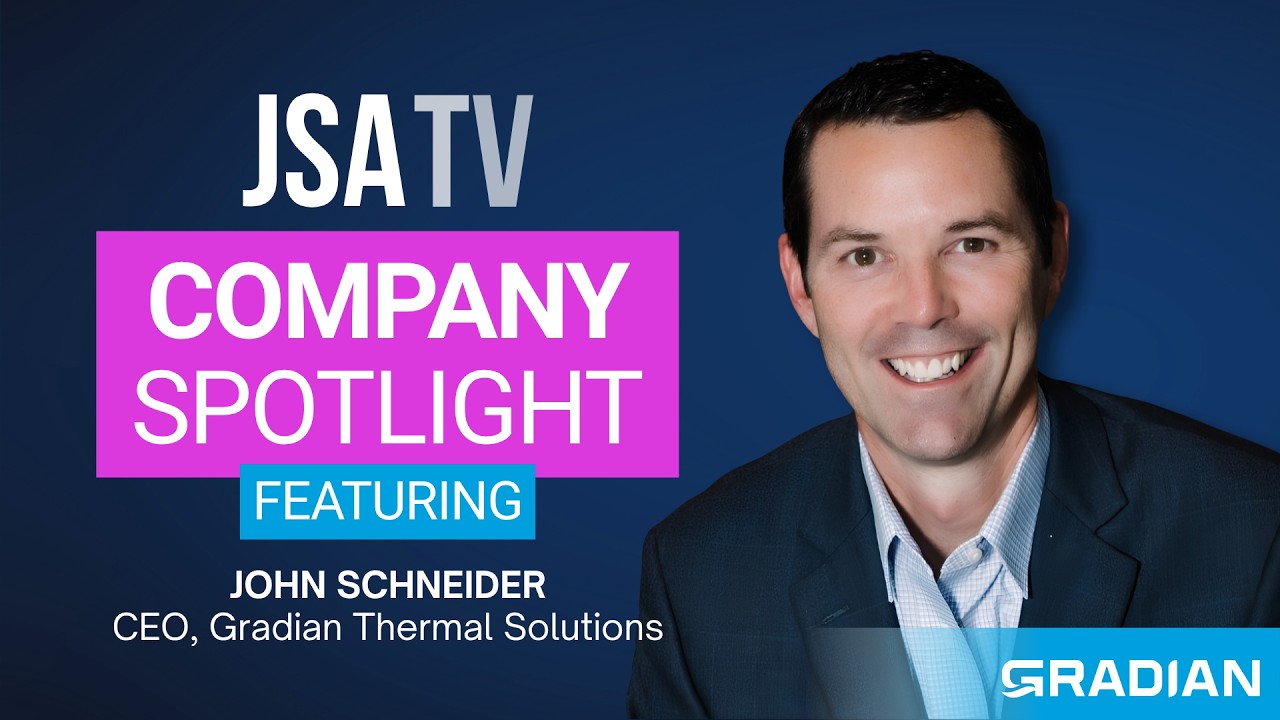
Gradian Thermal Solutions: Building for the AI Infrastructure Boom
Watch on YouTubeVideo summary
Gradian Thermal Solutions is a new brand entering the digital infrastructure market, driven by CEO John Schneider's extensive twenty-six-year background in heating and air conditioning technologies. With experience spanning major industry players like Emerson Electric and Verdive, Schneider brings deep expertise in global thermal management for data centers to this venture. The company was formed through the strategic convergence of three distinct business units: a sixteen-year-old mass HVAC division with strong air cooling history, Deep Cool AI which specializes in liquid cooling infrastructure, and Eco Chillers, an acquired leader in high-efficiency chiller technology. This unique combination allows Gradian to offer a comprehensive end-to-end thermal platform that addresses the full spectrum of heat removal needs required by modern computing environments.
The launch of Gradient Thermal Solutions is timed perfectly with the explosive growth anticipated from artificial intelligence workloads, which are expected to double demand over the next two years and eventually represent fifty percent of total data center capacity by 2030. To meet this surging need for rapid deployment and engineered solutions, Gradian has more than doubled its manufacturing capabilities and recently opened a new factory to better serve customers scaling their AI infrastructure. The company's core mission is defined by an intense focus on customer responsiveness and the delivery of innovative solutions that exceed market needs, supported by a culture where talented teams work collaboratively with mutual respect. This organizational approach ensures that Gradian can quickly adapt its portfolio as GPU architectures evolve and inference deployments expand to edge locations.
As data centers undergo a fundamental transformation from traditional raised-floor designs to advanced liquid cooling systems capable of handling high-performance computing, thermal management solutions must keep pace with these architectural shifts. Historically, the industry has seen significant migrations in cooling technology driven by changes in market demand, such as the rise of cloud and colocation services; today, that evolution is being accelerated by AI-driven applications requiring efficient heat rejection from critical chips. Gradian positions itself to navigate this dynamic landscape through its flexible engineering culture and ability to respond swiftly to changing system requirements. By maintaining a nimble approach and investing heavily in both technology and manufacturing capacity, the company aims to provide operators with reliable thermal systems that support mission-critical AI applications while driving continuous operational excellence for their partners.
Read the full video transcript
[music]
Hello everyone. Welcome to JSAT TV where
we're covering the latest stories,
trends, and innovations in the digital
infrastructure industry. We have a very
special firsttime JSA TV guest with us
today uh to talk about a a new brand
rolling out into the industry, Gradient
Thermal Solutions. So, I've got John
Schneider here, CEO of Gradian. Welcome,
John. Thank you for joining us.
>> Thanks, Candace. I'm glad to be here.
Thanks for having me.
>> Absolutely. I'm so excited to to jump
right into it. So, um first of all, I
always like to start kind of on the
human level first and then we'll get
into the company level. So, for anyone
um who hasn't crossed paths with you
yet, can you just tell us a little bit
of background about yourself and how you
became CEO of Gradian?
>> Sounds great. I'd be happy to. So um
I've been in heating and air
conditioning related industries for 26
years now. Uh a lot of time with Emerson
Electric in in their compression and
controls businesses. Uh also as part of
Emerson and then later part of Verdive
of what became a a data center
infrastructure focused business. So
spent uh seven plus years leading global
thermal management in data centers. Um,
and then most recently with Copeland,
you know, a former business of Emerson
Electric, really a global technology
leader around compression and and
controls. But really what attracted me
to to get involved with this great team
we have here at Gradian is the
investment in growth, the investment in
technology, uh, and, you know, the the
opportunity to best support the dynamics
that we're seeing in this market with
with three really great businesses
coming together to form a thermal
platform. We have a a great history
around air cooling with mass HVAC
business. Been in the industry for 16
years. A lot of great expertise around
focus on the customer and technology
combined with Deep Cool AI. You know, a
a team and business really focused on
liquid cooling and the technology
associated with the liquid cooling
infrastructure. and more recently a
company that we acquired called Eco
Chillers which is a technology leader as
well as just worldclass workmanship
around high efficiency chillers. So now
we have a a full end toend thermal
platform, the right technology, great
team and I'm just excited to be a part
of it.
>> Amazing. Yeah, thank you for giving us
that background on bringing these
incredible companies together into one
one brand. Um so let's talk a little bit
more about the launch of Gradient
Thermal Solutions. So you gave us the
the brief background there. Um can you
talk a little bit more about why now?
>> Absolutely. Well, you you know the
statistics and I I know everybody sees
it every single day around the the
increasing demand in AI workloads.
Demand is has been growing
significantly. Demand is expected to
double over the next two years. uh you
know with AI training and inference and
continued compute expansion over time AI
is expected to represent 50% of data
capacity by 20 20 data center capacity
by 2030. Frankly, I think it's probably
going faster and greater than that. So
this is a long-term macro trend uh with
a lot of strong dynamics as that
infrastructure gets built out. So the
time is now. The time is now to have uh
the ability to respond quickly to
customers that are driving rapid
deployment with engineered solutions.
And that's what we we have really sought
to do is invest to have the right
endto-end technology with the three
businesses coming together to have a a
strong platform around air cooling,
liquid cooling, and heat rejection to
provide a true endto-end thermal
management systems and solutions
portfolio that then we can then support
our customers with the capacity that
we're investing. We've now more than
doubled our manufacturing capacity.
literally started up a new factory
recently here uh in the last month and
so that's really helping us better serve
our customers. So the the time is now.
AI infrastructure is scaling. Our
customers need rapid response and
deployment and we have the right
technology and and culture in the
organization to really best support our
customers needs.
>> Amazing. Yeah, that's incredible. Um
congrats on the all of the the wins that
you listed there with the um expanded
manufacturing facility. Um culture is so
important especially as companies are
having to scale so rapidly to keep up
with AI demand. So um that's huge. Um so
as you said uh Gradient is coming to
market as a full stack thermal solutions
partner. So what would you say is the
advantage um of partnering with a
company that has that kind of full stack
approach? Um what does that mean for a
developer or an operator? Well, you
mentioned you mentioned culture, which
maybe now is the right time to really
talk about that because you think about
what this really means for our customers
and and the partners down channel that
we serve and support. You know, it
starts with, you know, why why we're
here in the first place. Why do we
exist? You know, our our mission is
really to rapidly develop and deliver
innovative solutions that best meet and
exceed the needs of our customers. And
we have really strong capabilities that
allow us to do that. I I've not seen a
more customer focused customer
responsive organization and that's
that's a feedback we get from our
customers of that of that gradient is
exceptionally customer focused when that
comes from the fact that you know we've
engineered solutions in the past we have
a process and a capability to be able to
do that we expect that to continue going
forward build on top of that having
innovation and technology to bring to
design new solutions uh and and bring
more value to our customers operational
excellence as we expand capacity and
drive continuous improvement in
performing for our customers every day.
But importantly, I I truly see this as
one of the most engaged talented teams.
A very strong set of talent that work
very well together, which again comes
back to culture. You know, our culture
is really focused on one team working
together, focused on our customers,
really driving continuous improvement in
what we do every single day and and
respecting each other and treating each
other as they want to be treated. And
that's really the foundation of
everything that we do and allows us to
to really bring some advantages to the
partners that we work with in mission
critical applications.
>> I love that. That's really well said. A
very value and missiondriven company is
what I'm gathering. Um, so we we need
more of that. Absolutely. Um, and so
last question for you. As we've been
chatting about, of course, data centers
are being completely reimagined right
now from the ground up to handle
everything that AI is throwing at them.
So what does that mean in your view for
how thermal solutions will evolve um,
alongside data centers?
>> Well, it it it's very dynamic and as the
markets move very quickly, we need to be
able to respond and move quickly as
well. And and that's not new. If you
think about how data centers have
evolved in the past, there was a
migration from you know an enterprised
raised floor traditional data center
cool thermal management design to the
you know as cloud emerged as collocation
emerged that fundamentally changed the
architecture and the kinds of cooling
technologies needed to now fast forward
to and oh by the way at that that time
high performance computing was probably
less than 2% of the market. you know,
was it was really more researchbased um
applications kind of niche, but you
know, something that, you know,
organizations that really wanted to
think about the future, you know, kept a
pulse on, kept a kept aware of and kept
innovating, kept technology uh in their
portfolios to be prepared for that
fundamental shift, which is what we're
seeing now. this this dramatic
transformation enabled by enduse
applications around AI high performance
computing enabled by GPU chip technology
but then the fundamental change in
thermal management solutions to to to
provide uh the to effectively and
efficiency efficiently remove th that
that source of heat from those critical
applications. So um so it's happened
historically and we have the the
flexibility and and engineering culture
to be able to respond to future system
architectures as GPU topographies
continue to change inference deployments
edge deployments continue to build out
which will continue to change you what
the right solution is for those sites
going forward. So th so so historically
we've seen it we see those trends
continuing. It's about being fast,
nimble, flexible um and responsive to
customer needs.
Absolutely. I think that's the perfect
note to end on. Uh thank you so much,
John, for joining us on JSATV and uh
allowing us to be a platform where you
launch Gradient Thermal Solutions.
Really exciting stuff. And um and thank
you to all of our viewers for hanging
out with us um as always on JSATV. Happy
networking, everyone.
>> Thanks, Candace.
>> Thank you.
>> [music]