GPC Webinar - Linking the Protection Analysis Framework to the Protection Analysis Updates
Watch on YouTubeVideo summary
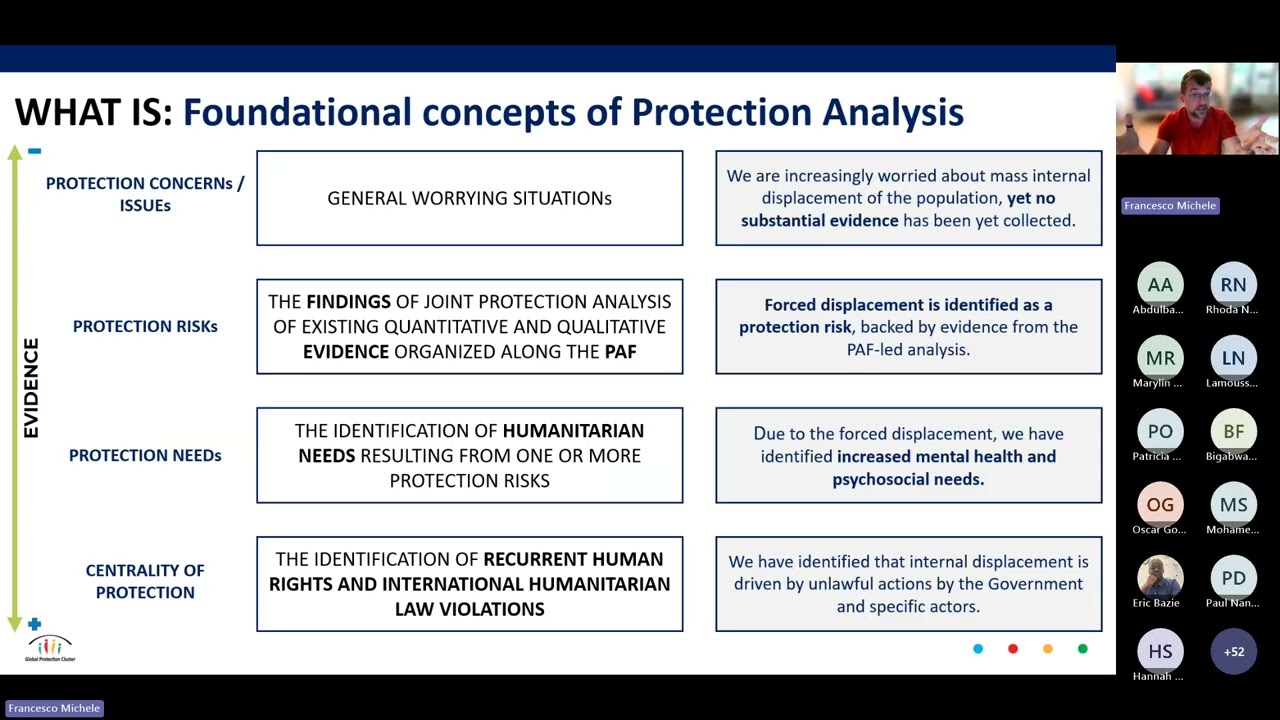
This webinar serves as an essential guide on integrating the Protection Analytical Framework (PAF) into Protection Analysis Updates (PAUs), clarifying core concepts such as protection concerns, risks, and needs to ensure a strategic approach for the humanitarian sector. The PAF acts as a foundational analytical tool organized around four pillars—threats, origins, capacities to offset effects, and exposure or severity—to structure data and facilitate dialogue globally. A PAU synthesizes these elements into a strategic document that highlights priority risks requiring action beyond standard Humanitarian Response Plans while informing donor prioritization; however, it must be drafted with clarity for non-specialist readers by avoiding generic statements like "women are vulnerable" without evidence-based justification.
To strengthen the quality and impact of PAUs, specific guidelines emphasize precise risk wording limited to a maximum of five clear titles that reflect shifts or trajectories rather than repetitive crisis descriptions. The analysis should contextualize data by focusing on qualitative insights from survivors alongside quantitative evidence, avoiding broad activity lists in favor of explaining capacity constraints and regional needs based on monitoring data. Furthermore, recommendations within the document must be concise, restricted to two pages with specific targets, timelines, and geographic areas directly linked to identified risks, while strategic timing ensures publication occurs before funding cycles like YHF to effectively influence decision-making processes.
Managing risk prioritization requires acknowledging that all identified risks are interdependent rather than hiding them or ignoring non-priority issues within the final five-anchor document. Presenters suggest four strategies for this balance: integrating secondary risks into contextual analysis, using overarching structural potential risks to frame linked priorities, conducting follow-up focus analyses on specific impacts like child protection, and utilizing advocacy lenses to demonstrate harm interconnections. Information should be organized against the Path pillar of the PAF tool which structures data into Threats, Effects, and Capacities (TEC), addressing common gaps where reports overemphasize incident numbers while neglecting descriptions of threats or capacities by requesting specific partner inputs aligned with these pillars instead of broad document reviews.
Despite challenges in obtaining combined qualitative analysis and quantitative data from partners due to submissions often arriving as either raw data lacking explanation or narratives without evidence, capacity building remains necessary for integrating these elements effectively. The Global Protection Cluster supports this integration, noting that some countries are already developing interoperable systems using Path logic as a standard organizing principle, with resources and recordings regarding the PAU framework available following the session to aid further implementation of these strategic analytical methods.
Read the full video transcript
English. Okay. So, we started. So,
again, good morning, afternoon,
colleagues. Um, today's session is a bit
of a refresher on um practicality since
a lot of you are actually now in the
exercise of protection analysis updates
and you are in between or finalizing or
starting your potential risk assessment.
So, the idea of today is to actually do
three thing. Uh first of all look a bit
of foundation.
uh clarify well what is the protection
analytical framework and why we use it
as a common framework for the cluster
and what is the protection analysis
update and then we're going to have a
sort of uh several slides that goes into
step by step different section of the
pus and how we could uh manage those.
So again stop me at any time but I will
just since it's a session let me go
straight into that.
Um so for the colleagues that are new
for many of you this should not be new
but I wanted to start by clarifying four
foundational aspects that we have in our
work as protection cluster. So
[cough and clears throat]
we generally speak about this in term of
acronyms or uh uh just by their name but
sometimes it's difficult to link those
and understand what they are but in a
nutshell the protection analytical
framework is the core agreed analytical
method. So it's a framework. So it's the
framework that we use to organize every
data and information and also to
organize the logic of our analysis.
The protection risk assessment is a
specific exercise that we carried out
now once a year at least in order to
assess the severity of the protection
risks and uh of course the protection
framework is foundational to use the
data and information for it. The
protection analysis update is a process
first and foremost on engaging partner
to actually uh pull together our
protection analysis in a digestible
manner sorry but is also our core
documents that we publish as a
protection cluster in a country and then
we have the global protection update
which builds on those other three
aspects. So everything brings to the
global protection update is the core
publication of the global protection
cluster that is done once per year and
is actually presenting and discuss with
donors in order to inform their
prioritization strategies.
How do they link? Uh so think of the
path as just a common logic. So a way of
thinking and organizing the information
and for specifically for the information
management colleague is uh what we use
to structure any sources of information
you receive from partner being data or
being given qualitative information. The
protection risk assessment is an
assessment process. So we look at how
protection risk are severe where and
whom and then we use this as a basis now
also for the H&P.
The protection analyst update is a
fundamental because it looks at is
synthetiz
synthetized uh what change why this
protection risk matters now what is what
actions are needed now so it's
fundamental for our strategic engagement
both of partners and external actors and
then the global protection update is for
us to actually advocate for critical
advocacy priorities a global level
everything we can scale up but also to
ensure that we show the specific
situational protection risks in your
countries and all your work that you
have been doing. Today we're going to
focus on these two. Uh we did a session
in June which is in available in the
website on the potential risk
assessments. So I think that you can see
this session as complimentary to that
one.
So I wanted to step back a bit on
clarifications on concept and how do
they link to the way we do analysis in
the cluster. We have been doing this
clarification in the last five years and
now it's solidly agreed also beyond the
protection cluster. So I think it was
for me fundamental to start from this.
Um so we can use the language protection
concern or protection issues at any
given point but for us it's fundamental
that we use that only when we don't have
an analysis. So when we have an analysis
we'll see afterwards but we can speak
about the situation in a country. We can
call it a concern or an issue but as you
can see in the example it's something
that we are very worried like for
instance we're worried about mass
internal displacement but we don't have
still evidence. This allows us to speak
about issues without even having started
the analysis because it's fundamental
that we speak about those issues. The
only thing is that when we speak about
those if we are not uh clear how much
evidence we have to sustain it let's use
concern let's use issues but let's not
use actually the language that we use in
analysis.
Protection risks is every time we flag
anything that is actually stemming for a
protection from a protection analysis.
So this has been given us in the last
four years quite as much more legitimacy
even in front of our other actors
because now when we speak about
protection risks it's clear that behind
there is an analysis. Okay. So it's
fundamental that we do well this
partition. Then of course we have
protection needs. The protection needs
are not the results of the protection
analysis. So these are already come the
first clarification. So in PAUS as
consequences of the risk we can describe
some humanitarian needs but the PU is
not the place of actually providing the
full account of needs and as you can see
here the example in uh in our work we
can say that we can have analyzed in a
country that is forced displacement
because we did the analysis and then the
needs resulting from that. So due to
force displacement we have identified
increased mental health and
psychological needs. This really allows
you or generally us as a sector to
engage the dialogue properly in the
different uh let's say setting with the
doitarian country team where we have to
use the language of risks and often we
have to highlight needs or the H&RP
where it's much more need focused okay
and then the centrality of protection is
all those elements that are related to
the combined actions to address some
aspects to reduce the risks that can go
beyond what we put in the HMRP. So here
for example using the same example we
will speak about mass internal
displacement as a concern before doing
the analysis we do the analysis we we
clarify that is a priority risk or is a
risk that we see severe uh from that
risk that we identify several needs but
also uh we have realized in our analysis
that there are a lawful action by
government that actually had to be
addressed by the responsibility of uh in
the framework of the centrality
protection. So for many of you this is a
given but uh um I wanted just to clarify
that this is a very we really clarified
the difference in the analysis between
needs and risks because this gave us a
much more legitimacy to present our
analysis.
So let me give you a very quick example
again. So we might see in a country that
there is deprivation due to denial of
resources opportunity and services. We
know it, partner know it but we didn't
do the analysis but we need to do an
advocacy no quickly so we can present it
and it's our concern. So we can speak
about the concern as a potential cluster
then we go deeper and we might have
identified that the situation is
actually a specific risk like this case
gender based violence. This will be
backed up by evidence and then we will
see through the session that I already
put there some aspects of the path. We
have several points of data or
information that together we use to say
there is these risks
but then this doesn't this allows us
also to speak about needs but there's a
consequences of those risks. So in this
case we see that our analysis speak
about potential risk of gender based
violence and as as resulting needs we
might see survivor face this threat
without safe support people harmed
cannot access essential health care
victims lack of access to justice and
remedies. So these are all needs that
then we can use to justify why we
provide certain responses. And then in
this case specifically when it come to
central protection uh in the protection
risk in the first line of context in
this specific scenario there's been a
law that is actually uh limiting the
movement of of women. So on the
centrality of protection what we could
flag is actually the reversing of
certain laws and certain aspects that
goes beyond our monetary capacity.
So this is the basis um
for I wanted to start with this because
it's going to be clear where portal risk
fits in term of analysis where need fit
and now we want I want you to introduce
a bit very quickly again the path but uh
before I move on is there any reaction
question
uh aspects that you would like me to
clarify on this
otherwise I will ask a round of thumbs
up if it's possible
see and thank you Patric and thank you
again.
So the path the protection analytical
framework so the protection analytical
framework is a framework uh again
developed in 2020
uh and has been developed by you know
with the collaboration of many partners.
So it's the reference framework and now
beyond the protection cluster. It's used
by basically almost all partner and is
now used as a reference in other
document like IC professional standards
the document the the IDP protection
solutions and all those. So is become
the reference that actually is helpful
for you to engage partner in
conversation.
He has two general aspect. One is a
structure that you can see on the left.
This is normally useful to IM
colleagues. We will see across the
presentation that these broad category
very simply are extremely useful to tag
information and this will make your work
on the PU and in general simpler. I will
repeat this message over in the next
slides. But for those colleagues that
are in the coordination role or that you
actually engage partner the path is very
helpful as a logic every time you try to
understand risks. Okay. So the logic is
always the same. Is there a main threat?
I mean as we in protection identify the
threats or harm to population what has
those effect there are capacity to
offset those effects and then with this
cycle then we we end up in saying how
risk how people is exposed to risk or
how severe is that risk so it's actually
a thinking that can also be used for
strategic for the cluster strategy and
other strategy we want to do
um here you have everything in the anxis
but I wanted to show here for instance
how one of the pillar looks We have
four. So this is the pillar of thread.
You have a pillar. You have three
subpillars and then you have categories.
As you can see I put first level to
organize data and info, second level and
third level. This is just a hint for IM
colleagues that these can be categories
to actually organize information. Okay.
So and it can also be category to
discuss with partner because sometimes
when we discuss with partner we ask for
information and analysis but it's good
to ask information analysis. So what do
you have on protection threat? What do
you have on the origins of the thread?
Using this language more and more allows
actually us to have a common how to use
the common framework in practice
in the path. Um even you don't have
necessarily to look into it. There are
questions indicative question that here
you can see some examples. So at each
category you have a question. So for
instance on the type of threat the
question is is the threat primary
perpetrated by individuals group
multiple actors not part of a group
practice. Okay and you have several
question the way I always suggest not to
get lost in the excel is first of all to
define what is the purpose of your
analysis. So when it comes to PAU, what
is the main strategic objective you have
this year with your PAUS? Is to change
the mindset of humanitarian country team
or coordinator because protection is not
priority is to ensure that there is
integrated programming for a specific
risk. So defining that very well allows
a much simpler approach to the PAS. The
question then can be helpful to be used
to actually identify if you already have
information. We have identified force
recruitment. We have some you we use
this question. Do we have information
actually to answer to those question and
knowing where is stemming from? What
population group is most effective? What
capacities and so on. And this allows us
to see the gaps of possible information
that we might need.
Um once we know the data that we or
information is available, is this
enough? So the goal is not to collect
more but actually to see what we have
and see if there is enough. So here is
where the question are actually very
useful in some exercises that I did with
some of you. I mean for my country these
10 question are important not the entire
questions of the path on these 10
questions we have enough with the
protection monitoring the child
protection IMS the GBMS we have enough
with that so then we have all the
information in the evidences
then other question might be helpful
just to clarify so if there is a doubt
on a specific situation to actually to
clarify that situation if the data is
enough so the logic is before collecting
actually to look at the data and use the
path for that.
Here I go very quickly. In some slides I
will go very quickly. Um but for
instance this I give you an example on
exploitation due to lack of civ status
documentation.
So we might know okay because we have
data these four aspects. So we might
know geographic location we know if that
is um um uh a policy or something much
more structure. uh we know if there are
enamelless or barriers and then
some of the capacity you can see from
the example that for instance this can
come from different sources. So we might
have information about B registration we
might know our partners showing us that
the government is establishing economic
and other criteria that cannot be met by
the majority of IDP population. So all
these aspects using the path is just
helpful to see what we have in a
structured manner
because it can allows us okay what do we
want to understand this is sometimes the
missing step. Okay. So in this case we
would like to know better who has
influence over the main actor
responsible the underlying driver. We
would like to know how different
population groups might be affected and
general trends and then we can use this
using specific question of the path
because they are there. So these are
coming from the path. So how are the
actors committing exploitation to
account? What factor actually um what
legal factor actually influence the
situation? What population move? And
then we can use this together with
partner to actually look at the data and
look at the sources. So the suggestion
is again it's something we're also
discussing with global partner is not
anymore to do this big registry of
assessment but do we then focus okay so
do we have enough and then just f
pinpoint two three aspects that maybe we
have gaps of information and discussing
with partner which information might be
available.
So I mean this I will go very quickly
but this I make you I made a specific
example where again in the case of here
we are looking at force displacement
we there are information that we miss to
be able to speak about force
displacement in this case. So we don't
know if the verific the legal
documentation has been refused purposely
by authorities. We don't know about
enough if the lack of legal
documentation is impeding access to
services. we don't know enough about the
availability of documentation. So this
is information that we might understand
we don't have enough and then you can
see with this can help us out in
actually organizing the available data
sources. So mean we might have an
incident reporting tool in the cluster.
We could use the IPC in coordination
with the food security colleagues. We
could discuss with reach an impact to
add specific question on household and
household level assessment to actually
address a gap of information. We might
actually know the DD DTM they are doing
their multis sector assessment as well.
So here is just an example but just to
show you that the goal of the path is
really not to is to simplify
specifically also for the AM colleagues
the organizing of the data but for the
the colleagues on the coordination side
is to simplify the dialogue with
partners because we are not going to ask
anymore with available assessment but we
are having a dialogue with partner on
what information and sources you may
have about this and this actually is
much more helpful also in order to to to
to move forward.
So very quickly the logic then in order
to use the path the the simplified as
the simplified logic is every
information needs you might have here I
just put some information needs coming
from partation monitoring organize them
by one or more risks by and by one
pillar of the path okay so that's a
simple logic this can really help also
in the dialogue with partner they might
have their own assessment um because
information might be different might be
formulated different but if we use the
same logic it's easy to put together.
Um this is complicated let me let me
jump it. Uh so on the same vein this is
an example that uh we made for uh a
training on protection monitoring in one
of your operations. So we were looking
at the risks and then we look at the
questions of the protection monitoring.
So the exercise that we did that might
be a useful one for you is what are the
key question of the protection
monitoring that gives you information
for that risk. So in this case
restriction of barriers and freedom of
movement. So here you can see this
question if the people is displaced was
the household of origins what are when
they were last displaced um is any child
missing. So also question that are
specific for our areas of work. But then
when you see the gaps so information
that is not captured about the
protection monitoring you can identify
what need to be observed and this can
become a guidance for our colleagues on
the field. Observe the state of shelters
and the absence of shelter. Observe
there are tensions in household or
between or communities are isolated. Uh
observe there is malnourishment. observe
if there are other flags on for instance
separated children you know and then
there might be other question in the
protection monitoring that might trigger
the potential uh presence of that risk.
So this was just an example on a way in
which you can think about your
protection monitoring. So identify
question that are helpful directly to
understand the risks identify gaps that
might require observation and identify
other question that can show the
presence of something. Okay.
So the path is where so this is the the
end point on the path. So I didn't want
to show you the old theory behind it but
a very practical way of using it is to
use it as a framework to organize data
and information and also the dialogue
with talk
any question on this
today is a very dense session so I'm
going quite quickly on some aspect.
No.
Should I move on? I always ask thumbs up
before moving on.
Thank you.
So the pus
um I just put a graph of all the
protectionized update all of you uh have
developed in the last five years. We are
you have published more than 120
something. So 130.
is actually incredibly good the work you
have done on this in this sense and they
are very welcome and there is actually a
a request from donors to continue um and
of course we are using as a as a message
to ask for support because that's
actually we know the the work that goes
into it in a general sense I just put
three objectives that are coming from
the to um the protection analysis update
is not a cat okay but it's fundamental
to uh call the attention to actually
call the attention of in your countries
on specific aspects that are related to
priority protection risks.
Um it has to be used strategically to
ensure that we also show information
that it might not come from data but
it's coming from people. Okay. So we
have purposely uh not push the pu to be
heavy on data or we didn't ask for it.
If there is data amazing but it's a it's
a it's a product that is actually has to
be helpful for you and for the partner
to convey what we observe okay because
sometimes in official document there is
a a bit of a blindness because there is
might not be hard data okay so the pu is
the is your possibility to actually
showcase what we really observe and what
partner observe okay
um I have five slides of each chapter of
the pus I will not go through them right
now because uh the idea was to share
this PowerPoint afterwards but uh it's
composed of an executive summary that we
always advise to be one page and has
been working very well when it's one
page because it's straight to the point
and uh is very readable. Um there is a
context which is organized in
subheadings. We advise that the
subheadings to actually flag a situation
because from our experience normally
people reads the subheadings
unfortunately. So use them
strategically. Um and then be concise
where we go to the context afterwards.
There is a section on risks which again
is a bit limited in pages as I remind
that normally we advise to actually have
maximum 15 pages and it worked very
well. um when there are more it's bit
heavy documents sometimes you might need
it for your strategic issues but
externally the shortest the better and
then um they just here I will start
introducing the way we use the 15 risks
those they they have become a very good
common aggregating aspect so really
don't merge them um the risk are not
specific to population group but each
risk you know has impact all population
group so it has use for that and all our
data mechanism here I made an example
for instance on the MRM data and
information can be feeding all risks
that we have in the periods
the response part I will go on this
afterwards is not a separ but it's the
to show actually what's happening in
term of capacities to address risks and
it has to be quite strategic and then we
have the recommendation section which
I'll also go afterwards and where we
actually recommend some aspects
so the on the paus there is a standard
format this is we will share it again
the section are quite uh structural so
exactly summary context risks response
and recommendations
and then um in term then of course you
can develop the way it's it's uh it fit
your country but there's a bit of a
logic that we maintain across all the
pus
so now I went quickly on more the let's
say refresher and Now I want you to
enter more in the practical part of
drafting a DPAU. So before I start as
usual now is the moment where I ask a
bit of you to just react quickly before
we enter in the section. So I wanted to
ask you in your experience or even in
your view what does or has made a PU
stronger in your context or weaker.
So I really welcome everybody that would
like to break the ice or even writing in
chat
otherwise since we know each other I
might call some of you.
Is a pu helpful for you and what make
you stronger?
Anyone?
>> Should I call out some of your
colleagues?
>> Gavin, Syria, Scarlett, because I see
you on the screen.
>> I raise my hand.
>> I can I cannot see hand colleague.
Sorry. Please open the mic.
>> Okay. Thank you. Uh can I can I speak in
French please?
Okay.
Republic Democratic Congo.
Oh,
I lost the colleague.
I think you are muted.
>> Okay.
Protection
analysis.
Don't
Republic.
You can go fast.
Foreign
Context
Mercy over
Um
thank you very much Paul. Uh so
colleagues Paul has been flagging two
things. He's a is a class coordinator in
in DRC. Um he was commenting that they
found themselves in a sort of repetitive
mode where PU became something that we
just continue but it doesn't have an
added value and recently they have been
doing one focus on the Ebola. So really
to show the situation of potential risk
during the abola response and that has
been very helpful in that sense. So it
was suggesting that one way to make the
pu relevant is to really link them to
the contextual situation. So try not to
avoid to to actually end up in the cycle
of just redoing the document uh without
presenting additional information.
Thank you Paul for that. I don't know if
is this resonate with colleagues and if
there is anyone else that would like to
suggest what make it stronger or weaker
in your context
please open your mic because I cannot
see the handsh
>> I don't mind if it's okay
>> yes please
>> thanks Franchesco so I think something
that we found in our context is um where
we were really able to center direct
perspectives quotes um qualitative
obviously mixed with the quantitative
data from uh the respondents that really
strengthened the human element of the
story. And I think another thing that we
found useful was of course to take the
um overarching protection risk but
really work to contextualize it and
really follow the trajectory or at least
that's what we're trying to do right
now. follow the trajectory of how that
looks in a different context and how
that might be different in comparison to
other parts of the country because it's
quite a um quite a diverse context.
Over.
>> Thank you very much, Scarlet. Yeah, you
touch on two points that I'm going to
highlight afterwards. The importance of
frame very well the qualitative
information because that's a great added
value and also to share the comparative
aspects in country. Sometimes uh in all
the pus that have been part of all of
them since the we started um sometimes
when you really say okay there is a risk
and that goes back also to your point
Paul but we are able to say the
difference between different regions in
the country that's extremely powerful um
yeah thank you Scarlet
I might take another reaction if anyone
would like to jump in
otherwise afterwards it's okay as
I don't see hands.
>> There is a comment from Aden in the
chat. The prioritization of protection
risks and evidence um make it stronger.
So the evidence-based analysis, so
building on what Scarlet was saying
about the qualitative evidence, Aden is
flagging the quantitative analysis as
well that makes uh the PAU very strong.
>> Thank you, Adam, for that. Yeah, the
prioritization we go back to that. Uh
that is one of the core aspects that is
fundamental.
>> No, thanks a lot for it. Yeah, there is
another one.
>> Uh yes, just one one one comment. Um
>> yes, link linking with what Paul said.
Uh so it's a question also of you know
time to decisions not to a calendar. um
a PU landing uh a month uh before the
HNO for example or a YHF sorry YHF is
Yemen human funding uh allocation that
shapes those decisions or or those
processes while one landing after is um
you would say an archive material. uh so
uh forwardlooking elements like likely
uh trajectory or or frontline shifts
returns etc etc this kind of thing.
Thank you.
>> Thank you Joshua. Great point.
>> Yeah great point. Strategic decision
when to publish so not just publish but
really link it with strategic decision
so it really supports your uh your
aspect qualitative and quantitative
prioritization.
Make it contextual. So let's not the G
from the GPC. We don't push just you to
do a PU because we have to do a PU but
we really believe that if it's
strategically designed it's something
that can reinforce your your work. So as
Paul was saying contextualize it and be
strategic. Yeah. Thanks a lot. So let me
go I will you will see that this is
coming a bit from the lessons learned on
our end. So I think that we some of the
things that you said um are resonating.
So
I just put it in five general aspects
that we've seen across the PU in the
last 125 that we did. So five general
elements that weaken a PU or it make it
stronger. So the prioritization it's
critical. So when there are too many
risks or risk are pulled together with
you know just merging them because we
want to show everything. This is really
a kill for the PUS and also for the
objectives that he has when we make
generic analysis. So we don't use the
data properly. We don't link. I think
this comes as given uh long context. I
think we are in a stage where we really
don't have to describe the crisis but
actually be very focused on what is
needed. Uh the citrop logic so really
leave the citral logic be outside of the
pu. Let's we have other documents for
that. And then I think it goes back to
the prioritization also on the
recommendation. Too many
recommendations. So I would have to say
honestly that across all the PUS that we
did recommendations sometimes is the
weakest part because we want to put
everything. So we end up with three,
four, five pages of recommendation that
actually they don't they don't help very
much. So let me go one by one and please
react and open your mic because I can't
see very well the hands. So the first
thing is
the prioritization. Many of you uh I put
on the from the left to the right we I
heard many of you say we need more than
five risk or we need a risk for each
area of protection work. We need to show
everything. Okay. So this is I know it's
happening and it's going to happen.
Okay. The suggestion is that we don't
transform that or you don't influence
the PU by those. Okay. We can
accommodate the fact that we need more
risk. we we can accommodate the fact
that we have to visibilize all our areas
of work but that should not be
transformed in more than five risks.
Okay. So very concrete
um use uh I will use an example from
Mali that is just recent use the
protection risk assessment. This will
give you an initial prioritization in
Mali. They did that they had five risk.
Then they had a discussion with partner
and the coordination team and they
realized there were many other strategic
risks that were missing out. They
revised the priority one and then they
go they went back to the partners. So
this really hankers very well as also
Joshua was saying the your
prioritization in evidence but also be
strategic. Okay. And here I made an
example from the recent PU from Colombia
where that prioritization was done
defensal
authority. So it might not be possible
in each country but has been used the
prioritization in order to discuss with
them what was possible and that really
helped in nailing in three risk actually
that were used for um inter sectoral
strategic plan. Okay. So as a general
rule, imagine not to be a protection
actor. So an HCT member will anal member
look at a PU and be able to remember the
risks very concretely or not. If you do
you see still some issue there, maybe
you can revise that part of the
prioritization. But prioritization is
fundament
uh when we prioritize we also in the
framing of the risk. So when you put in
the PU the titles of the risk those
actually might you know might be making
the weaker or stronger the PU. So I put
on the left examples that we have from
PUS and some of the right these are all
coming from PU. So the example I put as
generic or crowdy that is not helpful
selective homicide kidnapping threats
and attacks there are too many things is
not clear. So I think it's clear to me
the sense that we wanted to give but
this is not helping prioritization.
Uh children physical and psychological
safety and will be threatened by
compounding risks or gender based
violence with data risk of coffee
relating sexual violence, sexual
exploitation and abuse of trafficking,
sexual harassment and other form of GBV.
[clears throat]
We understand but this is really not
communicating externally a
prioritization. Okay. So this is wording
that we use in pastu. I'm not saying
that they were wrong but this actually
we actually [clears throat] suggest to
avoid because from our uh also the
lessons learned and the feedback we have
from donor this is not helping or the
last one attacks on civilian and other
violation of physical integrity rights.
Okay,
it's still not clear what we are
prioritizing there also because it it
open ups to all violation of physical
int rights. So it mixes a bit protection
risk and human right language.
On the right side some of the example
again from the pa h mental psychology
caused by acts of violence. It's very
generic but it really links where it's
coming from. So that's why it can be
helpful. The second unvoluntary and
indust return in advanced circumstances.
This is from a pu in Mozambique but we
have similar one in Nigeria. This takes
the risk of movements to the 15 one. So
you can see that there is no wording
that is originally in the original
definition but it's very clear. It's a
risk related to movement and it was very
contextual
uh excessive and other unlawful use of
force and attacks against protected
person. This it comes from Palestine and
is very precise because it uses exactly
the language used at the HCT level to
actually show that risk. So it was very
useful in that sense.
The last one, destruction of personal
property and land disputes related to
secondary occupation of homes and fields
in area where people have returned. It
seems a bit a lot but it's very good
because it focuses where the causes and
and you know so it's very precise. Okay.
So here just two here the two takeaway
the generic definition that we have is
extremely useful if you want to avoid
sensitivity in your country. that
language is a very generary language
anchor in in international language. So
you it's done on purpose not to have
repercussions. So use that definition as
it is if you find sensitivities but then
when you draft a pa try to be precise on
the risks there is not I know that we
want to show a lot of things but
sometimes when you put all in the title
it pushes back and it shows like we are
not prioritizing.
uh other two aspects uh often times we
see weak jumps so that's actually a
sentence that we have seen from one PU
there were incidents therefore women
children or the person and person with
disability are vulnerable
let's avoid this I think we all agree on
the sense but the PU is our document
where we actually show exactly so this
is I think maybe enforcing a bit
sometimes the vision that we are too
generic so let's avoid this weak ch if
you writing a weak jump. Let's not put
that sentence. Let's not put that
aspect. And the general rule is for
every piece of data information that is
provided by any partner exposed to what,
where, why, compared to whom.
Specifically, the comp I mean the
comparison part is fundamental
on the context. We touched on base
before. Uh we tend to be redundant. So
reexlain the entire crisis. the peace
agreement in 62 then this happened and
let's avoid that context really focus on
a shift maybe going back to what Paul
was saying in DLC let's there is no need
of representing the entire conflict of
the RC of course few sentences with
links to sources just to show the
conflict situation but then maybe in the
Abola focus what's happening on the
Abola situation okay so an event
something that you know the pu can touch
and explain why certain risk change or
uh and so
And then in case you want to provide
more information points readers to
background information so there is no
issue in uh in linking with the existing
uh contextual information.
Um I will pause afterwards. I have five
slides. the on the response side
with the usual logic on the left a
piece coming from a PU that we suggest
avoiding and on the right side some
example that might be very helpful the
left one is not bad we just suggest
avoiding because it's a seat rep okay
I'm sure that you have many documents
that shows how many people we have
reached how many funding we have how
many funding gaps there is no need of
repeating all of that in the PU okay so
point to another document point to a
dashboard you already have let's not put
all the pa is not expecting the paou to
show all the activities that we have
been implementing it can be an
additional document and so on and on the
right side some of the example that I'm
putting I just give you example why they
are interesting for instance child
protection response is constrained
specifically in those two areas okay so
it's specific on regions So we might not
be able to say something but clarifying
where certain response do we have some
constraint is actually very
h the second I think it's coming from
South Sudan h in joining displaced
families emphasize the need of
sustainable internet access they propose
the establishment of community early
warning system and protection committees
this is extremely helpful I think it
builds on what scholar was saying
because it shows what capacity are
needed or are asked by people in that in
that region Okay. And the last one, it
comes from Ukraine. It's very
interesting because it doesn't present
it present a shift. So something very
strategic that that you can use with
donors to explain certain situation.
Okay. So there are two things. The shift
on the response. So the trends on where
response is moving and the second is
probably qualitative information. But
many survival of violence do not seek
services immediately after any incident.
So we might not have hard data but this
is extremely helpful information very
strategic to show a problem in
capacities
at last and then I I made I make the
pose on our let's say pa clinic
recommendations.
So the recommendation as I was saying
often is our uh weakest part. So on the
left side I will not go through all the
example right now but the five criteria
to make recommendation stronger I mean
first of all please do not exceed the
two pages really I you heard me
sometimes when I revise the pus but if
we have more let's put it somewhere else
but let's make the pa very focused
recommendation and we can follow up okay
sometimes we mix advocacy message with
recommendation a recommendation has to
have a target very clear an action an
area geographic areas or a group a
timeline will be interesting. So we have
this has to be addressed by and then to
address which risk if we have those five
component more or less for
recommendation it's always very strong.
Okay. And then on the right side some of
the examples. So I just go to couple of
them like the last two expand legal
services which normally I see as a
recommendation without specification
which is bad but in this case to
nimbrros and kundus where partner
presence is limited despite large retic
case load. So it's very specific. So I'm
asking of course for an expansion or a
support to a specific area of protection
but very precise with a reason that's a
very strong recommendation or like the
last one expand cash and livelihood
support in provinces where monitoring
show highest child labor prevalence and
that there are the three regions this is
a very strong one because it's not just
saying it will be good for donors to
support cash and livelihood specifically
it's really precise very focused on the
analysis because it were actually there
is an increased child labor and specific
on an area. So honestly I mean now that
this you're working a lot on
recommendation the more you can be
precise on recommendation the more we
can do follow-ups.
So just to conclude this part find
general uh a sort of checklist when
you're going to revise or work on pus
first of all are there few clear
priority risks are they readable the
wording is not crowded is prioritize is
the prioritization based on the risk
assessment and discussion so that's
first is the analysis evidence based so
it really combines it doesn't do jumps
is the context analysis very specific so
it's a really helpful to understand the
risk or is just a general context
analysis. Is the response not just a C
trap but providing additional elements
to understand why those risk are
actually people is very exposed to those
risk and then are the recommendation
clear can we follow up on the
recommendation there is clear talent a
clear action a specific area so if this
five if you use I mean I'm I'm happy to
hear from you but from what we have seen
on the bulk of the corp of the all the
pu down so far if you generally use
these five rules to revise it they are
very they can become very strong
documents
h and generally one advice that we
always give also between the GPC
colleagues is imagine a nonp protection
actor reading the p okay always imagine
that so not because we have to not speak
protection but I think it's very helpful
if it's understood because it can really
push central protection inter agency
mechanisms convince HCT that are not
protection focus so you are the anchor
of the central protection so we can use
it properly.
Let me pause. I have been quick. Any
reaction on this part?
Even aspects that you might not agree
with or additional suggestions.
Please open your mic or Lisa help me if
there is any hands raised.
Is it clear so far? Can I have just at
least thumbs up?
Thank you.
>> Just to confirm, Franchesco, you're
getting plenty of thumbs up, but there
are no hands up.
>> So, I'm being very clear. [laughter]
>> Oh, yes.
>> No, thank you, colleagues. So, let me
relaunch a question. Let's dedicate two
minutes to that. Uh because there is I
know that the most difficult part you
face is the privatization. So I wanted
to just go through how to manage the
prioritization.
What does it mean one or two of you?
What does it mean for you to prioritize
a partial risks?
Is there any
one that would like to react
is prioritizing protection risk
selecting it for the
reactions today. The summary is coming.
So, let me jump on it and go into the
prioritization. Okay. So, I see in the
chat
uh Paul when pro particular challenge in
central Africa move some such related
device into the contest section. Great.
In Cameroon, the PU helps in focusing on
key protection risk. However, there is
need to more dissemination of view and
more involvement of local partners.
Great. Thanks a lot for that.
Okay. So, let me go to those points by
going to the next part.
Prioritizing.
Okay. So, I have been in many
conversation with many of you during the
last years on prioritizing. What does it
mean? How do we do it and so on. So,
let's recclarify once for all the way we
we look at it in the production cluster.
Prioritizing doesn't mean hiding other
risks. Okay? We decide which risk
anchors the Pau because they are
strategic. But then we use we have to
speak about all our risk. No risk is
independent. All the risk are
interdependent. So that's a given. Okay.
So here a bit of uh few points on maybe
how you can manage that. What is
important for us is as you can see there
that's the general process I suggest
following. Of course use the potential
risk assessment. Look at the severity.
This is your anchor to say that we are
evidence based and actually to evidence
on partner discussion. Okay. But then
the tool that we have that we see on the
previous session give you a ranking one
to 15 that doesn't have to become
automatically the prioritize risk in the
pus. Okay. So engage partner engage the
coordination team revise do strategic
considerations. Okay. After that you can
re revisit the order and then I suggest
that strategically you look into into it
with the coordination team the sides and
partner but the third layer is strategic
okay so maybe citing Paul in the RC
Abola is the issue there is one specific
risk that is fundamental because it's
linked with the conversation on Ebola
okay or um like in Mali right now they
change some of the risk because they
were not coming up. They have a
particularly objective to to work with
ACT and other clusters. So they actually
revise those risks. So evidence
verification lens with partnerial team
strategic verification and then what
goes in the PU the five risks are our
anchor are not are not the only risk
we're going to speak about okay and I'm
going to go towards that. So the
pressure of prioritizing more risk will
always come. The solution is not to
putting all of them in the PUS as titles
or sections. Okay, we are going to see
some some ways of that you actually have
done. Okay, so here for general strategy
that are not coming out of nowhere. This
is more or less how we managed that in
the last 120 something paus. So
uh some risk can go in the context.
Okay, I remember one in northwest Syria
where legal documentation and access to
legal identity was a huge issue and we
actually did the entire con the entire
context on legal identity and barriers.
Um we are now discussing with Mali that
psychological distress is a structural
risk. So possibility of putting it into
context. Um in other countries the
presence of mine is not a priority risk
but is actually in the big areas of the
country is one of the driver of other
risks. So risk can go in the context.
Okay. Um if there is one risk that is
overwhelming that is a situation like it
can be movement or force displacement or
force return because it's huge you it
can be the theatic lens of the entire
pu. So what does it mean that we could
do a PU where because also we we can
focus it on displacement on uh family
separation on recruitment and then we
prioritize five risks that are linked to
this overarching structural potential
risk in the country. Okay, that's also a
very from the advocacy perspective is a
very powerful way to present an analysis
show interconnections. So if there is a
risk other risk are linked. So if there
is attacks on civilian we know that
there is contamination we know there
might be displacement attached to it we
know that there is family separation or
even association of children with
recruitment. So you can present attacks
on civilian as the priority risks but in
the analysis you can present all the
linkages. Okay then once we do our pa we
still have the possibility because
that's part of also the way we work to
do a focus paou on something that are
byproduct of the original paou. So I put
an example in Venezuela where last year
we did a protection analysis update as a
cluster and then with the colleagues of
the child protection work stream we did
as uh later a focus pu on the impact on
children. So where we took the five
risks and then we focus and we actually
describe all the impact on children. So
these are four ways in which you can
manage the presentation of protection
risks that are not priority. Okay.
uh we don't have much time this I will
share it afterwards but it's a way of
actually what you can look at
uh this is now I want to link a bit with
the path um here is just an example and
again this is material we're going to
share once also for the I am colleagues
if you organize information against the
path pillar then this is the way you
could possibly put into the document so
in the context in the risk section and
in the response and particularly for the
risk section
So this one under each risk the logic
the let's say the narrative logic always
to present threats the effects and the
capacity between me and you the two
weakest weakest point that we all ac we
have generally across paus is we focus
so much on incidents so numbers
violation but we don't describe the
threat so there is an elements of
perpetrator to I know that we can't put
everything in the PU but there are
elements that have to qualify those
number okay so in attacks on civilian is
not enough to put in the the the
injuries or the death what is the threat
and the other weakest part is the
capacity we often never put anything on
capacity in the risk analysis okay we we
focus on the threats and then on the
effects okay so this is a way where you
can use the path use it to organize the
information and then use it to organize
the logic
I will share these these are examples
that uh I shared in previous uh in
previous training where what does it
mean inputting pieces of paragraph
related to threads effects and capacity
so I will not del into that the material
is available on this
um but here I want you to go on how you
can manage the endless process of asking
contribution to partner and to other
colleagues I know that is the most
tiring part
Use the path not because we are obsessed
with the path but because it gives you a
logic. Okay. So our suggestions or my
suggestion also have a look at the
processes with you is do not ask partner
to send all available data. There is no
need of it. It's going to be painful
because partner they expect you included
and for you when it arrives because
often it doesn't arrive it's really
difficult to put it in a document.
ask them conversely short inputs but
against the against the pillar of the
path for instance not just about the
risk um and even just a short input is
much better and also for the partner
specifically local partner just ask them
something very precise I would like to
know about threats or the effects on
this in this area and I put an example
on the right side okay so we are the
prioritized risk is impediment to legal
identity we context movement restriction
and document and checks have increased.
Threats authorities refuse civil
document at checkpoint effects displace
women headed households lose access to
services and capacities. Legal partner
verify cases support mobile
documentation. These are very general
but you can already see that they can
come from different partners you know
but then for you can be easier to pull
them together.
Again in the same logic avoid you have
been hearing me avoid section related to
our art of work we don't have gender
based violent risk child protection risk
my next action risks of course we have
one on GBV and one on my next action but
what I mean is all risk have impact to
all population groups and we have to be
able to describe the impact of all our
response across all risks. Okay. So when
you prioritize prioritize avoid
distributing risk by what by our way of
dividing or section only by who has the
data okay sometimes you just have a very
strong partner with strong data and then
becomes the productized risk that's also
to avoid
and then another things that I suggest
to avoid is asking partner just to feed
in one risk sometimes might be helpful
but you know partners if they are
specialized
They have information across all the
risk but even if they are not
specialized it's really helpful but
again use the path do not ask for look
at all risks but oh it might be
interesting to have your inputs for
attacks on civilian on threats or for
legal identity on effects okay and here
I put couple
>> don't really politics yet
>> hi Kim
so here the example uh you can ask
partner A, partner A on attack civilian
to actually just share data on threats
because they have that data you know and
just verify the trend. Partner B they
are on the ground they can observe and
they might just send you some inputs of
what they observe on effects. Child
protection coordination part or our
colleagues in the coordination team they
might have information on impacts to
schools that is very useful to actually
describe the threats and data on family
separation that it might be helpful to
describe effects. the GBV colleagues
might have information about the
functioning services that might be
helpful for capacity and in the same
vein you can see the second example that
can really help in organizing better
information. So instead of coordinating
the pa by oh you take this session you
take the other section you use the path
as a logic to actually feed in all the
blocks all the boxes
please tell me yeah I'm I'm conscious of
time so I'm trying to go quick but not
fast but please tell me at any point
here is I think that some of you already
said it here I think uh Scarlet said it
Lisa said it as well
we don't want the PU to focus only on
incidents. Okay. So we have been our
definition and a way we monitor it
doesn't just look at the data tells us
scale trends location most effective
fantastic but it cannot be the only
information that we put on the pu what
is fundamental is to actually have a
good balance between the incidents given
by the data and the monitoring and the
reality that partner observe why harm is
increasing who is the most affected what
the data may be missing. So this is
fundamental to really find the balance.
We had this recent conversation again on
Mali. Sorry for to put the colleagues on
the spot but it's actually we're looking
at real right now where they actually
contextualize very well our severity
criteria of the risks by having
benchmarks of the incidents. But let's
not use just that. That's very helpful
to organize the information but we
really need qualitative information. And
here I put an example. Avoid 124
incidents were recorded. That doesn't
mean anything. 140 incidents were
recorded here and there. Partner reports
that most occur at checkpoints affecting
undocumented retention women at the
household. So it's also there's a focus
on groups suggesting rising restriction
to legal identity and access to
services. So this is a good way of
presenting qualitative and qualitative
just pull them together properly. Okay
specifically when hard data is limited
for your information. For instance, we
are doing now with the colleagues in
Afghanistan are almost purely
qualitative pu. They run many focus
groups and we are discussing with them
how to pull together all the focus group
information and do a qualitative period.
Okay, which is also very powerful.
Um again, so I go back to the how to
frame the request to partners or to our
colleagues in the coordination team. I
go first to what avoid asking send
comments to the document by this date.
other paragraph on uh GBV on child
protection on minion on displacement on
inclusion on something that is just your
mandate share all the data you have
please review the whole pu so I for many
partners you might have these general
moments where you ask for comments fine
for the last for the last review it's
okay but when you are in the drafting
place in the drafting phase we suggest
that you focus on concrete questions
which risk does this evidence So if if
someone is sharing where uh which pillar
would you reinforce? So read the the the
section on these risks what where are we
weak in threats in effects in
capacities. Uh do you have inputs on
effects for children for women for
person with disability? So to specific
groups that's a very good question and
very specific uh the capac or this
session is weak. Can you verify if you
have this mechanism or this other
mechanism? Okay. So the suggestion is to
try to use the path again as a way for
you to actually guide better the
recommendations sorry recommendation the
the inputs that you can have from
partners. Okay. And also this will be
helpful much more for partners to know
where to put uh pieces of data and
information.
This is actually my last slide. So uh
the the the the objective a bit of the
session and uh I know that with this
time we don't have much a lot of Q&A but
was to actually give you a bit of
practicalities in the way we solve some
of the issues with the PU just for you
to think and come back to me or to us in
ways that we can support you more. So
the last slide is to show you a bit the
resources where they are but since we
have 10 minutes maybe I stop there if
there is any question or reaction or
comments
>> Dorian has his hand up.
>> Thank you Dorian and thank you Lisa.
>> Hi thank you. Um I just wanted to rec at
one stage you mentioned uh organizing
the data you you called upon the IM and
I I have a little bit of a practical
experience uh that I could I would like
to share. Uh so in in my experience in
South Sudan uh getting information that
will both have the analysis and the data
in the same let's say paragraph from the
partners is very rare. Uh so uh uh we
have
for the couple of years we have worked
on the qualitative comments let's say uh
bandwagon and it was very hard with the
data but luckily we have a protectionist
monitor system which kind of compensated
for that recently we have actually
established an information and analysis
working group where the members are
mainly M& IM uh data analysis
people and now we are getting a lot of
data and qualitative and quant but data
evidence but not really written in a way
that you just mentioned uh that what
that what what does it mean so uh still
we we have replaced one problem with
another problem so um I don't believe
that we will ever get inputs like that
uh maybe here and there uh that meaning
that we still need to do it ourselves
which requires time, energy, efforts and
and of course understandings uh uh of
all of that or it requires time time and
training. Um as we speak now I'm going
through uh many many inputs that I'm
receiving from my next uh pow which are
full of data and have very little
explanations. Uh and then also I get
inputs with explanations but with no
data with no evidence. So just wanted to
say it's it's it's it's not easy and it
is
really does require continuous
continuous capacity uh capacity uh
building and also it does require
efforts from outsides to to put these
three things together in a way that you
just mentioned. So I just wanted to flag
this is not not a commentary it's just
like a reality check from the field. So
one way is to have your u agency
directors protection people sending you
qualitative or getting the actual data
but getting both at the same time seems
to be difficult. Thank you.
>> Thank you very much Dorian. I will wait
to react on that if there is anyone else
would like to jump in.
Do you see any hands?
>> Uh, no hands, Francesca.
>> Thanks a lot. Sorry for asking.
[laughter]
No, I think uh maybe Dorian I pick your
input to just bring to the conclusion if
colleagues they don't have there isn't
any question. We are not there yet and
uh it's very clear from us at the at the
GPC and the reality check is actually an
important one. two aspects on that. Uh
the first one is take this as a starting
of a process. Um the having part in some
countries partner already think path. So
I'm I'm thinking of Syria. I don't know
if Gavin is still there but when we have
partner that were asking us we are
organizing information against the path.
So they were actually asking for it.
>> Uh sorry Gabin I didn't want to call you
in but please come in. [laughter]
>> No no no it's uh No, it's true. I I uh
no you're right. I actually just
received um a protection kind of
analysis report from one of the partners
using the the PA framework. So I do have
very strong partners. I think my ch and
I found this very helpful also a useful
refresher. Thanks Francesca. As you know
we're we're we're trying to work on our
PU now. But but indeed I I I worry
slightly because indeed there's then you
know I think we in in we can talk about
Syria bilaterally but there's one or two
preliminary steps that I feel we need to
kind of go back to basics uh uh somehow
but any we can talk about that
bilaterally but this has been super
helpful um and yeah we have a lot of
capacity here certainly in Syria to tap
into the challenge is you know our
capacity as a team to to structure and
and guide and and then indeed bring
everything together. I think that's
that's my perennial stress over.
>> I know, Gavin. No, and thanks for
jumping in and sorry for to call you in,
but this was for me to a bit compliment
on what Dorian was saying. Um I think
that now we have a clearer approach that
also is common to our core partners okay
that you sometimes don't see in the
country but as a GPC we're discussing
this very structurally with them with
the much the many protection partner
also local um and also it's also common
us in the consolidation so we are happy
I'm happy to support every single one of
you all capacity building the needing
country okay sometimes I found that it's
fairly
simpler to do an initial uh sort of
training capacity building in this logic
than one that we saw be today uh where
we agree with partner yeah I don't need
anymore all your data I just needed this
is the way I want it and then once it's
here then it might become a system or
not Dorian so I mean then depending on
capacity what surely we don't have to
push it's something that is just solid
and anchor and structured and might be
difficult to to to to flexibilize but
And we can really adapt in each country.
So in country might become a system that
is just interoperable in other might
become just a way of organizing the work
with partner. I remember in uh Burkina
three four years ago even before we
could support them they naturally start
they had an information and analysis
working group or less donian as you are
and then what they were doing they were
discussing that during the the the the
sessions they were having as an
information working group by risk and by
buff pillar so it became the logic of
the group and then slowly that became a
way where everybody was thinking and
made some things easier so it's a
process What I wanted just to show you
today is a bit of lessons learned on the
perennial
problem of the productization. Then in
the PU we have ways to address it. So
the five risks are for us to anchor
because it makes us stronger. the
clarity on the language of risk. it
makes us stronger. But then we are you
have way to present it and then uh ways
that where you can slowly start using
the path maybe to organize better the
request of inputs and organizing of
information. But for me the last message
is uh we now have several models and
lessons learn with many of you to do
this. So please reach out happy to do
capacity building or support and then um
between now and next year. So um as a
GPC we now have the right resources to
develop some technological tool as we
mentioned before to actually organize
the information against the path for all
of you for pus and other exercise but uh
I'm not saying it as just the last
positive message because we don't have
it yet but uh that we are very conscious
of the
difficult capacities that are or the
capacity that are needed to do this
exercise. So um for us it's a priority
to support you and then with this and
for anything else please reach out
um the resources we will share the
presentation so where also we put where
the resources are and we will share also
the recording but please reach out now
that you are in the process of the pus
for anything you need on my side. Um I
think I can close here. So if there is
no any last uh comment
over colleagues and with a lot of thanks
for every participating in this Gavin I
I know please have the last word.
>> No just to say thank you very much
Franchesco I really appreciate I mean I
I yeah I
hope we can uh at least meet some of the
standards that you that you've outlined.
So thank thanks a lot. No it's been very
helpful.
A pleasure G and uh thanks a lot
colleagues for all the work on this and
we are available at any time. So I miss
you and thanks a lot. Have a great rest
of the day.
>> Thanks Franchesco. Bye.