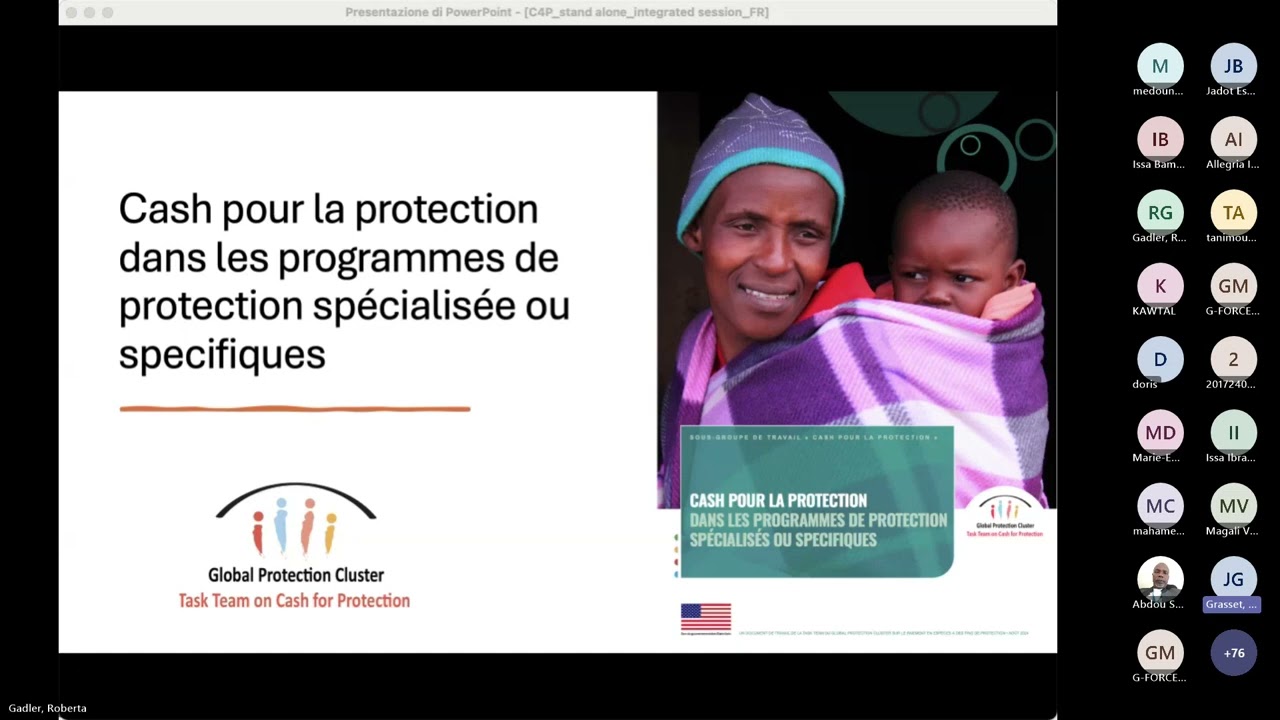
GPC 2026 Protection Series - Transferts monétaires à des fins de protection
Watch on YouTubeVideo summary
The fifth session of the GPC Protection 2026 series focuses on monetary assistance designed specifically for protection purposes, presented by Julia Grasset and Roberta Gadler as coordinators of the Cash Task Team. The core objective is to distinguish cash-for-protection interventions from general multi-purpose cash transfers by targeting specific protection risks and financial barriers rather than just basic needs. This approach relies on several key design principles, including individualized targeting based on protection risk analysis, case-by-case calculation of transfer values to ensure proportionality, and flexible frequency determined by the nature of the need. Furthermore, these transfers should generally remain unconditional unless restrictions are strictly necessary to prevent harm, with cases involving broader financial vulnerabilities being referred to social protection systems instead.
Implementing these guidelines requires overcoming practical challenges such as exhausted budgets and differing operational timeframes between rapid cash responses and long-term case management. To address this, the session emphasizes the importance of reserving specific budget portions for protection activities during project design and establishing a clear theory of change that links protection risks to economic obstacles through cross-analysis of risk and socio-economic assessments. A dual-system approach is recommended for safely identifying at-risk populations, utilizing both cash teams and protection teams trained in secure identification to facilitate referrals without conflating the roles of cash staff and case managers. When individualized assessment is not feasible due to resource constraints or urgency, alternative methodologies estimate needs based on risk levels and specific population profiles, as demonstrated by foster care cost calculations for isolated children in Gaza.
The session concludes by clarifying the distinction between specialized protection programs and integrated programs, noting that the latter combines protection goals with broader response objectives like food security within a unified design. While multi-sectoral cash transfers can yield positive unplanned effects on issues like child labor, evidence suggests they do not consistently mitigate severe specific risks such as child marriage or recruitment without explicit integration into a dedicated protection framework. To support further implementation, participants are invited to access new guides and resources available in English and French, which cover topics ranging from integrated child protection projects and gender-based violence toolkits to issues regarding mining and land rights, ensuring that evidence-based practices continue to evolve through capacity building and information dissemination.
Read the full video transcript
So, hello everyone. My name is
Marie, I work with the Global
Protection Cluster based in Geneva and I
wanted to uh uh
welcome you to this 5th
session of the GPC's Protection 2026 series
. Uh, welcome to this new webinar.
As you know, since the beginning of
the year, the GPC has been organizing a series
of events and webinars on
protection topics. Uh, this is
an initiative which aims
to strengthen practices and
knowledge in our sector and
also to use
protection partners, the
various tools that are being developed,
the guidelines and the
research that is underway to
improve protection outcomes.
So we are very, uh, very happy to
see so many of you
and to continue to receive
interest in these webinars. So,
during today's session, I
wanted to welcome Julia Grasset and
Roberta Gadler, who are the
co-coordinators of the GPC working group
on monetary assistance for
protection purposes. Uh, they will, uh,
they will lead
today's session and talk to you about, uh,
monetary assistance for the
protection sector. So I'll let you introduce
yourself in a few minutes, but
I just wanted to remind you that
this session was already done in
English a few weeks ago and so
today's session will take place
only in French. It will be more or
less the same content as the session
from 3 weeks ago, but it allows us to
have the session in
another language for the colleagues who
requested it last time since we did
not have simultaneous translation.
So it's an important topic.
Monetary assistance in the
field of protection, as you
know, is a response modality
that is increasingly used in
humanitarian responses and it can
also aim to support
protection outcomes and
reduce protection risks.
We see that actors in the
protection sector are increasingly integrating
cash transfers into their
programs, whether it be
specialized protection or, uh, into
broader integrated responses. But we
continue to face
operational issues in terms of
beneficiary targeting,
transfer design, and coordination. So that's why it seemed
important to us to give a little
reminder today about
financial assistance and the link
with protection. So
in today's session, Julia
and Roberta will present an
overview of the main elements of what is
called cash for protection, or
monetary assistance for protection,
whether in
specialized protection programs or
integrated programs. and then I will let them
introduce and uh and
also make the presentation and then at the
end we should normally have some
time to take questions if
uh if necessary for clarification, but do not
hesitate to uh also put your
questions and remarks in the
chat. And thank you also to those who are
in the process of introducing themselves. Um Julia
Roberta, thank you so much for being with
[clears throat] us and thank you for
agreeing to redo this session
in French and I'll give you the floor.
Thank you very much, Marie Muni. Hello
everyone, er, dear colleagues. So, I'm
Julia, I'm uh the coordinator of
this TAS Team with Roberta. Uh, and so I
am kind of the, let's say, the
hidden person of the two. Roberta
being, uh, a specialist in protection.
Um Roberta, I don't know if you want to say a few
words before we start.
Yes, thank you. Well, just hello, good
afternoon everyone and thank you for
joining us. Uh, maybe you've
already had the opportunity to participate in
other presentations we've done,
but we're happy to have you
here and I think we can begin.
Great, thank you very much. I'm just going to
remove the camera to, uh,
make sure the connection is good
for everyone. So we'll
start by giving you a little
overview of the activities of
the TAS Team. So this task team, uh,
it's already existed for quite a few
years. So, over the
years, we've worked on quite a few
things. We have
worked a lot on developing tools,
we have worked a lot on
capacity building. Uh,
so uh, now I'm going to present
a little more about what is part of the
work plan uh, and of this year and the
different initiatives. So that's going to be
at the beginning. Next we will
present with Roberta the two
main global guidelines
that have been developed on cash for
protection. So the first one is
a guideline that is specific to the
protection project which incorporates
cash. And the other is a guideline
that is currently being
tested, so being piloted in the field,
which is centralized on
integrated programs, so caching and
protection.
So there you have it, that's going to be the
first big part. We will also
talk to you a little bit, so
we will give you an illustration of the
different
tools and resources that have been
developed in recent years
.
Many of them have been translated into
French, not all but many. Uh,
and we're also going to show you where they are so
you can
access them easily. And we're also going to
talk a little bit about all the work we're
doing to uh better
document and better capture the impact
uh of cash on protection at the
uh global level and at the end we will of course have some
time for uh
questions and answers. So
broadly speaking, uh, let's say the
TASIM this year, it will focus
on, uh, let's say I think four
priority areas. So the first being, uh,
the finalization of these
guidelines on cash, on
integrated cash and
protection programs, which we will talk about in
a moment. The idea is therefore to
pilot them in the
field to ensure that they
are useful and
sufficiently comprehensive for
field actors. Uh, I'll tell you
a little more about these drivers towards the
end of the presentation. Well, we're working on it, it's
quite related, but we're
also going to develop
methodological notes on the issues of
targeting and calculating
monetary transfer values. That's because it has
been identified as a priority in the
sense that these are the two
technical points on which we have the most
questions. So we are really going to
try, uh, through these
exchanges with you and with other
colleagues around the world, to
better understand what the
main issues are
related to these two themes and we are
going to try to use these
methodological notes to uh better
address them. We will also have one that
will be more dedicated, slightly separate
in terms of theme but which will
be a little more dedicated to
coordination and therefore coordination
around cash for protection.
Another priority area, therefore, is
capacity building. So we will
finally go through the year and
a little bit into next year as well, we will
conduct several training courses.
So we have in-person training courses,
but we have also developed an
online training course. My knowledge
of it is not yet translated into French,
but I think it will be done
quickly. Uh, we'll
share it with you in the chat if it's
useful. So, this is a training course that
is uh specific to cash for
child protection. And we have just
finished the last module which
is specific to monitoring and evaluation
in this type of intervention.
Uh, we also work quite a bit on
the dissemination of information,
meaning that there are really a lot
of things that have been done in
recent years. So really one
objective this year is to make
sure that uh colleagues uh
are aware of these tools that
are available, that they know where to
find them. So, uh, to do that, we're
trying to do a bit more of these
presentations, like the one we're doing
today. Uh, we are also trying to, we
have several uh, uh workshops
planned also uh at country level uh at the
end of this year and next year and
we are also trying to work uh on the
promotion, let's say, of the
online library.
The GPC colleges have done a great
job, by the way, updating the
library that you will see,
hopefully soon. And we are also
finalizing a video
on cash for protection which will of course
also be translated into French
which I hope will help you to
introduce this topic
a little more easily. So, we're going to
try to really summarize what we're going to
present today in a
4-5 minute video. Well, there you go. And finally, two
last points. So one of our
priority areas remains technical support.
So we are at your disposal when
you encounter
technical problems. We have a helpdk. We will
give you the link right after that you
can use to
contact us. We will do our best to
answer you. And of course, the
way we primarily work
is through clusters. So, if the
point of entry remains the
national clusters, then of course
we come to support the cluster as soon as
necessary. And finally, uh, as I was
saying in the introduction, the last
priority of this year is therefore
on the construction of evidence, the
evidence building. Uh, and uh, we're going to
talk to you a little more at the end, uh, about the
presentation of what
this initiative consists of and how
you can take part in it.
So that's the general outline of
the TAS Team and its activities. Uh, so that's kind of the
timeline, so what
we've been working on this year, where
we are, we've currently
started to do these training courses.
There is a first one that was done
in Ukraine. There is a second one that we have just
finished with the
Myanmar teams in Bangkok and we are preparing to
carry out
uh between August and
October in Sudan uh in Syria as well as in
Afghanistan. Well, there you go
. And then, you have a bit of
the timing of the different activities
that I have, that I have, uh, I have
just talked to you about. Well, there you go
. With that, I think we're going to get
straight into the details and
I might hand it over to
Roberta who will introduce you to the
first of the two
guidance sessions, the two guides that we have
developed. THANKS.
Thank you, Julia. Yes. So we're going to
look first at this
first guide that we produced uh with
the TAS Team and in particular in a
small
technical working group that focused
on the technical aspects
precisely uh [throat scraping] in
relation to the covers for
protection. And just before I
present the note to you, uh, all these, these
two notes that we are going to
present uh today, in fact, are uh,
based on indicators of
our orientation, on
existing guidelines produced by different
agencies as well as on
protection classes in different countries. So we
also tried to capitalize on what
already existed in terms of
technical guidance. So this
note, as I was saying, focuses
on caches for protection
within the framework of
specialized or specific protection programs,
as they are called. Uh, the logic
a little bit behind this note and also the
second document that we are going to
present to you today, is in fact to
try to determine a
little bit what the standards,
key points, key considerations are
related to the use of
monetary assistance, therefore of
monetary transfer within the framework of
the continuum of protection. If
you see in the image, we have
the first sphere
which speaks to us of
cross-cutting integration of protection or the
cross-cutting nature of protection, which,
as I imagine you already know,
is everything that is linked to
the integration of
protection principles into humanitarian programming,
which is of course also valid when
we talk about cash transfers.
uh and which must of course be put
in place with uh attention to
all these aspects of non-discrimination,
security, uh dignity,
respect for the principles of accountability,
participation
uh and empowerment of the
population as well as the principle of
not flourishing. So this remains a
framework which is also valid with regard to the
cash
for protection.
Then, we have a second uh in second
approach which is linked to the integration of
protection uh which we will talk about a
little more in detail in the second
part of this presentation,
but just to frame a little uh
when we talk about the integration of
protection, we look at the program which uh whether we are uh
humanitarian programs which
are designed to support both objective
protection objectives and
objectives of other sectors uh so
support uh to populations which are which are
obtbl. And finally, uh, we have
specialized
or autonomous protection programs, uh, which of course
have a
focus on specific protection objectives
that aim to
prevent or respond to
protection risks.
And that's the subject of this
first note, this first
guideline that we're going to present to you.
Uh, so if we come to the
definition of cash for
protection or monetary transfer for
protection if you prefer,
[clears throat]
in fact, uh, that's precisely it. This is
the intervention which uses
cash transfers as one of the methods
to contribute to or meet the needs
for protection, whether for
individuals or at the household level.
Uh, this definition
includes three essential elements.
The first is that
monetary transfers will therefore be one of the
methods among others, therefore on the same level
as the provision of services or
supplies in kind,
in our
broader protection strategy. So, that is
to say, the
monetary transfer will be associated with other
protection activities to achieve
our objective or our
mental protection results.
Uh, the second aspect is that, uh,
cash for protection can be
used, uh,
both in
prevention programs and in
response programs. So we can use it to
reduce imminent
protection risks or protection risks
for a certain target, but
also to respond
reactively or correctively to
protection concerns that
people have already experienced. And finally, the
third point to remember is that we are
talking about cash protection, but that does
not mean that we are focusing solely on
monetary transfer as an
autonomous intervention. So the provision of cash
or vouchers must,
as I said earlier, be associated with
other
protection activities in order for it to be
considered part of our
CAS program for protection.
Uh [clears throat] often there is some
confusion between the
distinction
uh cages for protection uh
with multi-purpose cash transfers
the MPCA. So here, we're
trying to clarify the
two approaches
and explain them to you. So I'll start a little bit on the
side of MC, so
the multi-purpose cash transfers,
which are in fact
cash transfers that aim to
meet the basic needs of
households to cover in part or
totally the needs that
can be monetized of course, so these are
transfers that are
multi-purpose in the sense
that we provide cash and so the
households that receive the assistance
have the possibility to decide how to
use it to meet
their needs.
Uh, on the other hand, you see, we're going back
a bit to the definition of cash
for protection, and the first
distinction is, uh, the objective. So
when we talk about cages for
protection,
uh the objective is to use uh
aid uh monetary transfers
to achieve
protection objectives. So we're not going to look at, uh
[clears throat]
socio-economic vulnerabilities in
general, but we're trying to
understand what the protection risks are
and what the link is
between these protection problems
we've identified and how
financial assistance can be used
to reduce or mitigate these
risks. So as you can see, in this
context, the risks of protection are
central and remain our objective.
Uh, another important point to
remember is that, as these two
types of assistance have
different objectives, they are not
mutually exclusive. That is to say, the same
person, in the same household can receive both
a
multi-purpose monetary transfer and also
cash for protection. uh
the objectives [throat clearing] are
different and so the two
interventions can be combined to
support uh basic needs and
also the aspects of
protection and development.
I'll give you two slightly
more practical examples to reinforce this
distinction, this concept,
these two concepts. So in the first
example you see, we
can imagine a situation where we are a
person who, during a trip, has
lost their essential civil status documents
and consequently finds themselves
facing recurring violations of their
rights, such as
restrictions on freedom of movement,
risks of being arrested or
detained.
So in this context, the programs
that we can install in
terms of cash for protection,
we can put in place this
problem to respond through a
monetary transfer to the needs
that can be used to cover the
costs to deliver
civil status documents. Uh, which can
include, for example,
lawyers' fees, costs for the
document itself,
court fees, or transportation costs
to access the civil registry service,
and so on.
And at the same time, we can combine
this monetary assistance
with legal assistance, with
psychosocial support if necessary,
or other
protective activities. So these two parts will
constitute our cache for
protection in this context. Uh, here you
have, however, another example
which, uh, is not a cage for
protection. Uh, in this
example, we find ourselves in a
situation where a
humanitarian actor identifies a group of
people with disabilities
among the target population of a
cash transfer intervention.
So these people are included in the
list of beneficiaries uh
[clears throat] as a
vulnerable group and to meet their
uh basic needs.
Uh [clears throat] so as you can
see here uh we are not dealing with cases
for protection because our
objective uh is to meet
basic needs as I was
telling you earlier through
the multiprop cash. Well, that
always comes back to the concept of
protection in the sense that the inclusion
of people with disabilities
in these cases
is part of the
cross-cutting nature of
protection. So it's not about
cash for protection, but
rather about the
cross-cutting aspects of protection.
Uh here you see uh
[clears throat] a little bit of the cycles,
the decision tree if you will
which helps us to uh to define
[clears throat] the main
design steps of a
cash protection program within
the framework of specialized protection interventions
.
Uh [clears throat] you can find
this uh this diagram in the
guides. So [clears throat] we'll
let you go look at
all the details afterwards. We'll explain a little more in a bit.
What I wanted to mention first is that in
fact there is a
prerequisite, which is to establish in advance
referral mechanisms between
protection actors who are setting up
specialized programs
including cash for protection
and actors from other sectors in
general, but also
multi-purpose monetary assistance. uh, having
referencing systems that go from one side
[clears throat] to the other.
It allows us to somewhat meet the
needs and provide assistance.
Uh, and then the starting points, in
fact, for our design of the
cash program for
protection will always be
the analysis of protection risks, which is
basically to
identify the risks to which the
population is affected, and then
how a
cash transfer intervention can help us
respond to this type of
risk.
And I will now give the floor to Julia
to start explaining a little
more about the design aspects to be
taken into consideration.
Thank you very much, Roberta. So we're going to
start by, uh, talking about
the identification and selection of
beneficiaries. So this is an
important point because very often this is
where the mixing already begins to
happen between caching for
protection and standard caching programs
. Uh, in the
caching programs for protection,
the protection risk analysis,
and the primary entry point
. So it is through this that we begin
to identify this connection, let's
say, between protection risks and
financial barriers, which will
lead to monetary transfers as a
tool, in a way, to
respond to these risks. So
risk analysis in terms of protection
is really the basis that will
allow you to determine or build
the identification. This
will allow us to answer
the question we wrote on the
slide. How will financial debt
address the
identified protection risks and
contribute to a direct
protection outcome? Once we
have used this
risk analysis to get a
general idea of the identification, we can
potentially identify certain
profiles
of at-risk populations whose risks
are explained by
underlying economic problems or causes. [grunt]
So we move on to the selection part.
So for the selection part, the
most
recommended approach is
to use an
individual protection assessment approach as much as possible. So for
example in everything related to
case management, we will really seek to do the
targeting via, well, targeting is a bit like
the term we use in
monetary transfers, but in any case it is
through this individual assessment
that we will really understand if for a
certain given case, cash will be
necessary and will therefore
reduce certain risks or
mitigate them. It is also about being
able to have this more individual approach
versus the targeting strategies that
are more group-oriented in other
sectors. It is also that it will
allow us to better comply with the
principle of do harm,
because we know that
in some cases, well, each case of
protection is unique and each case of
protection can have certain
potential risks.
We also know that we always operate within
a context. So we
can also consider whether
targeting a particular person in this
context alone might
potentially put them at risk. So
, we really try as much as
possible to make this
selection based on the analysis and
individual assessment of
protection. In some cases, uh, in
some situations, you
may have certain
population groups that uh will therefore have
similar patterns, let's say. Well, that's still
quite rare. For
example, let's take the example
of
unaccompanied and isolated minors in
certain displacement crises. So
in this case, we know that more or
less this at-risk group all have
certain needs. So, we can
possibly in the early phases
of a response consider
something a little
more harmonized for that group. But
it's still quite rare because we
really do have some pretty
different groups. So. So
identification via risk analysis
in terms of protection, selection
ideally via individual assessment of
protection [grunt] and
also we always take into account the
fact that there is this notion of
complementarity which remains essential.
So really we always operate, well,
we really integrate cash into
protection activities. Ideally,
it can finally, in general, we
often take this example of
case management. It's a tool that supports
protection activities; it's not an
activity in itself. So in
case management, for example, we really integrate
monetary transfers into the
case planning. Uh, it's
really a tool.
So, in the next slide,
we looked a little bit at how we
did this targeting.
Uh,
we also look at, uh, afterwards everything
related to the calculation, so calculation of
the value of the transfers. So that's
another big point on which we
very often have questions.
We often get questions because we
are used to, let's say in the
cash world, having amounts that are
fixed
or at least having amounts that are
determined at the level of the cash working
group that may possibly evolve
from one area to another or possibly
we may have topups for certain
population groups. But in general,
there has really been
a big effort in recent years
to harmonize the amount of
transfers in protection. That's not
really how we operate
in the sense that, as I told you
earlier, well, just now,
there may be certain situations where
we have groups of populations that
may share the same needs, well, in
or at least the same
risks from a protection point of view
, but it's still quite
rare to have
something so homogeneous, let's
say. Uh, very often the needs
and the cases vary from case to case, and
so the needs vary, and so it is
very difficult to calculate an
amount that works for
everyone in certain situations. Well,
one case will only need
very occasional support, but a
very high sum. In another
situation, it might be support
that will be linked to transport, for example,
to access the service,
which will be something that will be
regular in the long term but not
huge in terms of volume.
So there you have it, so that's why
we really try as much as possible
when we talk about calculating transfers
in protection
to do it on a case-by-case basis
and to really have amounts that
are determined if you
work or operate within the
framework of case management that are
calculated
and designed really for the case and
not for a particular group.
Often, the
protective binders will have a
maximum amount. So, generally speaking, this is a
maximum amount that can be
used. Well, it's often calculated
using, for example, the different
prices of the different services. So it's, let's
say, a sort of
average. What is important in terms
of the cap is to ensure that the
amounts that will be distributed,
ideally on a case-by-case basis, or as close as
possible to the idea of a case-
by-case basis, is
to ensure that we are not
distributing, let's say,
$1000 in a context where
other populations who are not
part of, well, who are not
necessarily in a
protection program receive $10. You see, we still have to
think about ensuring that the
proportionality is not too
different so as not to
create new risks. Well, with
certain orientations, we very often
get questions about the budget. We're
told, "OK, but if we try
to make transfers as much as
possible on a case-by-case basis, how do we
create a budget?"
So, for the budget in general, what we
recommend is basing it
on previous experience.
For example, if you've only worked on managing Cam and
haven't used cash, you
can get an idea of what, for each
case, what
averages were needed,
what
services were required, and what
costs were incurred. So, to make an
estimate, you can
use that amount as a starting point
for the budget, but clearly state
in the
project proposal that this amount would be adapted on a
case-by-case basis according to the specific needs of each
case. So, those are the
main considerations to take into
account. The key
thing to consider is how to
address
financial obstacles through
cash transfers. If we really need to look at it
from this perspective... That prism. Uh, there are
reasons why certain
risks exist; there are economic reasons
that create certain risks. We try
to reduce the risks by addressing
these financial barriers.
Uh, in the next slide, we'll
talk a little more about everything
related to the design of the
transfer. As I mentioned
earlier, the frequency of
transfers is also something
we're generally used to
seeing guidelines.
So, cash transfers are
given for three months during the
lean season, or
monthly, or for
one month for
displaced populations, and so on. So,
generally, we have a
fixed timeframe, let's say. Uh, here it's
the same thing, the same logic as
the amount. Uh, it must be
determined on a case-by-case basis as much as
possible. You can, of course, make
estimates, but the
best thing is really to be able to see...
What is necessary on a case-by-case basis? Let's
take the example
of someone who might need
a fairly large amount for
civil documents, for example, but
who otherwise doesn't
particularly need assistance, or
perhaps needs assistance, but
rather
multi-sectoral cash assistance, let's say, not
necessarily protection,
versus this example of someone
who really needs very regular access to the service,
and for whom this creates a
financial burden. So, paying for
transportation, which isn't
a huge sum, but
rather an amount that needs to be spread
over a longer period. Another thing
to consider is
the profiles. Well, very
often we calculate
transfers
monthly, but we also need to consider
certain profiles, such as
programs that target children
through cash transfers, where we
[grunt] target... For teenagers,
we'll give them the cash directly.
Uh, in some situations, uh, when
talking with teenagers, we
realize that they
prefer, for example, to receive
smaller amounts
more frequently rather than one large
sum per month. So here too, we
really need to see this from a flexible point of view
and be able to adapt as much as
possible to the needs of each case.
Again, this is all in the interest of
not creating new risks through the
project design.
Uh, another important point on which
we very often get questions is
conditionality, restrictions. Uh,
it's very common to have—but this
isn't just about protection, it's
really pretty much every sector.
In general, when a sector starts
using cash for protection—uh,
sorry, monetary transfers—
uh, for the first time, there's
always this great fear that—uh,
the monetary transfers won't be
used exclusively to—uh, meet
sectoral needs. Uh, so very
often, we see a lot of
conditionality being put in place. There are
many restrictions.
Very often, I've heard of
case management teams, for
example, who are terrified that their case wo
n't use 100% of the transfer as
intended and who will ask for
receipts, for example, things like that
.
The basic recommendation is that
cash for protection is designed to be
unconditional and without
restrictions. That's the
basic recommendation because if
the identification is done correctly, if the
amount calculation is done correctly, we'll
also show you tools that
can be used in
case management more specifically to
support, let's say, the case
or the family in using the
cash transfer.
[grunt]
If all that has been done correctly, there's
really no reason why the
cash transfer shouldn't be used
to meet or address
protection needs. No more or less
than if you're providing assistance
in kind, with, well,
assets, let's say. And that's
finally The overall evidence
has shown, uh, demonstrated this. Uh, the cases
where conditionality and restriction
are necessary are
specific cases. So we often talk about
cases, for example, where there are
families, uh, well, in which there are
certain parents,
for example, who have
behaviors related to, well, maybe
alcohol or other
substances. Uh, so, these are
cases that, unless, of course, it's
a
specialized program, but these are rather
exceptional cases. So the rule
is unconditional, without restriction,
unless it's necessary and it's
demonstrated that it's
necessary. And again, as a
protection actor, you are
always in the best position to, uh,
properly conduct this analysis.
Uh, one last point, but I'll
go over it very quickly because we'll
talk about it a bit more in, uh, the
next section on integration, but, well,
always design and think about
referral. Uh, that's the idea,
really that The cash for
protection should be used as much as
possible to address
financial barriers related to
protection, access to services, and so
on. But you
will also very often work with
cases that have
other financial vulnerabilities and therefore other
types of needs. In this case,
always think about referring
multi-sectoral cash programs in
countries with
social protection systems to the
social protection system. You really have to
think of it in the same way
you make referrals to
access certain services. You
really have to see it that way and
build the necessary bridges
with other organizations that
distribute this type of assistance so that you
can refer your cases. This is
a
much more sustainable approach,
especially from a financial point of view.
So, I think that's about it for
this guide on cash in
specialized protection programs. I think I'll pass it on to you. Uh,
Roberta, over to you to move on to, uh, let's talk
about scenarios.
Thank you, Julia. Actually, we're going to hand things over to you
a bit, or at least
involve you a little more in this little
exercise. Uh, so, we just wanted to
try to go back over
the different typologies a bit; scenarios
help us to solidify the theory a little more
. Uh, so, I'm going to
show you three scenarios. I'm going to
present them to you. Okay, I'll put them all on the
slides so you can read them too
. Uh, and actually, the question we're
going to ask you in two minutes—I'm
going to give you a link so, uh, if
you have your phone, you can
answer the quiz online. Uh,
otherwise, you can also give
your answer in the chat. Uh,
so the question is, among these three
scenarios, which one gives us
an example of, uh,
protection related to what we just
presented? Uh, so the
first scenario, we have As mentioned in the
quote, our program
aims to strengthen the safety
and facilitate the recovery of
survivors of gender-based violence. So,
we identify
survivors, particularly female
survivors, who are at
increased risk of violence due to
economic dependence on their
abusers. Therefore,
following our
individual risk assessment, we decide to use a one-time protection payment
. This single cash payment
covers expenses such as
relocation and transportation. And we
also
provide ongoing support, including
legal and
psychosocial assistance. That's the
first scenario. The second scenario involves
a program designed
to help households affected by
flooding recover after the
disaster. We've included
a monthly cash transfer in our program
for households that have... They were affected
by the floods, and to
remember their food needs and
the need for shelter,
we
prioritized households headed by
women, the elderly, and
people with disabilities.
We also have our
protection team, which will oversee the
distribution and ensure
follow-up on certain protection cases
that are reported.
Finally, we have our third scenario here.
In this context, the objective is
to offer
family-based care to children who have been
associated with armed groups. So
we support host families
registered in the
programs for the care of
these children, and they will receive a
cash transfer to
cover the needs of these children,
including food, education,
clothing—all the needs
the children will have, as
defined in the individual intervention plans
for each child. child.
Uh, so these payments will
also be monitored by a
child protection manager
who will make regular visits
and monitor the
intervention plans in general.
I'll give you a moment to
reread if you like,
and then
I'll show you
the QR codes here so you
can scan them with your
phone to access the quizzes, or
you can also go to digit
testido.com
and the numbers you see to
enter the quizzes. So it's 7 107
86 2.
Okay, I see someone is starting to
join the quiz.
Very good. And as I was saying, if you ca
n't, if it's not
working for some reason, you
can also answer in the
chats. You just put scenario 1,
2, or 3, depending on what you think.
Good, I see quite a few people. So,
I'll come back to the question. You have
40 seconds.
So the question is Which of the scenarios
corresponds to an example of cash
for protection?
Good.
I'll leave you with the remaining 20
seconds of the quiz for those who
joined a little later.
And now, we'll see our results.
There you go. [grunt] Hello. So, the
quiz tells us that most of the
people who answered think that
scenario 1 is an example of cash
for protection. So, the case of
survivors of the BBG who receive a
one-time cash transfer to meet
their safety needs.
And in fact, that's correct,
it's a clear example of how cash
for protection can be used,
and in this context, it's also integrated
into the management of BBG cases.
So, to meet a
specific, individualized need,
assessed at the individual level, and
you see, there is a
very clear link between
protection risks, therefore exposure to
violence, and how
cash transfers can help reduce these
risks by... allowing the
person to find another space to
be safe.
We had some people say that
the second scenario, uh, is also about
shelters for protection, but in fact it is
n't. So, uh, well, congratulations to
everyone else who answered very well
.
[clears throat]
So, like, uh, somewhat similarly
to the example I
presented earlier, in this context,
it involves multiple cash
assistance programs, uh, so cash transfers that
include
cross-sectoral protection but
aim to, uh, [clears throat]
meet the basic needs of the
populations affected
by the disaster. And finally,
for the third scenario, I see that it's perhaps a
little less clear, a
little more complicated to identify. Uh, it's
also, in the case of, uh, an
example of shelters for protection.
Uh, it seems a little more
complicated because we're talking about the
basic needs of children. I imagine that it
can lead to a little bit of Confusion. But
actually, uh, as in the first scenario,
in this case, uh
[clears throat] it's about integrating
the CACH (Child Protection and Care Center) into
the response offered
through case management
for children who have been
associated with armed groups, for the
support families who will take them in
. So even if we're talking about
basic needs, food,
education, and so on, we're still
within the framework of ensuring the
protection of these children and
how the CACH can
help ensure a safe environment for
these children and reduce the
risks, for example, of being exposed to
further violence or recruitment,
and so on.
So thank you very much for participating,
and congratulations to everyone who
answered well. Congratulations to Ahed, who
answered very well and also
super quickly, faster than everyone
else. But congratulations to everyone.
Very good. With that, we'll move on to our
second [clears throat] [Throat] 2nd guide.
And if you have any questions about the
scenario, about what we said in
relation to the
first document,
you can also write them in the
chat. We can keep this for a moment at the
end.
Thank you also to everyone who
responded in
the chats. So, we come to our
second guide, as I was saying, which
focuses more on
cages for protection within the framework
of integrated protection programs
and other sectors that use
cash transfers.
As we told you, this
second guide has been developed but is
still in the pilot phase in
the field. That is to say, and we'll
explain a little more
about how you can
also contribute later. We
want to gather feedback on these
documents to enrich them, to ensure
that they are [clears throat]
very usable and meet the
needs in the field. Let's
introduce
the approach a little. In fact, when we talk about
integrated programming and,
of course, its connection to caches
for protection,
we look at how
integrated protection programming
can be implemented
to include caches for
protection. When we talk about
program designs that
simultaneously have a
protection objective and objectives related to
other sectors or
other needs, including, of course, the
needs of the population databases, then,
generally speaking, we
need a joint analysis
of the [laughs]
protection risks and, at the same time,
socio-economic vulnerabilities [clears throat].
And we also need to have an
integrated programming plan and a
joint design. So,
in this type of program, we
also need... Uh, a good
mutual understanding between
protection actors and other
sectoral actors who will contribute to our
integrated program, uh, and uh [laughs]
and a good level of
coordination as well.
So I'll let Julien
explain the
minimum configuration in a bit more detail [clears throat]
.
Thank you very much. So yes, we've tried to
isolate some of the key points,
let's say. Uh, so first there needs to be—well,
it seems a bit
obvious, but there needs to be a
proven causal link between the
protection risks and the
economic and financial obstacles. So it's a
similar logic to the one
we talked about earlier with the
protection programs that use the CACH. But
really, this causal link is what we're going to try to
demonstrate, and it's what
will
ultimately form the
basis of the integrated project design
.
Uh, as in any integrated project, of course
, there needs to be a A mix
of expertise, therefore, from two or more
sectors. I say "more" because it could, of course, be
a
caching program integrated with a
protection and livelihoods program, for
example. It could be several sectors
combined. Here, we're just focusing
on these two, but it can be much
more comprehensive. But of course, it's
necessary to have, uh, who is within the
organization or
consortium, right? It could also be
programs that are integrated between
organizations. Uh, so, solid
expertise in the area of
cash transfer and protection. Uh, what we
can also see, by the way, is
situations where we have, for example,
one actor who specializes in
cash transfer, uh, another who
is transformed and who
specializes in certain
protection themes, and yet
another in other
protection themes, for example. Uh, in any case
, there you have it, regardless of whether it's within
the same organization or within a
consortium, there needs to be This
expertise is needed to ensure
the successful implementation of the
integrated project. Of course, it seems
obvious, but in practice, we
often see it gets stuck.
A very high level of
operational collaboration is essential.
Each sector is very used to
doing its own little bit of work, as they
say, its own little bit of cooking. his corner. So
we are really used to working
much more in silos and well it's not just
now on this type
of program that we realize it but it is
quite difficult sometimes to get out
of these habits and
these somewhat standard operations and to
come and integrate with another sector.
So really this is work that
must be initiated from the beginning, from
the design of the project, bringing the
different technical experts around
the table and which then becomes much
more concrete, materialized for example
through the development of joint SOPs. So.
Uh, another point to consider
is that, uh, in
integrated programs, very often, especially in
the context of
integrated protection and
cash programs, we are often dealing with
timeframes that are not necessarily the
same. And this is particularly true
when working on topics
such as rapid
population displacement, or at least when dealing with
rapid responses. Well, one
where there is a new response, for
example, cash programs in
general are already operational within a maximum of 3 months
. It's something
that happens very quickly. Whereas, for
example, if you have to
set up an entire case management program
in a new area, you wo
n't be operational at the same time.
After 3 months, it's going to be very
difficult to be fully operational. Well
, I'm just giving an example, the
3 months isn't necessarily appropriate
for every context, but to give you
an idea, what
happens very often in this kind of
situation where you have to start from
scratch is that the cash program
starts and goes very fast and spends
its budget very quickly in practice and sometimes has
finished its entire budget when the
protection program starts. And
in this case, there was a
missed opportunity to integrate.
So when you are
designing the project,
when you are making the work plan and the
planning of the
distributions, you must ensure that there is a
proportion, for
example, of the budget that is maintained for
protection referencing. So, this is
just a somewhat
concrete illustration of how sometimes we think we're managing
to integrate something, but in fact we
realize we're not succeeding. This is
something that can
really help you in practice to make
it happen.
So, in the next slide we'll go back
a bit to the
main programmatic aspects.
So, the analysis of the situation and the
design of the program. This is what we're going to do
in this, in the
integrated programs. So we will of course
always continue to use the
analysis of protection, the analysis of risks, the analysis
of protection, the one
we use in
standard protection programs as we talked about
before. But no, in fact, what will
happen is that we will start to do
a cross-analysis also with uh uh uh
socio-economic analyses, so the needs
assessments, uh
needs assessments which are carried out by uh
by colleagues who work more
on monetary transformations or on
food security and so on. Uh,
so here we're really going to try to
understand what
the dynamics are on both sides, what the
needs are, and where the
areas of intersection are between the two.
always looking for this
causal link between certain
protection risks and uh
financial barriers, but also while fully
understanding that we are operating in a
system where populations, well, a
context where populations are very
likely not only uh in
need of assistance from a
protection product, therefore exposed to risks,
but also
vulnerable populations. In which case we will also
seek to understand these
needs in order to meet
basic needs through the
cash transfer part of the project and the
financial barriers specific to
protection through integrated intervention
with protection. So. So you
really need to
have a theory of, I don't know if
that's even a thing in French, a
theory of change, but in any case,
really have this causal link that
is conceived from the design of the project, from the
conception of the project, that this is
really what constitutes the
foundation. Uh, one last thing then, at this somewhat
crucial stage of the
project design, we also have quite a few
tools that allow us to
identify the potential risks associated with
different types of
monetary transfers. And uh, so we have this, that's the
more protection part, and then in the
more monetary transfer part, there are of course
feasibility studies
that exist. So the idea here too is to be
able to bring both together at the same time
and to be able to conduct both analyses
simultaneously. The feasibility is being studied.
What is the best way to transfer
money to a specific location? Yes, but
also if we use such a method, will it
be appropriate for
those population profiles that are
most at risk? So there you have it
, so we really need to use
two types of tools to
really succeed in identifying, let's
say, a method of assistance
or a transfer system that
is adapted to at-
risk populations.
Next, another
important programmatic aspect is
the safe integration of the
most at-risk populations. We can
therefore already talk about these
identification mechanisms.
Well, in this case, SEO really becomes
the very heart of targeting within an
integrated program. So that means we
really need to establish
two, uh, two entry points for
targeting or at least for
identification. We will see the
entry point which will be identification
via the cache teams and the
entry point which will be identification
via the protection teams. Uh, and we
will need to put in place
referencing systems between the two that
work while ensuring that uh,
we always pay attention to issues
of sensitivity, uh, sorry,
data risk. So, cash management teams,
for example, need to be trained in
the safe identification of
individuals at potential risk. That doesn't
mean that cash people
should suddenly become
case managers and start
asking lots of questions in order to, well,
start a
case management process. No not at all. We
just need these people to be trained in the
same way that we will train
several members of the teams in the
field in secure identification and
referencing. We will do the
same thing with the
cash teams so that if they
identify a potential case, they
know immediately what to do and then
to the protection team so that they
can carry out the necessary analyses.
That's something that, for
example, in some responses, allowed us
to identify many cases of
unaccompanied and isolated minors who came to the
cash distribution point and asked for help there. So
the fact that these references were
put in place and pre-existing made it possible for
the
protection teams to have access to this
population profile,
sorry, to isolated and unaccompanied children
who are, in any case,
sometimes quite difficult to
identify.
Conversely, the
protection teams, therefore, in their
work, their protection activities,
will sometimes identify cases
that have needs, that need
access to a
multi-sectoral cash program, for example.
So those who will be in a situation of
economic vulnerability and who will not
necessarily need other things
related to protection, who will
just need access to
a certain service, but which for example
may be a free service. In that
case, the protection team needs to
know how to refer
that case to the cash team. Uh,
in other situations, uh, the
protection team will work with cases
where there will be a need to receive
multi-sectoral cash assistance to
meet basic needs and a
top-up to be able to address
financial barriers specific to
protection. That's it, it works the
same way. It's a system of finally a
referral but at the same time the
protection team will ask the
cash team in addition to the MPCA to be able to
prioritize so this case for the MPCE but
in addition to making a more specific topup
to meet its
financial protection barriers. So, I've
already mentioned everything that was
a little bit related to the SOP. So of course, in order for
all this to materialize, it is necessary to
put in place fairly
solid operations which must be built by the
caching teams
and the protection teams and/or
any other sector which is
involved in the implementation
of the project.
Uh, a few points about calculating
transfer values.
Finally, the principles are
more or less the same as in what
we talked about just previously
for the protection program only
. The assistance must
therefore respond both
to basic needs and to the
financial obstacles that are at the origin of the
protection risk, which have been
identified. Uh, and we try as much as
possible, so there you go, to take this
case-by-case approach where we assess
on a case-by-case basis what the needs are.
Now we know that uh this
case-by-case approach is not
possible in all contexts and
all situations. It could be
because the program has just
started and we don't have enough
trained staff.
It could be because we are working in
a situation where we have to give very, very
quick answers and we don't have
time to do so, so there is an in-
depth case management and so on and so
forth. So there are other
methodologies that exist. However, we
finally have the gift I'm going to talk to you about. There are
other methodologies that exist.
However, it is important to take into account
that the best one is the one towards which
we should
always strive, and therefore the one on a case-
by-case basis. So,
an alternative for situations
where we are really in
quick responses, where we don't have the
possibility or the capacity to
do a more in-depth
analysis. So it's an approach
that, uh, that estimates, uh, therefore, that is based,
sorry, on three levels of
risk. So the risks are
uh very high, medium high
and low. So, for
each of these risk categories, we're going to
look at what the
main risks
associated with the context are. And on that
basis, we will make an estimate for
these main risks of what
the main financial need might be. So.
[grunt]
So we have useful
assistance that is specific to the
identified risk and we use this as a
methodology to be able to make a
quick response in situations that are a bit in between,
where we
still can't really do a
more in-depth case management. What we do
put in place, though, we
have established a bit more, let's say, what
we advise is to
calculate a top-up that will be added
on top of the
standard monetary transfers and that will be
provided to certain
population profiles. Uh, for example, uh, in the
situation in Gaza, so there were a lot of,
I'm sorry,
I always use the example of
unaccompanied minors, I don't know
why, uh, but anyway. So in
this example, what we were doing,
what was recommended, was to
place isolated children in foster homes.
So we calculated a specific top-up amount
that would be given to each
family that received a child. So, this is it,
we estimated the
monthly cost and, uh, we made this
top specific to a profile. So this
can be an
alternative methodology once again which cannot
be as good as the one at
Cabarca but which has the merit of being able to
provide assistance
which is still a little more
attached to either the risk profile or the
risk itself [grunt]
and to provide it a little more
quickly. So. Uh, and with that, I
think we're going to uh close this part,
Roberta, if I'm not mistaken.
Okay, I'm going to speak very
briefly because I'd like us to have some
time for
questions and answers. So, this
guide I just told you about
is a guide that we try to pilot as much as
possible and in as many countries as
possible. Well, the pilot himself, that doesn't
involve a huge amount either. This
means that, uh, if you are in a
situation where you are about to
design an integrated project or you are in the
process of implementing an
integrated project, the idea is to
do it by following this guide and
then tell us what
you thought of it,
whether this guide was
complete enough, whether there were aspects that were
missing, whether there were aspects that
were erroneous. So, if
you wish to be part of this
pilot, we have put the QR
code to scan at the bottom of the page and
if you are interested we will
contact you and we, of course,
can come and
support you occasionally
during the implementation of the pilot and
do some of these follow-up sessions. So.
Uh, so that's for the pilot and
then I think, uh, yeah, we
might move on to that, Roberta. Uh yeah
,
we can maybe just move on to
resources quickly then. So. So.
Very quickly. We mentioned
at the beginning that there are quite a few
resources available
currently, many of which are also translated into
French.
So, we've put together a small page here that's
more specifically about
child protection. So you have a typ sheet
which brings together a little bit of the
essential information, which is
available on uh the cash for
child protection. There are two
manuals that have been developed which
cover the entire design of the well,
not even the
study, uh, the risk and
needs analysis up to the follow-up
evaluation, so for uh,
integrated child protection projects. There is
a specific guide for, uh, hiding it from
teenagers.
And then uh there is a whole series of
uh monitoring and evaluation tools.
So, some are designed more for
adults and others more for
teenagers. And finally, you also heard about
a
childcare guide in
cash transfer projects. So
we also have several things
available regarding gender-based
violence. Uh
[grunt] so here too you have a
kind of so you have a
guide on how to uh on the whole
design of cash projects uh in the
management of cases of gender-based violence
and you also really have a
tool kit, a very
comprehensive toolbox on uh
uh everything that is
risk identification upstream and uh monitoring evaluation
so in projects more specific
uh to gender-based violence.
[grunt] Uh, and finally, we're
also working on other themes as well, of course
. So you will see, we
have put the link to the
library here in case you do not have
access to it. Uh,
we also have quite a bit of
work on mind
action issues. I don't have the
French translation. uh everything related to
mining uh uh and uh also everything
related to House Landing Land and uh
property. So these are two types of sheets
that bring together pretty much all the
information currently available
on the use of cash in
this type of project. So. Uh, one
last point, we have just
started, uh, to launch our
page on LinkedIn. If you use
LinkedIn, we invite you to follow it so
that we will start
sharing all these resources
regularly on LinkedIn as well as
all updates from the TAS Team.
So there you have it, it's a good way to
keep you
informed, to stay in touch with us. And
you also have the address of the uh at the bottom
of the technical questions to ask us.
Uh, there you go, and I think we'll
stop there and give you the floor.
So, we'll share the
presentation with you later. So for
the QR codes and to review what we just
said and also for the
links for the different resources
and also we are
preparing a list of resources in
French. So here you have seen the
images, it's from the site with English, but
actually everything is translated. will
also share with you directly the
links for resources in French
and if you have any questions, uh, just a
few more minutes.
I just see Maga reading in a raised hand,
sorry, I can't read all the names
but if you want to talk,
he has Magali's hand. Yes, Magalie
Vido and then Jérémie. Magalie, to you.
Ah, hello. Uh, so Magalie,
international handicap. Um, I
might have a question, a comment.
So you confirm that when you
talk about the cash for
protection approach in an
integrated program, you are referring
to an integrated program of
monetary transfer and protection because
protection can be integrated into
another sector, but here the
focus is really on using cash for
protection, integrated into a program that already does
monetary transfer, multipurpose cash.
Yes, absolutely. Finally, who is already doing it, or who is going to
start doing it for the first time
? Quite.
OK. Uh, very well. Uh, and so
indeed, because at the beginning I was a...
and so, uh, on the specifics,
finally, because for example,
it was mentioned that, uh, the
feasibility study on the use of
cash transfers, you
emphasized, but really, only at the level of the... of the
program that would be integrated. Uh, but
we're still supposed to do this feasibility assessment
, even if
we know we'll use cash,
even in a specialized
protection program, we still need to
do this feasibility study
on monetary transfers.
I didn't quite understand the
nuances in fact and what are the
specificities and
notable differences in fact between
the prerequisites on the
implementation of the use of cash in a
specialized program versus integrated with the
civil.
THANKS. I might let Roberta
answer more about the
differentiation between the two,
or rather between the two types
of intervention. Yes of course. Finally,
the feasibility study, let's say that what we don't
want to impose is that
the actors of protection should
suddenly have to conduct
feasibility studies of cash.
Well, that's generally something
that's being done more and more
at the cash working group level. Uh, and what we really
wanted was to finally
try to put more emphasis on, uh, the
emphasis in the cash guide
for projects specific to
protection, to put more emphasis on
how it was done
in terms of design. After,
in practice, yes, of course, the
feasibility study, finally, it must be
done when
using
monetary transfers and of course the studies,
the risk analysis
is something but which will perhaps be
done more often in
stand-alone protection programs
than integrated programs. So that's why we didn't pick it up
. Yes,
of course. OK.
I don't know if Roberta you want to
elaborate on the difference between
integr and
Yes, I might go back a little to
this slide which sorry we went through
quickly but in fact it's a bit of a
summary of what we just
said and the differences between the two
approaches between specialized protection
and integrated program.
Well, basically the difference
in designs comes from
the objective. So as we said, if we have
a protection program, of course
the objective is protection; when we have
an integrated program, we have a
protection objective which is also associated with
other, uh, broader objectives of
responses if it is for cases of assistance
with basic needs and so on. H so
[clears throat]
of course there are points in
common especially because it is
very difficult to have a
protection program that is
not in some way
associated with other programs
because we have needs that
require to be covered in addition to the
needs of protections to
ensure that the protection is
maintained in a sustainable way.
So uh there is yes
, so the difference in the
basics, I would say it's really
this design which is focused on
protection itself,
protection activities. So for example when we
use money transfer in
the context of camp management, that's
the example, it's a bit classic,
easier if we want more
understandable
specialized protection programs that integrate
caches. Uh, on the other hand, when we
look at it, and so, for example,
[throat clearing], we can have
external references if we want to
cover other needs in these
frameworks. If we have an integrated program, we
will have rather uh the same target which
uh can receive uh assistance
for aspects related to the
protection sector and uh the
multiple cages we take this example at the
same time or anyway
through the same program that's it that
explains a little bit the differences
Yes yes, absolutely. THANKS. Actually, it's
because for me, an integrated program
means you can have
integrated programs without
the CV section. But what I
understand is that when you talk about an
integrated program, it
automatically includes the civilian component and
perhaps other sectors. So that was
also what I had trouble
understanding. But now I understand that these are indeed
sector-specific results linked to
transfer activities.
Yes, absolutely. That's it. Well
, because since I come from
the protection field, it's true that, well, we
can also make integrated
protection projects that are not integrated
with TPM, and therefore we could still
use cash. Um, so that would
n't fit into that guidance,
for example.
Do you see what I mean?
Yes. Uh, if we take, for
example, a
child protection integrated with an
education program, we can of course have
cash linked to protection, that's it,
and associated with the education program as such
. But uh the guides also
want to answer, for example, if we have
a protection program that wants to
integrate cash transfers, uh, which
is integrated with the education sectors
that use cash forcing, so cash
transfers for education,
you see. So how can we
actually combine the two? That's more or less the
logic we
tried to
work with.
OK. In any case, I think you have already
spoken to my colleague who has already
volunteered to be part of the
piloting. So there we are, we can
continue the discussion on the subject.
THANKS. Quite.
THANKS.
[grunt]
There's still one more question, it was
Jérémie who had his hand raised for
a little while. I'm going to open the microphone,
Jérémie, if you want to ask your
question, and then we can
perhaps close the session.
Yes. Uh, hello everyone.
Actually, I had a quick question,
it's about uh,
monetary transfer and multiple uses.
and
monetary transfers for
protection. Actually, I wanted to
understand if the MPC cannot
meet the protection needs?
Because I imagine, I think to myself, uh,
in a situation for example where we
want to meet household needs,
for example, so there are households
where we want to help them strengthen their
financial situation. and that in this
household, there are also
protection problems. Can't this
address the financial and protection issues
beyond just vulnerability?
Thank you very much for the question. So
I'm going to answer you based a little bit on what we
know in terms of
monitoring, evaluation and impact study
that we have done.
So what we saw was that uh
cash programs uh so what we did was we
used
protection indicators uh in
multi-sector cash programs. So
, no integrated programs,
nothing, well, there weren't any
particular targets or
protection activities. We were just
curious to see, on certain
indicators, if there was an
impact.
What we saw is that, for example, on
certain risks,
here I'm thinking of the risk of,
oh I forgot how to say child
labour,
child labour,
child labour. We saw a reduction
simply by providing a
multi-sectoral transfer. So that's what's so
great about it. So it's a bit of an
impact, uh, no, no,
how to say no, planned, there you go,
but no negative, certainly, uh, that said,
this impact is, uh, not
common everywhere, so it's not
something we've seen absolutely everywhere, we've
seen it sometimes, and we haven't seen this impact
in all the different types of
risk protection, uh, there you go. So
I think what's important is to
take into account the fact, finally, to become
aware of the fact that
multi-sector cash can have, but not only
in protection, by the way,
beneficial effects not necessarily expected.
But if we really want to use it
for the purpose of risk reduction
or risk mitigation, then
it really needs to be
integrated into a protection program.
And this is especially true when we
start looking at risks such as
child marriage, recruitment,
or really other types of
risks. So there you have it, I would say that
sometimes it can, it can just
work like that, but it's more, let's
say,
a positive, uh, unplanned effect,
but it's not something that's going to happen
in all
programs. So that's why it
really needs to be
integrated.
Perhaps I see that there is still one
last touch from Isaya, but
unfortunately we are really reaching the
end. Ilaria, if I may give you the
floor for a second, a minute, just
to ask your question, and then
we'll close.
All right. THANKS. Regarding the last
slide that was displayed before coming back
here, uh, I could see a little bit, uh,
yes, the protection cache and then, uh,
no, the protection, well,
the specialized protections
against, against, against
integrated programming. [grunt] Sometimes there are
projects that are
multi-sectoral but there is no
integration because I believe that one
of the pillars of integration is also
having common targets. And in this
kind of project how
can uh protection work with
uh cash transfer programs
but for which the
design uh did not foresee
common targets. THANKS.
I, I, I will try, maybe, to
answer. Well, there are programs
that are multi-sectoral, but that's not
exactly the same as
integrated programs. So maybe, I do
n't know if that's what you, uh,
have in mind. Uh, and in fact, that's what we're
trying to promote here, it's
really this concept that
if we want to have an integrated program,
it's important from the very
design of the program to have this
joint analysis
[clears throat]
of protections within this framework
and all of the other
needs, of how we can respond to
what the needs of the same
population are and how we can
also align the response of the
two sectors. So I completely
agree. There are programs that have
said yes, they are multi-sectoral
but they can have different targets
and therefore meet
different needs for different parts of the
population. Uh, that's kind of our
program typology, it's that uh, we've
tried to uh, outline in
these in this guide.
So maybe we should stop here. A big
thank you to everyone for joining us
today. Thank you for taking the time
to stay with us until the end and
for all the questions in the
chat. I can
see from your commitment that this
session was, I hope, very useful.
A huge thank you to Roberta Julia for
agreeing to redo this session in
French. And as I noted in
the chat and colleagues also
mentioned, we will share the
recording of this session and
also uh the presentation uh which
will be available from tomorrow
on the GPC website. Uh, and we'll
also send one by email. So there you have it
, for those who need it,
these are public sessions,
so feel free to encourage
your colleagues who
may have missed today's session
to listen again.
Thank you all again. I
wish you a pleasant end to the afternoon and
Robert and Julien, thank you very much again
for being with us today. See you
soon.
Thank you very much for the organization and
participation. THANKS. Thank you so much.