Video summary
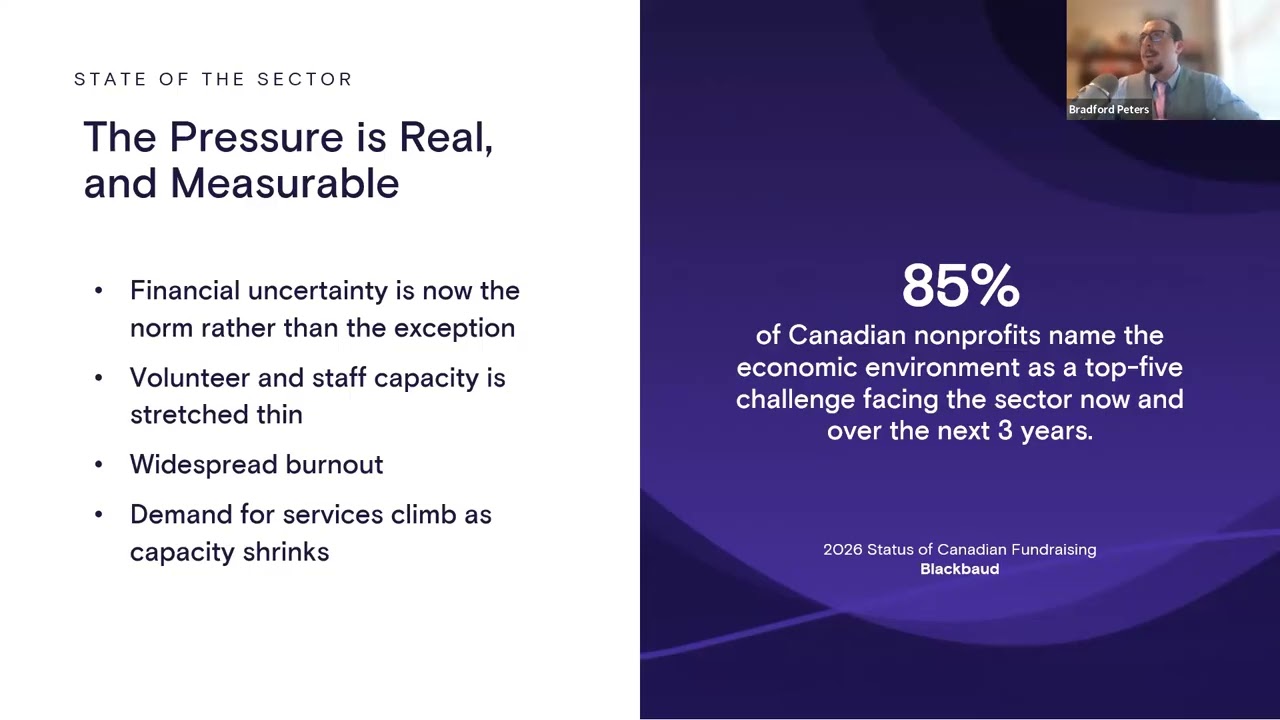
The nonprofit sector is currently facing unprecedented strain, with over 80% of Canadian organizations grappling with funding instability and half reporting significant volunteer shortages. This pressure has extended beyond unpaid volunteers to affect paid staff and leadership, leading to widespread burnout as demand for services rises while resources remain static. The situation has created a "K-shaped" trend where larger organizations are better equipped to handle these challenges, whereas smaller entities struggle with high turnover and shrinking donation shares. A specific case study illustrates this crisis through a community social service provider trapped in a "capacity trap," where stable government funding is offset by rising costs and complex needs, forcing leadership into constant crisis management that hinders strategic planning and fundraising. Consequently, boards often become reactive, spending excessive time on administrative mechanics rather than strategy, which leads to disengagement and mission drift.
To address these challenges, effective governance requires moving beyond simply filling seats or chasing specific credentials to building a resilient leadership team capable of navigating difficult decisions together. Key pillars for healthier recruitment include defining clear roles and expectations upfront, ensuring transparency about organizational challenges, and recognizing that board competencies must evolve as the environment changes. Role clarity prevents engagement issues by explicitly stating requirements such as event attendance or committee work outside meetings, while infrastructure is defined as systemic policies and processes that live within the organization rather than relying on individual knowledge to ensure continuity. Regarding recruitment, speakers argue against requiring specific professional credentials for every board seat, suggesting instead that organizations build infrastructure to train volunteers who possess values alignment, soft skills like conflict management, and diverse lived experiences, which are foundational to effective governance and preventing crises rooted in interpersonal conflict.
Supporting executive directors and preventing costly turnover also demands a shift from vague annual evaluations to formal performance management processes with clear expectations and quarterly check-ins. This approach helps mitigate the risks associated with "uneven engagement," where power concentrates in a small core group, creating bottlenecks and liability risks. New board members should be supported with structured onboarding, access to historical information like minutes and bylaws, and goal-setting to build confidence quickly; hesitancy in complex decisions is viewed positively as a sign of competence and humility rather than a lack of information. Furthermore, as the sector shifts from accepting broad quantitative impact metrics to demanding specific qualitative stories that demonstrate tangible changes in individual lives, nonprofits struggling with fundraising or grant dynamics are advised to seek external expertise from professional fundraisers or grant writers for assessment and guidance.
Ultimately, the path forward involves building necessary infrastructure that outlives specific directors to ensure accessibility for all members regardless of tenure, a goal supported by initiatives like Onboard's discounted rates for nonprofits via Tech Soup. By focusing on these systemic improvements, boards can transition from reactive crisis management to proactive strategic leadership, ensuring they remain aligned with their mission despite the sector's ongoing pressures. This holistic approach not only stabilizes the organization but also fosters a culture where diverse voices are heard and valued, allowing the nonprofit sector to navigate its current challenges with greater resilience and effectiveness.
Read the full video transcript
Raa, thank you so much. And for everyone
sending in their answers about what they
had for breakfast, I am sitting here
green with envy. Uh, this is the benefit
of having too many cats and just enough
dogs, which means we're up at 5:45
feeding them and I get to have two cups
of coffee before I start my day. So,
already getting a little bit hungry just
hearing all these wonderful things
everyone had for breakfast. But I
digress. We are not here to talk about
what we all had for breakfast. We are
here to talk about just the state of
governance, the state of nonprofits and
how we are all existing in this current
moment that we find ourselves in. Now,
very very quickly before we start to get
too deep into anything, just to call
out, my name is Bradford Peters. I've
had the great pleasure of working with
Tech Soup for more than a year at this
point, hosting several of these
webinars. As a quick background on
myself, I am a lifelong worker in the
technology space, not just geared
towards nonprofits, but specifically
within that space towards small, medium
uh small to medium-siz nonprofits. all
of those wonderful organizations headed
by such brave and fantastic leaders that
are trying to do the most while managing
with the least. And in that time, I have
been able to help thousands of
organizations not just survive but to
utilize technology to get deep roots
into their communities to thrive and
create sustainable change. But we are
also not here to just hear about me. I
have my fantastic and wonderful
colleague Nick Gaggliardi here as well.
Nick, can you give a quick introduction
on yourself?
>> Hey folks, uh, nice to be here today.
>> Um, I'm Nick Galardi. I'm a governance
consultant. I'm based in Peterbor Noji
Wanong in Mitis gig territory in Ontario
and I work with nonprofits right across
Canada um doing governance and strategy
work.
>> Nick, thank you very much for that
introduction and asth did bring this up.
I am coming to you live from onboard
digitally. Um we are a software
organization that helps nonprofits
simplify their governance. So that
members, especially on the board, can
quickly find what they need, act upon
it, be those very, very efficient and
effective board members to get the
strategic goals accomplished, but also
to save a massive amount of time on the
administrative end to make managing the
board from the leader perspective at the
front end of the nonprofit so much
easier. So, we work across 60 countries
with 6,000 and counting. I think we
might even be up to 7,000 organizations
served, hosting over 150,000 uh meetings
per year, I will let you read all of the
other stats on here. But the big thing,
if we do get to the end of this and
there is some interest in learning more
about how onboard can help with
governance, hey, we are partners with
Tech Soup. We have some very specialized
pricing to help incentivize this and not
make it a financial burden to see those
impacts happen on your board. But we
will get to that because today we are
talking about the overall state that
this nonprofit sector finds itself in.
We're going to talk about some of the
strain that is happening with governance
within this time. We are also going to
learn from Nick. And hopefully I have
one or two insights to help about best
practices to create a boardroom that is
able to operate and succeed within these
times we find ourselves in. And then at
the end, we'll be here for a live Q&A.
So do not worry about waiting until the
very end. Please throw those questions
in the chat as they come up. I'll be
reading. I'll be making sure that we
respond to these in time.
But today is going to be just a little
bit different than many of the webinars
that I have led before because that has
very often been me doing a monologue
talking about the state of things. But
we have Nick here. So here is what we're
going to be doing with the next hour.
We're not here to tell you that the sky
is falling. That is a bit of doomerism
that I find not just to be false, but to
be a very negative headsp space to even
operate in. But Nick and I are here to
talk and have a conversation about how
things are shifting within the nonprofit
space and what we are able to do about
it. So let's set the stage with just a
few numbers because I think it is worth
grounding this into some really concrete
information. So more than 80% of the
nonprofits over in Canada have
identified funding as a major
instability and uncertainty in the
future of their financial uh uh
steadiness. It's a concern. It is not a
fringe worry. That is the vast majority
of the sector telling us that the ground
is shifting under their feet. And at the
same time, roughly half of these same
organizations are reporting that they
are falling short of the volunteers
needing to help operate these
organizations. Now, turnover, that
steady churn within the nonprofit space,
that is nothing new with volunteers.
That is unfortunately table stakes. we
know all too well. But the real shift is
that this is not just being seen within
the volunteer space. This is being seen
with actual paid staff. This is being
seen with leadership. This is in some
places being seen with board members.
There is burnout that is happening these
days. And what makes it even harder is
that demand is not slowing down. These
days, we are finding oursselfves in a
section where more and more people are
needing nonprofit services than ever.
And as nonprofits are shuttering their
doors, we have nonprofits with less
people trying to address a larger
population. And that is also coming in
the face of this funding uncertainty. So
the pressure is real. It is very
understandable. It is measurable.
But numbers only tell you so much. So
Nick, you are doing a lot of this work
with organizations every day in your
work with these nonprofits all across
the country. What are you hearing from
executive directors in boards right now?
>> Yeah, I think I think the having this
data helps describe what's happening at
that high level. Um, and I'm always
curious, you know, when I work with
organizations to see how this plays out
on the ground, right? And knowing that
it's different in every organization.
Um, but definitely, you know, on the on
the staff on the exact side of things.
Um, I'm seeing EDS and CEOs that are,
you know, um, you you talked about
burnout. I kind of feel like it's almost
a moot point to talk about burnout in
the sector at this point. Um, but but
staff are as stretched as ever, right?
And there's this sort of
um strain of um leaders who who went
through the pandemic and still haven't
been able to sort of catch their breath
since then um because it's you know
things have been so um challenging and
uh you know they've been dealing with so
much uncertainty in their environment uh
for years now. Um what I'm seeing for
organizations is yes um demand is rising
but it's also changing in the sense that
um the work that organizations are doing
needs to be more complex. You're
addressing more complex needs. Um you
know some cases this is driving some
pretty innovative uh collaborations
across the sector. um it's driving
different kinds of professional
development inside organizations, but
it's also stretching, right? Um because
the um the resources that organizations
have access to just aren't kind of
keeping pace. And I think what's
happening in so many organizations is
that there's there's learning um and uh
adjusting that needs to happen in real
time. That sort of emergent um process
as your environment is changing. the
pace of change just keeps going and
going and going and so people don't have
that opportunity to kind of just pause
and find the space to think and plan um
and learn in their roles and then on the
board side I think boards are struggling
with that increased complexity as well
because you know um what we're what
we're expecting from boards is um a
higher level of knowledge about the
sector um about the complex issues that
organizations are dealing with. Um
boards are having to deal with more
emergent issues. So having to be in more
of a reactive mode often than I think
that they would like. Um and this is
happening in a context where uh many
many boards are struggling with uneven
engagement. Um they don't have the
infrastructure that they need uh to
fulfill their roles effectively. they're
often not um you know we don't always do
a great job supporting board directors
so they they don't always have access to
the training um or um or the expertise
that they would like. I I often have
individual board directors just reaching
out to me um by email or LinkedIn asking
for you know me to point them in the
right direction because they they just
haven't received any kind of um
orientation. And u and so I think when
when you're stepping in as a volunteer
to do this really complex really
important work um it's a big ask and uh
we see burnout on the board side as well
which I I think we don't talk about as
much um but I see all the time in my
work.
>> I think you are calling out several
really critical things. Certainly there
is this driving need for
nonprofits in leaders in staff to engage
and and learn to meet this moment. It's
requiring a wider tool set. But you've
also knocked it out of the park. There
is so little time now. There are so many
plates that need to be kept spinning to
address this moment.
We need to have that ability to hit the
pause button to get to the level, but
it's just not happening right now. It it
is a stressful place to be. So
especially with my interest in those
like smaller and more medium-sized
organizations like what is that
comparison like like when we are talking
about all of these stressors and all of
these needs that need to be met you know
how is that showing up differently for a
smaller organization as opposed to a
larger one that has that much more
structure funding that has that much
larger staff to help address these.
What's that difference you're saying?
>> Yeah, I think it's such an important
question. Um,
what we're what I what I see in the
sector is, you know, that sort of
K-shaped
um trend, right? Where larger um more
wellestablished organizations
are better uh better structured to meet
the moment as you say, right? um and and
smaller organizations are struggling and
we saw this, you know, about 10 years
ago, they started showing up in Canada
in um in donation data because we saw at
that point that large organizations
um were getting a bigger and bigger
piece of the donation pie, right? So
even though donor trends weren't
necessarily going down, the um amount of
donations available to smaller
organizations was shrinking. And so, you
know, it's it's easy to see it on that
sort of fund development side of things.
Um, but I think it's happening in other
places too, right? It happens um in
terms of um learning opportunities,
right? In terms of, you know, having a
budget for administrative support or to
send your staff for um for additional
training. Um you know, smaller
organizations tend to struggle more with
turnover. when you have a team of five
losing one person that's 20% of your
team right and so you can see how it
just sort of like compounds and we're at
the point now where you know in Canada
small organizations are the bulk of our
nonprofit sector um they are incredibly
important to our communities like and
they are I think heavy hitters when it
comes to impact like I I would I would
do an analysis any day of looking at ROI
um in terms of impact I think small
organizations punch above their weight,
but I am very concerned um about the
future of small organizations right now
just because it's um it's an uphill
battle.
>> Yeah, it's again it's tough and
especially with that fundraising piece
that you mentioned. Now, now fundraising
has been in a place where I don't think
we're seeing a decline. It's it's been
pretty flat. But yeah, when you're one
of those larger organizations, you have
that ability to raise awareness, to
attract attention, to trumpet all of
your wins across the community. And that
absolutely does impact these, you know,
small mom and pop nonprofits that are
just serving, you know, uh, one little
town and doing a huge amount of good
there. But how much can you get that
word out as opposed to hey we are an
organization that has an entire
marketing team and a PR team at play.
It's it is really difficult. So is there
a specific story that sticks with you?
One that kind of captures that real
world impact that these pressures are
having?
>> Yeah. I um I worked with a an
organization this past year um and they
are a community-based social services
provider. So not the smallest um kind of
organization, but they're locally
focused. Um and they're working in a
space in social services. I think this
is probably true for everyone working in
that space, but um demand for their
services is growing quite quickly. And
it's also uh an example of a um you know
the way that the sector is changing
where the the type of service that their
clients need is becoming more and more
complex. Um this is an organization who
gets it's core funding from government
which is usually a um a pretty
stabilizing place to be. Um but their
funding envelope hasn't changed in 10
years. Um and so they've certainly grown
and um you know costs and demand have
gone up significantly but that core
funding hasn't. And so what happens is
leadership is spending so much of their
time trying to find like creative ways
to close that gap um because they have
to. And um and then you know they they
have some legacy governance structures
right that haven't been serving the
organization well because they've been
too busy focused on other things and
they haven't had the resources to invest
in that kind of work. Um that's led to
board turnover right which leaves gaps
in leadership. Um you know they're
working hard to support staff but their
staff are burned out. Um, and so this is
like it it's it's what I often call a
capacity trap, right? Where you you just
need a little bit something to just give
a bit of a push and you can and you can
kind of break out of that. Um, but
you know, you just end up in this space
where where you're constantly dealing
with crisis. Um, and and you know, if
it's not internal, it's external. And so
it's a really challenging place to be.
Um, but that is literally
just a day in the life of this
organization. That's just their normal
operating reality. Um, and then in in
the midst of all this, they're still
trying to build their fundraising
capacity. They're trying to um create
um, you know, a strategic plan. They're
trying to build really innovative
partnerships to better meet the needs of
their community. So, it's it's um, I
think there's a lot of resilience.
There's a lot of brilliance and
excellence. Uh but it's it's a really
it's a challenging slog.
>> It's an unfortunate thing and it is one
of the most admirable things I find with
nonprofits is that ability to endure.
It's that ability to almost develop a
sense of um you know emotional callous
because it is chaos abounding in a lot
of places and seeing how boards and and
organizations can struggle because there
is that turnover maybe we can find new
people that's a huge chunk of time over
a number of weeks or months to get that
new person up to speed there is struggle
finding funding I think you mentioned or
maybe hinting It's something that that
I've found a lot with executive
directors, which is almost mission
drift. Hey, we're going to get creative
because now we're going to serve in some
different ways to try and attract
funding. Now we're trying to cover so
much more than this original intention
that we started with and trying to
stabilize resources across all this
stuff. Um, overall it is tough, but as
you said, it is absolutely amazing to
see how these leaders have been able to
persevere in March 4th. And we're going
to start to talk about and identify a
couple more of these strains in best
practices. But first, let's take a quick
poll. So, believe we have a poll that
should be coming up for everybody. just
what is the biggest pressure your
organization is feeling right now? Nick
has identified a lot of them. Not just
from a funding capacity. I think a cost
of living capacity is also certainly
impacting organizations. If you're
getting $100,000 every year, but it is
consistently bringing back less, what is
that doing for the organization? Is it
burnout with staff? Is it burnout with
board leaders? Is it mission drift? What
are the things that you guys are
feeling? Looking forward to see seeing
what these results are going to pop up
to be.
Yeah. So with [sighs]
70% in resource scarcity and funding
uncertainty
not shocking. This is what we are all
feeling across the space when we are
losing access to government funds. When
those funds are coming up and achieving
less each year, when it is harder to
fund raise, this is exactly where we
find ourselves at.
So, we have this pressure,
but what does it actually do to how a
board functions? That's where I want to
go next.
So as resources get tighter, the
mechanics of governance itself, pulling
together information, getting everything
out in front of those people in minds
who we need the knowledge of to help us
achieve our strategic goals to give us
the thoughts to create the plan that are
going to lead to success. It gets
harder. It gets more time consuming. It
doesn't get easier. as an executive
director has to turn their 12-hour day
into a 15-hour day to meet the moment.
How can they get this information to the
right people that are making up that
executive team to help find this
success? As that burden grows, directors
end up less supported than they should
be. And then less supported directors,
they sometimes disengage. and a lot less
engaged board means that it's spending
time managing logistics instead of
actually deliberating and enacting
strategy. So that's where the mission
itself starts to get lost in the
shuffle. Nick, I'd love your take on
that. Does that match what you're seeing
and what you're hearing, or is there a
piece I'm missing?
Yeah, I think um it's a bit of a
double-edged sword here because
>> um I think the reality is that
um a lot of board work is administrative
in nature, right? And that admin stuff
is not always, you know, the most
exciting or glamorous. Um but it is
incredibly important to the
organization. And when we um when we
get, you know, if we kind of like pair
down the board role to what are those
min specs, those legal requirements, um
a board is a is an administrative body
required by law, right? And so um so
that that admin piece, those mechanics
are um kind of the core of it. Um so
it's really important that that admin
stuff, those mechanics, it's really
important that they happen. Um,
but when they start to take up too much
time and effort, some of that other
stuff, like you mentioned, that
generative strategic piece, um, it tends
to get pushed off, right? And that stuff
is important, too. Um, and so I I think
I think this can happen often because
systems aren't there. They're not in
place. Um, and uh, as I mentioned
earlier, I I don't think we're doing a
very good job or I think there's a lot
of room for improvement in how we set up
board directors for success, right? We
don't always give people um, the kind of
training and support that they need to
understand their role and to fulfill it
effectively. Um, and then by the time
people figure it out, their board terms
are over. Um, there's new people coming
in and the cycle just starts all over
again where someone else is trying to
figure it out from scratch, right? I
think that's a piece where we can
definitely do better. Um,
having said all of that, I think the
flip side is that despite how important
those um, administrative pieces are, um,
we can also focus too much on them. We
can spend too much time on it. And, um,
I think that's often because governance
can feel really abstract. Because when
we're not supporting people to
understand their role on a board, um
people start to try and figure out like
what am I supposed to be doing? Oh,
here's a checklist. Let me focus on
this. um or when you're facing, you
know, really complex um work and
decisions, you know, in front of you as
a board director that maybe you didn't
know you were stepping into. Um it's
it's easier to kind of focus in on those
administrative or mechanical pieces
because those mechanical pieces can sort
of look and feel like we're doing
governance. Um when maybe we're not, you
know, maybe we're meeting those
requirements, but we're not actually
advancing uh the organization the way
that we want to be. So either way, I
think you want to you want to I see a
lot of boards kind of ending up in a
place where they're spending too much
time and energy on the administrative
stuff. Um and then other substantive
parts of governance, the sense making,
the trust building, those deep
conversations, all that stuff that um
enables that complex decision-m that
boards need to be doing um especially in
this moment can get lost.
You called out something right in the
middle there that that really speaks to
so many conversations I've had, which is
it taking a board member their full term
just to really figure out what is going
on. There are so many leaders I speak to
where that's, you know, effectively that
time to ramp is that whole term. They
talk about, oh, board members don't
actually start to really show up and
contribute until term number two once
they've figured it out. And you just
have to think there needs to be a way we
can get people up to speed quicker that
we can just slot them into the
structure, vest them with the knowledge
so that we can start to see that impact
in benefits in year one and hopefully
not in term number two. And overall, I
think what's standing out to me is that
this administrative work, it it doesn't
disappear just because the capacity is
light. If the systems themselves are
weak, the boards either spend too much
time on the mechanics or they avoid them
until something gets missed. So either
way, strategy is what loses time. So
when everything feels urgent, how can a
board support the executive director
without slipping into like running the
organization?
>> Yeah, I mean [laughter]
supporting the ED um
I think that's a really important
question. We often talk about
accountability, right? in terms of how
can the um how can the board hold the ED
accountable? But I really like flipping
it to look at that support piece because
that's really what you want the board to
be doing. Accountability matters, right?
>> Um but that support is really really
important. Um and so what I often um you
know there's a lot to be said around
role clarity and um you know board
conduct and that sort of thing. Um, but
what I often end up talking to boards
about is shifting away from an
individual focus and if and moving
toward a focus of building
infrastructure, right? So, um, if you if
you're a board director, rather than
doing the work directly, you want to
think about how can I build
infrastructure to to make sure the work
can happen in a way that outlives my
participation as an individual. um
because we just if we're always relying
on individuals to figure it out and do
it then we're always in that cycle where
we're sort of starting from scratch. Um
but if we can step back and focus on
building infrastructure that actually
contributes to uh increasing capacity
for the organization over time and I
think it's um sometimes a bit of a a
more reasonable ask for board directors
who are you know volunteers who have
busy lives. Um, so really focusing on
um, you know, don't bake the cake, just
make sure the organization has the
recipe, has the ingredients, um, and
then take a step back.
>> Yeah, I I really like that. Just that
idea of spending some time to focus on
building the right infrastructure so
that no matter who's at the helm, no
matter who is steering the ship, we have
the right vehicle, the right structure
in place to survive waves, no matter how
treacherous they are. that they can
steer through anything. I I really like
that. So that's the the resource side of
it. But then there is a a second force
at work here too. The people who are
actually in the room and how they are
handling a lot of this. So when a board
gets stretched thin, what actually
happens to how power and and an
engagement play
inside the room?
>> Yeah. what I often see um it's what I
call uneven engagement and I hear about
this all the time um from almost every
board that I've worked with um from
folks that I talk to in the sector. I
get um I get stories about it all the
time in my newsletter and um what what
it is and I think that this is I'll
describe it but I think people will will
recognize it. um you end up with a small
sort of core group of people uh who are
you know a group of board directors who
are basically driving the bus right and
everyone else is sort of along for the
ride um and you know it's in a in a
board especially on a larger board and I
think a lot of organizations um I think
the average board size is around eight
um but I've seen you know much much
larger boards pretty pretty frequently
um you know you can expect that board
directors who are volunteers are going
to show up with different capacities at
different times and so that level of
engagement that each individual can
bring to that role will vary and that's
normal and okay. Um but it becomes a
problem when it starts to affect quality
or effectiveness or sustainability of
governance and specifically you know you
asked about um the power dynamics. What
happens is that you end up with this
sort of um mini board that's in charge.
And you know the board um the way a
board is is designed um it's it can only
function as a whole. It's a unit. Um and
so if you um if you end up with a couple
of people who are kind of doing
everything right because it's easy or
make not it's not easy it's functional
gets things done. Um it can lead the
board to a dysfunctional place right be
where power and information is getting
concentrated in a couple of individuals
often the chair um sometimes it's the
executive sometimes it's a specific
committee a governance committee or
something like that. Um what we want to
see is like everyone on the board needs
to be fully tuned into what's happening
fully read in even if they're not you
know fully engaging at the same level.
Um and you don't want anyone any
individuals or any kind of um groups
acting unilaterally unilaterally without
you know without the board explicitly um
delegating that. So it can be a risky
space um for directors in terms of their
own liability um which is why you know
it's a problem. It can be a problem from
a sustainability perspective. So many
boards I meet no one wants to be the
chair. they have massive problems with
chair succession because the chair role
has just become so big. Um, no one will
take it on and chairs are burnt out and
and they don't necessarily want um to be
in that situation either. Um, but at the
end of the day, what really the biggest
problem I think is that you don't have a
you're not taking advantage of um the
full complement of board directors that
you need to meet that moment, right? To
to drive those complex conversations and
decisions. um and and that it's really
hard to come back from once power gets
concentrated like that. It's really hard
to pull it back. Um but it's really
really important I think for effective
governance today.
>> And so that sounds a lot like a cycle
that starts with good intentions. You
know, we have a a highly engaged chair
that steps in because something needs to
get done and then other directors begin
relying on them. And then the more the
chair carries the less that everyone
else sees their you know needs of their
own role. So you know Nick in your mind
like where is the line between strong
leadership and becoming a bottleneck.
[clears throat]
>> Um I I think it goes back to what I
mentioned earlier about that over
reliance on individuals. Right. So if um
if if an organization gets to that point
where like oh boy I don't know what will
happen you know when Sarah steps down um
that's that's a signal right that
there's a problem um probably for Sarah
and for everyone else um
but I think you really want to focus on
that element of everyone on the board
having equal power and equal
responsibility right and thinking about
governance you know there's there always
going to be informal aspects of
governance and formal aspects of
governance. But when power starts to
operate in that informal um space where
you know a couple of people are sort of
having those side conversations
um they're driving the outcomes of
decisions. They're they're deciding what
kind of information is getting shared or
not shared with the board. um when the
full board doesn't have access to
information that some board members
might um which we often see in the um
you know when when the chair has a um
significant role managing the ED that's
that's a problem that's a red flag that
um that there's a bottleneck there that
needs to be addressed.
>> Yeah. And um you're kind of lining this
up well because we are talking about a
chair that is intern managing the
executive director and you know
something that I've read in your
newsletters before and something that
I've sometimes heard from nonprofits
themselves.
Sometimes the executive directors don't
quit the jobs, they quit the boards.
Could you maybe expand on that a bit?
Yeah, I mean
it is there is nothing about being a
nonprofit ed that is not challenging. Um
and I can say that um having you know
worked in the SEC sector and in in
organizations for many many many years.
Um as well as working with so many
awesome EDs now as a consultant um it's
a hard job and it can be a lonely job.
Um, you know, people don't always get
what you do. You when you're in
leadership, you know, you're sort of
like lonely at the top, as they say. Um,
but working for a board is a unique
challenge. Working for a nonprofit board
is a unique challenge because you're
working you're you're you're a
professional. um you're leading an
organization
um and then you are reporting to 8 10 12
volunteers who may or may not understand
the organization. They may or may not
understand the nonprofit sector. Um
they probably have good intentions. I
would say 99.9% of board directors I've
met do. Um and then there's the every
now and then there's that ego-driven
director who who pops in. Um, but you
know, when you're when you're an ED
working for a board that doesn't fully
understand its role, um, maybe doesn't
have the systems and infrastructure it
needs to to to do what it needs to do.
Uh, you can be dealing with things like,
you know, a lot of inconsistency in
expectations. Um,
there's a lot of interpersonal dynamics
to manage. It can it can get
challenging. And then if you end up in a
situation where um what the practice
that we see so often is um the board
chair has this one-on-one relationship
with the ED. Um and you know if that
board chair is an ethical person, if
they have good communication skills, if
their personalities mesh with the ED,
that could be fine, could be a good
working relationship. Um but just as
often it's not and you can end up in
situations where that person may not be
using their power ethically. Um there
can be um you know um a lot of stress
and tension in that relationship. The
board chair is essentially the boss,
right? And so um the that power dynamic
is there. And then there I mean we get
into situations where we're even looking
at things that cross over into um like
harassment and discrimination, right? So
I've seen [sighs] too many um EDs leave
their roles because they tried and tried
um and just could not um could not build
uh an enabling working relationship with
their board. Um, and I think that it's
one of the big risks that boards need to
be looking out for. Um, because ED
turnover is no joke. It's very, um, it's
very disruptive. It's very costly. Has
an impact on your organization and and
your community. And once it happens
once, like so often I see organizations
um where one ED left and then they've
cycled through two or three more in the
next five years, right? Um, so th
there's obviously some internal issues.
Um, but I think that they're structural
and I think that people do have good
intentions, but again going back to that
sort of training, support,
infrastructure, um, if we're expecting
people to just kind of figure it out,
they're going to make mistakes and, um,
and those mistakes can unfortunately be
quite costly.
that relationship that you just defined
between the executive director and the
chair, the executive director and the
board itself. It's um it's it's an axom
I I think we don't often talk about
enough, but as I've heard from so many
folks I've worked with, you know, um
they talk to you about how to be an
executive director. There is training
for how to run a nonprofit. Well, there
seems to be less training and resources
people can pull on for how to be an
executive director working with the
board. it it often feels [clears throat]
like a truly secondary job that unless
you have served an organization prior.
It is a brand new set of skills that you
need to be able to hit the ground
running on very quickly to do it well,
which often involves, as you were
mentioning, interpersonal skills to a
degree. Some just HR skills, ability to
communicate well, to be flexible well,
and also to just sometimes keep your
head above a lot of that chaos that is
going on. It's it's a lot to keep in
your head at once. Um, so
is there
one thing that a board could do to to
keep in mind like to to be mindful of
partially about this sort of
bottlenecking with the chair but also
just towards ensuring that there is that
good working relationship with the
executive director, you know, just to
make sure this is all working well in
the first place.
Yeah, I have found um you know this is a
it's a question that I have asked myself
many many times. Um I'll go into
organizations and we're talking about um
strap planning or policy development or
something else but the real issue
underneath it all is that board
executive relationship. Um
and so
what I recommend now for organizations
is to implement a formal performance uh
management process inside an
organization and um I've actually
developed um a process tailored to small
organizations because this is a piece
that's missing. What we often tell
boards is you should do a yearly um
evaluation of your ED and most boards
aren't even doing that. [laughter] Um
but the yearly evaluation isn't cutting
it. Um so we really need a structured
process for
setting clear expectations,
right? Um for the executive director
with um a strong sense of what success
looks like, right? So there's too many
um you know when you're doing complex
work there's so many variables um too
many assumptions can get made and boards
have a reputation
um you know for shifting goalposts
because there's turnover on boards.
People come and people go that's normal
that's natural um but it can be
difficult when you're doing complex long
term work right to um to to stay
committed to a certain path of action.
So really um building some um some
formal processes around goal setting um
and uh and then at minimum quarterly
check-ins around those goals. Boards
should also be thinking about um
monitoring for policy compliance and
organizational stewardship as part of
performance management. they should be
asking that question that you asked
earlier about how do we support the ED
right through professional development
through how we work and and in other
ways um and uh really thinking about
yeah what do what do we need to do to
ensure that we have this strong
constructive collaborative relationship
with the ED because I think we often we
see that put on the EDS right where they
need to figure it out new board new
board chair um new relationship um it's
a
and boards need to take responsibility
for that as well, particularly because
they're in that position of power. Um,
and because, you know, you can't fulfill
your role as a board without supporting
your executive director, right? Um,
there's just no way to do it. And so,
it's it's a it's a really really
important piece.
>> Yeah. I'm I'm just hearing effective
relationship building, effective
governance. It's sounding like there
needs to be the definition of what we
are doing first and then holding to
that. And so often the process as it is
these days is we are working towards
action and trying to define it based
upon what we do which can lead to some
tension and can lead to things airing a
little bit and I want to pivot off that
point a little bit about what is
happening on this work towards the
executive director's end and really also
look at how boards renew themselves. You
know you've written extensively about
recruitment as well. what are you seeing
there?
>> Yeah, recruitment is um is important.
It's an ongoing challenge for boards
simply because it requires a fair amount
of capacity. Um and you know when we
look at the trends here in Canada, um we
know that boards tend to be older,
right? Um board directors tend to be
older. Uh we know that volunteerism is
declining um quite dramatically. And
when we look at time survey results, we
can see that like younger and
middle-aged adults have less free time
um than their predecessors. So, I'm
always thinking, you know, what are what
are boards going to look like in 10
years? And um and how can we start
thinking about succession from that
lens? Now, um
I think that most boards have too many
directors, right? The minimum in most
jurisdictions um is three and and as I
said the average I think is around eight
but most boards and smaller
organizations I would say skew on the
upper end of that. Maybe eight is closer
to a median than an average. Um and so I
think that you know when boards are
thinking about succession thinking about
moving towards smaller boards is an
important part of that. Um taking that
sort of minimum viable approach to your
board um would be helpful. The thing
that I that I um I think this is kind of
an unpopular opinion, but I share with
boards all the time. You know, I I see
people um putting up board postings. I
work with boards around this stuff. Um I
get people reaching out to me to share
board postings a lot. And what
organizations are struggling with, what
boards are struggling with around
recruitment is finding credentialed
professionals. So, we've gotten to this
point because nonprofits have become
more complex um where it seems like
every organization is has an expectation
that they will have a lawyer and an
accountant and um a fundraising
professional on their board and that
creates you know um a bit of a a
recruitment challenge for sure. Um and
again, I don't think it's necessary. Um,
I think that if we are creating boards,
if we're building infrastructure that
allows anyone to step into that role,
have the training, have the systems and
processes that they need to be
successful,
um, and and having opportunities to
access expertise when they need it, then
that's that's sufficient, right? That's
that's going to give you a level of
governance that gets you where you need
to go. Not everyone needs to have a
lawyer. Um, I've had organizations where
they have, you know, they have a real
estate lawyer on their board and then
they're expecting them to advise them on
on complex um, issues related to, you
know, uh, criminal law or something and
it's, you know, there's a disconnect
there. Um,
yeah. So, I think that moving away from
that expectation I think is really,
really important. The other thing I saw
some interesting data recently from um
the charity insights project at Carlton
uh university and it was about
succession planning for boards. Um and
they asked they asked um in their survey
uh you know what are what are the things
that you're looking for when you're
recruiting? And it was really
interesting because around half of
boards said that um they're recruiting
for diverse backgrounds and
perspectives. um they're recruiting for
community connections, they're
recruiting for lived experience. And I
was really excited to see that because
even in my time in the sector, that has
not always been the case. And I think
that's a really promising trend that has
come out of a lot of advocacy over the
last 10 or more years. Um but in that
same data pool only a third of of um
charities are recruiting for
interpersonal and soft skills which I
think is a big missed opportunity.
So, I want to see boards recruiting for
values alignment, right? You can teach
governance skills. You can show someone
um how to run an a performance
management um process, but you can't
fake values alignment. And values are so
critical to um to strong governance. And
so, so looking at that as sort of the
the foundation for recruitment, I think,
is really important, especially for
highly valuesdriven organizations.
um but also skills like conflict
management and problem solving,
communication, these things matter so
much and most of the governance
I don't know problems crises that that
I'm brought in to deal with um all
started from um just conflict aversion.
[laughter] So, um, we think that they're
complex policydriven issues, but they're
they're um they're coming out of
interpersonal like a lack of
interpersonal comfort with dealing um or
dealing with complex issues or or
conflicts. Um, and so I think that
having those skills on your board um if
you want to have uh a functional
effective board is really really uh
really important.
Yeah, I think this mapping and this
realization of the need of of soft
skills, of value alignment, I mean, this
is critical. I I think it's too often we
hear from nonprofits,
how they had the board member with the
right skills, but they were still not
the right person for the job. The zeal
wasn't there. Maybe the alignment wasn't
as as perfect as it seemed at first
glance. And that leads to not
necessarily rocky relationships, but it
does lead to having people that are not
able to go in 100% like the board
members with that right alignments. You
know, again, I think this goes back a
bit to a bit of defining things as we
talked about a few minutes ago. If we
could find the time in between the 29
and a half hours a day that an executive
director is working to really scope out
here are all of the various skills that
make our nonprofit board the best
version possible, the one to accomplish
this mission best. [clears throat]
and then start to really analyze not
just your board but potential incoming
members who is going to overall make it
to the board because sometimes it does
not need to be another board member who
is very effective at reading financial
documents if we have three or four of
those folks on the board I think we are
best served as we need to expand the
mission out as we need to tend to other
critical pieces maybe sometimes it is
not about chasing credentials it's
filling in those gaps
So overall, like healthier recruitment
isn't about filling seeds. It's not
about chasing credentials. It's about
building a leadership team that can work
through difficult decisions together and
then give those people the training and
the infrastructure to contribute and
hopefully to contribute quickly and not
have that first term sitting learning
absorbing just to be effective two or
three years later. So, out of curiosity,
Nick, what does healthier board
recruitment like?
What does it look like in in practice
other than mathing this out? Like, like
what are some takeaways that an
executive director in a team could bring
when they are interviewing new people
for an open seat?
H I think the first um and possibly most
important part aside from that values
piece that that we've um talked about is
role clarity. So um really
like on a internally the the board and
the ED should have a strong sense of
what is the role of this board right
because it can vary from organization to
organization
um and what are our expectations for
directors I see a lot of recruitment
that is kind of broad and general um you
know it's like oh four to six hours a
month and um you So, all you need to do
is show up to a meeting and then in a
committee meeting and then um and then I
have I have board uh board chairs or EDS
saying like, "Oh, my board isn't
engaged. They're not coming to my
events. They're not doing this, they're
not doing that." And um sometimes
sometimes there's an an issue with
engagement on on the director side, but
sometimes it's an issue of um clarity
around expectations. So, if you want
your board members to come to events,
then you need to be clear that that's an
expectation that you have. If you want
your um board directors to be doing
committee work outside of specific
meetings, then you need to be clear
about that. Um, so I think that role
clarity piece really really matters.
Um, and then I think
I think we're always looking for like
this is the way, this is the perfect
board. um these are the competencies you
need, these are the skills you need. Um
but when it comes to governance, you
know, governance is dynamic. It's it's
like a complex system in your
organization. And so as your
organization changes, as your
environment changes, you can expect that
the kinds of people you need on your
board will change, too. And so you
really want to be thinking about what
does our what does our board need right
now to fulfill its role effectively?
what kind of skills, what kind of
experiences, and there are so many
different axes that you can look at. Um,
you know, and I think we've touched on a
lot of them in terms of skills, um, you
know, identities, experiences, soft
skills, that sort of thing.
Um, and then the other thing that I I
think is really important uh, when
you're going through that recruitment
process is transparency. I've talked to
too many board directors, too. um were
recruited through sort of rose tinted
glasses and then when they joined the
board found out, oh crap, there's some
stuff going on here that is actually,
you know, going to be um quite stressful
to deal with. It's going to take up a
lot of my time. It's not what I was
expecting. Um and I think that that's
really unfair for volunteers, and I
think that it doesn't really set your
board up for success either. So there's
always there's always confidentiality
that we need to be thinking about, but
as transparent as we can be um in terms
of where where our organization is at,
where is our board at, what is our
infrastructure like, you know, um what
kind of support are we actually offering
to this director
and um and how can we make this a great
experience for them? I think um I think
that I think that matters too looking at
it from that end.
Yeah, I couldn't agree more. And I want
to highlight again and underline and put
in bold and make it size 28 font if
possible. Like that conversation around
expectations with board members at the
very front of the relationship is one of
the most critical things because so
often it feels like the executive
director has in their mind this idea of
how things are supposed to work. But
when that's not communicated, when the
board member signs on, you can't fault
them for operating in a different way
because there was no underlying
conversation around, hey, you are going
to be working on these committee
meetings outside of the main board. Once
a quarter, we are having fundraising
drives that you are going to attend and
you are going to use your poll within
the community to bring people into.
Communication is key and I cannot
emphasize that enough. So, thank you
very much for calling that out, Nick.
So very quickly since I know we are kind
of getting towards the end of this um I
did want to take a quick beat to overall
add one final piece. Um so we have
talked about mechanics of governance
about pulling things together about
taking uh you know minutes about keeping
everyone briefed about good relationship
structure about how to find the right
folks about how to increase that ramp
time for new board members. Um, I do
want to say for a lot of the boards that
I work with who are running governance
through emails, who are running things
through personal drives or whatever
premium level software that they have.
That is one of the major things that
styy governance with the board that make
communication difficult that create that
imbalance of a relationship that can
create that bottleneck with a board
chair. And this is what a lot of what
onboard was built to solve where it
gives not just everything a home to be
found. It increases and expands those
avenues of communication. It allows
people to quickly access those bylaws,
those policies. Have those
understandings. So since we are here
with Tech Soup, it is worth mentioning
if you are feeling the strain not just
of the current ground that we are on but
especially with managing the board with
communicating with hitting those
strategic goals with ensuring you have a
team that moves with you and not in half
a dozen different directions.
Onboard can help. We have that
relationship with Tech Soup. We have a
very discounted rate to ensure that
nonprofits are able to take on tools
that build that infrastructure that
helps slot people in quicker without
this being a massive financial burden.
So, it is not a replacement for
structural fixes. Nick just walked
through that, but it is another lever
and it is one that has certainly helped
thousands of nonprofits across the
United States and in Canada. So, do not
hesitate to reach out there. But in the
meantime, we have some Q&A that I have
very poorly been tending to. So,
starting from the very top with
everybody. Oh my goodness. And I
apologize for not checking this midway
through whatsoever. Um, one of the
questions I actually saw that Debbie
asked was just wanting a better
definition of infrastructure. So, Nick,
that is something you and I have have
spoken of. potentially my definition
might differ than yours, but when you're
talking about infrastructure, could you
um expand on that a little bit?
>> Yeah, for sure. Um yeah, it's kind of a
jargony term, but it's one that I like
to use. Um so when I'm talking about
infrastructure, I'm talking about the
policies, the processes, the systems,
right? So um some people might call it
yeah like admin um or workflows or
whatever but it's it's basically those
um those governance structures that live
outside of individuals that allow you to
um to to have that sort of systemic
approach to things so there's more
continuity in what you do. So I, you
know, when I'm looking at governance,
I'm thinking about um what I call the
three piece, people, power, process, and
the process piece is the infrastructure.
It's like all the things that you build
that um that live in the organization
itself rather than within organi or
within individuals.
>> Yeah, Nick, I couldn't agree more. And
and I think infrastructure can have a
broad term. It it can mean many things.
Is infrastructure a a place where we
hold information? Potentially. Is
infrastructure just a recurrent activity
of having a review process with the
executive director? Is infrastructure
having a process of thinking about the
different skills we're looking for
within board members? What we need are
replicable activities that live with
everybody instead of things that are
just being stored away by one person who
is the font of knowledge on everything.
because infrastructure is something that
anybody can approach no matter if it is
day one on the board or you know year
five as opposed to something that
potentially fades away when that one
particular board member with that
knowledge turns out is gone and we've
lost that forever.
So, we have another question uh from
John asking, "What are the best ways to
get new board members up to speed to
allow them to feel confident about
making significant or important
contributions?" Now, in my mind,
everything that I have heard from
executive directors at nonprofits, they
describe this as a hesitancy due to lack
of knowledge. There is that inability to
quickly get people information like
minutes over the past 5 years, all of
the policies, all of the bylaws,
strategic uh initiatives and how those
have been fairing over the last 3 years.
I think it is a bottlenecking of
information that prevents newer board
members from feeling like they have an
actual good sense of not just what is
going on today but what has been going
on in the past that is informing today.
So being able to provide that
information and set goals with that
board member that hey by the end of
month number one or number two
expectation is that you have studied up
on what these minutes have looked like
over the last two or three years. So
you're now informed about things that
you have a review of all of these
decisions how we have arrived at them by
month number two or three. access of
information, goal setting, an active
check-in from an executive director, not
to scold anybody for not doing anything,
but to form that relationship and ensure
that this person is checking off their
marks and getting up to speed. That's
what comes to mind for me. Nick, would
you have any other ideas on this?
>> Yeah, I would agree. Uh, Bradford, I I
do want to say, you know, when a new
director comes in um and there's some
hesitancy around big complex decisions,
I actually see that as a positive sign
um because yeah, like if if if if you're
if you're taking that role seriously, if
you're using your power um ethically and
effectively and you're brand new, um I
think hesitancy demonstrates competence
and humility, which in my mind are are,
you know positive attributes for a board
director. Um
so you know there are aspects of
stepping into a leadership role that do
take time to learn and that's okay. But
there are so many parts of nonprofit
board leadership that shouldn't really
be that complex or difficult if we just
documented them and shared them
effectively. And I think you've spoken
to that pretty well. So I won't I won't
belabor that. that, you know, there's
there's a difference between not
understanding what to do or where to
find the info or who to ask, right?
Those are all, you know, onboarding
problems you can fix, orientation
problems you can fix. That's different
from I'm still stepping into my
leadership role and I'm doing that with
some humility, which I think is a normal
positive um part of any kind of uh
leadership.
Thank you very much for that. Um,
okay. I didn't just hit the mute button
on myself. All right. Um, last question
that I am seeing in the chat is coming
from Debbie. Um, giving a lot of context
around some issues towards being able to
obtain funding um, about overall being
able to meet needs four years in a row,
which sounds like a very, very tough
place to be in. So Debbie, I would say
if there has been trouble towards
getting fundraising from state grants,
local grants, if there have been issues
towards partnership,
there are sometimes uh questions that I
have about the story that's being told.
I am sure you guys are doing a lot of
good but I think one thing I have
noticed quite a bit within the grants
piece is that we are no longer able to
get by as institutions talking about the
broad number of people that we helped
that was something that I think
everybody in this room you know 1990
through 2020 had no problem being able
to tell within this community we have
helped a thousand people out isn't that
fantastic
and unfortunately I think this trend
that has really reared its head over
over the last number of years is wanting
more specifics to better inform those
stories and those decisions of who gets
funds or not. Talking instead of a
quantitative impact has been replaced by
the need for many institutions to seek a
qualitative impact of people. So, if
there is a a funding issue, I know it is
not an easy one for me to provide a full
answer for on this call, but one thing
that has changed the funding situation
for so many nonprofits I worked with is
now not saying we've helped a thousand
people, but it's we've helped a thousand
people out and on average we took them
from a here in whatever we were trending
towards helping to a here because at the
end of the day, we are all telling
stories and giving stories about why we
are deserving of these things. So, at at
first glance, that is one that I know
has changed things for a lot of
nonprofits is talking about that
qualitative impact within people. Um,
Nick, I'm not sure if you had a chance
to see Debbie's comment. Do you have
other thoughts on your end from all of
your experience working with nonprofits?
>> Uh, I haven't seen uh the comment,
Debbie. Apologies. But what I will add
is that um philanthropy is like an an
entire industry
um with a lot of insider dynamics and it
can be hard to make sense of um and
break into. And so if this is an area
where your organization is, you know,
repeatedly struggling with um and if you
have any resources to, you know, get a
bit of expertise from um a professional
fundraiser um or a grant writer to sort
of look at what you've been doing and
and kind of point you in the right
direction. There's a lot of great
fractional folks out there. there's
people who will do um you know an
assessment or advisory session in an
hour or so that I think that can be
really really helpful because it is um
it is not an easy industry to understand
or break into
thank you so much for that so I'm double
checking here I I think we have hit all
of the questions that I am seeing but I
am happy to stay on the line if there
are other questions people want to ask.
Um, I'm happy to be here for a couple
more minutes. So, I'll be checking the
chat if there is uh anything else anyone
wants to ask that I can speak to. Nick,
I also know that we are five minutes
past due, so I don't necessarily want to
um hold you past this. I'm sure you have
a very busy day ahead.
Okay, I'm checking
not seeing anything else in the chat.
So, also say unless something pops up in
the next couple seconds, we can call
this a wrap for right now. So, for
everybody, um I hope there were some
good insights supplied to this. I know
that Artha is going to be sending this
recording to everybody to review later.
Um, as always, it is fantastic getting
to work with Tech Soup. It is fantastic
getting to interact with all the
nonprofits that are attending. If you
ever want to have another conversation
and not even make it about tech, my name
is Bradford Peters. I work at Onboard.
Do not hesitate to reach out. I will be
here to hop on, help, share whatever
wisdom I have morning and noon and
night, six days a week. Let me have
Sunday off. That's all I ask. thoughts.
Otherwise, everybody have a fantastic
Thursday. Have a great rest of week and
have a wonderful weekend.