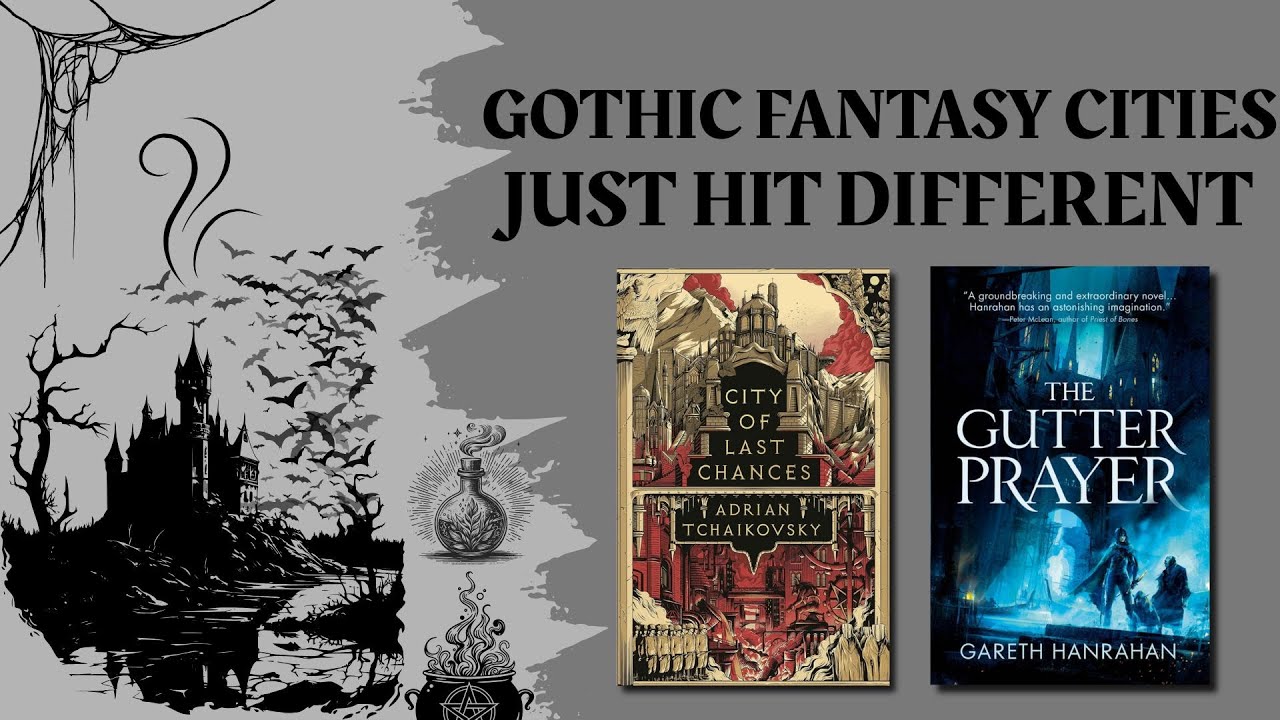
Gothic Fantasy Cities Just Hit Different || An Essay on CITY OF LAST CHANCES and THE GUTTER PRAYER
Watch on YouTubeVideo summary
The video essay explores the unique atmospheric quality of Gothic fantasy cities found in Adrien Chaikovsky's *City of Last Chances* and Garrett Hannerhan's *Black Iron Legacy*, arguing that these settings "hit different" by vividly portraying confusion, complexity, and a multitude of conflicting voices. Both Ilmar and Gerdon are depicted as sprawling urban environments where physical structures—ranging from spiky arches and dirty glass to ancient ruins and mana houses—reflect not just architectural style but deep temporal layers and social stratification. In these cities, secrets drive the fates of all inhabitants regardless of status, with connections between characters of vastly different backgrounds serving as catalysts for transformation; whether it is a rivalry between an academic and a refugee wizard in Ilmar or alliances involving thieves and ghouls in Gerdon, the narrative webs are dense enough to propel entire societies toward breaking points.
A central theme connecting these two fictional worlds is their existence under constant tension with themselves, driven by industrial might that masks darker realities beneath a veneer of progress. While both cities serve as economic powerhouses exporting unique goods—Ilmar through demon-powered industry and Gerdon via alchemical renaissance—they stand in stark contrast to the imperial ambitions they face or emulate; Ilmar is besieged by totalitarian invaders who view its potential solely as an opportunity for conquest, whereas Gerdon uses trade to maintain peace against similar threats. The essay highlights that despite their differences, both settings are haunted by a history of exploitation and violence where industry relies on the suffering of the poor, criminals, and refugees who breathe in toxic smoke or serve as reagents for inventions, illustrating how economic growth often comes at a fatal cost to the vulnerable populations living in its shadow.
Furthermore, these Gothic cityscapes are deeply rooted in their own bloody pasts that refuse to fade away, acting instead as active forces shaping the present and future much like classic Gothic literature suggests. In Gerdon, ancient black iron gods feast on sacrificed souls while growing tyrannical shadows from history remain largely forgotten yet terrifyingly powerful, whereas Ilmar's old quarter is permeated by a miasma of decay where former dukes hang as specters that drive inhabitants mad with their refusal to let go. Even the centers of learning within these cities are not neutral grounds but institutions burdened by agendas and institutional memory; universities in both settings operate under strict constraints or nefarious fronts, revealing how knowledge itself is entangled with power dynamics and historical sins that continue to haunt the current reality.
Ultimately, the video concludes that there is a profound synergy between Gothic fantasy aesthetics and social commentary, where decrepit grandeur serves as a backdrop for stories about progress built on oppression and negotiation replacing conquest through trade. The author expresses strong admiration for these specific settings not only within their respective book series but across the wider works of Chaikovsky and Hannerhan, noting that Gerdon is among his favorite cityscapes globally while praising both authors' broader contributions to sci-fi and fantasy genres. By examining how these cities function as microcosms of empire, industry, and historical trauma, the essay invites readers to explore these worlds for themselves to experience their splendid intricacies firsthand, encouraging engagement with the books through thoughtful discussion rather than sensationalism.
Read the full video transcript
Imagine an urban spread of countless
buildings, their ages and styles
suggesting not just a physical but a
temporal sprawl. Clawing at the sky are
spiky arches, stone and twisting metal
and glass dirty with suit. Down below,
brick buildings and sprawling mana
houses stand behind fences of iron
lattis work, while ancient ruins cast an
undeniable promise on the desperate
inhabitants of squalid ghettos and city
slums. Secrets are bought and sold for
fortunes or a pittance. And with them
the fates of rich and poor, powerful and
weak alike, are altered, even reversed.
Return above. Notice also the thousand
thousand chimneys of varying sizes. They
spew smoke without paws. It is not just
the consequence of burning wood that no
it is the pro byproduct of industrial
and alchemical industry the backbone of
the cities of Ilmar and Gerdon
respectively
Ilmar the setting of AdrienChaikovsky's
city of last chances
is a city of demonpowered industry under
the opaces of a totalitarian empire
obsessed with purity Gdon, meanwhile, is
an alchemical island of relative sanity
during a conflict that has driven the
very gods mad in Garrett Hanhan's Dark
Iron Legacy series. I find I have a soft
spot for such fantastic cityscapes as
these. They just hit different. They are
well able to portray the confusion, the
complexity, the sheer multitude of
voices and interests [music] that
animate any city sprawl. There is a
tradition here that horses draw from
when they render such cityscapes in
their works. The cities and the
connections that entwine the characters
within them are positively denzian.
Contrivances of every sort connect
characters from vastly different social
status. A rivalry between an influential
academic and a refugee wizard forced to
play the role of a fence in Chaikovsky's
city, for example, drives social forces
inside Ilmar towards a breaking point in
ways that neither character could have
imagined. Likewise, when Garrett
Henrahan puts together a disinherited
noble turned thief with a ghoul and a
stoneman of Gerdon, they each come with
nodes of unique connections between them
that jumpst start a transformation to
the face of this alchemical powerhouse
of a city.
These cityscapes have a lot more in
common. Both are places in tension with
themselves. As Hanhan writes about
Gerdon, Ilmar is a powerhouse of
industry. This is a big part of why the
Palisine invaders were so desperate to
extend their rule to the citystate.
Ilmar is also the site of a most unusual
mystery. The anchorage and the cops of
woods that rests just outside it. This
handful of trees conceal a pathway, a
shortcut to far away and unknown lands.
The pals see opportunity here to extend
their conquest and to benefit from its
incredible capacity for simplifying
trade. True, no one has yet domesticated
the woods.
all the strange masked inddwellers who
play the role of guides within it. But
the Palestine are ambitious. Theirs is
the conqueror's certainty, looking to
the failures of the conquered as a
deficiency in the ilm mari rather than
something to draw lessons from. They see
only the potential,
not the danger that the wood represents.
Admittedly, the potential is great.
Imagine trade caravans reaching for a
few days lands that it would take them
months and supreme effort to reach
otherwise. What the pals imagine must be
very like the trade that Hanhan's Gerdon
has accomplished for itself. I quote,
"If the map were accurate, it would show
Gerdon in brilliant silver with silver
trade routes spiraling out to all four
corners and of the map to the
archipelago, carrying wonders of the
alchemical renaissance.
The difference is Gerdon is what Ilar
used to be, a proud independent nation
state, an exporter to outside nations.
trade his survival to Gerdon. The unique
alchemical products that they offer to
the great powers of the archipelago are
not only the city's chief source of
income, they're also a guarantor for
peace. The Palisine are instead a
farreaching empire, the very kind that
Gerdon in another story world seeks to
protect itself from through the trade of
unique goods. All the Palestines trade
would seek to uphold the cohesion of
their empire or to seduce other nations
into joining true negotiation rather
than conquest. To empire, trade is
simply another avenue for
occupation.
I know what some be thinking. What?
Trade doesn't have anything to do with
Gothic. [music]
Wrong. Where do you think the impeccable
vibes of the Gothic genre come from?
Those fancy mana houses are built on
riches from industry and colonial
exploitation.
And those in turn are accumulated on
profiting of empire and imperialism,
whether directly as the Palestine do or
indirectly as is the case with Gerdon.
Both cities likewise are haunted by
ancient bloody history. In neither case
is this history truly put to bed. Rather
like in the best Gothic literature, the
sins of the past haunt the present and
have fatal consequences for the future.
Gdon's black iron gods, I quote, so
named because these deities were
incarnated inferrated perhaps as statues
made of metal. end quotes are an obscene
and tyrannical shadow from the past,
terrifying enough to be largely
forgotten.
They were able to feast on the souls of
those sa sacrificed to them and grow
more powerful carrying gods so hungry
they could not abide the slightest
[music] gap between mouth and meat.
wallowing in murder, writes Hanrahan in
the gutter prayer. Ilmar has its old
quarter where the old ducal line
subscene will hangs like a miasma,
driving mad most everyone who makes the
mistake of stepping foot within the
reproach.
I quote, "The decay seemed accelerated
beyond reason, even for how long this
district had crumbled here, abandoned,
or not abandoned. People lived in the
reproach, although not exactly people,
or perhaps not exactly lived."
Ricechaikovski
on page 112 of the City of Lost Chances.
The Vatzen Duke, Ilmar's old master,
makes for a terrifying spectre, and his
refusal to let go of this quarter of the
city has a powerful symbolic charge
about the way that the past defines the
present.
Ilmar and Gdon have another trait in
common. They both house significant
universities, centers of learning filled
with university students eager to change
the world for the better. [music] Though
their efforts are often steamied by
institutional forces within and beyond
[music] the university itself, the
knowledge these universities offer is
not absolute and it is not without an
agenda. Yomar's maestros have come to an
agreement with the palisine teaching
material that's just on the border of
what the totalitarian regime is willing
to tolerate in return for access to the
university's accumulated knowledge.
Gdon's university is a front for some
nefarious activities. Its institutional
memory is not beyond reproach,
and their financing makes them
accountable to noble patrons and
government alike. Of course, industry is
buried in the bowels of these Gothic
cities. [music] In Ilmar, it is powered
by demons, the denisens of an infernal
dimension. They are trapped and for all
intents and purposes trafficked by their
own feudal lords into performing work
that no human being is capable of
performing.
The horror of such imprisonment of
tireless work forced
on by cruel contracts. Well, if it's not
ringing alarm bells of recognition, you
haven't been paying attention. In the
shadow of industry live the poorest and
most precarious. All of them breathing
in the smoke from a million burning
hearts that hangs overhead like a ruddy
pole. Writes Hanhan. Desperate refugees
of distant wars. Criminals striving to
survive the vulnerable and powerless.
All of them carry the brunt of the
engine of economic growth that is
industry.
dying due to the poisonous byproducts of
this industry or even being used as
reagents for the alchemical inventions
that Gerdon's independence relies on.
I love fantasy of every shape and size.
Yet, there is something about these
Gothic fantasy [music] cities about the
kind of stories that can be told within
such settings. The intrigue, the
decrepit grandeur, the brushes with the
past and the icons of bloody progress,
aiming to prop up a disquing present.
[music]
Can't get enough of those.
This is why I would heartily recommend
that if anything I've spoken about
sounds good to you, you should
absolutely check out Adrien Chaikovsky's
The City of Last Chances.
A phenomenal first novel in an
interconnected but not in uh not
dependent
series of novels under the name the
tyrant philosophers. There are three of
them published with a fourth and last
one in the quarted coming out I think
either in autumn 2025 or in early winter
2025.
Likewise, Garrett Hanhan's Black Iron
Legacy series,
which currently has three books of, I
think, seven planned,
is an absolute
phenomenon of a series.
I love it to bits and Gon is one of my
favorite cityscapes in the whole world.
You should check both of these authors,
not just in those particular books and
series, but also in their wider uh
opuses.
Garrett Hannerhan is a writer of TTRPGs.
I have played quite a few of his
adventures now or read some of his
materials anyway
and I'm beyond charmed. Adrien
Chaikovski is a phenomenal novelist of
sci-fi as well as fantasy. I will be
talking about some of his sci-fi. I've
written some uh academic work on
Chaikovsky's
novels before. If you're interested in
it, you can email me about that. And by
all means, enjoy these books. Find for
yourselves
these cities because they are well and
truly splendid.
I'm Philip Magnus. This is possibly the
Tower of Books YouTube channel.
I think maybe that's the name I'm
picking. If not, whoops. And uh I will
see you next time. I do sci-fi reviews
on Mondays. I do fantasy reviews on
Wednesdays. And I do miscellaneous
videos, essays, reviews of comic books,
uh, classic literature, literary fiction
on Fridays. Maybe I do even more than
that. Or maybe I will. Who knows? Not
me. If you enjoy this video, please
like, share, and subscribe. Send it to
your grandma.
And um, yeah, let me know what you think
about Gothic fantasy cities, about the
Gothic genre. as a larger social
phenomena and I will be happy to not
only uh read your comments, I will
respond to them and I will do my best to
do so in a thoughtful manner which I I
hope this YouTube
channel is all about approaching books
in a thoughtful and enjoyable way
without uh undue sensationalism.
I'm Philip Magnus and I will see you
again next time. Bye.