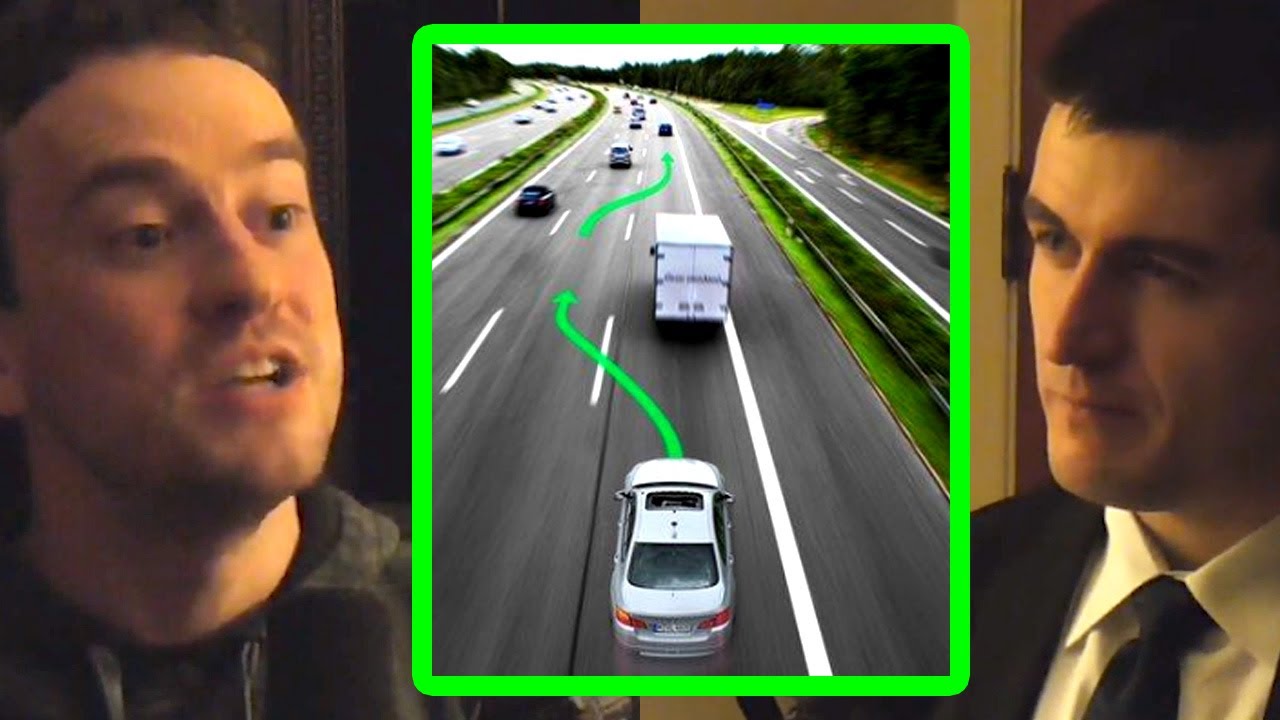
George Hotz: 3 Problems of Autonomous Driving: Static, Dynamic, Counterfactual | AI Podcast Clips
Watch on YouTubeVideo summary
In this discussion on autonomous driving challenges, George Hotz outlines a framework dividing the problem into three distinct categories: static, dynamic, and counterfactual. He notes that while companies like Cruise Waymo, Aurora, and Zoox utilize similar codebases derived from DARPA Urban Challenge technology, there remains significant room for breakthrough innovation in areas such as high-definition mapping under all weather conditions or advanced simulation environments. Hotz emphasizes that the first category, known as the static driving problem, involves scenarios where a vehicle is effectively alone on the road. This challenge can theoretically be solved with 100% accuracy using precise HD maps and localization systems, which allows for deterministic planning similar to how tractors are statically scheduled in farms to avoid collisions without needing real-time reaction from other agents. However, Hotz clarifies that solving the static problem is far more difficult than it appears when considering real-world conditions like lane drifting or deteriorating road markings. He points out that current systems often fail because they cannot maintain perfect localization across varying weather and surface states; for instance, Tesla's tendency to drift out of its lane represents a failure in this fundamental static domain. While he acknowledges that building high-quality localizers using LiDAR can achieve centimeter-level precision over vast distances like 100,000 miles with fallback conditions, the goal is to reach a reliability level akin to Özil D where the vehicle never operates without knowing its exact position. This ensures that even if minor errors occur, they do not lead to catastrophic failures or situations where the car is significantly off-course and unaware of it. The second category addresses the dynamic driving problem, which arises when other agents are present on the road, such as a car stopped at a red light or moving traffic. Unlike static objects defined in maps, these entities must be detected in real-time because their presence and behavior are uncertain; one cannot predict whether an object will remain stationary or move based solely on pre-existing data. Solving this requires robust models of human behavior to anticipate how other drivers might act, including the possibility that they may step out of line with expected patterns. This layer adds significant complexity compared to static navigation because it demands continuous perception and prediction capabilities rather than just precise map matching. The third and most difficult problem is identified as the counterfactual challenge, a concept Hotz associates with Judea Pearl's work on causal inference. In this scenario, autonomous vehicles must understand not only what other agents are doing but also how their own actions influence those agents' behaviors in ways that were previously unobserved or hypothetical. Since most current traffic consists of human drivers who do not follow programmed rules perfectly, the only viable method to address counterfactuals is through reinforcement learning on a massive scale involving all vehicles simultaneously. Hotz envisions a future where these systems can explore maximum exploitation strategies once fully deployed, allowing them to learn from and adapt to the complex, unpredictable interactions of human traffic in ways that static maps or simple dynamic models cannot achieve alone.
Read the full video transcript
[Music]
so the way you leapfrog right is you
come up with an idea or you take a
direction perhaps secretly that the
other people aren't taking and so cruise
way mo even Aurora no Aurora Zuke's is
the same stack as well they're all the
same codebase even and they're all the
same DARPA urban challenge codebase it's
so the question is do you think there's
a room for brilliance and innovation
there that will change everything like
say okay so I'll give you examples it
could be if revolution and mapping for
example that allow you to map things do
HD maps of the whole world all weather
conditions somehow really well or
revolution is simulation to where the
the what you said before becomes
incorrect that kind of thing I knew room
for breakthrough innovation um what I
said before about oh they actually get
the whole thing well I'll say this about
we divide driving into three problems
and I actually haven't solved the third
yet but I haven't idea how to do it so
there's the static the static driving
problem is assuming you are the only car
on the road right right and this problem
can be solved with 100% with mapping and
localization this is why farms work the
way they do if all you have to deal with
is the static problem and you can
statically scheduled your machines right
it's the same as like statically
scheduling processes you can statically
scheduled your tractors to never hit
each other on their paths all right
because they're you know the speed they
go at so so that's the static driving
problem Maps only helps you with the
static driving problem yeah the question
about static driving yeah you just made
it sound like it's really easy it's real
easy how easy how well because the whole
drifting out of lane when when Tesla
drifts out of lane is failing on the
fundamental static driving problem Tesla
is drifting out of lane the static
driving problem is not easy for the
world the static driving problem is easy
for one route and one route in one
weather condition with one state of lane
markings and like no deterioration no
cracks in the road I'm assuming you have
a perfect localizer so that's all for
the weather condition and me the lane
marking condition that's the problem is
how could you how do you have a perfect
you can build perfect localizers are not
that hard to build okay come on now with
with wood lighter why don't ya wood
lighter okay why don't ya but you use
lighter right like use lidar build a
perfect localizer building a perfect
localizer without lidar it's gonna be
it's gonna be hard you can get ten
centimeters without liner you can get
one centimeter with light our main
concern about the one or ten centimeter
I'm concerned every once in a while
you're just way off yeah so this is why
you have to carefully make sure you're
always tracking your position you want
to use lidar camera fusion but you can
get the reliability of that system up to
a hundred thousand miles and then you
write some fallback condition where it's
not that bad if you're way off right I
think that you can get it to the point
it's like özil D that you're you're
never in a case where you're way off and
you don't know it yeah okay so this is
brilliant so that's the static static we
can especially with lidar and good HD
maps you can solve that problem easy
no you just the static static I'm so
he's very difficult for you to say
something's easy I got it it's not as
challenging as the other ones okay well
it's it's okay maybe it's obvious how to
solve it the third ones the hardest oh
where do we get and a lot of people
don't even think about the third one huh
and you can see it as different for the
second one so the second one is dynamic
the second one is like say there's a an
obvious examples like a car stopped at a
red light right you can't have that car
in your map yeah because you don't know
whether that car is gonna be there or
not so you have to detect that car in
real time and then you have to you know
do the appropriate action right also
that car is not a fixed object that car
may move and you have to predict with
that car will dim alright so this is the
dynamic problem
yeah so you have to deal with this um
this involves again like you're gonna
need models of other people's behavior
do you are you including in that I don't
to step on on the third one
but are you including in that your
influence and people ah that's the third
okay
that's the boom we call it the
counterfactual yeah I believe that I
just talked to Judea pearl who's
obsessed with counterfactuals oh yeah
yeah so the static and the dynamic yeah
our approach right now for lateral will
scale completely to the static a dynamic
the counterfactual the only way I have
to do it yet they don't give you thing
that I want to do once we have all these
cars is I want to do reinforcement
learning on the world I'm always gonna
turn the exploiter up to max I'm not
gonna have them explore but the only
real way to get at the counterfactual is
to do reinforcement learning because the
other agents are humans
you