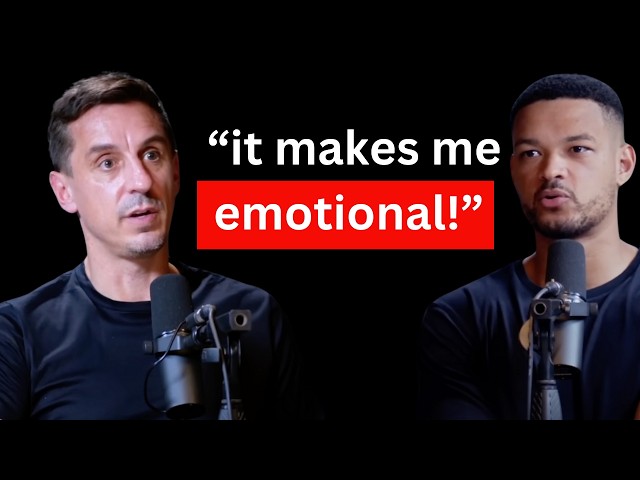
Gary Neville: From Football Legend To Building A Business Empire | E170
Watch on YouTubeVideo summary
Gary Neville opens his discussion on building a business empire and maintaining personal resilience by reflecting on the intense work ethic instilled in him from childhood. He describes how his father, a lorry driver for Constellation Luggage who also pursued commercial roles with Lancashire Cricket Club, would wake up at 4:00 or 5:00 AM to complete his main job before taking them to sports and doing fundraising afterward. This relentless schedule taught Neville the value of fitting as much into a day as possible, though he acknowledges the physical cost was evident when his father suffered health issues in his forties. Similarly, Neville collapsed with a fit at age 42 after years of overexertion, leading him to realize that while drive is essential, one must learn to slow down and prioritize mental and physical well-being through "mini-retirements" rather than long sabbaticals. The conversation shifts critically to the current state of Manchester United, which Neville attributes to a lack of leadership, vision, and direction from the top following the departure of Sir Alex Ferguson and David Gill. He argues that an embedded rot has developed within the club's culture, comparing it to an underperforming school placed in special measures due to poor governance rather than student ability. While he expresses sympathy for current players who feel alone without experienced mentors like Roy Keane or Peter Schmeichel to protect them during difficult moments, Neville is particularly critical of Cristiano Ronaldo's desire to leave the club. He believes that while Ronaldo possesses immense individual talent and resilience, a star player cannot single-handedly fix a toxic culture; instead, they need the guidance and patience provided by figures like Sir Alex Ferguson to thrive in such an environment. Neville also addresses his personal life and family dynamics with significant vulnerability, noting that he rarely mentions his mother's profound influence compared to those of his father or football legends. He admits guilt over not calling his parents daily as frequently as he did when they were alive, contrasting this with the open communication styles common in modern generations versus the stoic "don't whinge" attitude of their generation raised post-World War II. Despite feeling that his mother and her family are far better people than himself for prioritizing family above all else, Neville struggles to balance his demanding business portfolio—which includes a university, hotels, and media ventures—with being present for them. He highlights the dangers of suppressing emotions until they manifest as addiction or health crises, urging listeners to encourage open dialogue within families rather than hiding problems in silence. Looking toward the future, Neville outlines plans to focus on one specific project between ages 50 and 60 after establishing himself across media and business over his last three decades post-football. He emphasizes that he does not view life as having a finish line but aims for continuous growth without exit strategies, particularly regarding his university venture UA92. When asked about the ingredients of happiness, Neville identifies solitude in nature, such as skiing on mountains to escape constant noise, and spending time with children during their "good space" as key components. He concludes by expressing regret that he never told his mother how much she meant to him while they were together, a sentiment echoed when discussing the sacrifice her father made for his honeymoon, reinforcing his belief in acknowledging those who keep us grounded before it is too late.
Read the full video transcript
That's making me a little bit upset.
Fantastic. Incredible, man.
It's the owners of that business. It's
really simple. Joke. I don't think
anyone can believe it. One of the things
that people don't [music] know about you
is just the scale of your business
portfolio. It's quite honestly mental.
The only thing you can ever do in life
is work as hard as you possibly can and
never give in.
What is the cost? I basically collapsed
to the floor and had a fit. I went to
hospital, had checks, and [music] then
found that I need to slow down a little
bit. And I'd stopped doing the things
that kept me well. And I'd just run
myself into the ground. So, I knew that
that that point then I needed to see
somebody. Manchester United are failing.
I do feel sorry for the current players,
and that won't go down well with a lot
of Man United fans. These players go out
onto the pitch now, they feel alone. But
that's where I am a little bit critical
of Cristiano. You're the star. Now's not
a time to throw your arms around. Now's
the time [music] to make sure you lead
those people. Resilience and robustness
and hard work can be taught and learned.
I don't [music] think it's something
you're born with. The minute I joined at
11 to the minute I left at 36, Man
[music] United got everything out of me.
Everything.
Of all the people I always talk about
having the influence on my life, [music]
I never mention my mom and her mom and
dad.
They're far better people than I [music]
am.
That's making me a little bit upset.
So, without further ado,
I'm Steven Bartlett, and this is the
Diary of a CEO. I hope nobody's
listening. But if you are, then please
keep this to yourself.
[music]
We are a normal working-class family.
There are no famous sporting ancestors
in our in our family. Yet, somehow we
won a combined 218 caps for our country
at football and netball between us.
Tracey Neville MBE, my sister, went
twice to the Commonwealth Games and
World Championships, representing
England 74 times and coached the
national team.
How and why is that possible? That three
siblings in a family reach sport
sporting greatness when there isn't a
long lineage of,
you know, the granddad was at Manchester
United, this person was at this club,
and they opened doors for me.
I don't know, really. I I I
I'll start at the end because I was
having a conversation yesterday about
um
It was actually how long should you take
off after you've had a baby as a couple,
whether it be the the man or the woman.
And I was thinking about my sister, and
she took like two or three weeks off,
and then she was back at it.
And also
my father passed away 7 years ago, and
on the morning of his funeral, I went
and presented
uh our project St. Michael's at a
council meeting, and then went and got
ready at home and went to his funeral
straight after it.
And someone said to me, "It's not normal
that."
Uh uh And my sister
my dad passed away in Australia whilst
he was whilst he was watching my sister
play for the Commonwealth Games.
And me and my brother flew straight over
there.
My sister
was still coaching the team. She never
broke stride.
And he was on a ventilator keeping him
alive even though he'd actually, to be
fair, passed away. And they were just
waiting for us to get over.
The day after we got there,
my sister said, "I've got a game
tomorrow. We can't pronounce that he's
actually dead until after I've finished
the game and I come back to the
hospital."
And when I think of that,
that's the end I suppose in terms of
that sort of that feeling of just that
drive, that commitment to what we do.
I I I
People say it's not normal. Someone said
to me say it's not normal that that we
would continue our lives irrespective of
And that probably came from my dad and
from my mom.
But I think of it as in different layers
for me personally. I don't know what it
was like for my sister or my brother,
but for me personally, I think of it as
being The first layer was my mom and
dad. That love for sport, that
commitment to get there early to do
things. My dad used to say, "Get up
early, get there early, get your job
done."
And then when I got to United, I'm hit
by Nobby Stiles, Brian Kidd, you know,
Man United European Cup winners of 1968,
and then Eric Harrison, a northern tough
Yorkshireman who every single day
drilled us about what it was to be a Man
United player. And then you're exposed
to Sir Alex Ferguson and Roy Keane and
Peter Schmeichel and Mark Hughes. So,
these different layers
of you know, monstrous mentalities of
people who are just massive leaders.
We've been exposed to them. I was
exposed to them.
And that's why I always say that
resilience and robustness and hard work
can be taught and learned. I don't think
it's something you're born with. And I
think when you say like how did we
achieve that, I just think we're very
fortunate with our parents and the
exposure that we had to brilliant
leaders throughout our career and
examples and the standard bearers that
were next to us.
Learning through words, those words that
your dad would say to you about getting
up and getting out of it every morning
is a great way to learn, but actions, I
think in my hindsight, seem to be the
best way to to really learn those
lessons vicariously from observing our
parents and how they're behaving in
their lives. I I know I'll never forget
the day that I saw my mom my mom stopped
coming home, and then I asked my dad
where she was, and she said, "Oh, she
sleeps in the back of the shop now."
This corner shop she was running. And
then going there and seeing this bag of
rice that she was sleeping on that had
all these rat holes in it from where the
mice and rats had been eating it. That
visual of that she was working that
hard, even though she didn't have to, to
support our family, that she was
sleeping in the back room every night
and not coming home was was a lesson
that I learned without her saying a
word. Yeah. What are the lessons that
you learned from your cuz you cited your
dad there
as being pretty in in um
a pretty go-get-'em person.
How was he functioning in professionally
that taught you these lessons?
He was a lorry driver, and he basically
worked for Constellation Luggage, which
was just luggage, you know, suitcases.
And he had to do three drops a week at
Daventry, which is south of Birmingham.
And he actually had to get them there
basically by the end of Monday,
Wednesday, and Friday.
But we had a We lived in a two up, two
down terraced house.
And every time my dad got up, you can
hear your dad get up when you're young,
you just you just hear it because it's
obviously that you know, the lights come
on and you hear the sort of noise, the
floorboards are creaking.
And we always get up early as a family
anyway, but 4:00 5:00,
you'd hear my dad. We lived in the back
We were in the back bedroom, and his
his lorry his wagon was parked at the
back when he was doing to do a drop the
next day.
And he'd leave at 4:00 5:00 in the
morning on the Monday, Wednesday, and
Friday. He'd take the suitcases, he'd
wait for the depot to open at sort of
7:00 8:00, drop them off, and he'd be
back and have his job done by 11:00. And
then he'd start to go and do his what
would be his commercial work, the
fundraising for testimonials, the thing
that he loved for say for instance
Lancashire Cricket Club. That was his
passion. That's how he got into Bury
Football Club as a commercial director.
And into foot foot cuz he But he had he
had a sales mentality, my dad. But he
he'd get his his main job done by 11:00
every single morning. He'd be Daventry
and back in a lorry. And then after
school, he'd take us to football, and
he'd take us to cricket. So, the amount
he fit into a day was unbelievable. You
know, he'd almost do two jobs. He'd do
his job which was his main job, which
was earning him his money, which was a
lorry driver. He'd then come and do the
job, which would be potentially could he
do some sort of like side job selling
for like Lancashire Cricket Club or
Greenmount Cricket Club. He did He
organized dinners and events and things
like that. And then his family would
come after school where he'd he'd put
them into sport. We'd go to United in
the evening, or we'd go We were at
United from 11:00 11:00
Monday and Thursday night. So, this
constant drive of trying to fit as much
as you possibly can in the day. And
that's where I sort of the attack the
day was from my dad. Get up, get there
early. Let's make sure we're there. Even
at United, we'd get there early on
Saturday. There
was never any risk with the time of
being late. I feel sometimes that that
is a good thing. It's It's put that into
us. But sometimes to live by that now,
particularly with the
It's hard to keep Yeah, it's hard to
keep on doing it.
had heart problems at a very early age
of the age of 42. You know, he's a lorry
driver. You know, he liked to go for a
beer.
He liked a night out. He did too much.
He got stressed. All the things that I
think
[laughter]
So, you think there's a lot I can see in
my dad of me. Um but I don't think I can
change it, really. [clears throat]
What is the cost? Because for everyone's
I sat here with Tim Grover, who actually
coaches a lot of the young United
players now.
Yeah. Coached Michael Jordan and um Kobe
Bryant for a span of 15 odd years. He
was their their sole coach. And he said
for all everyone's greatness, the thing
that causes their greatness, in your
case, you know, that drive and that
ruthlessness and that dedication caused
you to become a Man United legend and
all these other things. But what is the
cost on the other side that people don't
don't see? From He He referred to it as
we have our light side and we have our
dark side. The dark side is a
consequence and a unavoidable
consequence of the light side. Yeah.
What was that dark side for you and your
dad? Um health, I think.
And I've seen that in the last couple of
years with myself. I think
Physical health?
No.
I've had
I've said this, to be fair, on something
that I've done myself in the last week
on The Overlap.
Um
I actually, to be fair,
um
Raheem Sterling scored the goal in the
uh
European Championships against Germany a
year and a half ago.
And I basically collapsed to the floor
and had a fit.
And after that,
I went to hospital, had checks, and then
found that, you know, I need to slow
down a little bit, basically. And it's
It's similar things to what my dad was
told in his forties
that you know ultimately I do too much I
think too much I need to relax more you
know to be fair my wife says it quite
often
you hear but you're not present
[laughter]
so and Justin was in doing interview the
other day and
it was with Jeff Shreeve Jeff Jeff known
me 15-20 years
he said the problem is when I'm asking
you a question
you've got my question inside the first
two seconds let's say it's a 10 second
question you've got my question inside
the first two seconds the next eight
seconds you're thinking about what
you're doing after I can see it in your
eyes already and he's right
so even during this interview I'm
speaking and sometimes I lose my way in
an interview and I have to forget what
the question was and quite often I'll
say what was the question you know if
I'm on a stage doing like a Q&A what did
you actually ask me cuz I've actually
drifted off whilst I'm answering the
question to something that I need to do
later
and it's I'm never present so the the
consequence is that maybe
I remember Sir Alex saying to me he
missed his children growing up I am
missing my children growing up that's a
consequence of my life I've been in
London for four days
you know but
what can I do I've got I come down to
Brentford Manchester United I then stay
down Sunday because I don't I can't get
a train back the trains there's a train
strike and then I'm down doing Monday
night football and I'll go back today
last week I was down for another four
days but it's what I do I I love what I
do I wouldn't change it but this
afternoon I'll get back to Manchester
I've got meetings till 6:00 and then
tomorrow it's I'm full all day Thursday
I'm in Glasgow doing a a dinner with Sir
Alex Ferguson so it is a constant sort
of every single day that I feel like I'm
filling days with things that I love and
want to do
but then you say to yourself you do have
those odd moments more now why am I
doing all this
why you doing this now
you love doing it maybe you know it's
what you enjoy but you sometimes have
those moments don't you I have more of
those moments I think why am I doing
this why have I got two hotels why have
I got a football club why have I got a
university why have I built an overlap
channel I'm on young sky why am I doing
these things but it's it's that idea of
I suppose
cramming as much into your life as
possible thinking you've just only got
this sort of short period of time
and
Brian Kidd used to say to us get your
pace early you can't make it up at the
end
and we used to sprint and sprint in our
runs and sprint
and that means if you collapsed at the
end and you didn't quite finish it or
whatever it's better than managing
yourself and thinking I'll save a little
bit we I have to say the players that I
played with at Manchester United we
never saved anything it was all left out
there on the pitch
and I I think that's how our our lives
are since as well we just leave
everything out there on the pitch
there's nothing saved so we just end up
I suppose saturating every single second
of every single day
I used to think that I was driven I used
to think that you know and that sounds
like a very good framing I'm driven I'm
motivated I thought that's what was cuz
you said right why am I doing this after
I do this podcast there's maybe you know
10 of the companies that I'm running I
have zero time in the day and then I try
and cram in my girlfriend and my family
and do a very bad job of that I used to
think it's because I'm driven and I'm
just whatever and then I asked myself a
question which I when I met Eddie Hearn
I I saw the same thing I mean his book
is called relentless
are we really driven or are we being
voluntarily driven as in we're making
the choice to drive towards something or
are we being involuntarily dragged by
some kind of insecurity or some kind of
discomfort with
the prospect of not being busy cuz for
me I'm convinced these days that I'm
probably being dragged by an insecurity
maybe but I developed it from a young
age yeah maybe I'm not sure I don't I
don't know I don't cuz could you stop I
don't feel
not sure cuz this idea that you know if
you stop it'll kill you and all that
sort of stuff slow down I do feel like I
need to slow down I read a book I think
I can't remember what it was a few a
couple of years ago where it talked
about you can never really retire
if you love work and you are relentless
but what you can have is mini
retirements during the year and that's
what I've tried to do I don't do it very
well so for instance this weekend I'm
going to Spain Friday till Monday
morning
I call that's a mini retirement
so that's a weekend it's a weekend it's
a mini retirement it's where I basically
can say for three days I'm there and
I'm basically taking I don't think about
work now I will but and sometimes some
of my best my best ideas come when I'm
on these types of trips but then in six
weeks I'll have another mini retirement
for five days or four days rather than
thinking you're going to stop for six
months and sort of have a sabbatical
that's not probably going to happen with
people like you or I because we just
basically don't work that way so to have
lots of mini retirements during the year
is what I've tried to do in the last few
years I'm not sure I'm doing it very
successfully I'm not sure what's wrong
with us if that's what you're asking is
there something wrong with us I don't
feel insecure or vulnerable I don't feel
insecure or vulnerable at all I feel
I feel I feel so confident and I feel
not confident I feel like I've got
coping mechanisms built to deal with
things so I there isn't any criticism
there's very very little criticism that
I receive now that even touches the
sides of me and I get criticized heavily
on social media through my football
punditry my opinions whatever it may be
because of what I went through at United
losing that confidence at the age of 24
post treble going through that difficult
patch where I didn't want the ball
seeing the psychiatrist on my own only
doctor knew not talking about it till I
was 35 but what that psychiatrist gave
me was coping mechanisms and perspective
I just ask you know if I go through a
difficult moment now
I ask myself the question will I come
out of it at the side did I expect every
day to be a good day
no I don't expect every day to be a good
day so when the bad day comes and it's a
really bad experience or you have a make
a bad business decision did you think
you would make every decision would be a
good decision in business no it wouldn't
be a good you're not going to make the
right decision every single day you're
going to have bad decisions bad choices
bad days so when they come now I can put
them into perspective and move on really
comfortably
so
I feel like I'm I don't feel vulnerable
or insecure
I'm not quite sure sometimes you know
people say I've got a strategy I've got
a plan
not quite sure any of us have really
because the reality of it is we don't
know what door is going to open next you
don't know six years ago five years ago
that Dragons' Den is going to come and
knock on your door you don't know that
you haven't got a clue or 10 years ago
certainly you don't know that's going to
happen in your life but when the knock
on the door comes you think
I fancy walking through that door
and probably the same with me when
things have happened in my life where I
thought I didn't expect that to come
yeah I'll I'll take that
so
we are probably being dragged
it's a little bit like jumping off you
go skiing you're off the sort of go off
the sort of black slope
you there's no way out of it you're
going down and you can't stop and it's a
little bit like you know I feel like to
be fair my life's a little bit like a
black slope a black slope in skiing you
you I've gone over the edge I've started
what can I do now slow down say to my
businesses say to the teams that I work
with sorry I don't fancy this anymore
well thanks for that but you we're here
still what what's I've got no choice
I've got no choice you've got no choice
[laughter]
we're in
I read this book called The Body Holds
The Score and I was actually speaking to
one of my best friends yesterday who was
an extreme workaholic and then he
started having panic attacks he ends up
in hospital and he said to me he said I
felt fine
but the body goes gives out first the
body will you know when the mind is
telling you no you can cope with this
you're doing fine the body will show you
in a pretty
drastic fashion that you're not okay and
that you need to listen to to yourself
ever since you you collapsed on that day
have you made [clears throat]
changes honestly
cuz I'm going to ask I'm going to ask
you I'm going to ask Emma
[laughter]
I did
I did I
I have I think
but then it's the actual sustain it's
sustaining the changes and not dipping
back into your old habits
that's the problem
that's to what do I do I train four five
times a week I wasn't always training
pre that
I try
I've got a sleep ring and it focuses me
more on the time I need to sleep at
night and but then
I don't always wear it now you know it's
a couple years later it's in my bag it's
here I didn't wear it last night and I'm
annoyed with myself cuz I didn't wear it
last night cuz I forgot to put it on
when I got back
so habits really that sort of do you
drift back into your old habits
I try not to pick my phone up when I
first wake up but I feel I'm failing
miserably at that
I'm failing miserably but I have to take
an email off my phone I've taken
WhatsApp off my phone
because they're things that I think were
emails if I think if you wake up to an
email
at 4:00 in the morning that's an email
that's not a great email let's say it's
something that you think I've got to
deal with that you aren't getting back
to sleep so I've taken email off my
phone it's only on my iPad it helps
WhatsApp I mean WhatsApp announced last
week that they were going to sort of
this idea that you you couldn't
you couldn't be joined in groups and
people didn't know when you were online
I just felt like it was an intrusion
WhatsApp I felt like people were
attacking me a constant attack of added
to groups and they see that I'm online
and things like that
and I
oh no
get off get away from me so I just do
iMessage now
and I say to people ring me
so there have been changes that I've
made that are helpful
because I do feel email is
[sighs]
I love speaking to people so I lived in
a dressing room where the camaraderie we
didn't email each other at Manchester
United Sir Alex Ferguson didn't email me
we had a brilliant team spirit in the
club we were there every single day we
spoke to each other
we socialized with each other we'd help
each other we knew each other
and that's how you build a team spirit
and I felt that sometimes email can be I
know it needs to happen in businesses I
know that you need to see attachments I
know you need to communicate with each
other I do believe that they can be
quite damaging to culture sometimes,
particularly if the wrong tone is on the
email. I think you can be mis-
misunderstood on email. I think it can
come across harsh. I think they can put
pressure on people. And I realized that
the first 5 years out of football, I was
emailing people 5:00 6:00 in the
morning.
But you imagine, you know, you emailing
people at 5:00 6:00 in the morning, the
impact that's going to have on them when
they wake up.
I've got to deal with that. I've got to
email them back. It's like, that's not
fair. It's not right. So I have made
quite a few changes, but probably not
enough.
Yeah, I I completely agree. I don't I'll
be on the people this will surprise
people. I look at my emails once a week.
Oh, wow. So my my assistant looks at my
inbox and then if there's she puts them
on my list and then I go to my list when
I'm ready. And also with all my
WhatsApps and all that stuff, all
notifications off. And it's just for me
trying to take back control of my time.
So I choose when I go to it. It doesn't
notify me that that it needs me now. And
I used to have email dread. Yeah. You
know, early mornings, especially when
you're running a big company, you've got
what, 600 employees or more?
Yeah. There's always going to be
something wrong.
There is. Yeah.
doesn't care what time or occasion, it's
going to interrupt you. There's always
going to be and I don't want that
anxiety in my life.
Also, if there is a problem and
something's gone wrong, then just ring.
They can call you. Yeah, ring me. Just
ring me. Anyone can ring me and just say
like I've got a problem and then we we
drop everything, don't we? I always feel
like it's the biggest responsibility I
have is to the people that I work with.
And if they ring me and they're they're
in trouble, they've got a problem, we
have to deal with that. That's an
absolute immediate.
You always going back to your early
years in football and as you came
through the ranks, you you always and
I've seen this in multiple interviews,
kind of a little bit self-disparaging
about your own abilities.
you.
[laughter]
I just played with brilliant players,
didn't I? I mean, if you think about it,
just go through the players who I played
with. Jaap Stam,
you know, Denis Irwin, Peter Schmeichel,
Roy Keane,
to to David Beckham, Cristiano Ronaldo,
Dwight Yorke, Eric Cantona. Every single
one of them had more talent and ability
than I did.
You know, they just they just did. It
was just obvious around me. When I got
to United, the juice about insecurity,
the only time that I ever felt insecure
was when I got to United at I got to
United at 11.
And I joined at 11 and there was a
center of excellence group and then we
got retained every single year. But at
14 is where it gets really serious and
they start deciding the the school boys
and the outer town lads come in.
So all of a sudden, you were exposed to
them, to Beckham, to Scholes joined at
14, all these brilliant players.
And you think, how am I going to survive
here? I could just I'm aware.
I know my own abilities.
Um and
I had to I had to just do things
differently. I was a midfield player,
then I was a center back, then ended up
at right back.
You know, there is an element of truth
in what Carragher said. No one wants to
grow up to be a Gary Neville, meaning no
one wants to grow up to be a full back.
Everyone when they're a kid scores goals
or sets up goals and then you find out
that you're not good enough to do that
and you get pushed back the team. That's
what happened with me.
I was one position away. That was the
last my last hope, right back. You know
what I mean? If I was out of the team if
I couldn't play right [laughter] back,
I'd I'd gone from center midfield as 11
year old at United, then center back
from 14 to 18 and then told I wouldn't I
wasn't good enough by my reserve team
coach to be a center back at United cuz
Steve Bruce and Gary Pallister were
there.
And then I go to to right back. So
you are aware that you're being pushed
out of your positions by better players
and that that's your only route to
success is hard work and playing at
right back and trying to adapt to that.
And then
it was good enough for me in the end,
but you know, it's it's not disparaging.
I I I knew the game. I I could organize.
I knew the game well.
I read the game well.
And
um on the pitch, I would never ever I
would never give in. So the around me,
this idea of being able to organize the
team, I could see the game in front of
me. So I had an impact I believe I had
an impact on the other players that I
played with beyond my talent through my
understanding of the game and making
sure that I never stopped going and we
never stopped going. We keep going. We
just keep pushing forward. So if we're
fighting for a goal, you know, I always
think what's the I never go into this
like level of grandiosity. I probably
never said this before. When people say
to me what's the greatest moment in my
life,
I say it's the final in '99 in New Camp
when we won the treble.
But that I I made a run from right back.
I got the corner for the first goal.
Cuz I went all I I ran sprinted over to
the left wing and took the long throw to
put it into the box. It came back out to
me and we got the corner.
It's not an assist by any stretch of the
imagination. It typifies my career of
seven goals and very few assists. I'm no
Trent Alexander-Arnold or nor even a
Denis Irwin.
But that I that that that you have to
find a way to win. You have to just do
everything you possibly can. You cannot
leave anything on the pitch. You just
sprint everywhere. You just do
everything. And that to me typified what
probably I was, that I could see
something in that, you know, in terms of
how to impact a game, whether it be
through impacting someone else by
getting them going and giving them the
ball and get and keeping them at it. Um
and that's why I think he kept me there
till I was 36 cuz it wasn't through
ability at the end. He kept me there
till I was 36 just through my influence
and my impact I had in the dressing
room. I'm I'm pretty certain of that
because it wasn't through anything I was
doing on the pitch. So I'm always
humble around my own ability because of
the talent I had around me.
And that's why I get caught on Twitter
quite often people will say to me if it
hadn't have been if you hadn't have been
at Man United, you'd been a jobbing
right back somewhere at Fulham or
Bournemouth or
Maybe I would
I've never heard anyone in a higher
managerial position disagree with the
phrase that hard work beats talent when
talent doesn't work hard.
Yeah, I mean, that's one thing I could
never ever
I could never ever be accused of
anything other than from the minute I
joined at 11 to the minute I left at 36,
Man United got everything out of me,
everything. And to be fair, the club
gave me everything. So we we didn't owe
each other anything.
Um and that's something I'm proud of.
Longevity is actually probably one of
the one of the things that consistency
and longevity, being able to
consistently work hard every single day
at a good level of performance and turn
up every single day and be there is
underrated actually. And that's the
thing that to me for surviving at 25
years under Sir Alex Ferguson in that
environment of excellence and demands
that he placed on people was,
you know, it was a great achievement,
but I did that with a lot less talent
than the other players in the club.
When was the first time you realized
that Sir Alex Ferguson was
you you felt his influence.
You felt
his mindset.
You know what something in the early
days, it was the old school like head
teacher. No, he's not a head teacher by
any stretch of the imagination, but you
got a little bit of fear that you maybe
have of your father as well. If your
father sort of gets a bit angry with
you, you know, that little bit of that
dominating male
of the '70s, '80s, '90s, probably going
back beyond that, was was apparent in
Sir Alex Ferguson that, you know, you
knew when he walked into the room, the
room went quiet. There was that
presence, that aura. The boss is here.
And so you felt it straight away.
When people say to me sort of, how did
you keep coming back every single year
and continue to keep winning? What was
the secret of that?
It was by his actions and what what he
did. I always remember when I was 30
When did we lose the Champions League
final? 2009, so I'd have been 34, right
near the end of my career.
Uh I was doing my um
We played the Champions League final on
a Wednesday, we lost.
We got back on the Friday
from Rome or Thursday or Friday. On the
Saturday, I had to go and pick up my
boots at Carrington, the training
ground. So it was a Sunday morning. I
had to go and pick up my boots at
Carrington, the training ground to go to
St. George's Park cuz I was doing my A
license coaching badge.
And it was my final assessment.
And I went in at 7:00 in the morning.
I'd organized to meet with the caretaker
who was basically there on site all the
time to let me in.
And I parked on the back
and they his office lights on and he's
there in his chair.
I thought, oh no, I don't want to see
him. We'd just lost the European Cup
final four four days ago. So I drove
around the front and went and got my
boots and moved out. But he was there
Sunday morning, 6:30 7:00, the only
person in the building with his light on
four days after we'd won the European
Cup final. And he'd been in his mid-60s.
And I thought,
no one can live with that. The
That That's the reason he's winning.
That's the reason he's winning cuz no
other manager,
no other leader that I know,
four days after that defeat in his off
time in the summer is in his office on a
Sunday morning at 6:30. And he didn't
know he didn't know I was coming in
obviously and he didn't see me either. I
just saw you could just see him in the
distance. It was
I couldn't believe it. And it just all
those sort of examples of that work
ethic
they hit you every single day. And he
knew how to tap into here. He knew how
to get you. No matter who you were in
the dressing room. He always used to get
me. I always say this by mentioning my
He used to used to used to mention my
grandparents. What about your
grandparents? Getting up every single
day, putting their tie on, the work that
they put in,
how they never complained about
anything, you know, what they must have
lived through obviously in the Second
World War.
And he would say things like that in his
team talks and it would always tap into
me cuz I used to sit with my mum's dad
and look at his medals that he'd had he
got during the Second World War. He'd
had three or four wounds. He had
shrapnel wounds in his shoulders that he
could still show me and bits and bits of
metal still in his body. And he would
talk to me about the medals and where he
got them from and how he'd been in
Holland and how he'd sort of had to come
back and then he went back over, how he
married my nan on one of his returns
back.
So that used to get me every single
time. So when I used to play for United,
when you think about what motivates you,
what gets you going,
and he used to mention say for instance
grandparents. And there's that difficult
moment on a pitch where you think, we're
struggling here a little bit.
And now I think of my youngest daughter
when I'm training. What keeps me going
to the end of that training session?
I think of silly things.
If I don't keep going here, someone's
going to get my youngest daughter and
I'll there's nothing going to get her,
so I've got to keep going. And there is
my is was is was grandad, my mum's dad.
And I used to think he wouldn't he
wouldn't stop going. He came back having
been wounded twice and trapped in the
wounds twice and went back out
to fight again.
And he had those medals and he would
speak to me about it.
And I used to think how can I stop? But
he would tap He would find that in me.
Sir Alex would push He would push those
buttons and press those buttons. For
someone else, it would become something
completely different, I'm sure.
It might be talking about the father. It
might be talking about him going on
strike in the government shipyards. It
might be talking about another
experience that he's had, but he would
tap into everybody in the dressing room
in some way that would mean they'd find
something
to mean they would never give in. And
that's what he You know, his film's
called Never Give In. He never gave in.
But also the influence he had on others
never to give in through finding
something in them was was incredible.
Rio talked to me a lot about culture and
the culture that Sir Alex Ferguson said
everyone said the same thing. Having
left football now and working in the
world of business, you might must be
looking back on the culture he created.
Yeah.
And in some ways drawing a lot from that
in your own businesses, right? What
What have you learned about the
importance of culture? Because There was
this comment Rio made to me on the
podcast that I've never forgotten, which
is about Sir Alex Ferguson's like lack
of presence at the training ground. Rio
said he only came into the training
ground training room dressing ground a
couple of times because he didn't need
to. The culture was in there. Yeah. And
then Rio talked about how then when Rio
went and moved on to another club, in
that same dressing room players are
talking about how much money they're
making and then all of these other
things which would never have happened
at United.
No.
How How does How does one create that
culture?
I suppose
being grounded.
He was grounded and he believed in the
sort of the work Work ethic was
everything to him. Being proud Being
proud to work hard. Being proud of the
people around you work hard.
Uh being proud of your teammates. He
used to say, "Look around the changing
room. Look around. I'm proud of every
single one of you, but look at each
other. Look at what you each do for each
other on the pitch and how you can't
achieve what you're going to achieve
without each other." So he made us
respect each other. Not everybody got on
in our changing room, but most of us
did. Um
but he tapped into those things all the
time. It It It was It was It was
non-stop and being grounded
um looking after people. Little things
like when Wendy used to get the charity
balls signed.
Um and Roy Keane was like this as well.
So Wendy every Thursday would have 30 to
40 charity balls that we would sign and
then they would go to the children's
charities or the different charities in
Greater Manchester or in the country.
And sometimes you're in a rush, aren't
you? You're a football player. You're
young. Ah, Wendy, I'll sign them after.
I'm just I'm going to have a massage.
I've got to go and do my stretching.
I've got to have a massage. I've got to
go and have treatment. Whatever it might
be that you say on the way in to
poor excuse that you'd give. Or maybe
you just generally did. And there was
one day where he basically, I think Roy
had walked past Wendy. She was a little
bit upset and only five players out of
the 23 in the squad had signed the
balls.
And Roy went upstairs and said to Sir
Alex, "It's an absolute disgrace. This
has happened a couple of weeks now."
He killed us. He absolutely killed us.
The lack of respect
to to walk past Wendy, who was there to
get the charity balls signed and not
sign them for her, for him was a a
dereliction of duty. It was a lack of
respect. It's not what you do.
We're equal in this football club. We
treat each other equally. We look after
one another. We make sure that we're
sort of compassionate. And the idea of
not doing things like that, little
things like that um I think just little
things like that stand out in my mind.
So now sometimes I walk into the
businesses and you know what we're like.
We sometimes walk in on our phone and we
don't say hello to people because we're
that immersed in our own blinkered sort
of space.
But then I'll walk past sometimes and
I'll realize I've not said hello to
someone. I'll go back and say, "I'm
really sorry." And I'll I'll you know,
I'll say, "How are you okay?" And
I do feel like even when in the office
there is no
I sit next to people in the office. I
don't sort of have my own glass tower.
Yeah, I don't I don't I I make sure I go
and sit in Cafe Football in the hotel or
I go and sit in the main restaurant at
Stocks or at Salford. I'll just go and
sit in the main office because the idea
that basically we don't He was He did
have his own office and he did have his
own space. And he did, to be fair,
delegate and he would keep his But I So
I don't think I'm I'm like Sir Alex in
the way in which I now
look at my business because I do believe
it's very different now.
Um
but he was very The staff loved him.
Everybody loved him at the club because
he protected them. He knew everybody's
name.
He asked about the families. He knew the
families' names. He He was really,
really attentive. He's He was far better
than I am. Far better than that than
that than I am. But I probably, to be
fair, mix with my teams more than he
maybe would. So
but the work ethic is the thing.
Honestly
the only thing you can ever do in life
is work as hard as you possibly can and
never give in.
And he said, "You've got that choice
every single day." Really simple. That's
it. The talent you've got you just work
as hard as you can every single day and
never give in and then you come back the
day after and do it again. And that's
it. That's the secret to what he
believed cuz he said the talent
is his problem.
Forget talent. I've chosen you to be
here, so I'm telling you you've got the
talent. Don't you worry about that bit.
What I need back in return is that other
bit, which is the the focus, the
commitment, the dedication to make sure
every single day you get up and you're
here and you give your all and you don't
give in. And that's why I think I stayed
where I was because I believed in him. I
trusted in him. And now it's the same.
If someone comes into our business
and they've been selected to come in,
that's because I believe they've got the
talent or someone in our senior
management team believe they've got the
talent. All they have to do in return
now is go for it and give their all and
be enthusiastic and not give in and then
come back the day after and do it again.
And I I keep it try and keep it as
simple as that. I know there's a lot
more to it than that, but it is
it was that simple for us. I know that
then there's the tactics, then there's
the decision-making.
Then there's the the sort of conscience,
all the things that go with it, but that
was the sort of heart, I think, of every
all the messaging that we got from him.
They almost seem like old-fashioned
values.
What you're saying. It
It almost sounds, and I'm going to be
honest, it almost sounds like
what the modern-day professional culture
might consider to be a little bit toxic.
Yeah. You know what I mean? Yeah. This
this drive for hard work, but I have to
say I've never sat here with anybody
that's reached the peak of their powers
in their career that hasn't said the
same.
But now, if I'm in my businesses
so I don't things like
I I don't have I'd never work the first
week in January.
I think it's the most depressing week of
the year. After Christmas you've had a
high and then you go back. It's dark.
It's miserable that first week. So I
always take it off, but I always give
the rest of our team in the office that
I work in off as well.
So I don't make people do what I'm not
going to do. I'm going away I think in 3
weeks for 5 days and I said to everybody
in the office, "Don't worry about the
fact you've got 28 days in your
contract. Those 5 days you're off. Have
the last 5 days off of the summer, then
we'll go for it to Christmas."
Also people have flexible working. They
can come in Monday. They don't have to
come in Tuesday. They can come in
Wednesday. I trust them to do what they
want. So there is an element of yeah, I
want hard I do expect hard work, but I
also want people to have a brilliant
time and share in the success that we
have, but also make sure that if I'm off
I would expect that they have those
times off as well. I wouldn't expect
them to come in. Uh I don't I hate the
idea of a of a work package. Just got
like you've got 25 days holiday. You
have to book it in. I hate that. I hate
the idea of restriction.
I hate it. I feel like it's bullying.
You must sit there in the office. I hate
it.
It's not right. It is not right.
Don't tell people where to sit, how to
work. You know, obviously there is a
direction and there is a leadership
that's needed, but I just feel it's
really not acceptable. But you know,
this this was pre-COVID. Mhm. Our office
is like, to be fair, this this this room
that we're in here now. Mhm. So someone
could be sat there. Someone could be sat
there. Someone could be sat on the floor
over there with a with
you know, on a laptop. That's how it
should be in an office. It should always
be like that, I think. I don't think it
needed I don't think it ever I don't
think you needed COVID to make modern
business act properly with the teams
that they work with. So I
I do feel it's very different than how
we were at United, which is
old-fashioned value. There's still some
old-fashioned values. You have to work
hard. You have to get the job done. We
know that. But why do you have to say
that to people?
I think people know they have to work
hard and get the job done. So why do you
have to say that to them?
You're looking to tap into them, make
something unique in your business that
makes them want to stay, really. That's
what you saw. You make You want to make
it enjoyable. Mhm. And that
[clears throat] can still be enjoyable
through hard work.
I think
I think it's quite enjoyable working in
our Yeah.
[laughter]
I don't know what everyone else thinks.
No, well, I know people that work for
you, obviously, cuz you know, we've got
a got a got a colleague that used to
work for me that works for you now and
they're all very, very complimentary. So
that's supported [laughter] by that's
supported by the evidence that I have.
Um but you're right. I I've always found
that the contradiction there is trust.
You're saying to your team members to
trust you, but you're not trusting them.
And trust I feel like has to go both
ways. And so And there's And the other
what what ends up happening when you
have those, in my experience, those very
rigid rules, is you'll get compliance,
but you won't get like motivation. And
as you've described it, you want people
to be internally driven, not compliant
because of punishment. Yeah. And that
gets the best out of people, right?
It's interesting because
um
Valencia taught me a lot, but around
that time I was with England coaching
with Roy Hodgson. Um and I'd lived at
United where we were We were fined. You
know, Nunez got sent off last night for
headbutting
Anderson. That's two weeks' wages at
Manchester United. I got fined two
weeks' wages regularly, four, five
times.
It happens football. It's wouldn't
happen in a normal workplace, but we
know Sir Alex Ferguson's rules. If you
violent conduct or
chatting back to a referee
you get fined. It's fact. He You accept
it. People think Sir Alex Ferguson was
like get after the referees, but if we
actually got booked for having a go at a
referee, we would get fined. So, very
much quite a rigid thing. And then Roy
Hodgson said something to me when I was
with England. I I and I felt those all
standards were slipping a little bit one
time. I can't remember exactly what it
was about.
And I said, "We need some rules."
Cuz I had a we'd had a code of conduct
at United. I was the players' rep. I
knew what the the sort of standards
were.
And he said to me, "We don't set rules."
He said, "Be very careful with rules."
Uh he said, "Because it's always the
people that you don't want to break them
that break them."
I thought, "That's quite clever, that."
And
ever since, there are no rules.
There are no rules in our business in
terms of you must behave, you must do
this, you must wear that, you must you
know, I don't expect formality in in
dress. I don't I expect people to be
comfortable. So, I don't say, "You
should wear this or you should be here
at that time or we should we've got to
do that." In any part of my business, I
don't create rules anymore. Because once
you create rules,
for start, it's rigid. I don't believe
it's right. And the rules are there that
they're unwritten actually. The rules of
sort of working hard and turning up and
doing your job. All the things that that
they're the rules are there just they
just don't have to be written down.
Um and
you know, he said, "What happens if your
star player walks in
that's breaking cuz you know, you know,
the ones that you know, we were talking
about that were setting the low
standards."
He said, "What happens if one of the
star player walks in and we need to work
with the players to make sure that they
understand what we expect of them and
the standards. We don't need to set
rules because if you set rules and
consequence and punishment,
then it'll be the one that you don't
want to break them and then you're in a
big
you know, you're in big trouble. So, it
was it was a good lesson for me. And in
football, it's very much a different
place than a normal workplace anyway. It
doesn't live by HR rules, a football
dressing room. It doesn't.
It doesn't you know, players are still
getting fined.
Players still get told where to be, when
to turn up, what to wear.
We like it as well.
I still like it now actually. I I like
it to be told what to do. I actually
like it at Sky when people say to me,
"Gary, we're doing this." You know, I
like being told what to I respond to it
really well cuz I've had it to be fair
but I've been instructed from Eric
Harrison, Nobby Stiles, Brian Kidd, Sir
Alex Ferguson. I've been instructed. I
lived through the '70s and '80s. You
could not live through the '70s and '80s
as a child, early '90s, without being
instructed cuz that was the form of
leadership. So, we still respond to it a
little bit in our own lives, but then
when I think about my children, I don't
instruct them.
I like independent thinking. I like
them. So, when people talk about social
media or when people talk about, you
know, I I was sat with someone yesterday
who said, "I'm I'm fearing my
my children going on social media." I I
I always say to them, "Your children
should get good at social media really
quickly because they have to.
They have to. They have to be good at
it."
So, my children are 13 years of age now.
They're both they're all obsessed with
social media, with the apps. They're on
it all the time. And you know, sometimes
we'll say, you know, "That's enough
tonight." And you know, let's
come off it, but I want them to get good
at it.
I want them to use it and find out what
information they can trust and what they
can't trust. I use Twitter now all the
time for my well, one
to have a debate.
good at it, to be fair.
But also to actually my news my major
source of news is Twitter.
It's my major source of news in my life.
It's really helpful. I don't think as a
sports journalist, broadcaster, I could
live without Twitter.
It's really important to me. So, when
people say at Twitter is a cesspit, get
off it, there are elements of it that
are, but that's that's a really
important thing for me in my life.
Because I find all the sort of articles,
all the sort of opinions,
you know, all the breaking news is
there.
How can I live without that? It's what I
rely upon to be able to do my job.
So, when I come off the pitch last
Saturday Sunday doing Manchester United
so doing West Ham Man City and I see
Manchester United have bid for
Arnautovic, I used to have to wait till
the morning after for the newspaper 15
years ago. Our children aren't like that
anymore. They want things instantly.
They see things quickly. And they don't
like to be instructed.
We have to collaborate with them. Mhm.
There's an inevitability you're
completely right to social media and the
internet and digital that will actually
I believe as well will serve as a
disadvantage to them if they if they
don't keep up because you can't think of
a profession these days that doesn't
involve social media or the internet.
So, you're you're you know, in in an
effort to try and protect children
sometimes, we actually cause them a
pretty substantial career disadvantage.
It should be taught at schools. It
should be it on the curriculum.
Social media, how to use it, when to
what to use it for, how to get good at
it.
The dangers.
The dangers of it. It should be
something that's taught It's got to be
more useful to them than some of the
subjects that they're currently being
taught in 2022. Yeah.
You you know when you and this is I mean
this is not a nice topic to talk about
cuz we're both Manchester United fans.
But through all you've been through in
the era you grew up in and all of those
famous influences you had that instilled
those values in you,
um and even the early initiations you
had in that dressing room from the
senior players and you know, I I read
about all of that stuff as well. When
you look at what's going on at the club
today, even though you're not you're not
in the dressing room, you must have a
pretty pretty strong hypothesis as to
why Manchester United in 2022 are
failing based on what you experienced.
Yeah, I think it lack it comes down to a
lack of leadership and direction from
the top and vision and um a
deterioration of the sort of
beliefs over a long period of time.
I said last night actually that um a
school that's underperforming over a
long period of time and getting poor
results
gets put in special measures by Ofsted
and by government.
And they're not blaming the kids. It
means that the governors, it means that
the sort of the head teachers, the
people at the top of the organization at
the school have not basically set the
standards for those children and they've
let the school basically rot and the
results become poor. I think that's
what's happened at United.
It was a high-performing school.
The head teacher has left.
The board of the governors left, David
Gill.
And what's happened since is that
they've been replaced with people who
haven't got it. And poor standards
have just meant that ultimately over a
period of time there's become an
embedded rot.
And that's what's happened. And also
that the kids, the players
look now like they haven't got a clue
anymore and they're getting poor
results. I don't believe all those
Manchester United players that are on
that pitch are poor players. When they
came to the club, some of those players,
I was really excited by their arrivals.
And I've seen players that weren't as
good as them go to other clubs and
excel.
So, the environment, the culture,
the
yeah, the enthusiasm that you need to go
into work every single day, I don't
believe has been created by the
hierarchy at the club. And then there's
been a sort of a
a
lack of investment into the facilities,
into the stadium, into the training
ground. So, now Tottenham, Liverpool
Liverpool now Liverpool for buyers to
laugh when he used to go to Anfield when
I used to compare it to Old Trafford. I
used to they can never catch up. They're
too far behind.
They're just building that second stand
now behind that left-hand goal where the
away fans sit.
We saw it last night towering up. The
main stand now is towering up and it
holds I don't know how many it holds
20,000.
Anfield will be a more modern ground
than Manchester United and Old Trafford
in 12 months. That is unforgivable.
From to to think where not only have
they overtaken us on the pitch,
but actually they've overtaken us off
the pitch. Manchester City are light
years ahead on and off the pitch.
Tottenham have invested 1.3 billion in
stadium. Have you Have you been to a
Tottenham stadium?
Oh, yeah. It's out of this world. It's a
it's a One of the best in the world.
museum. It's the best in the world. I I
can't believe what I'm walking through
when I see it. And yet if you go to
their training ground, which I've been
to, it's an amazing brilliant facility
that is far better than Carrington where
we moved to in 2001.
[snorts]
We moved to to Carrington so in 2000 we
moved to Carrington. We left The Cliff
training ground in Salford. So, 22 years
we've had a bit of investment, but in 20
years Manchester United have not
invested in the stadium. They've not
invested in the training ground that
much.
And then they've lost
the two main people and before you know
it, you've got a club that's really
struggling.
And I've said that in the last couple of
years, the only thing that I really do
think can change it now is the is is the
ownership. And
I say that on here more calmly than I
say on Sky Sports, but it's it's not an
emotive subject anymore. It's a very
serious issue. There is an embedded rot
at the club.
You know that they're walking past
Wendy's balls now, don't you?
Do you know what I mean? No.
Is in like signing Wendy's balls.
Yeah, sorry.
It's solidified for me
Yeah. caring about values in every
single touch point. Even the small
stuff. Yeah. And so I I was thinking
then I I can almost imagine now those
small expressions of our values as you
said they come from the top down are
probably now being messed. And it's
funny cuz as fans we look at the thing
we go, "Oh, he's not running fast
enough." Or we'll blame this player or
Fred or this player whatever. But when
you've when you've worked for me when
I've worked in an organization, I
realized that the values, the culture,
everything starts from the top. And if
you bring in great And as we've seen at
Manchester United, you can bring in the
best stars into a bad culture, they'll
become bad performers.
And um I always I always said in a
business context as well, if the culture
is strong enough, new people become the
culture. If the culture is weak, the
culture becomes the new people.
It's why I was kept at the age of 33 to
36 in the dressing
you were a disciple of the culture.
Because because Rafael da Silva from
Brazil comes in, I'm the right back
that's the senior right back.
And who does he look to?
He looks to me. He looks to
Paul Scholes. He looks to Rio Ferdinand.
And he sees people that are at the very
top of the game. They're experienced.
They're end of their careers. That's why
I looked at Steve Bruce and Bryan Robson
and Eric Cantona. I had nowhere to go as
a young player. I knew I had to do what
they had to do else cuz they were all
doing it every single day and they'd
been doing it for 15 years.
I do feel sorry for the current players
and that won't go down well with a lot
of Man United fans cuz a lot of Man
United fans will say they're overpaid
and they're chancing it and bluffing it.
They're not. They're not. I know some of
those lads, they're good lads. If they
were sat here now with me and you, you'd
be thinking there's an element of
vulnerability there.
There is a lack of confidence.
They're crying out for help.
I wish they had Sir Alex. I wish they
had Roy Keane in the changing room
with Nemanja Vidić and Rio Ferdinand at
center back and Peter Schmeichel in
goal.
Because if they did,
they would grow, they would thrive, they
would but deliver.
If the Man United team today
was David de Gea in goal,
Patrice Evra at left back,
Harry Maguire at center back
with
Varane.
It was me at right back. In midfield,
there was Roy Keane and Michael Carrick.
On the left was Marcus Rashford, on the
right was Jadon Sancho.
Up front was Martial
with
Rooney or Hughes.
Those same five or six players that
we're currently saying can not are not
not not good enough to play for Man
United,
they would be outstanding
if Sir Alex Ferguson was the manager,
if the culture was still there.
It's I don't honestly I I
that might be
I don't even know what I've just said to
be fair. I've not said it before. You
know what I'm trying to say. It's just
surround yourself by those people who've
got those standards, who've got that
experience, who can cradle you through
the difficult moments like we were when
we young players, when we won when
people said we won the league with kids,
we didn't. We wouldn't have won the
league without the experienced players
in that dressing room around us and the
guidance of Sir Alex Ferguson.
They've not got that guidance off the
pitch and they've not got that guidance
and comfort on the pitch. I used to walk
out in the tunnel
with Peter Schmeichel in front of me,
Roy Keane in front of him.
Behind me obviously David Beckham always
went behind me but Denis Irwin in front
of me. I felt safe. I was 21, 22, 23
years of age. I felt safe.
I felt comfortable cuz I knew I was
being looked after by experienced
people. I knew that I was wasn't alone.
These players go out onto the pitch now,
they feel alone. They don't feel like
they've got anybody. That's where I am a
little bit critical of Cristiano.
You're the man. You're the star.
You're the You're the best player in the
world.
Come on. Now's not the time for you
throwing your arms around. Now's not the
time to be walking off the pitch. Now's
the time to make sure you lead those
people. But he wants to leave. He wants
to go and play somewhere else and that
might happen and who could blame him? He
wants to finish his career at a club
that's achieving great things but
I I do think he is the only player in
that dressing room that could lead them
cuz he's the only one that's got the
inbuilt resilience and mental strength
to get through a moment like It won't be
touching him this. Other than on a
personal frustration level, the fact
that that he's playing in a team that
isn't giving him the chances, the goals,
the success he wants, but on a point of
view of criticism, he won't be touching
him.
He's just He's seen He's played at Real
Madrid, he's played at Man United, he's
won five, six Champions Leagues, he's
won Ballon d'Or. He's not You can't
touch him with the criticism or words.
It's impossible. So he can withstand all
this pressure and protect those players
on the pitch. That's what I think Roy
Keane did with us, what Peter Schmeichel
did, what Cantona did, what Robson did.
They protected us. If I took prime
Cristiano Ronaldo when he came in from
Portugal and I put him in today's team,
he'd struggle.
He'd struggle. I think he really would
struggle without Sir Alex's guidance,
without the patience of Sir Alex and
Carlos Queiroz who had that patience
with him at the time. Do you think his
career would look entirely different?
look different.
You know, you speak to Paul Gascoigne
and ask Paul Gascoigne when he chose
Tottenham over Man United and he says
that if he'd have come to Manchester and
work with Sir Alex, he feels as though
his career and his life would have gone
down a different path. And that's why I
said at the very start of this interview
why am I like I am. I was very fortunate
that I wasn't in the center of London at
22 being led by experienced players who
wanted to go to night clubs or to bars.
I was in Manchester
with Denis Irwin and Sir Alex Ferguson
and Roy Keane and Mark Hughes and Bryan
Robson who don't get me wrong, they
liked a night out but they knew also
that that had to come at the right time
and they would be responsible and make
sure you delivered on the pitch.
So I feel blessed and privileged by the
influences that I had in my life. We
talk about influences now in a different
way, don't we?
But actually we're heavily influenced by
the people that we come into contact
with and that's where your luck comes in
in life cuz I can't choose who I come
into contact with
in life. You know, you you walk into a
business to take a job, you don't know
if there's 150 people in the business.
There could be some really good people
in there that influence you well and
make it really comfortable for you or
there could be some bad eggs that mean
that you have to have a bad experience
and influences in a different way. I
just got really lucky throughout my
career that I arrived at United when
they started winning the Premier League.
And then obviously I had a brilliant
manager. I had brilliant senior players.
I had good parents.
Everything was right in my life to
influence me to be what I am today.
Without that, I'm not the person I am. I
wasn't Gary Neville resilient, tough,
mentally strong,
could handle anything, better work ethic
than anybody else when I was 10. I
wasn't. I was a kid just to be fair
going to school like everyone else.
But I had exceptional people around me,
I believe, that helped me and I don't
believe these lads now in that dressing
room have got that around them or they
haven't got that around them.
I had a a thought cross my mind for the
first time ever this week. And as a Man
United
to go down. Well, [laughter] I grew up
My birthday year was 1992. So I've only
ever known great times at Man United
pretty much and it was the first time
that I played out the scenario in my
head that it's not guaranteed that we
return to being champions. It's all I've
ever known. And it was the first time
that I started doing the equation of
like how do great clubs fall? And this
is one of the years where I've seen one
of the real catalysts is Okay, so the
brand starts to deteriorate, they lose
commercial deals, then great players
like Haaland and Núñez
don't choose the club. Then we So we
can't get great talent. We then don't
have the money to get the great talent
at an inflated price which we could have
paid in in the first couple of years
after the downfall. And then I'm
thinking, okay, so this could we could
there's there's a chance
and I hate to say it cuz I'm an eternal
optimist. It's embarrassing but every
year when we do our little score
predictions in my football chat, I'm
like, "We're going to win the league."
every year.
[laughter]
For the last three years I've I'm
deluded. But this was the first time I
entertained the thought that we might
It's not guaranteed that we return
to the club we were. Um I I I put us in
the top four every I did it last week in
my predictions. But you know something,
I know full well we're not going to
finish in the top four but I have to
just because it's the Man United inbuilt
thing that you say we're going to finish
in the top four. But that's how our
expectations have dipped as well because
we used to say we're going to finish
top.
Yeah. Um
No, I'm convinced Man United will
return.
Absol- absolutely convinced. Why?
It's not arrogance this and it's not
because I'm biased and it's not because
I've gone to watch the club since the
age of five.
I've traveled around the world with the
club
for the last 30, 40 years.
I've
seen the extent of the fan base, the
emotion that exists within the fan base,
the scale of the club
and it's too the foundations are too
deep. But those foundations were created
because of like generational success.
Yeah, but we had a we had obviously the
you had we had the Busby Babes period
with Sir Matt Busby. Then we had 30
years, 25 years before Sir Alex brought
home a league title. So we've had 25
years before that we've gone through
without success. Man United
um is not going away.
It's not going It's too big. It's too
big, it's too magical, it's too good.
That is not That is not emotion that.
That is just You I I I feel very, very
strongly about that that is There is an
element of cycle here
that you know, we're getting sort of our
down period. But we shouldn't accept
that because I'm happy to lose football
matches. I'm happy to be fourth in the
league, third in the league, sixth in
the league if we're doing the right
things. So, have we got a world Man
United should always have a world class
stadium.
It hasn't. It should always have best in
class training facility. It should
always have best in class fan
experience. It should always buy the
best being for the best players in the
Premier League. It should always have
young talent coming through and it
should always buy should always buy
young emerging talent from overseas.
It's veered away from all five or six of
its key principles and objectives that
it's always ever had. Any business does
that then it's in trouble. You've got
owners that to be fair are now taking
dividends out of the club. They're
taking big large payments in debt out of
the club or interest payments on debt
out of the club. All the money that the
club generates to be fair is not going
back into the club
and it's now come home to roost. They
only own 69, 70% of the club and they
need a billion quid to be able to
fulfill those infrastructure projects
that are needed. Their walls are closing
in on them
and they do need to do something big
through partnership or through an
investor or through a
a sale in the next I think 6 to 12
months. This cannot go on. That was a
watershed moment at Brentford on
Saturday. What we were all experiencing
in that stadium and I didn't obviously
know you were in the stadium at that
time but now I know you were and you
said you were just compelled to stay cuz
you couldn't leave. Everybody that I
spoke into was like, "I've not seen
too many things like that in 30 years of
Premier League football." And actually I
never want Man United to lose.
But actually it could have been an
important moment and a and a big moment
where you actually start to think like
you're thinking.
Could we you know, people have said
could we be relegated? I said last night
on television, if we bring poor players
in in this next couple of weeks or don't
bring players in
and Cristiano does leave which I think
he may,
we could finish in the bottom half of
the table
with a 1.25 billion pound transfer spend
in the last 8 to 10 years
and finish in the bottom half of the
table.
And so we are starting to think that
way, but I've no doubt it's going to
return. It's It's It's too big. It's too
good. It's
fan base is too great. It's It's
enormous. It's It's I go I've been a
I've been abroad and watched 15 50,000
people watch us train in Thailand and in
Malaysia and in Singapore. And I've seen
Manchester the passion still for the
club is huge. And so it it's still full
now. Yeah. It's just I just get
concerned that if you know, there's
another generation that are growing up
without the the experience I had. And
who are they going to choose in terms of
you know We'll lose some. Yeah. We'll
lose some. We have to lose some on the
way. There will be some collateral
damage. Depends how long we go through
this. If this is two decades, then
that's a whole generation that never saw
what we saw growing up. So City
City have done brilliant things. Pep
Guardiola is a genius. The football is
mesmerizing. The operation is slick.
Um
But
I say this because it will bring, you
know
criticism from probably some football
fans and certainly from Manchester City
fans.
It will never ever be Manchester United.
And that's not arrogance. It just cannot
be. What won't? Manchester City. It can
never to replace Manchester United in
terms of scale and size. It can win
trophies. It can win more trophies, but
it can never be bigger in scale and
size. It's impossible. It does not have
the roots, the history
the It just does not have it. Manchester
United is too set.
We'll see. I'm I'm not I'm not worried
about the long term. I'm very worried
about the short term.
Um What One of the things that people
don't know about you, I believe, because
I was I'm you know, I'm fairly well read
on on what you do, but I didn't realize
this, is just the scale of your kind of
business portfolio.
It's It's quite honestly mental.
[snorts]
I don't do all of the
the media stuff that you do. I'm not,
you know, on on TV all the time
presenting football. I'm not in that
arena. And when I look at your business
portfolio and mine, I'm going this guy
does as much as I do from a business
perspective. But you're not you're not
known to the world first and foremost as
an entrepreneur. Maybe that's the second
thing. People know you as a football
legend. Second Second thing will be
entrepreneur. And the second thing is
you don't even like the word
entrepreneur.
Not really, no. I don't
I suppose it's like broadcast I don't
like the word broadcaster. Maybe it's
like Maybe that is an insecurity
actually or a vulnerability.
People say to me, "You're a
broadcaster." But I say, "I don't feel
like a broadcaster. I don't feel like
I've earned, you know, I feel like
Martin Tyler
or
um you know, Des Lynam. They're
broadcasters.
They're journalists. They've They're
experienced. They do it. I don't feel
like a broadcaster cuz I feel still feel
young, but I'm not young anymore that
really in terms of been doing it now for
11 12 years. And same with entrepreneur.
If you If I always feel there's
something a little bit Can I swear? Of
course you can. You swear all the time.
It feels a little bit wankerish. Yes.
[laughter] To say I'm an entrepreneur.
Gary Neville Gary Neville CEO and
entrepreneur is like No. Gary Neville
chairman of the Relentless Group and
entrepreneur No.
Makes me sort of skin crawl a little
bit. But I think to be fair, probably I
should start calling myself that because
I do have The There is one constant.
They're all in Greater Manchester. Mhm.
Apart from a media career which can
sometimes obviously be in London. But
they're all in Greater Manchester in
Salford, Trafford, Manchester city
center.
And I feel very focused around my
investments in that area. Some people
would say
that's naive. You should expand beyond
Greater Manchester. No, I'm passionate
about where I come from, where I live,
and I want to invest back in to that
part of the country. So the two hotels,
the football club, the develop the big
developments that we're doing, the
university um
the project management consultancy, all
of them in Greater Manchester. Um and I
want to continue to do things. I don't
think I'll do many more startups.
Although the overlap is a startup. But I
just startups are hard. Do you think
startups are hard? Oh, they're so
painful. It's
[laughter]
They're rewarding, but the pain I mean
all of mine have been startups. Right.
So apart from Salford which to be fair
is a bit of a startup. It was like
eighth tier. They had 170 fans. They're
all startups. So not one of them has
been sort of a business that I bought
into.
I'm not sure that that's that's the way
I like it cuz we can influence them.
And we can make them our you know, our
culture can come into the sort of
businesses.
Um But yeah, I I wanted to do a lot in
business, but in Greater Manchester
build teams. It's the teams part of it
that gives me great satisfaction. And
then
Yeah, I love the sectors that I'm in.
And it's crazy cuz you when I look at
your businesses, when I've looked
closely at them, you run really
good
businesses as it relates to attention to
detail. Your hotel in Manchester, the
Stock Exchange Hotel, I have to say
is by far my favorite hotel. It's not
even close. When I filmed Dragon's Den
the first year, um all the dragons
stayed at the Lowry.
[laughter]
Even though it was my first year, I was
like, "Please guys, stay at the Stock
Exchange Hotel." And I stayed there.
It's by far and away there's nothing
close to it in Manchester in my view.
No. And I have to say some of my So the
university I think is more of a social
project. They're trying to be more
inclusive and sort of remove the
barriers to higher education. The
football club started off as a sort of a
a more of a social project in terms of
bringing young players through and
believing in young talent in football
like we've been believed in. But then I
also have this other side of me which is
I want to raise standards.
And we wanted hospitality to be the
highest level in Manchester. And the
Stock Exchange was my ambition to create
the number one hotel, premium hotel in
Manchester, luxury hotel. The same with
the development St. Michael's which we
hope to be the new number one hotel in
Manchester when it's built, a new
five-star hotel. Manchester only has one
five-star hotel in the city center.
Those Lowry's in Salford, but they only
have one five-star hotel.
So then some people will throw at me
you know, how does that sit with your
sort of social conscience that you've
got these sort of expensive apartments,
you've got these expensive hotel rooms,
you charge 40 pounds for a steak?
And I'm like
I think it's okay to be offended by
Manchester
not having enough affordable housing.
And also not having
high-class luxury accommodation and
luxury product. I'm offended by both.
Why does Manchester all have to be sort
of pigeonholed into this three four-star
market? So this idea that in Manchester
is that you know, and I get called
champagne socialist sometimes. And
sometimes get criticized for the fact
that I have a university that is trying
to improve
you know,
inclusion and and and and and and and
access to higher education. But then Oh,
Neville, he's just basically selling
developments. You know, he's he's he's
selling apartments for five 600,000
pounds. He's He's you know, his rooms
are 250 300 pounds at Hotel Football or
at Stock Exchange.
But I'm offended by the fact that we
can't raise the standards at sort of the
highest level and the fact that we can't
look after people and make sure that
everyone's got the sort of a house to be
able to live in that's of a comfortable
size and in in the area they want to
live. So I feel that I'm
um a little bit torn between my projects
and what I feel. But I want high
standards in our city. I want Man
I'm offended that Manchester does not
have
five-star
international standard hotels. It
offends me that London always has to
have these things or that Paris you
know, why do people from Manchester have
to go to Paris or London to experience
five-star hospitality
and service. We should be able to get it
in our city. So I want to drive
investment into our city
um and raise the standards as That was
That was what the Stock Exchange was
about, raising standards of hospitality.
And we got to number one. Which was
brilliant. I mean it's But you're right
because if there isn't that a supply
there for the high end, then the economy
is going to suffer because you're right.
It won't attract business. It won't
attract um investment into the city if
you know, if And that's you know
I love coming to Manchester because I
you didn't pay me to say this, but I
love going staying at the Stock Exchange
Hotel. It's better than my house.
And at the standards there are, you
know, unbelievable.
Politics.
You've become quite um political
specifically on Twitter in terms of
social issues and using your voice to
shed lights on shed a light on things
that you feel like are going wrong in
politics. Mhm. What is the thinking
there? I just I think I think it's Look,
the thinking is that I don't think it
it's not acceptable to be quiet anymore
if you're in a position of influence.
And if you're seeing something that's
wrong. It's like your stance on the
Glazers. Yeah. I think it's got to the
point whereby I was I was quiet when I
played at the club. And to be fair, we
were winning. So you think, "Well, okay.
Winning to be fair covers everything."
And then when you leave, you think,
"Well, hang on a second. You know, let's
let them have time after Sir Alex
Ferguson." But it's got to the point now
whereby
I can't keep my mouth shut on it. It's
wrong. It is just wrong. Same with uh
with with Johnson. Eventually his own
party got to the same position that I
was at and many others. It's wrong. We
cannot have someone like that leading
our country. I'm passionate about our
country. Are you ever going to do
politics? No, I won't do politics. And
the reason I say that is that you know,
sometimes you have this idea in your
head, don't you, that you think could
you go in? But the reality of it is it
means that I wouldn't be able to be as
honest as I am on television. I wouldn't
be able to do the Sky Sports. I wouldn't
be able to do the media. I won't be able
to do my projects in Manchester cuz I'd
feel conflicted with different things.
And
I don't think I can I think I'm more
I think I can have a greater influence
in Greater Manchester
and with my voice in the media than I
would do being an MP for Bury South. I
genuinely believe that. I think I get
caught up and stuck in the treacle and
the mud like everybody else.
That's what people say about politics.
Just go in and you just get stuck.
Um and I don't want to be stuck. I want
to be able to try and influence things
in the private sector away from public
sector.
And we'll get called a champagne
socialist for it. And we'll get attacked
heavily in the last 12 months
by people from the right side of
um the country in terms of you know,
like regular every single day we'll get
attacked for being a champagne socialist
when I talk about say for instance the
Stock Exchange or I talk about um you
know, the St. Michael's development. And
then they say, "Well, how can you
be arguing against Boris Johnson? And
how can you be arguing How can you be in
the Labour Party?" There's this idea
that you can't be in the Labour Party
and be entrepreneurial and be successful
and earn money.
That the Labour Party have got to change
that perception.
They've got to change that perception.
How is it that you cannot be someone who
owns a business, makes profit, hands
that profit back to its shareholders,
and to the teams that you work with,
create a great environment for them to
work, pay them well, and that you
believe everybody should have an equal
opportunity. How can you not be Labour
and have those principles? Because we've
been basically
conditioned to think that it's only the
Tory Party that is good for business,
and the Labour Party has created that.
It's so true. It's one of the things
that's really made me feel quite
disenfranchised. I grew up with in a
Labour family that I mean, I've never
voted Tory in my life, but in recent
years, as I've become more um successful
in my career, I almost feel a little bit
sometimes by some people, not everybody
on the left, but some people on the
left, that I'm inherently evil because
of my success. Like I'm inherently a bad
person because I'm an entrepreneur or
CEO. And that that pushes you out. It
almost pushes you into this middle. I'm
not going over to the right, but and I
want to belong somewhere. So, you're
completely right, and I don't think
that's talked about enough. I was so I
saw an interview on social yesterday. I
was actually been in the middle of
Monday Night Football, and it was an
interview It was only released
yesterday. It was with Keir Starmer, and
the gentleman asking him said, you know,
"What do you earn?" And he said, "I earn
130,000 pounds a year."
And he was about to start a line of
questioning around Keir's position on
um energy, and the fact that well, you
can afford the 3,000 pounds, 4,000 pound
energy bills this year.
I was offended by that line of
questioning. The leader of the
opposition in this country, politicians,
in my opinion,
should be the highest quality
of business people and entrepreneurs to
be able to deliver
the the plan and that that we all want.
I think that we need to encourage people
to go into politics. And the idea that
the leader of the opposition was being
attacked because he was on 140,000
pounds, because he's a Labour
politician. It's almost like you're a
Labour politician, you shouldn't take
the MP salary. You should almost donate
that to charity and work for like
nothing. I mean, that's just ridiculous.
I So, the perception of Labour and what
people think about Labour is that if
you're in the Labour Party, you have to
be on minimum wage. You have to be a
socialist. You have to think like that.
No.
You can think in a capitalist way, but
with some compassion and feel like you
can
be equal with other people and and
spread your wealth, and that actually
you can want people to be able to afford
their energy bills, and you can fight
for them even if you're in a sort of
wealthy position yourself. Why can't I
or you fight for people who can't afford
their energy bills this winter? Just
because we have a bank account that's
more than people would like it to be. I
I I don't get that.
I don't get that. I don't understand it.
Yeah, it's a weird thing. I I I I don't
get it. We have to change that. I think
it's a perception. That's why I joined
the Labour Party. To think that actually
I can be successful. I'm a northern
north from a northern family that have
done well. I've I've earned good money
and continue to earn good money, but my
principles where I am now, even though
I'm an entrepreneurial
individual who to be fair has
profit-making companies,
I can be
uh I can be Labour. I can think
with with a social conscience. I I I I
don't think that's a problem.
To me, that has to be the future of the
Labour Party. I have to say because then
I'll And you're the leader of it. Oh,
well, I I
[laughter]
I won't go into politics either. No, no,
no, no, no. I No.
No, this is enough. I like my life. I
don't You know, I get criticized
[laughter] as it is. But but um no, I I
also have felt really disenfranchised by
the left that I grew up um feeling part
of for that very reason. And I I would
love if anything to to see the next
leader of the party really speak to
that. And that would make me feel um
energized again about politics.
You talked about being attacked. You've
talked about this unbelievable
relentless work ethic you have. But when
I say attacked, you get attacked every
day on social media as you've said, but
because you've got a big voice, you have
it's unavoidable. You've talked about
this relentless work ethic you have. And
you've talked about how you had that
moment where you collapsed one day.
Over the last 10 years, our
understanding of mental health and male
mental health has risen tremendously.
When I was growing up, to have
a mental health issue meant that you
were crazy. That's what I thought. That
was the stigma. We've come so far,
thankfully, from that perception.
What has your experience been with
understanding your own mental health
over the last
couple of decades?
And have you ever had a moment where
you've gone,
"I need to put my mental health first
now because,
you know, other than that collapse
moment where you've experienced anxiety
or depression or these kinds of
elements?" Yeah, I think that obviously
losing my confidence as a football
player, being criticized, stopping to
having to stop reading the newspapers of
the day. When at the age of 24, I didn't
read a national news didn't read a
tabloid newspaper from the age of 24
through to the end of my career. Why?
Because they were damaging. Damaging
how?
Um if you read something really critical
of yourself in a national newspaper, and
the thought that then millions of people
are also reading that, particularly when
you're young and you're vulnerable,
it impacts you and you lose confidence,
and it I did lose confidence. So, I lost
form, got criticized heavily by
newspapers, would read the newspapers,
and it would have a direct impact on me.
Physical impact is it? No, no, direct
impact on me in terms of how I felt. It
would drain me of confidence. And then
you get you almost then lose more
confidence. About 6 months this went on
for. I also at the time had lost um
I I'd come out of a relationship um with
someone I'd been engaged to and been
with for 7 years. So, I had two things
going on at once. Once I'd lost I'd lost
my form, and I'd come out of a
longer-term relationship. And at that
point, I did feel really low. Didn't
tell anybody, as you would you wouldn't
do back in sort of well, what would that
have been?
1990
or 2000.
2000, 1990 Yeah, 1999 2000, so 24 25
years of age.
Um made two big mistakes against Vasco
da Gama.
Played a poor tournament for England in
Euro 2000, and it went on for 6 months.
Um but went to see a psychiatrist, and I
got coping mechanisms. I got coping
mechanisms, things that basically he
taught me about about how to put things
into perspective. And that dealt with my
mental health issues at the time, and it
also helps me to deal with things that
come forward now of critical nature.
When you say you were feeling low, what
were the symptoms of feeling low for
those 6 months? Not wanting to play, not
wanting to take the ball on the pitch,
and confident to take the ball and pass
it, hiding a little bit, fearing games
coming forward, anxious about games
coming forward, thinking about my
relationship breakup during matches,
which is un un unthinkable for me. I
remember playing a European game away. I
think it was either in Anderlecht or
somewhere like that. And actually
thinking in the middle of the pitch
about my ex-girlfriend, and thinking,
"I'm playing for Manchester United. This
is not what what's going on." And it
impacted me in thinking that But then
that happens, I'm sure, to every single
football player. So, I knew that that
that point then I needed to see somebody
because I wasn't playing well. Um he
subbed me against Real Madrid in the
quarterfinal of the European Cup,
um and I had a nightmare. Absolute
nightmare.
Um and I thought,
"Oh." I remember we won the league that
year
at Southampton away.
I remember jumping up. There's a picture
of me jumping up on the pitch with the
rest of the players, and me feeling
empty, and not even feeling like
celebrating it.
I always remember that, and it was the
worst league that we ever won
for me.
But for others, it might have been a
great league, but for me, I just hated
that league. I didn't enjoy it at all. I
feel like I just needed to stop, and you
know,
I felt like I was spinning on a
roundabout, and I couldn't get off it.
Um I remember saying that to the
psychiatrist at the time.
Um and then he started to put these
little coping mechanisms in place. So,
if I get nervous before a game, think
about what you're going to be doing
later on that you're going to enjoy. If
you have a really bad day, think about
something simple like did you know, ask
yourself a simple question, like I said
before, "Did you always think you were
going to have a good day every day?"
Such a good question. And I love that
question.
Yeah, I thought I think I'm going to
have some pretty bad days going forward.
It's like self-compassion almost. Yeah,
that's how I dealt That's how I dealt
with my dad. Did I think that my there
was a good chance in my life that my dad
would die before me?
Yeah, I I I was prepared for it.
And that's not right, but that's how I
dealt with it. Really simply. There was
always going to come a point where my
parents and grandparents were likely to
die before me, and I would have to deal
with that.
What we can never ever comprehend is
obviously losing someone that's younger
than you in your family. We can't
comprehend that. That's the unthinkable.
That's the one thing if you said to me
that sort of breaks me.
Um
that you know, I think I think would
break me completely. But then on the
other side, we know that, you know, my
grandparents lived till they were eight
in their 80s.
My dad lived till he was 65. I thought
I'd love I'd love I'd loved him to have
lived another 10, 15 years, of course,
but he didn't. But I was able to deal
with it through the idea that
he lived his life to the full. He didn't
make those changes that I'm probably not
making now. He carried on going out with
my sister and the mates till 3:00, 4:00
in the morning having a drink, traveling
to Australia watching a play, and
you know, living life watching United
every single weekend, doing the things
that he loved. And you know, his life
was taken away at the age of 65. So, I
could almost explain that to myself and
deal with it in a pragmatic way.
Some people say I you know, some people
close me say I've still not dealt with
it 5, 6, 7 years on because I not
probably shown the proper emotion and
grief that I should have done through
it.
But
I feel like I have dealt with it.
Um
just through being able to put those
coping mechanisms in place.
So, I always feel we all need those
simple coping mechanisms. For others, it
might not be the same as me. One of the
big things I think for me is definitely
training.
So, I blew up at Sky one Boxing Day
where I just run I always got the sprint
to Christmas where everyone tries to get
everything in before Christmas, and then
you just collapse when you stop. Boxing
Day one year, the only time I've ever
missed a Sky game.
Uh
Everton v Hull, Boxing Day. I was going
to Hull. I woke up in the morning, I
couldn't get out of bed. And I just run
myself into the ground. I'd stopped
training. I was eating too much. I put
weight on. You'll see in the first few
years after Sky.
I'd stopped doing the things that kept
me well.
So, training now, if I don't train for a
week, I feel terrible. Not just
physically.
I feel it up here. I've got one of those
bodies because I've been a football
player.
I know when I put
I feel every chip.
So, I feel I can feel it here. I can
pinch myself. We're all the same as
football. We had our body fat done you
know once a week. We're weighing
ourselves every day because we know
that's big part of our performance.
Hydration, nutrition, weight is a big
part of our performance.
And so, I know it. I've lived it for
15-20 years, but then I stopped doing
that for the first five, six years out
of football and then you blow up and
then you feel awful. You look awful. And
you've got people on Twitter sending you
you know
Jesus, you're carrying a bit.
You know what I mean?
Stop eating the chips. Choose the salad.
All those things get sent to you on
Twitter. You know what I mean? And you
look at yourself in the mirror and you
think
they're right, aren't they? And then you
start to think oh, I've I've got to
change. So, you eat a little bit better.
You eat a lot better and then you train.
And training for here is it just frees
me. I I don't No one likes it. I do it
first thing in the morning, but once I
finished it
[sighs]
I feel I can go I can go. And I wasn't
doing that. So, that's an important part
of my mental health strategy now. It's
just to feel better by The one thing I
need to deal with is alcohol.
Cuz I like a glass of wine.
You know, I can I can I can I drink one
or two glasses of wine, but COVID I'm
drinking one or two glasses of wine
every night.
And then now, even now, I'm just I'm at
home tonight. Salford are playing at
home. So, I can't wait. It's one of the
greatest moments in my life now.
Tonight, you'll get nothing out of me
between 7:45 and 10:00. Salford are
playing away at Newport. I'm not going,
but I'm going to put the feed on on my
telly, but I'll I'll have a glass of
wine.
And I'm it's a magical moment. I don't
need it.
So, I've got to stop doing that. We'll
find out.
[laughter]
We'll have to ask Emma. Tonight. That's
why I always have a glass of wine. When
Liverpool are playing, you know what I
mean?
[laughter]
2015, um your dad passes away. When I
was reading
that in your story upstairs and the age
he passed away, it struck a little bit
close to home because um
[clears throat]
I feel like in my life my dad has had a
tremendous influence on me and I feel
like my relationship is not as close as
it could be with him. And he has
outlived all of his siblings, but in my
view had a much more stressful life.
And he's 65.
And um
I guess the question I had for you is
like
what advice would you give for me?
And is there anything that you wish you
had said or done whilst you all behaved
differently whilst that person was here
that you now know in hindsight?
Um he's the only I don't ring people.
I don't speak to I don't I don't ring my
brother every day. I don't text my
sister every day. I don't ring my mom
every day. I rang my dad every day
three, four times a day. He's the only
constant in my life every single day, my
dad.
Um advice, looking after things
what you're up to. He loved picking the
kids up. So
I made I put his office next to our
house as well so that he cuz basically
looked after my stuff as well.
So
for me he was the constant in my life
every single day and that constant's
gone now.
And I always say this, I've still got
him at the top of my favorites in my
speed dials and I'll never move him. And
it freaks me out sometimes, you know,
when you're clunky with your fingers and
you press the button just by mistake cuz
my mom's underneath him and you want to
ring my mom and you and some the odd
time, once a year maybe or whatever, you
press
you know
dad mob.
And it freaks me out a little bit cuz I
think I and it makes me get well up a
little bit cuz I think I used to ring
him every single day three, four times a
day and it just went overnight. I
couldn't ring him anymore. So, that's
the constant has gone. So, in terms of
advice, obviously I don't know your
relationship with my dad. My my dad's
relationship with me was so influential.
But it would be to
I say that I think this sometimes with
my mom.
What excuse have I got not to ring my
mom every single day?
I've got no excuse not to ring my mom
every single day for two or three
minutes and ask how she is, but I don't.
My brother does. My sister does. But I
don't have that relationship with my
mom. I had it with my dad.
I had it with my dad.
So, for me just speaking to him every
single day
um I I
I wish
you couldn't tell my dad to stop going
out with my sister and the mates, to
stop going out with his mates, to stop
going to the football, to stop traveling
away to watch United in Europe. All
those things that may have taken years
off his life.
Cuz people people say to me, "Do you
miss your dad?"
I say
I do.
But what I miss most
is what he's missing with my children
and my brother's children and my
sister's little boy.
That gets to me because I know how good
he was with them.
I know I I I saw it for six, seven
years.
It was unbelievable.
He adored them and he was starting to
slow down because of them. He was
starting not He was starting to make
decisions to stay at home to look after
them rather than going out.
But he gone out for 15 years and he had
a brilliant life, did everything.
You know, he did absolutely all those
sort of things that you you you you read
out at the beginning of the 217 caps and
the the tournaments for my sister. He
was at every single one of them.
He was at every single one of them. He
didn't miss a Manchester United game. I
went I I walked out onto the pitch 602
times for Manchester United.
And I waved at my dad 602 times
there in that spot every single time or
in the away end I'd have to try and find
him, but that was easy cuz he was 6'2"
and he had a massive big wire you know,
head of hair.
And I waved him every single game and if
I didn't wave to my dad I could tell I
found my dad. Some of the odd game in
the away end, you know, Newcastle away.
You see that where you sat up in that
top bit.
You're like you're looking for ages and
I couldn't settle until I'd found him.
I couldn't settle. That was one of the
things. It's not a superstition whether
it's a routine.
So, to miss that from my life, I missed
that idea that he was just there and
then I feel comfortable. He's there.
Right, I'm okay.
Dad, anything happened?
No, no, everything's good. All right,
bye. Had to spoke to him and you know,
anything it's it's that.
You know, it's that that's so
maybe speak to your dad, maybe
ring him every morning.
Maybe make him your first text.
People say you've you've not grieved
that.
Some people close to me do. Because they
were because they were expecting
Maybe maybe maybe Emma, maybe maybe my
sister. I don't know what Phil thinks
about it. Maybe I don't know cuz I just
carried on. We all I maybe we all
carried on.
Maybe we all carried on.
You know, I I
you know, on the day that obviously he
died
you know, it was only a couple of weeks
ago, the anniversary of it. You know, I
always text my mom, you know, I miss him
so much, mom.
And
you know, I I feel that's the one time
where I feel like I connect with my mom
on it. I I don't feel like I can even
talk to my mom on it.
Cuz I know sometimes that
you know, when
when you've got parents that you're so
close to
and then they've been together
what you then find is my mom's been
unbelievable since
you know, my dad passed away.
She's absolutely unbelievable, my mom.
But there are times when we're out for a
meal together
or I can see it and she'll just
disappear.
And she'll stare into the distance and I
know where she is.
But I can I never say "I know where you
are, mom. I know what you're thinking
about." I don't feel like I ever should
say that.
Because it's my mom's space. It's my
mom's thought and
you know, it's how we deal with it.
It's how we deal with it at home. We
just
No. And cuz if I said to her, "You all
right, mom?" And sometimes maybe the odd
time I'd say, "Are you all right?" Yeah,
I'm fine.
You never get anything out of her.
That's not what you know, we don't bring
our problems onto each other.
You don't bring your problems onto each
other in our family.
That's how we do it, but that's not
right. We should talk to each other. We
should encourage each other. But it's
just the way we've dealt with things.
But in our businesses now in the way
we try all the time to encourage people
to speak, to make sure that they reach
out.
But it's not how we probably act
internally.
There's a there's almost a bit of um
I I'm I'm guessing from what you've
described and as a lot of that might
have come from your father.
That that Or was he a an expressive
emotional expressive
emotions to be fair. I think my mom's
probably less emotional than my dad.
Yeah, I think my mom and dad's quite
emotional.
But again, he probably did. Yeah, he
wouldn't
push his stuff onto others, I don't
think. But he he didn't do, did you? You
don't do. I say the '70s and '80s
period, you don't push your stuff onto
others because the parents of my mom and
dad grew up coming out of the World War.
[clears throat]
So, everything in perspective is that
you've not got a problem.
You've not got a problem. We had
problems back then.
So, don't you whinge about this.
But we now in this generation now
I think have to adapt and change.
Cuz there's a consequence to not
speaking about these things.
There is. There is. There is.
stored in the back room somewhere and
they come out as you know, alcoholism or
other addictions.
we've all seen that in people around us
and it shocks and surprises us. You
know, I've got a couple of friends
who've had issues in the last four, five
years that I would never have imagined.
Would never have even thought.
And you think, "How have I not spotted
that? How have I not seen that?
How have we not opened up to each other
about that?"
It happens.
It happens and that
in all walks of our life.
In all walks of our life. So, we have to
we have to encourage it.
Hopefully that's what we're doing here.
Yeah, I hope so. When you you know, I I
read that you when you look forward at
your future, you kind of plan in 10-year
cycles.
So, the obvious question is what is what
is what is the next 10 years about for
you cuz you know I don't I don't
feel like I believe that you're you're
doing what you're doing because there is
some
finish line in sight.
[laughter]
No, that's me. Just It was like when we
set up a a university. I remember the uh
vice-chancellor of Lancaster said, "You
do realize you're entering into
something with no exit." Yeah.
I like the idea of that.
No exit.
You can't sell UA92. How can we? We are
UA92.
Can't sell your own university.
You can't In my opinion, you should It's
what we are
That to me is perfection. There is no
finish I think it should go on forever
that you've created. So, we don't think
short-term.
I don't think short-term. I never think
short-term. But, like I say, I think I
came out of football thinking the next
15 years were critical to establish
myself in business and to try and remove
that tag of Gary Neville, ex-Manchester
United football player. That was my
target. That was my plan.
So, whether that be media, whether that
be business, whatever that might mean.
So, I'm 3 years away from that. I do
feel like there are bumps in the road.
There always are with businesses, but I
feel like I'm on track.
I need to continue to keep working hard
and focus, but I wanted from 50 to 60 to
be laser-focused and try and work on one
particular thing. And that would be a
result of my previous 30 years in work,
the football experience, the business
experience, the media experience and
bring it together into something that I
can go and do that's special. I want to
do something special in my life.
Um that's special to me, not necessarily
special in sort of you know
a greater sense, but special to me.
I have a few words to say about one of
my sponsors on this podcast. My
girlfriend came upstairs yesterday when
I was having a shower and she said to me
that she tried the Huel protein shake
which lives on my fridge over there and
she said it's amazing. Low calories, you
get your 20 odd grams of protein, you
get your 26 vitamins and minerals and
it's nutritionally complete. In the
protein space there's lots of things,
but it's hard to find something that is
nice, especially when consumed just with
water and that is nutritionally complete
and that has about 100 calories in total
while also giving you your 20 grams of
protein. The salted caramel one, if you
put some ice cubes in it and you put it
in a blender and you try it is as good
as pretty much any milkshake on the
market just mixed with water. It's been
a game-changer for me.
I wanted to ask you a a question that
I've asked pretty much I think the last
10 guests as well, which is if you were
to view your own personal happiness and
fulfillment as a
recipe of ingredients. And these
ingredients come in different
quantities, but together they make you
happy.
When you look at that list of
ingredients, what do you think is
missing
from that recipe for you to be
completely
happy?
Is it a good question or a difficult
question? It must be a good one if I
can't answer it. Shut me up on it. Well,
I I I
This isn't the question, but I but I've
asked the last 10 guests that exact
question, which is you know if you view
your happiness as this list of
ingredients and it's a recipe.
Do I have a That's the problem. I
remember interviewing Tyson Fury and he
said I said, "What what what what does
the successful life look like for you or
what does the future look like for you?"
He said, "Just to be happy." Mhm. I
thought, "How simple is that?" I never
think like that.
Cuz I'm It's the goals or whatever.
Yeah, even with football. I never
enjoyed it while I was doing it.
Yeah, it's crazy that. Because I just
felt so intense. So, I don't feel like
I'm ever assessing what makes me happy
or what
why I'm doing what Yeah, I I I I feel
like I'm just like you said before,
you're just doing it.
Yeah.
Yeah, there is an element of that.
What makes me happy? Watching Salford
um winning makes me happy.
Spending time with my children when
they're in a when they're in
their good space makes me really happy.
What would make you more happy? That's
That's what I'm getting at is if what
ingredient is potentially missing or out
of balance in that
recipe?
I know others would say to be present
more.
What would you say?
To be on a mountain in ski lodge
isolated away from everything.
It's weird, isn't it?
[laughter]
Why? Why?
I don't know. I feel free on top of a
mountain. I obviously found skiing after
football. Feels really sort of basic
what I've just said. When you're you're
asking me something really deep.
there's something profound in that, that
solitude and space.
and isolation and not You put that
helmet on, the mask on.
I'm up on that mountain
and I'm free. The air's fresh and I feel
like, "Wow." Free from what?
From
this. Mhm. Having to talk all the time.
I think I'm quite No, no, no. I'm
joking. I'm saying I think I'm tired I
think I'm a little bit tired of hearing
my own voice.
I think that the next thing that I do at
the age of 50 has to be something that
means that Gary Neville doesn't speak as
much.
Don't believe you.
[laughter]
It's difficult that. Yeah. So, the
closing question that's been written for
you from from our previous guest is
what are some words you've not said to
somebody, why haven't you said them and
who should you have said them to?
I think it would be to my mum.
That
her and her mum and dad
of all the people I always talk about
having the influence on my life. Sir
Alex Ferguson I mention all the time. I
mention my dad a lot. I mention
Eric Harrison a lot, Nobby Stiles, Roy
Keane, all the influences that I I have.
I never mention my mum and without a
shadow of a doubt she's the best person
that I've ever met in my life and her
mum and dad
were the best people I ever met in my
life.
That's making me a little bit upset.
And they were the people who
I think
keep me grounded every single day
because they're just good people
who do the right things, who look after
the family.
They would put the family before
everything and I don't do that.
Why does that make you upset?
Because they put the family before
everything.
And
would drop anything for anybody in the
family, their immediate family. But, I
don't.
And to be fair, Emma is similar.
Emma is similar.
They're far better people than I am.
I feel that, you know what I mean? And I
never tell them.
Because they
that traditional
you know, they do their job, they get
up, they work, they look after the
family, their responsibilities to the
family.
Whereas
you know, I'm
floating around.
So, yeah, it would be that I think.
For them to know that that I I I don't
take it for granted. I understand the
the the importance of of that in my life
and in our lives.
The most I've ever grieved in my life
was when my mum's dad died. It was the
first person that I'd ever died. I was I
was lucky to have my grandparents till I
was 30.
And my mum's dad died and I came home 2
days after my honeymoon
started. He died 2 days into my
honeymoon and we I came straight home.
I didn't even break. I just got on a
plane from the Seychelles
because I had to.
Because he he deserved that. He deserved
that sacrifice for me to give up the
honeymoon and that and Emma
was fine with it.
Because he had such an incredible
influence on my life.
Gave up all his time for me, took me
everywhere.
Cooked for me, was there three, four
nights a week.
I didn't need to do that.
So, they're they those those three
people.
And there are there there are others
obviously, but I think those three
people and you know
Emma is very similar.
Gary, thank you so much.
Thank you. Um I've watched you for my
entire life on TV as a as a huge United
fan growing up um and then obviously
even to this to this day on the overlap
and what you do across broadcast
television. And I I think it's amazing
and I I've after this conversation I
figured out why you've managed to sort
of grace so many different industries
and reach the top in all of those
endeavors. Um and it's because of that
those the set of values that were
instilled in you and that that you
clearly exude today. Your
relentlessness, your focus on hard work
and all of these kind of old school
values which I think are a little bit
lost in my generation. Thank you for the
inspiration. Thank you. You've inspired
me so tremendously and your
vulnerability and your willingness to be
open in that regard I think is going to
create a better future in many respects
from for young men that are that are
driving towards their ambitions and
young women, but also um as it relates
to politics and what's going on in our
society. So, you're an a very important
person and it's unbelievable that a a
Manchester United um
a Manchester United right back has gone
on to do all of these things. It but
it's a huge inspiration for me and many
many people that are listening I'm sure.
Thank you. So, thank you. Huge huge
honor for me. I have to say that. No one
wants to grow up to be Gary Neville.
[laughter]
Quick one. We have a brand new sponsor
on this podcast which I'm very excited
to tell you about. They're a brand
called Blue Jeans by Verizon and they
are a video conferencing and
collaboration tool that has changed the
game for our team. So, I'm so glad to be
working with them because as you know,
one of the most important things for me
is when we have a sponsor, it is part of
my world, it is part of my life, it is
part of my companies. As someone who's
on calls pretty much 80% of the day
building my businesses, speaking to my
teams all over the world, it's the
guaranteed security that differentiates
Blue Jeans from all of the other options
that are out there in terms of video
conferencing. Their enterprise-grade
security means you can protect your
organization from malicious attacks and
establish real trust with everyone that
joins your meeting and that is
something. There are so many things that
make sense and and make Blue Jeans
um a better option than the sort of
competitors out there and I'll be
talking about all of those aspects,
those features and the reasons why I use
Blue Jeans in the coming episodes. If
you want to check it out, you can head
to www.bluejeans.com
to learn more.
[music]
[singing]