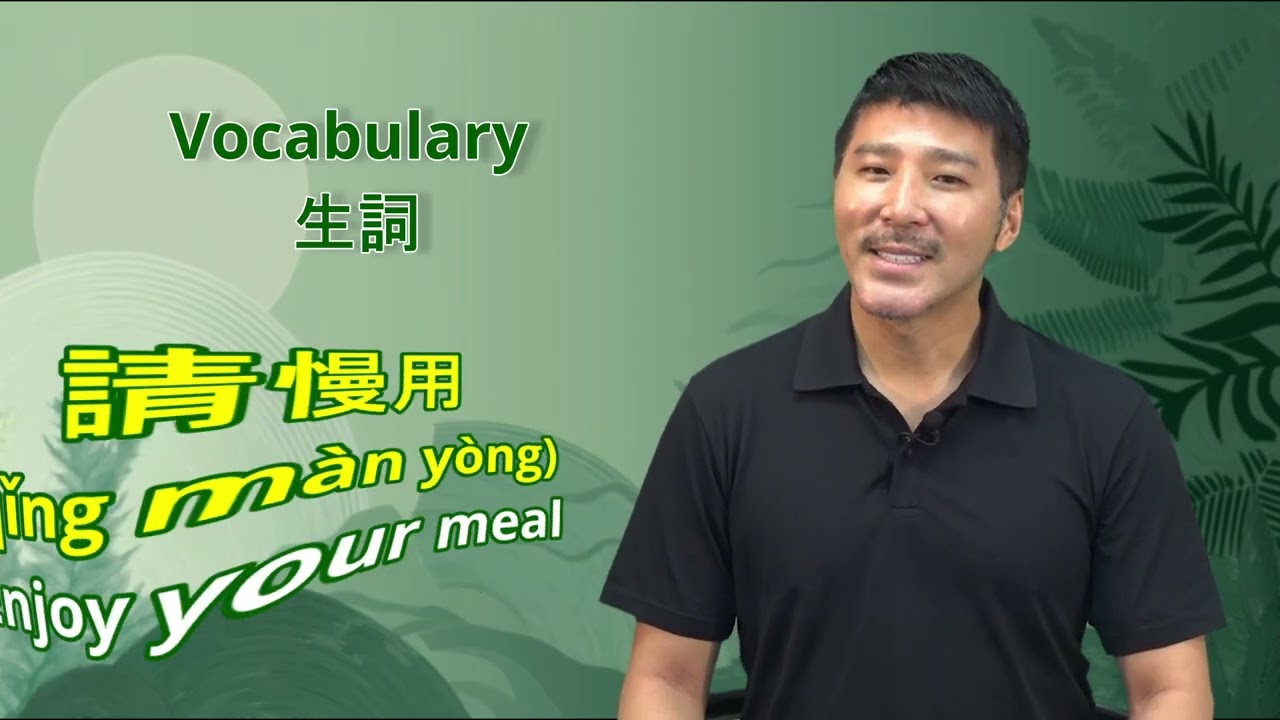
Video summary
This episode of Fun Mandarin introduces essential vocabulary and phrases for ordering food at restaurants in Taiwan, starting with the word "càntíng," which literally translates to meal hall. The lesson covers polite greetings like "nǐ hǎo" and "huānyíng línghào," along with key pronouns and request structures such as "wǒ xiǎng yào" for saying I would like something. Viewers learn how to specify quantities using terms like "yī fèn" for one portion, choose drink sizes with "dà bēi" for a large cup, and combine items using the conjunction "hé." The transcript also explains common staff responses, including phrases for acknowledging orders, asking customers to wait while food is prepared, and encouraging diners to enjoy their meal.
Beyond basic ordering skills, the video highlights several iconic Taiwanese snacks and dishes that are staples of local cuisine. These include chǔfǔ, or stinky tofu, a fermented street snack known for its strong aroma and delicious fried texture; niúmiàn, a hearty beef noodle soup with rich broth; zhūròufàn, which features savory pork cooked in soy sauce served over rice; and kēchā, a sweet black tea often paired with pastries. The episode also mentions the unique green fig and salted fish salad, noting that while some descriptions mistakenly reference St. Lucia, these foods are deeply rooted in Taiwan's culinary tradition and are frequently found in night markets across the island.
The discussion then shifts to the cultural history of Taiwan's night markets, explaining their origins dating back to the Qing Dynasty when they evolved from street gatherings near temples. These markets grew alongside temple culture, serving as social hubs where people could enjoy snacks after religious activities, and later became vital economic engines during periods like the 1960s manufacturing boom and the 1970s oil crisis. Today, famous night markets such as those in Taipei, Taichung, and Kaohsiung are celebrated not only for their diverse food offerings but also for their lively atmosphere, which attracts both locals and tourists. The video emphasizes that despite occasional messiness, these vibrant spaces represent a cherished part of Taiwan's cultural identity and provide an efficient platform for small vendors to thrive.
In conclusion, the episode encourages visitors to embrace the chaotic yet charming experience of night markets as a must-see activity when traveling in Taiwan. Whether it is a first-time visitor or a local seeking late-night eats, trying dishes like stinky tofu, beef noodle soup, and pork rice offers more than just a meal; it provides an immersive taste of the region's history and street food culture. The hosts wrap up by reminding viewers to keep these essential phrases and food recommendations in mind for their next trip, promising that exploring these markets will reveal the dynamic spirit of Taiwanese life.
Read the full video transcript
Welcome to Fun Mandering with Andreas,
where learning mandering is fun. I'm
Andreas G from ICDF Taiwan. Today, we'll
be teaching you how to order food at the
restaurant. We will also introduce some
useful vocabulary and phrases you might
need when dining in Taiwan, as well as
talk about some popular Taiwanese snacks
like sticky tofu, big noodle soup, and
breast pork rice in the night markets in
Taiwan. Knowing how to order food is a
must when you're visiting Taiwan. So,
let's start with a simple download that
you can use when ordering food at a
restaurant. Listen carefully.
This dialogue shows how to order food at
a restaurant. Now, let's break down the
vocabulary.
restaurant
means meal and ting refers to a hall or
room combined
literally means meal hall or restaurant
hello. I think we've learned this in the
previous episodes. Niha is a standard
greeting in Mandarin used in almost any
situation, including when you walk into
a restaurant or a store. It's a polite
way to acknowledge someone when entering
a a place.
Welcome.
Means welcome and is a respectful way to
say arrival or presence. together. In
Guanging is gorgeous way to staff to
welcome customers into a restaurant or
store. And you'll hear it often as soon
as you walk in. W
I or me. W is the main pronoun for I or
me. It's a fundamental world you'll use
constantly, especially when expressing
personal preference or making requests
like I would like.
I would like
means I means want or would like. This
polite phrase is key when ordering food
or drinks at a restaurant. For example,
means I would like a portion of fried
chicken.
One portion. E means one and refers to a
portion, share or serving. When ordering
food, you can use e to indicate that you
want one portion of a specific dish. For
example,
means one portion of beef noodles.
Fried chicken
means fried and chi means chicken.
Refers to fried chicken. A popular and
beloved dish that you can easily order
at many restaurants in Taiwan.
H
and H is the world used to connect two
nouns just like and in English. For
example,
means fried chicken and cola.
One cup or one glass. As told last
season, E means one and B means cup for
or glass. This phrase is used when
ordering drinks. For instance,
means one glass of cola
large. Ta means large or big. In the
context of ordering foods or drinks, ta
refers to a large size like a large cup
or bigger portion of food. For example,
means one large cola.
Cola is the mandaring word for cola, a
popular soft drink in many restaurants.
It's commonly ordered as a refreshing
drinks to go along with meals.
How?
Okay.
How is a polite way to say okay or all
right is commonly used in restaurants to
acknowledge an order or a request from
the customer.
Please wait a moment.
Means please and means wait a moment.
This phrase is used by restaurant staffs
when they need to ask you to wait while
your food or drinks are being prepared.
Enjoy your meal. Means please and means
enjoy your meal slowly. It's a common
phrase used by servers after serving
food encouraging the customers to relax
and enjoy their meal.
Thank you. Is the standard way to say
thank you in mandaring is a polite
phrase you can use after receiving your
food, drinks, or service. It's always
appreciated when thanking staffs at the
restaurant.
It's delicious. H means very and means
tasty or delicious. This phrase is a
compliment used to express that the food
is delicious. For example,
means this dish is very delicious.
In addition to the above new vocabulary,
let's also learn some more new words
about food in Taiwan and St. Lucia in
Mandarin.
Chfu
chu. Stinky tofu.
Sticky tofu is a famous Taiwanese street
snack known for its strong smell and
delicious taste. It is made of fermented
tofu either fried or steamed with soup.
Big noodle soup.
Big noodle soup is a classic Taiwanese
dish consisting of noodles, beef, and
flavorful broth. A signature dish that
you can't miss when you're in Taiwan.
Luro fat. Luro fat.
Luro fat is a popular dish in Taiwan.
Made with brace means pork cooked with
spice and soy sauce over rice. It is as
common as a green fig salad in St.
Lucia.
Kocha.
Kocha. Coco tea. A sweet and refreshing
drinks that pairs well with many
pastries in St. Lucia.
Green fig and sawfish salad.
Green fig green figs and sawfish salad
is a unique salad blending green figs
with a savory taste of salted fish. This
dish is traditional in St. Lucia. Now
that we have covered the basic
vocabulary for ordering food, let's
introduce some classic Taiwanese snacks
that you absolutely have to try when you
are in Taiwan. Introducing Taiwanese
snacks. First up is to do or stinky tofu
is a famous snacks in Taiwan known for
its strong smell but delicious taste.
It's often deep fried and served with
pickled cabbage. Don't let the smell
scare you all. It's really good.
>> Next, we have Nomian, our beef noodle
soup. This is one of Taiwan's most
beloved dishes. Is hearty bowl of
noodles with slowcooked beef and a rich
broth. Perfect for any meal.
>> Another favorite is luro fan or brace
pork rice. This dish consists of means
pork cooked in a severy sauce served
over a bowl of rice. It's simple but
incredibly tasty and you can find it in
many places across Taiwan.
Now that we've introduced some classic
Taiwanese snacks, let's dive into the
rich history of Taiwan's night markets.
Did you know that night markets have
been an integral part of Taiwan's
culture for centuries? In fact, their
origins date back to theQing dynasty.
Night markets in Taiwan began in urban
centers like Tao Chun in Taipei. These
markets weren't always a daily event.
Instead, they evolved from small
gatherings of street food vendors who
set up near temples and bustling areas
where people congregates after dark.
Over time, these gatherings became what
we now know as night markets. Places
full of full stalls, st games, and shops
that stay open late into the night.
That's why Taiwan's night markets
develop alongside the temple culture.
Many of the earliest night markets start
around temples because temples were
social and commercial house. People
would gather for religious activity and
stay to enjoy snacks. By daily
necessities or simple socialize.
This close relationship between temples
and night markets still exist today. In
fact, some of Taiwan's most famous night
markets like the Gilongo night market
and the tongam night market are located
near temples.
Another key factor in the growth of N
markets was Taiwan's economic changes.
As Taiwan's manufacturing industry grew
in the 1960s, more people saw flexible
ways to make a living. Night markets
provided opportunities for small
business owners to sell products or
food. In fact, during tough times such
as the 1970s oil crisis, night markets
became important places for selling some
factory products. further embedding them
into Taiwan's economy and culture. And
this is not uncommon to hear the story
of some vendors who then establish their
own enterprise empire out of the small
business at the night market. Sadly,
over the decades, N markets have become
much more than place to eat or shop.
that have become a part of Taiwan
economy fabric offering an efficient way
for a small scale manufacturer and
vendors to sell their goods. Night
markets have treat the dynamic
economic giving people the chance to
experience Taiwan's vibrant street food
culture while also supporting local
business.
To these days, night markets have become
a cherished part of Taiwan's cultural
identity. Despite their occasional
disorder, the lively atmosphere of night
markets is one of the things that makes
them so popular with both locals and
tourists. And let's not forget that
night markets have become tourist
attraction in their own right. There are
even competitions where people vote for
their favorite night markets based on
the best food, the most charming
atmosphere, and even the unique snacks
they offer. Some of the top red night
markets include the famous night market
in Taipei, Night Market in Taiong, and
Night Market in Gawong. Night markets
like this truly captures the essense of
Taiwan's street food culture. And each
one has its own special charm. From
sticking tofu to beef noodle soup and
breast poke rice, night markets offer
endless trees that keep people coming
back again and again.
So whether you are visiting Taiwan for
the first time or you're a local looking
for some late night eat the night market
thing is a must see. You will not only
find delicious food but you will also
experience the rich history and culture
behind these lively gatherings.
>> That's all for today. We hope you enjoy
learning how to order food and get a
little taste of Taiwan's amazing snacks.
Remember to try stinky tofu, beef noodle
soup, and brace pork rice when you visit
the night markets in Taiwan. They are
all must try dishes. See you next time
on Found Mandry. Bye.