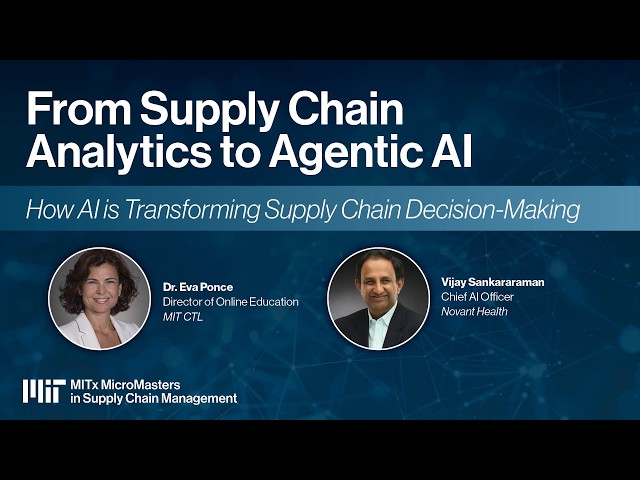
From Supply Chain Analytics to Agentic AI | How AI is Transforming Supply Chain Decision Making
Watch on YouTubeVideo summary
The webinar explores the transformative impact of artificial intelligence on supply chain decision-making, tracing its evolution from basic descriptive analytics to advanced agentic AI. Historically, supply chain management was viewed primarily as a cost center focused on minimizing expenses through descriptive tools that analyzed past data like dashboards and scorecards. Over the last decade, advancements in machine learning and cloud computing have shifted the industry toward predictive analytics, enabling planners to forecast demand with greater accuracy by ingesting vast amounts of variables such as weather patterns, social events, and IoT sensor data. This transition has moved the field from a reactive stance to a proactive one, allowing organizations not just to cut costs but also to identify new profit opportunities while managing complex constraints like perishability and bespoke product sourcing.
The discussion further distinguishes between predictive, generative, and agentic AI, highlighting how each serves different stages of the decision-making process. Predictive AI answers "what will happen," while generative AI assists in creating new content or negotiating drafts, and agentic AI operates with a higher degree of autonomy to execute tasks like analyzing thousands of supplier contracts for healthcare organizations. A key example provided involved using agents to reconcile price variances across multiple surgeons and suppliers in a hospital setting, ensuring the right balance between cost efficiency and quality while maintaining a "human-in-the-loop" for critical decisions. The speakers emphasize that AI should augment human judgment rather than replace it entirely, particularly when dealing with irreversible strategic choices or unstructured data like medical images, where human validation remains essential to ensure accuracy and relevance.
Finally, the session addresses the profound implications of these technological shifts for the supply chain workforce, arguing that automation will eliminate routine quantitative tasks but elevate the need for critical thinking and foundational business knowledge. As AI takes over repetitive analytical work, the most valuable skills for future professionals will be the ability to ask the right questions, understand core supply chain fundamentals, and validate AI outputs rather than blindly accepting them. The consensus is that companies must ground their employees in solid operational principles before layering on AI tools, ensuring that technology serves to enhance human intelligence rather than replace it. Ultimately, the path forward requires professionals to become lifelong learners who can adapt to a circular, automated business environment while retaining the judgment necessary to navigate uncertainty and drive meaningful innovation.
Read the full video transcript
[music]
Thank you for joining our open webinar
today hosted by the MITx MicroMasters
program in supply chain management. As
academic year begins here in Cambridge,
Massachusetts, we are excited to have
several of our courses opening at this
time that align with our discussion
today and more details will be shared
through the chat. I'm Eva Pon. I'm the
director of online education at MIT, the
center for transportation and logistics
and the founder and director of the MIT
omni channel supply chain lab. Today we
are going to explore how AI is
transforming supply chain decision
making with VJ Sankar Raman Chief AI
officer at Novan Health which is a
leading healthcare organization.
Welcome BJ and thank you so much for
joining us today.
>> You are pleasure to pleasure to be here.
Thank you uh for having me here. It's a
bright day. I mean, especially the way
we all have, you know, registered
ourselves into the the new
transformative AI era and how we are
powering ourselves to move through the
supply chain and more things. I'm very
happy to share that.
>> Thank you, VJ. Really an honor to have
you joining us today and we have a big
audience joining live too. So, welcome,
welcome everyone. In this session, we
will start by looking at how AI and
advanced analytics are being used to
make better predictions and improve
inventory decisions.
Then we are going to explore the
evolution from predictive AI to
generative and agentic AI.
And we are also going to focus on how
these technologies are changing the way
supply chain decisions are made. We will
also talk about what these changes mean
for supply chain professionals and the
skills that will be important moving
forward in the future. But before we
begin, we really want to learn more
about our audience. So let's try to
launch a fun poll in order to know how
often are you using AI for work. Let us
know in the last month how often you use
AI for work.
Let's see. And while you are responding
to this fun poll, let me briefly share
the plan for this webinar. We will start
learning about BJ's leadership journey
and his current role. Then we will
explore two use cases that show how AI
tools are transforming supply chain
decision making process. Then we will
explore two use cases that show how AI
tools are transforming
supply chain h decision making process.
And finally we will discuss what
capabilities supply chain professionals
need to develop to lead these
transformations.
Let's try to have a look to the first
poll and see how often are you using AI
for work. Okay VA more than 60% of our
participants use it daily or almost
daily. Um 25% several times per week. So
definitely most of our participants are
definitely using AI for their work. But
now I we really want to know a little
bit more about that use and please let
us know in which areas of your work you
are currently using these AI tools.
Let's see if it is for demand
forecasting, inventory management,
transportation, supply chain risk
management. So poll two is already uh
open. Please erh go to that poll and let
us know. Um while you are responding to
this poll, I'll be sharing some
guidelines for this webinar. So if you
have questions, please [clears throat]
use the Q&A feature. We want this
webinar to be interactive. So be sure
that you log with a name and we will
also launch additional polls during this
session. We so try to to to keep engaged
with with the speaker and and with me
during this webinar with several of our
courses having just started or opening
soon. We will also share program and
course resources in the chat throughout
today's event. So keep an eye also to
the chat and let's try to take a look to
the results of the second poll. Let's
see. Okay VJ this is interesting because
I think we have 22% of our participants
use AI for demand forecasting and
planning we are going to talk about that
20% for inventory management and
optimization
16% for transportation and logistics 14%
used for procurement and sourcing and I
know we are going also to discuss how
you are using Aentic AI for procurement
and sourcing seen at Nobang Health, 13%
used in the environment of manufacturing
and operations and 15% for supply chain
risk management. Super interesting.
Thank you. Thank you for sharing with us
uh how you are using AI in your
day-to-day job. But now let me formally
introduce our industry speaker. So BJ is
the chief of AI officer at Novang Health
and he has been in that role for about
two years. His previous experience was
in the retail industry. He was the vice
president of product and technology at
Lois for five years and he also had the
role of being the head of product
management and technology at Walmart for
three years. BJ has an extensive
experience working with technology
advancement product development in
different uh sectors. So BJ healthcare
is a sector very different from retail.
H working to improve people's life
definitely open a completely new
paradigm. Could you tell us more about
about that and also about your
leadership journey to get there? Eva
again thank you for having me here and a
kind introduction as well right I mean
first things first
the way I have brought my upbringing and
been humble and fortunate to be part of
a number of institutions you mentioned
but all through my journey I've held on
to one belief where
who we serve and what problems are we
solving are far more important Then the
means to getting there because it
evolves.
Given that the perspective that we have
held is working through a variety of
consumer focused companies in Walmarts
and the Home Depots and the loes has
given me the perspective to look at what
uh an everyday person including myself
putting myself in that shoes. What
friction am I going through in order to
complete what I want to complete and how
do I how do I get past that faster?
Health care makes it more personal.
Personal in the sense that each and
every one of us at some point during our
lifetime andor for our loved ones may
have to make a trip to even to get a flu
shot or or something of that sort.
Right? So when you go through a variety
of phases in our uh you know on our on
our lives if you will those journey
through the health care systems
especially especially in the in the era
that we are all in is laden with
friction. Friction in the terms of how
easy or not is it to get an appointment
how easy or not is it to you know
complete through a surgical journey. How
easy or not is it through pay a bill
understand the the the economic bandage.
So when you go through all of that there
is an element of supply chain there is
an element of marketing there is an
element of uh you know operations all
runs behind the scene how can AI and
technology and the advancements help
move and eliminate the friction to make
it easier for us that's the core purpose
of uh me doing what I'm doing
>> that's a very interesting angle VJ how
to eliminate this friction for for
patients and for people that really need
uh to have a smooth process through
through that. Uh let's uh let's start h
by t taking a step back and looking at
how supply chain analytics has evolved
and and how companies have been using
these tools to support decision making.
So I personally I have been working at H
in supply chain management for 25 years
and truly statistics, forecasting,
optimization, operations, research have
always been kind of at the heart of
supply chain decision making. But in in
many ways AI is building also I believe
on on that foundation of all of these
operation research techniques uh for
decades. Correct. So BJ in the last
let's go back the last 10 15 years. Uh
what did supply chain analytics look
like and and how has this evolved since
then? Uh mainly my my question focus
more on what were companies primarily
primarily using analytics for that at
that time.
>> Yeah. You know, I think if you all of us
date ourselves back to your point, you
know, say see 15 years ago, even even in
that in the line of it,
we were very busy creating dashboards.
We were very busy creating u scorecards.
We were busy in understanding you know
what happened last month, what happened
last year, what happened yesterday, what
was my inventory, how much traffic did I
run through, how much do I need to keep
up with what potentially could come. All
this was descriptive in nature. So
essentially if I have to encapsulate in
one word, it was descriptive analytics.
Now that was in vogue, that was popular.
We all heard the word big data. We have
all heard the word uh ERP. We've heard a
lot of things. And by the way, all of
them are still around. Nothing wrong
about them. But the word largely
was fixated about leveraging that. The
other piece I'll bring to the
connotation is back in the time 15 years
ago or so, supply chain from the genesis
of it from my eyes at least largely was
a pure cost center. Your purpose in life
as a supply chain leader was to keep the
cost as low as possible.
which is perfectly fine. But as
technology evolved, as the advancements
evolved, more and more we walked into
what we called as the deeper analytics
aka the the early innings of AI, machine
learning and all the fun stuff we can
talk later came about and at the crux of
it
the move went from being what I would
call it as purely descriptive to bit
more predictive. Now, now I'm I'm not
just merely looking backward with the
available technologies in front of me as
a planner, as a supply chain leader. Now
I'm also being bold enough to go lot
more predictions. Now in the process,
I'm not just merely obsessed over
cutting cost. I'm also looking at where
I can make profit. We can talk more
about it. So that those are the big
changes.
>> Yeah. Yeah. and and 100% know about this
evolution from descriptive to
prescriptive analytics and also what has
changed is not simply simp simply that
we have more data that we have or more
computing power we also have that but
also the types of patterns we can
identify and the kind of decisions we
can support is is also evolving. So what
what how do you see machine learning and
what change
machine learning is bringing to the
table in that evolution?
>> Yeah. Um
see first things first the the all the
definitions of machine learning out
there my simplest way of explaining uh
to to to uh at the time my fifth grade
now she's she's grown up to be a junior
here um if a job is best done by a
machine
let the machine do it.
>> Mhm.
With that philosophy in mind,
the advancements allowed the machine to
be more and more I use the word machine
in a in a very figurative way to become
more and more immersed in what we do and
learn the patterns, learn how we do what
we do. And to your point, there are a
few other
friends of the family of machine
learning came about. Cloud computing
became more prevalent. Cloud computing
became cheaper. All that allowed for
gargantuan amount of data to be
ingested.
You're no longer married to your
computer, your physical uh you know
limitations of your computer. The cloud
was wide open for you. So what that did
was
and the other pieces were in the
traditional world at least 15 years ago
or so you think about demand planning,
think about inventory, think about
transportation, everything that we saw
in the in the poll few minutes earlier.
These were humans with at the time
available uh computing power computing
knowledge ERPs had dealt with 1 2 3 four
call it eight variables at a time. For
example, I'm looking at uh you know last
year sales history. I'm looking at uh
the lift I would get with a promotional
uh uh you know that I might be able to
do. I'm also looking at uh you know um a
causal factor like a weather. three or
four factors were largely dominating how
a science married with the art of the
human would would help predict a
transportation planning or a demand
planning allowing inventory. Fast
forward machine learning comes about
learns and and ingest and all of this.
Now you have an element of physicality
or the physical intelligence getting
into it. RFID, IoT, data sensors, the
list goes on and on where the data that
was only available otherwise on a
weekly. How many of us can put your hand
up and say, "Hey, you know, do you
remember the weekly batch runs?" You
know, every Saturday night and a Friday
night, something would run to predict
what needs to happen that week. Gone
know those days where the amount of
learning now you the compute power and
the intelligence where you could do
anything you want within the hour. I can
I can predict the one route. I can
predict the one store. You get the
point. So what happens is that now
collapse the window of how often
anything can be done and situate more
and more into the dis shifting the
decision powers little bit more equally.
Now in the process the variables are no
longer limited to handful. you your
variables could now be in my in my in my
quest as a supply chain planner to
predict how long would it take for me to
go from point A to point B.
>> Mhm.
>> I have I can look at social events to
say what you know uh what else is going
to be happening in the route that day.
Which event is happening? Maybe there is
a a presidential campaign that's going
to come by. I'm just going to throw one
out there that that may have a traffic
impact to something. All those factors
are now lot more sourcable
at the at the tip of an intelligence
hands factors that and gives far more
prediction. So I think machine learning
created that uh element of jump from
being reactive to lot more uh predictive
if you will with the level of accuracy
that you know in the in the last 15
years we've seen significantly go up.
>> Yeah. and and one thing I found
particularly interesting is how you
connect the dots between prediction and
better decision making. Um a forecast by
itself doesn't create value but when we
connect this prediction to make better
decisions is when we really are bringing
this value that you were mentioning. So
you you saw this firsthand h at lowest.
So um can you walk h us through the
approach you use then and more
specifically how did you move from this
predicting demand to use those
predictions to make better inventory
decisions just to connect these two dots
>> absolutely I'll give you a specific use
case when we think about lows there are
many products that makes up
one key category that is uh highly
highly valuable for the company, highly
valuable for the consumer out there is
what they call as the appliance sector.
Your refrigerators, your washerd dryers,
your dishwashers, what have you.
No points for guessing. Lowe's remains
the market leader in the US for the
appliance category for a long time and
obviously would love to remain in that
space.
But buried under the supply supply chain
aspects of it, appliance
is also one of the most
highly unpredictable sourcing
categories.
It is unlike certain other categories
where the supply is a plenty. This is
[clears throat] the opposite of it.
Especially
the fact that some of these have to be
sourced from far east. some of they have
to be coming from an Asian you know
manufacturing facilities if you will you
know and you you're now looking at
different ports they have to carry
through the traversing through varieties
of uh you know pieces have to come
together the number of no longer a
refrigerator is a refrigerator with a
sort of kind of a um bespoke models
coming through so all of that put
together it's a constrained supply chain
so when it becomes a constrained supply
chain for us back in the time the
problem was no longer I could rely on
traditional inventory management and
transportation to keep the product. For
context, we have roughly about um we had
roughly about
1,700 locations where the point of sale
would happen plus the giant.com which
means I could ship anything anywhere.
Think about every zip code in the
country and you only have certain amount
of shipping points to get there. So
physically the idea was to go multiply
the last mile shipping points but the
last mile shipping points cannot become
an inventory holding point cuz then
you're now you're you're only
multiplying your constraints. You're not
you're not deducting it. So then the
science was applied to say look how do I
predict
what do I need when what categories
within the appliance are needed which
ones for example you think about a
certain categories of refrigerators or
what we call as uh distress look you
know I I run an apartment I just broke
my refrigerator broke I don't care which
one I need I need something ASAP I'm not
looking for the the $2,500 bespoke model
that's a category which is separate from
Arana household. Uh look, I don't buy a
refrigerator every other year. I buy
once every five, six years or 10 years,
what have you. Uh and I want to make
sure I pick the right one and you know
keeps my wife happy or my wife thinks
keep the guest happy.
So that is a different category. So
understanding and nuancing out who these
are. How do I then apply
reusing the word bespoke bespoke supply
chain through each of these and now I
need the science in this case a machine
learning model to be performed through
each of these and that's how we kind of
look through
>> that's an excellent example BJ thanks
for sharing that. Um uh we have almost
900 live attendees. So [laughter]
is really very interesting. So and we
are receiving some excellent questions
from the audience. Let me bring one from
so habit. He's from Pakistan and his
question is very interesting. He's
saying classical models consistently
beat more sophisticated models like
recurrent neural networks for example in
retail demand planning. at least in his
experience. What are your thoughts on
that? Because definitely I I I think
he's highlighting a an important point.
Sometimes more sophisticated models
don't automatically mean better results.
What What are your thoughts on that?
>> Absolutely right. I think I think spot
on, right? Um horses for courses. You
don't you know just because we have a
very sophisticated model that can
ingest a whole bunch of variables uh you
know and spit something out doesn't
necessarily mean that it's going to be
that much better than everything. It all
depends on what is the situation we are
trying to predict models for. I'll give
you an example. If we are looking at an
everyday uh you know supply that we are
trying to you know stock up in a in a in
a in a store or stock up in a warehouse
a traditional model in fact you could
even get away with the way back when
minmax and nothing wrong about it now
you're looking at constraint now you're
looking at something that has even
perishability that gets into it now you
look at other variables that may have an
apply and I'll give you one context to
that back in the time in my Walmart,
as many of you would know, Walmart still
runs the largest grocery chain in the
country. You walk in there, you would
see strawberries and bananas.
Every strawberry that you see there is
not made alike and every banana you see
is not made like in every store. What I
mean by that is when they come from the
sources before we had any level of
intelligence we applied almost a decade
ago. Now all bananas would generally be
routed treated alike and go to every
store. The the store that was closest to
the the the supplying warehouse got the
freshest pack and the store that was
farthest out got a day or two older.
Hence the perishability of that
particular batch of bananas were faster.
In other words, their shelf life was
smaller. So now a simple logic that was
put in place to say we will also factor
that into which one gets routed all of a
sudden change the narrative and there's
more to it. So where I'm going with that
is you're absolutely right. It comes
down to what use case are we solving for
then pick the right one. In the in in
our world we use what we call as
ensemble model. So not every model runs
everything. The ensemble decides which
one I need to use.
>> Excellent. Excellent. Yes. Not every
technology fits for all the problems. H
so h let's move now to the sec to the
second part VJ. So you have also frame
very well with real examples that we
really value that h the predictive the
use of AI as predictive descriptive and
predictive tool. Let's try to move now
to generative AI and agentic AI. So from
a supply chain practitioner's
perspective, how would you explain the
difference between these types of AI AI
generative and agentic AI?
>> Yeah. Yeah. It's it's very interesting.
We are gradually increasing our
vocabulary of what these AI are, right?
So I [snorts] mean in the simplest way
I've learned myself is when we think of
predictive AI it tells it answers the
question what will happen
you know I look at all the content I
want to know how much is going to happen
when how fast can I get somewhere what
will happen is the question predictive
AIS do all the models and all the data
that looks into it generative
crosses another boundary and says
Help me to create something new. Get me
use all the context you have.
The word generative here literally
allows us to go create something net new
that I don't have it before. Synthetic
included. Agentic is simply saying that
I get that I get what you're going to
know when I get to know. I also know you
need to create something. Let me do it
for you.
>> Right? I put it all pieces together. It
is not one is more intelligent than the
other. It's just the fundamentally
predictive, generative and agentic in
the order that you have increasing scope
of autonomy that we decide to give.
>> Yeah. The use case we one of the use
cases we look in supply chain for us is
when I look at how much I need to
purchase to fulfill a category within
within a within a store or a hospital or
a DC wherever the need is predictive
tools come into play. Now if I have to
go use that to help negotiate with a
supplier, negotiate with uh you know um
how much do I you know uh you know uh v
vary based on the contracts look at that
and look at the contract and adjust for
prices. Generative AI now helps me to
create that draft that conversation that
amount of uh uh articulation to get
there. But if I'm saying all that is
fine, I simply don't have the time to go
look at thousand suppliers every morning
and and and do all of this. Agentic, you
take it from there. So it's a matter of
autonomy that opens up. That's how we
look in supply chain
>> and and you have seen this transition uh
VJ very clearly in your current role at
Noman Health where you are using AI
agents in in healthcare system and in
the healthcare industry. Can you give us
an example of how Agentic AI is being
applied to procurement in particular erh
for in that environment?
>> Absolutely. Now first things first
being in the healthcare I want to
underscore the fact that
we believe in having a human in the loop
to get the right remarkable patient
experience. There is no compromise on
that.
Which means when we look at where AI and
the forms of AI like an agentic AI or
agents come into play is exactly where
it has the most relevance where it is
closer and closer to a clinician or a
patient. Closer and closer the human in
the loop is involved. Given all that
when we look at procurement
one of the use cases for us was similar
to many other large healthare systems
here we are made up of thousands of
contracts
thousands of supplies and each of these
supplies have
a genesis of when they started why they
started I'll give you a a very poor
example but to hit the point think of um
surgical sort of instruments or scalpels
that we use
for grins. We have about seven different
uh orth orthopedic surgeons operating at
our seven different the seven is just a
a notional number different I mean by
each of these surgeons through variety
of choices they and practices they bring
to the table they have a particular
choice of uh an instrument they want to
use and some of these instruments are
made by three different suppliers. Now
pretty quickly the number of same s the
same procedure done by different
surgeons
choice of scalpels made by different
providers uh suppliers I mean by
multiplies and each of them may carry a
contract or two depending on when they
were written what was negotiated. So
suddenly you see for one product you got
multiple contracts before you know it
and there is variance in each of these.
Dr. Eva may have signed up for you know
$50. I'm making a numbers appear
scalpel. Dr. VJ may have done for 45 and
maybe somebody else would have done it
for 65.
And given the breadth and the scale of
things out there, it is not humanly
feasible
to be able to look at each of these and
and and syn align and synchronize. Maybe
maybe should we get everything a 45 or
the quality is better for 55. All those
things has to be looked at. We have
deployed agents to help analyze those
variances,
help make a recommendation what makes
the most sense for a particular
category. that obviously ensures the
human in the loop, the clinician in the
loop ensures, okay, that's the right
thing for us to use
and then help draft a conversation with
the the vendor and the supplier and say,
hey, how could we help align closer to
so we reduce the variance in terms of
procurement I have to do? So that
reduces the contract variances.
So that's one of the one of the spaces
where we look at agents.
>> Yeah. And this raised also an important
question about how much autonomy we
autonomy we should actually give to this
system because you also mentioned at the
very beginning the human needs to be in
the loop and and here is a very
interesting question from singing from
France. He said in procurement which
decisions are most suitable for agentic
AI you you just bring that example but
which decisions are the ones that should
remain under human control.
>> Yeah. No, that's a great question right
not just in procurement but I can also
extend other parts of supply chain but
in in general when a decision
which is routine
reversible
and it's a bounded cost
you are you are more likely than not at
some point to help an auto automation or
an agent to take over.
But when something is whatever rhyme a
reason uh irreversible
or or something that is uh too too one
of something that truly is more let's
call it strategic to the aspects of the
company aspects of what you do. You're
branching into a brand new um you know
venture of business within your
organization or you want to try
something out at large at scale.
those things significantly require a
human in the loop because
the reversibility aspect to me is the
most important.
>> Yeah. And and I think this distinction
[clears throat] between what AI can do
and what AI should do is really
important and this is very important
point you are bringing here BJ there is
another this is probably a more
technical question but also very
interesting from Reene from India. He
said, "How would our agents when the
data is good but unstructured?"
>> Yeah. So, so here here's the beauty of
data, right? We talk about AI a lot. We
talk about agents, everything, all the
glamour and the glitz that that aspect
of the science brings to the table,
which is very popular out there. But the
reality is none of this is any good if
the underlying data
is of no use. That's the weakest pole in
the link, right? Given that the question
is all about if you had more
unstructured data, how do you use it?
Now, by nature,
lot of the data that we get to see in
our lives is unstructured. I'll give you
one example. In the clinical world, I'll
give you an example. I'll give you in a
in a retail world. In the clinical
world, many of us go get X-rays.
Your X-ray by design is an unstructured
data. It's a picture. Well, it's an
image, right? It's radiology image.
Having to read an unstructured data like
an image, like a picture and deduce
information from it through all the
knowledge on it is is a highly complex
piece to it. You are you as much as an
AI would have in it, there is an element
of human required to ensure that's
validation. So, you got to you got to
balance who you are. In the retail
world, when you think of an unstructured
data, you can think of lots of product
cataloges. How many of us here can think
of a retailer? You don't have to name
it. Think of a retailer who you saw a
picture on the on the on the catalog on
the web and what you got at your home
two different things, right?
When you think about any which of these
use cases, the idea here is what
ultimately what use case are we having
to have this AI to solve for and what is
the underlying data? If the underlying
data is unstructured, how do I put the
decision loop in a way that it is
meaningful versus doing for the sake of
tech? Never [clears throat] do anything
in my opinion, never do anything for the
sake of tech.
>> Yeah, I'm glad that Reing brought that
question because also brought the how
important data is, data quality and the
type of late data. I think that's a
great place to to leave this part of the
conversation because we have gone from
AI helping us to predict to recommend
and now potentially to act and and and
take action. But as these technologies
take a one take more and more work I
think the question and the the concern
becomes is about what happened to the
people doing that work and what skills
become more important. So let's now talk
about this evolution from supply chain
analytics to agentic AI and how this is
impacting the workforce and let's start
hearing from our global audience because
we still have almost 900 people live. So
please share with us h launch poll three
and let us know how do you expect AI to
affect your own career during the next
three years and while uh the audience is
[clears throat]
responding to this poll BJ
as AI takes over more routine analytical
and execution task how do you see supply
chain jobs and the workforce changing?
Yeah, I think see reality is as more and
more AI and automation come about in
everything we do and everything we see
the quantitative grind shrinks meaning
the need for somebody to run a dashboard
every day. The need for somebody to make
thousand phone calls to to do something
what have you. The quantitative grind
will shrink. When that quantitative
grind shrinks
the judgment
gets elevated
that will be a shift not an elimination
in my opinion of functions
shift I mean by
the need for now the humans in the loop
to say is what's coming out the right
thing do I how do I ask better questions
so the way I think about is that
most important important skill that we
all should prepare ourselves as we get
ahead of us is
realizing the the automation and the AI
can do what they can do with the power
of compute and all that fun in place
there is going to be a part where the
fundamentals aren't changing let's not
let's not assume that is going away
if we don't know to ask the right
question
you're not going to get the right answer
no matter no matter what level of
intelligence that's going to be out
there. If you don't know to feed the
right data, structured or unstructured,
you're not going to get the right
answer.
>> To do that, you need a level of human
intelligence to play in it.
>> It's a shift that is required to help to
get to that that part of the the stage.
So uh my ask of
rising folks who wants to participate in
the AI in the supply chain what to do
from here would be not everybody needs
to be the the most strongest AI
developers or coders. In fact many of us
don't need to be it's a it's a there
there are places for it. What is
required though is the ground
understanding of the business
fundamentals, the ground understanding
of what supply chain regardless of the
function you're part of that is not
changing. How do you use that and create
in in the world of AI we use the word
prompt, right? That is how do you prompt
for the right question? How do you
prompt yourself to get to validate the
answer? Just because you get an
automation answer doesn't mean it's
always right. Right? How do you know to
ask the right question? How do you know
to see what things are to be able to get
to that? That is the skill that that's
the muscle and that's the skill we have
to develop.
>> Yeah,
>> I see a shift not an elimination
>> definitely and I think this is 100%
aligned with the responses. Let's try to
share the results of poll three. But
most of our attendees, they see this 42%
more as an opportunity than a threat and
33% as a significant opportunity which
is great. You also brought BJ the
important of business accumment and this
understanding of of the business that
need to be there for sure as well as the
quality of the data and the type of
data. Um yeah one of our our attendees
from Vietnam
he said okay if how do you see companies
now hiring junior analysts to learn on
the job? um is the expectation of new
graduates to already work alongside AI
agents from day one. I think you already
answered the question because definitely
the prompting and bringing the right
questions to the to the tools h is part
of that but I don't know if you want to
elaborate more on that interesting
question.
>> Yeah, I mean definitely an interesting
question and and this is the turn in the
transformation era we're all witnessing
in front of us, right? I mean quite
quite candidly a certain population
gets to become a bit more vulnerable
than the others particularly the newer
entrance to the business because they're
new they're graduating from wherever
they are they they're just walked in
walked into the workforce and the most
entry-level jobs sometimes become the
most obvious candidates for automation
AI to sort of take over. So you know
it's it's almost like a like a like a a
mishmash. So my ask of that situation or
the entrance in this case is
do not skip the fundamentals.
Do not do don't assume everything is
only going to be AI and AI is only going
to be as good as
how you're going to know how to use it.
So there is always going to be a role.
It's just a shift in the narrative. be
prepared, understand enough to know how
to how to ask the right questions, how
to tame it. You don't have to be an
expert in building dashboards. You
obviously need to know what how to ask
the right questions, right? So, I think
it's it's preparing yourself than than
than uh relying on what what was working
20 years ago.
>> I couldn't agree more on on the need of
understanding these fundamental
techniques and the foundations in order
to build on that and be augmented by by
these tools. Now let's move to the last
poll because we want to learn from our
global audience about specifically that
which skills do you believe are most
critical for future supply chain
professionals. Um BJ you already
mentioned the importance of foundational
supply chain skills analytics statistic
optimization supply chain fundamentals.
um what should also companies be doing
in order to prepare their workforce for
this transition?
>> Yeah, I mean here is the core argument
for me.
You can't judge what you don't
understand. Meaning
the population that drives the companies
in any which level has to ensure that
they are equipped with the knowledge of
what is going to be success for that
function to be which includes
understanding the core aspects of the
function, understanding the the
principles where the companies want to
go, all of the above.
only when when you have either a
physical or or or a virtual automation.
You're not talking about just AI coming
in the form of an LLM or a chat GPD with
you. It is also the robotics and the and
the physical sensors that they're going
to be hitting you all day every day.
Regardless of that, there is an element
of how do you know if that automation is
doing the right thing? Only if you know
the function, you'll be able to ask the
question. So the companies have to
prepare their audience grounding
themselves again and again in the
solidarity of what they are going after
with the basics and and give them the
enrichment for lack of a better word
with AI and automation along the way.
AI and automation cannot be a substitute
or or a or a or an alternative for not
having a grounded fundamentals.
>> Yeah. Yeah. and and also to to just
challenge this output to understand the
output and being able to challenge that
output. Let's try to see now the results
of this poll because our audience 75% of
them
vote for critical thinking that is
totally aligned with what you are
bringing here. H 55% analytical skills.
Yes, these fundamental and and and basic
tools that we need to understand in
order to to understand the solution and
the technological and AI literacy 57% uh
vote for that one with that uh VJ what
advice would you give to professionals
who are building and advance and also
advancing their capabilities in supply
chain management?
I mean the first and the foremost I
would tell you is that
the business of how we or the art of
business the conducting the business is
evolving as well. The business itself is
not static.
What was otherwise let's call it 20 25
years ago a linear way of doing things.
you plan,
you then make and then your ship all
that is now largely with the automation
AI in place is is becoming more secular
in nature. I'm going to be planning lot
more factors based on how that's going
to get shipped, how that's going to uh
you know get potentially returned and
every function is looking much more
circular in nature.
That transformation and how the business
is also being conducted is an extreme
element that we as professionals should
adapt to.
AI, automation and whatever other fun
things that are going to be coming ahead
of us that we do not do not know, do not
predict will always be there. Technology
is only there to advance.
But the most important thing is if we
get a grasp of how the business is
shifting, what questions do we ask? it
is less important what answers I'm going
to give because there are tools and
automation out there that can give a
good answer but if I do not know how to
ask better questions
the the the answers are not going to be
no matter what AI is out there the
answer is going to be raj irrelevant
right so first my only advice from
myself and anybody in this audience is
stay grounded with what you can learn in
terms of the business stay grounded with
how effective of a questions we can ask
that improves the response that comes
from wherever it comes from.
>> Yes, become a lifelong learner.
[laughter]
Thank you BJ for such an insightful and
engaging discussion. We really
appreciate you sharing your experience
and giving us a practical perspective on
how AI is changing supply chain decision
making and also how this is impacting
the workforce. And thank you to our
audience for all the great questions and
for being part of this conversation
as you reflect on the topics we covered
today from supply chain analytics to
generative and agentic AI and also the
changing skills required in the field.
If you are thinking about continuing
your learning journey, our supply chain
analytics and supply chain fundamentals
courses part of the MITx micro masters
program in supply chain management are
now open for enrollment. You have a we
have also shared more details in the
chat and also invite you to explore to
continue investing in your learning
journey that we have been discussing
today is really critical and important.
I would also like to thank my team Elis
Jonica and Caragrini for supporting this
event behind the scenes. And finally, we
would love to hear from you. We are
launching a final poll now to get your
feedback on today's webinar. Your inputs
help us to continue improving these
events and provide a valuable learning
opportunities to our community. So,
thank you again to our global audience
for joining us today and keep an eye uh
for future future webinars. Let's
continue to grow and learn together in
this exciting field of supply chain
management. Thank you BJ and thank you
everyone.