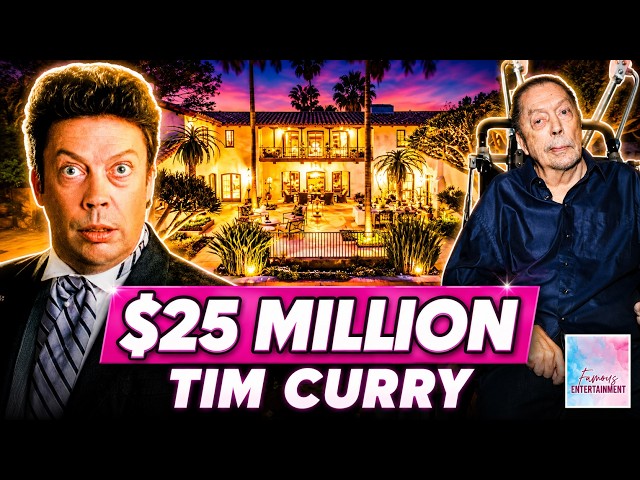
From Pennywise to Gardener: The Side of Tim Curry Nobody Knew
Watch on YouTubeVideo summary
Tim Curry, the legendary British actor and singer celebrated for iconic roles in cult classics like *The Rocky Horror Picture Show* and Stephen King's *It*, has passed away at the age of 80. His long-time manager confirmed that he died peacefully at his home in Toluca Lake, Los Angeles, following a major stroke suffered in 2012 that left him with paralysis on his left side and confined to a wheelchair. Despite these physical challenges, Curry never stopped working or performing, maintaining his distinctive spirit until the very end. Even while seated in a chair he jokingly called "silly," he refused to be defined by others' expectations, continuing to delight fans with his dynamic personas across comedy, horror, drama, and music throughout five decades of a remarkable career.
Beyond his theatrical achievements, Curry was known for his extraordinary taste in home renovation and his deep passion for gardening, a hobby inspired by his late father. After moving to Los Angeles in 1988, he purchased and meticulously restored historic properties, treating each house like a stage set for the life he wished to pursue. One notable example is his 1922 Spanish Colonial Revival home on Aberdeen Avenue, which he bought in 1993 and revived by preserving original details such as exposed wood beams, hand-painted surfaces, and stained glass windows. His dedication extended beyond his own properties; he was an avid horticulturist who helped friends, including Queen frontman Freddie Mercury, tend to their gardens, blending his English roots with a Californian lifestyle in a way that few celebrities have achieved.
Curry's legacy extends through the homes he left behind, three of which were subsequently owned by other major stars like Robert Pattinson, Kristen Stewart, Jim Parsons, and Aaron Paul. Each new owner spoke reverently about the properties, noting that Curry did not just renovate them but improved them, leaving a tangible mark on the architecture and atmosphere of these spaces. His final residence in Toluca Lake represented a sanctuary he chose after his health struggles, reflecting a life journey from a tenement in South London to hillside mansions in Los Feliz. Through his carefully curated homes and gardens, Curry told a story of an Englishman who fell in love with Los Angeles, treating every wall as a canvas and every garden as a script, ensuring that his unique spirit would outlast his physical presence.
In the end, Tim Curry's life was defined by a commitment to building worlds worthy of the lives he imagined, whether on screen or within the walls of his private sanctuaries. He approached death with the same fearlessness and originality he brought to every role and renovation, welcoming it as part of the natural flow of existence. His story reminds us that while public figures often hide their private selves, their choices in living spaces can reveal a profound truth about who they truly are. As the video concludes, his memory is honored not just through his performances but through the enduring places he called home, leaving behind a legacy that continues to inspire and shelter new stories for generations to come.
Read the full video transcript
There are moments that stop a city in
its tracks,
>> [music]
>> and yesterday Hollywood lost one of its
most singular voices. Tim Curry, the
legendary British actor and singer best
known for his iconic performances in
cult classics like [music] The Rocky
Horror Picture Show and the original
screen adaptation of Stephen King's It
has died. He was 80. His long-time
manager and friend Marcia Hurwitz
confirmed that Curry died peacefully
[music] at his Toluca Lake home in Los
Angeles. A cause of death was not
immediately disclosed, though his final
years were marked by the lasting effects
[music] of a major stroke he suffered in
2012.
A stroke that left him wheelchair bound
and unable to walk with complete
paralysis on his left side. And yet,
even in those [music] difficult years,
he never stopped working, never stopped
performing, never [music] stopped being
Tim Curry. Just last September he
appeared at a special screening of The
Rocky Horror Picture Show telling the
audience, "I still can't walk, which is
why I'm in this silly chair that's very
limiting." But then, in the same breath,
he laughed. [music]
That was Tim Curry. Even at the end, he
refused to be anything less than
himself. Variety. "Throughout his life,
he refused to be boxed in or confined to
others' expectations." [music] His
announcement read. "Across five decades,
he moved fluidly between comedy, horror,
[music]
drama, and music, delighting himself and
his legion of fans with his countless
dynamic personas.
He played Dr. Frank-N-Furter, he played
Pennywise, he played Wadsworth, Long
John Silver, Rooster Hannigan, and King
Arthur. He was, without question, one of
the most theatrical, most fearless,
[music] and most genuinely irreplaceable
personalities this industry has ever
[music] produced, and he did it all from
some of the most extraordinary homes Los
Angeles has ever seen. Today, we are
honoring the life and legacy of Tim
Curry, not just through his
performances, but through the places he
called home. Because here is something
most people never knew about this man.
After moving to Los Angeles, Curry
became known for buying and renovating
homes in the city, and also for his deep
love of gardening, a passion inspired by
his late father.
>> [music]
>> He was, in every sense of the word, a
man of extraordinary taste. And the
homes he chose told you everything about
who he truly was.
To understand why Tim Curry chose the
homes he did, you have to go back to
where he came from. He was born on April
19th, 1946 in rural Grappenhall,
Cheshire, England.
>> [music]
>> Following his [snorts] father's death in
1958, the family moved to South London.
He was 12 years old. He was already
learning at a young age that life moves,
that places are impermanent, and that
what you carry inside you is the only
constant. He developed into a talented
boy soprano. His father died of
pneumonia in 1958 when Curry was 12
years old. The family moved to South
London where he attended boarding school
before attending the prestigious
Kingswood School in Bath. He went on to
study at the University of Birmingham,
graduated with a combined degree in
English and drama, and in 1968 took his
first professional role in the original
London cast of Hair, where he would meet
the man who changed his life forever,
Richard O'Brien, who was writing a
musical send-up of classic creature
features that he would eventually call
The Rocky Horror Show.
>> [music]
>> The rest, as they say, is mythology.
After moving to Los Angeles in 1988,
Curry restored a 1920s mansion in the
Los Feliz neighborhood, finding a new
passion for home renovation and
gardening [music] at the same time his
Hollywood career took serious flight.
But the story of how he found that house
is unlike almost any other celebrity
real estate story you have ever heard.
In a 1998 Architectural Digest feature,
Curry opened the doors to his historic
1922 Spanish Colonial Revival home and
revealed the unusual story of how he
came to own it. The house [music] had
once been scheduled for demolition and
another potential buyer had recently
backed out. None of that stopped Curry
from deciding almost immediately when he
saw the property. Amused by Los Angeles
architectural dreamscape, Curry went
with his friend and fellow actress Annie
[music] Potts to look at a property that
had just come on the market. One look
was enough. He knew. The property in
question was 2666
Aberdeen Avenue, one of the very first
homes built in the rolling hills above
Los Feliz, just below Griffith [music]
Park, designed in 1922 by celebrated
architect Stiles O. Clements, the
[music] same man who designed the El
Capitan Theatre in Hollywood. It was a
1922 Spanish Colonial Revival estate
sitting on nearly 1 and 1/2 acres of
terraced grounds and it had already made
its Architectural Digest debut just 2
years after construction. Tim [snorts]
Curry purchased the property in 1993 and
lived there until 2000.
>> [music]
>> And what he did with it in those 7 years
was nothing short of extraordinary.
>> [music]
>> The 1998 Architectural Digest feature
documented Tim Curry's meticulous
restoration of the property's original
details, exposed wood beam ceilings,
hand-painted surfaces, stained glass
windows, iridescent copper, and vintage
tile. He didn't renovate the house, he
revived it.
>> [music]
>> He treated it the way he treated every
role he ever played with complete
commitment, with deep research, and with
a theatrical instinct for what makes a
space feel alive. Tim Curry once told
Architectural Digest, "I feel most
comfortable in a house of many layers."
>> [music]
>> Standing inside 2666
Aberdeen Avenue, you understood exactly
[music]
what he meant. The checkerboard entry
floor, the Spanish archways, the [music]
century-old gardens climbing the
terraced hillside behind the house. On a
warm Los Angeles evening, you could hear
the music drifting down from the Greek
Theatre just up the hill. This was not a
celebrity mansion. This was a sanctuary
designed, as Curry himself put it,
[music] for the life he wished to
pursue. "It's rather like designing a
set for the life you wish to pursue,"
Curry told Architectural Digest. That
one line tells you everything you need
to know about Tim Curry's relationship
with home. He was always building a
world, always setting a stage. Away from
the cameras, away from the scripts, Tim
Curry had a passion that almost nobody
in the general public fully appreciated.
Architectural Digest described Curry as
an avid horticulturist who worked not
only on his own gardens, but also on
those of friends. Among [music] them,
Queen frontman Freddie Mercury. Curry
jokingly attributed his love of
gardening to his English roots. "I think
if you're English, a trowel appears in
your hand when you're 30, like a
prosthetic device," he said. Let that
land for a moment.
>> [music]
>> Tim Curry, Pennywise, Dr.
Frank-N-Furter, spent his private hours
in Los Angeles tending gardens and
helping Freddie Mercury with his
flowerbeds. That is the man behind the
mask.
>> [music]
>> Tender, curious, rooted in something
deeply English, even while standing on a
Californian hillside above Los Feliz.
Here is where the Tim Curry real estate
story becomes genuinely extraordinary.
>> [music]
>> Three of his former estates went on to
become the homes of other massive
celebrities. The Aberdeen Avenue home he
sold eventually passed through the hands
of Robert Pattinson and Kristen Stewart,
then to Jim Parsons, and then to Aaron
Paul, who called it a home with a deep
soul.
Every [snorts] owner who followed Tim
Curry into that house spoke about it in
reverent terms, as though what he had
left behind in those walls wasn't just a
renovation, but something harder to
name. He sold another house in 2005 to
Christina Ricci for $1,695,000. Another
home he once owned became Colin
Farrell's Los Angeles residence. And
then there was the Los
Feliz estate at [music] 4724 Cromwell
Avenue, purchased from Frasier star
David Hyde Pierce in 2006, paying $2
million for the four-bedroom,
four-bathroom, 3,365
square-foot home.
>> [music]
>> Under Curry's ownership, the 1920s era
home underwent an extensive restoration
that brought it into the modern century
while keeping the period details and
charm of the private home that sits on
park-like grounds. Tim Curry didn't just
live in houses, he left them better than
he found them
>> [music]
>> every single time. Toluca Lake, the
neighborhood where Tim Curry drew his
last breath, is one of the most quietly
distinguished corners of the San
Fernando Valley, a refined enclave close
to the studios, tree-lined, private,
[music] and long beloved by the
Hollywood establishment. His publicist
confirmed he died peacefully at his home
in Toluca Lake, Los Angeles. It was the
home he had chosen in his later years.
After the stroke, after the wheelchair,
after the surgery, the place where the
world's most theatrical [music] man
chose to be in the end, simply quiet. He
had found a home. He had always found a
home.
That was the through line of Tim Curry's
life from the tenement in South London
after his father died to the hillside
mansions of Los Feliz [music] to the
garden quiet of Toluca Lake. He was
always, in every room he entered,
building a world worthy of the life he
imagined.
>> [music]
>> Tim Curry once said he tried, above all
else, to protect certain parts of his
real-life story from the public. He told
an interviewer it was critical for him
to not encourage an identity. And yet
the homes he chose, the gardens he grew,
the walls he restored by hand, they told
the story anyway.
>> [music]
>> The story of an Englishman who fell in
love with Los Angeles, who treated every
house like a stage and every garden like
a script, who left behind not just
performances but places, [music]
properties that outlasted his ownership
and went on to shelter other stories,
other lives. [music]
He was, as his long-time manager said,
someone who had reached an age he didn't
necessarily expect to see, but he wasn't
afraid. "I try to avoid it,"
>> [music]
>> he said of death,
"as I think we all do,
but I suspect that in the end
I will welcome it." He was Tim Curry.
>> [music]
>> He welcomed everything. Every role,
every house, every garden with full
commitment and complete originality.
There will not be another one.
Rest well, sir. If this tribute moved
you, please subscribe to Famous
Entertainment and ring the notification
bell.
>> [music]
>> Leave your memories of Tim Curry in the
comments below.
Which role did you find him for you? And
which of his remarkable homes do you
think best [music] reflected the man he
truly was?