Video summary
Marvelous, a doctor aspiring to work in the UK, initially struggled with the IELTS exam after failing thirteen times due to a cycle of false confidence and lack of direction. Her journey began with an over-reliance on free YouTube tutorials, which provided her with a temporary boost but ultimately left her overwhelmed by conflicting advice and confused by contradictory methods. This uncertainty was compounded when she attempted to compensate by using textbooks and practice papers without receiving any feedback; despite believing her English was sufficient, she continued to fail because she remained unaware of the specific errors in her writing. The core issue was that input alone—whether from videos or books—is insufficient for skill acquisition; without targeted practice and, crucially, high-quality feedback, students cannot identify their mistakes or correct them effectively.
The turning point in Marvelous's preparation came when she finally hired a qualified one-on-one teacher who provided honest, expert feedback rather than empty praise like "good job." Through this professional guidance, she discovered that her failures stemmed from two specific, interconnected problems: she wasted valuable time trying to generate complex ideas and then explain them using overly complicated grammar. The examiner's scoring criteria revealed that for a high band score, the vast majority of sentences must be error-free, yet Marvelous was making mistakes in about eighty percent of her writing. By simplifying her explanations and focusing on generating relevant ideas quickly, she was able to reduce her grammatical errors significantly, which in turn improved her overall coherence and vocabulary scores. This process highlighted that success requires not just effort, but the humility to accept one's current limitations and the discipline to work systematically on identified weaknesses until they are resolved.
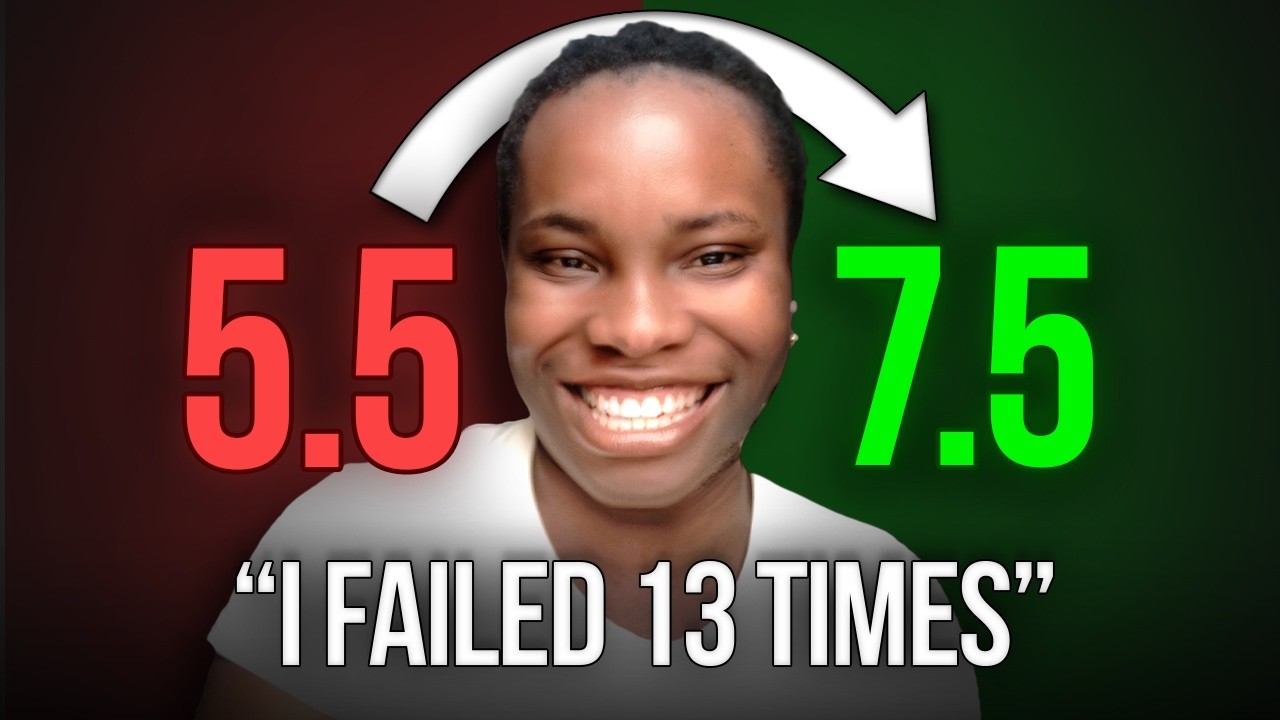
Ultimately, Marvelous achieved a dramatic improvement, jumping from a band 5.5 to a band 7.5 in writing, which secured her dream of working as a doctor in the UK. Her success story underscores that the key strategy for IELTS preparation is not merely consuming content or taking tests, but engaging in a structured cycle of high-quality input, deliberate practice, and expert feedback. The video concludes by emphasizing that humility is essential; students must accept that they are not yet ready and need to take concrete action to improve rather than assuming their current level is sufficient. By following this systematic approach and maintaining the right mindset, learners can overcome repeated failures and achieve the scores necessary for their academic or professional goals.
Read the full video transcript
Marvelous had dreams of working in the
UK as a doctor, but after failing IELTS
13 times, understandably [music] she was
ready to give up. But with our help, she
jumped from a band six to a band 7.5 in
writing, [music] and all we did was
identify four key problems that led to
so many failures. And then we taught
[music] her one simple strategy that
helped her get the score that she
needed. It's something that you can
learn, too, to dramatically increase
your chances of getting the IELTS score
that you need. So, let's talk about the
first problem. Like many of you, because
you're doing it right now, she first
started learning all about IELTS on
YouTube. So, YouTube is great because
it's free and there's so much content.
And what happened to Marvelous is as she
watched more videos, her confidence got
higher and higher, and she felt that she
was ready to do the test. [music]
Now, interestingly, many of her friends
who are also doctors who are going
through the same process told her to be
wary of YouTube. They told her that it
might cause some problems. When we speak
to students, they often say things like
they feel overwhelmed. Why do they feel
overwhelmed? Well, there's so much
information there. It's like trying
[music] to drink from a firehose. And
they felt confused. Why did they feel
confused? Well, as you know, one YouTube
channel says to do it this way, another
YouTube channel says to do it that way,
a third YouTube channel says to do
something completely different. So,
overwhelmed and confused. And then, to
make it even worse, that leads to
uncertainty. [music]
And what you don't want to do is to go
into the IELTS test with that feeling of
uncertainty, because that leads to
hesitation. You don't know what you're
doing. You don't know how to answer the
question, which leads to a lot of
stress. All of these are bad things. So,
after that initial boost of confidence,
[music]
she started to feel less confident,
uncertain, and confused, and
overwhelmed.
>> [music]
>> So, even though she had these feelings,
she told herself something that many of
you tell yourselves that my English is
good. It's an English test. I will be
fine. So, she booked the test even
though she didn't feel 100% ready,
[music] and the result was she failed.
And her confidence fell through the
floor. Lots of YouTube videos did not
work for her.
>> My mistake was watching too many YouTube
videos. There's so many errors, so many,
you know, they tell you to write a
sophisticated English. Those things
don't matter, you know.
>> Her strategy now was to look at lots of
[music]
textbooks and practice papers. So, she
started looking at lots of books and
doing lots of practice tests, and her
confidence grew [music] even more. She
thought that her English was good
enough, so she went and booked the test.
And the result?
Her score
was even lower
than before.
>> I found out that after written so like
very good essay, and I come back seeing
like 5.5, 6. I'm like, well, I wrote
very well. I had really great points,
ideas, and I even gave examples and
results.
>> [music]
>> But then when I see my score, I'm like,
why?
>> So, textbooks and practice didn't work
either. So, can you figure out why? Why
[music] did textbooks and just doing
lots of practice tests not actually help
her? What was missing? So, there's
nothing wrong with YouTube videos and
textbooks per se. These are all input.
So, for learning anything, we do need a
certain amount of input. The better that
input is and the higher quality that
input is, the better. [music]
But you do need that to start off. Then,
we need to actually practice
that thing. So, you can't watch a video
on how to get better on something, and
then [music] like The Matrix, where Neo
is learning jujitsu, and they, you know,
they put that a probe into the back of
his head, and then he wakes up and like,
"I know jujitsu." That is not how skill
acquisition or education actually works.
You [music] need to get some input and
then practice that input. In the first
try, she tried this and it didn't work.
Then she tried this and it didn't
[music] work. But why? Because she was
missing the next step, which is, you
probably have guessed it, feedback.
These books are great. [music] They are
the best books for you to practice from.
A lot of YouTube videos and a lot of
textbooks [music] are great as well.
Some not so great. Practice is
important, but you [music] are probably
making lots and lots of errors that you
are completely unaware of.
>> Completely unaware that I was making
those mistakes. [music] I didn't really
see any source online to tell me where
exactly my fault was coming from.
[music]
>> Unless you have feedback, you are not
going to be able to spot them. [music]
And think about the reason why she
didn't get feedback. Because she kept
thinking, [music] "My English is good
enough." So, you know, what is the
strategy here? Have any of you figured
it out yet? So, after, you know, a
little bit of disappointment [music] and
taking some time away from IELTS to kind
of get her confidence back, she decided
that what she would do next was hire a
one-on-one teacher
to give her feedback. Like many of you,
after you use the cheap methods or the
free methods, and after multiple
failures,
>> [music]
>> you start to take the test seriously.
So, you start to think like, "I'm going
to actually invest some time and money
in this and then, you know, get the
[music] score that I need." So, did she
actually get the score that she needed?
So, we talked about, you know, you need
input, you need [music] practice, and
you need feedback. But all three of
these things must be [music] quality.
For example, if you're using fake
practice tests, they're going to be
highly misleading. Or if you get [music]
a textbook that has been published by
someone who doesn't know what they're
talking about, it is going to actually
make you worse, not better. And [music]
if you get feedback from someone who
maybe doesn't know what they're doing,
again, [music]
you are going backwards, not forwards.
So, the one-on-one teacher that she
hired claimed to be an ex-examiner. So,
she had a lot of confidence that he was
going to really, really help her. So,
her confidence started to grow again.
So, you have this person saying, you
know, they've marked thousands of tests,
they know exactly how to help you get a
high IELTS score. Let's see what he
actually taught her. So, we have here a
question.
And one of the first things that you
need to do is you need to paraphrase the
question. You normally do this in the
introduction. This proves to the
examiner that you've understood the
question and you have good grammar and
vocabulary. But what he taught her was,
you have to change every word and you
must change them in order. And if you
use synonyms, they need to be
high-level.
Now, to a student, this sounds like
great advice. But practically, what does
this actually do? Well, it makes your
task impossible. So, in her real test,
she spent around 20 minutes of the 40
minutes, half her time, just trying to
paraphrase this. And because she
couldn't change every word, because she
couldn't change them in order, because
she couldn't think of high-level
synonyms to use, she started to panic,
she started to stress, and the result,
her score got even lower. I can't follow
that system. I can't paraphrase in that
way. It's impossible for me as a native
English speaker and an IELTS teacher to
do that. So, how would a student be able
to do that? And you might also be
thinking, like, obviously when he taught
her to do that, she would be messing it
up in front of him and the essays she
was producing would have been at a very,
very low level. Well, he made a mistake
that lots of teachers make, not every
teacher, but it's also something that AI
does as well. AI is famous for doing
this when giving feedback to students. I
want you to watch this short clip and
tell me what you think it is.
>> So, imagine if Jones had just said,
"Well, that's okay, Charlie. I
That was all right. Good job."
And then Charlie thinks to himself,
"Well, I did do a pretty good
job."
End of story. That to me is
an absolute tragedy.
But that's just what the world wants
now. There are no two words in the
English language more harmful
than good job.
>> It is very difficult, and I know this as
a teacher, to tell someone they're not
ready for the test, they're not good
enough, and they're making lots of
mistakes. Instead, what many teachers do
is just tell students, "Good job. You're
doing well." That [music] is being nice
at the time, but it is setting someone
up for failure. [music]
And this was her 10th failure. At this
point, she's just real full of despair.
She's ready to give up.
>> I was really stressed. At the point, I
really wanted to give up. Like, it was
after the 12th time, I said, "I'm just
going to find somewhere else." And that
was when I went online to browse and I
found out about IELTS Advantage. I
looked at the scores from other
students, and they were very
encouraging. So, that's why I decided to
register for the VIP course. When I saw
the price, I was like, "Oh, okay.
This is different from what I've been
seeing online. But then, I have to
choose. It's either you quit now or you
pay the money."
>> When students come to us for the first
time and they say, "Oh, your course is
is quite expensive." The thing that we
always say, "Yes, it is, but it's not as
expensive as failing your test two or
three times, but definitely not 13
times."
>> [laughter]
>> Yeah, definitely. I was hesitant at
first because of the money, but
obviously now it paid out, so yeah.
>> So, at this point in the video you're
expecting me to say, you know, she
magically got the score that she needed.
No, we still needed to help [music] her
fix certain problems. So, we helped her
identify this missing piece. So, this is
a whole system. You need high-quality
input, high-quality [music] practice,
high-quality feedback, but then you must
do one important thing. So, when we
started looking at her essays, we
identified two problems and they were
connected. So, the first problem was she
spent so long trying to think of ideas
that [music] it led to a lot of wasted
time. And then she would explain these
ideas in an overly complex way, which
again took more time. And that led to
her biggest problem, which was actually
grammar.
>> Grammar [music]
was a disadvantage for me because it's
not something that I can do at the same
time writing. Like, so I have to finish
and then go back to look at the grammar,
because I spent so much time trying to
explain [music] my ideas, I run out of
time and then I just submit.
>> And the interesting thing about her
grammar, and this is the case with the
vast majority of of people that we work
with, is she only had
>> [music]
>> two areas of grammar that she needed to
work on. She didn't need to relearn the
whole grammar book. She just needed to
fix two
>> [music]
>> errors. But these two errors occurred in
around 80% of her sentences. So, the way
that an IELTS examiner will look at your
writing is they will look [music] at
each sentence and they will count how
many sentences are error-free. And if
you want a band seven, eight, or nine,
the vast majority of your sentences need
to be error-free. Shinai understood what
the actual problems were.
Before she was guessing. Now, because
she had the truth, because we were being
honest with her, she knew knew the
problems were and she was able to then
deal with those problems.
>> After I found out that the grammar was
the main issue and I started getting the
points that I wanted, it felt so much
better. I know, I felt relieved that
okay, this was my mistake and I was able
to work on it and now I'm seeing the
results.
>> So, what we did was we taught her our
idea generation techniques, our idea
generation strategies, that allowed her
to think of relevant ideas pretty much
instantly. That eliminated the problem
of wasting a lot of time. And we also
showed her how to simplify
all of her essay, all of her
explanations and examples, and actually
pick the ideas that were easiest for her
to explain, not the most complex, which
again
solved the time issue. Then she was able
to fix this issue and this issue, which
reduced the number of grammar mistakes
that she was making dramatically. This
[music] helped her grammar, but also
improve the rest of her essay. Because
if you're making grammatical errors in
80% of your sentences, it's more
difficult to read, which lowers your
coherence and cohesion score. It can
also cause problems for vocabulary and
how you answer the question as well. So,
by just focusing on simplifying her
ideas and focusing on grammar, she was
able to identify exactly what was wrong
and work on that. So, that's the next
crucial step, which is work on
weaknesses. So, the feedback just
identifies [music]
the weaknesses, but then you need to go
away and work on those weaknesses. How
do you do that? Well, you learn how to
improve those areas of grammar or those
ideas, you practice that using
high-quality materials, you get feedback
from people who know what they're
talking about, and then you just keep
doing that until you have no weaknesses,
and we tell our VIP students, you are
ready to do the test or you're not ready
to do the test and you just [music]
continue on this cycle until you are
ready. So, that means that she went into
the test with full confidence because
she had been told by experts, you are
ready to get the score that she needed
and she did. She went from 5.5 to
7.5, two bands, which is absolutely
huge.
>> I finally got the 7.5. So, yes, my whole
family amazed with they were very happy.
I've always wanted to be a doctor,
right? Just coming here not doing that
just made me
ask myself questions. Is this really
what I should be doing? Should I find a
different career? So, yeah, we're all
very happy when we found my results.
>> The strategy that fixes all of these is
one word. Have any of you guessed it?
Well, you probably noticed the pattern
here. She thought, my English is good
enough. I just need to watch some videos
and then my English is good enough. I
just need to look at some practice tests
and some textbooks and then I just need
to hire a one-on-one [music] teacher,
but let's not break the bank on the
one-on-one teacher. Let's hire the
cheapest teacher I can find because, you
know, [music] my English is good enough
and I'll probably get the score that
that I need. And then once we showed
her, here are the exact problems that
you have, it was actually difficult for
her to accept that because again she
believes that she is good enough. She
had to
>> [music]
>> accept that we knew more than her and
then take action, which is all about
being
humble. You need humility. What does
humility actually mean in this context?
It is accepting that you are not good
enough yet
and you need to take action to improve
to the level that you need. And until
you accept that, you are not going to
get the score that you need.
>> Just be humble. That's what I'm going to
say. Humble yourself and learn. Yeah.
>> This is just one of the systems that we
teach on our VIP course because of the
level of feedback and the level of help
that we give students. We have a limited
number of places. If [music] you want
in, there is a 10% discount in the
description. Just click on the link and
if we have places available, you can get
in for 10% off if you'd like us to use
this system and many other systems to
help you. If you don't want that,
>> [music]
>> totally fine. I know 99% of you will
never buy anything from us. If you just
want more free help, here are two more
success stories that will help you
because of how you exactly what they did
to be successful.