Video summary
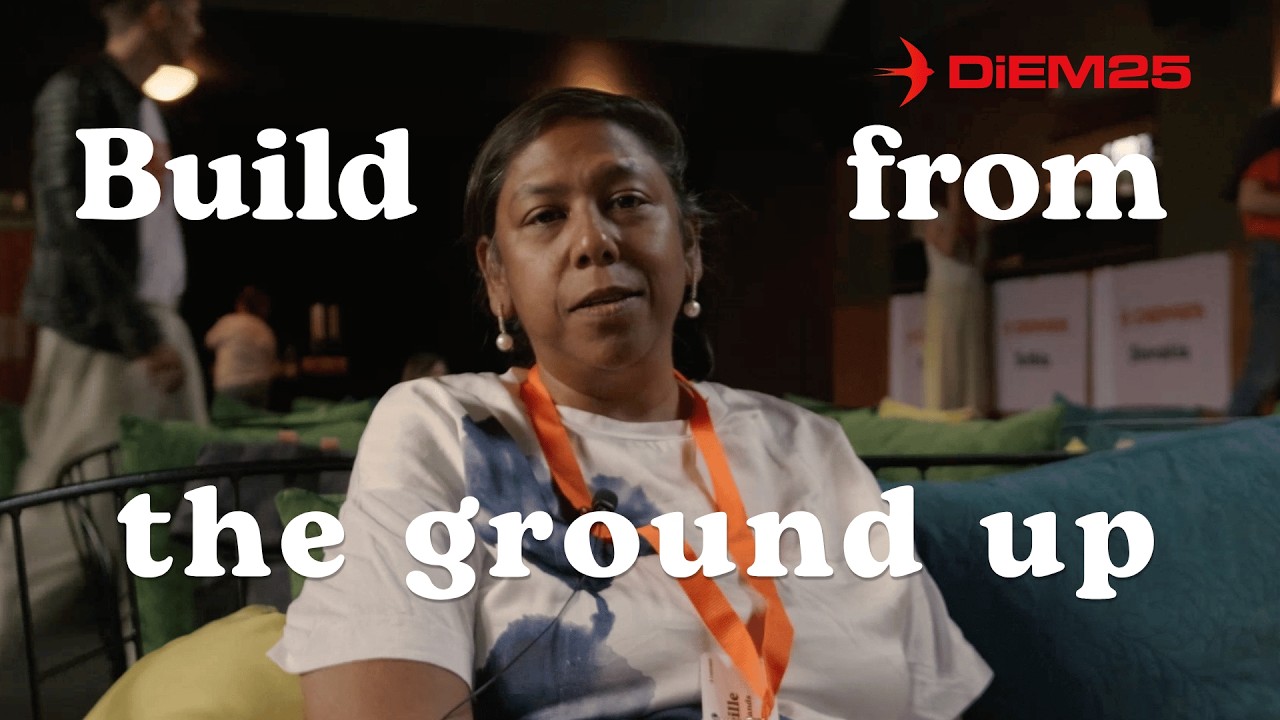
The speaker reflects on their political awakening in apartheid South Africa at the age of fourteen, where interactions with young activists from the banned African National Congress ignited a lifelong commitment to social change. Drawing an analogy between navigating life's challenges and driving a vehicle from point A to point B, they emphasize that while extras like air conditioning or warm seats are desirable, survival depends on utilizing whatever basic mechanism is available at hand. This pragmatic approach underscores the necessity of focusing on fundamental strategies rather than getting distracted by peripheral issues when striving for significant societal transformation.
Central to this strategy is the vital role of community and building movements from the ground up while maintaining a clear game plan. The speaker highlights that DiEM25, or Mera25 as it is known in Turkey, functions like the vehicle itself, but its true power lies in the engine of strategic planning which drives progress forward. By listening to experienced voices who have previously organized and achieved success, activists can avoid reinventing the wheel instead choosing to creatively adapt existing structures that address global problems through well-defined policies and procedures.
Recent collaborative activities with figures like Kinza and Johannes provided fresh inspiration for how to effectively plan ahead and transfer knowledge from national coordination teams down to local areas across various regions. The speaker notes that DiEM25 stands out because it does not focus on a single issue but rather offers a comprehensive analysis of current realities while imagining a new future, allowing organizers to build upon established foundations rather than starting from scratch every time they attempt political mobilization.
Ultimately, the core lesson for Europe's left is to stick to the basics by leveraging available resources and proven organizational models without fear that these methods are outdated or insufficient. By downloading information learned at higher levels of coordination and applying it locally, activists can ensure their efforts remain grounded in reality while still pushing toward an envisioned future where systemic change becomes achievable through collective action and strategic foresight.
Read the full video transcript
I grew up in apartheid South Africa, and
when I was 14 years old, well, I was
already in high school, and then I met
two politically active young men who
were part of the ANC. At that time, the
ANC was banned. Uh,
but they started to talk to us about the
future and about what could be the
future of South Africa.
And I got politically activated at that
time and never ever stopped. I was in
the previous academy also last year.
That was very energizing.
I'm going to use the analogy of a of a
vehicle. You know,
if you need to get from point A to point
B,
you
need to use whatever mechanism you have
available to you. So, let's use a car. I
need to get out of the city somewhere
else, and the only means of transport I
have is a car. I have to use that car.
Whether that car has air conditioning,
warm seats, and all these extras,
[music]
I can't consider those things. So,
listening to everybody, I've taken away
that
>> [music]
>> we need to make the main thing the main
thing,
you know, and stick to the basics, stick
to the things that we know,
listen to the voices of those that have
organized before us, that have the
experience and also the several
successes that they've had,
and
plug into those things. That's number
one. Number two, community is the most
important thing we have at our disposal.
So, we really need to
plug into our communities
>> [music]
>> and build
from the ground up, listening to the
voices, of course, but having a game
plan.
And so, the previous activity with with
Kinza and with Johannes, as well, and
yesterday's activity has really given me
the inspiration of how to plan ahead,
because I would say that the the vehicle
is is DM25 or Mera25, but the engine is
really the plan. And you can't have one
without the other. First thing I'm going
to do is actually speak to the national
coordination team and transfer all the
information as best as I can from what
I've learned to them
and then take that information and try
and download it then to the people in
the various different areas and then
organize our next big event or whatever
it is we're going to do organizing
politically. For me, the most enjoyable
part of DM25 is the fact that it's not a
one issue organization
that it has properly analyzed where we
are
or let's put it this way. Yiannis
started about 10 years ago analyzing
where we were. So, where we were
where we are, but also imagining a new
future and how we can get there.
Because
if you look at DM25, it has basically
looked at everything that's wrong in the
world, created policies, procedures, and
imagined how we can organize around
that. And so, I think if I want to
inspire other DMers and other people
that are organizing, we don't have to
reinvent the wheel. We can use the
structures that are already there and be
creative around how we can organize
around those things. [music] But yeah,
it's already been thought of. We just
need to use what we can.