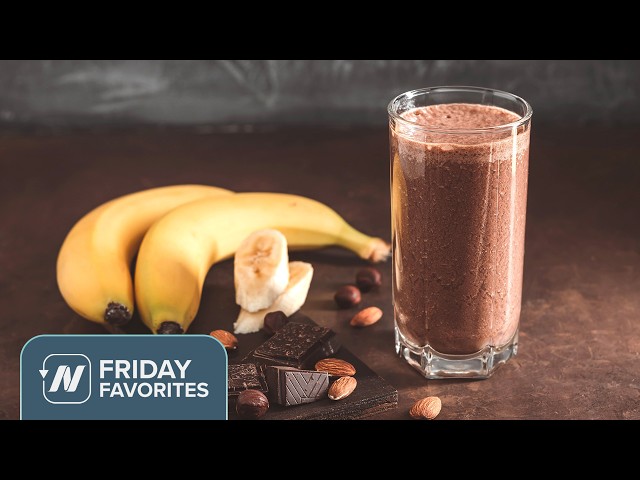
Friday Favorites: Are Banana Smoothies Blocking Polyphenol Absorption? Banana vs. Mango Explained
Watch on YouTubeVideo summary
Recent dietary guidelines have highlighted the importance of consuming bioactive compounds like flavanols, a type of polyphenol found in cocoa, tea, and berries, which offer significant cardiometabolic benefits when ingested in sufficient quantities. However, a major obstacle to maximizing these health benefits is an enzyme called polyphenol oxidase, naturally present in foods like bananas and white mushrooms. This enzyme acts as a plant's defense mechanism by breaking down polyphenols upon exposure to oxygen, causing the familiar browning effect seen in cut fruits and vegetables. Research indicates that when cocoa flavanols are mixed directly with banana enzymes in a smoothie, absorption into the bloodstream drops dramatically, with levels plummeting by over 90% if the mixture sits for even an hour due to the rapid activity of this enzyme.
The impact of this enzymatic reaction persists even after ingestion, as studies show that mixing cocoa flavanols with bananas in the stomach still results in approximately 37% less absorption compared to consuming the cocoa alone. While cooking destroys the enzyme and heating bananas can suppress its activity significantly, simply adding lemon juice or vitamin C offers only a partial solution, reducing enzyme activity by about 13% rather than neutralizing it completely. Consequently, fresh smoothies containing both bananas and polyphenol-rich ingredients like cocoa or berries may deliver fewer nutrients than intended unless consumed immediately after blending, as the enzyme remains active enough to degrade the beneficial compounds before they can be fully absorbed.
To mitigate these effects without sacrificing the creamy texture that bananas provide, researchers suggest looking to other fruits with negligible enzyme activity, such as mangoes, which have been found to possess 500 times less polyphenol oxidase than bananas and do not brown when cut. Similarly, leafy greens like kale are preferable to beet greens for green smoothies due to their undetectable enzyme levels. For those who prefer to use bananas or other high-enzyme produce, practical solutions include purchasing pasteurized bottled smoothies where heat treatment destroys the enzymes, or avoiding the combination of bananas with specific polyphenol sources in fresh preparations if maximum nutrient retention is the priority. Ultimately, while bananas remain a delicious and creamy addition to many recipes, understanding their enzymatic properties allows consumers to make informed choices about ingredient pairings to ensure they receive the full spectrum of health benefits from their diet.
Read the full video transcript
[music]
>> There are recommended daily intakes of
essential nutrients like vitamins to
prevent deficiencies,
but recently the first dietary
recommendation for a bioactive food
compound was published. Bioactives are
food compounds that are not necessary
for basic human needs, but may have
health benefits.
For example, plant metabolites called
flavonoids. Flavonoids are a type of
polyphenol, of which the most commonly
consumed are flavan-3-ols, also known as
just flavanols.
A review of the literature suggested
that the intake of 400 to 600 mg a day
of flavanols would be beneficial for
cardiometabolic protection, potentially
helping to improve blood pressure,
cholesterol, and blood sugars.
Note it specified that these are food
guidelines, not supplement guidelines.
Though really they're more like beverage
guidelines as tea, green or black, would
be by far the easiest way to reach those
levels. Though there are also certainly
some in a variety of berries and cocoa.
However, there is an enzyme called
polyphenol oxidase that can break down
polyphenols like flavanols. That's what
causes certain fruits and vegetables to
brown when you cut into them like
bananas and potatoes.
Why would a plant do that to itself?
Apparently as a defense mechanism, part
of the plant's own immune system.
When exposed to oxygen, polyphenol
oxidase can oxidize polyphenols into
breakdown products with antimicrobial
activity.
So when a banana gets bruised or you cut
open an avocado, the polyphenol oxidase
can start oxidizing polyphenols into
defensive compounds that can clump
together and form a brown compound
called melanin. The same class of
compounds that darkens the skin of a
banana darkens our skin, too.
Okay, no problem. We can just not eat
brown bananas. As that's visual evidence
that many of the polyphenols have been
lost.
But, what if you mixed that banana,
which you know is filled with a
polyphenol oxidase enzyme, into a
smoothie [clears throat]
with polyphenol-rich foods like berries
or cocoa? Might you end up with less
nutrition? Big chocolate-funded
researchers sought to find out. They put
about a half a cup of cocoa's worth of
cocoa flavanols into a smoothie
containing banana compared to the same
amount in a berry smoothie with no
bananas.
Here's a measure of how many of the
chocolate flavanols made it into the
bloodstream within hours of drinking the
chocolaty berry smoothie compared to the
same amount of cocoa blended into a
banana smoothie. It's almost as if you
hardly put any cocoa in there at all,
presumably because the banana enzymes
chopped up all the chocolate goodies.
Let's not presume, though. They blended
up the chocolaty banana smoothie again,
banana, almond milk, and cocoa
flavanols, and then just measured the
amount of flavanols as the smoothie sat
for an hour. Check it out. The cocoa
flavanols plummeted. More than a 90%
drop. A half-life of like 10 minutes.
So, every 10 minutes or so, the levels
drop in half.
How do they know for sure it was the
polyphenol oxidase enzyme? Because when
they added specific enzyme blockers,
they blocked the effect.
Okay, no problem. If you're adding
bananas to your smoothies, can you just
chug it quickly before the enzyme does
its job? And presumably, the enzyme
would be deactivated when it hit the
acid bath of the stomach, but let's not
presume. You don't know [clears throat]
until you put it to the test. I love
that the researchers did all these extra
steps. This time, they made study
participants alternate sips
between a straight banana almond milk
smoothie and like chocolate milk, cocoa
flavanols plus almond milk. So, there
was no pre-mixing in the blender between
the banana enzyme and the flavanols,
just mixing in the stomach. Here's how
many cocoa flavanols make it into your
bloodstream when sipping the chocolate
milk alone.
Mixed in the stomach with banana and you
get this, 37% less in your bloodstream,
which shows that the banana enzyme can
still do some polyphenol damage in the
stomach. And yes, in simulated stomach
acid conditions, the polyphenol oxidase
enzyme is indeed down but not out.
So, yeah, if you drink a smoothie with
banana in it, it's better to not let it
sit around, but even if you drink it
immediately, you may still get less
polyphenols in your system than if you
would have skipped the banana.
But, banana makes smoothies so rich and
creamy. Anything we [clears throat] can
add to the smoothie to counter the
banana enzyme's effects? That's exactly
what I'll cover
next.
There is one food that has more
polyphenol oxidase activity than a
banana, and it's a vegetable that's not
a potato.
What vegetable turns brown that's not a
white potato? A white mushroom. White
button mushrooms are packed with that
polyphenol munching enzyme, even more so
than bananas. Uh now, for those of you
thinking, "Don't worry, I don't expect
to be putting mushrooms in my smoothies
anytime soon." Some people add avocado
to smoothies or or make a chocolate
avocado pudding.
Here's a question. What if you eat
mushrooms with a meal packed with
polyphenol-rich foods? Might they mix in
your stomach and decrease the absorption
of the anthocyanins in red cabbage or
the berries in dessert, for instance?
You could also imagine having some
potatoes or eggplant in a meal. But,
note this is for fresh produce, the
enzyme is destroyed by cooking.
And remember we should be cooking our
white mushrooms anyway because of the
agaritine, right? So, problem solved.
Who wants to cook their bananas though?
What else can we put in a smoothie? My
favorite is mango, which you can buy
frozen when it's not in season. Do we
have to worry about it having polyphenol
eating enzymes? Well, what happens when
you cut open a mango? Does it go brown?
No. So, it's probably fine. And indeed,
when researchers measured polyphenol
oxidase activity in a bunch of fruits
and vegetables, mango had 500 times less
than banana.
The apple doesn't surprise me since it
goes brown so fast, but what's with the
beet greens? Better to use something
like kale for your green smoothies
instead, where enzyme activity is
undetectable.
This study raises so many interesting
questions.
Should you not add bananas to your
oatmeal? I no longer add it to my
cran-chocolate-pomegranate
breakfast bowls since I don't want to
lose any of the polyphenols.
But what if you're not making something
chocolatey? The study only tested the
effects of the enzyme on cocoa
flavanols. Like they didn't check
[snorts] to see if mixing bananas with
berries would affect the berry
phytonutrients, but the presumption is
that it would. And what does this mean
for bottled smoothie drinks that you buy
off the shelf in the store?
Well, if they've been pasteurized, then
it should be okay since the heat should
destroy the enzyme.
That's why vegetables are blanched
before they're frozen to destroy the
enzymes. Even just heating banana to 70°
C, which is like the temperature of hot
tea for 2 minutes in the presence of
vitamin C and citric acid, which might
come from lemon juice,
would suppress the enzyme by 80%.
I'm not suggesting drinking hot
smoothies, but rather that depending on
the ingredients, pasteurized smoothie
drinks may not share the same problem as
fresh made smoothies.
What about just the vitamin C and citric
acid alone, like putting lemon juice in
your smoothie?
Only cuts the enzyme activity down by
13%.
Works wonders on a cut apple though,
slashing enzyme activity nearly in half,
which explains why lemon juice can keep
your fruit salad from turning brown.
Anything we can add to a banana smoothie
to inhibit the enzyme? Sulfites used to
be put on fresh fruits and vegetables
until they were banned in 1986 following
cases of sulfite induced asthma. They're
still used in dried fruit though to
prevent browning. What about natural
agents?
Onion extracts can prevent the browning
of pears, both fresh and cooked onion
juice,
but there's got to be a better option
for your smoothie.
Pineapple seems to help keep apples from
browning and bananas too,
but that was after soaking in pineapple
juice for 3 days, so it's not clear if
it would work right away. There was a
study comparing lemon juice and white
wine to prevent browning in pastry
dough. You've heard of hard cider, hard
seltzer. The lemon juice beat out the
wine though, so better a lemon squeeze
than drinking a hard smoothie.