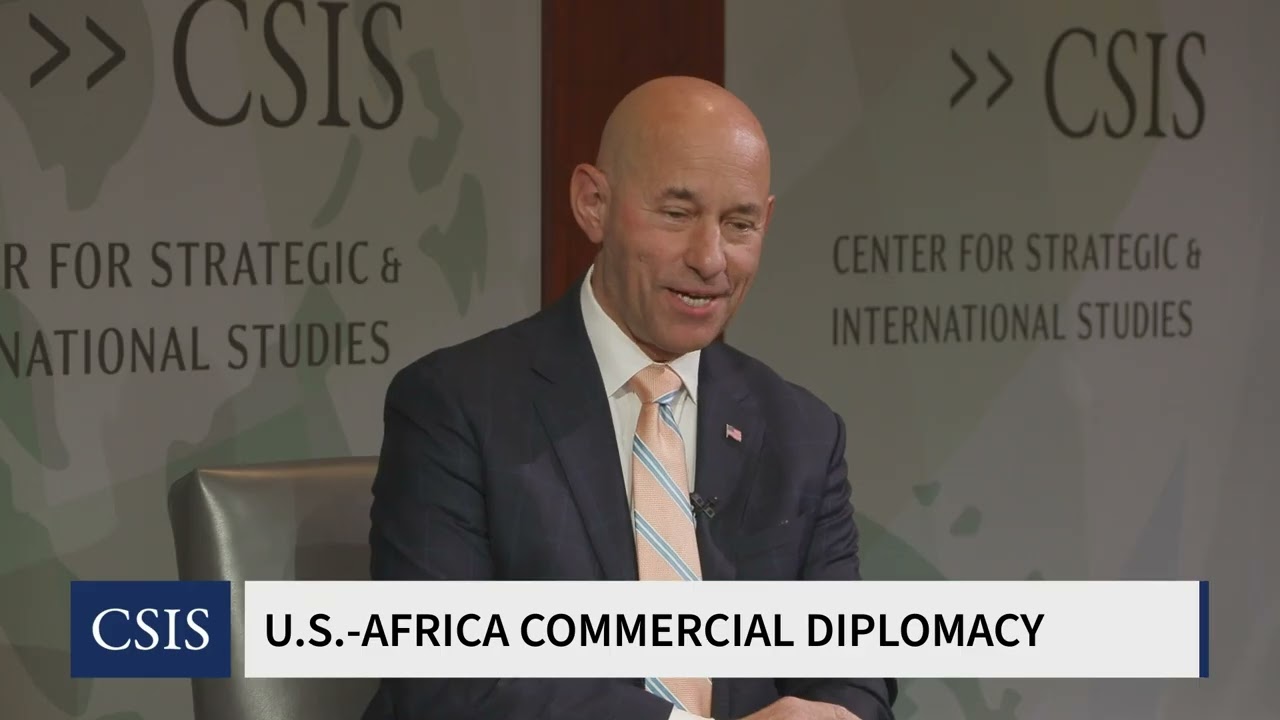
Frank Garcia, Asst. Sec. of State for African Affairs, on Future of U.S.-Africa Commercial Diplomacy
Watch on YouTubeVideo summary
Frank Garcia, the Assistant Secretary of State for African Affairs, has rapidly established a new era in U.S.-Africa relations by shifting the focus from traditional aid to a robust "aid-to-trade" strategy that prioritizes sustainable commercial opportunities. Since taking office, his administration has taken immediate and concrete steps to deepen economic partnerships across the continent, as evidenced by recent visits to Zambia, Ethiopia, and Kenya. In these engagements, the U.S. emphasized trade policy over aid, facilitating deals in agricultural food security, expanding aviation capabilities, and supporting the aerospace industry. A key strategic pivot involves moving away from being mere miners to becoming technology leaders in mineral refining, ensuring that value addition happens locally rather than just extracting raw materials for export.
The administration is also restructuring its approach to critical minerals and health initiatives to ensure long-term sustainability and mutual benefit. Regarding health, the U.S. has introduced a new framework for Memorandums of Agreement where African partners must invest their own resources, gradually reducing reliance on U.S. taxpayer funding over five years while holding nations accountable for their commitments. In the mining sector, the U.S. is leveraging its technological advantages to help African countries process rare earth elements and critical minerals locally, addressing the continent's need for industrialization. This approach aims to make projects more bankable by combining mineral extraction with agriculture and manufacturing along key corridors like the Libido corridor connecting the Democratic Republic of Congo and Angola.
To overcome the challenges of financing and risk perception in Africa, the U.S. is utilizing a coordinated effort involving the State Department, the Export-Import Bank, the Development Finance Corporation, and the United States Trade Representative. A central tool in this strategy is the "Strategic Minerals Framework Agreement," which provides a transparent set of rules to guide negotiations and lower barriers to entry for American companies. Furthermore, U.S. embassies are being empowered as critical nodes on the ground, utilizing customer relationship management tools similar to those in the private sector to track deals from initial discovery to closure. This business-like approach has already yielded significant results, with the administration reporting over 60 deals and approximately $26 billion in revenue for the United States since its inception.
Looking toward the future, Frank Garcia envisions a partnership where the U.S. and Africa are both "great again" through a strengthened economic alliance that bet on American leadership while uplifting African nations. By combining transparency, collaboration, and a clear focus on commercial viability, the U.S. aims to become the partner of choice for African countries seeking industrial growth and security. This strategic shift not only addresses national security concerns regarding supply chains but also fosters a relationship built on shared prosperity rather than dependency. Ultimately, the goal is to create a resilient economic ecosystem where American technology and capital help African nations build their own industries, ensuring that both sides benefit from a truly equitable and forward-looking partnership.
Read the full video transcript
Frank, thanks so much for joining us.
>> Oh, thank you. This is really an honor
to be here and to see old friends, new
friends, young friends, and everyone in
between. Yeah. Thank you.
>> I would love for you to kick us off
today with how has your first uh couple
months in this role been? You've been
incredibly busy.
>> Yeah. Yeah. Well, no, thank you. I, you
know, I appreciate that and and I also
appreciate CSIS's leadership, you know,
on this front and the challenge that was
laid down by CSIS.
um three days after I took over as the
assistant secretary and and it was a it
was really you know kind of an awesome
article that came out and said hey
Frank's got to get it in gear which was
which is which is awesome I actually I
actually loved it and if it's okay with
you I' maybe I can respond and so um
respond to this so you know I have the
mic I get to do this right so before we
jump in the discussion I want to thank
thank thank you for this piece and and I
mean I did write it
>> genuinely. You're CSIS. You know, you
get you get to wear it. Um, so, you
know, as you might recall from this
article, it suggested about a half dozen
near-term steps I should take. And I'm
happy to tell you that I've taken them
and more. So, first and foremost, Bureau
of African Affairs has signaled
seriousness on trade, which is
instrumental to this assembly that
you've brought together today. So, I'm
I'm grateful for the opportunity to
participate. Um last week in my second
trip to the continent um visited Zambia,
Ethiopia and Kenya and each of those
countries the overriding message was our
emphasis on commercial opportunities
um and and framed within our overarching
trade not aid policy. So I think that
that's that's key. Um in Ethiopia we're
moving several deals in a positive
direction. We're deepening agricultural
uh food security partnership. Um, you
might even have seen my tweet when I was
on a John Deere tractor with two thumbs
up. It was really fun to be at the end
of this assembly line, you know, there
in Ethiopia on a John Deere tractor
being able to start it for the first
time. There was something that was kind
of like you feel like a proud dad in
some ways. Um, not that my kids were not
born green, so just just to be clear. Uh
we also have an opportunity to expand
the US Ethiopia aviation relationship
and the United States is you know
instrumental in helping the Ethiopians
take off pun intended with their uh
aerospace industry. Um there's a new
airport that they're designing there in
Kenya. I had a chance to meet with
President RTO and um them developing
their mining sector is absolutely
instrumental and one of the things that
um I had a discussion with him on is
United States made a decision early on
that we weren't necessarily going to be
the miners but we were going to be the
technology leaders in going after the
the minerals. And so I think you know in
that strategic pause which was one of
the reasons I was interested in talking
with you um in that strategic pause we
have invested pretty heavily in the
technologies to get after kind of the
refining phases and we'll talk about
that maybe a little bit later on. So I
think that was a very much a positive
thing. Um as also suggested in this
article we've engaged our African
partners early and directly. So I've met
with um you know basically heads of of
of many of the countries uh and u so six
countries so far um and then in terms of
measurable benchmarks which was um uh
which was one of the challenges so we
have a tracker um our team compiles this
tracker we have our deals in there we
have brought together under this
administration uh with secretary Rubio's
leadership um basically disperate
pockets of deals that were being tracked
across across all the different parts of
the state department have brought been
brought together into one portal that
allows us to have view across all of the
state department where we are pursuing
these commercial deals. So it was a
great idea and it was an idea that uh
Secretary Rubio you know had put into
practice and uh we're driving that
really hard. And then you know finally
in terms of um addressing diplomatic
ballast and and and and I take this as
like okay the administration perhaps
wasn't moving as fast as we would like
uh in terms of ambassadors. You know I
respond to that by we have career
diplomats that have been um you know
working in Africa for 20 to 30 years.
They may not be uh chief of mission at
the ambassadorial role, but they are
consumate professionals and I have
absolute confidence in them and their
ability to do the job and I've had the
chance to see them uh carrying that out.
But on that um on that front we have um
two this week. Somalia and Djibouti were
announced just this week and then the
Senate is starting to move forward with
their uh in terms of Benin Gabon Kenya
and Togo uh confirmation hearings this
week and uh our nominee for Cabo Verde
was uh had her hearing yesterday. So
we're we're moving we're moving ahead
aggressively on that front and I I
actually do I read these things. I
appreciate them. Uh my my skin is thick.
Uh maybe not as thick as my skull on
sometimes, but that's okay. Anyway, but
but thank you for the opportunity,
>> Frank. And thank you so much for your
leadership in the space. You've
accomplished uh an extraordinary amount
in a short time, and you've certainly
been a lot of places. Now, you uh came
into this role with a long history on
the continent that maybe not everyone in
this room knows about. Could you tell us
a little bit about what first drew you
to Africa and how that path led to where
you are now?
>> Sure. No, thank thank you for the
question. So, um, in in one of my
earlier careers, um, I was a naval
officer on board a ship and the ship was
operating in North Arabian Sea and, uh,
in and around the Straight Hormuz, heard
that name recently. Um, and um, you
know, and and so we've been operating in
there for for quite a while. Um, while
off station from the North Arabian Sea
and the Straight of Hormuz, we had an
opportunity to do a port call in Mobasa,
Kenya. And um and it was really I think
it was a combination of having been at
sea for quite a while, but most
importantly um the people that I met
there were friendly. They were you know
kind of innovative. They were kind of
driven um and very very welcoming to us
as sailors. I said there's something
very special about this place. And that
kind of sparked my interest. and in the
intervening um decades I won't count how
many um the you know I continued to to
go back to different places across
Africa and then while um while on the
House Permanent Select Committee on
intelligence um I had the opportunity to
kind of select the area in the world
that I wanted to specialize in and it
was real clear to me what I wanted to
focus on. So I wanted to focus on the
intelligence underbelly of Africa, the
continent and all of the issues that uh
that make the continent great and some
of the issues that hold the continent
back with regard to security. Um and so
uh for for many many years I've had that
opportunity and so that kind of brought
me to to the point where um when this
opportunity came forward I was ready to
jump and have been enjoying it
>> and well placed for this event. I recall
you blew something up in a mine in
Rwanda once.
>> Indeed. Yes. Yeah, that was that was
actually a lot of fun. I had an
opportunity to travel with Ronnie
Jackson who uh has been, you know, kind
of a longtime travel uh partner. Um he's
the uh the chair of the intelligence
special operations uh subcommittee on HS
on the House Armed Services Committee
and uh also very much an Africanist. Uh
we were in a um not in the mine at the
time, but we were outside of a mine in
Rwanda and um and this is I think
Trinity Metals and they gave him the the
detonation plunger. I think it was
actually like it it was actually a
plunger. Um and so there we stood
outside the mine and you know you can
imagine all of the kind of nervous faces
from you know the company leadership
there. Okay, a member of Congress is
going to detonate this shape charge and
we're going to hear a big boom and you
know and and you know new minerals are
going to come gushing forth. So he yells
fire in the hole. [laughter]
Nothing.
And I'm scanning the faces of of you
know the sea the seauers that were
there. Nothing happened. And he's like
uh and they're like try again. Try
again. [laughter] So he yells fire in
the hole. presses the plunger, waits,
boom, the the deep thunder and you could
just see people kind of melting like,
"Oh, thanks be to God, [laughter]
you know." So, I think everyone in the
sea suite kept their job. Um, but it was
it was really it was fun to be there and
to see um, you know, to see what Rwanda
was doing on that front, what Trinity
Metals was doing and uh, and actually go
down into the mine and and get dirty and
muddy and watch the, you know, watch the
mining crews uh, doing their job. It was
um, really fascinating. It was really,
you know, the first uh, mine of that
sort that I've been in. So, I'll go in
more. You never learn more lessons than
when you are right at the rock face of
these operations.
>> Frank, I want to shift a little bit. We
hear a lot about a new era of US Africa
relations. What actually makes this era
different?
>> So what what is you know in this
administration what we're doing that I
think makes it very very different is
you know the aid to trade moniker is is
not just a nice rhyme. It's a reality
and that reality is instead of you know
kind of dropping off you know kind of uh
relief aid which is wonderful in terms
of saving some lives the focus now is
very much on kind of commercial
opportunities
that actually can be sustained and spawn
um further development and helping to
pull countries out that choose to
cooperate with us. Um, so I think that
that that that drive for commercial
venture um and coupling that commercial
venture with aid that can also help
facilitate the commercial venture.
Coupling those two together is really
powerful. I don't we didn't have the
ability to do that before. um USAD had
you know controls of you know a lot of
the the throttles in terms of where the
aid was going but now with this this
architecture that we have you know to
answer your question we've brought those
two together so we can take um an aid
package we can couple it with an
economic an upcoming economic
opportunity investment and then help do
things that are you know are are local
um but also at the national level help
our African partners work with us to
help grow uh jobs here in America and
also help develop opportunities for the
countries that are working with us. So,
I'm really excited by that. And um and I
think that that is different. Also, in
terms of the health memorandum of
agreement, like this is like one of
those things where you'd say, why didn't
we do this before? So for those of you
that may not be tracking kind of the
health memorandums of agreement, uh the
idea here is well let's make sure that
the African countries are investing in
their own health programs. And so the
United States took took a position on
these health memorandum of agreement and
we said okay we're going to be we're
going to start as the biggest
contributor in that but you're going to
have to have some some skin in the game.
And then over time, over a 5-year
period, the amount the US taxpayers are
going to be um carrying drops down and
down and down, while the amount that the
African partner is carrying increases
and increases and increases. And if they
default on their option year, guess
what? We match the default. So it's
compounded um pressure that's put on the
African nation. Um and I'd have to say
that's probably the second thing that is
very very significant is the structuring
of those health memorandum of agreement
that we haven't done before. But the the
the African nations that we have
partnered with are ecstatic about it.
And coupled with that we continue to
provide um you know in like in Zambia um
I was part of a a donation from the
United States in len capavir which is a
um a anti-retroviral drug um which
requires like two doses a year for um
for HIV. So, we're continuing to lead
the charge on that front and uh and I'm
very proud that the United States is uh
continues to to be that that large the
world's largest donation entity
>> and it's incredible how much African
country they want jobs. They want the
economic growth and that does require
growing the economic pie through
meaningful investments. Is there a
particular project that you would mark
as a a good demonstration project of
this new era?
Uh there well there there's a couple of
them. Um I I think what we're doing
right now in the Libida corridor is
really huge and uh and that has been you
know kind of a very very big project. So
for those of you that may not be
tracking, libido corridor, you know,
connects a lot of the mineralrich
regions in um Democratic Republic Congo
um with going out to down towards
Angola. And all along there, what we're
looking at is not just a a a pathway to
be able to build refining and extraction
opportunities to be shared with the
continent, but we're also looking for
agriculture to be to follow that whole
rail line because one of the biggest
challenges, you know, uh Africa is
blessed with with plentiful plentiful
land oftentimes, you know, plentiful
rainwater, mineralrich land, and so but
Now we'll have this corridor which will
couple both uh our need and demand for
uh rare earth critical minerals um value
addition with uh with you know DRC and
and Angola and then also be able to
double down on it with agricultural food
production. So, I think that's probably
a really huge um example of um of uh a
corridor in particular that um that
really covers down on on both rare earth
critical minerals and um and egg
>> and really makes a project more
bankable. It's hard to make an entire
transportation corridor work on the
economics of minerals, right? But if you
add in manufactured goods and
agriculture, you also increase the
bankability of the project itself.
>> Absolutely. No, with without a doubt
that's no that that's exactly right and
I think that's one of the things that
you know one of the challenges we're
perpetually facing oftentimes capital
doesn't necessarily flow uh so easily
into Africa um but it's when we are in I
think within the state department and
we're working with our partners in XM
and DFC and we're working together as a
team and USR we're working together as a
team that the anxiety uh in terms of the
due diligence phase for you know some
what I'll call the US venture capital
you know banking segment gets reduced
tremendously and and I think that
there's there's great power in that now
we do things differently you know we
have these different pots of money and
different focuses um and I think the
onus is on us in the state department to
make sure we're addressing that issue
which is who do we go to and how do we
buy down the risk you know for the US
taxpayers and to make sure the return is
there but yeah bankability is absolutely
key and uh and and remains a challenge
for many of the projects that we're
after but not an insurmountable one
>> absolutely so you know one of the things
we'll hear from some of our African
ambassadors later today and there is a
push on the continent to get more value
addition out of their materials they
don't want to go to the traditional
model of extraction and then exporting
raw materials out what uh what does US
support look like for Africa's
industrialization particularly on
critical minerals.
>> No, that that that's a great question
and I I mentioned briefly in my response
to the article um you know that that the
United States made which was you know
why I had had reached out on on what has
the cycle of critical minerals in the
United States look like over decades. Um
and on that front um United States 15 20
years ago made kind of made a decision
like okay let let China do it. We don't
we didn't really care where it was going
to happen because and they were
manipulating the market you know really
you know dropping down prices to prevent
others from entering the market. Well,
to some degree that was to our benefit,
right? I mean, so let them lose money.
Uh let let us, you know, use that
capacity, still get what we needed. But
then we we we woke up one morning and
said, "Wait a minute, you know, China is
starting to manipulate the market in a
way that is threatening to US national
security, unacceptable." Uh, President
Trump came in, Secretary Rubio with his
leadership said, "Okay, we're going to
we're going to turn this around. We're
going to flip the script. We're going to
take this technology investment that we
have invested in for the last 10 to 15
years. We're going to start deploying
that into Africa. Um, in this last trip,
um, I won't be specific about the
country, but we have a tender that we're
putting putting an offer in on and where
value addition is intended to happen as
part of our offering. That's what our
African partners want. They want the
value addition and in this particular
instance I have in mind there is
absolutely um you know really leading
edge US company high-tech uh being able
to move the mineral up the value stream
and also be able to access more than one
mineral that's in the value stream. In
the past with the some um extractive uh
work that has been done by others um
there were multiple minerals that were
as part of an extracted um mineral
baseline. Well, they're able to make
bank on each of the minerals that were
in that extraction and this kind of
stops that. And so I think that that
gives us greater credibility and
transparency with the countries that
choose to work with us in that segment.
>> You mentioned um how other countries do
things on the continent. Obviously
there's a lot of competition for these
key strategic sectors on the African
continent. How does the United States
become the partner of choice?
I I I think we become the partner choice
by being who we are and and who we are
is you know we do business I think in a
very transparent way. I think
transparency is is absolutely key. You
know we we tend to be collaborative and
not coercive. You know we tend to be
transparent in our business processes
and not opaque. And I think just that um
that approach in terms of the US how we
work uh it really matters a lot and it
starts with something that we call like
a strategic minerals framework
agreement. So one of the challenges of
you know of having these kind of
agreements in countries that don't
necessarily work with us frequently is
they haven't done a lot of this with us.
So how do we lower the barrier to entry?
we go forward and we offer a strategic
framework agreement and that framework
agreement gives kind of a set of rules
to guide uh follow-on negotiations that
are contract specific. So I think those
framework agreements help to um one
improve the transparency, two it helps
to establish a common set of principles
that we will negotiate a contract on and
then three helps us when we move into a
a an offer on a on a particular tender
for them to understand what we're
getting. So, so it really is a way of
creating an on-ramp that is, you know,
again lends to that kind of
transparency.
>> And how do we better align US government
financing behind this?
[sighs]
>> We scramble. I mean, it's it's it's a
it's a great question. You know, um
alignment is um is key. you know, one of
the one of the advantages and
disadvantages of having um kind of the
USbacked capital in a couple of
different ways um you know either within
um u some knobs are controlled by USR,
some by XM, some by DFC and they are a
little bit different. So I think early
on um looking at an upcoming project and
doing that kind of initial um you know
kind of I guess I'd have to kind of look
at it as a dart board. What does the
dart board look like for funding this
particular project and what are the what
are the circular rings that are you know
around the bullseye for us to be able to
leverage it. So, it it really is I'm not
an attorney, but I'll use the answer, it
depends. And um and I think that that uh
that that package of financing really
depends on the project. I had just
before getting started here today had a
um had a brief conversation about small
modular reactors. Well, I that's
something, you know, the US has been the
world leader in nuclear power, you know,
I'll say forever, but almost forever.
and and our programs and our
technologies in that sector, you know,
are are unparalleled in the world. So
like banking that takes because it's a
little bit on the new side of things
that we're looking at, you know, putting
small modular reactors into Africa to,
you know, boost electrification and also
to provide sufficient power for
refinement. Um, it can do both of those
things, but banking that is there's a
dance there. So, and I can't tell you I
know all the steps to it yet.
>> We're all living it out in real time.
So, you know, you talk about we talk
about financing. The other really
powerful form of de-risisking for the
United States is our embassies. We have
incredible soft power that we can
leverage through our embassies. And in
your Senate confirmation hearing, you
talked about supporting our embassies to
help make it easier for American
companies to do business, removing
barriers to investment. How do you see
our our ambassadors and our embassy
playing into these strategic goals?
Because they really are the ones on the
ground.
>> No, absolutely. And thank you for the
opportunity to brag a little bit about
our embassy teams. Um they've gotten the
message, you know, rare earth, critical
minerals, industrial capacity, shared
benefit to the United States and our our
host countries. Um every single almost
every single officer at our embassies is
is lit with this. they really are on
fire and are doing an amazing job. Um,
we're using we're using increasingly
using tools that industry or that I use
like an industry um in terms of customer
relationship management to kind of build
the pipeline because it is about the
pipeline and so I'm doing the best I can
do to run AF bureau like a business. So
where we're very focused on you know on
you know uncovering and discovering
opportunities that gets into a a
customer relationship management from
there we mature the opportunity we're
tied together from our headquarters to
the field uh each of our embassies using
a particular CRM and then when it
reaches a maturity point then we bring
it into our our our case manager that
gives us the ability to track it to
close and then and then book And and
thus far um since the start of this
administration, we have booked uh about
60 deals and we've closed about 26
billion dollar worth of revenues for the
United States of America. I'm very proud
of the the work that uh that the teams
have been been doing there
>> and our embassy speaks so highly of the
support they are getting from you and
the Africa Bureau in Washington. And
that's an incredible bridge to to close.
Um, Assistant Secretary, I have one last
question for you. A year from now, what
is the headline that you want to see out
of this bureau?
>> Okay. Um, [laughter]
wow. What would that What would that be?
I I I would love I would love for that
um to be you know something along the
lines of um you know I mean bet on USA
number one but uh you know kind of maybe
America and African economic partnership
making both great again. How about that?
>> I love that and I'm so excited to hear
from the Alcoa CEO later today about
their investment on the continent.
>> I'm I'm looking forward to actually
meeting with them as well. So yeah,
thank you so much for this opportunity.
This is really great to to sit down and
chat like this.
>> Thank you so much and thank you for
setting the strategic tone of the day
today and laying out how the US
government and the state department are
thinking about that more commercially
focused partnership and I'm so grateful
for your leadership on this agenda and
really excited to see what the you and
the team continue to do beyond you know
your first few days and first few
months. Please join me in giving the
assistant secretary a round of applause.
[applause]
>> [music]