Video summary
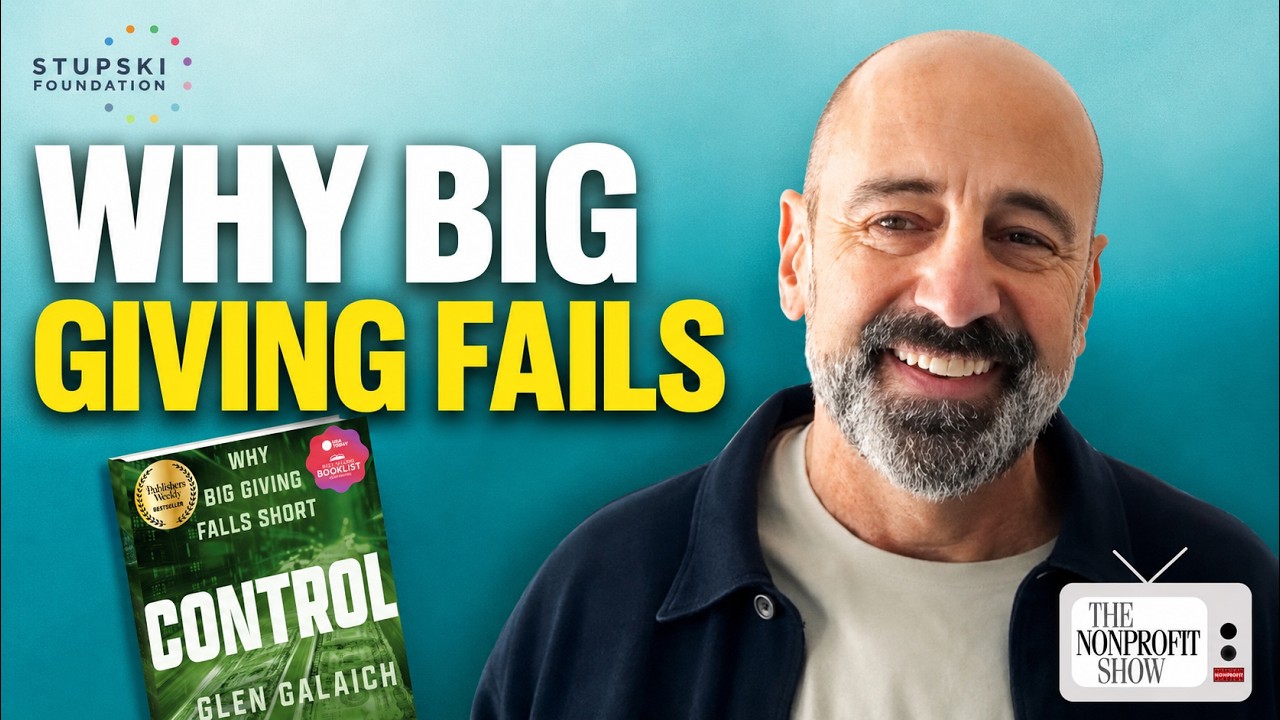
In this compelling episode of the Nonprofit Show, host Julia C. Patrick interviews Glenn Gallich, CEO of the Steppsky Foundation, to discuss the critical issue of "control" within the philanthropic sector. The conversation centers on the unique journey of the Steppsky Foundation, which was originally established in 1998 by Larry Steppsky as an operating foundation following a near-death experience that shifted his focus entirely to giving. After Larry's passing and a period of restructuring led by his wife Joyce, the foundation committed to becoming a "spend-out" entity, with a plan to fully distribute its assets by the end of 2029. Glenn explains how this process forced him to confront deep-seated cultural norms in philanthropy, particularly the tendency for wealthy donors and foundations to prioritize legacy and control over actual social impact. He argues that the very structure of private foundations often leads to money being invested in counter-mission activities like hedge funds and private equity rather than flowing directly to frontline organizations, creating a bottleneck where trillions of dollars sit idle while community needs go unmet.
Glenn challenges the common narrative that foundations are purely altruistic institutions, suggesting instead that many were originally created primarily for tax benefits rather than public good. He highlights a pervasive fear among nonprofit leaders and grant recipients when interacting with foundation executives, noting that this hierarchy stifles open dialogue and prevents necessary accountability. The discussion reveals how the sector is plagued by "fake rules," such as the belief that foundations must exist forever or that large endowments are essential for meaningful change. Glenn points out the irony that while the nonprofit sector relies heavily on foundation funding, service and advocacy organizations rarely question why their funds remain in investment accounts instead of being deployed locally. He emphasizes that successful business leaders often struggle to reconcile how they made their wealth with how they wish to spend it philanthropically, leading to a disconnect where boards prioritize rigid systems over community needs.
To address these systemic issues, Glenn advocates for a shift in mindset among both foundation leaders and nonprofit practitioners. He urges foundation executives to stop reinforcing the illusion of small grants against massive endowments and instead face questions about why billions aren't being deployed to solve crises. For smaller nonprofits and individual donors, he encourages pushing back against restrictive donor controls by focusing on actual community needs rather than simply accepting whatever a funder is willing to give. He suggests that leveraging social media to question the lackluster performance of major foundations could create the necessary pressure for change, noting that many leaders are defensive because they equate questioning their methods with attacking their identity as "good people." Ultimately, the episode concludes with a call for bravery and courage within the sector to dismantle these opaque power structures, ensuring that philanthropy truly serves its intended purpose of driving tangible social change rather than preserving wealth and legacy.
Read the full video transcript
[music]
Hey everybody, welcome back to another
episode of the nonprofit show. This is
going to be a barn burner of a show
because we are welcoming Glenn Gallich.
He is the CEO of the Steky Foundation.
Did I say those two names correctly?
>> I mean, you have a gift, Julie. That was
impressive.
>> Well, it's impressive that you would
join us because, you know, foundations
are mysterious entities. People are so
afraid of them. They're so afraid of
leadership. And so I am thrilled. Um
Glenn, you're what you what we call a
big get, right? Because you're going to
come you've come to us and you're going
to be talking about fun control and we
can't wait to hear why you are seeing
big giving falling short. And um this is
going to be riveting. We are here now.
We just celebrated 1,600 episodes last
Friday. And we're here because of our
partners. They include Bloomerang,
American Nonprofit Academy, Staffing
Boutique, Your Part-time Controller,
Third Sector Company, and JMT
Consulting. I am so excited to um let
you know that we are moving forward with
uh the global edition of the nonprofit
show. We'll be in London in a couple of
weeks working on episodes that deal with
international philanthropy. So, we hope
you join us there. I'm Julia C. Patrick,
CEO of the American Nonprofit Academy.
More importantly, Glenn Gallich. Wow.
Okay. You're the CEO of this amazing
foundation,
but you're also an author. Talk to us
about your book and this process.
>> Well, thank you for having me on. This
is such an honor. I feel like you're the
big get. I can't believe you're
referring to me that way. Um we we have
been through a process at Stubsky and um
first of all I just want to point one
very important thing out and that is
that Joyce Stepppsky who is the
co-founder of the foundation back in
2014 decided to make us a spend out
foundation meaning we are completely
spending out
>> and we'll complete that process by the
end of 2029.
>> So um I did not do that. I came in as a
CEO into a spendout and it was that
experience of uh going through the
spendout process and having done a lot
of reflection and changes. A lot
happened between 2018 in 2022 in
philanthropy I would say and we
definitely got swept up in that. Um and
that led to some realizations that
brought us around to writing this book.
>> It's such an interesting thing. I I love
your perspective. super unique, super
exciting. But then you attract attached
the word straight away control.
>> Right? I mean that says so much across
the philanthropic landscape. How we see
ourselves, how we see our funders, our
relationships, how we communicate. Um
really powerful concept. So um it's a
delight to have you on and to to learn
about, you know, what you're seeing.
Let's start off with this amazing
foundation. Um, if you want more
information, you really need to go to
the foundation website and read the the
moving story about the the stuffskies.
Um, but share with us the origin story
of this.
>> Yeah, you know, it it I get emotional
just seeing Joyce's picture because
she's she passed away in 2021. It's been
about five years
>> right around this time. Five years ago,
she passed away. Uh Larry Stepppsky is a
kind of an unknown person, but he's had
a big impact on a lot of people. He was
the person who took Charles Schwab from
being a small little boutique finance
company in San Francisco to an
international powerhouse. Um and in the
process of doing that, he um obviously
made a lot of money. There were a lot of
liquidity events that turn became the
Steky Foundation in 1998. Um he also
suffered a very severe heart attack that
literally killed him in his early 40s
but he was revived on the table and in
in and when that happened he completely
changed his life um in many many ways
and dedicated it to philanthropy and
turned the foundation into an operating
foundation which is not so common. Um
Joyce on the other hand was not a big
fan of that structure.
>> Larry had terrible health problems most
of his life. He ended up passing away in
2013 from something very similar what
President Biden is going through. He had
gotten prostate cancer and metastasized
into bone cancer and then he died. So a
lot of that really affected her. She
decided to close the foundation for a
year. She restructured it into a
grant-making spendout foundation on on
the issue areas that you see on our
website. I won't go into them in two
geographies, Calh Northern California
and Hawaii. So
>> in so many ways she was very different
in how she thought about philanthropy
and I really loved that about her and
>> we had a great relationship and we
challenged each other all the time and
much of that I write about in control
the control of the book is very much a
philanthropy book I don't want to
>> right
>> that fact but it [snorts] is also a
story of my own conversion from what
we've traditionally called strategic
philanthropy
>> to something different um which I
haven't named but it it is very similar
to what you hear from other writers and
thinkers out there around community
first funding.
>> Um, and it's also uh the story of of the
conversion of the foundation from from
one thing to something else.
>> And it all has to do with this concept
of control. Who gets to make decisions?
Why do they get to make these decisions?
And how is our system set up so that I
believe we are undercutting our ability
to get impact because of that control.
It's fascinating because when I was uh
preparing for this interview and and
reading their story, you know, it made
sense to me that there would be um
different approaches because he was a
man of numbers and impact and you know
in the world of finance and wasn't she a
retired teacher?
>> She's a retired teacher. They met
because she opened up an events company
[laughter]
and she was like their events planner
and he he he just
>> he just that all happened. Um
>> and so yeah, you know, she she never in
my opinion never really got over her
grief. I think in many ways that's what
killed her. Um
>> it was very hard for her. Uh I in a
weird way, you know, I I became like her
business partner and you know and and
friend. And so in the book I talk about
the many times that we would sit and and
talk. Um it was it was great. It was a
great experience for me.
>> Well, what a powerful thing because
we're talking about um a phenomenal
amount of money and influence,
>> right? Um and then to look at this and
to spend down or spend out um is
shocking when you think about the work
that has to get done with the the speed
with which it has to get done. Um, so I
am absolutely fascinated by that and I
want to kind of ask you that question
and and get you to reflect on that under
the umbrella of this culture of
philanthropy and creating a new way to
think about it because it had to be a
huge exercise in your own brain just to
say, "Yeah, we're going to navigate this
whole thing
in a short period of time."
So, you know, we talk a lot at the
Stepppsky Foundation. We even have a
podcast called breaking break fake
rules. And there are a lot of fake
rules, norms, mythologies in the
foundation sector. Number one is just
the concept of the foundation as an
institution to begin. I think the part
we kind of forget and that's I think by
design. I'm not a conspiracy type
person. And so I when I say by design,
I'm a little bit I'm a little bit
nervous about that phrase. But there's
an aspect of this that we forget a
couple of really important points at the
origin of a foundation. Number one, it
is a donation. That's all it ever was.
An organization was created to accept a
donation.
That organization was then named after
the person who gave the donation and is
therefore and then the bylaws are
written so that those people govern the
foundation. At the end of the day
though, it was just a donation. In
theory, the donation could have gone
directly to frontline organizations and
skipped the step of a foundation.
>> Yeah.
>> We don't talk about that.
>> No.
>> And the other part is, which is probably
one of the more controversial statements
in the book, even I had a woman helping
me with the book, and when I first said
it to her, she was like, I can't believe
you're going to write that into this
book. But I do think the thing we have
to remember is that the reason most
people start private foundation and fund
it is for tax benefit. They don't go
into it with the idea of doing public
good at first.
>> And so when I said the controversial
statement I said is when someone tells
you they started a private foundation
for the benefit of of the world, I tell
you that I think they're probably lying
to you.
>> They really did it for tax benefit. And
so when you look at the overall impact
of these two really important
uh realities of how foundations get
started, it shouldn't come as a surprise
if you're just going to jump through to
the end of the point of of the book.
Shouldn't come as a surprise that we
have two trillion dollars of assets
piling not just piling up but actively
invested in things like private equity,
>> hedge funds, venture funds, uh you know
currency speculation. That money should
be moving to charitable benefit but it
is piling in these very countermission
activities
>> and we are not interrogating this stuff
enough. We are not talking about this
stuff enough. And the irony is you know
the nonprofit sector which should be
benefiting from all this the by
nonprofit sector and I we these terms we
use get very murky all of this is
nonprofit from foundation to service to
advocacy all of it but the service and
advocacy organizations and there are
over there millions of them now in the
United States
>> play along in this as well uh and don't
ask questions either about why this
money is not in their bank accounts
where it's getting work done it's
sitting in, you know, um, investment
accounts,
>> right? Well, you know, it's a very
mysterious thing. Yeah.
>> Um, the relationships and I find that
um,
>> and in my community there's some very
large foundations. Um I God I was just
literally I was at an AFP event uh last
week and there were uh there was a panel
of some very large uh CEOs of some
foundations. Um I don't ask for money so
I don't and I have relationships with
these people so I don't have that
structural um fear or or problem. I
could not believe how fearful the room
was even to go up and introduce
themselves or shake hands or just
interact and it really reminded me of
like wow there is this hierarchy and
there's this fear um that which goes
back to control and so yes it it just
happened like it just reminded me I
guess I should say um and so I really
applaud you for for bringing that out.
Well, look, that's that's a huge reason
why this money is not moving in my
opinion. Um,
>> look, I've gotten lots of very positive
accolades for the book. I'm grateful for
it. I've also had some real tussles with
some of the biggest names in the sector.
They don't like it when I ask these
questions. Um, and I think it and I I
understand why. I really don't you know
I think our sector uh foundations in
particular so you've used some really
good words today mysterious opaque
>> our the foundation sector and I like to
differentiate that from philanthropy
because we talk about philanthropy
broadly but the foundation sector is but
a sliver of what is American
philanthropy financially speaking right
so we're going to do over 600 billion in
philanthropy this year 100 billion of it
will come from foundations so it's
really like 20% % it's not the it's not
the bulk but it is it is that driving
engine there's a lot of money that comes
in bulk uh ways from these foundations
so people really play to them you know
as a side note I don't know why more
work is not done to appeal to the
everyday donors in America because they
are controlling 400 to 500 billion in
giving every year's far more attention
way too much attention in my opinion
given to the foundation sector which is
what pumps them up these the we we we we
love to be plenary speakers at events
like yours. I love to be a plenary
speaker. If I didn't have my title, if I
didn't have my job, no one would want to
hear a word from me. I know that. I
don't know if they know that. Uh I do
think many of these people start to
believe that they are pretty special
people
>> uh and important in that way. So that I
think is a part of why the money doesn't
move because people can't imagine a time
where their brand is gone.
>> Mh. Um, so that's part of it. But the
other really, you know, I think the big
one in all of this is is that um there
there just is this culture of wanting to
control decision making, wanting to have
a legacy, wanting to have these entities
around for a long time. And um and for
that and you know, it's it's fun
actually to be able to say, "Hey, I
think I can change this thing."
>> Yes. and I'm going to put these
resources to it.
>> Yeah.
>> But there's just a lot of irony in that
when you look at how we actually
practice social change.
Well, I I have a lot of opinions on this
and and now is not the time, but um I
would say that what I see when I
interview
uh people of financial means that have
navigated toward this section of their
life where they're invested in
philanthropy, oftentimes they don't
realize that how they made their money
and how they're going to distribute
their money in a philanthropic
environment don't necessarily align. the
way that you make your money, right?
>> Um versus the way you spend your money.
There there's some actual opposing
issues, right? And so I think that's a
really hard concept for successful
people to necessarily embrace. And we
see this on boards.
>> You know, successful people in business
go onto nonprofit boards and they're
like, "What the hell? You just need to
run this like, you know, I ran XYZ
corporation." It's like, yeah, it
doesn't quite work like that, but
there's this there's disconnection. So,
you mentioned this $2 trillion
bottleneck that needs to be fixed. Um,
it's part of the great wealth transfer.
There's been so much money made in this
country that's now, you know, moving um
because we have people passing away. Um,
that is an astonishing number.
Yes.
>> I'm just like, you know, we know this
number.
>> Yes.
>> What are other foundations
talking about when you are with them as
a peer?
>> Um, well, they're not talking a lot
about this number. Um, there are a
couple of important numbers that I think
we all need to start to grapple with.
I've been I've been very um pleased that
in the last 24 to 48 hours, we're
starting to talk a little bit more about
our $40 trillion national debt.
>> Um because we hit 40 trillion this week.
>> That's right.
>> The other number that really which
really brings that to light is that
since 1975, Rand the Rand Corporation
came out with a report that since 1975,
our economy has transferred
$80 trillion from the working class to
the 1%. Mhm.
>> Um, so a piece of that are these
foundations. What make that possible are
foundations and the tax evasion they
offer. So you end up having this money
piling up. We're going to see. So then
you got that transfer from working class
to the 1% and now you have an internal
transfer within the 1% happening. And as
that happens, there's going to be more
taxes that need to be evaded. And what
happens then is that gets piling up and
up and up. In the next 20 years, we
could have as much as 20 18 to 20
trillion in these charitable accounts.
And you know I think at that point
Americans will have to start paying more
attention to this sector. I just you
know we were talking earlier before we
came on and we we surveyed a lot of
people about the behaviors of
foundations and you know the one thing
we did not ask is do you know what a
private foundation is?
>> Yeah.
>> Do you know where they operate? Do you
know what they do? Most people don't.
>> Right.
>> Uh even you know very very informed
people don't know.
>> Sure. And you know what? I would I've
always kind of been curious. You you've
you've alluded to this in this
conversation. I'm not so sure a lot of
even nonprofit executives know much
about foundations.
>> Oh, I totally agree.
>> Yeah,
>> I totally agree because
you know, we use that word mysterious.
People are afraid to talk about it.
>> Yeah.
>> They know that there's a power structure
there. And I think that Yeah. I think
it's very secretive and I think it's
very egofilled
and um yeah I I definitely
>> you know there's something I wanted to
say earlier because that when you say
that people are afraid that is at the
core of that is is a really big problem
in our sector and this is I meant to
mention this when I said I've gotten
some push back
there is a everybody who does this work
you know you and I both want to be good
people and want to do good things and we
believe so much in the way we do good
things and it becomes a big part of our
identity and we become very defensive.
I'll speak for myself. I become very
defensive when people start to question
the way we do good at Steky
>> and I really challenge myself when that
happens. I have to say why am I being
defensive? At the end of the day the
feedback I'm receiving is just feedback
about being better at doing good things.
And but many of my peers and many of the
people in this sector are very resistant
to talking about doing this work better.
There's some sense that if we're not
doing it as well as we can that we're
doing something bad.
>> I think we need to get over that because
if we're not able to do that, we
stagnate. And I think that's part of
what's going on here is that,
>> you know, if you question something like
perpetuity, which is a huge
fake rule of our sector, that your
foundation must live forever.
If you question that, people get very,
very defensive about it. And I think
part of why they get defensive about it
is that they feel like you're kind of
attacking them. They probably internally
have some guilt that that money is going
to sit forever and not get used in a
moment of crisis like we're in now,
>> right?
>> And so I just think we have to get over
it. We are incapable of having open
conversations at the foundation level.
>> Yeah. It it's a it's an interesting
thing too because when I look at my
friends who are in this space, you know,
they go to bed every night with their
employees on their on the pillow next to
them, including their own jobs,
>> you know, and so you're buying yourself
out of a job or you're spending yourself
out of a job, I should say, right? And
so
>> that's human, right? That's human.
>> Sure.
>> I mean, you can be like, "Yay team. I
want to do the best for my community or
my interest, but at the end of the day,
you're
it's bold. It's bold to say this is
going to go away, right?
>> Yeah.
>> It's completely antithetical to the
American minds for any human mindset. It
doesn't be American. I don't think there
are a lot of countries that are saying
it's let's get rid of ourselves. It's
not it's not it's very antithetical.
Everything is about growth, growth,
growth, growth, growth. I'm telling you,
as a spendout leader, I am constantly
swimming upstream to to shut down this
entity. It's not easy.
>> It's not easy.
>> No, it's it's it's so fascinating to me
that you are in this place in time.
Also, you knew the founders, so you you
have that voice in your head.
>> This is this is real. I mean, you you
you're carrying on the value of of human
beings that you knew. Then you're in a
in a time of crisis. I mean, she passed
away before some of these modern
crisises. He certainly did. He did. So
then you're you're like, "Oh my gosh,
what would they have done during these
times?" I mean, it's a fascinating place
to see where you live. Um, so I want we
don't have a lot of time left. I have so
many questions. One of my first
questions and and this is going to maybe
seem like it's come from left field, but
when you wrote when you were writing
control,
>> if you weren't with a foundation that is
a spend out um spend down, would you
have had these same sensibilities and
these same theories?
>> I'm going to say no. Um however
I don't know what was in the water
between say 2016 and 2020 but I was
because I had worked with in a prior job
which I held for quite a while training
individual donors on on how to give
strategically as we called it and I talk
about this in control. Um, you know,
after working with thousands of
individual donors, I kind of started to
question a little bit about what what
was I doing here and what was I teaching
them and and were they getting as much
as they could out of their impact. So, I
kind of came I wanted to work at a
spendout because it was different.
>> But I'm not going to tell you that uh
I'm not going to say I I was having
these thoughts about reforming our work
when I got there. It definitely was the
benefit of being there, making grants,
making strategies, having to take
accountability for this stuff, which I
didn't have to do before.
>> Yeah.
>> Um, so that was a certainly a big part
of it. And I know a lot of
>> I I talk to CEOs on a daily basis across
the foundation sector and many of them
go through transformations once they're
in a position of really guiding these
entities. Many do. And there there is
and this is just this is just an an I
don't have real data to support this but
I've noticed that there's more
willingness to change the lower the
amount of resources you're stewarding.
The higher you go up the more rigid you
are about these systems.
>> Sure.
>> Just my experience. I can't tell you
why. I mean I I would love it if we have
a new very dynamic leader at the Ford
Foundation. I would love to see her do
something incredible. I don't expect she
will because it's just not common to
anything over a billion dollars to do
and especially if you've been around for
a long time. It's just hard. They don't
want to make those changes.
>> A lot of pressure uh on that leader uh
with the historic nature of of what's
going on and and think about the change.
Yeah. That they have navigated just in
the last 25 years was revolutionary when
they started.
As we finish up, I've got to ask you
more about this restrictive donor
control and and you have been so
incredibly articulate about
your journey, what you see engaging the
wishes of your your founding your your
founders.
How can somebody like me or the person
running the dog shelter down the street
or the art museum push back against
restrictive donor control? Um, do we
just have to wait for a sea change or or
can we actually be engaging in the in
this fearful conversation?
[snorts]
>> I understand the fear. I understand
there's a power dynamic in a system
where you're trying to build your
organization. But I do think and I so
look I put the onus on this almost
entirely on the foundation leadership to
start to make these changes from
trustees to CEOs and even program
directors. I do and the investment world
if they would just kind of back out and
get the hell out would help a lot too.
But that aside, I I do think there is a
role for the nonprofit leadership. I
think by nonprofit again I mean service
advocacy groups working at a dog
shelter. There are two things I really
encourage and I know it's I know it's
you said fear and I don't I don't want
to come off as being you know blind to
that fact but to the degree that you
have strong relationships with donors or
program officers and feel that you can
speak somewhat safely with them we need
to see service and advocacy
organizations asking for what they need
to do their job not what they need to
get the grant you know there's there's a
lot of this that goes on we we are
trained as fundraisers And I've done
quite a bit of that myself to know the
inside and outside of what a foundation
or an individual is willing to do even
though they could be sitting on 5 to 20x
the amount that they're willing to give.
We have to challenge donors to meet
community need. The only way I can think
to get donors to become more aware is to
tell them what the community really
needs, not what the donor is willing to
give. Mhm.
>> Um, so I do think there's a
responsibility there. I recognize it's
challenging, but you you're using the
phrase pushing back, so I'll I'll lean
into it. That is a push back we need to
see.
>> Um, the other thing I'll say, you know,
is
pay attention to announcements that
foundations make online. There's a lot
of positive reinforcement on social
media to the very lackluster work that
foundations do. So most foundations are
going to give at the minimum they're
required, it's 5%. When a multi-billion
dollar foundation announces a $100
million grant, that's eyepopping, but it
is still within a 5% giving structure,
>> right?
>> So a hundred million for most of us
individually would be whoa. On the level
of the problems we're dealing with, the
entire endowment of of a Ford Foundation
is still pocket change against the
issues we're addressing. When they
announce a $100 million grant, please
don't like it. Stop positively
reinforcing this. Ask the question, why
a hundred million? Why not 1 billion?
Why not two billion?
>> This we are we are reinforcing the this
behavior. I expect when we make grants
that look very small against our
endowment, I would hope people would ask
why such a small grant.
>> They don't. No one does. There is no
accountability for us. There has to be a
wider net of accountability to put
pressure on us to make these decisions
because we we don't like again we are a
culture of good. If someone's
questioning our good, we don't want to
come off
>> bad. So there is there is leverage in
social media. I believe again I know the
risks, but I I would encourage the more
we come out in mass and question some of
this stuff,
>> the more we protect ourselves.
>> Wow. Okay, I'm just going to call it
out. This has been one of my favorite
episodes that we've done in seven years.
Thank you.
>> Um but our time is up. Um everybody go
out and get Glenn Galish's book. It is
really important that we have this
conversation. Um, control is such a
loaded word from how we are funded to
how we serve, how we work within our
communities. And I think this has just
been a riveting conversation. Um, Glenn,
we're going to rope you back into some
other episodes. This has been
fascinating and uh I really applaud your
um your bravery and it and the way
you've thought about things. That's what
I love. The way you thought about this
and and your approach I think has been
absolutely
>> fascinating. Um go to um stupitsky
stubsky.
>> Got it. You got it.
>> Uh.org and look at how this couple
navigated this vision and this journey
and what they fund and how they are
working through it. It's very
interesting and I think it can teach us
a lot about this mindset. Certainly
Glenn's book echoes what he's learned
and what he's seeing. It's a
fascinating, fascinating thing that we
do need to be talking more about. Um,
I'll get off my soapbox, Glenn, uh, as
our time winds up and I'll thank our
partners. Uh, they include Bloomerang,
American Nonprofit Academy, Staffing
Boutique, your part-time controller,
Third Sector Company, and JMT
Consulting. Um, again, wow, one of my
favorite conversations ever and uh
really powerful. We need these messages
and we need to have more bravery and
courage uh when it comes to to this. Um,
it's just been a pleasure. Thank you,
Glenn.
>> Likewise. And congratulations on
thousands of episodes. Uh, you've
obviously got a great audience. Thank
you so much.
>> Yeah, we do. We have we do have a great
audience. And thank you. Thank you for
saying that. Hey, as we end each and
every episode of the nonprofit show, we
leave with this message and it goes like
this. To stay well so you can do well.