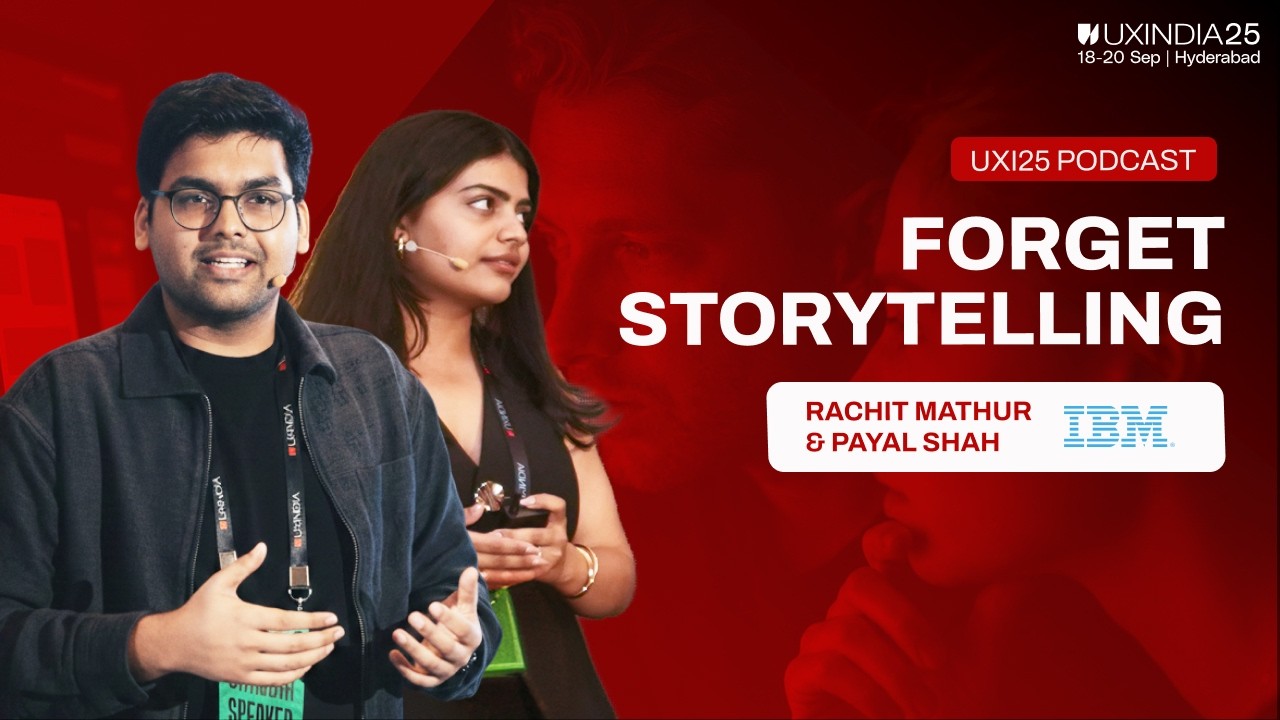
Video summary
The video introduces "story listening" as an essential, yet unconventional skill for designers that complements traditional storytelling by focusing on understanding complex domains through personal analogies rather than just explaining concepts to others. The speakers explain that this practice emerged from the need to navigate highly technical fields like cybersecurity and enterprise products where jargon often creates barriers between creative teams and stakeholders. Instead of feeling overwhelmed by unfamiliar terminology, designers can mentally map these new concepts onto familiar universes they already know, such as Harry Potter or Star Wars, effectively turning confusing technical data into relatable narratives that make sense within their own mental models.
To implement this approach in real-world scenarios like kick-off meetings with stakeholders who use heavy industry jargon, the speakers recommend creating a "web of understanding" by actively searching for metaphors and analogies during initial conversations rather than pretending to understand everything immediately. They illustrate how turning abstract technical problems into fun stories—such as comparing a Great Firewall blockage to a tunnel in a fantasy world or relating cybersecurity concepts to healthcare systems based on personal background—makes the learning process more engaging and easier to communicate across different disciplines. This method not only helps designers quickly grasp domain expertise but also fosters better collaboration by allowing team members from diverse backgrounds, such as sustainability experts moving into new product areas, to bridge gaps in knowledge through shared storytelling frameworks.
The discussion highlights that while everyone naturally engages in this type of mental modeling without realizing it, consciously practicing story listening allows designers to navigate complex enterprise environments more effectively and gain a deeper insight into the problems they are solving. The speakers emphasize that as AI tools become prevalent, new entrants to the field can leverage these analogies by asking software like Perplexity or ChatGPT to explain concepts in simple terms suitable for three-year-olds, which often sparks the initial creative connections needed to build their own unique design universes. Ultimately, the session concludes with a strong message that story listening is not just about memorizing facts but about building personal narratives that make technical realities sensible and manageable for designers who must constantly adapt to shifting domains while maintaining empathy for end-users.
Read the full video transcript
Welcome to you India 2025 Hi my name is
Gaurangi and today I have Payal and Rachit
UX Desires at IBM today I am so
excited to have you guys here and today
we will be talking more about story
listening which is a not very conventional way
of talking about design briefs. So, we are just
going to deep down and understand how
story listening is helping us and how we can
actually adopt it ourselves
? So, let's do it.
Ok. We are excited to be you too. Do you have any
questions specific to
story listening? Because I can see it, it comes
out very surprising because you know
story telling but we are saying story
listening in what is it?
No no no no we have a bunch of questions
actually. Nice.
And I'll be shooting them on you. So
first to start with how are you liking the
experience of UX India and how was
your day? yesterday. It's been amazing
so far. Ah it was just the day one yesterday.
And I think it's fun because there's so much
happening. It's Not Just UX But There
Is All Things Design. And it's it's been
amazing. Like I love the dog. I love the
energy and there was a lot of networking
and getting. Need a lot of new people.
Yeah. The Kind of Energy You Get at the UX
India Conference Is Completely Different
From Other Conflicts That I Have Been Through.
And this is the energy that we kind of all look for as
designers. So it's it's it's have been
amazing.
Thank you so much. Are you excited for your
session, your talk?
Definitely.
Very much. And this is the first time I'm talking
about the story Listening Outside Our Team. So it
feels like we're going to get a lot of
questions. It looks like a very personal
topic, right?
It is so let's start with what is
storytelling and how did that thought emerge
to you and like you decided to talk about it
and on the deeper level on your personal level how do
you relate with that same topic?
I can tell the truth. Yeah. So, I think I work in the
cybersecurity domain and these domains are so
complex in it's own way it's
going to get more complex and the job that
designers really have to do now is step by step
inside the early process and
really work through the discovery side of things
to strategize and figure out all the technical
jargon and what it really means for the
user on the surface level.
Ok.
It's Been It's Been So Many Months That I
Really Worked On Figma. Or like design
screens because that's not really the part
of the job that they ask me to do.
Right.
So story listening comes through the picture
when, I was listening to this technical
jar. It wasn't making sense to me. But all of a
sudden I was making analogies from what they were
saying. So something like ah
database became castle. And like cyber
security tools become mode. And I was,
I was creating stories in my head, as I was
listening to this technical
documentation. And I think it also has to do
with the domain. I was working on
cybersecurity is very notable about this that they have a
lot of system metaphor.
Caslan Mode Itself Is Like Well Known One. Oh
so, it just hits you all of a sudden because
you're designers, you're coming from
design school where you've thought about these
technical jargons, but you have all the
design tools, but you've thought about these
domains. And When You're in These Meetings,
You're All Confused and Suddenly Someone Calls
Out Castle and Mode. And something which is
finally relatable to you, and then you
start making analogies. So story
listening is that's why I say it's like the
opposite of storytelling. You use
storytelling to explain stuff to someone. And
story listening is you use stories to
explain yourself and could be your own
universe.
Yeah. But the thing there is that you know when
you start practicing story listening.
It actually helps you to tell stories.
Like It Improves Your Story
Telling Much Better. Makes you story telling much
better. So, I think it's more about ah you know how everybody needs
to get that
domain knowledge expertise these days and how
you can practice story listening to get through that
and it's not like an a skill or
a new method that you need to learn. It's
actually something that we all do in our
everyday life. But it's just that as designers we don't
practice it much often. So, maybe we should
practice story listening as a way
to learn, leverage it to get our
own benefits and
understand. Knowledge is better.
Right. Actually like listening to you I had
a movie in my head. I could actually
visualize it. Right. I could visualize it.
And I personally like I never had a term
for it. But I am realizing that I think we all do it.
So which is very
interesting. Movies in Your Hand.
I will tell you the expression that we just
had. We have similar expressions with other
team members and everyone thinks in this way.
But no one head really documented these
findings. So, or so we're like, let's go ahead
with the story listing. It it seams
very design term that might.
A New Generation Design Term. So, like,
just to make it out, bring it all together,
story listening is something you're trying
to listen to, you're trying to understand. Yah!
Hmm.
So, from boring paragraph, long brief.
To A Nice Way of Understanding Things
Yourself?
So, how do you communicate this? And how do
you communicate in your design process.
Like, from
for example, you, again, you get a design
brief.
To the design process. In, which
involves like the whole functioning,
communication, with the team, telling people.
And Not Just Date. Also, how are you
documenting it.
Hmm.
Yeah. So that's a really good question. So how to
put it actually into practice is
what you're asking and a Jess. So am you know what we like imagine we
entering like
a new kick off call of a new project
that you're meeting with the new
stakeholders. And you know they are throwing all these
jargons at you. Because you don't know
the domain et al. And ah you are trying to
understand and make some sense out of it. But how about
the time like the f the initial
meetings that you have with them usually just
goes by you knowing at them and you're not
pretending to be like you understand everything
but actually what you do is you
go and search later and try to understand ah later
so how can you do get these domain
expertise actually ask questions like ah
and create analogies like for us
we think of tech ah ah technical
concepts as medal stories. So, we
try to connect it to some kind of
obsession like we love Harry Potter. So, we
try to connect it to H Hapotter and you
know, just give map everything like map
what your users are in your domain. Like
try to create those connections and have some kind
of metaphors that actually work
for you.
And create those analogies. So bye bye
connecting those gaps. I think slowly you
will build that web of understanding.
Or understanding personal level. Also about
slowly modeling the whole universe to
understand your domain. So when you talk about getting
like a design brief. Am.
You There's a lot of conversation that goes on
when you're decoding that design brief
with your stakeholders. And you are
trying to ask questions. You're trying to
figure out what exactly they're saying.
But you don't know what the right questions to
ask.
Hm so, the way we usually do it is we get a
design brief and
then we do like a the briefing among ourselves.
And we have a mural setup
like a white board setup where we have our
own understanding of the whole product
already listed. So if this new design
brief comes up it's more like adding to that
whole jobs to be done framework which is
very analogical to our understanding and just by that we
derive a lot of
questions that we can ask.
What if like one of the examples that we're
giving in our talk is around the
great fireball of China.
Fire Chinas Has Blocked Google Right? So,
that's the way we see it, it's really like everyone knows there's
a great fire over China, and how a
VPN could be like a tunnel which could
basically allow WeChat to log you in.
So we talk about this terminology which also keeps the
mediations fun.
Because everybody imagining the great word
China is all the politics stuff which is more
fun to talk about than rather like technical
Georgians. So, we kind of coded it at that
level. And that brings us a lot of different
questions and that we can communicate with
stakeholders and everybody knows about these
bigger analogies that we can.
I mean that's the best part because in like when
you have like some kind of ah, you know,
fun stuff added to it, it gets easier to get
hold of those awarenesses and that domain
knowledge and you can communicate better with
your team. You can explain each other better
by using just these stories. That you al
understand well.
Right. It Is Like in a Very Normal Way How We
Teach Small Children Toddlers Exactly
Right. Exactly and you know when you like
visualize things it helps you to remember
things better. So it's not like
just memorizing something or reading it out
like you know by hearting something and just
trying to remember it. But just drawing these
connections to remember yourself. Like just
visualize and remember it.
Yeah. And I think it's
similar to how you teach kids, as you said. I think
people are going to watch this recording will be
like, this it is like mental model. Right?
This main model is for users. This is like,
ah what system metaphor for developers of
developers are watching this. And this is
exactly it, is just that, they, they all have their own
methodology and their own parameters,
for us as designers, story listening could
really be a mental model for us. And we are the
end users. So, so it could be our
universe. We Don't Have to Think About If
Floppy Disks Are a Universal Mental Model
for You Right We Have to Think About Our
Universe and What Makes Sense to Us
Exactly I Am Into
Hogwarts So That's Why Harry
Woward Is My Story Listening If Someone Into
Star Wars Pick That Universe If You're
in Marvel Pick That Universe |
Or it can also be something, I mean not just Harry
Potter and Marvel and things, but it can also be something like
any world that
you like exploring. It can also be like if you like something related
to say,
hot hospitals, and your own kitchen, like, even if you have
to explain your domain to your
mom, how would you do it? So you can use
analysis from the kitchen? And like Home or Anything That
You Want to Relative to.
One of my product managers
used to work in the healthcare industry
and then he came to cybersecurity. So,
in his known stories, war was
around health because he has mastered it so much.
So, he was trying to understand cyber
security concepts with you know stuff
related to healthcare systems and.
Yeah. So everybody is doing it
or baby everyone does it do it
consciously
or we are just terming it
or so very fun they sorry even when you
explaining it someone you know you know you usually give analysis like if they don't understand
what it is you like you know this
is something like that so kind
of yeah. Yes yes. This and that and then
making it a whole new picture. We're just
building upon something. So, building on my
same question and the thing that you just
explained, how are you implementing story
listening in UX at IBM?
So like I'll tell
you, you want answer this.
You can go for us.
Yeah.
Okay, so, I personally like handling
complex domains and IBM mostly has
enterprise products. And Enterprise
Products Have Very Complexities.
Yeah.
IPM Haven't Been Completely Designed. They
Work on a More Stitch Together Team. So, you are
working with developers and architects
and that is your day to day job to do it. So,
and we all come from creative backgrounds.
I I did my Bachelors in Srishti and
we were thinking about everything but cyber
security and enterprise products. We're
Never Seen in This Area All Together. So I think I think everyone has their own way
of
visualizing their own complex domain.
You work in sustainability and other other
products and every domain is completely
different and complex.
Mind is cyber security. So I think
everyone is implementing their own stories
in their own domains and trying to
visualize it. So if I if I have to do a
cross disciplinary talk about what your
domain is about it would she would be talking
in a more designer language and not a
technical one so I can understand what he is about
story listening again to help us ya so as he said he
works in cyber
security domain and I work in
completely different domains and we have like everything here gets
extremely
technical you have to have get that domain knows very quickly
and since you keep moving from one
product domain to another. How do
you quickly get it? So that's where like
story listening comes in for us. So, you know
, it gets easier because you can x
you can get hold of those things and
I don't think in those technical jazz anymore.
Like I try to relate it to
something a very unknown concept that I
already know of. And like try to base it on that
and learn a new thing that I don't know.
Right. There is one thing which we have to
realise.
Yes. A lot of people who have tried to come on
board. into enterprise products the major
problem the issue was to understand the
domain I've seen people doing jobs because they don't
understand the domain they're working in and get
so overwhelmed up to one point and with a
coming in and all different and it's it's
just gonna get more complex. So I
think one of the skills of one of the
things that we have to do is just get a better
gasp of domain knowledge because. That's Gonna
Be The Main Area You Have To Really Design
For. You really have to bridge the gap between
what developers are thinking and what
surfaces to the users. And you have to do
object-oriented exercises to like
pick each and every terminology that they're
thinking about and then it makes it sensible.
Yeah. Definitely. Yeah.
Yeah. So just to add to that. Like what he said that
you know, you have to get better at your
domain expertise. And we all are great
designers already. We have all our
frameworks and our methods and you know our
user journeys and you know design
thinking very well. But the actual job like
becomes easier when you actually
understand the domain better and you can get
real insights. You can navigate those
meetings, those technical meetings and have a say in
those meetings as well.
Or, actually. So, as you guys are from
different domains all together. And you have come in together.
You're co-hosting The Design
Talk right now. So what all different kinds
of special skills are you bringing in
together?
Like from different domus, you're
posting it.
I think.
You want to go ahead?
Go ahead. I think I think one of the things that was an
aha moment for me was I was
thinking about story listening in a very silo
a story listening to itself in a very
silo team. So I was just talking to a bunch
of people giving examples, look, you can imagine it like these
different umpires, and
I was just using kindness terminology inside
my team. But then when I talk to her. She was also
using similar methodology in her
team. And then we talk to a bunch of other people who are
also using just like just that.
So, I think one of the reasons why we
decided to do it together is because we both have our own
examples. And it just gave us because
no one has ever talked about this
and made it tangible. Right? That Story
Listening Is a Thing. And that's why it was more
difficult to think about this as more than an
abstract concept. Ah, and
when we bring on examples, it gives this more
ah validation that, hey, this is a real
thing and we're all not doing it. So, let's just talk about this.
So if we're going to talk about this,
you're going to think about it consciously.
Wonderful wonderful covered it right.
Or Actually Wonderful. So like there's so
much about story listening and talking about storytelling
alone and actually
realizing the whole thing that we do even when
listening to any story is the main
like the answer. Story listening. So, it was like so
wonderful talking with you. Just to
sum up how we're actually going to add
AI and what is the future of story
listening and how like new people who are getting
into the field can actually
implement storytelling because new
people are getting into AI too much.
And they want to do things that are like
we all are doing from back then. So AI
together and the future of story listening
goal I think I think one of the practical
approaches I found was when I was talking to
people they were like okay but where to start how can I
think about a story and just
combine it with the domain I am working on and I I keep telling
you just need one spark
my spark was Caslon mode and someone was
using it and then I started thinking about you know all made well
era movies
Jodha Akbar and those thinking from that
perspective
so I think if you can't get that spark
from those meetings and your meetings are
really boring then I would use software
like cloud and perplexity because they have
already been so much system metaphors being
made at all most of the domains. One
practical hack is to just go and ask
prospect your clout to just
explain this as like a three year old kid
and like make an analogy
around it. Most of those analogies won't make
sense to you, but then you will get a
spark from one of those pointers, and it might just allow
you to
think in their direction.
That is so true. That is actually so true. The
best part to add on to that is the best
part about the story thing is that
whenever some analogy or some metaphor doesn't
work for you because it's your own world and
it's your own universe you can always switch
it. You can like reframe it. You can talk about anything that you like
and explore the
world.
wonderful. That was really a fun chat. Now we just have
a few questions. A small rapid
fire around to light and it up? Are you
guys ready? Or.
Sure.
I'll be she she she she she she she she she
shooting you with questions. You need to answer it
in one word.
Ok. Ok? Let's start. Describe
yourself in one word.
Ok.
I want to say more than one but I'm just got to say one. I think could
smart and getting insideful
outcomes. Smart?
Also you can use one word smart. Ok.
All right.
I I would I would place it more like a one more
? Yeah. Owl from Eye Wood. If I say owl then
explain that I work at night and
I am ya. And bunch of others of
ya ya ya make sense. Owls are very like
observe. Or.
Look.
I get it.
So, one book or one movie that you find very
inspiring? And I close to your necklace.
Love watching The Intern again and again.
Oh! And it's just so much fun to see
ah the movie again and again. I will I
love reading. Ah and whenever I have to
gift a book to someone then I gift
Anthropocene Review. And it's just an
amazing book. If you guys have. If You Do
Guys Don't Read Then They Also Have a
Podcast Around It.
Oh!
And just keeps giving you a new
perspective whenever you
read it.
I definitely scared it.
I read it because he is suggesting me that.
I am also taking in your suggestion. So
what's the best part about your work day?
I think the best part is I really love
talking to a lot of people and I think I have like a
good eye for noticing things that often get kind of
unnoticed in between
calls, just conversations and I remember
things, well I feel. So I think dating
helps me like talking and
communicating. Helps me get more
insights. So I like to do that. Say like thought
you gonna say something like tea break because yes yes I don't
ready tea I am sorry even I don't
drink tea I think for me we
normally have stand up every day and great
my team is global like some people sit in
Boston and then Ireland and Australia
and then we all have like one time at which we all are
awake so like just come for the
stand up for like 15 minutes and just
talk about it the stand up
is supposed to be just only
for like 10 minutes you you you you we just give
you brief and that's it. But we
usually stretches to one hour because we just have an
amazing team and amazing
bonding that's fan. We just keep talking about what happened
in our life and so that's something I always look out for. That's so
interesting. So what do you love
about UX India? Like in one word
describe UX India?
In One Word I Think I
Think It's
The Partnership Between All Things Design.
I know it's not one word but ah the
partnership between all things design and
you know the best part was that I met a lot
of people yesterday in the day one. Ah who are not
from the design background.
I was interesting to see how they're
adapting ah right you know new
ways to do work. Is a design thinking yah. I would
say family because sometimes like the one-
one of the things that I realized about us in
India is they think about everyone, they need every year most every year right it happens every year
and every year it feels like they are
checking upon you that how it went
last year if you find something just tell us if you found something interesting
and this is something that we found so we are going to speak about it
and it felt more
like a check point every year that they check upon
you that how is it going? Something? It's more
like bonding. Yeah, it's more like
bonding and like even in the first day,
Bapu was talking about the next five
years.
So, he was keeping a check on like this
is what we're envisioning as designers as
family. And I think this is something which would have been
missing if
UX India wasn't there. So, I would say
family is involved.
I have delighted to hear this. So, if not
design, what other field would you be in?
I think I would be a pilot.
Wow.
I think I would be in theatre.
Interesting.
Thank you so much for taking in the time. It was
really a fun chat and so insightful like eye
opening. Thank you so much.
Thank you so much. Thank
you.