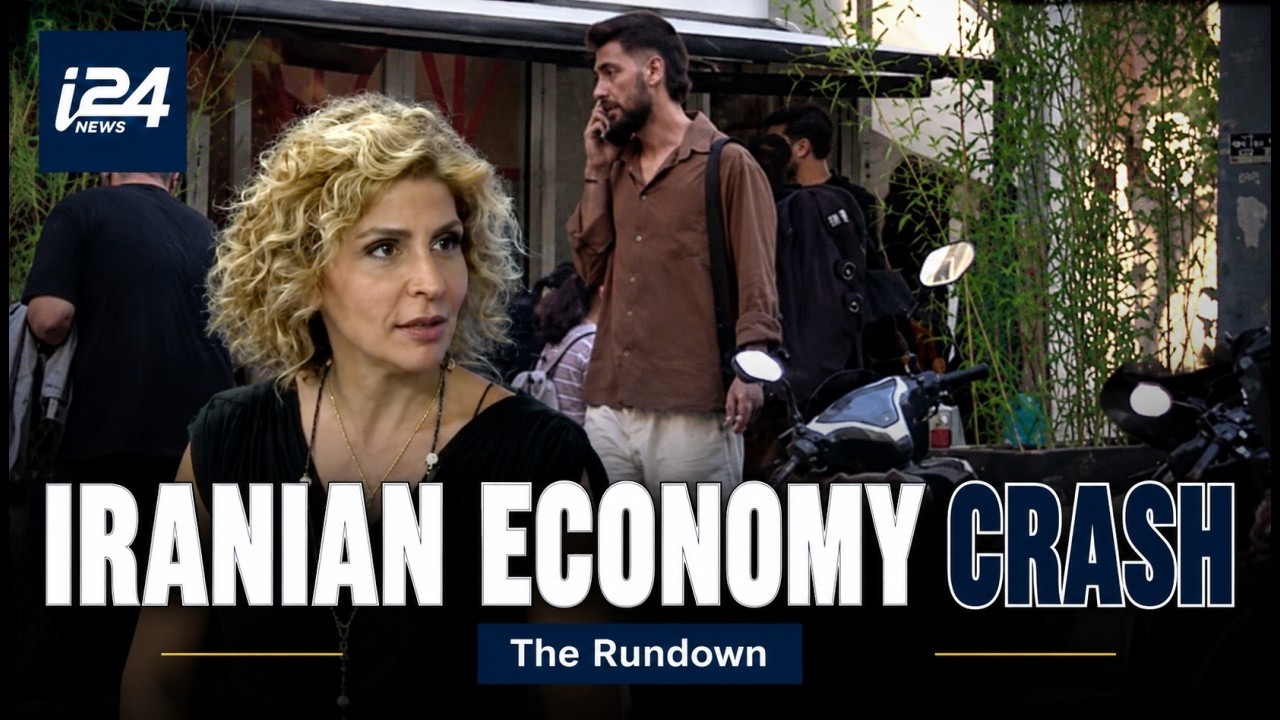
Food prices soar as war, sanctions and blockade batter economy in Iran
Watch on YouTubeVideo summary
Iran is currently grappling with severe economic instability driven by war, international sanctions, and a naval blockade that has severely strained the daily lives of ordinary citizens. Inflation has reached alarming levels, with annual rates hitting 66% in July alone, while food prices surged by 128% over the year. This hyperinflation has rendered previous salaries insufficient to sustain families for even a few days, forcing many households to eliminate basic necessities like meat and chicken from their diets. The damage to infrastructure and the disruption of trade routes have compounded these issues, leaving the average Iranian struggling to meet fundamental needs as the cost of living continues to skyrocket.
While the general population bears the brunt of this economic collapse, the regime has historically found ways to circumvent sanctions and maintain its financial stability through parallel banking systems and illicit activities. However, recent developments suggest a potential shift in this dynamic, particularly following the United Arab Emirates' decision to suspend all economic and financial bonds with Iran. For years, the UAE served as a critical lifeline for the Iranian leadership and its Revolutionary Guard Corps (IRGC), providing a haven where officials could launder money and operate without consequence. The suspension of these ties threatens to cut off a vital funding source, potentially undermining the regime's ability to pay its security forces and maintain control, thereby increasing the risk that economic hardship will reignite mass unrest.
Amidst this growing desperation, anger among ordinary Iranians is increasingly directed not only at the domestic leadership but also at external powers like the United States for imposing the naval blockade and restricting access to the Strait of Hormuz. Despite this external pressure, many protesters express a willingness to endure suffering as long as they believe it will lead to an end to the current regime. The situation has become so precarious that the primary concern for the leadership is no longer just the economic pain itself, but the fear that worsening conditions will push the population back onto the streets in unprecedented numbers. This potential resurgence of widespread protest represents a far greater threat to the regime's grip on power than the economic metrics alone would suggest.
In response to the humanitarian crisis and the risk of aid being siphoned off by state actors, a new initiative is emerging to provide direct support to families in Iran without involving the IRGC. This project, developed through a joint venture between Iranian and Israeli entities, aims to create a regulated, OFAC-approved platform that allows the diaspora to send financial assistance directly to those in need. The goal is to alleviate poverty systematically while ensuring that the funds do not enrich the regime or its military wings. By bypassing traditional channels controlled by the IRGC, this humanitarian effort seeks to empower individuals and families without inadvertently strengthening the very structures causing their oppression, offering a glimmer of hope amidst a landscape defined by scarcity and political tension.
Read the full video transcript
Inside Iran, the regime is facing
growing pressure from a war battered
economy and the risk of renewed unrest.
According to Iran's statistical center,
annual inflation reached 66% in July,
while food prices rose 128% yearonear as
damaged infrastructure, disrupted trade,
and the US naval blockade deepened the
strain on ordinary Iranians. President
Trump is now threatening new,
never-beforeseen economic measures, but
it's not clear exactly what those are
yet. Still, for Tehran's leadership, the
greater threat may not be the economic
pain itself, but the risk that worsening
hardship reignites mass unrest and
brings protesters back to the streets.
To discuss more, we're joined in studio
now by Pente Modi, an Iranian journalist
and documentary filmmaker. Pente, thank
you for being with us here in the i24
News studio.
>> It's an honor to be here, Nicole. Thank
you.
>> Can you take us inside Iran as best you
can with food inflation at 128%.
What does this economic pressure
actually look like in daily life for
ordinary Iranians? It means that a
salary that was enough to feed a family
for a month is now disappearing within
days. It means that many people have to
choose uh what necessity and what basic
food they can afford. It means that a
lot of families have uh now vanished u
meats, chicken uh and red meat from uh
their table. Um and a lot of uh people
are currently indeed suffering
economically. Those who consider
themselves being a middle class are
finding themselves now with um a salary
that is finishing in a few days and they
can't afford even uh red meat or
chicken. Well, this is certainly hitting
the ordinary Iranians most, but Pontea,
what will be the signs that it actually
hits the regime? What should we be
looking for to so see that the regime is
unable to pay the IRGC forces, the
besiege forces, that it's actually
making an impact rather than just
hitting the ordinary Iranians? Nicole,
very good question. Actually there was
um I was reading the newspapers and I
saw that a lot of them are saying oh
Iranian Iran's economy is still holding
up and then um the first question that
comes to you as in Iranian is whose
economic is are you talking about
exactly the regime's economy? Yes.
because they have found a lot of ways
through the years how to circumvent
through the um sanctions, how to build
parallel um ways to still enrich
themselves and how to abuse um how to
abuse actually other sectors to gain the
money that they need for their
endeavors. But people that is another
question with their economy. Today was a
good news actually that um United Arab
Emirates had suspended um all economic
uh uh and financial um bonds with Iran.
And that is an important important
actually developments because United
Arab Emirates have been for years the
economic lifeline of uh the Iranian
regime and now um this will make
actually a lot of difference. But it
still comes back to the same question
because we've seen the Iranian economy
in shambles for years. We've seen how it
impacts the ordinary Iranians. But you
just said that the regime has found ways
to circumvent this pressure and still
stay intact. So what should we be
looking for to see that it is actually
making a difference on the regime's grip
inside Iran? Mhm. Um I think that
honestly when the uh military knows
where for example and how Kame in uh is
where he is about his whereabouts I'm
sure they know what economic line is
keeping this regime alive and they
should cut that this important
development with the United Arab
Emirates was definitely an important one
because for years we have been hearing
that a lot of uh IRGC people are just
are it's their haven. They go there,
they withwash their money, they they do
everything and they just nothing is
actually touching them economically. And
now this or this is we're going to see
this um also with the hormones uh um
closure um well people are at the moment
indeed suffering from that but
>> there are many ways that I'm sure
countries such as United States if they
want they can find all those ways how to
how they can cut uh the legs of
>> where's the anger right now among
ordinary Iranians because you mentioned
the naval blockade the straight of
Hormuz that's coming from the United
States is some of this anger towards the
economic hardships spilling over towards
Washington because they're the ones
putting this pressure that's trickling
down into the the people. Um well of
course in every society you have
different people but there are people
who are against the war for exactly
these reasons but at the same time they
they have enormous anger against the
regime. Um but protesters many
protesters their anger is so high that
um they say okay we are prepared to go
through this suffering as long as we
know for sure that
>> an end to them is coming.
>> Yeah that's certainly the main question
that we're all looking for. Pente join
us often on i24 news but you're from
abroad. You're here in Israel right now
and I just wanted to ask you about the
project that you're working on while
you're here. Yes. Well, uh, thank you so
much. Um, I'm here for a joint project
between Iranian and Israelis. It's the
first joint venture between them since
1979.
And um what we want is actually to make
sure that p poverty in this kind of
situations that we are dealing now
doesn't become another um systematic uh
tool for the regime to abuse this
poverty poverty against the people
because as as you know people um
let me let me say it like this
is about helping people without um
without making the regime powerful. Um
it is an humanitarian uh platform. Um
and it is a system, it is an
infrastructure to uh make sure that
people are getting the humanitarian aid
without the IRGC getting a portion of
it. Uh a lot of people are helping their
families in Iran. But always the tr it
goes through the channels that IRGC is
enriching himself
>> with that portion of the money. Um this
is a regulated platform OFAC approved
and the aim is to help families
and take them from the poverty because
the Iranian diaspora has has enough
money to help people in Iran and at the
same time IRGC doesn't get anything.
>> A very important initiative. Pentam
Modiri, thank you for being with us in
the i24 news studio and sharing more.
Appreciate it.
>> Thank you Nicole.