Flash Talk at SustainableHEP: The lawphysics initiative as a tool to communicate research in physics
Watch on YouTubeVideo summary
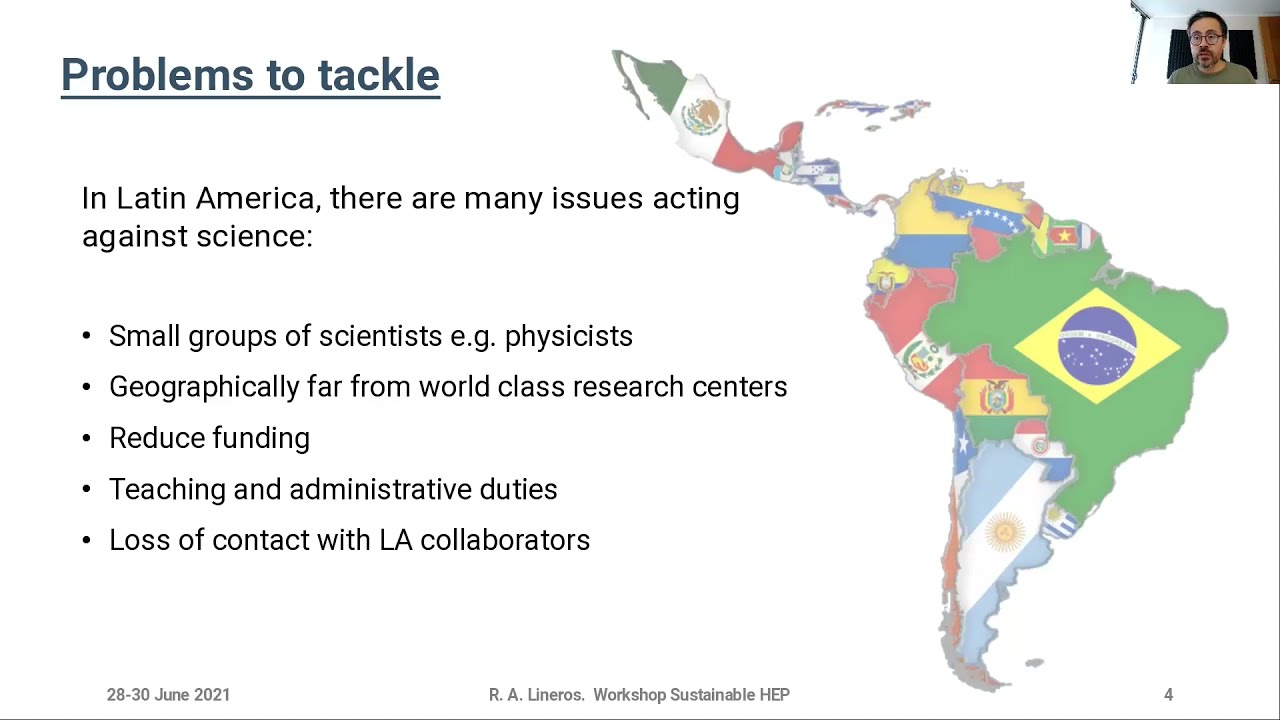
The Law Physics initiative, developed by researchers from Universidad Católica del Norte in collaboration with experts like Alejandro Cardenas and others, serves as a strategic tool designed to enhance physics research communication within Latin America. Inspired by Richard Feynman's observations on the unique challenges of teaching physics in the region, this project addresses specific structural issues such as geographical isolation from major global research centers, limited funding access for universities, and administrative barriers that hinder international collaboration. The core mission is to bridge the gap between Latin American scientists and their counterparts worldwide who are conducting research outside the continent, ensuring that scientific discourse remains vibrant despite these logistical hurdles.
To achieve this goal, Law Physics operates as a web seminar series launched in 2015, featuring four-minute talks streamed live on YouTube covering topics like high-energy physics, particle cosmology, gravitational waves, and early career development for scientists. Since its inception, the platform has hosted over one hundred fifty-five webinars alongside six colloquia and special events such as a dedicated Dark Matter Day in 2016. The format allows speakers from any nationality to present their work without needing physical travel, effectively democratizing access to high-level scientific discussions. This approach not only expands the reach of individual talks beyond typical conference audiences but also provides recorded content that remains accessible indefinitely for future viewing and study.
The initiative offers significant benefits to both speakers and listeners by creating a permanent archive where PhD students can revisit specific topics multiple times until they achieve full comprehension, while also humanizing science by showcasing the researchers behind the work. Metrics gathered over several years indicate substantial engagement with approximately twenty-two thousand views across all videos from three hundred subscribers, though data reveals a persistent gender gap where eighty percent of viewers are male compared to only twenty percent female. These insights highlight both the success in broadening access and the ongoing need for diversity within the scientific community that the platform aims to support through its inclusive structure.
In conclusion, Law Physics stands as an incredible instrument for communicating science and research globally, demonstrating that a well-defined objective is essential for any successful webinar cycle. The experience gained since 2015 provides valuable lessons on how to maintain effective communication channels even during challenging times like the pandemic, proving that digital platforms can sustain scientific dialogue when traditional methods are disrupted. By offering certificates to speakers and providing open access to a vast library of content, the initiative empowers early-career scientists while fostering a connected global community where knowledge flows freely regardless of location or nationality.
Read the full video transcript
hello everybody my name is roberto
lineros from universidad catolica del
norte
i'm going to talk about the law physics
initiative as a tool to communicate
research in physics this is a work in
collaboration with the law physique
coordinator alejandro cardenas
nicolas fernandez perez and mauro
campios
but to motivate the talk we are going to
use some words from richard feynman
from the first inter-american conference
on physical education in regeneration
1963
in which he was addressing the problem
of
teaching physics in latin america to be
similar to anything in latin america
we know that the social political and
economic context in latin american
countries is much different
from foreign countries in europe or in
the united states
nevertheless at that time the problems
that were present
and basically regarding to teaching
physics where the students are all alone
and the small number of people that are
involved in physics education
so for the case of researchers the
problems are basically
the same the problem wanted to tackle
with the low physics are basically to
we focus in five different points one is
the
small group of scientists or points and
physicists the
the group case that we are interested
also latin america is geographically far
from world-class research center
in europe and in united states or japan
also the access to funding is much
reduced for the case of universities in
latin america
and of course for the case of phd
postdocs and
professors in latin america we have the
problem that teaching administrations
make harder to go abroad for doing
collaborations and
the most important the one the also we
want to address with the
physic initiative is the the loss of
contact with latin american
collaborators
that are outside latin america doing
research so
low physics or latin american webinar
physics is a web seminar
that we proposed many years ago
as a way to deal with this big problem
that we i just
mentioned the goal of love physics is
making research accessible no matter the
place
the type of speakers are basically
researchers from all over
the world regardless of the nationality
because we wanted also to
allow the communication with latin
america with the rest of the world
in the same way that people goes to
conferences or goes to give seminars in
different
resource centers the format is basically
four meeting talks
per minute 40 minutes so talks in sum
and in
live streaming in judo and the topics
that we covered
are essentially related with high energy
physics as the particle cosmology
gravitational waves
and other type of topics like for
instance orientation for
early career fitting so we have been
doing these initiatives since 2015. we
already have 115 webinars with six
colloquia
and one large event that was a dark
matters day that we organized in 2016.
so what are the advantages for the
people in low physics for instance for
the speaker they have a
reach to a larger audience also the
talks are
recorded and also making public making
the the the
reach of the talk to be much larger than
a typical conference
also we address we provide a certificate
and
open the possibility for to promote
early career scientists
for the audience is is very interesting
because they can access to broad topics
that maybe in a university
is not possible to cover just with
regular seminars or in a conference
also they have access to all the
previous webinars and future webinars
because of the platform that we are
using
the possibility to replay the seminar is
very important because
especially for phd students following a
specific topic they can
watch again the seminar until to have a
better understanding of what is
the topic about also very important is
to see the faces of the people that are
being researched
so another big impo
information that we can get from all of
these years doing low physics
is the the metrics of the of the
platform for instance in our case we
have 1400 subscribers
and in the last three year we have
around
22 000 views from all the videos that we
the 115 webinars that i
i just said but the most important
information
that we can obtain from the metrics is
regarded to the
gender gap that 20 or viewers are female
and
80 percent is male are male and also the
age
of the people that are watching the the
webinars so
just to conclude i'm gonna point it out
that the webinars are an incredible tool
for communicating
with science and research a webinar
cycle has to have clear objective this
is
key you know that if you want to start
your own webinar cycle
we have been here getting experience
from doing webinars since 2015
and many of the lessons and regarding to
the know-how
we were we learned much before they
called 19 pandemics and they are
very useful to keep communicating so if
you got curious
you can contact us and also i'm going to
be happy to answer all your questions
here in the workshop sustainable
thank you very much