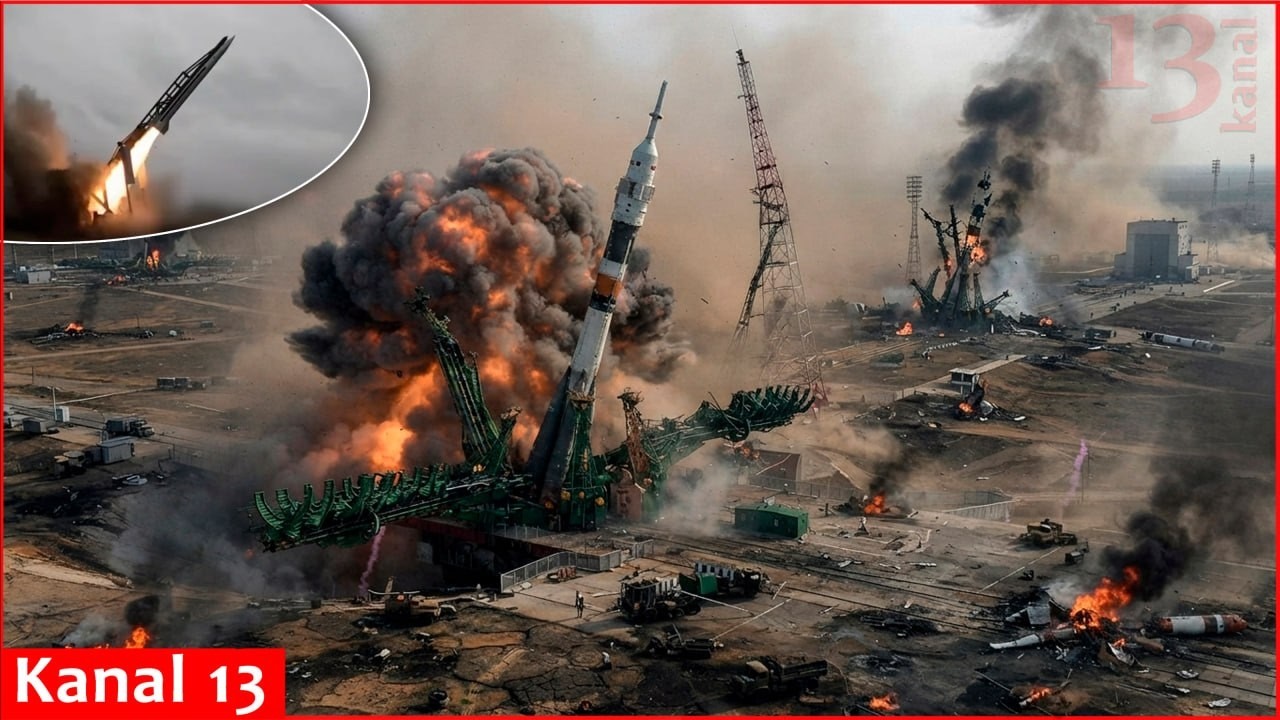
Flamingo missiles destroy Russia's space program; Kremlin loses ability to quickly launch satellites
Watch on YouTubeVideo summary
On the night of August 15th, Ukrainian defense forces executed a series of long-range strikes targeting Russian military installations, with preliminary reports indicating that one specific objective was the Progress Rocket and Space Center in Samara. This facility serves as a cornerstone of Russia's space industry, and around 4:00 a.m. local time, a missile alert was issued in the region following observations of aircraft overhead, powerful explosions, and massive fires. While researchers are still working to pinpoint the exact impact site using available imagery, some evidence suggests that two Flamingo cruise missiles were launched against the target, potentially causing significant damage to the western part of the complex where final production stages occur.
The strategic importance of this strike lies in the fact that the Progress Rocket and Space Center is the sole large-scale production facility for Soyuz launch vehicles, specifically the Soyuz 2.1B variant. These rockets have been instrumental in launching Russia's Rassvet satellites, which are designed to form the basis of a domestic satellite constellation similar to Starlink, as well as various military satellites for the Russian Ministry of Defense. If the strike successfully damaged the production workshops and equipment within this unique complex, it could severely disrupt multiple Russian space programs simultaneously, leaving the country with only a limited number of already manufactured rockets available at spaceports.
In response to potential disruptions in Soyuz production, Russia would theoretically need to rely on the Angara family of rockets produced at the Polyot plant in Omsk as an alternative. However, this transition presents significant challenges because the launch rate for Angara rockets remains substantially lower than that of the Soyuz system. Since 2022, Russia has managed only nine launches of the Angara rocket, comprising two heavy A5 models and seven lighter 1.2 versions, highlighting a stark disparity in operational capacity. Consequently, serious damage to the Progress facility could leave Russia with few viable options for future space launches, effectively crippling its ability to quickly deploy new satellites and maintain its broader space ambitions.
Read the full video transcript
As reported on the night of August 15th,
Ukrainian defense forces launched a
series of long-range strikes against
Russian military installations.
According to preliminary and unofficial
information, one of the targets was the
Progress Rocket and Space Center in
Samara, a key facility in the Russian
space industry, Defense Express reports.
Around 4:00 a.m. local time, a missile
alert was issued in the Samara region.
At approximately 3:40 a.m., local
sources reported the sound of an
aircraft flying overhead, a powerful
explosion, and a massive fire. Some
videos suggest that two launches were
conducted. This theory is indirectly
supported by a post by Fire Point Chief
Designer Denis Styler man, who showed
footage of the launch of two FP-5
Flamingo cruise missiles. Using one of
the available images, researchers are
attempting to determine the exact impact
site.
It is tentatively to be located near the
Progress Rocket and Space Center.
However, the extent of the damage will
only be fully confirmed once satellite
imagery becomes available. The Progress
Rocket and Space Center produces Soyuz
launch vehicles, particularly the Soyuz
2.1 B. These rockets have already twice
launched the Rassvet satellites into
orbit, which are intended to form the
basis of Russia's equivalent of the
Starlink satellite system. At the same
time, Soyuz 2.1 B is also used to launch
other Russian military satellites.
Therefore, serious damage to the
facility could potentially impact
several Russian space programs. The
enterprise is located on the premises of
the Aviakor Aircraft Plant in Samara. It
is effectively the only large production
complex, consisting of workshops
totaling approximately 1 km in length,
where the various stages of Soyuz launch
vehicle production take place.
Preliminary estimates suggest the strike
may have hit the western part of the
complex, where the final stages of
production take place. If this is
confirmed, damage could have been caused
not only to production facilities and
equipment, but also to launch vehicles
in various stages of assembly. After the
outbreak of full-scale war, Russia
launched approximately six to eight
Soyuz 2.1B spacecraft per year. They
were used for various space programs,
including satellite launches for the
Russian Ministry of Defense. If the
damage to the Progress rocket is
significant, Russia could face serious
problems with future space launches. In
that case, it will be left with already
manufactured rockets delivered to
spaceports, of which there may be only a
few. An alternative is the Angara family
of rockets, which are produced at the
Polyot plant in Omsk. However, their
launch rate is still significantly
lower. Since 2022, Russia has conducted
only nine Angara launches, two heavy
Angara A5s and seven light Angara 1.2s.
>> [music]