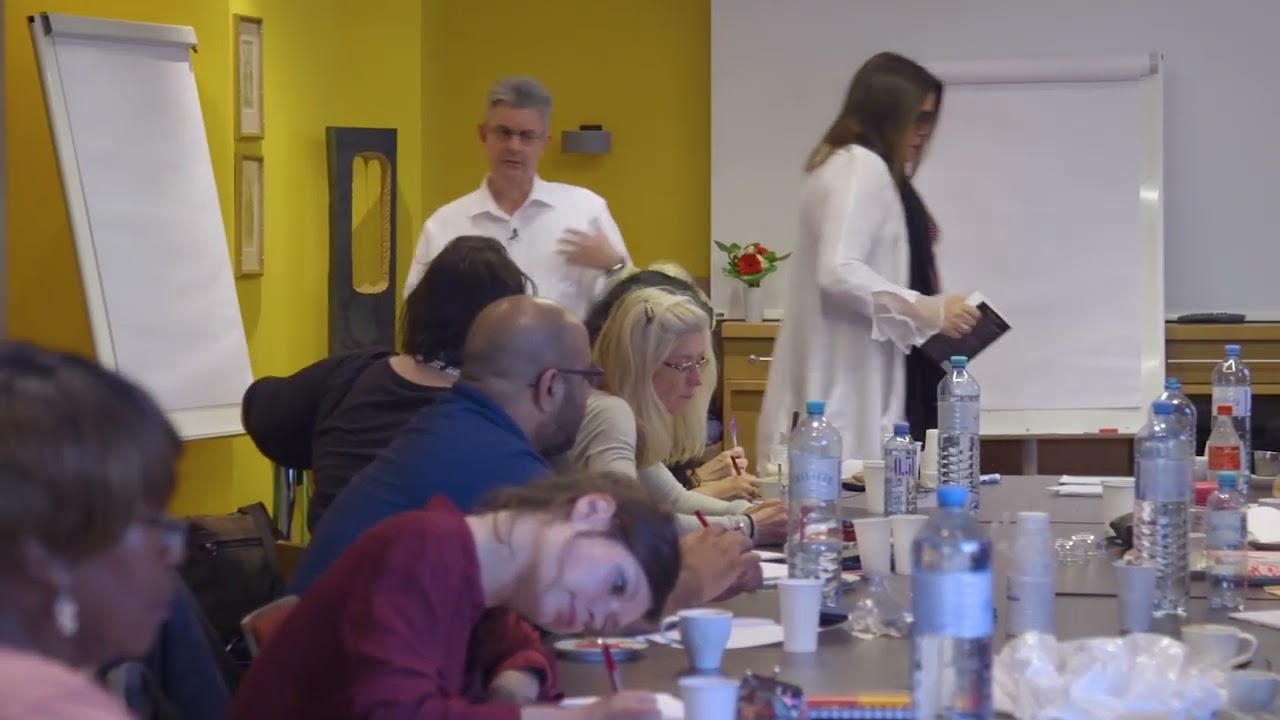
FIXED Healing Narcissism: Cold Therapy Seminar, Part 6, Vienna, May 2017
Watch on YouTubeVideo summary
The healing process for narcissism described in this seminar utilizes advanced psychological frameworks derived from Dissociative Identity Disorder treatment and Internal Family Systems theory, specifically focusing on role-playing and emotional re-regulation. In the initial role-play phase, patients are guided to teach their therapists how to act as their specific abusers, a technique that forces them to understand the motivations and limitations of their own false selves. By engaging in exercises like the empty chair method, where they dialogue with an empty seat representing their false self, patients learn to distinguish between their true identity and the defensive persona used to survive hostile environments. This integration process aims not to discard the false self immediately but to eventually convince it that its protective function is no longer necessary once the inner child feels safe, thereby shifting control from the abuser back to the patient.
Following this structural shift, the therapy moves into a critical phase of emotional re-regulation designed to address the severe dysregulation caused by an internal "swamp of hurt." Since narcissists often use their false self as a firewall to avoid overwhelming emotions that could lead to disintegration, the treatment employs nineteen specific child psychology techniques to help patients access and survive these raw feelings without collapsing. The primary goals of this intense period involve transforming external defense mechanisms into internal coping strategies, shifting the patient's stance from victimhood to task-oriented management of their emotional chaos, and moving away from controlling behaviors toward a healthier codependence. Furthermore, by fostering rudimentary empathy through emotional access, patients begin to recognize others as autonomous entities rather than sources of supply, allowing them to transition from social withdrawal to genuine social functioning.
This rigorous therapeutic approach often triggers intense reactions, such as hysterical panic or increased vulnerability at night, but it has proven effective in breaking compulsive cycles of seeking narcissistic supply. The speaker illustrates the profound impact of this work by recounting a personal experience in Russia where he successfully severed his lifelong addiction to media attention and grandiosity within just three months, a timeline significantly faster than the typical year required for average cases. Although some self-destructive inner critics may persist, the therapy successfully dismantled the need to cancel events or react emotionally to rejection, demonstrating that even secondary sources of supply, such as relationships with children, can be navigated to facilitate rapid individuation. Ultimately, the seminar concludes that by simulating play and interaction, individuals can overcome their innate restrictions, learn to regulate their emotions, and rebuild a cohesive sense of self capable of authentic connection.
Read the full video transcript
You recall that
based on the previous stages of the
therapy,
the therapist came to be identified with
the abuser. Came to be the abuser.
Actually, transference is a little like
flashback. It's real. So, the therapist
is now the abuser. And he had he has
never relinquished this role. hasn't
changed throughout.
Actually, for the narcissist to
experience himself as a good object, the
therapist had to take upon himself all
the prim primal sins of the abuser. The
therapist had to become an abuser so
that the narcissist can feel as a good
object by comparison. So here we are.
therapist is still the abuser and now we
enter a new phase and that is the phase
of role play.
During the role play
the patient is asked by the therapist
to play roles which is why it's called
role play to play roles.
And
it starts with the therapist
telling the patient, "Teach me how to be
your abuser.
Teach me how to abuse you."
So the therapist asked the patient
for a quick seminar on how to be that
specific patient's abuser.
He asked the patient, "What techniques
should you use? overt techniques, covert
techniques. He asked the patient what
are the patients vulnerabilities, which
buttons to push, how to obtain maximum
impact.
He asked the patient to do what the
patient had been doing all his life very
well, to be an observer,
to be an observer of himself, to observe
himself and inform the therapist as to
how to abuse him. highly non-traditional
method, shall we put it gently?
But it forces the the narcissist,
narcissistic patient or client. It
forces the patient to think as the
abuser might have thought.
It forces the narcissistic patient to
enter the mind of the abuser, to try to
understand the abuser's motivation, to
decipher the abuser's subtle and less
subtle techniques, to realize the
abuser's limitations,
to manipulate the abuser as an internal
object.
Of course, since it is the patient who
is guiding the therapist on how to be
the abuser,
the patient has the upper hand. He is in
control. He has mastery of the
situation.
Again, for the first time in the
patient's life, it is the patient who is
the puppet master. He is puppeteering
the abuser, not the other way around for
a change.
Once this phase is finished, the
therapist has graduated as the abuser of
that patient.
Now it is the ro and certified of course
received certificate. Now is the role of
the now is the turn of the patient. So
now we have classic role play adopted
from other systems of therapy where the
patient is asked to act as the therapist
as a parent as a child as an adult and
many and other roles which might be
pertinent or relevant to the specific
trauma.
Gradually as the patient role plays,
emulates these roles, acts, assumes both
the cognitions and the emotions of these
roles and so on so forth. Gradually
there is a process of deeper
understanding of what had happened, why
it happened, where it led
and also the rudiments rudiments of
integration.
You remember
that um I told you that call therapy
borrows techniques from the treatment of
dissociative identity disorder, multiple
personality disorder. Role play is one
of the techniques borrowed from
treatment of did
and the
thing is to demonstrate to the patient
that acting solely as the patient he can
imitate and emulate other people without
becoming them.
No need for him to become other people.
It is enough to imagine. It is enough to
master one's cognitions and emotions. No
need to summatize them. No need to
become them.
And so uh slow process of integration
takes place and to hasten it or to speed
it up. The last part of the role play is
to is the empty chair technique borrowed
from Gisht.
We put an empty chair.
The narcissistic patient faces the empty
chair. I don't know those of you who are
acquainted with gestal, it's a gestal
technique faces the empty chair and then
uh the therapist suggests to the
narcissist that the empty chair is
occupied by the false self.
And now the narcissist should talk to
his false self.
Talk to it
about anything.
The narcissist can ask the false self
questions, challenge the false self,
ridicule the false self, mock the false
self, undermine the false self, support
the false self, agree with the false
self. Any and every interaction is peri
permissible. And of course, all these
interactions teach the therapist a lot
about the interplay between the
narcissist's true self and false self.
You will recall you will recall that in
uh previous stage we gained access to
the true self finally.
So when we put the false self on the
chair we ask the narcissist to
acknowledge that he is not the false
self that the false self is a separate
autonomous entity and that a dialogue
between the narcissist who is now
probably the true self because if the
false self is gone, what is left?
[clears throat] To acknowledge that a
dialogue between the narcissist and the
false self is possible.
We force the narcissist into a state of
interaction, the need for the false
self.
The patient may reach a conclusion that
the false self is no longer needed or he
may reach the exact opposite conclusion
that the false self is crucial and vital
and so on. Based on either of these two
forks of the dilemma, horns of the
dilemma, we proceed with the treatment.
If the narcissist decides that the false
self is no longer needed,
we proceed with various techniques to
encourage the narcissist to separate
from the false self. If he decides that
the false self is more needed than ever
because of the secretary delusions,
because of the environment is hostile,
he may decide that the only defense he
has left is the false self and get
attached to the false self even more a
process called cexis. He may cex the
false self. So if we if we observe cexis
of the false self,
then we proceed with other techniques. I
will during this seminar assume that the
narcissist has reached the conclusion
that the false self is his only hope and
his only defense against the hostile
non-holding unsafe environment and
gendered by the therapist. That the
therapist is the bed object, the source
of persecution. And the only defense
against the therapist is the false self.
So there's greater cathexis, greater
emotional investment, greater bonding
and attachment between the narcissist
and the false self. This is not a bad
thing. This is not a bad thing because
ultimately we are going to integrate the
false self. The false self is not going
to be discarded because it cannot be
discarded. But we are going to integrate
the false self together with the true
self.
That is a technique used in DID,
dissociative identity disorder, the
process of integration. But
role play uh the roleplay um
characteristics or attributes in cold
therapy are borrowed entirely from
another type of therapy and another type
of school another school of psychology
known as um everything okay sorry
known as internal family systems.
There is a school of psychology known as
internal family systems IFS
and it's a fascinating school of
psychology because it is based almost
entirely on work done in DID and yet it
is a leading treatment in child
psychology.
um what IFS internal family systems what
the treatment modality affiliated with
or emanated emanating from IFS does is
that it assumes that inside the child
there are all kinds of competing
entities. They are protectors and there
are exiles and so on and so forth. And
what they do in IFS is they seek to
reach a consensus between these entities
so that the protectors will allow the
exiles back and agree to vanish.
The aim of internal family systems
therapy is to prove to the protectors
that the child is safe and protection is
no longer needed. at which moment at
which split second the protectors
vanish. Now as opposed to cold therapy
IFS has a rich history with numerous
case studies and it is all the rage in
some circles. So similar to cold call
therapy we see that when
protection is no longer needed the
entities that provided protection vanish
literally immediately.
Can you you said the first uh it's like
the separation that you recommend to
separate. Can you talk more about that?
>> I'm sorry.
>> Yeah. Yeah. You said like this is the
second if I got it correctly. If the
cexis if the the needs of feps are not
there the force is no longer needed. So
you recommend to separate the
separation. I didn't get that.
>> No, I said there are two possible
outcomes. Either the narcissist decides
that the self true false self is no
longer needed
>> in which case we proceed with certain
techniques
>> or he decides that the false self is
actually more needed than ever because
the therapist is a is a secretary object
a bed object and so on hostile
environment in which case we proceed
with other techniques and this
>> separation
>> sorry
>> no separation
>> no in this therap in this seminar we are
going to assume that the narcissist
decided that the false self is very
important more important than
I advise all of you those who are
interested at least to look up on the
internet internal family systems
therapy. It's a pretty amazing truly
amazing um therapy and concept. The
child is treated as all children are
treated as though they have multiple
personality in IFS. All of them are
treated as though they have multiple
personality and the aim is to let the
protectors to allow the protectors to
vanish because the child is safe and no
longer needs them. Exactly the same idea
underlies uh call therapy. Precisely the
same idea to convince the false self. In
other words, the narcissist because the
narcissist is only the false self. Yes.
To convince the false self that it is no
longer needed. And the minute the
narcissist develops this inner
conviction, the false self literally
vanishes. This I've seen with my own
eyes. False self, grandiosity,
everything vanishes overnight. Nothing
is left. Like nothing is like there was
no narcissist there.
Now had I been the only one to make this
claim, you could have had your doubts.
But I'm referring you to IFS because in
IFS there are hundreds of documented
cases where similar structures like the
false self known as protectors vanished
overnight.
These are traumatized children and so
on.
So these traumatized children developed
protectors, imaginary entities that
protected them. But when IFS was
applied, the protectors
themselves were convinced that they are
no longer needed, admitted it and
vanished overnight. They vanished on the
spot. They were no more to be seen ever
again. So we have a precedent
precedent of a protective agency, a
protective construct or structure which
vanishes when it is no longer needed.
And that's what call therapy does.
Okay, after the role play where the
narcissist finally confronts his false
self and talks to it, let us assume
because that's a majority of cases that
the narcissist actually ends up being
convinced that he needs the protection
and love of the false self more than
ever because now he has a mortal enemy
and that is the therapist.
We move on to the next stage and that is
the stage of emotional re-regulation.
[clears throat]
>> Emotional reation
>> reeregulation. Narcissists suffer from
emotional dysregulation
and we move on to obtain emotional
reregulation. Why do we do that? The
previous stages we introduced the
narcissist to his true self. We made the
narcissist realize that he's not guilty
for the abuse. That is the good object.
He's not the bad object. He didn't
deserve the abuse. Yes. As a good
object. He did not deserve to be abused.
So we convince a narcissist that he's
the good object that he didn't deserve
to be abused. We put him in touch with
his true self and then we put him in
touch with his false self to have
finally a dialogue. This is the this is
the process after after having
identified the initial or primary the
originating or primary trauma. Why do we
suddenly move from from tackling the
protective structures because
grandiosity is a defense, false self is
a conglomerate of defenses. Why do we
move from defenses to emotions? It's a
curious move. Theoretically and
ostensibly, we should have now moved on
to tackle the false self head on. Uh why
do we accept the narcissist's decision
and verdict that he needs the false
self? We say, "Okay, you know, you want
to have the false self, have it, no
problem. Now, we're going to deal with
your emotions." Why this uh why this
move?
>> Because it's been so frozen for so long.
I mean, doesn't hasn't had emotions up
now and released them. You can regulate
what may still be some false.
[clears throat]
>> Yes, not bad. False self is a defense
against the narcissist emotions mostly.
Of course, it has functions of
regulating grandiosity. But why does the
narcissist need grandiosity? Because he
feels inferior, helpless, mocked,
ridiculed, humiliated.
False self is exclusively a defense
against the narcissist's own emotions.
The remember the function of the false
self functions of the false self are
decoy. It's a the aim is to remove the
narcissist from the locus of his own
being from the locus of his own
existence. The narcissist existence
narcissist inner world is a myasma of
pain. It's a swamp of hurt. It's a
horrible hellish environment. The child
cannot survive this environment and many
adults cannot survive this environment.
The narcissist therefore is constantly
diste depressed dysphoric sorry
dysphoric diste. The narcissist
if
was left beereft of defenses might
become suicidal. So
the the aim the main uh task of the
false self is to isolate the narcissist
to protect him not from the outside as
most people think but from the inside.
The threat to the narcissist is never
from the outside. It's from the inside.
You remember yesterday I told you that
narcissists have no distinction between
inner and outer worlds. Their inner
world is the outer world. The outer
world is a part of their inner world.
What they do is they digest and
assimilate the outer world. They
internalize it symbolically in the form
of representations, imagos and so on.
They have no boundary between in and
out, there and here, inside and outside.
They have no boundaries. These
boundaries because the abuser made sure
that they don't develop boundaries. They
are boundaryless people. Because they
are boundaryless people, they are the
most vulnerable people imaginable.
Most vulnerable imaginable thousands of
times more than any victim of abuse.
Because they are that vulnerable, they
have developed these extremely rigid and
powerful defenses.
They cannot allow themselves to get in
touch with what's happening inside them
because if they do they're doomed and
they cannot they don't want to die. No
one wants to die not even narcissists.
So they don't want to die and because
they don't want to die they say okay I
don't exist therefore there is no threat
but I have to interact with the world
somehow. So here is this agent, floating
agent, fictional character, and let him
let him interact with the world. Let him
suffer the pain. Let him cope. He's
invulnerable. He's godlike. You know,
I'm not worried about him. Nothing will
happen to him ever. Nothing will happen
to him ever. He's immortal. He's
perfect. He's brilliant. He's, you know,
infallible. So, he will cope with the
world. I I will cease to exist. The
minute the false self is invented, the
narcissist ceases ceases to exist.
And the false self takes over as the
only form of being in the narcissist
life.
But the main task of the false self
psychonamically speaking is to isolate
to firewall the narcissist to separate
him from his emotions. If we want to
undermine the false self ultimately to
make it vanish and wither
to render it utterly unnecessary
obsolete and redundant
we need to take care of the narcissist's
emotions we need to reeregulate the
narcissist's emotion emotions so that he
can get in touch with them without
succumbing without getting depressed or
angry or we need to
reintegrate the narcissist with his
emotions. Once the narcissist has full
unmititigated access to his emotions and
nothing happens, he is safe, he
survives, he does not feel threatened,
then we can move on to the next stage
which is convincing the false self that
it is no longer needed because the child
is protected.
Everything is okay. The fire is out. The
child is protected. You can go. Thank
you for your services. you know
right this is done in cold therapy at
least
um via emotional reeregulation
>> just one little uh uh I had a case that
there was like we were working on it and
then not I'm not sure if it was really
like with a pathology or not but the
case was
He we went through the emotions.
Everything was fine. The the client was
feeling really good.
And then first thing after um he left
he was driving the car and then there
was some construction on the car on the
on the on the on the road and then
suddenly out of nowhere the the
construction people started yelling it
like like the the client is attracting
it like even though he experienced the
emotions he felt safe but he's still
attracting it in the upcharge world kind
of. So, uh, does cot therapy takes
eventually everything like away so he
can kind of not be the attraction point
to those kind of magical people, you
know, yelling at him constantly just out
of nowhere.
>> That's not a question I can relate to
because it assumes magic and I I don't
assume magic in the world.
>> I don't believe he attracted anything. I
believe that he probably did something
wrong, trans transgressed on the on some
line that he should not have or
something and provoked the construction
workers.
>> The more relevant question, if I may,
would be if he could if he can now
following therapy would be able to cope
with this negative input
and um
because he now doesn't have defenses. He
doesn't have grandiosity. He doesn't
have false self. As as you will see,
we're taking away his fantasy. We're
going to take away all the defenses.
Ultimately, he will be left with no
effective defenses against negative
input. And the question is, can he cope
with it? The answer is that narcissist
cannot cope with negative input because
they have to constantly defend an
unrealistic fantastic construct.
Uh the narcissist self-perception is
fantastic. It's grandiose
and obviously it is open to attack. So
he's constantly on the defense trying to
convince people of the improbable.
Trying to convince people that he is
what he claims to be. In other words,
trying to extract narcissistic supply.
When the grandio structure vi [cough]
when the grandio structure vanishes
there's no need to defend it anymore and
the sensitivity or hypervigilance
the sensitivity to insults
uh criticism disagreement and so on also
vanishes because he doesn't need to
protect anything. In other words, if I
think I'm a genius and I need to prove
to all of you that I'm a genius every
sing every single second and so on and
one of you tell me, you know what,
you're not an ages a genius. You're a
fat idiot,
>> which is a possibility. So, I will I
will feel the need to defend myself
>> because I'm a narcissist. I I have to
invest resources in defending my
grandiose self-image, my fantastic
fantastically grandio self-image.
Your attack telling me you are a fat
idiot would be perceived as a challenge
to this grandiosity. To restore the
grandiosity, I would need to convince
you that I'm not or devalue you. By
devaluing you, I can restore my
superiority, etc., etc., etc. Requires a
lot of energy, a lot of work, but
imagine that I don't have this self-
image as a genius. And you say you're a
fat idiot. Okay, so you say you're a fit
idiot. [laughter]
>> Yeah. So, yeah. Thank you. So, so the
grandiosity is still there. It's your
idea.
It's uh it no longer requires defensive
measures. Bulk of the narcissist
existence
and energy and mental resources are
spent on defense trying to prove to the
world something that the world can never
ever accept. You know, I'm the best, I'm
perfect, I'm this, I'm that, I'm a
genius. And of course, this opens
creates many challenges because people
are envious or because it's not true and
so on. The narcissist provokes the
attacks on his grandiosity because he's
grandiose.
If he stops being grandios, if he does
not bendy about some kind of fantastic
um perception of himself, no one will
attack him. I mean
who would why would someone attack
someone who is you know normal
run-of-the-mill you know but uh
narcissists walk into the room and their
body language informs you that they are
superior and godlike and you know and
the body language is sufficient to
provoke by itself
constantly on the defense. So, emotional
reeregulation
in cold therapy deploys no less than 19
techniques from child psychology. I have
the list here. I'm willing to read it to
you. We have no time to go through all
of them. You will need to look them up
the internet if any of you is
interested. Yes. And these are the
techniques that call therapy deploys.
emotional intensity control,
behavioral control but only the
termination phase of behavioral control.
When you look up behavioral control, you
will see that it has various phases and
last one is called termination phase. So
we are using call therapy only the
termination phase
>> that termination
>> termination
>> termination phase
uh
interpretation of emotional cues. These
are techniques from child psychology
and social cues, emotional and social
cues,
avoidance and aggression balancing.
Focusing on the positive,
attention and focus control,
modeling desired behavior,
self-regulatory freedom versus
constraint. These all techniques, these
are all names of techniques.
Self-regulatory freedom versus
constraint.
Countering over stimulation,
countering excessive frustration,
identifying, encountering,
discriminating thoughts and emotions.
That's a long one.
>> Can you repeat that?
>> Identifying and countering
discriminating thoughts and emotions.
And finally
internal construction, external
representation. Now these are all
techniques borrowed from child
psychology.
And if you read and because there in
cold therapy uh these these techniques
are used as they are they're not
modified in any way, shape or form.
Simply reading about these techniques
will give you everything you need to
know about about cold therapy. If you
want I can repeat
>> the last one.
>> Would that be useful?
>> Oh yeah. Yeah.
>> Okay. So emotional intensity control
termination phase of behavioral control
interpretation of emotional and social
cues.
Avoidance aggression balancing.
Focusing on positive
attention focus control
modeling desired behavior
self-regulatory freedom versus
constraint
countering over stimulation.
Countering excessive frustration.
Identifying and countering
discriminating thoughts and emotions.
internal construction, external
representation.
So all these techniques are used
simultaneously. They are not um very
complicated techniques. They are
oneliners
>> representation.
>> Yes, they are oneliners. They're the
junk food of the fast fast techniques.
So putting all of them together, the
narcissist is managed clinically as a
child. Simple. Exactly as we would treat
a child, we treat the narcissist in
order to obtain emotional reeregulation.
What do we why do we do that? What do we
hope to what's the emphasis? What do we
hope to achieve or what do we achieve
actually using these techniques?
Sorry,
>> it's a regression back to find that real
self.
>> Once once uh once we have put the
narcissist in touch with himself,
once we have put the narcissist in touch
with his true self and we have removed
the grandiosity defense,
all that is left,
all the narcissist has left is a
fantastic false self.
So now we circumvent the false self and
we access the narcissist's emotions
directly as a child because now the
narcissist has has access to the true
self. Before that he did not have access
to the true self. Now we have he has
access. We can tap it but we cannot
expose the true self now. It's
dangerous. We cannot remove the false
self until the false self is no longer
needed.
So now we establish contact with the
true self. We are re reregulating the
emotions. The next stage would be to
eliminate the false self.
How long does it take this phase?
Usually
>> entire call therapy from A to Z in the
most complicated case I ever had was
seven months.
>> It was on daily basis.
>> Sorry.
>> On daily basis.
>> Uh beginning. Yes. After that once or
twice a week. But the beginning is at
beginning it's on a daily basis because
of the suicide risk and so on.
The retraumatization phase is absolutely
on on a daily basis plus on call
whenever the patient wants they can
call. So they will call me, you can ask
my long-suffering wife, they will call
me at midnight and 10. And
>> yes,
reeregulation has four aims. All of them
achievable with uh with these techniques
and it it's important to understand that
these techniques are unique to child
psychology. So we are treating the
narcissist as a child. Now he has access
to the true self. We are now trying to
reeregulate his emotions and then we
will talk to the false self and tell it
you know it's okay child is here his
emotions are okay he's not at risk let's
negotiate what will it take for you to
disappear how much do you want right
>> yes how much do you want if it's a
Jewish false self or anything
>> right
[cough and clears throat]
>> so
would you please repeat the emphasis of
the 19 techniques techn emphasis
>> 19 techniques
>> of the 19 techniques to begin like the
emphasis of the 19 techniques is to
>> achieve
>> no no to achieve four goals I'm about to
explain
>> okay
>> to achieve four goals first of all to
convert narciss the narcissism of the
narcissist from externalizing disorder
to internalizing disorder. Now you
remember that an externalizing disorder
is a mental health disorder which is
directed at the environment, directed at
the world. Internalizing disorder is
directed inwards. It's very similar to
the very old distinction between
neurosis and psychosis. If you remember,
those of you who are old enough to
remember uh neurosis and psychosis
like uh inward and outward. So
externalizing, internalizing what
emotional reeregulation achieves is that
the narcissism of the narcissist is now
d gradually being directed inwards
rather than outwards. Why? Can you guess
why? Why the narcissism the narcissistic
complex is now suddenly directed inwards
not outwards.
>> Find some responsibility.
>> What is narcissism?
What is narcissism?
>> Supply
certain
>> supply is part of it. But what what does
it aim to do? What's its function? To
defend
>> protection. So when we access emotions
using these techniques, the narcissist
feels threatened very. And the crisis is
internal, not external. So the the
threat is now internal, not external.
Because narcissism is always about
Narcissism is always about, you know,
what other people think about me, what
they're going to say about me, are they
going to give me supply, how can I be
more powerful, more rich, more famous,
more it's always an externalizing
disorder.
But when we threaten the narcissist from
the inside,
his narcissism
becomes from externalizing to
internalizing. In other words, he rushes
to the emergency inside. He redeploys
all his resources to the emergency
inside and he completely forgets about
the world. Now that's very interesting
because if he completely forgets about
the world, he has no need for
narcissistic supply.
Nor he has he any need to victimize.
He seizes interactions with the outside
world that are narcissistic
because all his narcissism now is
deployed inside to cope with the threat
of being exposed to his own emotions.
So
almost immediately at the in this stage
the need for narcissistic supply
declines precipitously
and then gradually
as the reeregulation continues the
narcissist stops interacting with other
people in socially unacceptable ways,
abrasive ways, dysfunctional ways, etc.,
etc. Narcissistic ways. In other words,
as far as other people are concerned, he
stops being a narcissist. That is not
true. Of course, he is a narcissist
full-fledged. However, he is now inward
directed, not outward directed. He his
disorder became internalizing disorder.
The second thing we achieve
is a change in the victim stance.
The narcissist narcissism is about
grievances, about complaints, about
being the victim, the eternal victim.
the narcissist is misunderstood,
discriminated against, mistreated,
not uh justly or fairly tackled, etc.,
etc. It's constantly in a state of
victimhood. Victimhood is a very
powerful tool because it can be
leveraged or used for emotional
blackmail and to guilt trip other
people, make them feel guilty and then
of course to manipulate them. So
victimhood is a powerful tool in the
arsenal of the narcissist and during
emotional reeregulation
the narcissist reverts from grievance
orientation or victim stance victimhood
to task orientation.
Again, why there is nothing more crucial
to the narcissist,
nothing, absolutely nothing more crucial
to the narcissist than to not be in
touch with his own emotions. Nothing.
Not narcissistic supply, nothing comes
close to the need [clears throat]
to the existential need not to be in
touch with his emotions.
If he's in touch with his emotions, his
very life is threatened. And this is not
an exaggeration.
Once we force the narcissist to get in
touch with his emotions using this child
psychology techniques,
all the focus of his narcissism
completely changes
from outside to inside from victim
stance to task. What is the task? To
stop the access to the emotions. So now
he's focused on how to stop these the
crazy voices in his head. How to stop
the the tumult? How to stop the chaos
that erupts inside him? How to how to
cope with his shifting moods, shifting
depressions,
insanity, inability to sleep. He forgets
completely about being victim. It's
completely forgotten. He is now focused
on the task. How to stop this mess? How
to somehow recover? How to So, he
becomes task oriented
rather than grievance oriented.
We got rid of narcissistic supply and
victimizing others. Narcissistic
behaviors directed at others. And we got
rid of the narcissist perpetual need to
present himself as victim, victim
stance, emotional blackmail and so on.
The next thing emotional reeregulation
achieves is a transition from
counterdependence to codependence.
Narcissists are counterdependent.
Counterdependents are people who
defy authority, defy rules, conventions,
mores, edicts.
They are their own. They are rule unto
themselves. They are lone wolves. They
they are in control. They are masters.
They are It's very critical for
narcissism because if the narcissist
cannot control his environment, he can
also cannot control the input from his
environment.
In order to secure a steady flow of
positive or or negative whatever
narcissistic supply, he needs to be sure
that he's in control of the sources of
supply. And in order to be in control of
the sources of supply, he needs to
control their environment, the
environment of the sources so that he
can punish the sources, deny them
important things or motivate them and
bribe them to continue to provide
supply.
Control and mastery of the narcissist
environment.
Narcissist environment is what I call
pathological narcissistic space. Okay?
Control of the pathological narcissistic
space is crucial to this to securing a
steady regular flow of narcissistic
supply.
So the narcissist is preoccupied with
control. He's a control freak.
Preoccupied with control in a variety of
ways. He can control directly,
indirectly, subtly and so on. We need to
break this habit, this need to control,
this control freakery. And we do it by
converting the narcissist from
counterdependent. Countdependent, as I
said, is someone who makes his own
rules. From counterdependent to
codependent.
Now, here's something that very few
people are aware of. When the narcissist
experiences loss, for example, when the
narcissist experiences the loss of an
intimate partner, actually source of
secondary supply to be precisely because
narcissists have no intimacy. Yeah. So
when they experience loss of secondary
source of supply, they actually become
codependent.
They become codependent for very short
period of time, but they become
codependent.
Many women will tell you that when they
left the narcissist, he began to cry, to
beg, to cling, to court them, to, you
know, he became codependent.
clinging,
hugging, not letting go, stalking became
codependent. These are not narcissistic
behaviors. Clinging and begging you to
stay are not narcissistic behaviors.
Believe me, they are codependent
behaviors.
>> So,
isn't it more to do with loss of
control? They can't hang on to you
anymore. More than
>> No, it's not loss of control. It's
without narcissistic supply.
>> What's going on here? Pens are
exchanging hands and I don't know
something
>> something bizarre.
>> I I feel completely out of control here.
There's no control.
>> Good for you.
You're describing discovering your true
sexuality. Very good.
>> Poco, what do you mean?
>> Multo, [clears throat] you will.
Shall we?
>> Wouldn't it be easier?
>> No, there just let me answer the lady.
Um, narcissistic supply, the narcissist
uses narcissistic supply to regulate his
internal environment. One of the main
functions of narcissistic supply is to
maintain a stable sense of selfworth.
Another function is to allow the to feed
the false self. Narcissic supply is like
fuel and the false self is like a car.
So it's fuel gasoline for the car. And
so when the source of narcissistic
supply vanishes,
the secondary source of secondary supply
vanishes, the narcissist cannot regulate
his supply. The role of the secondary
source is not to provide supply but to
regulate supply. So he cannot regulate
the supply and that terrifies him
because that means there will be huge
spikes and ups and downs in the supply
and he can disintegrate. he can
decompensate in cases of deficient
supply narcissist falls apart. So it's
an existential threat. It's not about
and so but when this happens any woman
who left the narcissist would tell you
any woman who has ever left a narcissist
will tell you when she leaves the
narcissist there is a brief period a
long period depending on the narcissist
where he effectively becomes
codependent.
effectively. Now, here the narcissist
experiences loss,
a loss that is much more important than
the loss of a secondary source of
supply. Because what is this reservoir
of emotions inside the narcissist? Do
you remember what I told you yesterday
and today? The narcissist is in constant
mourning and grieving. He's mourning and
grieving his own vanishing, his own
disappearance when he was a child. He's
mourning it. Whenever someone dies or
something dies, we mourn it. I had a
goldfish. It died. I cried for three
days and I wrote a short story. It's
true. I'm not kidding. It's available
online. So, of course, it's available
online. I'm a narcissist. [laughter]
How come it will not be available
online? The fish is lucky I didn't kill
it in order to write the story. So,
[laughter]
so
>> jumped off.
>> But loss, you know, loss is loss. So,
the narcissist reservoir of emotions is
predominantly concerned with loss, the
loss of innocence, the loss of life
because the narcissist dies dies and a
new entity is born. It's a constant
state of mourning and grieving. When the
narcissist touches upon this loss, he
becomes codependent.
So we convert the narcissist from
counterdependent to codependent. That's
not the best possible outcome, but it's
far better than than counterdependent.
Whatever you say about codependent,
codependents, they are less malignant,
less, you know, socially asocial,
antisocial.
And the last thing we achieve
in this process of reeregulation.
Last thing we achieve
is converting the narcissist from a
social
from social withdrawal to social
functioning and integration.
Now that sounds completely wrong.
Narcissists are very social animals.
They are gregarious. They seek company.
They seek people because they need
narcissistic supply. So what on earth am
I talking about? What is this social
withdrawal that we are winning the
narcissist off? Why do we need to
convert the narcissist to be socially
functional and integrated? If you know
narcissists are social animals, why do
we need this? Well, of course,
narcissists are not social animals.
Narcissists do not interact with people
at all. They interact with sources of
supply. They do not perceive other
people as separate autonomous entities
with their own wishes, priorities, uh,
moods, minds, etc., etc. They interact
with representations of these people
introjected into their own mind, inside
their mind. It cohort called it immagos.
So, uh, narcissists are actually
completely asocial.
Never mind. You can see a narcissist
sitting in a group of 100 people.
Everyone is laughing at his jokes. He is
the center of attention, the life of the
party. He's drinking. He's kissing. He's
He is alone.
Completely alone.
Everyone around him are shadows and
echoes in the chamber of his mind.
Think how terrifying this is. Can you
conceive how terrifying this is?
Yeah, it's absolutely terrifying. It's
like living in a world populated by
ghosts. Only by ghosts.
>> I am strong. I mean, try me later.
>> Try me later.
>> Yeah. So, it's pretty terrifying.
The narcissist
interacts with these apparitions, with
these two-dimensional representations,
manipulating symbols in the endless
computer of his mind, living inside a
matrix like matrix-like simulation.
That's a narcissist's life. by tapping
into the narcissist's emotions using
these techniques. And the only reason
I'm not explaining these techniques is
because they are fully explained online
and there is not not a single change
done made to these techniques in call
therapy. So no need to waste your time.
Using these techniques we tap into his
emotions definitely and when we do the
narcissist loses his social withdrawal
and becomes socially functional and even
at a much later stage socially
integrated. Can you guess why? Why would
tapping into the nasi emotions force him
to
spring out of his isolation and begin to
recognize other people as as full scale
entities?
>> Can you guess why?
>> Compassion.
>> Sorry.
>> Compassion.
>> Yeah, actually not compassion but the
rudiments of empathy.
>> Rudiments of empathy. Rudiments.
>> Very rudimentary.
>> I'm a dreamer, right?
>> Yeah. Not compassion. Don't exaggerate
please Claudia [laughter]
but rudiments of empathy
narcissist begins to because he now
experiences emotions or taps into his
own emotions. He's beginning to access
parts of himself that he was not aware
of before. And emotions of course are
the foundation of empathy
because empathy is mediated via
emotions. A non-emotional entity can
never have empathy. It can have cold
empathy, which is the cognitive aspect,
but it can never have full-fledged
empathy. Full-fledged empathy requires
emotions. Once the narcissist has access
to emotions, he begins to develop the
rudiments of empathy. I'm saying
rudiments. Don't get carried away. He's
not becoming a nice person, you know,
but the rudiments,
>> right?
Absolutely.
>> So he's beginning to develop the
rudiments of empathy. Okay, great. But
why does it render him social? Why does
it make him a social animal?
Many people have empathy and they are
loners. They're not like other people.
They have empathy and they're not evil.
They're not, you know, they empathize.
>> Is it because it's missed for a long
long time catch up?
>> No.
>> Learn.
>> That is that is sex.
That is six
>> to learn because he never interacted
with real people. He interacted with
entities.
>> Mhm.
>> To learn to interact.
>> Yes. It's getting close getting warm.
Let's put
>> he wants to be perfect in this area too.
So
>> no
>> no it's not a grandio actually and the
contrary is in total panic during
emotional reeregulation. The narcissist
is absolute panic. It is during this
phase that narcissist called me numerous
times a day and at night. And you
remember the guy from Canada? I mean,
it's a completely insane phase. It's the
worst possible phase during the whole
this.
They're in utter panic. Utter utter
hysterical panic.
>> Wouldn't it be easier and safer to
create some something like um um no not
am not on a hospitalized basis.
>> Ah to to be committed
>> in China. No, no, there's no it's
>> so vulnerable that they are vulnerable.
>> They are very vulnerable, but it's not
more excessive than other types of
outpatient treatment. I mean there are
other other mental health disorders that
are go through the same phase. For
example, in dialectical behavioral
therapy when we treat border lines, they
go through the compensation phase and
narcissists don't decompensate in cold
therapy, but border lines decompensate
in DBT. It's extremely dangerous but uh
it's manageable techniques to manage
suicide risk and so on. But u I'm asking
a different question. Why if the
narcissist taps into his emotions he
suddenly feels the
urgent need to be in touch with other
people and he need
>> he feels the need of course and he and
he begins to function with them
>> more or less function and ultimately
over I mean over a few months he begins
to integrate. He begins to be socially
normal more or less. Why? Why does he
feel this uh sudden urge?
>> He doesn't he doesn't use his emotions,
>> right? He doesn't see them as objects
now.
>> Okay. He's beginning to see them as real
people to interact.
>> He wants appreciation for his change.
>> That would be that would be
narcissistic.
That's just
>> correct.
>> Actually, it's a combination of these
two answers.
>> Uh when the when the thing you the thing
the others, those of you who didn't get
it right, forgot is that the narcissist
is in this fa this phase is a child
>> because we're thinking about adults.
what adults will do
>> but he's a child. So we know from
children in child psychology
>> we know that yeah exactly we know that
there is a process of socialization that
is mediated by peers and uh uh part of
the process of socialization is
identifying other people's emotions so
that you can identify yours.
So identification of one's own emotions
is crucially dependent on observing the
same emotions in other people. This of
course fosters empathy but it's also
part of this socialization and later
acculturation but socialization process.
Narcissists simply go through belated
socialization process. The urge to be
with others is innate. It's not
something imported from the therapist or
from the parent. Children want to play
with each other not because the mother
tells them you must play with each
other. Actually mother often tells them
don't play with each other. Don't play
with others.
Frequently the the parents forbid them
from playing because they have to do
their homework. I don't know what. But
but children have this huge
uncontrollable urge to be with others.
It's probably biological biologically
determined. It's in all societies, all
cultures, all periods. And it is in
defiance very frequently of uh
strictures and commands by adults. Very
frequently adults will try to prevent
the child from going out because he has
to do this or he has chores or whatever
and the child will sneak out, climb out
the window or something. It is that that
strong. So narcissist simply goes
exactly through the same phase. He wants
to play. We have this in dogs by the
way. Dogs are the same. dogs when they
go when they reach a few months I mean
they want to play you can't stop them
they seek other dogs and they begin to
play play
is the main instrument of learning play
because in play you simulate other
situations
play simulation
any type of play is simulation
so children learn via simula simulation
or simulated play
and and so do dogs in their environment
enironment and so do you know other
animals. It's an animalistic biological
thing. Narcissists go through this
socialization process and as Claudia
said, it is in order to learn about
their own emotions and they learn about
their own emotions by comparing their
emotions what they are experiencing with
others.
And this is the normal way to do it.
That's how children do it. They learn
about their own emotions contextually by
observing other children.
Constantly there are feedback loops in
groups of children between children.
Uh they constantly compare emotions,
cognitions, behavior patterns and they
constantly modify each other's behavior.
Each child modifies
other children's behavior and the group
as a group has its own existence and
modifies the member's behavior. So
narcissist not only will become
functional become functional at this
stage but they actually become
gregarious they seek groups not only
people individuals
and this time it's not as sources of
supply actually at this stage at this
late stage in cold therapy narcissists
are utterly uninterested in supply I
will tell you something about myself of
course
how can you without normally
I will tell you something about myself.
I gave a series of lectures about cold
therapy in uh Russia. When you give a
lecture about cold therapy, inevitably
you go through some of the techniques
and so even reading about cold therapy,
even preparing this seminar and lecture
had effects. My wife can confirm that
for a period of three months when I was
giving these lectures in Russia and
other places I was utterly uninterested
in narcistic supply completely. I re
turned down requests for interviews in
the media. I turned down requests
put me in a straight jacket. Lead me
away.
uh and my wife can confirm that I lost
interest in in uh narcissistics apply
completely. So but I mean completely
like journalists would call me come
television come to television give an
interview because I'm a political
analyst and not connected to this. So
come give an interview about this
situation that situation Trump Russia
this nothing I'm not interested off
it and it's pretty pretty shocking for
me. It's absolute shock. I'm a media
addict. I'm completely I would do
anything well almost anything for media.
[laughter]
It just something something occurred to
me. You know that that I will not do.
>> Sam
>> Claudia that I will not do. Stop it. I
will not do.
>> So Sam, did you go on play dates
instead?
>> Sorry.
>> Did you go on play dates instead?
>> No, but
>> No, I mean
>> but actually he did it.
>> He actually did it.
>> From 9 years old for 6 months. He grew
up to 17.
>> You could probably witness and see that
honestly.
>> Oh yeah. Then I have closer.
on that. I spent I spent I spent six
months doing nothing but contemplating
call therapy, writing, preparing
seminars, reading and so so all my world
was occupied my with call therapy just
by proxy vicariously not not being
treated just reading about it made me
lose completely my need for narcissistic
supply which is for me I can't imagine
how shocking it is for me. So I all my
life I'm 56 years old since age nine I
have been compulsively seeking attention
especially in the media since age nine
and for three months I was utterly
uninterested and by the way I'm still
uninterested completely in narcissistic
supply utterly for me is utterly no
[applause]
>> and then we give you supply [laughter]
>> now you broke it now you're now you
broke it bloody hell
>> it's like you gave me a drink
Like you gave me a drink. Yeah.
[laughter]
>> Ah, four months you didn't drink
alcohol. Great. You deserve a drink.
Yeah.
>> But that mean by explaining perhaps
extensively to a narcissist or
psychopath
uh [laughter]
cold therapy theories. Could that work a
bit as well?
>> I don't ever tried but I don't think so.
But I don't think so.
>> Investment in that sense. It's just an
outside coming.
>> But yes, I would say that I became a lot
more social.
When I went to Russia, for example, my
behavior was a lot more sociable, wasn't
it?
>> You you belonged you like you were
transferred to another world.
>> Mhm.
>> And uh because I what I said before
there was like uh I I played the role of
mother.
But it's not only with him. I didn't
have mother. So I had to imagine a
mother. I took the role upon me when I
was a child. So that's my my construct
my inner construct it was not
intentional nothing to choose and uh uh
actually he individuated and separated
because I was also his secondary source
of narcissistic supply and uh before
that I had my trauma it was uh like I
didn't want refused actually I grew up
in for myself after the trauma my I had
some changes. He couldn't accept these
changes so much because I stopped
supplying him.
>> So he lost the second the secondary
source of narcissistic supply and he was
actually like uh like uh he had
abandonment anxiety. Uh but it was very
good timing for him to individualize
because the loss was big. the loss uh
his loss was enormous and it was
traumatic. So he had to do something
about it. He had he was pushed forced by
himself actually to individuate and
separate.
>> Can I stop you here for a second? Do you
realize what happened? You created a
hostile unsafe environment.
>> I know.
>> No, no, no. I'm not I'm not accusing you
of anything.
>> It's exactly exactly like call therapy.
>> Exactly like therapy. There was a period
where I was very aggressive. I was uh
refusing to participate in his
psychosis, his shared uh psychosis. I
refused even to travel with him and so
on. What before it was uh no way that it
would have been uh done. So when I told
you Claudia the last few months so this
is uh what has happened but he is
intelligent
you know I'm not that stupid. So it was
very fast what you will achieve with a
uh let's say normal uh classic
narcissist I mean pretty average uh
intelligence what will take for one year
and more it took him 3 months and I
think he closed the cycle
>> no I'm not I didn't lose my narcissism
but I I definitely lost a lot of my
grandiosity a lot of my and just by
reading about cold call therapy was
pretty for me pretty shocking
It was very important uh for him because
uh he had still the narcissistic
self-destructive behaviors pun punishing
himself. I'm not good enough that he
wanted to cancel this seminar and that
was you know like don't do it you must I
mean like don't cancel do it
>> and it was very important because uh
>> but it also proves lack of interest in
narcissistic supply
>> exactly
>> so I would never cancel a seminar it's a
great source of supply
>> but he is here and this is good enough
achievement proving
>> the whole therapy is working on
Somehow it's working. I I I'm utterly
I'll give you I I'll tell you another
small story. Yesterday I got a phone
call from u the standard. There's a
newspaper here something and they call
me and said we want to come and uh and
cover the second day of the call therapy
seminar. Can we come? I said yes but
don't shoot the people. I will shoot
them myself. and [laughter]
and so on and um
and this morning I received a a message
from the standard we canceled it we are
not interested now normally I would be
utterly devastated I mean it I'll be
ruined I swear to you I'll be crying
here and you'll be handing me ank and
don't ask
but nothing happened nothing I have zero
reaction to this like okay yeah came
didn't come
You can't imagine what a break it is
from previous uh my previous version.
You can't cannot begin to imagine. I
mean I I it's it's pretty amazing.
>> I have the the the will to give you a
hug.
>> You do?
>> I do for this now.
>> My wife is there. Can we do it later?
>> Do it later.
>> Can we do it later?
>> To your true self. It really
>> she mentioned the self punishment. Are
you getting to it or can you share with
us how you feel about it now?
>> No, I'm still I'm still very
self-destruct. I didn't My narcissism is
not gone by far,
>> but already
>> but it's like I went through like I went
through the first three techniques.
>> I'm like I graduated the first three
techniques more or less. Um but the rest
is there of course we tomorrow we'll
deal with the issue of
self-destructiveness and self-punishment
and inner critic and and so on. So this
is still there big time. Today we Today
I think we we are done. If you want to
set fire to the hotel, you [laughter]
have to call me
with with the management.