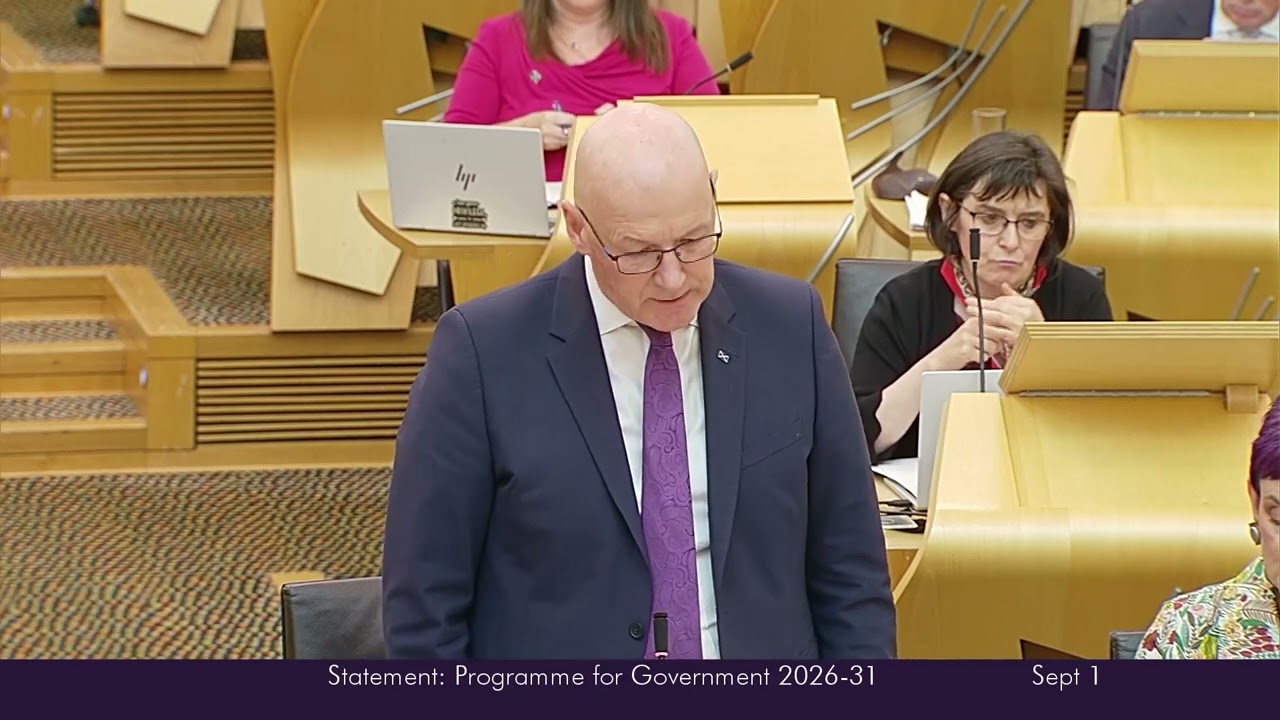
First Minister’s Statement: Programme for Government 2026-31 - 01 September 2026
Watch on YouTubeVideo summary
In his statement outlining the Programme for Government 2026-31, First Minister John Swinney presented an ambitious vision to transform Scotland into a nation where every citizen can succeed, eradicate child poverty, and tackle the climate crisis. He argued that the country's potential has been stifled by low economic growth tied to the stagnating United Kingdom economy, exacerbated by austerity and Brexit, which have fueled the cost of living crisis and eroded public trust. Consequently, the government commits to a radical reshaping of public services over the next five years, shifting focus from existing bureaucratic structures to the immediate needs of citizens. This transformation involves simplifying government operations, removing barriers to progress, and ensuring that every pound of investment directly improves frontline service delivery for people across Scotland.
A central pillar of this programme is the restructuring of local governance and public health to create a more responsive and efficient state. Swinney proposed rebalancing power between national, regional, and local levels, aiming to strengthen regions while empowering communities without creating unnecessary layers of administration. Specifically, he outlined plans to replace the current fourteen territorial NHS health boards with two strategic health boards to improve joined-up care and reduce waiting times, with a clear target that no one waits more than 26 weeks for treatment by 2031. Furthermore, the government intends to reform social care by establishing a single line of accountability involving the NHS to resolve complex funding issues, while also rationalizing the number of public bodies by merging transport and environmental agencies into core government functions.
To address immediate economic hardships and improve quality of life, the statement details concrete measures including the rollout of a £2 bus cap across the entire country, the introduction of a legal price ceiling on essential food items, and significant investment in affordable housing to deliver 111,000 homes by 2032. The programme also emphasizes supporting businesses through new offices dedicated to major projects and high-growth enterprises, alongside a commitment to green industrial transitions that create jobs while lowering energy costs for 100,000 properties. Social initiatives include expanding childcare support to allow parents to work more hours, investing in mental health infrastructure such as triage cars and walk-in hubs, and launching a misogyny bill to tackle violence against women and girls through legislation and targeted public health campaigns.
Ultimately, Swinney concluded that these structural and cultural changes are necessary to empower Scotland's people and regions, asserting that self-government is the only path to fully realizing the nation's potential. He reiterated his unwavering commitment to the case for independence, arguing that full control over energy policy and economic levers is vital to securing a prosperous future for all Scots. By prioritizing citizens' day-to-day realities, the government aims to deliver tangible improvements in lives, from shorter hospital waiting lists to stronger communities, fulfilling the mandate given by the public to build a fairer, more resilient, and ambitious Scotland.
Read the full video transcript
use for this week. Apologies to those
members I was unable to call.
The next item of business is a statement
by John Swinney on program for
government 2026 to 2031. The first one
is a statement before by debate, so
there will be no There should be no
interventions or interruptions during
it. I call on John Swinney.
30 minutes.
>> Presiding Officer, the Scottish
Government that I have the privilege to
lead is optimistic and hopeful for
Scotland.
We are inspired by the potential for our
country to be ever more successful.
That view is the foundation of this, the
first program for government in the
seventh parliamentary session of the
Scottish Parliament. We are here to
improve the lives of the people in of
Scotland, creating new opportunities for
all to succeed. This government is
ambitious for Scotland.
We will act to eradicate child poverty.
We will make Scotland the best place to
do business. We will tackle the climate
and nature crisis. We will improve
Scotland's public services.
As we build on the enormous strengths of
our country, we will confront the
difficult challenges people in Scotland
face
and the malevolent forces that seek to
divide our country.
We will address the cost of living
crisis. We will work to create community
cohesion. And I will give the personal
leadership required to tackle the
epidemic of male violence against women
and girls in our society.
We will give the leadership for Scotland
to decide our own future and set out our
case that Scotland will be better off
with independence.
To succeed, we will have to embrace
change.
We will undertake radical and widespread
public service reform, putting the
individual at the heart of the changes
that we make.
We will require all public services to
make a decisive shift to prevention and
early intervention.
We will simplify government, remove
barriers to progress, and make sure
every pound of investment is focused on
frontline service delivery.
In pursuing this program, we recognize
that we will need to reach agreement
with other parties in Parliament and
partners across the country if we are to
make progress.
I commit my government to working to
create common ground and invite those
who share the values that underpin our
country to work with me to achieve those
aims.
Presiding Officer, I believe there is
agreement across this chamber that we
need to change the way government works
in Scotland. It needs to be more joined
up, simpler, and citizen-centered.
It needs to be focused on the realities
people face in their everyday lives and
better able to target resources in a way
that maximizes impact on individuals.
And that is what this government program
for government delivers.
The vision I set out today will mean
more modern, more flexible, more
person-centered public services
delivered by a Scottish state that is
rewired and reimagined.
We will build on what is already the
most generous cost of living package
anywhere in the United Kingdom.
We will deliver more and more flexible
child care available from 9 months to
the end of primary school.
We will ensure that by the end of 2031,
no one in Scotland is waiting over 26
weeks for NHS treatment.
We will deliver more new homes for
families, more help for growing
businesses, a stronger economy, and a
fairer society, meaningful support to
help people boost their incomes and get
back into work. And we will protect our
beautiful natural environment alongside
climate actions that create jobs and
reduce costs. That is the promise of
this program for government.
Presiding Officer, so many of the most
immediate challenges we face as a
country are rooted in levels of economic
growth that have been too low for too
long.
That is in part the consequence of
Scotland being tied too closely to the
stagnating economy of the United
Kingdom, an economy designed to serve
the few while leaving the many
short-changed.
It is an economy ravaged by the
disastrous pursuit of austerity and the
folly of Brexit.
We see it in the cost of living crisis,
which in turn has fed discontent with
politics and a loss of hope and trust
amongst too many of our citizens.
People are angry, but that anger must be
a call to action, not a reason for
despair.
Economic inequality exacerbates
inequality throughout society. It
undermines cohesion. It runs the risk of
spreading dissolution among too many
young Scots. It is one factor that fuels
growing violence against women and girls
in our society.
These challenges are all different, but
they're also interconnected.
We must drive the change needed in
attitudes and behaviors, confronting the
sexism and misogyny that continue to
harm women and girls, and tackling
head-on the racism and prejudice that
too many people in our society face.
I will provide the personal leadership
to tackle violence against women and
girls, but I'm clear that the actions we
take forward are not the responsibility
of any one minister. They cut right
across the work of government.
And while government has a vital role to
play,
lasting change requires all of society
to play its part,
which is why campaigns like the Sunday
Post's It's Time campaign are so vital.
Through legislation, we will seek to
make early progress on the serious issue
of violence against women and girls
through a misogyny bill.
We will end the postcode lottery of
service provision to ensure that every
woman and girl, regardless of where she
lives, has access to safe and
sustainable services.
That includes developing a new
multi-year fund for specialist third
sector organizations responding to what
organizations need to sustain vital
services and deliver critical
preventative work.
We will enhance protections for women by
recognizing pregnancy as an aggravating
factor in domestic abuse cases and
provide support for those leaving
abusive partners through our fund to
leave.
And we will invest in targeted
interventions including a multi-year
public health campaign to challenge and
to change problematic misogynistic
attitudes in boys and young men so they
understand harmful influences and
behavior before it escalates and women
and girls are harmed.
Presiding Officer, the increasing
frequency of intimidating process
alongside experiences of discrimination,
prejudice, and hate has caused faith,
minority, and migrant communities in
particular to feel less safe and more
fearful.
There has been extensive engagement with
communities across the summer both
proactively and to provide immediate
reassurance in response to events that
have left communities concerned for
their safety.
I've welcomed the opportunity to engage
with communities directly, but I believe
we must do more.
This program for government sets out a
range of actions towards building
strong, inclusive, and safe communities
including addressing the root causes of
hate crime, strengthening reporting and
support for victims, and addressing
racism in education through the
anti-racism and education program.
We will increase investment in the
community cohesion fund to 500,000
pounds to support grassroots community
initiatives and we will also bring
forward a human rights bill aiming for
introduction in year two of the
parliament.
Presiding Officer, this program for
government represents my priorities and
the mandate I secured from the public in
May.
But more than that,
it reflects also the experience I have
gained and the lessons I have learned
from almost 20 years in government.
There is much to be proud of and much
that we do well.
We are blessed with public servants who
go above and beyond to deliver for
people day in and day out.
Those things that we do well, we must do
more of.
But those things that are not delivering
as we need them to, as people rightly
expect them to, they must change.
As a starting point and at the heart of
our plans is the very clear expectation
that the public sector in Scotland will
fundamentally shift its focus, asking
first and foremost what are the needs of
our citizens rather than what are the
needs of the existing structures and
systems.
That will mean over the next 5 years the
most radical reshaping of public
services since the establishment of the
Scottish Parliament.
It will mean more effective use of
technology.
Staff working on the front line should
be encouraged and enabled to break
through silos between organizations in
order to respond to the real-life needs
and experiences of the people that they
serve.
Our communities should be empowered in
new and effective ways.
Services should be delivered at the most
appropriate level to meet the needs of
the public.
Those aspirations, which I believe are
widely shared across Scotland, must be
turned into reality and this government
will lead that process.
Presiding Officer, let me start with
local government. Scotland is fortunate
because of our size, some priorities are
best delivered at a national level and
because of our diversity, others at a
regional or more local level.
Getting the balance right between
national, regional and local is
essential to enable us to deliver more
responsive and more effective government
that meets the meets the needs of our
people and our communities.
In Scotland today, we are faced with the
reality that some of our councils are
too small to be strategic and some are
too big to be local.
The government believes that should
change.
What we propose is a rebalancing of
power within Scotland
with our regions strengthened and our
communities empowered to bring new life,
new opportunities into the places that
they love.
Today begins a 3-month period of intense
engagement with our local government
partners and with other parties in this
chamber and beyond about a new structure
for local government in Scotland.
While I enter those discussions with an
open mind and do not wish to be overly
prescriptive at this stage,
I do also have a very clear sense of
what is needed.
It is not a blank sheet, but equally,
our ideas are not delivered today as
though they were on tablets of stone.
Our starting point is that changes must
not create another layer of
administration or a new group of
politicians.
As an end point, reform must mean
stronger and more strategic regions with
the powers, the permission, and the
flexibility they need to drive economic
growth and investment in all parts of
Scotland so that we can in turn improve
people's lives in all parts of Scotland.
I'm open to devolving powers over a
broad range of economic levers to these
stronger, more strategic regions,
including, where relevant, new powers
devolved to Scotland from the United
Kingdom.
But within these regions, local
communities must emphatically be
empowered.
Reform must deliver councils that are
big enough to be strategic, but which
contain within them localities that are
also small enough and strong enough to
enable genuine local decision-making.
And this process must involve resources
currently caught up in a cluttered and
complex landscape being freed to be
spent on improving the lives of our
citizens.
Within any program of reform and
renewal, the needs of our island
communities must be distinctively
recognized, including through our
ongoing commitment to advancing the
single authority model where it is
desired.
Our actions are about improving public
services, and at the heart of this
approach is the need for simpler and
more coherent decision-making
structures.
Right now,
the arrangements we have in place to
manage social care in Scotland are
overly complex with competing lines of
accountability. No one understands this
more than those on the front line
delivering these services.
Decisions on social care at a council
level impact on the health service and
the NHS's ability to deal with problems
like delayed discharge.
That means money is being spent in ways
that do not deliver the best results for
citizens. This too must change.
Reform to social care, therefore, will
also be part of our engagement over
these next 3 months with partners in
local government, with trade unions,
with the third sector, with partners in
our communities, and with parties in
this Parliament. Again,
I do not seek to be prescriptive, but I
cannot see us resolving the fundamental
challenges facing social care without a
single line of decision-making,
accountability, and funding with the NHS
taking the lead.
For the NHS itself, in order to ensure
more joined-up delivery, to improve
access to care, and to reduce inequality
for some patients due to health board
boundaries,
we will replace the current 14
territorial health boards with two
strategic health boards.
This will be the most significant
structural reform of the NHS in the era
of devolution.
Alongside targeted investment and our
national floor plan,
it will enable us to deliver the
additional capacity to ensure by the end
of 2031 that no one waits more than 26
weeks for the treatment that they need.
Change for a very clear purpose. Change
that will improve quality of life for
thousands of Scots each and every year.
Presiding officer, work is already under
well underway to deliver a tell us once
approach so that citizens engagement
with a range of government services
becomes simpler, easier, and more joined
up.
As the program for government details,
action will be taken to rationalize and
simplify how we make payments, collect
revenues, undertake inspections, share
services, manage inquiries, and share
data.
More broadly, we will also substantially
reduce the number of public bodies over
the course of this Parliament.
That will include, among other steps,
bringing Transport Scotland into the
core government, bringing our
environment bodies into a single
national environmental body to make our
interventions more impactful, and
exploring the establishment of a single
ferries body for the Clyde and Western
Isles routes.
As a result of these actions, at the end
of these 5 years, people in Scotland
will notice clear improvements in their
lives and in their experience of public
services delivered by the Scottish
Government and our partners.
Change will be structural, but also
cultural.
More open and flexible, acting as an
enabler of positive change with an
attitude rooted more in yes, if, rather
than no, because.
Citizen-centered delivery, a prevention
first approach, public service reform,
and a decluttered public sector
landscape. It is an ambitious program of
public service reform, a program
designed to transform Scotland. It will
make our nation a better place to live,
work, and bring up our family, and
deliver strong, sustainable, effective
public services for the future.
Presiding Officer, we are changing the
way we do government because we are
determined also to change Scotland to
deliver tangible improvements that
directly impact on people's lives.
It is our ambition and intention to put
more money in families' pockets,
building on what is already the most
generous cost of living support package
anywhere in the United Kingdom.
The national rollout of our £2 bus cap
has already begun. It is in place right
now already in the Highlands and
Islands.
We promised to extend it first to
Glasgow and to the west of Scotland.
We will keep that promise.
I can confirm today that bus fares in
the west of Scotland, be that Glasgow,
Renfrewshire, Ayrshire, Dunbartonshire,
Lanarkshire, or Inverclyde, will be
capped at £2, and the £2 bus fare will
start this coming Monday morning.
Today, we have also begun formal
consultation on the legislation that
will introduce a legal price ceiling on
a basket of essential food items, giving
families greater peace of mind at a time
of rising prices.
We will continue to deliver support on
energy costs, with 100,000 people over
the next 5 years saving an average of
£450 a year on energy bills.
And we will deliver financial support
for energy costs for people with
life-saving equipment in their homes and
those who are terminally ill.
Presiding Officer, we can lower energy
costs for some with the powers of
devolution, but we can only lower energy
costs for all with the full powers of
independence where Scotland's vast
energy resources finally in Scotland's
hands.
>> [applause]
>> Our ambition and our intention is that
more people in Scotland get a home that
they can afford. That includes
investment to deliver 111,000 affordable
homes by 2032
with at least 70% available for social
rent.
Our First Home Fund has been launched
and will continue throughout this
parliamentary term. It will give
much-needed help worth up to 10,000
pounds to thousands of first-time
buyers.
And we will ensure fair access to safe
housing including the rollout of our new
50 million-pound homelessness prevention
fund with the first awards made this
year.
We will support innovative activity to
tackle homelessness and work with
partners such as Social Bite providing 2
million pounds to expand the Village
Project and their efforts to address
homelessness and provide rapid
wrap-around support for some of the most
vulnerable in our society. And we will
end the use of unsafe and harmful
harmful temporary accommodation for
children.
This program for government today will
get more people into good secure work.
We will expand apprenticeships funding
at least 150,000 apprenticeships and
grow the opportunities provided by
graduate apprenticeships.
We will develop a new apprenticeship
accelerator grant focused on supporting
businesses.
We will make it easier for parents to
find work or increase their hours with a
generational expansion of child care
support.
That means breakfast clubs in all
primaries by the start of the next
school year
and after an after school and holiday
provision available for all primary
children by August 2029.
This will ease the pressure on family
budgets for thousands of young parents
across Scotland as well as creating new
opportunities for work and a boost to
productivity and growth.
Underpinning this investment in a
stronger and fairer society is our
commitment to supporting Scotland's
wealth and job creators as we work to
dramatically improve Scotland's economic
performance.
Our ambition and intention is to pursue,
enable, promote, and secure both
homegrown and international investment.
Put simply, we will take the steps
necessary to make Scotland the best
place to do business.
To assist in that effort, we will create
a major projects office
which will accelerate progression
nationally and strategically significant
investment and private capital projects.
The major projects office will unlock
barriers and unlock investment with a
particular focus on strategic sectors
including housing and energy.
This is a central part of the enabling
government I seek. A government that is
active in finding solutions. A
government that will remove barriers and
obstacles to speed up economic
decision-making and is laser-focused on
attracting high-quality projects which
can deliver well-paid, high-quality
jobs.
For the same purpose, we will establish
also a Scottish high-growth unit working
with senior industry leaders to identify
and accelerate delivery of the right
support for high-potential businesses so
they can grow to scale in Scotland and
just as importantly, they can stay here
in Scotland.
Scotland is rich in resources and rich
in innovators, and I'm determined to see
the many advantages we enjoy deliver
real benefits to our economy and to our
people.
Our ambition and our intention, guided
by the expertise of my National Council
for Economic Growth,
is growth that is generated and felt the
length and breadth of Scotland.
That also means investment in our
nation's infrastructure, improving
digital connectivity, support for local
regeneration, including town center
regeneration, and projects to build
community wealth and resilience.
And it means ongoing investment in our
transport network, including delivering
on our commitments to dual the A9 and
the A96, find solutions for the A83 Rest
and Be Thankful, and support progress on
the Clyde Metro.
Because a flourishing rural economy is a
fundamental part of a flourishing
Scotland, we will start work on our
rural renewal bill, designed to support
rural businesses from farms to food
producers and the rural way of life.
Presiding Officer, Scotland's culture
sector is at the beating heart of our
national identity, but also close to our
economy.
And I want to make sure that goes from
strength to strength.
We will deliver an extra 100 million
pounds annually for culture by 2028-29.
By the end of this Parliament, we will
add a further 50 million pounds to our
annual culture investment, whilst
expanding opportunities for cultural
participation in a youth culture pass.
We are working with the sector to design
and deliver a national performing
company for traditional music, ensuring
traditional music has the same status as
our other highly respected performing
companies, and we will also pilot a
Scottish artists minimum income.
As the Member of Parliament for large
ways of rural Perthshire, I know how
important the local pub or local shop
can be, which is why we will establish a
last provider fund to support the
sustainability of the last remaining
shops and pubs in our rural and island
communities.
This program for government today will
ensure that our economy, climate, and
communities all benefit from the green
industrial transition and are resilient
to the impacts of climate change.
We will introduce a heat in buildings
bill, enable the scale up of heat
networks, and support clean heating and
energy efficiency measures with the aim
of lowering emissions and costs for
100,000 properties.
We'll support the expansion of community
renewable schemes,
which for some communities will provide
them with vital assets and a source of
income, and for others, lower energy and
heating costs, making community
buildings and other local projects more
resilient and more viable.
We will continue to invest in workers
and businesses in Murray and the
northeast through our 500 million pounds
just transition fund, and we will
continue to call on the UK government to
match our investment.
Presiding officer, a clear commitment
was made to the people of the northeast.
They were told that as opportunities in
the oil and gas sector declined, they
would be replaced by opportunities in
green energy, whether in offshore wind,
hydrogen, or carbon capture and storage.
But UK government policies have seen the
decline in the oil and gas sector
accelerated and green energy projects
hampered or held back. That is a
shocking failure of the United Kingdom
government. If we are to keep the
promise made to the northeast, then
getting control of energy policy for
this parliament is vital.
That promise is why we will place the
case for the energy profits levy to be
replaced and continue to invest in the
green industrial opportunities that are
so important to our nation's economic
future and success. The Scottish
government, using the powers we have,
will play our part for Scotland's
energy. It is with a stronger economy
that Scotland will enjoy the highest
quality public services.
Our ambition and our intention is to
deliver shorten shorter waiting times
for treatment in the NHS.
Over this past year, we've been able to
increase capacity and activity in our
NHS,
and as a result, bring down long waits.
Building on this progress, we will
ensure that by the end of 2031, no one
waits more than 26 weeks for treatment.
There will be at least 10 billion pounds
of capital spending over the next
decade, funding among other things, new
community health and care hubs across
Scotland, starting in Fife, West
Lothian, and Inverclyde,
and a new university hospital Monklands,
with the aim to start construction in
2028.
We will continue to expand the network
of GP walk-in centers, a service built
around the realities of family and work
life, which will make it easier for
thousands of Scots to access a GP at a
time that works for them.
Our ambition and intention is to deliver
a sustained reduction in delayed
discharge from our hospitals.
We will create one connected system with
one simple route to care, ensuring
people receive the care they need as
quickly as possible and in the right
setting.
That includes more care in the
community, with hospital at home
expanding, so that over this winter,
10,000 people can receive hospital-level
care in their own home.
And in recognition of the campaigning
efforts of the family of the late
Anthony Bundy, we will deliver 24/7
thrombectomy cover regardless of
geography.
Presiding officer, we will treat drug
use as a public health emergency. An
additional investment of 250 million
pounds through our national mission on
drugs will mean more residential
rehabilitation beds.
And recognizing the complex interplay of
issues that can lead to drug abuse and
addiction, we will provide additional
mental health support, including new
walk-in mental health hubs and expanded
24/7 support with the rollout of mental
health triage cars to every region in
Scotland.
We are ambitious for the next generation
of Scots and will create positive
futures for children and young people.
We want our children and young people to
get the most out of their school
experience learning so they can achieve
academic and vocational excellence.
That means reform of our school
curriculum, further work with local
government partners to empower head
teachers, ongoing investment of up to
200 million pounds to reduce the
poverty-related attainment gap, and
legislation on a mobile phone ban in
Scotland's classrooms.
We will expand the Bookbug program to
reach an additional 20,000 families,
expand the opportunity for young people
to learn a new language, including
Gaelic and Scots, and ensure that every
child with additional support needs has
access to appropriate, including
specialist, support.
We will also continue our work to keep
the promise by 2030.
Presiding officer, in our criminal
justice system, we will be strong on
punishment and effective on prevention
and rehabilitation.
I want communities in Scotland to be
safe and just as importantly to feel
safe.
Of particular concern, Scotland has seen
several high-profile and heartbreaking
examples of youth violence, including
deaths from knife crime, which have a
profound impact on families and
communities.
We will continue to work with partners
to tackle and prevent youth violence,
and in particular knife crime, through
education programs on the danger and the
unacceptability of carrying a knife and
taking part in violence.
We will do this by supporting
organizations and initiatives such as No
Knives Better Lives, the Youth
Navigators project, and Mentors in
Violence Prevention Program.
And in recognition of the inspirational
campaign of Lisa Petri, whose son John
died in September last year, we will
roll out bleed kits to community
settings across Scotland.
We'll also build on our net landmark
victims and witnesses legislation to
ensure that victims are heard,
supported, and protected, and treated
with compassion, including through the
appointment of Scotland's first victims
and witnesses commissioner, and the
establishment of a trauma-informed
sexual offenses court.
Presiding Officer, this is a Scottish
Government that works for Scotland, that
wants the very best for Scotland.
That means giving our citizens a greater
sense of control over their lives, and
demonstrating that once again, they can,
by studying, training, or working hard,
make their lives better.
It is about empowering our communities
and our regions, but also about
empowering Scotland as a whole.
It is about demonstrating to people that
we, the politicians, get it, and that we
are acting to make their lives better.
That requires a new way of doing
government, and a new way also of doing
politics in this place.
In my heart, I believe in
self-government for Scotland.
Self-government has been good for our
nation, and we need more of it.
The Prime Minister has opened the door
to new powers for this Parliament, and I
will work constructively it people
inside this chamber and partners outside
it to identify the new powers that can
be quickly devolved if we are to
maximize economic growth, reduce
inequality, and do even more to put
money in people's pockets. But,
ultimately, Scotland's constitutional
future should be a matter only for the
people of Scotland.
That's why I will continue to make the
case for Scotland's right to decide on a
fresh start with independence, the
change that will make the biggest
positive difference.
Presiding Officer, this is a government
that believes in Scotland and in our
people.
We see a nation brimming with potential,
but held back because too often
decisions taken elsewhere get in the
way.
We have deep-seated challenges, but we
have the wealth, resources, and
ingenuity to overcome them. I have no
doubt that the more powers we have, and
the more policy levers we can control
here in Scotland, the more we can
achieve.
My commitment to the people of Scotland
is clear. You come first.
Government works for you, and we will
always be alive to the realities of your
day-to-day experience. That is the
starting point for this program for
government, a program for government
that will deliver more money in people's
pockets, shorter waiting lists, more
homes, easier access to GPs, action on
the climate, public services fit for the
future, decisive action on violence
against women and girls. These are the
aims of a government that is ambitious
for Scotland. The people of Scotland
have put their trust in this government,
and we will deliver what we have
promised.
>> [applause]
>> Thank you, First Minister. The next item
of business is a debate without motion