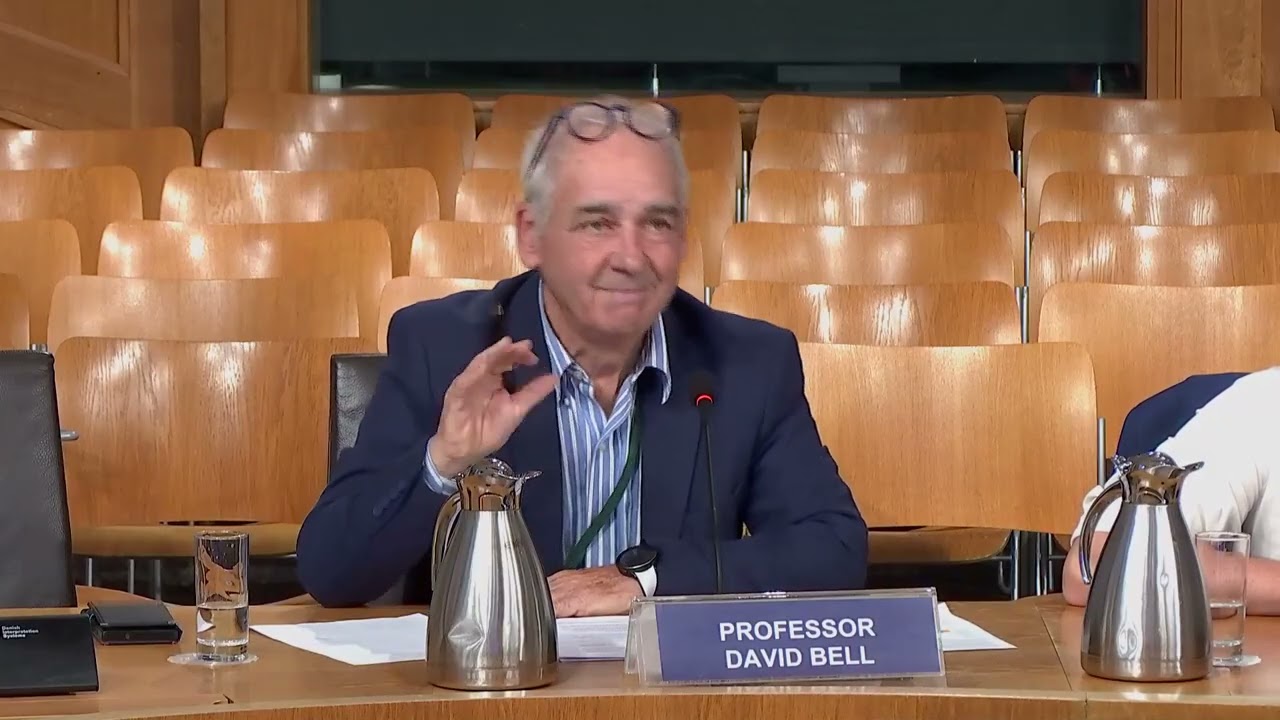
Video summary
The Finance and Public Administration Committee has scrutinized the affordability and sustainability of Scotland's tax and spending plans, highlighting significant concerns regarding the government's ability to achieve fiscal stability. Witnesses from the University of Stirling and the Institute for Fiscal Studies argued that the identified savings are often targets rather than proven reductions, warning that relying on last-minute cuts could severely harm essential services like health and social care. A major vulnerability lies in the sectoral composition of the economy, where declines in oil and gas revenues reduce high-income tax bases, while financial services have underperformed; furthermore, experts noted that proposed efficiency measures, such as NHS board mergers, face substantial upfront reorganization costs and implementation challenges that may prevent them from generating significant savings within the current parliamentary term.
The discussion extensively covered the complexities of the fiscal framework, including issues like "fiscal drag" where wage growth pushes more earners into higher tax bands, and the reliance on outdated Council Tax valuations that unfairly penalize less prosperous areas. While there is a consensus on the need to shift toward preventative spending and redesign property taxes to encourage economic activity, this transition has been delayed for over 15 years due to political reluctance to fund necessary upfront investments with current cuts. Additionally, the feasibility of issuing Scottish bonds to cover capital shortfalls was debated; experts caution that such bonds may merely substitute existing borrowing rather than creating new power, potentially carrying higher costs due to market uncertainty and a lack of liquidity compared to borrowing from the National Loans Fund.
Beyond fiscal mechanics, the committee emphasized the critical importance of focusing on outcomes rather than just input savings or job cuts, particularly in light of regional disparities in business growth and infrastructure. Critics pointed out that while Edinburgh boasts robust services, other regions suffer from inadequate transport and grid connectivity constraints caused by decades of underinvestment, necessitating localized solutions rather than a one-size-fits-all approach. There is a strong advocacy for a bottom-up strategy that empowers community groups and the third sector as key partners to ensure equitable service delivery, especially in rural and island areas where top-down reforms often fail to account for local realities.
In conclusion, the committee heard that the current path to fiscal sustainability does not match the scale of the challenge posed by block grant adjustments, public sector pay pressures, and inflation. The witnesses recommended greater transparency in spending data, an updated Fiscal Sustainability Delivery Plan that details realized savings, and a cautious approach to using one-off funds for long-term commitments. Ultimately, the session underscored the need to simplify fragmented efforts, integrate private sector investment into essential infrastructure, and build reserves to manage economic downturns, ensuring that public finance plays a constructive role in promoting long-term economic development without compromising service provision.
Read the full video transcript
Good morning and welcome to what what's
our fourth uh meeting of the finance and
public administration committee and
session seven. Um I've got one apology
for today's meeting which is uh normal
convenor CLA hawk. So um panel's got the
joys of me convening uh the meeting. So
the first item of business is to decide
whether to take agenda item three in
private and to take future items to
consider evidence heard during the pre
pre-budget scrutiny 2720 in private. So
uh do we have agreement from the
committee?
>> Thank you. Okay. So the next item on our
agenda is to take evidence from the
committee's pre-budget scrutiny 2728
which is about affordability and
sustainability of Scotland's tax and
spending plans. Um can I welcome the two
witnesses uh this morning from panel
one. Um we've got Professor David Bell,
professor of economics at the University
of Sterling and uh Dr. Sha Souza, senior
research economist at the Institute for
Fiscal Studies.
Um, so just a reminder, I think these
are well seasoned being before the
committee, but um, not to worry about
turning on your microphones during the
the session because these are controlled
automatically by broadcasting. If you do
want to come in during a discussion,
please raise your hand or indicate the
clocks and we'll try and facilitate that
as best we can. So, if we just quickly
move on to questions um, and I'll call
Michael Mara to do opening question,
please. Thank you, Camina. Um, thanks
nice to see you both this morning on I'm
going to start with issues of
sustainability, fiscal sustainability
and thank you to you both for your
submissions. Um, Professor Bell, you say
in your submission that the the savings
that the government has identified
remains and I quote targets or plans
rather than demonstrated recurring
reductions and expenditure. Um, would
you perhaps like to set out a little bit
of context for us as to why that's your
view? Well, so I think that the um sorry
the the the program for government as
has set out thus far is uh identifies in
general a number of areas in which
savings might be made. But I think we're
now at the stage where we need to be
much more precise about where savings
can be made. And there are there are
acknowledged serious uh dangers that we
will exceed the um current plans around
issues such as public sector pay and
also spending on uh on welfare. uh and
these may may jeopardize the the
achievement of of the savings that are
that are currently proposed and without
a very a more precise uh explanation of
how these savings are going to be
achieved. There is a danger that we kind
of drift into situation where
uh savings are are made uh in a in a way
that is not beneficial in terms of
service provision because uh they're
they're effectively being made uh at the
last minute to achieve um budget balance
which the Scottish government has to
achieve.
>> Dr. exerciser. Would you generally agree
on the issue of sustainability and lack
of clarity?
>> I agree with with what um Professor Bell
said regarding the the lack of detail.
Um we have noted in our submission that
um two about twothirds of of um savings
in terms of efficiencies are meant to
come from the health and social care
portfolio, but lots of that come is
meant to come from NHS boards. Now I
understand that there there is a um
[clears throat] there's some uh
discussion as to what form
reorganization of the NHS might take.
It's it's still very stretching um set
of targets if those don't materialize
and and audit Scotland highlighted that
um B NHS boards have actually mostly
failed to meet what were less stretching
targets than these um and so that's not
guarantee of of what will happen but you
might think that that informs what you
might expect to happen in the next few
years. Then the real um problem is that
you end up in a situation where you
might have to live with a a
unless you can find funding from other
areas which is possible. You might live
in in a situation where you just can't
do as much as you would otherwise want
to do. Um and obviously you know that's
that's not an ideal situation. So so
that's something that that that is
important. And the other thing is that
say you know just becoming more
productive um in in in some things
doesn't necessarily mean that that
actually releases cash to be saved. Uh
and that's another thing that we
highlighted. Uh so you might think that
for example the NHS might be become more
productive um at doing some sort of of
of elective surgery for example but
unless you then have control on top of
that to ensure that you're not then
filling that with additional activity
which might be demanded by by the
population and therefore you know you
might assume that that's a good thing
but from a financial sustainability
point of view those have to be bankable
savings for for the suns to end And if I
can come on that point, you you
mentioned the NHS savings and one thing
that I think committee in the last
session found difficult to get clarity
on was the status of those savings as it
pertained to the deficit. Um because
there was talk that this these savings
could be reinvested within boards in
inance most likely to try and meet a 26
waiting 26 week waiting time guarantee
or others there'll be returns to the
front line. Do you think there's clarity
in terms of the whether that saving
should contribute to the overall5
billion pound deficit or whether
actually it's about funding expansion of
provision?
>> I I guess I would say there's the the
health and social care area in
particular are where there is least
clarity in terms of of where the the
savings will come from. Um
it's it it's you know it depends what
the priorities of the government are
going to be. So the government is
perfectly within its within its per can
decide that it wants to do that. But
these are not easy decisions. None of
these come without tradeoffs. Um and if
you want to spend more on health
to meet particular targets. Um then the
funding has to come from somewhere. um
you know it's so so just just spending
more without finding the the tradeoff of
to where it comes from um doesn't
necessarily answer the the question of
financial sustainability. Could it could
I I just add to that? I mean um the one
point that I make in my paper is is
around services that are demandled
uh and and those include uh health and
social care to a certain extent uh and
also the welfare budget and it is very
difficult to um a
manage a budget that is more or less
fixed with uh elements that are
effectively demandled and you you it's
eligibility that that determines how
much you're going to spend and the
consequence of course is that if the
demandled uh elements of the budget
increase other parts of the budget have
to decline.
>> Okay. And and you've both mentioned the
program for government last week and the
first minister's presentation of that to
parliament. Uh there was a lot of
discussion about change in the public
services. So particularly um around the
NHS reform to boards and councils. Just
focusing on the NHS issue again, you
you've both um raised that. I mean, is
it clear to you whether these plans are
devised to deliver savings to the
overall budget or whether they will are
about delivering better services because
the actual discussion of the 5 billion
pounds uh deficit was was pretty absent
from the presentation to parliament.
>> Professor Bell. Well, I I've got to
agree that that there isn't sufficient
detail as yet about how these plans
might be carried forward. You know, what
will actually be the geography of uh of
the new boards?
>> Can I push you on on one point in there
though, the whether given your previous
experience, a long-term observer of
these processes, um is there a risk
around upfront costs to reorganization?
So you know for instance the uh changes
to the police single police service
there's significant upfront cost over a
period of years and whether we might see
a reorganization costing money rather
than saving money. I mean my my view
certainly is that is that in the short
term yes you it could increase costs
because uh you don't um reorganize a
workforce uh very significantly without
incurring costs what whatever I mean
these may come in different forms but
but major reorganization always involves
some upfront cost
>> that's not necessarily a reason not to
do it uh because if you if you think
that the the benefits of running it
further down the line in a more
streamlined way are going to outweigh
that then then that's a reason for going
for it but it I think it naturally does
take up both cost but also time. Uh one
of the things that that that is
important to note is that we are you
know in year we're partway through the
the the public sector reform program
already. Um and so
It's it's unlikely that this is going to
happen overnight. Well, it's not
possible that it will happen overnight.
So, it's unlikely that it's going to
deliver savings immediately. Again,
that's not necessarily a reason not to
do it. Uh but it's something to to bear
in mind as to um when those savings will
be delivered because the the the the
budget balancing has to happen across
the piece. Um, I would say that I I
wouldn't focus necessarily too much on
on the 5 billion pounds that from the
MTFS because clearly there's been plans
subsequent to that that have reduced the
the spending plans. Um, there are still
pressures on top of that. Um but there
has been a kind of a a recognition of
you know the the MTFS was in some sense
the medium-term financial strategy was a
pre- prioritization document um in my
view so it was listing all the things
all the pressures that might happen and
then the the spending review was kind of
saying well actually the funding isn't
going to be there to to match that so
this is how much we actually plan to
spend which is significantly less per
year uh which would would have to have
been the case in all situations because
uh the deficit cannot materialize. So on
that issue of path to savings and we
have do you feel what you've heard in
the last week is commensurate to the
scale of the challenge on pace because
we have you know we know that in the
coming couple of years we've got a
significant block grant adjustment
really constrained uh fiscal settlement.
We so we know the shape of that. We also
know the shape to some extent through
the fiscal sustainability delivery plan
of where we have to get to. So last week
we heard two essential parts of uh the
conversation about significant change,
health board reform and a pretty broad
woolly conversation about local
authority reform. Um I'm not one to
judge either of those things. My
question is about the path to
sustainability and whether actually it
will give us the pace required to meet
the outcomes that that to meet the the
budget deficit. I don't [clears throat]
the signals that that I've been able to
detect thus far don't really indicate
that at the moment we're we're we're on
that path. I mean I I did um highlight
already the issue of public sector pay
but that's going to be a very difficult
issue uh a forthcoming uh given given
the way that uh settlements have already
been made and the commitments associated
with those settlements seem to me that
uh in terms of the of the uh trajectory
that we might expect public sector pay
to take. it's not commensurate with the
kind of savings that we're also thinking
about.
>> I uh I think that there's a there's to
to your comment about path 202728 looks
like a really really tough budget. Um
there's the the reconciliation
uh next year. There's also the fact that
the the block grant is falling in in
real terms. Um
there's the the public public sector pay
uh policy pressures already that that
were built into the existing paid policy
plus the inflation pressures that we are
seeing um that will erode the value of
of the settlement that were already
made. Um
now there might yet be additional
funding from from decisions taken uh at
UK government level. We can't know that
uh for certain, but next year looks
really really difficult. Um and if if
costs of reorganization come at a time
when the budgets being squeezed already,
then that just makes what was a pretty
difficult task even more so.
>> Okay. And my last question, Kavina, is
that okay? Just Yeah, the last one.
Sorry. On the the lack of an MTFS MTFS
this year, you mentioned already do
size. Um there is you suggest in your
paper that what we could be looking for
instead is perhaps an update on the
fiscal sustainability delivery plan. Um
you think that that would give us a
better insight into whether these
targets have been met? You think that's
something the committee should be
pursuing?
>> I I think I think an update to the FCSDP
and um the savings that have been
realized and the plan for for the ones
that haven't been um realized yet would
be helpful in that regard. Yes. Thank
you.
>> So Tim and Liam would indicator come in.
I think I'll let Liam in the back of
that and then you can come in and ask
your other questions.
>> Just just following up. Good morning. Um
following up Miss Amara's earlier
question around um the upfront cost of
that restructuring
fairly pointed to the experience in
police Scotland. The one that leapt to
my mind was um college reorg uh
regionalization where consistently the
government's argument was was that this
would release efficiencies that would
pay for the uh for that restructuring
but those efficiencies were only ever
going to be realized 2 three four five
years down the line. Is there a way in
which um the government can be clearer
about the time frame for for releasing
those efficiencies if indeed their
expectations are that they will cover in
whole or in part that the cost of that
reform process? Is there a way that the
committee can be um in a sense putting
pressure on the government to be clearer
about that that timing? No, I I I think
the committee uh uh should be trying to
get as much information as possible from
the government about this, but ne
necessarily these kinds of uh
reorganizations involve a lot of uh
transactions,
conversations between the relevant
parties to to identify how the savings
are going to be achieved and these can't
be done overnight. So although one might
want to get information as quickly as
possible, I think to some extent that
won't really be possible. So it yeah, I
think the committee should be trying as
hard as possible, but but in undoubtedly
major reorganization is is is a complex
and uh timeconsuming
uh exercise.
C can I before come in, can I just ask
in the back of that? So, as has rightly
been pointed out, there's probably going
to be upfront costs associated with
reorganization and shrinking the
workforce. I'll inevitably involve some
redundancy payments for some people as
well, which is further upfront cost.
Does the fiscal framework make that more
difficult as well because effectively
you're only supposed to be able to
borrow for reconciliation and and budget
shifts? So it's therefore harder as you
said professor Bell much spends demand
le so it's therefore much harder to set
aside chunks of money that will bring in
efficiencies um at the back end as it
were. Is that would that be a correct
interpretation?
Well, I I mean I think having uh
significant elements of the budget that
are demandled alongside a relatively
small borrowing uh a availability is
always going to make uh uh uh the the
management of budgets difficult.
I think I think it's fair to say that
the the the the lack of ability to
borrow up front um which which is a
wider point about the fiscal framework
as to whether whether there's there's a
case for like any particular pressures
that that the the in Scotland that the
the Scottish government could be allowed
to borrow. You know, you could make a
case that have being able to do so would
ease that transition. Um and certainly
that isn't available. Now that that
doesn't mean that the Scottish
government doesn't have any powers to
smooth things over time. Um
you know if you're going to do um
reorganization within that kind of
framework, it probably means that you
have to to leave yourself a a gap that
you know cannot be used to deliver other
services during that particular year. um
otherwise things won't add up.
I was aware the other day of um uh the
head of audit Scotland making the case
that uh we should have whole of
government accounts for Scotland which
uh would include all the assets as well
as the um
uh a
cash situation of uh of the government
and and having all of government
accounts uh might help us to identify Y
areas in which there cash could possibly
be generated through um using as an
asset base uh to to uh uh generate
income rather than uh having to rely on
borrowing exclusively.
>> Okay. Thanks.
[clears throat]
>> So gentlemen, there's two parts to my
question. Um the first uh relates to
information that I've been given by
previous members of this committee that
the information that you get in terms of
the medium term reports and also the
outturn don't give enough clarity
because they don't give detail on shifts
between departmental budgets um and to
what extent do you think that's an issue
and what extent do you think we should
be pushing Scottish government to have
more clarity in that regard and touching
on something um that Mr. Mara raised in
terms of health. Um I read recently that
a lot of the budget in health actually
goes out the door to services run by in
contracts. So in terms of trying to save
money from the health budget, how much
flexibility would the Scottish
government have immediately given uh
that constraint?
So in terms of of information um
provided in in budgets I guess the
because the the the way that of that the
the Scottish government is organized
um it's in in portfolios which which
have I would describe as more porous
bound boundaries than the departments
would do in in um in white for example.
it's easier to transfer things across.
Um, and there's a case for some
flexibility around that. However, I
think in in both my my current role in
my previous role, I've I've uh made um
quite clear that I think that the the
budgeting should be done on the basis of
where things are going to end up over
the course of the year. And the there
should be the transfers between
portfolios should be limited to genuine
reallocations of money relative to what
was uh previously thought would be spent
rather than putting for example
education spending in the health budget
that then gets transferred to the
education portfolio to then be
transferred to pay for for education of
doctors and nurses uh for example or
social care allocations. they go in the
the health and social care portfolio but
actually they then get transferred this
general revenue grant from the local
government portfolio to actual local
authorities. I think that having that um
that kind of pattern makes it really
really difficult to understand up front
um where things are headed. Um, and you
know, obviously it's it's our job at the
IFS to to look at that, but it shouldn't
require us doing all that rebaselining
and and and and things out to where we
think uh things will eventually land
because ultimately the government has
better information uh about it. Um, and
so we think that it should use that
information, make it public and make it
easier to compare things.
>> I Yeah, I I completely agree with that.
I mean, ultimately, you want the budget
to reflect where money is being spent on
what kind of service. And if uh for and
the local government's a good example,
a very significant proportion of that is
going into social care. Uh and so if
you're just looking at the local
government uh uh line in the budget,
you're not actually uh picking up uh how
much uh of of their budget is being
allocated to social care and therefore
the pressures that are coming through on
the services that are provided to
Scottish public uh are are being
allocated in that in that direct in that
particular uh direction.
It's it's also the case that that
although the the Scottish government um
does calculations on the basis of how
much he wants to fund in terms of
uplifts for pay for example that money
just although it might notionally be
thought of in that way in reality it's
money that go gets transferred as a
block grant to local governments who
then have their responsibility because
they are the ones who are uh who have to
respond to pressures and to provide
services. They are the ones who have to
reallocate things. And so there's no
there's no direct link between how much
money gets put into the social care
budget um on in in the in the Scottish
budget and how much actually gets spent
in social care in by local authorities
because they are the ones who get to
decide that and they have to to
obviously um respond to local pressures
and you know it's their responsibility
statutoily.
>> Yeah. I mean it it is it it it we have
to um be uh cognizant of the of the fact
that local government you know is is a
democratic institution and therefore it
has some ability to uh determine its own
budget but an at least an indicative
um
allocation within you know the bud the
the documents provided uh uh by the
Scottish government around its around
its budget would give a clear indication
of of how one would expect the actual uh
end users of or how much finance would
be would be would be uh allocated
towards the the end users of services in
in in the Scottish public.
So just as a quick followup, um other
European countries are much better at
doing this than we are. And in some
countries, they've actually managed to
get a system where they can follow the
pound or the euro, if you like, and see
exactly where money spent. Do you think
that's an ideal scenario we should be
pushing for here, or do you think it's
just never going to happen?
I I think I I won't comment on on on
other European countries because I'm not
aware of um of detail enough to to to be
um to be clear on that. But I think
knowing what is spent um is important
and that's something that that that
obviously I think everyone would agree
on. Um
I I do think it's um it can be difficult
to trace like you know revenue comes in
it's obviously fungeible right so a
pound that goes in from one source and
another one once it goes into into the
allocation
they're they're indistinguishable so
some of the the kind of follow the money
um kind of calculations they make
actually also rely on some assumptions
question about what would happen if if
revenues didn't didn't come as as
intended. But, you know, it transparency
in terms of of expenditure, I think it's
probably a good thing.
>> Yeah. I mean, I I I'm all for as much
transparency as possible, but I I'm also
constantly
uh remember when when I was the adviser
to the committee, we were searching for
ever greater levels of detail uh around
around uh spending plans. And at the end
of the day, I wasn't entirely sure that
that information
was of huge value to the committee in
the sense that
that it w it would not manage to effect
change based on that very detailed
information.
I think uh yes, we could do a better job
in terms of budgetary information, but I
think we could do a wholly better job
thinking about outcomes because
ultimately what what this budget is
aimed to do is to provide the people of
Scotland with the kinds of services that
they that they wish uh as efficiently as
possible um and as effectively as
possible. And uh in order to do that, we
have to be able to understand what kind
of outcomes people want and then to
measure them very clearly. And I think
we're not all that good at the moment.
What we've got at the at the back of
this is what's called the national
performance framework which is a set of
um in a way aspirations as to where
um uh where we should be going in in
respect of different metrics like um
poverty and uh climate and so on. But um
the linkage between the activities of
this committee and the outcomes that are
achieved for people are are um there's a
big gap there in my opinion.
>> So So just one final point on that.
Would you not agree though that with
more clarity around spending that might
enable opposition parties to draw an
alternative budget which then would push
the Scottish government towards
outcomes?
I mean the there there is the power to
do that certainly and but it would take
a huge amount of work it seems to me to
be to be able to do that and and of
course another uh um issue that that
hasn't come up but which is a recurring
issue is the timetable for the budget
and that is so short that the ability to
produce a detailed alternative budget I
think is heavily constrained
I'm hoping that in due course I might
help with that and I think my colleagues
got a question on that later. Thank you.
>> Um okay if uh bring in Liam K.
>> Good morning panel. Uh Professor Burl,
you state in the evidence that you've
[snorts] submitted to us that it should
be earnings and employment rather than
simply higher taxes uh that might drive
the economy going forward. and you
suggest that we need to evaluate the
increasingly large difference between
Scotland and the rest of the UK tax
according to its behavioral effects on
as you say migration hours and location.
So a few questions around that. Firstly,
the Scottish higher rate threshold is
being frozen again uh such that wage
growth will pull more middle income
earners into the 42% rate. Now the SFC
says that over 26% of Scottish taxpayers
pay higher rate or above and that
compares with about 22% in the rest of
the UK. So to what extent is Scotland
now relying on fiscal drag rather than
genuine growth in earnings in the tax
base and is that sustainable?
Um I think that's a very difficult
question uh uh to answer. I mean there
is very noticeable fiscal drag or drag
both at the Scottish level and at the UK
level um with the decisions that have
been made by the chancellor. And the key
issue
that one needs to address is what are
the behavioral effects of those uh
uh of of that level of fiscal drag.
These are very difficult uh uh to assess
and evidence uh well uh the evidence in
my opinion is mixed. Um so uh
but an important issue which is kind of
at the back of of what what you're uh
asking is that um Scotland's budget is
now uh determined by its performance
relative to the rest of the UK and and
the biggest element of the budget that
is raised uh by the Scottish government
is income tax and uh effectively If we
are if uh Scotland's uh income tax per
head is growing less rapidly than that
in the rest of the UK, our net tax
position will be negative and therefore
there is a uh pressure which wasn't
which wasn't there in the pre it wasn't
effectively there in pre 2016 when the
Scotland Act came in where these
additional powers were added.
uh around a taxes on the one hand and
welfare which we might come to on the
other but these powers have uh I I think
um perhaps been not it's not been fully
appreciated that the relative growth in
Scotland is vital uh for the um uh
health of the Scottish government's
budget
>> and and to that because of the
progressive nature of of the income tax
system, people who earn a lot more um
pay a lot more tax and the comparator
geography which is uh England and
Northern Ireland. This is mostly driven
by London and Southeast. he's got a lot
more um additional rate taxpayers as
it's called um in the rest of the UK or
would be top right here which means that
even if both
earnings in both geographies so Scotland
and England Northern Ireland grow at the
same rate because you get more income
tax per person um that is up at the top
rate the the gap between the two widens
naturally.
So to maintain the same um the same gap,
you'd either have to have faster growth
in Scotland
because of the lower yield per per
taxpayer or you'd have to have higher
tax rates and effectively we have we
have higher tax rates. Um and it kind of
makes up in some sense for that actually
raises a bit more revenue but but some
of that effect has been through freezing
[snorts] the the the higher rate
threshold which has been done at UK uh
level as well but at a lower rate. So
this is essentially the pre Philip
Hammond reform to to increase it from 43
to 50. It never happened here and now
it's frozen in in both geographies. I I
guess another thing to add to that is
that it is per person. So it's the it's
income tax per person. So that's over
the whole population including children
and including older people. And when you
have a a greater proportion of older
people who are not uh generally uh um uh
adding to the the income tax revenue
that that depresses the income tax per
person number for Scotland relative to
uh England and Northern Ireland
>> and it's the per person calculation that
goes into the the the the block
adjustments.
>> Yeah. So that that that determines the
block grant adjustment which uh is is
what's taken away uh relative to the
income tax that we generate. And the
difference between these two is called
the net tax position. And and that's the
the thing that that suddenly had a 700
million pound hit uh a couple of weeks
ago because because the income tax data
is always delayed by a couple of years
because of the u uh
the way in which income tax is collected
from the self-employed is is at well
after the event. And that's why these
reconciliations
take place uh considerably after uh the
end of the fiscal year. I'm grateful.
And sticking with the constitution of
the tax base that you've just outlined,
you talked about the older demographic
for example. Uh the ONS has said that
45% of workers earning £50,000
or more uh are hybrid or remote working.
um and they contrast that with 8% of
those earning under £20,000.
So they conclude that managerial prof
professorial occupations are most likely
to hybrid work. Now, if that's correct,
then is there any evidence that or is
there any risk that those having a
Scottish job and earning more are more
likely to live and pay tax elsewhere in
the UK?
>> I I it's possible, but I don't think
there there's uh any um
clear evidence that of that being the
case. and and I think that's because
that uh information hasn't been
collected in a in in a systematic way.
>> I think I think I don't want to say that
it's not a risk. Obviously, it it it is,
but I I don't think there is data to
suggest that that's happening in a scale
that would affect tax revenues in in in
a big way.
it. I I don't question that at all other
than that uh there's a report this week
that across seven Scottish health boards
the number of staff registered at
addresses outside Scotland has risen by
56% in the last 3 years. So is there any
evidence that that's connected to the
tax rate? And in conclusion, is there
given what you've said about the lack of
evidence actually uh is that something
that the Scottish government ought to be
investigating alongside the growth of
remote working and the impact of fiscal
drag? And should the 2728
budget accommodate these facts?
>> I I haven't read the reports. 56% sounds
like a large number, but it might be
from a very small base as well. So, I
don't know what what what that refers
to. So, I I I think we should be
cautious about
seeing that as necessarily indic
indicative of a of a of something that
is kind of material to the to the broad
uh income tax revenues. Um that doesn't
mean they you shouldn't be looked into.
And um the Scottish government should
definitely have an interest in in uh in
ensuring that the the right tax is paid
as HMRC would collect the the tax on
Scotch government's behalf. So I I leave
it to them to to to do anything if
anything needs doing.
>> Uh but yeah.
>> Yeah. So I I mean I I agree. I I I
wonder if if these are are perhaps on
the books of the health boards that are
brought in for short very short-term
contracts
uh uh to tide over for example you know
absences and and and that kind of thing
but I don't know so so it's it's
something that could be uh certainly
could be followed up. What one thing I I
I think is not given enough attention is
whether
and to what extent people don't come to
Scotland because they they are told that
it's a that it's a high tax regime in
Scotland uh relative to the rest of the
UK. Um that's a very very difficult
thing to measure but um it I I think uh
it may well be the case that arguments
are made about uh that in in general
about the positioning of employees and
so on that relate to tax uh which which
were perhaps not being made prior to
these differences in rates but
incredibly difficult to draw. uh
accurate evidence on that.
I'm very grateful. Conven,
>> thank you. Did you say one in in the
back of that?
>> Yeah, questions if possible.
>> Um, Professor Bill, you were you were
explaining um some of the problems
created by the need for reconciliations.
This was a a topic we picked up with um
Professor Roy and the Scottish Fiscal
Commission uh colleagues last week. Um
and intriguingly they were suggesting
that their um their estimates of tax
revenue actually become more accurate
but the the the scale of the
reconciliations were bigger than ever
and actually the expectation going
forward was that would that that that
was anticipated to be um a kind of
factor. So I just wonder whether
um you have any thoughts about the way
in which Scottish government can better
manage that that that lack of kind of
certainty whether it it will require um
adjustments to the the fiscal framework
or there's anything that can be done in
the in the interim and the impact that
that's having in terms of trying to
achieve the the budget savings that
they're seeking to achieve over the next
two three years.
>> Yeah. Well, so I mean it it kind of uh
harks back a bit to um what I was
talking about later earlier, sorry. the
the issue around having now an
increasing uh proportion of the budget
being demandled on the one hand uh and
the fact that we're dealing with
forecasts that may have significant
errors associated with them even if even
if this are smaller the the total amount
that we're talking is around 18 billion
so you know 2 or 3% either way which is
certainly not unknown in in in
forecasting terms does make does make
quite quite a bit of uh of difference.
What um you would uh perhaps uh uh think
about is is uh where your current
borrowing position is and what action
you might consider taking in
anticipation of uh this kind of uh
pretty significant re reconciliation
that that that we've seen. So how do you
buffer that that kind of uh change which
which will have a significant effect on
on next year's budget?
>> So in in terms of of the the the
forecast I think part of it is a product
of the fact that there are two
institutions that that do forecast and
do they forecast different things but
the things they not forecast have to be
netted off. So the Scottish fiscal
commission forecasts income tax
revenues. The block grant adjustment is
forecast by the office for budget
responsibilities responsibility. Um each
of them is trying to do their best
forecast of the thing that they've been
asked to forecast. So SC Scottish fiscal
commission has been asked to forecast
the Scottish economy. This is their best
view and they have a particular judgment
about um uh where income tax is is
likely to go. Um the office for project
responsibilities try to forecast growth
uh in earnings um and the UK for the UK
economy as a whole. They have a more
pessimistic view. Again, that's that's
perfectly reasonable. Um however, what
matters for the Scottish budget is
neither one or the other in isolation,
but the two put together. and the fact
that the Scottish fiscal commission has
a more optimistic view. They say not of
Scotland in particular but of earnings
growth for the whole economy of the UK
which manifests itself in higher growth
in Scotland um than the implied by the
OBR means that that gap has grown in the
forecasts. Now
even if the Scottish commission physical
commission is getting more we're getting
more accurate and you know the in some
sense you could say that they've been
vindicated by the fact that growth in
earnings has been faster than what the
OVR has predicted that doesn't change
the fact that the net effect is what
matters for the Scottish budget. Now the
reconciliation essentially if it's a
negative reconciliation says actually
the the gap was too big. This money was
spent before. Therefore, u there has
there's a clawback of that money a
couple or three years in a in a
um so this in in our view at the IFS
certainly um this gap looks too big in
the forecasts and so that's why we think
that there's going to be negative
reconciliations in the next few years.
Um obviously all else equal. Uh so it's
it's important to kind of look forward
and think well if this is going to
happen then how can we prepare
ourselves. Um David mentioned the the
the the borrowing position. I would say
looking at the reserve as as a way of of
uh of managing this is is good. There
there's been some reforms to the fiscal
framework which have been genuine
improvements. So there's been increases
to the amount of borrowing uh that can
be done for these purposes and and there
could be a case for for not having
annual limits on borrowing for example
on this. Uh but there we think there
should still be some sort of cap because
otherwise you just delay the pay
inevitably until it all comes due. uh
but it's um you know it's it's it's
something that that is difficult to
manage but but ultimately it it just
reflects the fact that you know the
forecasts were too optimistic for the
the the the gap between the two. Um so
that's something that that needs um
needs to be to be taken into account.
The other thing that that has happened
before actually is that the so these
reconciliations are obviously one-off
pots of money right you know they come
every year but we don't know how how
they will relate year to year so you
can't predictably rely on them being
positive for example and what the
Scottish government has done in the last
few years is use those pots of money to
finance not oneoff um spending but
actually recurring spending so it's kind
of used these pots of money to just say
well we need to for example increase pay
awards um because of marketing
conditions uh or we want to expand a
particular social security um
payment or things like that um and we
have this funding but if you spend all
this funding that is oneoff to fund
recurring spending eventually if that
turns negative doesn't come in then you
have to find some other way of funding
at that recurring spending. Otherwise,
you you're just in a position where the
numbers don't add up.
>> Absolutely. I mean, it it it just
doesn't make sense when these are
oneoffs and are, let's say, completely
randomly distributed uh to use them if
they're if they're if they averaged out
to zero.
uh to use them to make commitments that
are long-term because on average you'll
get nothing from the reconciliations. So
it's a very it's a very very dangerous
path to go down to use them for for uh
recurrent expenditure.
>> I just just come in the back of that. So
back back to Dr. SA you you mentioned
the reserve
as other problem you've already touched
on borrowing powers but is there not an
issue that the reserve is not big enough
to actually deal with a these
reconciliations and and and maybe other
matters and something else I was
thinking about so we need need to get to
the current savings so if we take the
the previous medium-term financial
statement we're talking about 2.6 6
billion of recurrent savings by the end
of the parliament. But strikes me if and
this is maybe somewhat optimistic but
see say you get to a point you've got
1.5 billion of the current savings early
you can't actually put am I right in
thinking you couldn't put that whole 1.5
aside in the reserve because of a
clawback. So it makes it even more
difficult to smooth out your savings as
it were if you're if you're trying to do
it in a smooth incremental manner.
um there there are limits to the
reserve. I would say that that that and
it's about 750 million pounds. Uh there
one of the things that happened in the
in the last um review of official
framework which I think was helpful was
the abolition of the annual limits as to
how much can be put in and drawn down.
That's obviously helpful. um the the the
reserve I would view in conjunction in
in terms of of smoothing this with the
borrowing powers already um in place for
reconciliation errors. to deal with
that. You know, for example, the the the
Scottish government can borrow 600
nearly £700 million. So, so it'll borrow
the nearly all the reconciliation next
year. Um you'll have to pay interest on
that, but there will be a bit that will
be above that that if you had some some
money in the reserve to pay for that,
then you could um kind of smooth that a
bit more than than than if you don't.
But, you know, the the cliff edges and
the clawbacks, I think it's it's fair to
say they're probably one of the things
that would be that the that you can
understand why they were put in, but
they aren't necessarily great design
mechanisms because they encourage,
you know, if you don't want to lose it
to spend on things that you can spend it
on uh rather than to to to to to just,
you know, uh do
do what would bring the most value. I I
think the I would take the the the kind
of savings more in the round because the
the Scottish government I don't think
would necessarily be thinking, oh, we
get these savings, so we're just going
to put money in the reserve um if we get
these savings. it it then goes into how
much funding you actually need to cover
all your expenditure. So that that then
takes you into into the point where you
might think well we we're spending say a
billion less so we don't have to raise
necessarily as much tax to to pay for
that for example that kind of thing. Um,
so it's it's not just, you know, can can
you bank all those savings. It's also
well, if you if you don't need as much
revenue to pay for what you're spending,
then the the way the fiscal framework
works is that you have an incentive to
not necessarily raise as much revenue.
Yeah,
>> you could you could look to cutting
taxes for example which which might have
beneficial effects on the kinds of uh
issue that we were discussing earlier
about income tax per head.
>> But of course there's a there's a
two-year lag in reconciliation before
you see the the positive or negative
effects of that as well.
>> That that's true. But we we don't the
the we would see the forecast effects.
It's only if the forecast that then
turns out to be wrong that you get the
reconciliation. So you'd see the
immediate effects of that
but then there would be a reconciliation
down the line to make sure that the that
the forecasts then align with actually
would actually happened.
>> Okay. Thanks. And I know we're doing
chairs proive jumping in there. So, if
you can make it quick, Liam, and then
we'll go to
>> That's absolutely fine. I I'll I'll
leave um Liam K maybe to to cover the
bond issue that probably flows from some
of what you've been saying. Dr. Susa, I
I was intrigued by um the comment though
in uh in the IFS submission suggesting
that Scotland's tax and economic
strategies have traditionally focused
more on how economic growth can boost
the tax base rather than how the tax
system can best support growth. I mean,
I think some of what you were saying
there in terms of the the response or
the reaction the government might take
um to uh to to additional reserves being
there um maybe you pointed to to some of
what you think would be an alternative
strategy for the government to take. I
would be interested if you could flesh
that out a we bit.
>> So there's there's obviously the the the
the tax
that that gets raised but also the way
in which the tax gets raised uh I think
matters. Um, so we've we've kind of I
think it's become a a classic IFS
talking point that we think that things
like land and building transaction tax
or stamp duty, you know, house uh um
property transaction taxes are pretty
bad taxes. They kind of they stop people
transacting um and moving houses when it
would be beneficial for everyone because
there's this tax on doing so. and that
actually you could have a different
property uh tax that could raise as much
money and be less less distortionary to
to the economy. So thinking about tax
design is really important about that.
Um there's there's also, you know, even
within the income tax system, which
we've been talking a lot about, there's
uh quite weird
um I mean, I wouldn't call them design
sources. I would say they're more like
design accidents. uh like the the the
very high marginal tax rate that you get
for people between 43 and 50,000 pounds
uh of salary if they are employees
because they are subject to the higher
rate of national insurance contributions
and the higher rate of income tax uh
which means that you end up with a sort
of roller coaster income tax schedule um
that I think doesn't doesn't really pass
the the the the good text design uh
test. Uh so thinking about how those
distortions can could be eased would
support more economic activity. Um and
and that you know economic activity you
know more economic activity is good as a
whole period even if you didn't raise
any more tax revenue because people
would be better off in average on
average. Um but uh certainly then if you
could encourage even more growth then
you might get some rewards. Uh not you
know and not not saying like tax cuts
paying for themselves or anything like
that. I I I don't think we're anywhere
near the that that kind of um situation
for most t taxes. Uh but certainly, you
know, they they could support growth
through design of the tax system.
>> Yeah. I mean, I'm a uh I'm a convert to
the IFS view about tax design. It all
stems really from the Deon review of uh
of taxation in the UK and uh Angus
Deiton uh a good Scott um highlighted
problems with uh with generally the
taxation of property and we're now in
situation where we've got LBTT, we've
got council tax, we've got mansion tax
and we've got second home premium in
some parts in some parts of the country
And this is uh uh as I said creating
very strange incentives that that are
not consistent with overall improving
economic activity uh in the country. I
mean it obviously some of this applies
to the rest of the UK as well. Um uh but
uh you know there there's a there was a
quite a long time ago one of uh the
early MSPs Andy Whiteitman uh did a lot
of work on land value tax in Scotland.
I've done a little bit of updating of
that work, but it it in order to um
possibly raise the same amount of
revenue, but at the same time do much
more to encourage economic activity, we
really need to encourage the Scottish
government to start thinking seriously
about redesigning the way that that
property is is taxed in Scotland. And I
also completely agree about the
structure of the income tax schedule.
When you combine with national
insurance, it just looks I more like a
uh a camel with two humps. Uh it it
doesn't make sense at all for people on
on that particularly in that 43 to50,000
band. The marginal tax rate they're
paying is extremely punitive.
>> Thanks.
colleague Paul staff you've been very
patient but if you don't mind I just
going to do a couple of follow on
questions myself and then I will bring
you in so I appreciate your forbearance
just on touching on that there that that
was raised there in the responses to Lee
MacArthur council tax and LBTT council
tax first of all I mean it it struck me
clearly we're still using council tax
which is based in valuations in 1991 so
many people now buying houses the the
valuations older than the people that's
actually moving into the property
itself.
But and it it's all clearly it's always
been a kind of thorny political issue
and how do you get agreement but what
would a fairer council tax system look
like and how would we get politicians to
coalesce around a solution that that
that would fly through parliament and
nobody would complain about winners and
losers and would stimulate economic
growth and economic activity. What what
would that look like? I I think
I if we knew that uh and if you all knew
that then then then that might have
passed already as the old joke about
economists thinking that if something
was great it would have happened
already. Uh but it's I mean the thing
about casual tax is well first of all
you're right about the valuations it's
it's the the the point is also like it's
not about the actual valuation itself
because you just get placed in a band
right it's about relative to the price
of other properties how much is yours
worth [snorts] um so it's you know
you've got a lot of regeneration of of
places
weren't as good places to live, for
example, in 1991, uh, relative to to to
the rest of Scotland. Um, and and those
would be, you know, if if you just
revalued, they they would be the biggest
losers of of this. Um, I think thinking
about where where
things should end up is probably tells
you how then you might structure
the transition to to that system. Um,
and it might be that it costs money in
the short run which is a which is a
challenge. Uh, but that is for example
how uh business rates or non-domemestic
rate valuation h uh happens right. uh
you don't immediately jump people from
where they were before uh to the new
valuation. You gave them transitional
relief.
Uh and we've successfully revalued uh
non-domemestic rates um many times, many
more times than we have council tax. I
think that with council tax um it's so
bad now that uh um in in some sense a
sense it's it's hard to imagine how it
could be worse. Uh, so that's uh and and
and the further we get into that the
>> Yeah, I'm not I'm not hearing a silver
bullet that I'm looking for.
>> No, but I think I think the the the
further along you get in that, the more
obviously unfair it is and therefore the
more obvious opportunity for a reform
that improves things, even if it's not
the silver bullet or the perfect tax. um
you know the more the the easier it is
to get to to a place where things are at
least better.
>> Yeah. I mean I I was involved uh at
least 20 years ago in in one of the
early attempts to reform uh uh council
tax which uh was essentially about
changing the bands the the the uh ratios
applied to to the bands and it never saw
the light of day. it just did not fly
politically uh at all. But um
a key issue it seems to me is is the
geographic uh variation now in in you
know if if if you do a casual valuation
of what's happened since 1991 clearly
some parts of Scotland have suffered
economically relative to um other parts
that have prospered and those that are
that have suffered are still paying
relatively high uh uh council tax. So
that money is is is um uh not uh a
reasonable reflection of the value of
the property that they have now. And
equally some are playing relatively um
uh low council tax uh which is not
reflective of of the value of of the
properties that they have. So um I mean
the issue of valuation which seems to be
much less of an issue in relation to
non-domemestic rates uh is one that has
not been for I guess political reasons
uh successfully addressed since well
well prior to uh devolution even.
>> Okay. Um, Paul Stafford,
>> thanks. Thanks, chair. And can I just
start by putting my register of
interest, drawing members attention to
my register of interest as a elected
member at West Loian Council. Um, it's
moved on a little bit, but if it's okay,
I'd like to come back um to the point
around the risks to devolved tax
revenues that Mr. K raised. Um, I think
we talked a little bit about some
Scottish specific risks. Um in your
submission, Professor Bell, um to the
question number seven, what's the what's
the main risk to devolve tax revenues?
You said the largest risk is relative
economic performance and you stated that
this is a function of the fiscal
framework. Um so I just wondered in a
general sense given our our growing
fiscal autonomy um is the fiscal
framework still um fit for purpose to be
able to accommodate these these larger
risks that come with that? And we talked
a little bit about Scotland's faster
aging population. Um, thinking of other
things that are not within our power in
terms of immigration policy. Are there
any other Scotland specific risks that
would affect um that?
>> Um, so the the fiscal framework uh is
essentially about giving Scotland power
to raise its own tax uh and uh that
replaces money that used to come through
the block grant. So there has to be a
reduction in the block grant and it's
how those two are lined up against each
other um that that determines what's
called the net tax position that we've
both referred referred to easy earlier
and there were a whole variety of uh uh
options. I I was quite involved with
with the discussions around how that uh
takeaway from the block grant would be
determined and we've kind of touched on
that. It's it's it's the uh income tax
per head is is the key metric. for a
while it was just going to be income tax
and that was deemed to be um not
beneficial to Scotland because of the
faster growing population uh in in
England and therefore the which in
itself adds to obviously to income tax
revenues. So it was brought back to
income tax per head. But these are
extremely arcane calculations that are
carried out and and end up in in these
reconciliations that we that we that
we've discussed uh earlier on. Um the a
Wales has gone for a somewhat uh a per
potentially less risky uh method of of
determining its block grant adjustments.
Um, so it because it's it's taken over
income tax and it was recognized
probably due to the relative weakness of
the Welsh economy relative to the
Scottish economy that that it couldn't
take that higher uh level of risk. But
um
uh it it's it's a it's um uh
difficult to avoid the logic of of of
needing to make a reduction. It's just
the question of how you design that
reduction. And it also seems to me that
it's incredibly difficult to get it
across to the population both the need
and how the block grant is is actually
adjusted. Uh it's a very very arcane uh
um a calculation.
>> Yeah. Um I think it [laughter] the the
fiscal framework basically combines two
elements like more power but with more
power there comes a um a share a bigger
share of of the risk that comes with
raising that revenue. I think that is a
that is a fair um trade-off to have. You
you know can't just have the good
things. you know, if you if you're going
to be given uh the power to to make
quite big decisions, then you know that
that that means that they have to to to
share in some some of that risk and and
that seems like a a principle that that
should be applied. Um, as David pointed
out, there's there's lots of detailed
calculations and different uh ways you
in which you can design this. Some are
more beneficial to the devolved
government, some are less beneficial. Um
and but it in some sense they are trying
to get at the same thing is what would
have happened otherwise if there hadn't
been uh this transfer of powers. Um so I
think I think that that that really for
for in in in the way devolution works
within the United Kingdom, I think that
that probably would have to stay. That
doesn't mean that you can't improve
things in the in the physical framework.
Um particularly regarding flexibility
um you know there is a case for for
that. There is also a case for doing
things like instead of indexing. So we
we've done the first step which is the
the limits for borrowing and for the
reserve are no longer in cash terms
which is great. Um, now they're indexed
by inflation, but because revenues grow
by more than inflation year normally,
um, then you might expect that actually
relative to spending and revenue raising
powers, they're actually decreasing. So
there's a case for doing something like
indexing it to revenues.
>> Uh, but these are tweaks to the fiscal
framework rather than necessarily being
massive overhauls of it.
>> Yeah. I mean, just just to add to that,
I mean,
The outcome of the fiscal framework that
was agreed was essentially a compromise
that in effect um the Treasury wanted
another potential way of um a a
determining the block grant adjustment
uh which would have been more difficult
u fiscally for for Scotland. uh but the
income tax per capita one which was
eventually agreed on was less so but
perhaps because of that the borrowing
powers were less extensive than
as we've been saying uh given the kinds
of uh u
swings caused by things like re
reconciliations
it it it becomes difficult for the
Scottish government to manage the budget
within within those parameters.
>> Yeah. And just thanks for that. Just to
follow up, I think the Institute for
Fiscal Studies um and their submission
has said that um sectors like oil and
gas and financial services um mean that
we're we're more exposed probably to
some small fluctuations can make a
bigger difference. Is that can you
expand on that a little? So this kind of
just relates back to the point that I
was making about um high earning uh
taxpayers having disproportionately
large effects on um how much income tax
gets collected. Oil and gas in
particular. So we are exposed on
finance. Finance has not been doing
brilliantly but not too badly. uh oil
and gas has been doing pretty badly um
over the the the last decade which means
that we have fewer of of of those uh
high paying taxpayers and their earnings
are actually gone down in real terms. So
we're relatively collecting less than
than than we were from that sector and
because that sector raises quite a lot
of income tax. Um if that doesn't
perform as well that kind of depresses
the the revenue that we get in Scotland
uh because of that. So one taxpayer
earning £100,000 pays a lot more income
tax than than two taxpayers paying
50,000.
earnings for 20,000 I should say and
>> then just on your um final a final point
about migration of high earners that Mr.
care um talked about and you said Miss
Professor Bell, you'd be interested to
know um how many people are put off
moving because of the the around it
being a high tax regime. Is there any
evidence um about what the motivation of
taxpayers is um on on the opposition
side in terms of tax might not be your
only priority? It's about quality of
life, well-being, what other benefits
are available. Is there any data to
suggest that? I it's it's so difficult
to to to know, right? Because you know
some in some way you kind of trying to
to work on what's called revealed
preference or you know people might say
oh yeah I'm really concerned about this
they might they might still move anyway
or not move out even if they're
concerned about it. Um so we want we
want to do it on the basis of like what
people actually do rather than what they
say they'll do. And that's something
that that is really important for
determining how how people actually
respond. Um
I mean that I think I think there is
evidence that that there is still
migration from the rest of the UK to to
Scotland. Um that is a pattern that
actually is is not just for Scotland is
for Wales as well. you see and it's part
of a broader pattern of people
a lot of people moving to London um
where early in their career and then
kind of moving outwards um but also
people can who come to stay study in
Scotland for example things like that um
so that that looks like it's part of a
broader pattern um so it's not like
there isn't that migration the question
is then what would have been in the
absence of of that change. That's where
the tricky bit is. Uh because we also
have limited data that we have about
these people. So there was an HMRC um
study uh looking at the the first uh
batch of of changes to Scottish income
tax. Um and actually what they have to
construct is is a counterfactual of what
would these people what would this group
of people with these characteristics
have done in the absence of this? That's
so difficult. Yeah.
>> Yeah. The interestingly um the situation
in Wales is is uh even more tricky in
the sense that it much larger proportion
of workers cross the border anyway. Um
so uh that's one of the reasons I
suspect why why Wales uh ability to vary
tax rates is is limited.
Um clearly time's gone on but I'll I'll
run run the session on a bit a bit
longer and we're indicative of timings
presum that's okay with the two
panelists. Um and in the back of that
get Michael want to come in and then
come but try and make them kind of brief
and then we'll go there.
>> Thanks a question Dr. Sa. Um the IFS
during the election campaign said that
the S&P manifesto pledges additional
[clears throat] spending costing an
estimated 1.4 4 billion pounds a year by
21 203132 without credibly saying how it
would pay for this. I wonder if you
could tell us whether you have any sight
of how that will be paid for and for
clarity in terms of examination of the
budget is that in addition to the MTFS's
identified 5 billion pound gap.
So it's I don't think we have any
anything to add in terms of of of of the
paying for for this to to what we said
at the during the campaign. Um it's it's
adding to to pressures. It's not adding
to the five billion because as I said
before the the five billion was the
indicative gap at the MTFS. Then we had
the the spending review which brought SP
so funding
I'm simplifying but funding didn't
change by very much. Uh spending was
adjusted down significantly to match
that funding. The the the spending uh on
on manifesto pledges will be on top of
that uh that spending review settlement.
Uh
and the spending re review settlement
itself depends um on or or it's
predicated on efficiencies being
achieved which
you know look like they might be
challenging not impossible uh um and not
unreasonable to to to aim for but
certainly difficult to deliver at the
same time as doing transformation of
public services. So there's there's
there's there's a a multi-billion pound
pressure there. Um
less than than it was at the MTFS more
than there was at the spending review
>> and and the 1.4 billion is additional to
that
>> is in is additional to what was in the
spending review.
>> Yeah. Okay. Thank you.
come in. Can I just ask and maybe I'm
too lateral in this because politicians
like round figures in there Michael Mar
5 billion gap but that's split between
revenue and capital isn't it's two very
different things when we talk about 5
billion spending gap round about 5
billion that actually is going to get
dealt with two with two very different
funding streams. Is that correct?
>> That that's right that the there is
split between the two. It's not that
different between one and the other. So
is um so it's I think it's it was two
and a half for one and 2 point something
for for the other. Um David might have
the the actual numbers uh in front of
him. Uh but uh yes so these budgets are
managed separately. They both need to be
funded every year. So that doesn't kind
of take away the that that fact but yes
they are they are separate uh separate
pressures.
>> Okay.
So, um, you talked about tax revenue
being lost because of what's happened
with the North Sea oil workers, and we
know that the wages and green energy
jobs are not, um, at such a high level,
which ultimately means that we have to
grow the tax base in Scotland. What
advice would you give to the Scottish
government in terms of growing the tax
base?
as as innocent bystanders.
>> If we can't make it succinct, we would
like we didn't get for by the way.
[laughter]
>> Um, so I I mean I I I certainly think
there are
opportunities that are in danger of
being lost around supply chains uh and
particularly in relation to green
energy. Uh and um again, it's one of
these areas where a bit of spending up
front
can can potentially uh add to uh
positive outcomes uh going forward. Um
but there are you know it's a very
competitive industry. China is a huge
supplier of of
the main elements of uh of renewable
energy. Um but there there are there are
still
potential there that's an area of
potential growth. uh that that we could
be looking into and there are there are
um
other sectors I won't I won't spend all
my time going going through them all but
there are also big challenges and I'm
from the islands and one of the big
challenges at the moment is around the
whiskey industry which is which is uh
struggling um and uh although it's not a
big employer uh it it's a it's a key uh
element of um both Scotland's export
growth and indeed the UK's export export
offering.
>> I would say that um areas to to to focus
on we talked about tax design um that
that could help focusing on education
and skills and matching the the and or a
kind of role in in in kind of helping
develop the skills that will be needed
for for for the future. um helping
provide training beyond um you know
usual school years um and retraining uh
is really key. Uh, and those are things
that are within the the the Scottish
government's um competencies to to to do
and to to help improve um essentially,
you know, we we want workers to be to be
trained as well as possible and we want
them to be matched to the best jobs that
they can be at. Uh that's that is a key
driver of productivity, that match in
the labor market. Um, and so kind of
doing what we can to facilitate that
transition to to better matches and to
having a dynamic economy is um is part
of of of growing the the economy and the
tax base.
>> Yeah. Sorry, I I should have jumped in
because I I've done a a little bit
around that too. One of the issues, one
of the big issues that's been uh uh
well starting to be addressed at at UK
level is that of needs. those not
employment, education or training. And
my um estimate suggests that the rate in
Scotland isn't that much different from
the UK as a whole, which means that
around 13.5% of 16 to 24 year olds are
not in education, employment, aren't
training, and there is an issue. So that
that group is split into those that are
unemployed, which who are looking for a
job and those who are what are termed
inactive. So they're they're not
apparently uh seeking uh seeking work
and and this is we know that from past
uh uh past experience of this that
people who do not have a good entry into
the labor market when they're young tend
to suffer right throughout their
careers. And so as we were saying the uh
provision of um services to this group
seems to me because they are the
potential taxpayers of the future seems
to me to be incredibly important. And
one of the areas that that I'm uh uh
I have been puzzled by for a long time
is the gradual decline in support for
the college sector sector which which
may uh be which may have closer ties
into that group than than does the
university sector. And just as a
supplementary to that, are you concerned
at all about the additional funding
that's going to be given for retraining
older people um in terms of college
funding and that that might disadvantage
the group that you've just talked about,
the ones that are leaving school um end
up on benefits and and aimless uh
leading that into their later life.
>> I mean, I'm not sure that they're
necessarily substitutes. It depends how
much capacity there is in the college
sector. uh to train them. But there's
als there's a good case uh for for also
training older people because um those
uh often who drop out sometimes with
health for health reasons in their 50s
then become uh then may end up in
poverty uh because they have effectively
no no pension support. So it I I I don't
want to treat it as a you know a contest
between the young and and and older
workers. It's it's important to to um
maintain the possibility of gainful
employment right across the spectrum.
>> Thank you.
>> Almost a session as a standalone
William
>> convenor. One more question for me. add
one suggestion that's been made to
support public investment is the issuing
of bonds. Now, Professor Bale, you
highlight uh that this is not free
money. Um it's got to be paid back
eventually. And the IFS then went on to
say that issuing Scottish bonds could
actually cost more than borrowing from
the UK's National Loans Fund. Now, to be
fair, I think the Scottish government
analysis suggests the other way round,
but Dr. Soua, can you then explain why
might Scotland nevertheless prefer bonds
and what evidence would allow you to say
that they represent value for money?
>> So the just just to to to be clear, the
bond bonds are one form um that's
allowed for the Scottish government to
borrow for capital purposes. Um you can
also get commercial loans can al get
loans from the national loans fund which
is basically getting money borrowing
money from the UK government which then
has to finance it somehow. Um so you
know that tends to come at a relatively
low cost. The spread is very small at
the moment um between how much the UK
government pays and how much um is
charged to the Scottish government. It
has been larger in previous times. Um I
think there there are two so the the the
interest rate there I think there is
some uncertainty as to what um the
actual interest rate will be if if
Scottish bonds are issued. Um it's not
unreasonable to expect that the market
won't be as liquid.
There's less of a a track record of uh
of of borrowing in in the bond market.
So you might expect a small premium but
it's it's not there is uncertainty there
but then you have two other things that
you might want to consider. One is
there's some more flexibility the in
terms of the of of how you can issue
these bonds. Uh for example repayment
terms might be delayed into the future.
So you can have what is this called
bullet bonds where you you you it's
almost like an intereston mortgage. So
you pay interest uh all the time until
the principal comes to you and then you
pay all of it. You still have to to find
money to to to roll over that debt at
the end or or or pay it pay it off. Um
and the what you could have as well is
uh some wider economic effects. So um
the the first minister's investor panel
uh um and we had some this is just our
interpretation of of what was written in
the IFS Scottish budget report last year
by the chair of the investors panel but
they concluded that there could be you
know you could meaningfully potentially
improve the engagement of the the the of
the the Scottish economy with bond
markets and if that's the case if you
can bring in more investor investment
then even a small amount of additional
investment could pay for the additional
administrative costs and maybe if the
costs are relatively small uh to um to
to borrowing with bonds. Um so I guess
you know none of these things are
certain uh and it requires a judgment to
be made but you have to cons I guess you
have to consider four things. One is the
admin costs of of running the scheme.
Potential differential costs. You could
do like a trial to try and see if uh if
there's going to be lots of demand for
it or not. Um it's not cost free, but it
stops you issuing loads of bonds that
don't get subscribed afterwards. um how
much value the Scottish government
places on this additional flexibility of
repayment terms and to what extent you
you are confident about the wider
economic impacts that that having this
would would bring. I'm very grateful.
Just a very quick clarification uh for
my own purposes. Then how does the
Scottish government set the yield on the
bonds such that they're more attractive
than the interest rate on the the
national loan fund?
>> Is it can they set it whatever they want
to make it attractive to subscribe?
Well, normally what you what you do with
with this um is, you know, there'll be
an underwriter who will try to to market
this. Um, but you don't you don't set
the yield as such. The the the the bond
is is issued and essentially uh
potential buyers of it bid for it and it
clears at a certain point. You don't
have full control over it. Now there
have been cases in in uh in other you
know uh in countries who who kind of say
they're going to issue bonds. It turns
out it's undersubscribed for example and
they might pull it which does have
costs. You have to pay um for that but
you don't have to you know if it's
undersubscribed you might end up paying
like a much higher interest rate than
you would want to. And so the penalty
that you pay for pulling out is smaller
than the cost would have been. Uh but I
guess you can you can have an an
interest rate that you have in mind or a
yield that you have in mind at which
point you might pull the plug on it. And
that's why we you know a trial could be
helpful in that because it helps you to
gauge that without going the full hog of
putting a massive issuance out. Um but
you don't have as much control over it.
I mean, you don't have that much control
over the national loans fund uh rates
either, right? Because um as we've seen
with the the the UK government uh
borrowing costs, those have increased as
well. And that means that any new
borrowings on the national loans fund
will also have been increased.
>> I understand. Very grateful.
>> Okay. Uh thanks very much and thanks for
staying on a bit longer than was
probably indicated. Thank thanks to
colleagues. Um, as I said at the start,
we're going to review evidence in
private later on. I'll be interested to
see if we all heard the same answers
from you or if we all heard different
answers or different variations on that.
But, uh, thanks very much. Um, so I'll
now suspend the meeting for a comfort
break and for change over um, of panels.
So, thank you.
Okay. Um we'll now uh reconvene and
continue our evidence uh taken as part
of the committee's pre-budget scrutiny
for 2728
which is upon the affordability and
sustainability of Scotland's tax and
spending plans. So a warm welcome to our
sec second panel of witnesses this
morning. Um, we've got Steven Boyd,
director of the Institute for uh, public
policy research Scotland. Professor Jim
Gallagher, trustee and chair of the
Edinburgh Audit and Rust Committee at
the Royal Society of Edinburgh. And
we've got Allison Payne, research
director at Enlighten. Now, again,
you're probably aware, but just a
reminder, you don't have to try and
activate your microphones. That that
will happen automatically through part
of the the broadcasting uh features. And
so if it's okay with you, we'll just get
straight into questions and ask Michael
Mara to kick us off.
>> Thanks very much, Kim. I'll come to IPR
first and I'm sure members will be
careful not to be scrolling on Twitter
given uh relevant. Exactly. Okay.
[laughter]
We'll all be on our best behavior now.
The police are in. No, not at all. So
innocent until proven guilty. Um so I
wanted to come to your evidence on this
issue. Um so you're um obviously clear
that the government has talked about the
scale of the deficit but I think in the
evidence you presented to to committee
in written form you said that they
failed to provide a clear and credible
plan for addressing it. So you'd like to
expand on that please.
>> So I mean I think the medium-term
financial strategy does a a very decent
job of setting out the scale of the
fiscal challenge does so in great detail
and I think that's to be welcomed but
you look at the policy framework as a
whole. So the MTFS, the um fiscal
sustainability delivery plan in
particular, the spending review and
other documents published since these
taken as a whole do not provide a
credible and coherent plan for dealing
with the fiscal challenge that the
Scottish government is going to face
over the course of this parliament. I
think the FSDP in particular has a lot
to say about the efficiency of public
services. Now much of this we would
agree with but again I think in totality
the chances of these measures summing to
a total that's going to make a real dent
in the in the fiscal gap that we're
going to face by the end of the decade I
think is vanishingly unlikely.
I think again the measures on growth
again many of these you could welcome
but again I think there's generally uh
sometimes quite wild optimism I think
about what deolved policies can do in
terms of growth over the short term and
finally in the tax strand I think the
the tax system we get more I'm sure
we'll come into detail this through the
the the discussions today but you know
there's nothing in that tax section of
the docking that leads me to believe
that the government's thinking seriously
about how tax might be used to help fill
this gap for the coming years.
>> And a couple of particulars, the um the
3% target for efficiencies within NHL's
health boards. Do you have clarity on
whether those efficiencies would
accumulate to the health boards or
whether they would result in a reduction
in the deficit?
>> We don't.
>> We don't. Do you have any clarity on the
1.4 4 billion pounds of additional
spending committed by the S&P in their
election manifesto as to what a status
that it has whether that'll add to the
scale of the deficit.
>> I would have nothing to add to Dr. SA's
response to the same question the
previous panel thought answered it.
>> I don't know. And would you agree that
the with the IFS's recommendation that
this committee might pursue uh in the
absence of an MTFS this year an updated
FSDP?
>> Would that be a useful tool?
>> That seems absolutely reasonable.
>> Yeah.
>> Okay. That's that that's appreciated. Um
you've also said in the evidence that
there's a danger that overly optimistic
assumptions on the potential fiscal
benefits of reform measures might push
back a more cleareyed view of uh what
might need to happen. I'm going to ask
all three of you to perhaps reflect on
the um program for government last week
and some of the measures that were set
out there. Do you have clarity as to
whether those measures are going to uh
go with health boards in the first
instance
contribute to savings within the to meet
that deficit or whether they're actually
about a change in delivery mechanism and
improving outcomes?
>> I mean my understanding it's a bit of
both would be my reading of the
documents. My concern would be when it
comes in the fiscal side realizing these
savings over the course of this
parliament I think will be tremendously
challenging indeed. I think if you're
going to do change well and do it
effectively in the short term you're
probably looking at additional spend you
know so [clears throat]
I would think it's unlikely that will be
making a significant contribution to
filling that gap that was discussed at
length in the last panel over the course
of this parliament. Als
lack of clarity in terms of how that
might work. So if you take on the
reforms of the structures of the health
boards and if we have two mainland
health boards um there wasn't a great
discussion around about what happens in
terms of the delivery of primary and
community care because at the same time
we're also reviewing local authority
boundaries. So it's not even as if we
can see well okay primary care is going
to be devolved down to local authorities
because we're going to be devolving
we're going to be changing what our
local authorities are. So there's that
lack of clarity as to how things are
going to be organized. Um the certainly
that my concern is that that lack of
joined up thinking about the health
board structure and the local government
structure. I think they need to be taken
together because we're properly looking
at where responsibilities lie where
powers and um and spending and things
should be organized in a a strategic
way. We don't march ahead with the
health boards and then kind of tap on
the local authorities later. they have
to be done in conjunction. So in terms
of any savings, um I don't see how that
we can possibly have clarity on that
because we don't know the the structures
that we're going to have.
>> Okay. Would you not be worried about
upfront costs as well? Steven Boyd
recognizes some of that in terms because
we have a short time period in order to
address the deficit, the fiscal deficit
and trying to get a path to balance.
Certainly, definitely. I think as you
mentioned in the earlier session that
the uh the example of the police
centralization um was not one that is
going to bring up front costs to begin
with and I think generally speaking whe
whether it whether it's a good thing or
not when you rationalize or centralize a
service there are upfront costs and the
savings will come considerably later. I
think in the um fiscal uh the FSTP it
talked about there the need to review
every single spending line. I don't
think there was any evidence of that
last week. I think there's um there's
additional spending. There are things
like, for example, the breakfast clubs,
which sound like a great idea on
principal, but when you start unpicking
it, what are the capital costs? Because
how on earth do you put 500 kids that
are going to school that are starting at
different times? Where's the room? Where
are the teachers? Where's the staff? Are
there capital costs that going to be
associated to that? There there's
additional spending that comes that's
not clear. and how does that sit that
new commitment sit alongside a
commitment to review every single
spending plan and to consider impact and
outputs. I think we're still focused on
um inputs rather than outcomes.
>> Okay.
>> Professor Gallagher on the uh program
for government whether it meets that
path to sustainability or whether you
feel there's any clarity on that. So to
the extent that the program for
government is an enabler for public
sector reform, it should in principle be
able to contribute to the budgetary
savings which are necessary though those
are very large and the time scales are
problematic.
However, if the public sector reform
program is to have an impact on
spending, it needs to be much more
concrete than it currently is. Um the
the RSC gave evidence also to the public
sector reform committee on this and
these issues are deeply connected. Um if
public sector reform uh is to make a
contribution uh even over a rather
longer time period uh it needs to have a
series of specific proposals that will
save actual money uh rather than a
series of broad acceptable principles
which don't actually contain any
concrete reforms. And if one looks over
the uh last 10 years or so, the only
substantial
reform uh of this kind has been in
relation to the police as Allison
mentioned that has produced budget
reductions but not because of the reform
but by reducing the number of police
officers and this takes us to the
question of health board merging.
There's nothing magic about the present
number of health boards. uh they are
perhaps an accident of history and there
may well be nothing wrong with merging
but whether two is the right number I
think is a reasonable question to ask
but it would be a mistake to assume that
you get substantial savings from cutting
the top hamper of organizations or
merging them. uh most of the expenditure
and most of the pressure comes not from
the high heions uh but from the people
actually doing the work and that's the
doctors nurses supporting staff simply
because of the volume of them. You can
make some savings by having fewer chief
executives or fewer directors of finance
but arithmetically that doesn't come
come in the end all that much even
though they're very uh they're
relatively uh well paid. So the the
challenge for this budget round uh in
respect of public sector reform is the
lack of concrete
um changes and the timetable which they
might take if there were any. uh and if
one looks at the public sector reform
strategy, it's full of additional
documents and propositions and plans and
pillars and foundations and beliefs and
principles, but it doesn't actually have
a single concrete reform program in it.
Okay. And in that short run question,
you mean you mentioned cutting the top
tier of management that [clears throat]
the reality is that moving from 14 chief
executives to two, those 12 chief
executives would have to be paid off, I
would imagine. And you know, any
organization doing that would have to
then take those costs over a period of
time. So there's there's also initial
upfront investment to allow that to
happen. Is that the case?
>> That is undoubtedly correct.
>> Yes. Okay. Thank you.
>> Thanks.
Just following on from that, Professor
Galler, you you spoke about the fact
that it's big numbers in terms of
savings that need to be achieved. And I
don't want to belittle the sums because
it is large sums, but it's reality not
in terms of percentage terms of Scottish
budget. That is only a few percent that
needs to be saved. I say I'm not not not
decrying there's not going to be a
challenge there but in actual percentage
terms
>> um you [clears throat] you are of course
right that the uh we're not talking
about 10% of the Scottish budget um we
are talking at one two or 3%
um uh the medium-term financial strategy
which the RSC has welcomed as a as a
first step down this direction identify
some potential savings and they are a
few% of the budget um I think I would
say two things about that. Uh first of
course um it is not certain that the
spending pressures have all been taken
into account in the medium-term
financial strategy. Uh as the earlier
panel pointed out substantial components
of the Scottish budget are now demand
determined and not actually chosen by
ministers. Uh and the mechanisms for
managing that demand particularly in
relation to social security are really
very limited. So there's an upside risk
in spending uh and the um capacity to
make the kind of savings we're talking
about over the time period we're talking
about uh is um I'm afraid
[clears throat]
uh
limited and the Scottish government's um
uh ability to deliver them uh seems not
to be uh certainly not in the short term
uh readily available. So the result I
fear and this is a fear uh will be that
uh straightforward slamming slicing cuts
might have to be made in order to
achieve say one and a half% or 2%
savings which in other organizations is
certainly achievable.
>> Okay. And can I just ask what uh Steven
Boyd um IPR Scotland I think said that
need to in terms of spending review
plans need to shift practice um
more towards prevention and reform which
preventive spending is always it's like
the holy grail that I want to get to but
how how do you make that shift in the
short term and how do you actually
measure the benefits of say additional
upfront investment for preventive spend
because clear quite often different
organizations will say if you spend £5
here you you'll save £10 in the long run
but there's you're almost proving a
counterfact show at the start with that
investment. So how how do we reshape
that while we're trying to do public
sector reform or make that that shift in
a meaningful way. So I mean I think it's
it's worth commenting the fact that the
Christy Commission proposals achieved a
degree of consensus in Scottish civic
society and political circles. I think
that's highly unusual for Scotland and I
think you know presented a real
opportunity 15 years ago to make a
decisive shift towards preventative
spending that this hasn't really
happened. I think emphasizes the
challenges that are inherent in this
agenda. So I think the the key challenge
is again to do this well you're looking
at additional spending in the short term
you know and I think that is why these
decisions have been postponed and
postponed again over the the last 15
years or so. I think the Scottish
government's recent introduction of
preventative budgeting tool was
interesting and I have to say I've not
really found time to properly
interrogate that with various
stakeholders and we look to do that over
the coming year or so but you know it it
signals a degree seriousness that
perhaps was not there in the past but
you know again
this is the right thing to do. Is it
going to make a tangible impact in
addressing the fiscal gap by the end of
this decade? I think probably not.
>> Okay. And did you want to come in also?
>> Yeah, if it's just um I just wanted to
say I think part of that conversation we
do totally need to invest in prevention.
There does need to be that shift but a
shift implies that we stop doing
something else and I think that's the
one thing that we've not really had a
conversation is about is that you
efficiencies [clears throat] aren't
enough. We need to look at if we want to
shift that investment to prevention,
what are we going to stop doing? And I
think that's a conversation that is kind
of being ducked too often.
>> Okay. Professor,
>> um I think this prevention qu this
prevention question is uh very
important. Uh the first thing to think
about is everybody agreed with the
Christy Commission 13 years ago. They
all said this is a great idea. We
believe in this. We have to ask
ourselves why in substance it hasn't
happened because it hasn't. Um there are
potentially two reasons for that. And if
one looks um at the for example the uh
prevention tool that uh Steven mentioned
um prevention is not an abstract
concept. Uh if you're going to prevent
something you have to want to know what
is it you want to prevent? What is the
bad thing that you want to stop that's
costing lots of money and how are you
going to prevent it? A prevention tool
has none of those things. Again, it's a
bit like the public sector reform
strategy. It is insufficiently concrete.
The second uh potential problem uh is
that you've really got to drive
prevention because it requires you, as
Allison says, to make some cuts today to
find the money to invest for uncertain
savings in the future. And if the
government are unwilling to be first of
all bold uh and wanting to do that,
secondly having the uh drive to to put
it into practice and thirdly knowing
where to put the money uh we won't get
any prevention and that's been the
experience of 13 years.
>> Okay. But on that shift from maybe
stopping doing something to put more
money into preventive spend. I'm hoping
my colleague Liam K is going to help me
because the center know he's got he
wants to come in in two ways to save
money so
>> yeah it's just a couple of questions
that arise good morning and and thank
you for coming um because we talked
about services
talked about the size of the workforce
and cuts um the previous UK government
had a public sector productivity program
which put I think 800 million into
delivering ing 1.8 billion of savings by
2029,
especially by using things like
technology and AI. Is there any evidence
of the Scottish government doing similar
thinking around productivity uh
especially in relation to technology?
>> Um thanks Mr. K. Um public sector
productivity unlike productivity in the
private sector is quite hard to me
measure. In the private sector, you've
got money in and money out, and you can
see when you're getting more money in
for less and more more money out for
less money in. In the public sector,
you're um your outputs are not
marketized. You can't put a price on
them. So, productivity is hard to
measure. The the OS south of the border
has measured uh has made an attempt at
measuring productivity. I wouldn't put
too much authority on it but it does
suggest that in uh in England and Wales
at least I think um there's been some
improvement of public sector
productivity though the mechanism by
which that has been achieved is not
clear um no s no detailed measurements
have been made in Scotland though um the
um assumption of the fiscal commission
looking backwards I think it was the
fiscal commission uh uh was that public
sector productivity in Scotland hadn't
improved. There's no no data on that. Um
you might well be right about um the use
of AI. Uh if one looks at the public
sector reform strategy, uh one of the
aims, one of the places where it seeks
to look for uh improvements is in
so-called back office functions. Uh the
RC's view is that that's an unhelpful
distinction between back office and
front office. But nevertheless, some of
the processes which one thinks of as
back office might well benefit from the
use of AI.
>> Um I wasn't going to particularly draw
on the public sector, but there is
plenty of evidence and learning that
could be have from the third sector and
people that are working in communities.
If you look at um organizations say like
the wise group that um or chest heart
and stroke Scotland or others that are
delivering prevention and working on
tight budgets and having to constantly
kind of manage themselves um they have
been able to show and they can show
productivity and how they can develop um
outcomes. On the technology side, I
think there's a um there's obviously
lots of potential from AI, but there's
some basics that just improving our
health data and data sharing that you
know that we need to get right first. I
mean, I think the whole thing around
about if you look at the the development
of the health app in England and the
fact that we don't share health data
between hospitals and GPS here that
we're we're still kind of trying to play
catch up. massive potential there that
we've been talking about for years that
you know if you've got an occupational
therapist, a physical therapist that
works for a local authority, they have
access to different patient records than
if you work for um the health board.
Things like that have been tried to be
addressed for years and have always kind
of been stuck in the too difficult pile.
There's so much work that we should be
doing there around about data sharing.
>> Yeah. So a few comments to make. Um the
first I mean professor Galer's
absolutely right that measuring
productivity in the public sector is
just incredibly difficult. So ONS have
just been through a very extensive
review this came 20 years after the
Atkinson review of famous review of
public sector productivity almost
exactly the same exercises. So I think
that points towards the kind of
intrinsic difficulties here. I think
measuring productivity in some private
sector services can be difficult as well
but that is massively compounded by the
lack of market prices when attached
outputs. I think the second thing to see
is when we're talking public sector
we're talking about labor the delivery
of what are intrinsically labor
intensive personal services and the rate
of productivity growth and the services
will always lag that for the economy as
a whole. if gets there, it's probably
one of the best evidenced areas in all
economics, I think. So, we should be
modest in our expectations about what we
can achieve through productivity
improvements. And thirdly, technology.
Again, we need to tread very carefully
and this is kind of an issue about
whether or not you're going to just for
quality in your measurement of
productivity. So we can introduce
technologies and you look at health
services over the longer term utterly
transformed by technology
and have massively improved outcomes but
they have added to cost because they
tend to be complimenting rather than
substituting for labor. So if you look
at manufacturing, new technology tends
to displace labor and you see quite
consistent and large productivity rises.
In public services, you don't see that.
You see better outcomes and depending
how you adjust for quality, you can see
increases in productivity, but
nonquality adjusted is what really
matters when it comes to costs. So you
might see quality adjusted measures
going up, but you see non-quality sp
adjusted spending continue to rise year
on year. So I think as William Bulmo the
kind of economist who kind of led the
agenda here said it's all very well to
say to a hospital to a hospital hospital
administrator that your quality adjusted
productivity has gone up year on year
but I administer say well so are my
costs you know so I think we just have
to tread very carefully when we talk
about productivity in the public sector.
understand a related point then uh in
2020 between 2022 and 2024 I think the
UK government uh UK government
department saved about 300 million
pounds uh in property running cost
efficiencies uh they did collocation
government hubs that sort of thing is
there any evidence that the Scottish
government is also looking at the same
sort of uh thing which could mitigate
reductions in frontline services
>> I I believe there is. Yes.
>> Mhm.
>> Um some buildings have been disposed of.
This was uh I think uh described by
possibly the minister for finance maybe
even in the last parliament. The
Scottish government has done some of
this and I believe it is planning to do
some more which is entirely sensible of
them. [clears throat]
>> Very grateful. Conven
you want to come in briefly?
>> Did take a a quick step backwards. the
convener identified the scale of the
necessary adjustment, but I thought I
thought it was worthwhile maybe taking
to yourself Steven Boyd regarding some
of the comments that you had made in
your submission about where that falls
because in essence because there are
parts of the budget that are protected
health spending growth frontline uh
workers. You've set out that you think
that that could result in certain
sectors having a reduction of 13% by
2930. Is that maybe expand a little bit
on that in terms of the differential
impact that you would see around those
cuts?
>> Yeah. So I mean I think I mean it's all
there in the spending review you know.
So we know over the next three years
there'll be real term spending cuts in
education and skills local government.
I don't have it all to hand I'm afraid
but you know and even the real terms
increases for health are insufficient by
the Scottish government's own numbers to
meet current demand. And then you've got
some specifics. So I mean we focus quite
tightly on the headcount reduction
target of 0.5%.
So the Scottish government has said this
will be met by losing jobs from back
office functions. So we don't really
accept the delineation as valid between
front line and back office and the
public sector. I don't think it's
helpful. But if you assume that certain
areas of frontline delivery will be
protected and if you assume that health
and social care employment will continue
to rise roughly in line with demand then
that assumes very significant cuts in
areas that the Scottish government might
describe as back office amounting to
probably 20,000 jobs by the end of the
decade. Now you know the point we make
about that is that's all well and good.
Now we think that's very unlikely to be
achieved without you know sufficient
cost to the quality of public services.
But if that is your target then you have
to set out how it will be achieved, how
you think this will be affected by
demand, how it will affect the quality
of the services etc. And that has just
not happened thus far.
>> Okay. Thank you.
Go to Paul and Stafford.
>> Thanks chair. um if it's okay to um just
come back to the IPR um response. Uh in
terms of the risks to the Scottish
spending review, one of the um one of
your submission points was around
climate change adaptation, mitigation
and damage um repair measures and I'm
conscious that we're all here after
quite a volatile summer of responding to
these emerging impacts and that going
into the future they probably won't
emerge in a smooth or predictable way.
Um, so the question is just really
around are there any Scottish specific
risks emerging in the next decade that
you see in relation to this and do you
think the fiscal framework gives us
enough resilience to be able to respond
to the to the scale of these potential
shocks?
>> Yeah, it was really brought home to me
in the summers actually walking to the
green lock and the K gums the day before
the wildfire. So I mean it's all seemed
very very real. So in terms I mean I
love Scottish specific risks. I mean,
I'm I'm not sure about that. I would
have to give that a bit of thought. But
I think we know that, you know,
experience throughout Europe this summer
has shown us that these risks are very
real. Your own welfare risk is an
obvious one. It's one Scotland seems
quite exposed to. I think the you know
the point you know the broader point
really is round about the capital
spending challenge and I think professor
Bell touched on this in the last panel
if you know so it's about climate change
mitigation adaptation certainly but we
also want to be building those supply
chains related to the buildout of
renewables etc which will undoubtedly
require public investment so yeah I mean
I think some additional flexibility
around about that for the Scottish
helping to be able to invest in these
areas particularly in those areas that's
going to leverage our private investment
would be very welcome.
>> Allison pain or professor
>> I'm pretty sure that Steven Boyd is
right to say that Scottish specific
risks are relatively small compared to
the big risks that you refer to. Uh you
asked in particular whether the fiscal
framework cope with this. Now to the
extent that the UK government deals with
these UK risks that will feed through
into by in the fiscal framework in the
Baret formula.
>> Thanks.
>> Um I'll get Michael Marin to come back
in.
>> Can I about the issue of bonds um and
regarding the RSSE uh submission said
RSA feel RSSE feels the Scottish
government's plan for the purpose and
mechanism for bonds is unclear. I
suppose I'm feeling that this is um
accelerating at the moment. Feels that
the government's approach to this with
hearing announcements. So I'm I'm
interested to hear a little bit about
why you feel that it's uh there's a lack
of clarity on those key issues of
purpose and mechanism.
>> Uh thanks Mr. Mara. Um the
just to set to put this into context,
bonds are not a way of spending, they're
a way of financing.
um they do not produce any more capital
spend. Uh it's all that's all
constrained within the uh capital
spending totals. So the question is
whether uh bonds can effectively be used
to substitute as was discussed in the
last panel from borrowing from the uh
national loans fund which is where the
Scottish government borrows almost all
borrows indeed all of its money from at
the moment. um that the unclear lies in
the nature of the process. Uh we know
that the Scottish government has uh
spent a reasonable amount of money uh in
trying to ascertain the potential demand
uh in the city of London which is where
uh one finds the market. Um it's not
clear however
uh turning that into actual bonds that
are value for money will be done. Um the
underlying uh reality here is that um I
don't think we are aware of any
subnational government which uh pays
less than the sovereign government for
the issue of bonds. The reasons for that
are obvious. Uh uh the subnational
government has a a smaller revenue base
uh and it is dependent on the national
[clears throat] government for some of
that. That's true worldwide. That's not
just a Scottish story or a UK story. uh
and second uh there's always a degree of
uncertainty uh and we see this in the
United States about the extent to which
a national government would stand behind
bonds issued by a subnational
government. So these uncertainties have
not been answered as far as one can tell
uh in the Scottish government's uh
proposals on this subject.
>> Okay. Comments on this?
>> Yeah, I tend to agree with most of that
and agreed with Dr. SA's comments in the
last panel. It's not clear to me where
this view that bonds are going to be a
cheaper way of borrowing has came from.
I think it's widely assumed that they
will be more expensive. I mean, a
slightly unpopular point to make. I
think recently came from the Scottish
government. I don't think it's unhelpful
that the Scottish government is engaging
in a really comprehensive way with
financial with financial sector and
markets in a way it's not done before.
And I think building that capacity is
potentially to long-term benefit. Now
you know as if that's coming at the cost
of more expensive borrowing at a time of
very tightly constrained public finances
then yes I can understand the questions
will be asked but I think the work
that's been done up until date up until
till now is likely to stand the Scottish
government in you know goodstead to
longer term in terms of that capacity
build
>> and I think I would accept some of those
trade-offs and potentials within it but
it's do you think that the committee
suppose my concern is that we might find
ourselves in a budget process towards
the end of this year where we are told
that part of the capital shortfall,
which this committee is concerned about,
is going to be met by a bond uh at some
point and that there is a kind of an
assumption that all of that will be
fine. But we haven't really had those
tradeoffs set out to parliament or to
committee in a policy statement because
it would sound like you've not seen any
of that. We're just kind of No, there
shaking heads here. So with can I just
please um it is not possible to meet a
capital shortfall that's to say a gap
between the capital budget and the
aspirations for capital spend by
additional borrowing because all our
capital is uh is either directly uh
funded by the government or within the
existing borrowing uh limits which are
with the national loan fund. All a bond
would do is substitute for um borrowing
from the national loans fund. It will
give no additional spending power. Okay.
And a very useful clarification um as
well. Um but the still the risk I think
that that is presented in a budget
towards the end of this year without
that kind of detailed policy trade-offs
being set out to parliament. Do you
think that this committee should be
pursuing a more detailed account from
the government as to how they perceive
those c costs and policy trade-offs and
opportunities as I'm sure they would
like to uh include within that? If the
Scottish government were to propose to
issue bonds, it would have to make
provision uh in its budget uh for the
additional uh cost, the spread in the
jargon which uh was mentioned earlier
and for the administrative costs which
are substantial uh as was explained in
the last session. Uh one doesn't simply
go to the shelf and pick a bond off. Uh
you have to construct it yourself. You
have to decide on the terms of the bond.
uh you have to decide uh on the duration
of the bond, how many years uh are you
borrowing for? And you have to decide uh
to whom it should be marketed, who
should underwrite it, and it's possible
to get a price a bank to say if nobody
else buy it, we'll buy it off you.
That's underwriting. How the uh the
yield is assessed uh in advance. What do
you think you might get it for? in other
words. But then there's the uh the the
uh moment of truth is when you offer
this for sale and somebody uh offers to
buy it at a much bigger price than you
thought. At that point, you're in
trouble. And
>> we had some evidence last week from the
Scottish Fiscal Commission around some
of what they perceive their likely a
possible role to be in this. And I found
some of that slightly concerning in
terms of the the fiscal commission's uh
role in terms of projecting the broad
budgetary position um in terms of the
income and expenditure side of of where
the government was going to find itself
but also having to put itself in a kind
of position of neutrality given not
wanting to comment on a market sensitive
issue such as the costing or the likely
issue of a bond. Do you think the
infrastructure around the budgetary
pressures resulting from the issuance of
a bond um is accounted for within the
current fiscal apparatus
of Scotland? I don't think if you look
at the spending review you will see any
funds set aside for the administration
cost of bonds which could well run to u
millions, tens of millions potentially.
uh and um it's not a criticism of the
Scottish government to say that they
don't have the technical capability at
the moment and they would have to buy
that in uh as they've done in the
exploratory work which they've done.
where in where in that apparatus I'm
happy to hear from either of the other
uh colleagues as well but where in uh
the apparatus would we find the
objective assessment of the fiscal
impact against the actual budget of
meeting the costs of an unissued bond
given that we have um a a constrained
fiscal settlement and by those terms I
mean in technical terms you know the
Scottish government devolved
institutions have a constrained set of
options whereas a UK government a
sovereign issuer of debt has other
options and broader borrowing. I I'm
wondering who's going to tell us how
much this costs.
>> I think there will be two things here.
Uh one is who's going to make the
estimates? Um and I imagine that that
will be a combination of the Scottish
government officials and whatever
advisers be brought on for the uh for
the bond um uh uh launch if there was
one. uh but ultimately whether this is
value for money uh would be an issue
which the accounting officer the
accountable officer rather would have to
determine and my understanding here um
though this um isn't gospel uh is that
that would be the permanent secretary in
the Scottish office and if he took the
view that the issue of bonds was not
good value compared to the others it
would be for him to seek a direction
from the Scottish ministers to proceed
with it nevertheless
if that's what they wanted to do.
>> Sorry for clarity. The permanent
secretary of the Scottish office.
>> Scottish government.
>> Scottish government. Thank you. Okay.
>> Showing my age, Mr. M.
>> Well, indeed. Sorry. Okay. That's is a
use clarification. Any any other input
on that,
>> Steven Boy?
>> Yeah.
There's quite a few supplementaries
triggered from this. [snorts] No
problem. Thank you.
>> Sorry. So I I suspect the
supplementaries will will facilitate for
the answers anyway. So I've got uh Kim
first
>> uh panel. In the past we've often relied
upon capital projects to produce
economic growth. Given that we've had
scant economic growth in recent times
and given that the level of our capital
debt is quite high, do you think that
the plans that the Scottish government
have in terms of capital spending are
maybe slightly ambitious? What what
would your views be on that?
I think they're not clear. I think I
don't think there's enough detail. I
think thinking about reflecting on what
was in the program for government and
also what are the knock-on other capital
expenditures that might come out like
you mentioned the breakfast clubs for
one that could quite easily um um
necessitate uh additional uh capital
expenditure and some of the others if
you're looking to properly restructure
our health boards so that you end up
with more centers of excellence are we
looking at more hospital programs that
are a part of that so that we are
centralizing and building in proper ly
having a sort of centers of excellence
that would make sense if you were
restructuring the health boards. So I'm
not sure from the program from
government last week what additional um
capital would be on as a knock on from
the policies that have been implemented.
I think there's an awful lot of
questions that we still don't have
answers from that don't tie up to um
what we set out in the medium-term
financial strategy and and in the the
fiscal sustainability uh delivery plan
that there's a there's a lack of clarity
and there's just a a lack of um
money properly sort of allocated and
what we're doing and how we're pay
paying for these things. I think there's
too many um questions remain. So it
comes back to the general feeling that
we're walking in the dark without a
torch. Often in terms of
>> I think we know we're walking in the
dark with a torch though. That's the the
most frustrating thing is we know that
these problems there. We know that we've
spoken about Christie. We know what we
need to do. We know that there are are
whether we learn from others that are
operating in Scotland that are
delivering the prevention programs that
we talk about. We know what we need to
do. The problem is we seem to have had a
long-term ery
problem that we we don't know how to get
from where we are to where we want to be
and that the painful political choices
that we have to make along the way to
get there. I think there is no easy um
when they were talking about the council
tax discussion earlier. The problem is
winners and losers and to to shift and
and to to make the changes that we're
going to require. There will be people
that will lose um and will not like some
of the policy prescriptions. And I think
we've been too afraid of making and
having those hard conversations
>> and we don't have a good track record of
delivering capital projects, you know,
over time, over budget. That just seems
to be a continuous story
>> to to be fair. Um, some capital projects
have been delivered on time. Uh, an
example would be the new fourth road
bridge, the third fourth crossing as it
was known at the time, but others have
been quite disastrous. uh the fairy
story uh stands as an example. But to go
to your original question whether
capital investment uh improves the
economy, it depends as much on what the
capital investment is as how uh much of
it there is. So in the uh so-called
fiscal gap, there's a chunk uh which is
a gap in supposedly a gap in capital
expenditure. That's a gap between the
Scottish government's aspirations and
its budget. Uh the question is how you
spend your budget. Capital can do two
things for the economy. Uh one is to
make the public sector more efficient.
Generally speaking, it increases the
cost because you got a nice new hospital
rather than anything else or maybe not
nice new hospital. uh uh uh and but the
second one is investment in
infrastructure
uh to improve economic growth and that
is that is critical for the economy uh
and um can probably be best managed at
the regional rather than the national
level uh which takes you how to uh to
the allocation of capital spend to local
government or in regional partnerships.
Can I just very quickly think professor
G has set out economic case for capital
spending very nicely. I think in
Scotland looking at a particular
challenges I mean there's very obvious
areas I think require investment as soon
as possible. I think housing is a really
key one and I think you know there are
many contributing factors to a
relatively low rate of productivity
growth but housing constraints I think
increasingly a major one and you know so
yes there's a social need there as well
but you know also being an economic
imperative I think you know again
referring back to the various climate
change investments earlier on and how we
build you know supply chains and
renewable energy sectors there's
definitely some public investments in
port and transport instruction transport
infrastructure that would help you know
leverage in private sector investment.
But I think it's also worth stressing in
terms of the conversation we're having
today about the Scottish government's
budget over this parliament. The idea
that we're going to identify bits and
pieces of infrastructure, deliver them
over the course of this parliament and
then see the fruits in terms of higher
economic growth I don't think is
particularly credible as a much longer
term issue.
>> Okay. Thank you. That's why I've got a
couple other colleagues still wanting on
growth but the civil engineering we feel
is obliged to point out in terms of
project delivery M74 the M80 uh the M8
upgrades and actually and it's worth
noting that rail electrification
Scotland's 50% cheaper per kilometer
compared to the rest of the UK. So there
are some good news in capital delivery
projects as well. Um I'll bring in Liam
K and then Pauline.
>> Uh I'm very grateful. Just following on
from the questioning uh that Michael
Mara was doing about bonds. Uh the
Scottish government is also proposing a
mutual investment model which some might
say looks rather like PFI or PPP except
that the public sector I think gets a
share of the returns and holds an equity
stake in the project. Now Steven Boyd uh
the IPR have said that that this model
could lead to higher long-term costs.
Can you explain that and can it be
designed in such a way that uh it
provides value for money?
>> Yeah. So I mean we are speculating there
because we've not seen sufficient detail
to make a proper assessment of this. So
I mean in the same way that PFI led to
higher unforeseen costs at the start by
not delivering the quality of the
service that it was intended to do. You
can see similar outcomes emerging from
this model. But I would be reticent
about commenting about it in any detail
until I see much more detailed plans.
Professor
Galla, um I think this is an important
area. Uh in a time of um constrained
capital spending, uh
harnessing private investment to provide
assets may well be a good thing. Uh the
challenge is structuring the transaction
in such a way uh that everybody
benefits. The private capital has to be
rewarded.
there's an interest charge and it will
be bigger than the interest charge you
would get by borrowing the money if you
could from the from the national loans
fund. So the structure of the project
has to deliver better outcomes or um
lower costs uh in the service concerned.
So simply buying things on higher
purchase is is more expensive than
buying them. Uh and I'm afraid we've
been guilty a bit of that in the
provision of assets. uh you get a
private sector to build say a school and
you pay for it over 25 years, you get
some benefits because they might well uh
build it more cheaply. They might well
control the cost over 25 years. Uh but
the main thing that's going on in the
school is the teaching and they have no
real effect on that. Uh it is however
possible to imagine ways of structuring
deals uh that are a win-win. Um uh and
it's certainly a good idea for the
Scottish government thinking about this.
Uh and uh housing might well be an
example. There we see the Scottish
National Investment Bank uh trying to
attract private investment into housing.
Uh I'm not sure it's got it right yet,
but at least they're trying. So there is
scope uh for private investment to be
drawn into public projects and for the
benefits to be shared between the
investor and the public.
I think there's potential around about
um social impact investing and there has
been there sort of I think tried to be a
few sort of um pilots of that I think
where where you've got you know you've
got your private sector investor you've
got a third sector organization that is
kind of the delivery partner um and I
think where it's fallen down is getting
the public sector to be on board um but
there have been I think in Perth a
couple of of programs looking at housing
small programs that can be piloted and
um that are not necessarily capital but
are looking at different ways of meeting
out outcomes and they're look they're
they're based on the the delivery and
outcomes. Um and I think trying
different things are important. They're
not always going to work. They might not
work but trying things on a small scale.
The growth partnership has done quite a
lot on this. Um and certainly um I think
Gordon Brown looked into quite a bit of
the sort of social impact investing in
during his time and I think there there
is potential for experimenting because I
think that is it would also be a way of
bringing in more of the expertise from
the third sector in terms of delivery. I
think that just just to touch on one
other thing as well in terms of the sort
of the capital projects I think
sometimes we're we're not great at the
uh the long-term um look. So when you
mention some of the rail
electrifications, so if you look at the
borders railway, we we we built that and
it's been a success, but we did it in
the short term and we didn't so we built
bridges that couldn't go over a dual
track. So when we think, oh well, if
this expands and how do we manage to
think about this for the long term, we
might want to create a dual track, but
we've got bridges that are set in such a
way that we can't expand. So it's how do
we when we are doing these projects
think to the long term and not to the
short term or the immediiacy of right
we've delivered this we can go rather
than what is the long term what will be
so building a bridge so they go over go
overs the space even if we can't you
know afford to to dual track a line at
the moment just having that kind of
foresight and thinking ahead because I
think we've not been great at those kind
of the longer term implications around
some of the decisions that we do
>> thank you s can I just come in the back
of that if that's I mean obviously the
the funding envelope was even different
when the borders rail was built but is
that not a further potentially a
function of constrained capital
borrowing and very tight capital limits
where you actually
you can you can have aspirations to
build X but then when you're looking at
your spending envelope you maybe can't
do that and that's where you you make
some savings and I take the point about
the the dual track and the the bridges
but there's there's the funding and
envelope pressures that that need to be
managed as well.
>> But is that I think we're we're we tend
to focus on the short term and I can
totally understand those pressures, but
that's then just going to build up a
cost to the longer term. So if we the
border railway which has ended up being
so much more successful than we thought
it would potential for expanding that
becomes so much more expensive because
it means we've got to all that
infrastructure additionally. So it's
more about if we can afford to pay more
upfront in the shorter term, the longer
term um that the potential for
developing things further down the line
is
>> presumably that means also getting the
business case model right because the
passenger numbers were greater than
initially predicted. So therefore, you
know, yeah,
>> could I add something to that conveyor?
As it happens, I was working in the
Scottish government in those days and at
the time um as you say, the the business
case for the Scottish uh for the borders
railway was marginal. Um now, as it
turns out, it's been so much better than
expected because business cases aren't
always right. uh but it would have it
might well have pushed uh the borders
railway over into an unacceptable
business case if we future proofed it.
Uh so uh I suspect it wasn't it wasn't
as much capital constraint as as the
assessment of the business case at the
time. It's a long time ago now of course
if you bring in Paul
>> thanks convenor I've got a couple of
questions along the same vein I think to
professor Gallaer um in your submission
around um capital spend um helping e
economic growth uh you've said that in
terms of public finance we should be
looking at joint funding to derisk
developments in areas um of innovative
business startups scaleups so I just
um I guess for the whole panel as well.
What's your what's your take on the role
of public finance to shape the direction
of growth and leveraging public private
money to support some of these things in
ter you touched on the Scottish National
Investment Bank um and how we could how
we could look to use bonds as well and
that kind of social impact investing.
>> Okay. So there's um I think the social
impact bond question is is a slightly
different one. Come back to that
separately. Um it's undoubtedly the case
that um in a way which wasn't so you
know 100 years ago uh the um the public
sector and the government have a role in
promoting economic development. Um uh
you can slice it in different ways. Uh
the first and most important thing is
all the supporting infrastructure that
makes an economy work. uh everything
from the court service that enforces um
contracts uh to the education service
that that ensures that people are able
to work uh and to more as it were
concrete literally concrete projects
bits of physical infrastructure which
enable people to get to their work which
enable businesses to send their products
in and out and so on. uh you've got to
integrate all of these things and one of
the the relatively recent successes of
um both the Scottish and the UK
government in this area has been the um
city deal partnerships which are focused
on uh doing precisely that and um and
this is where we come to the where you
began your question uh public bodies are
uh investing alongside private sector
bodies uh in into um enterprises one
sort or
Um, and it has to be both. Uh, because
typically you're taking a bit of a punt.
You're not sure this enterprise is going
to work. Uh, but it's got to be
investable for the private sector as
well. Otherwise, you're going to throw
money down the drain. Uh, and it's the
role of the various economic development
agencies inside the Scottish government.
And we spend, I'm doing this from
memory, so it may be wrong about 2
billion pounds a year on this. Uh, so we
ought to be getting good results. guess
we're not so far. Uh and um finding a
way uh to mix the private sector with
the public sector. We haven't quite got
right yet. Um there are arguments about
whether private sector falls short. Um
it has traditionally said that um
private equity managers can't go beyond
a day's travel uh to go and visit the
businesses they're investing in. Well,
part of the government's job is to make
it a bit more attractive to do that. Um
uh the uh the challenge in all of this
is integrating the stuff and the large
number of public bodies which are
involved in [clears throat] economic
development is a challenge there. uh and
the auditor general um uh sorry the um
audit Scotland have pointed that there's
rather too crowded a landscape in public
sector uh um support for enterprises and
he's a bit simplification a kind of
one-stop shop approach if you like um
we've got Scottish enterprise we've got
South Scotland enterprise we've got
Highlands Enterprise we've got uh the
Scottish tourist board we've got the
Scottish National Investment Bank uh uh
we've got
a list of local authorities with these
pairs and some have forgotten. Skills
Scotland, skills development Scotland
for example. So there's too many players
on on the pitch for the for the game to
work. Uh but the principle is correct.
>> I just wanted to mention about the local
government element of that in terms of
public finance and how it supports
growth. We can't do it all from the
center. And I think if you saw the
recent news story about the job losses
in Inenver, if Inenver is swept amongst
Glas Glasgow in the greater Glasgow
area, the impact on that community in
that area is kind of is lost. Um, and I
think that that's why it's so important
that local authorities are a key
delivery partner in a lot of these this
what happens here and how do we how do
we address the different needs and
circumstances that are impacting whether
it's included whether it's iness um
there are different um priorities that
need to be addressed um the
infrastructure differences in terms of
you know the two pound bus cap that's
been talked a lot um about the impact of
uh buses you know in Edinburgh we've got
excellent functioning bus service that
has will undoubtedly contribute to
economic growth, but in other parts of
the country, you know, kids can't get to
school on time with a bus. Um, so there
there's a we can't do too much of a a
once for Scotland. There has to be an an
acknowledgement of the differing needs
and circumstances that are going on um
within Scotland and empowering those
different communities and and and
regions, but at the same time where we
can pull things together and we can um
drive things in a in a more uh efficient
way we should do. But I think it's
really important that it's not just a
case that everything's driven from the
center.
>> Yeah. And I think the the business
growth ecosystem in Scotland just isn't
working very well. And I think our
recent track record over the you know
the whole period of devolution I think
has been particularly worrying. If you
look at renewable energy sector I mean I
remember sitting in this room 20 years
ago talking about the opportunities in
renewables. Have we in Scotland
developed any domestic loan firm of any
real scale in that sector that's now
playing its trade across the world? We
haven't really. You know, I recently did
an exercise looking at the 10 largest
films by market capitalization,
domestically owned films by market cap
across a range of European countries. I
mean, Scotland performs really
worryingly badly, you know. So, compared
Denmark, you know, combined market caps
about 700 billion over North about half
of that, but you've also got other
really big domestic loaned players in
there. Most of them are trust owned,
which means all the decisions have been
made within the country. You know, you
look at Scotland's 10 largest domestic
loan firms, you know, I mean, SSC 25
billion. You could have an argument
about what extent that's really
domestically owned. And then you're down
to where's Pumps at 8.5 billion, you
know? So, it's really worrying, I think,
about where we are in Scotland in terms
of that kind of business landscape. Now,
who's to blame for that? I also think we
spent 20 years arguing about that, you
know, and I think at times there's been
a an overfocus on enterprise networks
now. You know, I'm not arguing they're
working perfectly, but there certainly
the whole private side of that ecosystem
isn't working very well in terms of
nupturing Scottish firms. I'm skeptical
about the crowded landscape argument.
You know, I think if you're a business
looking for support from Scotland's
public sector, it's not that difficult
to find that support. And I've spoke to
many firms over the year who have lent
on enterprise networks and skills
development Scotland for support at
very, you know, really important points
in their journey. They've not found it
hard to come by. You know, again, it's
not to say the system's perfect, but I
think we have to be looking at both the
public and private sides, but I think we
also have to be raising this issue and
profile in Scotland. I mean, if we're
not managing to grow domestic loan firms
of any scale, and I don't really think
we are, you can always point to kind of
outliers. I think that's something that
should concern us all, you know, and
requires a really holistic view of
what's working and what isn't working.
>> Just to follow up on that then because
the other part of the question is is
more specific and you also mentioned um
it's out with our control but one area
that requires investment is improving
grid connectivity and capacity. So I
just in terms from your perspective to
what extent is an inadequate grid
capacity now becoming a constraint on
economic growth and and this given the
security um to private investment in
Scotland is that
>> from an point of view we haven't looked
at that I'm afraid
>> understanding is as a constraint you
know but I mean I think you're
immediately there into a whole range of
issues about how we can effectively
invest in the grid and whether or not
that's best done on a UKwide or a Scotch
basis etc. It's a a very complex issue
and I think again you know we're now
confronting the challenges of decades of
underinvestment in that system.
>> Thanks.
>> I was going to bring Liam K back you're
okay.
>> Right. Thanks. Can I just ask um Steven
Boy there? So you spoke about renewable
energy and there's an ongoing debate
about whether we've maximized
opportunities or not and obviously you
you feel there's not been enough supply
chain development as part of the issue
that when you look at the contracts for
different auctions for so long it was
lost price wins. So therefore, it
becomes much harder to invest in startup
or or to actually get companies up and
running when you're competing with
established foreign investment or where
labor's cheaper because obviously China
cornered a lot of the market. So
therefore, it's much harder to compete
and build up that supply chain.
Is that one of the factors that that's
inhibited that renewable energy in terms
of manufacturing and supply chain
growth?
It may well be but I mean I think the
issues are much broader and deeper and
extend much further back in time. So
again you I remember sitting in this
very room discussing renewables 20 years
ago and we had a a bunch of companies at
that time that were at the kind of
global frontier in their own particular
sector. So you think of Palamis and wave
wave gen and wave up and iness you know
a number of them why so there might be
an issue in wave energy and just you
know the viability of that technology at
commercial scale but you know you look
at tidle you look at wind onshore and
offshore given the extent of the
opportunity in Scotland that we've been
discussing for a very long time why did
that not lead us to develop our own
domestically
owned companies of scale in that sector
so to me That's a a much broader issue
about the business development
ecosystem. You know, I think, you know,
yes, there've been failures in the
public side and that, but I think there,
you know, very significant failures on
the private side of that as well. And
it's it's kind of a UK issue as much as
a Scottish one. So, what is it about the
UK system that doesn't allow us to
develop companies of scale in a way that
other com countries seem to be able to
do quite regularly? I think, you know,
it's not something I would pretend to
have an answer to. Certainly not one I
could articulate very quickly, but you
know, again, I think it's an issue that
I would like to see much more public
debate about overcoming months and
years.
>> I would agree.
>> Will you excuse me for a moment? Sure.
Can you
>> I'd agree about a great public debate. I
mean, I I actually want to now debate
with you about energy choices, but I'll
I'll leave that. Um I'm conscious, Liam,
that
not any I've not brought you in yet.
>> Yeah. I I was going to um go back to a
point that Miss Payne was making earlier
on actually offer a confession similar
to Professor Galler that I was in the
Scottish government at the time. The
first business cases were being brought
forward in relation to the borders
railway and and bluntly marginal was
probably the most um charitable
description of how officials were
suggesting those first business cases
looked. I think the problem at the time
was that um those business cases were
being looked at and analyzed as if they
were um transport projects in the
central belt and actually as a political
decision about um infrastructure
investment in areas out with the the
central belt. So I linking back to the
the points that were being discussed
earlier about um concerns raised by r a
range of witnesses to the to the uh the
committee and written submissions about
efficiency ser um savings leading to
service reductions. Um I think that
seems to be a concern across the piece.
I would argue that there is probably a
greater level of concern in some of the
rural and island areas about a
disproportionate impact of those um
service reductions as part of that kind
of efficiency saving process. So as
we're taking it forward alongside all
the other things that we we need to um
see the government and and us
collectively achieving as part of this
reform process.
What waiting um do you suggest that um
we should be attaching to ensuring that
there's an equitability about this and
that that there are some parts of the
country who are not paying a heavier
toll um for these driving these
efficiencies uh than than others.
>> I would suggest that you you need to
start the the whole process from the
bottom up. If you do it from a top down
then you are going to end up um having
huge problems. Um we recently had shared
a an article from a woman in tongue
talking about the problems around about
social care and um um sort of the
palative carees when people are dying in
a very remote area um and the inability
that they they've got community
organizations who could deliver the
services but the inability for the the
health board to adapt to their
one-sizefits-all well we don't we can't
do things differently. I think we have
to be able to deliver services in
different ways in different parts of the
country and I think if we start from the
top down that's going to be very
difficult. If we look at what's actually
already working in many of our
communities then how do we empower those
who are already delivering public
service reform? Why do we need to
constantly reinvent the wheel and have
everything done from within government?
Um, so I think if you work with the
communities and if you work with places
that you're you're sort of identifying
where there is a potential danger of
feeling that they've been left out and
suffering more disproportionately. Well,
in many of those communities, there are
already groups there that are doing and
they're making up the existing
shortfall. So, how do you empower those
groups? That would be my starting point.
It' be well, what's actually happening?
Who who's working and bringing them as
part of the partners in terms of
delivering public sector reform? I think
too often the the third sector is a kind
of like an adjunct and we'll bring in at
the kind of the last minute. They need
to be a key partner. Um and we need to
be willing to deliver services in
different ways in different places and
try different things as well because
there is a danger sometimes to say well
something's worked in one area it'll
work all over Scotland and it doesn't
always work like that. And I think it's
a case of well what is right for one
area is great let that work there. Let's
see how we can adapt and learn. Um, and
so that that I think has to be that
starting point of working with our
communities and the more that can be if
we are going to end up with two health
boards, if we're going to end up with
more fewer local authorities, there has
to be more down at community level. Mhm.
I I I mean is there is there a risk that
during a process where for
understandable entirely human reasons
individuals and and and and teams will
be desperately looking to justify the
roles that they play maybe adapt them
somehow but in a sense they're kind of
circling the wagons and therefore the
sort of discussions that you're talking
about that designing in that third
sector involvement from the from the
outset becomes more difficult because
there's an element of um defending your
patch.
Undoubtedly, Turkeys don't vote for
Christmas to put it very bluntly and
that's an unfortunate we put but that is
the thing I think what we've seen as
well since the program for government.
So much of the particularly the the
narrative in the media has been how many
civil servants will be cut, how many
jobs will be lost, how many and it's
been very much that has been that focus
rather than looking at it a different
way. Well, how many communities will be
empowered? How many new different types
of jobs will be created? But if we if we
very much look at it only in those
headline figures and not about how we
rewire and deliver better outcomes, I
think the whole discussion has still
been very much on the inputs that is as
if the structures by themselves will
magically fix the way the country
operates. But there've been nothing
about in terms of how does changing
those structures lead to better output.
Whereas if you are then bringing in
those community groups, then you can
talk about the outputs. You can talk
about what does this mean to the to
individuals in our community? because
I've not seen anything that's saying
that, you know, how is how is um two
health boards going to help somebody get
to their GP or get an appointment or go
through the waiting list or get the help
that they need or access social care.
It's the outcomes that we need to be
focusing on. And if you start from a
design point of well, how do we improve
outcomes and work back then you end up
with a different conversation rather
than well, how do we we need to find
money, let's just cut certain things.
Okay.
>> Thank you.
um a great risk of getting back down the
bonds rabbit hole. Um could I ask ask
Professor Galler, you spoke about I mean
I think you said in terms of
administration and cost it could cost
the Scottish government tens of millions
of pounds. Now I'm aware Aberdine City
Council issued something like£370
million worth of bonds.
has then they done a review how much
that's cost them in terms of
administration set up and obviously
there's a learning there you know I'm
not not comparing the council to the
Scottish government but it means it has
been done in Scotland before
I'm not aware of the Aberdine story I'm
afraid convenor I'm slightly surprised
to learn it to be honest um but
historically local authorities in
Scotland elsewhere have issued bonds uh
but uh very few now do um in the there's
a very very limited local authority bond
market. Um but in all cases uh bonds
issued by local authorities had a spread
in the jargon uh over bonds issued by
the central government.
>> Yeah. Well, if my phone scrolling, which
wasn't Twitter's correct, it was city
bonds that Aine city council did.
>> Um [clears throat] they may have been a
structured product um rather than a a
liquid bond.
>> Okay.
Um, does any colleagues have any
questions? Um,
okay. I'll maybe just do one more from
the chair if that's okay. So, we heard
earlier on in the earlier panel about
restrictions in the fiscal framework
particularly around borrowing and you
know there introduces some risks and
less flexibilities. Um can I just ask
professor Galla so as I understand that
the fiscal framework's due for review in
a couple of years time [clears throat]
is that mandatory or is that almost
within the gift the UK government
obviously any changes the negotiation
between two governments but does any
review I mean does UK government
effectively control the the fiscal
framework in terms of whether there will
be changes on the review and therefore
other events could could overtake
priorities in terms of in that review.
>> Um my recollection convenor is that when
the first fiscal framework was um uh
created which was after the devolution
of taxes under the 2016 act it contained
a provision for a review after 5 years.
I imagine but I haven't checked that the
present one contains the same because it
will be in the UK government's interest
as well as the Scottish government's
interest uh to have a review
undoubtedly.
>> Okay. Thanks. Um and just one final
question for Steven Boyd. So at the
outset um you you spoke about optimistic
growth. You think that that it's not
realized.
is that in terms of the long term
because obviously in a a year-to-year
basis the Scottish government's working
off um estimates from the OVR and the
Scottish Fiscal Commission and but we
saw in the the latest reconciliation
that Scottish Fiscal Commission had
overestimated income tax revenues by 200
million pounds. So there was an
overestimate but in terms of scale I
mean it's a very small scale that
optimism. So, is that what you're
getting at or
>> I think all I'm trying to say is when
you look at the devolved settlement, the
powers that the Scottish government have
are very relevant to longerterm growth.
It has considerable supply side powers
and if it does the right thing with
those powers, you'd expect growth to be
higher in the longer term than it
otherwise might be. But its ability to
affect growth in the short to medium
term is just massively constrained. I
mean the way you affect growth in that
period is through policies that affect
aggregate demand and we just don't
really have those powers, you know. So I
think it's just been in terms of this
debate about how we meet the fiscal gap
by the end of this decade. I just think
we have to be very very cautious about
deolved policies leading to higher
growth in Scotland that's going to make
any kind of meaningful dent in that
fiscal gap.
Okay.
One one of the issues that you discussed
in the last panel which was very
informative is the uh are the technical
issues around the management of the
uncertainty in the stream of revenues uh
which um is the fiscal framework is the
place to address and I agree with Steven
uh that the supply side tools which the
Scottish government have are long-term
tools uh not short-term tools. uh and I
think we we've probably gone beyond the
world in which I hope we have uh under
which we use macroeconomic policies to
create temporary booms uh because they
they come back and bite you as they
become temporary downturns. But there
may may be scope um uh for improvements
further improvements to the uh fiscal
framework uh to increase the certainty
available to the Scottish government
perhaps at a price overall. Um as you
rightly say on one measure the
uncertainties are really quite small.
They're hundreds of millions uh in a
budget of several many billions. Uh but
of course at the margin in public
spending uh you're always arguing about
not the not the 60 billion but the
couple of billion at the edges. So
they're quite significant uh yeartoyear
and as I heard in the previous um uh
session the Scottish government has a
set of tools to manage this um and they
include building up reserves uh so that
in a bad year you can fall on the
reserves. Uh the temptation however is
to spend every penny you've got every
year and that's an error.
>> But the reserve's got a limit.
>> Thank you pardon.
>> But the fiscal reserves that
unsurprisingly but if you spend it all
in the first year you you you hit the
limit.
>> Okay. Right. Um big thank you to the uh
three panelists um for sticking with us
and we started that we bit late as well.
So thank you. um next the next committee
meetings uh [snorts] next week Wednesday
16th September where we're going to
continue um hearing evidence on pre uh
pre-budget scrutiny but that does now
bring uh the public session part of this
meeting to a close so thank you and
thanks colleagues
thank