Video summary
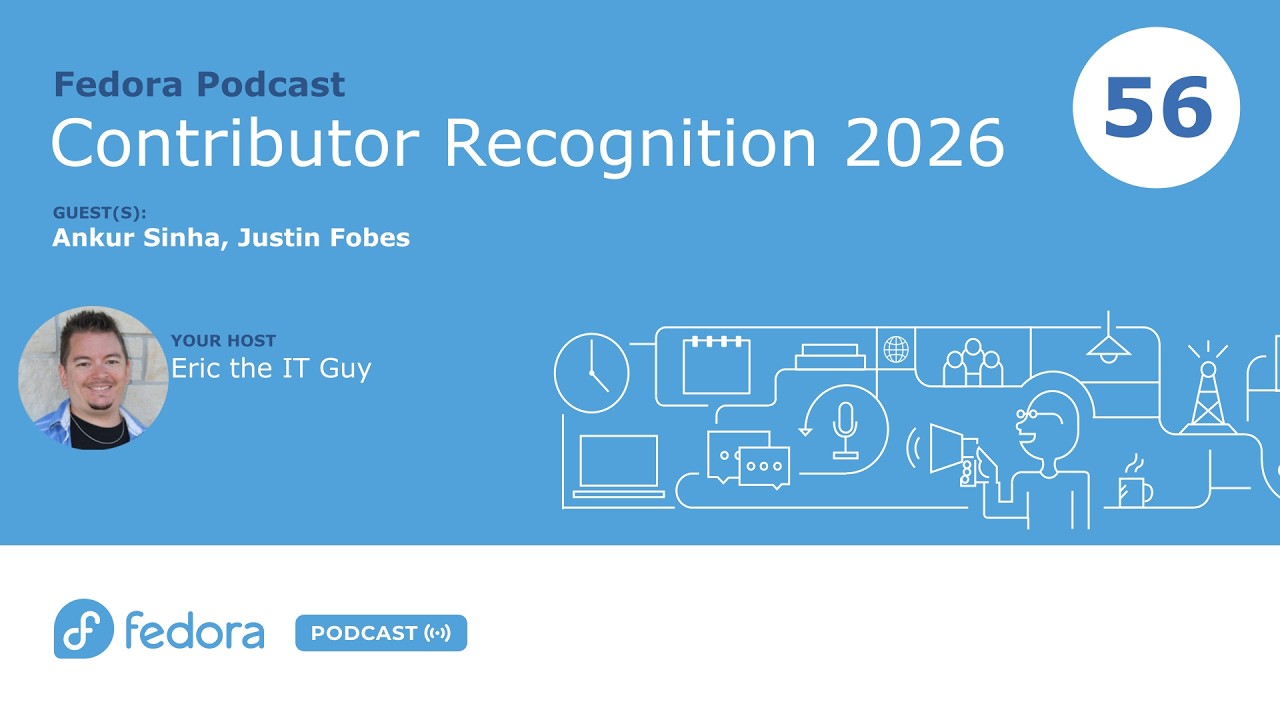
The Fedora Podcast 056 celebrates the 2026 Contributor Recognition Program by honoring Justin Forbes and Anorha for their exceptional service within the community, a selection process driven entirely by peer perception rather than quantitative metrics. Both recipients were surprised by their nominations at Flock to Fedora, underscoring that recognition is based on how others view one's contributions. Justin Forbes has been maintaining the Fedora kernel since 2012, focusing heavily on security updates and fostering direct relationships with upstream developers like Linus Torvalds; he prioritizes critical fixes that prevent data loss or unauthorized access while advocating for a "Fedora first" philosophy even when it conflicts with downstream distributions like RHEL. Anorha serves as a maintainer for approximately 400 packages and leads efforts to integrate newcomers through the Fedora Joint SIG, which has shifted its focus from assigning technical tasks to fostering social connections that help new contributors feel welcome without overwhelming senior members.
The discussion highlights how academia relies heavily on open-source software for experiments and data sharing under the "open science movement," a trend facilitated by NeuroFedora's initiative to simplify complex neuroscience packaging for Fedora users. As Fedora has evolved from a bleeding-edge distribution into a stable platform suitable for daily use, it is increasingly adopted in universities and research institutions where its DNF/RPM ecosystem aligns with supercomputing infrastructure; this adoption extends to supporting AI/ML workloads through specialized SIGs despite the significant compute resources required. The podcast emphasizes that scientific computing relies on open-source foundations like curl and Linux, making Fedora an essential tool for researchers who need reliable environments for collaboration and validation of results according to FAIR principles.
For aspiring contributors, the episode offers advice centered on finding a personal passion within the project rather than rushing into tasks or fearing imperfection, noting that every team needs help regardless of skill level. Volunteers are encouraged to engage in communication channels, join the Join SIG, and understand that meaningful contribution includes support and mentorship alongside code commits, effectively debunking myths about Fedora being too stable for new input. The segment concludes with a mention of handcrafted recognition awards sent from the Nairobi Linux Users Group in Kenya before Eric thanks his guests Justin Forbes and Anorha as the 2026 winners, announces future nominations scheduled for April 2027, and invites listeners to submit topics via Matrix or direct contact.
Read the full video transcript
Have you ever wondered what it actually
takes to leave a lasting mark on the
Fedora project? Every year, the Fedora
Contributor Recognition Program shines a
light on the people doing exactly that.
Welcome to the Fedora podcast, and today
we're going to be talking about uh the
2026 Fedora contributor recognition
winners.
[music]
>> [music]
>> Hey there and welcome to the Fedora
podcast. I'm your host Eric the IT guy
Hendricks and this is episode 56 of the
Fedora podcast. I'm really excited
because uh over the last few years
Fedora has introduced a contributor
recognition program. This is a chance
for the Fedora project to kind of give a
hat tip to those that uh pun intended uh
to those that are actively contributing,
those that are working on the Fedora
project day in and day out, whether or
not uh they're a part of uh working on
Fedora as a day job. Uh but the idea is
uh to recognize people that uh are part
of the the project who work hard and
don't necessarily get a lot of
recognition. We work in open source. we
work uh a lot of the work that we do is
free. Um so the recognition program was
instituted uh to kind of uh kind of just
give some recognition where recognition
is due. You don't have to be a developer
in order to win. Uh from what I
understand nominations open up in April,
they close in late May. And uh the
winners are announced at the Flock to
Fedora event. So, uh, just a few weeks
ago, Flock was was live and in person,
and the, uh, the winners were, uh, uh,
the winners were announced, and I've got
two of them with me today, uh, to talk
about, uh, what they do with the Fedora
project, what it was like to win. Um,
they can talk about all the cash and
prizes. Oh, wait, no, no cash and
prizes. Oh, sorry, no cash and prizes.
But, uh, the these two gentlemen do a
tremendous amount for the Fedora
project, and I'm really excited to have
them on the show. So, with me first uh
I'll introduce uh Justin Forbes. Justin,
welcome to the Fedora podcast.
>> Oh, thanks for having me.
>> Yeah, I'm glad uh I'm glad we could set
this time aside and uh in the green room
uh before the recording, we we'd already
established that you're coming back on
the show again uh to talk about the
Fedora kernel. So, congratulations.
You've already volunteered for a second
one. [laughter]
>> So, I always ask
>> There you go. So, I ask I always open
with the same questions. Who are you?
What do you do? What do you do for
Fedora? And what do you do for fun?
>> Ah, I'm Justin Forbes, a Fedora kernel
maintainer for very, very long time now.
I think since 2012.
Uh, before that, I did Fedora
virtualization. Before all of that, I
ported Fedora to X8664 for Fedora 1.
[snorts] So, I've been involved uh with
Fedora pretty much from the beginning.
uh took a little break in the middle to
do a different job. But
um
so that's what what I do for Fedora is
uh all the colonel maintenance and then
uh occasionally chip in other places
where I can be of assistance. Um I'm
part of the security SIG. We're talking
now about perhaps trying to get
representation on on DRO list there. Red
Hat has reputation,
but that doesn't always work out uh with
the volume of CVS and things we have now
as far as getting Fedora maintained and
and those bits. So, we have to to try to
get our own representation, but that
also comes with we have to have
processes because uh Fedora is
completely open, right? Uh I did a build
last night that I I couldn't put the
patch. I've seen the patch, but I
couldn't put the patch in the, you know,
in the kernel and do a build until it
was public because
>> uh everything, you know, our
infrastructure is designed around that.
And I think that's a wonderful thing. I
don't want to change that, but we do
have to have some processes there uh to
to make that so that we're not breaking
embargos or doing things like that.
>> So, uh for not Fedora, um I now live on
a ranch in Colorado. We've got horses
and and those things. Uh obviously music
stuff. Uh I do a lot of music stuff.
Still skateboard and snowboard and ride
motorcycles. [laughter]
>> Oh gosh. Love it. A little bit of
everything.
>> Little bit.
>> Oh, awesome. Glad to have you on the
show today. And uh my my second guest is
uh Anker. Welcome to the Fedora podcast,
my friend.
>> Thank you so much for having me.
>> Yeah, it's great to have you here. And
uh I'll I'll start you off nice and
easy. Uh I I'll give you the same
questions I gave Justin, so you kind of
got a leg up. You you got to hear his
answers and and plot your own. But uh
>> tell us a little bit about who you are,
what you do, what you do for Fedora, and
something you do for fun.
>> Um right. Um I'm Anorha. Um
>> I'm not I've never actually worked in a
job that's paid me to work on Fedora. Um
I'm an academic by training. I work at
University College of London. Um so I'm
it's more to do with the brain and
neuroscience and building models. So I
do write a lot of software but all of it
is in the scientific domain. Um for
Fedora at the moment I am a package
maintainer and I do I try to help with
onboarding with the Fedora joint SIG
which I think we'll speak a little bit
about later. Um I'm also on the code of
conduct enforcement committee. Um which
is not the best job to do but is a
necessary job that we have to do. Um but
I mean I haven't been around as long as
Justin. I wasn't around for one but I've
been around I think [laughter] according
to my fast profile this is my 18th year.
Um and I've sort of dived into
everything. I've done a bit of design.
I've done marketing. I was an ambassador
back in the day. Um, I've dabbled with
infrastructure.
So, yeah, I've sort of been everywhere,
which is why I I know so many people all
over Fedora and I try to act like a hub
where I can connect people
>> and so on. So, that's kind of my role in
the community. You stick around long
enough, you know enough people, and then
you can kind of link people together and
get them to do things.
>> Um, yeah. Um, for fun, well, I I'm not
an adrenaline junkie, so I don't
skateboard and I don't used [laughter]
to ride a bike when I was a student. But
but that's dropped off now. Um I I do a
lot of reading. Um I'm in London, so
lots of shows, lots of gigs. Um lots of
food. I'm a massive foodie. Um which
gets hard as you get older because it's
it's hard to keep your health in shape.
>> Um [snorts] yeah. Uh play lots of DND,
goss, all that sort of stuff. Yeah.
Yeah. Lots of things. Yeah.
>> Well, awesome. I'm glad to have both of
you on the show. We we did have uh bit
of a scheduling mixup. Uh so Fabio
Valentini was supposed to join us as
well. Uh hope hope uh hope Fabio's doing
okay. U and uh Fabio, if you're if
you're listening to this, uh feel free
to reach out and we'll we'll get you on
the show at some point. But uh in the in
the meantime, um we kind of talked about
what the program is. Uh, and I' I'd kind
of like to hear from both of you. How
how was that process? Did did uh were
were you notified that you were
nominated? Uh, how did you find out that
you won? Uh, Aner, just kind of why why
don't you start us off and why don't you
tell us a little bit about what that
process looked like?
>> Um, no. Um, I don't know about you,
Justin, but I had no idea that that we
were um that we were in the running or
that we had been selected. um we were in
the crowd at Flock and they said, "Oh,
we're going to do the recognition
program next." And our names came up and
that's that's all we knew about this.
So, it was it was a very very uh
pleasant surprise. But yeah, um no uh no
prior notice. Um and um I've only
managed to attend flock last year and
this year because for work commitments
and things I haven't managed to attend
in previous years. So I don't know how
the organizing committee ensures that
people who are selected do turn up and
flock and things of that sort. So so
there's clearly some some stuff in the
background that that we're not privy to.
>> So I want to call out the irony here
that for an open source project that is
as transparent as Fedora project for
this entire process to go through and
for neither of you to have any idea this
was going on. [laughter]
>> Dustin, how about you? Did did you have
any idea this was happening?
>> No, I had no idea. I had no idea it was
nominated. Uh, in fact, I was standing
outside and I was talking to Adam. I was
standing outside the room before and I
like Adam's on the committee. Uh, but I,
you know, and I was telling him I wasn't
sure that I was going to go in because I
had some colonel stuff that needed to be
dealt with. And so he didn't say, "Yeah,
you should probably go in," or anything
else. uh which he didn't know who won
either. Uh you know, he just isn't on
the voting committee. But yeah, so I had
no idea I was even nominated and uh was
quite surprised. I I have this I have
this uh philosophy that nobody should
know who I am. And the reason that is is
because nobody cares about the colonel.
The colonel is not something you
interact with individually. Uh and so
nobody should be looking for me unless
something's broken. which means the
fewer people who know who I am, the
better I'm doing my job. And so
[laughter]
anyway, I guess that that changed all of
that, huh?
>> Yeah, you're you're no longer in the
background. And I I I started out trying
to say, well, no, no, no, people should
know who you are and like trying to
reaffirm your your belief, but at the
same time, it's like a former systems
administrator. If no one was talking to
me, it means that everything was running
fine. And I was like, oh, but I I
interact with the colonel. No, I
couldn't even tell you what my Fedora
server home lab systems are running
right now if I'm being completely
honest. So, I I tried to debate you on
on whether or not people should know who
you are, but it it Sorry. [laughter]
No, they like I said, they really
shouldn't. Uh, and that's been my
philosophy the whole time. As long as
the better job I'm doing, the fewer
people know who I am. So,
>> so let let's let's talk a little bit. Um
actually quick question uh were you just
given a recognition or was there
recognition and kind of some
justification of of um you know
obviously Justin Fedora kernel
maintenance big deal. Did they say that
there was something specific or was it
cumulative um or just like here's here's
our group of winners?
>> There was a small little blurb um but
you know it was kind of a summary. I
think the people who nominated could say
why they were nominating and then they
they kind of put a little uh very short
summary there.
>> Yeah. Um I I I think the idea is because
Fedora is so large and so varied um we
we it
lots of people work in very specific
roles. Um so I think the idea is just oh
if if people have made whatever
contribution and people on the panel
think that these contributions are
important uh then that's sort of it
there no metrics behind any of this as
far as I know we don't we don't really
have any metrics in Fedora right people
are working on it but but there are no
metrics you're a contributor you're a
contributor there no metrics to say how
much you do what you do um yeah so so I
think the idea is just yeah um if people
have seen continue around and they think
what you do is important then you
somebody nominates you and then um the
panel goes through the list and selects
three people um I will point out that um
there's one rule which is when you do
receive recognition you don't you can't
be nominated for the next year I think
this is something this set at flock
because the idea is to spread um the
appreciation around and and not have the
same three people get it repeatedly sort
of
>> so Justin's plans to start campaigning
now for next year just not going to
work. [snorts]
>> I'm I'm not much of a campaigner.
[laughter]
>> I I think if that were the case, Kevin
would just get it every year,
>> right? He got it last year and he would
just get it every year because without
Kevin, we we don't function. So
[laughter]
>> there there are several people like
that.
>> Yeah,
>> there's Yeah. [snorts]
So, Aner, tell me uh what what was the
little blurb that was uh read off when
when you uh when you were recognized?
>> Um I don't I don't really think I
remember is probably more to do with the
joint thing because that is more the
public facing bit that I do. Uh because
package maintenance, as Justin said, if
you're doing your packages right, you're
not getting pull requests and bugs,
you're doing a good job. Um I think it's
a joint slig where I may interact more
with people and newcomers and our
creature candidates and stuff like that.
And so so that's kind of the human
facing side of things. So I would think
that is probably more that's is probably
better known as my contribution than the
400 packages that I now maintain
somehow.
>> Gosh.
>> Yeah. So so I think I think it must have
been something related to on boarding
and helping out newcomers and a bit of
mentoring and that sort of thing.
>> How about you Justin? Do you do you
recall?
>> Uh there was mention of the security
updates was part of it. Um, I don't
really I was so shocked um when I got
it. Honestly, it was kind of a blur.
>> Yeah.
>> Um, it was, like I said, I totally
didn't expect it at all. Uh,
I was nominated or anything else. So,
>> no. And and and we had to go up on stage
and and they gave us a few things and
yeah, it all went by very quickly
because Yeah, it was just Yeah.
unexpected.
Unexpected.
>> Your words are really cool though. Uh,
was it the mine? And I was pointing at
it before if you can see it in the
background.
>> Yeah.
>> Yeah. For for our audio listeners there,
uh uh there there's the fedora uh bird
on a little plaque. Um
he's got a name. I forget I forget what
the bird's name is. I should probably
know that. It's part of the marketing
and podcast 6. But uh
>> I mean what what I know is that these
came all the way from Kenya. So they
came from they were sent by the Nairobi
Linux users group
>> and I think they are hand cut into
metal.
>> Um so so um Benenit if I'm pronouncing
that correctly he sent these over and he
said we would like to sponsor
recognition program. So these all the
way from Kenya. Yeah. Which is really
really cool.
>> Yeah. It's it's it's beautiful. It's
it's uh bright shiny metal with uh some
kind of engraving on there. Yeah, I mean
these these are beautiful. So if you're
listening to the audio podcast as as
most of our listeners do, jump onto the
YouTube video and and scroll about, you
know, 20 minutes in or so, uh about 15
minutes in and take a look because it's
absolutely beautiful work. And if it's
if it's really handcarved, that's
handcarved, hand welded, whatever. Um
handmade. There we go. Um but it it
really is beautiful. That's that's
awesome to see. Um, [laughter]
uh, so I I want to kind of dive into
both of y'all's stories. Um, Ancher,
you're you're top of the list, so uh I
think I did these in alphabetical order,
so uh so no one gets any uh any extra
recognition, but uh so you you've
mentioned your work with the join. Uh
and so for those that have found the
podcast but haven't really found the
community, what does the join sig
actually do?
Um it's it's kind of I mean the label
gives it away. The idea is um Fedora is
really large and lots of teams have
various onboarding
um hopefully lots of teams have
onboarding systems um but every team has
their own system and um for newcomers
that are not used to going into an
environment where they don't know people
and trying to sort of for the lack of a
better term infiltrate a community. Um
it's quite daunting, right? Um
especially youngsters who are not used
to going out and speaking to people.
They are um they have imposter syndrome
and they are worried about asking silly
questions and so on and so forth. So
they don't they don't necessarily have
the life experience or the confidence to
go and just speak to somebody and say,
"Hey, I would like to get started." Um,
so the point behind the joint sig was to
have almost a protected space where
anybody that wants to learn about Fedora
and get started could turn up and we
welcome them. We now have a process
where we can open a welcome to Fedora
ticket for them which gives them some
highle information about the philosophy
behind Fedora and how it's organized. Um
and then they can just use the ticket to
ask questions and um tell us what
they're interested in and then we sort
of act as leers and we'll point them to
different parts of Fedora that they may
be interested in um and then they go on
and hopefully we speak to people in
these various teams. Um and as they get
more and more comfortable then they can
start contributing and hopefully become
long-term contributors. So the idea
really is to have a safe space for
newcomers
um and they can hang around there as
long as they need. There's no time
limit. We're not rushing them, but it's
it's just to make joining a new
community without prior experience a
little bit easier for people. Uh that
that's basically it. And then the
various processes which evolve depending
on feedback that we get and requirements
and you know postcoid so everything is
online pre-COVID we try to do more
things in person and so on and so forth.
But the systems are really just a way of
trying to achieve this protected space
for people. Um yeah that's really it.
And and so we keep trying to get more
and more um seasoned contributors to
just hang out in the channels because
somebody might turn up and say, "Oh, I'm
interested in this." Um and if there's a
community member that is already
participating there, then they can help
guide them and tell them where to go and
what to look at and how to get started
and so on and so forth. So it's it's
it's sort of a many to many mentoring
program if you will where people come in
and just speak to the whole community
and the whole community tries to help
them in there and they're starting their
journey pretty much. Yeah,
>> that's amazing. And as as someone who's
been around open source since as as a
contributor as a community member since
about 2015 obviously been involved with
Linux long before then but you know 2015
is kind of the semiarbitary point where
I just kind of said okay this is when I
started contributing. Um I I've been
around projects where you just walk into
the the room and it's it's like the it's
like the movie trope where you walk into
the room and everything goes silent and
everyone stares at you awkwardly. And
you you can even feel that even if it's
like a matrix room or or matter server
or something you join it's just like
okay um now what
>> having a join sig having a group of
people that are explicitly there people
that like like you said you you know who
people are you know you know the
structure you know who to introduce
people to. Um, it's it's a lot of fun
for for new people to come in and just
go, "Hey, hi. I'm I'm Eric and I'm
interested in XYZ." And having someone
like you step right up virtually or
physically and say, "Oh, you're
interested in that. Well, you need to go
talk to Joe or you know need to go talk
to Barbara or whatever and just just
make those make those people
connections." It it is so important not
only for the individual contributors,
but for the project itself. I think
that's one of the reasons why Fedora has
such a strong open source community, why
there's so much social engagement around
Fedora is because everything starts with
that foundation. Everything starts with
that joint sig and builds from there.
Being able to get new people engaged,
which takes load off of the more senior
people so everyone can kind of spread
the work around. And it's not just about
work, it's about the community as well.
I and I adore Linux. I mean, I've built
my career off of it. It's one of my
hobbies as well. I I love the kind of
kinds of stuff that I do, but I don't
stick around just because uh just
because I like the technology. Um I
could go full boore into into marketing
and not deal with the technology as much
anymore, but I stick around because I
love the people. I have friends that
date back 10 years. I have friends that
literally have changed the course of my
career and the course of my life. And
being able to continue to be a part of a
community like that is just so
empowering. So kudos to uh to you Anker
and to the uh to the joint sick. I I
love what you all are doing and uh I
think we're planning later on this year
on on having an episode specifically
about the joint sick. So might uh I
might uh I might shanghai you into that
as well.
>> No, that's great. Um yeah. Um so to to
add to what you said about the people um
traditionally the way Federa worked for
onboarding was we used to have something
called easy fix and the point of easy
fix was that everybody marks easy tasks
and issues and this static website got
populated every day and when somebody
came in and said hey I'm new how do I
get started u the response was oh go
have a look at easy fix and pick up an
easy ticket um And that works for people
who are maybe more technical and are
happy just to dive into code or issues
and so on and so forth. Um but I think
well my again we have no data on this
because we haven't really been gathering
a lot of data and it's hard to gather
data on human activity of this sort. Um
but my personal feeling was that lots of
people um they would address an issue
and
because they never really felt part of
the community they would then leave and
go elsewhere. Um so a few years ago we
we decided we wouldn't point people to
tasks at all. We would point them to
people and hope that they become friends
with lots of people. And if they become
friends with people, as you said, they
will hang around because even if they
aren't necessarily working on tasks,
it's just part of the day to log onto
the chat and have a good, you know,
chinwag with people and somebody else
comes in, just by listening and talking
to people, you you still pick up so much
information that you can then pass it
forward to the next round of newcomers.
You don't really have to do anything
technical, right? I mean a lot of fedora
community is not about doing technical
work. It's about helping people find
what they need to uh to do to do any any
task whether it's design or whether it's
package maintenance. So so now we don't
people come and ask us what's a task I
can start with and we say no no no we
don't want you to dive into tech. I want
you to hang out for a bit, get to know
people, um, and hopefully then you stay
long enough to find something that
you're already interested in, um, and
that you would do without being
resentful, uh, which is quite important
in a volunteer community, right?
>> Mhm.
>> Justin, have you uh, have you worked
with the uh, the join sig at all?
>> I have not. Um, I I
really just don't have the time. Um so I
try to we people who are looking to do
kernel work tend to come into the fedora
kernel channel directly. Uh and that's
great. So I I do kind of take time to
work with them and I like to talk to
anybody who wants to you know talk to me
at conferences things like that. Uh
certainly want to be welcoming but I
just haven't had a lot of spare time to
dedicate to uh other things at this
point. So, uh,
but I think it's a great program. Uh,
you know, it really is because you do
get people, uh, and it's it's always
been the case from the beginning of
Fedora. You have people come in and and
what do I do? How can I, you know, get
started there? And
it's daunting for [snorts] anybody. So,
having a group that that kind of guides
you where you want to go. Um, and then
you also have so many people who don't
understand that, you know, well, they
love Fedora and they want to, you know,
be a part of it, but they're not
technical. So, uh, how can you
contribute? I would say probably
>> more than half of the contributions to
Fedora are non-technical contributions
because, you know, there's a lot to keep
this community running to keep, you
know,
>> and
being able to point to somebody and say,
well, here, go over here and check this
out. I think that's a a great thing.
[snorts]
>> So you you you're you're less on the
front lines, but more that second tier.
You're you're one of the mentor types
that that Anker would say, "Oh, Fedora,
a colonel development." I I know just
the guy. Go talk to go talk to Justin.
>> Definitely. Yeah. Yeah. I'm sure we have
passed people on to the colonel mailing
list where they they've probably spoken
to Justin. [laughter]
>> We've definitely gotten uh several new
people coming in and interested in
helping out. I'm always happy to see it.
>> So, I had a very brief but very direct
uh experience with the uh with the join
sig. Um it was probably
it was spring of 2021, maybe late or
maybe very beginning of the year. So, I
guess that'd be winter of of 2021. Uh I
I volunteered.
I jumped into the join sig and was like,
"Hey, I I noticed that the uh Fedora
podcast hasn't really had a lot of uh a
lot of new episodes. Uh I' I'd be more
than happy to be a stand-in host or a
co-host or something." And within about
a month, uh the the entire program was
was uh I don't want to say mine, but
fell under my my purview there.
[laughter] You're just going to lend a
hand and all of a sudden they're like,
"Here, what can you do with this?
>> You need YouTube access. Here you go.
What what do you need? I
>> I think we're getting much better at
volunteering people to do things, which
is an important skill in the community.
[laughter]
>> It really is. It's It's one I've had to
master for sure. Uh not just in the
Fedora podcast, but as as a product
marketer as well. It's like, "Hey,
you're an engineer. How do you feel
about talking in front of people?
>> You're you're okay with it? Okay, cool.
You're you're coming on the show.
Congratulations." [laughter]
>> Definitely. Yeah.
But uh it I mean like I said mine was a
little unusual because I knew exactly
what I wanted to be a part of. I knew I
wasn't a developer. I knew I couldn't go
and and make changes to a kernel but I
can talk. Um I I like to talk maybe too
much but uh uh so it was it was really
it was it was really nice because I I
just jumped in the joint sig said hey
here I am this here's some of my work.
Is is there some way I can contribute?
Now, never in my wildest dreams did I
expect that all these years later that
I' I'd be one of the uh one one of the
hosts that kind of rotates in. But uh uh
but I mean that was that was part of the
joint sick. someone in the joint sick
knew um you know knew Matthew Miller who
was the Fedora project lead at the time
and and uh and you know just kind of uh
put me in touch with Justin Wheeler
who's been an amazing uh an amazing uh
contact to help keep the podcast going u
and it's it's so the join sig is really
really effective in what it does so once
once again congratulations Anker and uh
and to the entire join sig
Um, so I know that you've got uh Neuro
Fedora as well, but I want to jump over
to Justin for a minute. Um, you know, we
he said he only got about three hours of
sleep, so I I want to make sure we keep
him awake and engaged. Um [laughter]
uh so Justin, we we talked a little bit
about the Fedora kernel, uh but I I
think our audience might be a little
curious about what day-to-day kernel
maintenance looks like, especially as
something uh as critical as being the
upstream to enterprise Linux. I mean,
you've got CentOS, you've got re, you've
got some of the downstream clones. Um so
Fedora really leads the charge. So
what's the uh what's the day-to-day look
like?
Well, that that's one of the things I
really love about the Fedora kernel is
the day-to-day is different every day.
Um, I am reactive to what upstream is
doing. I'm reactive to what our users
are are seeing, what they're filing. Uh,
it kind of ends up I I couldn't tell you
what I'll be doing later today, much
less what I'll be doing tomorrow
morning. Uh,
and that's yeah, like I said, that's
that's a part that's interesting to me.
So we do we follow Linux tree and merge
everything is now maintained in source
git. We actually don't even do discit. I
mean we we have to do discit but we
automatically overwrite it every day. So
I do have to check and make sure
nobody's made any changes that you know
proven packager or something like that.
But uh we build from Linus tree every
day. Uh which is good. We get users out
there testing that. Um we also makes it
a little bit easier to find out when a
bug came in, right? Uh if
you go back and and here's every day is
builds.
Um so doing that and then Fedor ELN is
also part of that and that's the part
that actually does uh it's the same disc
getit but it's uh it's basically the
real kernel config uh built against you
know modern fedora eln [snorts] and so I
know I'm doing that every morning
>> [laughter]
>> um and then outside of that like I said
it depends on uh if if upstream is doing
stable RC's then I'm, you know, building
and testing those. Um, I'm, you know,
looking at bugs. Uh, every, every Fedora
kernel bug comes to me. So, uh, looking
at those, looking at updates to those
bugs, try and see, uh, if there's
something corresponding upstream that
that might explain those bugs. uh it's
and then you know I the nice thing is
because we don't have you know paying
customers that are you know well this is
a huge customer so even though this this
bug seems less important they've got a
whole lot of machines you I can actually
look at things and say well I I think
that this bug is important it's
affecting a large number of users uh or
you know this this bug maybe not
affecting so many users But it's a file
system bug where someone can lose data
that those things and I get to look at
them and say, "Well, this is what I need
to focus on right now. This is what's
important right now." Um, and I feel bad
because I wish I could, you know, fix
them all, but I can't. And as soon as I
do, more are introduced. So, you know,
[laughter]
that's why see, sorry.
>> No, you're fine. Uh, that that brings up
an interesting question, though. Have
you seen an uptick in the number of bugs
in CVE since uh everyone's favorite
topic AI is becoming more and more
prevalent? So [gasps]
CVEes are an interesting topic because
Linux Foundation became the CNA for
kernel uh was it two years ago something
like that and at that point um CVS got
assigned to a lot of things because uh
but but
yes there's CVE but there's levels of
CVES right
>> so you know we were going through
hundreds of CVEEs and that the nice
thing about it though, is they don't
actually assign a CVE typically until a
fix is in a stable kernel, which usually
means by the time a CVE has been
assigned, Fedora users already have that
kernel if they're updating regularly.
Um, that's great. That's fantastic. U
you know that yes, there's a lot of CVS.
It's a problem for rail because they
have to backport things, but you know,
for Fedora, usually we're taken care of,
so it's not a problem. What we have seen
with AI is people developing and
publishing exploits for these CVEEs uh
which
on the one hand I think is is highly
irresponsible
uh you know especially when you see them
at the bottom of it advertising their
security company or something like that
and it's why you publishing an exploit
here. Um but the other the flip side of
that reality is if you don't publish an
exploit um well someone else is going to
come back and do it probably anyway.
Like we had during the dirty frag stuff,
there was a a code path that Red Hat
found and you know had an exploit for
and [snorts]
we published the update without the
exploit and I believe I'm pretty sure it
was probably developed by AI internally
but anyway uh that the exploit was but
within an hour and a half or something
some other group had seen our patch and
developed a a exploit
and published
So, it's happening quickly. Uh, that
changes everything because when you have
CVEes but no published exploits, uh,
there are certainly a problem. You want
to get them fixed fairly quickly, but
users are less at risk. And now that
people are publishing these things with
exploits, uh, oftentimes, you know, a
patch is sent to the list and it's, you
know, Linus hadn't even taken it yet and
there's published exploits for it. Mhm.
>> That's become a huge problem. Uh so
that's
that's why I've spent long nights a few
times in the past couple months. Really
seems since about May, beginning of May
that all this really started. [snorts]
>> So
>> yeah, and then that seems to be when we
started to see a lot of these more high
severity uh CVES get published, the ones
that get goofy names and web pages and
that kind of thing. Uh seemed like
middle of May we had like three back to
back toback that were all kind of a
branch of the same the same general
exploit.
>> Yes. So the way that that um
the way that it works is usually I won't
push I will not mark a kernel as a
security
update for a regular update because
every kernel update is going to have CVS
but the CVS haven't been assigned yet.
We don't know what they are
specifically. So I I can't rate it. I
can't do anything else. Just assume
every kernel update is a security
update.
>> But with the ones with published
exploits, if there is a published
exploit out there and it's something,
you know, if it's a system crash, maybe
not so much. But if it's anything that
gives you local root or, you know,
privilege access, those types of things
are, you know, they have to be fixed
immediately. They can't wait. So, we fix
them. We push them. Uh,
if
and they're marked as a security update.
So if you're seeing something marked as
a security update that I've pushed out
for a kernel update, it means there's an
exploit out there.
>> Definitely. Yeah. Yeah. Bug fixes and
security fixes in just about every every
update, but if it's marked security,
then you know it's it's a big deal,
>> right? And that doesn't mean
>> there have been colonels that we've
pushed out that uh you know the security
the the CBES weren't published until two
or three weeks later and some of them
have been very very critical. Uh in fact
the the first what copy fail when it
came out we had already pushed that
kernel two weeks prior. So we had a fix
two weeks prior but you know the the
exploit hadn't been published yet
>> and so nobody knew there was that big of
a deal. [snorts]
That's so uh you you mentioned Lennus a
couple of times. Have you uh have you
met uh Mr. Torvaults?
>> I've met him. Yeah. I mean we uh he's
and he's actually sent us when when we
have when something comes in upstream
that he knows might impact us. Uh he's
sent he sent me email saying, "Hey, is
this are you aware of this? Do you have
any input on this?" So, uh, he's very
good in that regard, but he's a busy
man. So,
>> right.
So, what's, uh, what what does Fedora's
relationship look like with the
upstream?
>> Uh, not as great as I would like. And,
and when I say that, uh, we have a very
good relationship with with most of
upstream. Um, Greg
said, let us as things um, we've got a
lot of Red's got a lot of the upstream
maintainers. Uh but unfortunately we
don't get to push as many fixes upstream
as I would like to be able to. Um so
that's what I mean by not as well as I
would like. We we uh try to to stay as
close to upstream as possible. And so we
try to help out upstream in any way we
can there,
>> but uh for quite a while now it's been
pretty much just me. Um, so I've, you
know, not had time to to do as many push
as many fixes upstream as I would like
or or things like that.
>> So
if you're if you're in the join sig and
uh keep keep an eye out for kernel
maintainers. Sounds like Justin needs
some help.
>> Uh, we I'm getting some help. That's
actually wonderful that this is a fairly
newer thing. So Austo has been doing
some builds but has not been doing as
much with the community and bugs. uh but
now he's going to be doing a little bit
more of that and we have uh someone new
Charles who's actually been in Red Hat
support kernel support for a long time
and now he's coming over uh as a kernel
maintainer about 50/50 between re and
Fedora so
>> Oh cool
>> that's great because it's somebody who's
you know who's got debugging experience
in those things so we're getting help
but [snorts] yeah it's been several
years since I've had the time to to
really you know be able to debug in push
patches upstream.
>> I was I was going to ask what how do you
manage to go and leave if you are the
single point of maintenance for the
colonel? How does that work? Because
>> um I always have a laptop with me. So
[laughter]
>> that's not going Yeah, that's not going
on leave though. If you have to take
work with you,
>> right?
>> It's you know it's uh I I care about the
community so it's just kind of been it's
been that way for a while. Um, Austo did
step in. So, I I was actually out for a
couple of months, two years ago, because
I had open heart surgery
>> and, uh, Austo stepped up there a decent
amount. And then we had a couple of
other people who were helping out with
Rawhide, but
>> uh, general general day-to-day, if I go
on vacation or those things right now,
I'm kind of taking a laptop with me. Uh,
which is why I'm glad to have some
people coming in to help now. So,
Yeah, great questioner.
Um,
and so that that kind of brings up the
the flip side of of my previous question
of what what's what's your relationship
with downstream look like?
>> Uh, so I am on the rail maintainer team
now, but
I sit in meetings with them. Um, you
know, I I certainly will give input on
stable rail things as they are, but
really we're once it branches to CentOS
stream, um, it's kind of no longer my my
day-to-day responsibility. So, unless
someone asks, uh, but everything
happening in Rawhidede, uh, ELN colonel
arc, that is that is RE 11. So, we are
preparing for the downstream. We're
always thinking about, you know, how is
this going to impact the rail
downstream? Uh on on the other side of
that though, uh I've I've always said
that that kind of my job is to be the
Yeah. the one who looks out for Fedora.
So because we're a shared thing, there
there are, you know, sometimes things
that that would benefit Rail that
colonel maintainers want to want to
bring in that don't benefit Fedora. are
actively not good for Fedora. So, uh, a
lot of extra patching, things like that,
uh, that we just don't want to carry.
So, that that's kind of been my, you
know, yes, I want to I want to shepherd
for as well as I can as far as for real
11, but if it comes between the two, you
know, my job is to be the advocate for
Fedora. [snorts]
>> Oh, that's awesome. That's a great way
to look at it, too.
and being able to have that separation
of responsibilities sounds really
effective. Um, you know, conflict of
interest is too too strong of a of a
term, but you know, Fedora's goals and
RE's goals are ultimately different. U,
so it's great that you've got that
visibility, that pipeline of
conversation to the downstream, uh,
specifically RE, but uh, but it's also
nice that, you know, you're you're very
Fedora focused, Fedora first in a lot
of, uh, in a lot of ways. Oh,
absolutely. And and like I said, there's
there's always a way we can kind of work
around some things. Uh one of the one of
the neat things I have, so RE's got a
process where, you know, every every
patch has to be acted by uh other
developers and those things. Make sure
you get patch review and all those. And
that can take time. Um, for Rawhide
though, we're building every day and so
we don't necessarily have time to wait
for all those things when I've got a
build fix or security fix or something
like that that needs to go in
immediately. So I have a short circuit
which is great. I can I can actually tag
merge request in a certain way and we
don't actually build out of the main OS
build tree. We build out of this tree
called arc latest which is rebased every
day. and it is the OS build tree plus
any merge requests that have my special
tag on them. And so that way those
things end up in discit and they're
available to Fedora even though they
haven't been reviewed and merged yet. So
I don't have to wait around for process
there. So there's there's always ways
that we can accommodate both. It's just
sometimes we might have to have a little
bit of a compromise. [snorts]
>> Yes, sir. That's awesome. And I I don't
know about uh about Anker, but there's
no doubt in my mind why uh you've gotten
the uh why you've gotten this
recognition this year. That's a ton of
work and that's really amazing uh just
how much time and and energy you've
invested in Fedora. That's that's really
awesome.
>> It's it's critical work, right? For
sure. It is absolutely critical to
>> to everybody. Yeah.
>> Well, the Fedora community has been
great. I said it's been great from the
beginning. So,
it's I I feel a responsibility to the
community
and and I
I enjoy doing that, you know what I
mean? Uh
it it doesn't feel too much like work
because I'm doing it for the Fedora
community.
>> Totally. Yeah. Totally.
>> That's awesome.
So, uh, I want to jump back to you,
Ancher, because you you mentioned
Neuropodora, and admittedly, that's only
something I'm very tangentially aware
of, but I would love for you to tell our
audience a little bit about what Neuro
Fedora is and how it connects the
broader Fedora mission.
>> Well, um, it's it's just a bunch of
people that a bunch of package
maintainers that try and focus on
software for neuroscience and making
sure it works on Fedora. Um because when
it comes to open source, a lot of us are
aware of how
basically global infrastructure depends
on open source software, right? There's
a very famous XKCD post about all of the
software and a tiny little thing called
curl that's holding global software
stacks together. Um
but but I don't what's I don't think the
community realizes that it's not just
the software stack the scientific stack
that's used around the world is heavily
depend on open source software because
you do have proprietary tools let's say
something like matlab um but most
academics rely heavily on open source
software not just for uh the experiments
the analysis u the data archival and
sharing u but for collaboration etc etc
Right. Um because with science a lot of
the software is prototypes because it's
at the edge of knowledge. Um and these
prototypes need to be put out in the
community as open resources so that
other academics and researchers can use
them and improve them. So um so there's
a massive open science movement. They
don't because it came about after the
open source movement. It's not called
the free and open science movement. It's
just called the open science movement.
Um but it's becoming more and more
prevalent um because science like all
software should be free you know I mean
when somebody talks to me my my response
is well my grandmother should be able to
read the scientific result she doesn't
have to be an academic she should be
able to run my code she should be able
to validate um and it's it's really
important because if if somebody can't
validate a scientific result we don't
necessarily know that it holds um and
all of that requires so in scientific
terms It's called fair, findable,
accessible, interoperable and reusable.
That's the scientific kind of side of
open science. But all of that is goes
very well in hand with open source
software, right? Um so the point of
neuropedura is um because I work in
neuroscience, I'm aware of all of the
software. Um can we package up stuff
that requires compiling and complex
build systems so that users don't have
to do it? Um and with Python we try and
run a test suite to make sure that stuff
um just works on Fedora out of the box.
Um and then
the idea is a little bit to try and
leverage the Fedora community to because
the Fedora community is very very good
at talking about the philosophy of of
open source software and so I'm hoping I
can piggy back on that and increase
awareness about open science
>> you know building on open source
software. So that's where Neuroff comes
from. But at the technical level, it's
it's a bunch of package maintainers that
focus on neuroscience software. It's
like the Python ST, but instead of
Python, it's neuroscience. That that's
basically what it is.
>> That's really cool. So is is Fedora
being used in universities or research?
>> It's being used more and more. Yeah, it
is being used more and more. Um um
so not not like other areas u leader um
years ago because Linux for humans and
all the rest um but as Fedora has
improved and we focus more on making
ourselves um cutting edge rather than
bleeding edge and we've changed our
update policies to make sure that our
release versions are stable. You know
the workstation working group has worked
a lot to make sure that it's usable on a
daily basis for developers. Um, and so
that translates to being usable on a
daily basis for researchers. Uh, because
researchers, like a lot of developers,
don't have the time to debug and fix
their systems, right? They're overworked
and underpaid already. They don't have
three hours to debug an issue and figure
out what the hell's going on, right?
They need something
>> job is is physics or meteorology or
something, not not kernel debugging.
>> Exactly. So, so as as we focus on making
Fedromo usable that just that percolates
into the whole ecosystem anyway. Um, and
of course it helps that a lot of um
supercomputing infrastructure works on
either real or some gradient of real
right so um there used to be scientific
Linux and so on and so forth um and it's
all come together. So mo most research
infrastructure is part of the Fedora
ecosystem whether people realize it or
not. Um and so it's useful for people to
use Fedora as a workstations because
it's very close to the supercomputing
infrastructure that they didn't have to
move to because it's all DNF based and
RPN based and so on.
>> So it's it's really huge in science.
Yeah.
>> So Justin looks like you're about to say
something as well.
>> Yeah. So our our current FPL uh Jeff he
he was one of the very early adopters of
my trying to port Fedoral 1 D8664
>> and at that time he was doing research
physics and that's you know what it was
being used for uh I thought it was
incredible uh but yeah so it it's
interesting Fedora's been involved in or
the scientific community has been
involved in Fedora from the
And now it's a FPL. So
>> yeah. Yeah. And it's it's it's
attractive because people that
understand the philosophy behind open
science find Federal really attractive
because being open is front and center
for us, right? Lots of L institutions do
it, but we have a well recognized
reputation and trademark for being open
first,
>> right? And so that links in very
strongly to people that believe in the
philosophy of open science because it's
the same thing. It's a software we're
talking about scientific artifacts. Um
so we try and piggyback on that and
we're trying to work on it and we're
trying to talk to more people. Um and
and open science is luckily becoming the
default. So I expect more and more
scientists and academics to uh jump onto
Fedora as it becomes more and more
usable. Um
uh from from anecdotal evidence it's
either Linux or Mac. Um and now with the
Windows subsystem for Linux, people are
using Windows too. But most of these
tool require the command line. Uh which
is why Linux seems to be seems to be the
choice.
>> That's awesome. That's a that's an
interesting uh corner of the community
that I'm admittedly not very familiar
with. Uh I've I've worked for companies
that have an interest in in uh in
scientific computing, but uh not really
encountered it firsthand myself. So that
that may be a topic to dive uh more
deeply into on a on a future episode.
>> Definitely. Um I do believe there is um
a high performance computing SIG that's
very active now.
>> Mh.
>> Um because with AI you do need to
extract all the compute you can from
your piece of hardware rights are very
very uh computing intensive. So so
people have come together to make sure
machine learning models and LMS work
better on Feros. players and HPC SIG.
Um, so it' be really cool to speak to
them and the AI and ML SIG because they
all kind of linked in this requirement
to to extract every bit of juice you can
from your Federal Workstation.
>> For sure. So, uh, last question for you
both.
If you came across someone who is
considering giving their first Fedora
contribution, what advice would you give
them? Justin, we we'll start with you.
Um, it's really find something that
interests you. Uh, and then, you know,
when when you've got something that you
care about, you're passionate about,
whether it's packaging something new,
whether it's it's uh getting the word
out to people about Fedora and and doing
that or helping people on uh discourse
or mailing list or uh it's just you've
got to find something that that that
speaks to you. And once you find that,
uh, I would probably recommend going
through the joint sick because
[laughter] they can point you in the
right direction to to do what you need
to do there. But, uh, yeah, that's
there's some so many aspects to Fedora
that, uh, you know, if you want to
contribute, there's probably going to be
something that you like, you're
passionate about, that you can do that
can benefit Fedora.
>> Aner, same question.
>> Oh, yeah. I mean, I agree with
everything that Justin said. Um, I think
my um I think over the years my advice,
my first piece of advice is don't
there's no need to rush into it. Um, a
lot of people come in and there's an
expectation that in the first week they
have to have made a contribution. Um, I
I said no, there's no need for that.
Hang out, figure out what's going on. As
Justin said, talk to different teams.
just hang out in the channel, look at
the mailing list, see what's going on,
and that's when you really figure out
what you're interested in and what will
make you happy. Um, and the fun thing is
when you hang out for a while and you
actually speak to the people, you
realize that there's so many other
people that probably want to do what you
want to do, too. But because you're
volunteers, we prioritize
>> and we can't, right? So, a lot of people
are very happy to say to you, that's so
awesome. We would really want to do
that. we don't have the time. If you
would like to, we are here to support
you. Right? And so even without
realizing it, you already have a team of
people that are working on this thing
that you want to work on, right? And
then you have your tribe and you have
your group and and then it just becomes
a thing you just do every day. So
>> I I always like I said, I I don't want
people rushing into work and tickets and
bugs and no just go speak to people,
find your people, and they exist, right?
I mean, we know as Justin said, Fedora
is diverse. Um, you will definitely find
somebody who shares the same interest as
you,
>> right? I mean, I can say that. Yeah, I
can say that with a guarantee.
>> Go talk to people, hang out for a bit,
get to get to see how much fun things
are,
>> and then once you realize how fun things
are, it's it's no longer a task you have
to do. It's something you really enjoy.
Um, and you realize you don't have to do
it every day. You don't have to it's
it's not meant to be a daily chore,
right? You can do 15 minutes a day. You
can do 15 minutes a week. You can just
hang out in the channel and reply when
you can. Uh the whole point is to give
what you can when you can as long as you
enjoy it, right? So speak to the people
is what I always say. Just become part
of the family and then you're fine. Then
you're already a contributor. Even if
you just speak to somebody, you are part
of the group. Right? It's not about
actually having a commit somewhere.
That's not that's not what federal
contribution really is about.
>> I would also say perfection is the enemy
of good there. And for sure
>> for for people coming in who are afraid
to try to make their first contribution
because they're afraid it's not going to
be perfect. It doesn't have to be
perfect. Open source has always been
this way.
>> Yeah. You know, if you look at colonel
mailing list, which I spend a lot of
time on, you know, the number of times
that that people iterate a patch because
it's all about you you you send
something, you get feedback from the
community and then you you might you
might have to change your approach a
little bit, but that feedback is is, you
know, how you learn. So, it doesn't have
to be perfect. [snorts]
>> For sure. And and the the the thing I
would add to that as well is um the
these guys and so many others uh across
all of Fedora do such a fantastic job
that the the [clears throat]
common fallacy that I see is well look
how well Fedora is running. They don't
need my help. That is not true at all.
Um [laughter]
every team inside Fedora could use
additional help. We could always use
more ambassadors. We could always use
more people in the joint sick. could
always use more kernel maintainers.
Technology is becoming more and more a
part of our daily uh of our daily
existence. U and with that the velocity
is increasing, the amount of security
threats are increasing. Uh the need for
good documentation. Um and and one of
you I think it might have been Justin
mentioned that over 50% of commits uh to
the Fedora project have nothing to do
with code. Um, so if you're u heck the
the Fedora podcast team could use some
help. Um, every team within the
community could use some extra help. So
don't don't talk yourself out of doing
something conceive conceivably dangerous
or risky and and getting involved
because there there is a place for you
in inside of Fedora. There there always
will be. Um, people need vacations. I
would love to send Justin off on a trip
at some point uh where he didn't feel
like he needed to get his laptop out of
his suitcase.
So there there's always a need. So don't
uh don't talk yourself out of doing
something for Fedora just because you
think that your your skill set isn't
needed. In fact, that's one of the
beautiful things that makes Fedora as
amazing as it is is the sheer volume of
people spread across the globe from
different backgrounds, different
upbringings, different skill sets,
different experiences. That's what makes
Fedora, not not the kernel. Sorry,
Justin. Not not scientific workloads
that are being run on top of it. U but
it's it's the people. I mean, that's
it's the people that have gotten me to
stick around over the last few years. U
it's it's why Justin's been around for
what 18 years? Or no, Anker, you said 18
years. Justin uh Justin's work on Fedora
kind of predates Fedora itself in some
ways. So just uh just jump into the join
SIG, find a place to to plug in and and
become a part of the community whether
it's 15 minutes a week, 15 minutes a day
um or maybe uh maybe a few hours every
other weekend. I mean more or less
that's that's kind of my contributions
is uh I I spend a couple of hours a week
uh on the Fedora podcast whether it's
planning episodes or like today we're
recording and publishing episodes. Um I
I I in I inject the time when I can. Um,
and you know, personal admittance here.
Um, the last couple of months have been
kind of rough. I, uh, I had a short-term
contract that ended up going for a
little over five months, and when that
contract ended, uh, I unfortunately
didn't have anything lined up. So, I'm
kind of in the job hunting, uh, mode
right now. And guess what? Um, we're
we're a few weeks overdue for an
episode, and I apologize for that. But,
no one's fired me because it's it's all
volunteer. We all work on Fedora when we
can. uh th those of us that are are are
strictly volunteers. Um if it's in your
job title, like Justin, it's a little
bit different, but uh you know, like an
you said, you're you're an educator. Um
so I I imagine finals week, you may not
do as much on Fedora work as as you do
other times of the year. So u you know,
it's it's one of those deals where it's
volunteer what you can when you can and
and it always turns out really really
well.
So, uh, with that said, uh, Justin
Anker, I'm really, really glad that the
the both of you, uh, could join me for
this. Uh, it was really enlightening to
see, uh, kind of spotlights shown on a
few different areas of Fedora, but also
get to celebrate your all's achievements
as well. And, and congratulations to
Fabio as well. Uh, again, hope you're
hope you're doing well. We missed you on
the recording today, but uh, yeah,
Anker, Justin, and Fabio were our
contributor winners for 2026. uh make
sure that uh I mean we've we've got in
10 months or so, but start thinking
about who who do you know in the Fedora
community and uh we'll we'll do uh we'll
do nominations again in April of 2027.
That'll be here before we know it. Uh
but u it's a really great program. So it
was great to get to highlight uh the
program and and its winners. U join us
again hope I think in two weeks. I've
got three or four different uh interview
requests out that I'm working. Um, so
we'll we'll be talking about some of the
infrastructure back end about Fedora.
Maybe uh maybe Justin knows a couple of
people on the colonel maintenance team
that might want to join him for for a
conversation about Fedora. You know, it
seems like every episode we think of
three new topics. So if you're if you do
work in Fedora and you have something
interesting to talk about, just reach
out to me on Matrix. There's the Fedora
podcast uh Matrix Room. Um or you can
reach out to me direct. I'm IT guy Eric
everywhere. Um always looking for new
content. It's it's always a struggle to
get the the topic, the person, and the
time all lined up to get the starters to
align. We just for this episode, we
ended up just kind of having to pick a
date a few weeks out and say, "Okay,
this is the date. This is the time. If
you can be there, great. If not, sorry."
But, um, and considering that we've got
about a six, six, and a seven hour time
difference between the three of us. So,
um, it was uh it was fun to try and
schedule this. So if you are interested,
please join the Fedora podcast matrix
channel, present a topic or or volunteer
your friend to uh to come and talk about
a topic. Uh I I always love when someone
volunteers a friend of theirs. U anyway,
this has been episode number 56 of the
Fedora podcast. I'm really excited to to
continue to do this. This is uh this is
my little corner of Fedora and I love uh
I love that I get to do this. I I get to
meet amazing people like Justin and like
Aner. So thank you all for tuning in.
Make sure to hit that like button and uh
subscribe if you haven't to the Fedora
YouTube channel. Uh also, if you're
listening to the audio version, please
go find the Fedora podcast on your
favorite podcast player. Take a couple
of minutes and just hit that fivestar
rating. Uh it's dumb. Uh it's painful, I
know, but it really really helps us grow
the show and grow our audience and find
more amazing guests to come on and
present even more amazing conversations.
So with that said, I've been your host
Eric the Icy Guy Hendricks on behalf of
my guests Justin and Ancher today
talking about the Fedora contributor
recognition program. We uh really glad
that you joined us and we will see you
again real soon. Thank you so much.