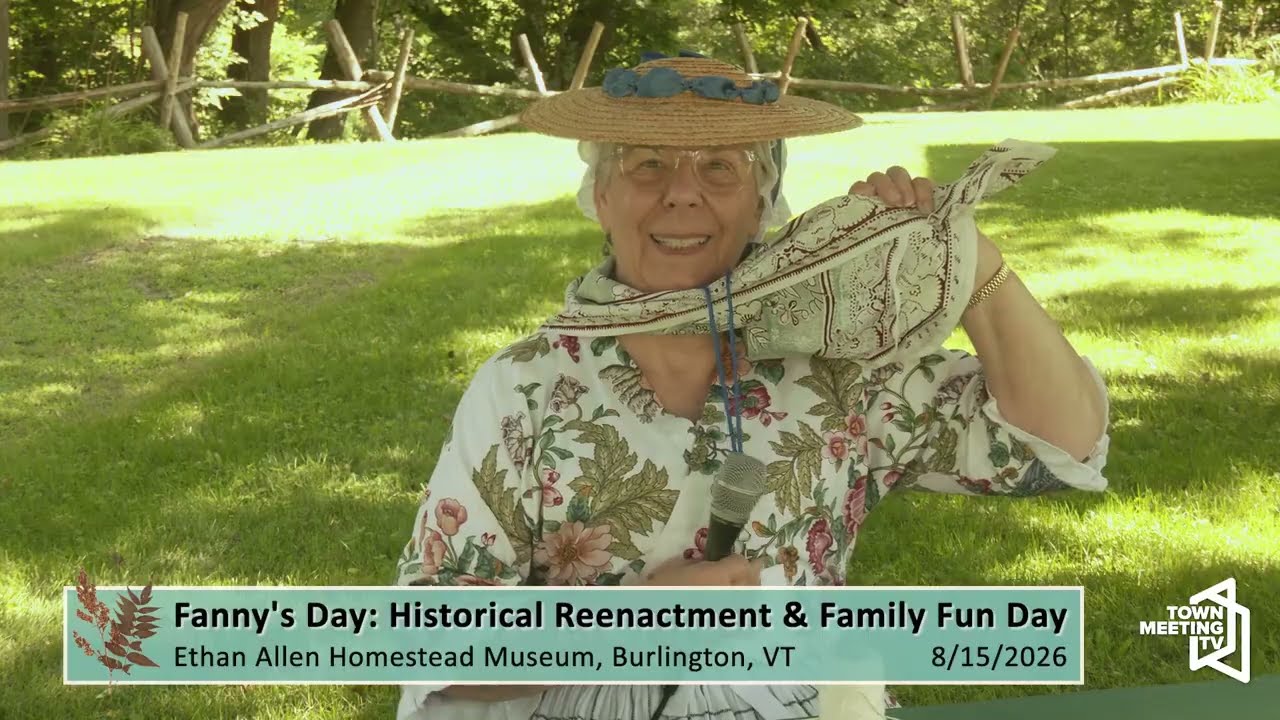
Fanny's Day: Historical Reenactment & Family Fun Day at the Ethan Allen Homestead
Watch on YouTubeVideo summary
The video documents a historical reenactment event at the Ethan Allen Homestead Museum known as "Fanny's Day," which celebrates the life and legacy of Fanny Allen, a pioneering botanist in Vermont. The day is filled with activities designed to immerse visitors in 18th-century life, including tours of an historic garden, demonstrations of traditional crafts, and the harvesting of flax. A central theme of the event is the exploration of daily survival skills from that era, such as growing medicinal plants, making clothing by hand without sewing machines, and utilizing every part of a plant to avoid waste. The reenactors emphasize that unlike modern agriculture, 18th-century farming was entirely functional, with gardens serving practical purposes like food production and medicine rather than mere decoration.
A significant portion of the presentation focuses on the intricate process of turning flax into linen thread, a skill that required immense patience and labor before the advent of industrial machinery. The reenactors demonstrate the various stages of processing, starting with harvesting the plants and moving through soaking them in water to rot the outer husk, a step necessary to break down natural glues. They also explain the difference between "tub reding," where flax is soaked in buckets, and "field reding," where it is left to dry on grass using natural dew, noting that the latter produces a stronger fiber. The process continues with combing and hackling to separate the valuable inner fibers from the woody straw, resulting in a material that was durable enough for farm work but rougher than modern cotton fabrics.
Beyond the technical aspects of textile production, the video highlights the social and cultural significance of clothing and color in the 18th century. The reenactors clarify common misconceptions about period dress, explaining that garments like stays were designed for support rather than to restrict movement or enforce modesty out of fear. They also discuss how women used loose-fitting shifts and adjustable gowns to accommodate changing body shapes during pregnancy or nursing, showcasing the practicality of historical fashion. Furthermore, the event explores the vibrant world of natural dyeing, where residents created bright reds, purples, and blues using plants like madder and lichens, as well as fermentation techniques. These colors were not just for beauty but served as a way to express personal wealth and identity in a society where clothing choices were limited compared to today.
The event concludes by reflecting on the deep connection between people and their environment in the past, where nothing was considered waste. Every component of the flax plant had a use: the seeds could be eaten or pressed into oil for cooking and health benefits, while the leftover husks were utilized for cleaning, stuffing mattresses, or even fueling fires. The reenactors stress that this holistic approach to resource management contrasts sharply with modern habits where much is discarded. Ultimately, "Fanny's Day" serves as an educational bridge between the present and the past, allowing families to appreciate the ingenuity, resilience, and creativity required to sustain life in the 1700s while enjoying interactive fun for all ages.
Read the full video transcript
You guys will be good at harvesting the
flag. That's what you're
folks in there to be able to talk to you
about living with Alan Fanny Allen. So,
a lot of really exciting activities.
>> Yeah. And we have a lovely garden as
well that's uh people are going to be
in. So, you can ask questions about
that, too, because Annie was one of
Vermont's first botist.
>> All right. Hi and welcome to the Ethan
Island Homestead Museum. This is one of
our free reenactment weekends. It's
Fanny's Day. Today we're going to be
having a host of really wonderful
activities at the museum. Kite, do you
want to tell us about them?
>> Yeah. Uh so today we have several things
going on including some craft tables for
18th century crafts and uh someone in
the garden because we have an 18th
century garden dedicated to Fanny. And
then we're gonna do a an harvest of our
flax that we grow here every year. And
that's going to be a crowd-pleaser for
sure.
>> Absolutely.
>> All right. So, come on by the Ethan
Allen Homestead Museum. We're happy to
see you.
>> Bring it up like this.
Come on.
It tells you all about
different flowers.
[music]
So, I do want you to check those out
before [music] Sam
Yes.
>> Yeah. 84.
>> Last time I was there, I gave someone
your phone number.
>> Okay.
If you can
Oh, yeah.
[snorts]
Bunny
and 11year-old son.
Shortly after, Fanny gave birth to
another son, Ethan Alonso. It was these
two babes, Ethan's surviving sons, not
his widow, who inherited the estate. And
women are at an enormous disadvantage in
um the legal system of the period. So,
women can't own property, they can't
write wills, they can't write mortgages.
and she returned to Westminster [music]
within a few years had met Jez Penman
who was a doctor in Westminster.
>> Fanny married Chavez Pennyman in October
of 1793.
Just as her marriage to Ethan Allen
helped Fanny retrieve her inherited land
claims, Fann's new husband, Chavez, took
an active role in helping Fanny earn her
right to the Burlington farm.
for my
spokes
today.
Thank you.
>> Yeah.
What's this called? a cheaply or
something.
probably
very
giant
snake goes up.
I'm excited.
Yeah.
like
Yeah. Yeah.
And I also
Okay. Do
>> you want to talk about whatever plan or
whatever you're doing?
>> Okay. You have like a 20 to 30 seconds
left. Ready?
>> Welcome to gardener
here at
this
peak of gardener season. I'm so glad you
right over there in our patch. And then
I will be talking after that a little
bit more about some of the things we can
do with the harvested flax. So right
here you're seeing it in its different
stages as we prepare to turn it into
linen thread. So we have some of our
harvested flax from last year's crop
which has been dried. We have some of
our scotched and combed flax which
refers to
beating the flax with what's called a
scutching knife to remove its outer
husk. And then you can see the more
pliant inner fibers that are being
revealed. And then combing removes any
sort of residue or extraneous fibers
that are too short or too broken to make
it into the final product. And finally,
once you have this consistency of flax,
it is ready for spinning into a
rudimentary thread or this is really
more of a rope. So it's all to do with
how finely you spin it. So, this is a
very useful rope. And you can see that
there's a rather large uh footprint for
a pretty small yield. This is the only
rope that we achieved from last year's
crop, but it's still better than
nothing. So, you can see how you can
imagine how 250 years ago, there would
have been considerably more flax being
grown to handle a family's daily needs.
>> You're welcome. And if you would like to
help me harvest in about half an hour,
we'll be meeting right over there.
>> Yeah, I'm thinking like right over here.
Sure.
>> Oh, kind of.
>> Sure.
>> This pot
right here.
>> And here is your table, sir.
Um hi. Uh I am working on an 18th
century craft or actually even earlier
called lucette. uses a uh lucet fork
which is it's it's almost a kind of a
crochet or or knitting where we're
making a loop and we go over the the uh
bring we bring our our thread around and
then we go over the loop again and we
are creating
a braided cord that can be used as a
draw cord in on my shift uh or on a
skirt. Um, so it's a way to uh make our
own clothing.
>> So [laughter] that's it.
>> So are you wearing anything that's
homemade at this moment?
>> I am wearing I have made all of my
outfit or most of it anyway. Um the uh I
have a shift underneath which has a
drawstring which is where something like
this would be used that tightens it
around my neck. Um and my uh my apron is
linen which we will be harvesting our
flax. Uh and that is you know all
handsewn. Um because we did not have
sewing machines in the 18th century.
They weren't invented until the 19th
century. So anytime you wanted something
it had to be done by hand. Uh and you
took very good care of your clothes and
you didn't just throw something away
when it had a hole or a worn spot. It
would have been patched and repaired and
then eventually cut down for perhaps a
smaller person or a child. Uh, and only
when it was basically down to shreds and
then it would be used to stuff a pillow
or you might use it to stuff your
pinball
because my clothing is all pinned
together. So, I carry a pinball in case
I lose any pins.
>> Okay. Couple of of uh
misconceptions that people have about
18th century dress is that it was very
uh uncomfortable. I I have on stays.
They are not tightened to the point to
give me a 18-inch waist because that
isn't going to happen. They are there to
support my my body and my and my bust.
Um and also to allow me to have things
tied around my waist without it being at
all uncomfortable.
The negief is not so much for modesty as
people think that oh my goodness you
know this puritanical got to hide your
body. This is to protect me from the sun
because you know there was no sunscreen
in the 18th century. Uh some women even
would have linen mits to cover their
forearms to protect them from the sun.
Uh again not for modesty because they
were covering up their body but for the
practical purpose of not getting a
sunburn.
>> Okay. Could you pull up the scarf just
so that I can see? I can't see the
difference between There you go. Okay.
>> Yeah. See? So, I've got my my shift and
the the uh my short gown underneath.
It's it's almost a kimono style and it
it just wraps around. That allows for
changing bodies. So, if a woman were
pregnant, then she just wasn't had it
looser. And then when when her body
slimmed up down a little bit, then she
would just tighten it up. And you didn't
have to have quite so many clothing so
much so many clothes because, you know,
you had to make them. Uh, and so that
allowed changing women's bodies, which
was very practical. And then instead of
having pins or instead of having buttons
or or ties, I'm I'm pinned together.
>> I see.
>> Um, which again allows me to adjust it
according to how I'm feeling that day.
If I'm a little bloated, it's a little
looser. Um, really practical.
That came out so wonderful.
>> Beautiful fascinating.
It's medicinal, but our favorite use
here is that um rub leaves on your skin
and it's a natural um insect repellent.
>> Love it. Cuz I know I've seen it. I've
seen the name, but I guess I never
associate with the flower. It's so cute.
>> We got to grow tanzy.
>> It grows really well here. I don't know
if it's just been a great year for it or
>> I'm excited. Is it a perennial or?
>> Yes.
>> Love that. We we we've been actually
having to cut it back because it's
>> it's growing so fast
>> and the and the squash was like peeking
out in in the pathway.
>> I know. I'm so excited about that.
>> Here for squash.
>> We have squash, too.
>> Some sassy squash at our house.
>> Sassy squash. I love it.
>> All right.
>> Can we?
>> All right. Where would you like me?
>> So, do you want to stay there or
>> It's up to you.
>> Do you want to show me something that
you're doing?
Um, yeah. I mean, I can just show you
the
>> Okay, so here's this.
>> Can you do that?
>> Um,
>> two hands, three hands.
>> It might be one of those two hands,
three hands, um, sort of thing. Um,
>> so,
>> but I already have some examples. So,
>> okay. So, what are you doing?
>> All right.
Okay.
>> All right.
>> Hello. My name is Heather Kenyon and I'm
one of the living historians here at the
Ethan Allen Homestead. This is what I do
for fun. I love recreating the 18th
century and li trying to live as close
to an 18th century person and sharing my
experience with others. Today at Fanny's
Day, I'm representing the garden in
making tussy musies, which are just tiny
little bouquets because you're living in
a world that is full of animal smells,
people smells, and sometimes you just
need
just something nice to smell, something
pretty to look at. And you can kind of
think of this as a mixtape that you
would give this to someone that you
love. Just a little thing of saying,
"Hey, I'm thinking about you." And this
is a token of friendship or love. And
it's just a great way to come kind of
full circle on people are people
wherever you are. And we all love
flowers.
>> So, what type of flowers do they have
here at the homestead?
So, we have a bunch of cultivated
flowers. Um, we have things like marold.
We have a lot of medicinal plants. They
didn't tend to do um in the 18th century
in a kitchen garden. You wouldn't have a
lot of uh flowers that were there just
to be pretty. It's a working farm. You
have to have mostly um have a reason to
be there. Also, we are at the Intervil,
which is a hot spot hot spot of
biodiversity. So, I'm using a lot of
wild flowers, things that are just
growing there. Doesn't need any tending,
doesn't need any attention. You're using
everything around you.
>> Okay. Anything else?
>> Not that I can think of unless you had
any questions.
>> Yeah, it's all right.
Are you out of time or
>> running?
This is the sun.
Charlie, you getting what you need?
>> Thank you.
>> My husband is going to be excited to
meet you, too. He's been watching Fox.
He's I think in the museum right now. We
have a friend with me from out of town.
So, he's kind of playing
four doors a day. We're open every day
for six months a year and we usually
have all of our flax out here. Right
now, it's out of order and the flax
break is usually right here. And every
day as part of the tours, people do the
process. And so we have the display to
help uh people figure out the different
steps as we go.
I like
most
people.
So, and then this is some of the we've
grown in the past years. And you can see
um some of this needs to be
>> welcome to the Fanny Island homestead.
>> Come on in.
>> I like
So you you start like this. You make a
loop
>> and then you put the long end through
>> and then you pull it like that.
Okay.
>> Okay. So here here we go.
Well, it's it's a it's a crochet
>> knot.
>> You want it to be able to
>> Okay. So, see how that
>> Yeah. A quick release.
>> So, just going to put a loop over and
then bring this
one and then bring that over.
the other way.
>> I think
I'm wondering if there's a
>> well
find a hole.
You want to see those?
>> I thought that it might have just been
used to turn into linen,
>> but it might well have been a deer.
>> Yeah.
>> Come on down.
You can add Oh, yeah. As many as you
can. The more you do, the more
>> organic.
>> Yeah, that's fine.
>> Oh, they absolutely are.
>> Yes. So, what you want to do is you want
to have some hand.
>> So, this this should be very easy to
pull up.
>> You want to grab about a handful by the
by the bottom
>> and they're not
it takes any force to pull it up.
>> It's not ready. So, go ahead and grab a
handful and just uh they're happy and
you're happy.
>> Just clear the tree.
>> There you go. That's how you know it's
ready.
And they fertilize.
>> Yeah. You can you can eat the seed.
>> Great. They're great for uh where was
this cooking?
>> Uh like healthy fat.
>> Yeah. So you can if you grind the flax
seed, you can press it into oil. And so
in the grocery store you can buy flax
seed or um people might put in their
oatmeal or their smoothies. You can also
buy flax seed oil.
>> Yeah. So I'll show I'll show you. So
this is um so the seeds come into the
pot. Yeah,
>> you can actually if you open up this pod
you find
>> cows are picky.
>> This is actually
>> Oh, really?
>> Nothing but
each pod has like five or six.
>> Is that a function of is that is that a
function of their dynamic system or is
that their personal
>> I don't know the anatomy of it but I
just remember that
>> correct. Yeah. So, so we grew the black
bear planted it in May or early May for
that purpose.
>> Um, we actually had a group of high
schoolers who came out and come out
every year and they do project.
>> Um,
>> from a ghost perspective, it's like
going out.
>> We have to
>> Yeah, cuz when we harvest it, we
actually pull it out.
um reenact
[laughter]
>> so linen was very popular
for the society for creativeism.
Yes.
>> Pleasure to meet you.
Asian reenacture.
Um so keep their body
but also naturally whatever you
basically
pre
1650ish
so I portray a German mercenary
and natural
fighting but we also have a guild of of
foresters. So people will go out
into nature and do like hike like
bushcraft survival. Uh we'll do hikes in
their carb. A lot of them make their own
garb. I am exceedingly lucky that my
wife's special interest is also making
is researching garb and she has made me
a an absolutely wonderful
right now.
multiple absolutely wonderful outfits
for
>> for my era, but like she made the shirt
that I'm wearing now which is also break
down.
>> Yes.
>> So, we're going to put this in a tub of
water and leave it there for about a
week and that will
um then we lay it back out dry it again
and at that point it sounds
>> Oh yeah. So when you bend it
even
>> and this is much easier to understand
when you see the plastic parted and dry
when we're done.
No. Okay.
>> I I am interested in
>> faction phrase called like a black
hair boy.
>> That is part of my problem.
>> I've always wanted to do everything.
Laundry like is I mean it kind of
naturally I'm
>> right. I'm not going to put it in the
washing machine. Right.
>> Exactly.
>> Yeah. So, exactly.
>> Yep. We got to make So, this is I'll
give you one.
>> Okay.
>> Exactly. Exactly.
>> Extremely easy. Um I always tell people
if you can make a fire, you can make
>> carefully. So, if you have enough ash,
if you have enough wood to make a fire,
then you'll have enough ash to do
laundry.
>> Um and then actually, so I make it here.
I'm I'm not that
I get to I our soap station you can see
right over there
but I think most of the time I
>> just
run a
lie and there's a whole um image display
in the house the the fat
>> you just need um you just need enough
light to do an back up what I
>> think that will the costic the alkaline
nature of the lie will go a long way
>> people have known you can eat so you
don't even need the soap
>> the oldest recorded evidence we have
>> I make my own soap
>> oh wonderful what kind of
German
uh deer fat. Um
>> olive oil on its own to make like
>> No, that's I haven't I haven't yet
gotten into I haven't yet branched out
into the um
>> Charlie, did you want to come see the
rippling?
>> I'm very I'm showing it off right here.
>> How little I can do to get things in
between.
>> Yeah. Like I'm interested in like just a
ly rinse and then just the the graphic
which goes a long way too.
>> So when you're done rippling it, where's
it going to go? Yeah. Very good. Except
for you want to make sure all the seeds
are off. You still see a few.
>> You can pick them off by hand if you
want.
>> Yes. And also the um the
>> Let me know when you're ready and I can
tell about
>> Yeah. So that's that's what that's
about.
thing is that
>> I'm going to talk about the rippling.
>> It's not just It's not just the sun.
It's that the laying on the grass, the
oxygen comes up from the bottom. So,
it's a natural oxygen.
>> Okay. I guess we'll just
>> Very cool.
>> Yeah. And in a military,
>> I can pick it up if that's easier. Linen
is an antiseptic
>> and so
we are doing the next step after the
flax harvest and we are rippling the
flax.
>> So after the flax is plucked from the
ground we want to comb the flax through
this ripple comb. You want to
demonstrate?
>> Making sure that you keep your
>> And as we comb it through, all the seed
pods are going to pop off.
>> And then we're collecting the seeds
>> in this bucket right here. So these are
the seed pods. And people would do this
in the past because they wanted to use
all parts of the plant. So the seeds can
be eaten, the seeds can be pressed to
make flax seed oil. Um or you can plant
the seeds for next year's crop as well.
And um in the seed pods,
>> if you open up the seed pod, so here's
what an individual pod looks like. Um
and then if you open it up, there's like
10 seeds inside the pod. So then that's
what the individual seeds look like. So
you might be familiar with it at the
grocery store where you can buy flax
seeds or flax seed oil. And this is
where it comes from.
>> Microbial indigo on the silk. your body
can just break it down and you won't and
the arrow goes in
the armor.
>> That's purple.
>> Okay. So, the next step with our flax
crop is that we are going to soak it in
water
>> because we actually want this to become
rotten. We want to rot it. It it'll
smell really bad. And the reason for
that is what we actually want are the uh
hairike fibers that are inside this
stock right now. Um, the stock is very
bendy. So, if I go to bend it, it's just
it doesn't break. The stock has a lot of
bend to it, and that's from natural
glutens. So, we want to break down the
glutens by soaking it in water until
it's rotten. And then we're going to
pull it out of the water, dry it out,
and then um once it has dried after
being rotten, that when you bend it, it
will snap and the husk will break open
and we'll be able to get to the hairike
fibers that are inside. until synthetic
dye being
>> and then those hairike fibers are what
we're going to spin into linen thread
and that linen thread could eventually
make a linen shirt like this one
compartment.
>> So is there something you want to show
them over here?
>> Yeah, I can show you the process over
there.
>> Moving.
>> Okay. So after the toe has been ready
and dry, we've got to get out
the straw portion.
um the hard woody portion of the fiber.
This comes off, but you doing this by
hand is not very feasible. So you got
your hackles. This is not a torture
device. You would come and
kind of comb this through and this takes
out.
And now you see the fibers.
And
this is what you'd spend a lot of time
doing
over
and over
until you get
your sketch effects
like this. Um, we if you've ever heard
of like a tow headed child or something
like that, this is what we're we're
talking about. It's It looks a lot like
hair.
I'll give some examples here.
>> Yes.
>> The hand around.
So, here's some examples of the flax
once it's been fully sketched and
hackled. And you'll see here that
there's two different colors and
textures. Um, this is because last year
we did half of our flax as a pool
redded, which means it's it's soaked in
a a bucket. Um, and then we did half of
it as field redded. Um, and field redded
means you just lay it out in the grass
and you let the natural dew of every
morning um, wet make it wet. And field
reading takes a lot longer, but it
actually comes up with a much stronger
flax product. So this is our field
redded flax versus this is our tubed
flax here. Yeah. So that's why we got
two different colors from it as well.
Bill, have you gotten to touch the flax
and feel what it looks like? Feels like
>> this feels smoother, too.
>> Yeah. And that could be um
>> This is the tub.
>> This is the field redded.
>> Oh, this is the field redded. Sorry.
>> And this is the tub redded. Yeah.
>> Okay. Feel
>> Yeah. The the tub rider feels smoother
as well.
>> And
>> it could be just because this one looks
like it's been more combed. That one
looks like it might need a combing. It's
still a little cuz we do we do bring
these out and the the field trip kids
get to do all this process. So sometimes
these get a little [clears throat]
>> worse for wear.
>> So this is more solid. You said it turns
out more solid.
>> It's supposed to be really strong.
>> Stronger.
>> Yeah. So it would um less likely to like
uh make a rip in your clothing. Yeah.
>> Yeah. So, more durable.
>> Yeah.
>> Okay.
>> And then this might be softer against
your skin, but you know,
>> might get a hole in it more easily. So,
>> yeah.
>> Sammy and Alex, do you want to feel what
the flax feel like?
>> So, this is the tubed flax. So, this is
the the stuff you just harvested would
soak in a tub of water until the husk is
rotten. And then um and that's going to
break down the glutens. So then we can
uh break the husk to get to the fibers.
>> This is field rudded. So it's just
outeten.
So that's why
>> every life
>> um Charlie I have some finished product
here I can talk a little bit about if
you're interested.
>> Okay.
>> Okay. Let me know when you're ready.
>> Go ahead.
>> Okay. So we have some finished product
of flax and I have two different
examples here. This is our handwoven
flax and this is our machinewoven flax.
So this is more like what you would see
in the stores today and it's a little
smoother. Um the handwoven flax is what
they would have been wearing 200 years
ago and it's a little rougher but it's
extremely strong. So, it was very
durable, really held up to the farm work
and the physical labor that people were
doing 200 years ago as well. Um, flax
was the most common product to make
cloth from. Flax and wool was pretty
much what everyone was wearing prior to
the 1800s. Um, because you could grow
flax in your backyard and you can grow
wool in your stables with the sheep. Um
today that flax and wool have been
replaced by cotton and cotton is the
most common uh cloth product. Um that
happened in the 1800s when the cotton
gin became really popular and that made
cotton uh a a crop that was much easier
and faster to produce. So now cotton is
very cheap and very common. But during
the time of the Revolutionary War,
cotton was considered a very elegant
fabric that was very rich and you'd only
have a few things like a a a
handkerchief or something made of cotton
to show off your wealth. Otherwise, you
were wearing flax.
>> Would you like to see the two different
kinds? So, the second plant you're just
picking that's eventually
>> didn't have cotton grow here. And then
you have the slave states. You would not
>> be dealing with them very often.
>> It broke all the way.
>> It still has the die bash bath on it.
They smell a little mushroomy.
They smell
>> good.
>> I have all the colors you get from this
mushroom and wool too.
>> Purple. Look at that.
>> I know that wool takes.
>> So this purple there
>> is not the snail purple. This is made
from fermenting lychen and ammonia.
>> Certain species of lychen give you this.
>> What is the material?
>> Uh wool.
>> Wool.
>> So here's the fleece. This came from the
same die pot, but this was an al this
was the alkaline finish to it. And this
is with an acidic finish. This was
treated with vinegar after. So you get
>> no doubt after you removed it cuz I'd
love to see these sheep out in the field
before. [laughter]
>> Yes. After a thorough scouring. And then
some of these other colors are other
lychans,
but they're not fermented ammonia. You
just boil them directly with um your
wool. It's kind of dyed in the wool. And
this is my exhaust bath. So after I got
all the nettle fabric dyed, I put in
this mortanted fleece into the exhaust
bath um to just soak up the last of the
color.
>> But it took 200
um 200 g of this dried mushroom to do
all that cloth and all this
>> fleece. It's quite a bright color.
>> You think people wore this bright color
often?
>> Um I I think you would have one thing
Hollywood does is rob us of a colorful
past. People had these plants. It was a
way of showing off.
>> Look at the movie Hamnit. you. She's
wearing Shakespeare's wife is wearing
>> pretty
good red. I mean, all of them in fact
were and that's probably from Rose
Matter.
>> Yes, exactly.
>> So, matter.
>> It surprised me. As red as her shirt, if
not lighter.
>> Uh,
>> and matter is a tricky one to get the
chemistry just right. If you go too hot,
you will burn out the color to a brown.
You need to have hard water with a lot
of calcium in it for to to get a really
good bright red. And to get that color
to imprint on something like linen or
cotton, you were probably treating it
with um slaked lime, animal dung,
aluminum acetate, oak galls, all in this
sequence to get a good mortant because a
plant fiber unlike wool does not lend
itself to taking out the dive.
>> So why would they bother going through
all that trouble? Why not just wear
drag?
>> Cuz we like colorful things. Okay. We
like color.
>> It didn't have any other purpose.
>> Yeah. Uh other than I mean why do people
make anything beautiful? Why has there
been decoration through all of human
history? And
>> clothes are precious. It covered you
know the the most precious um real
estate which is your body. [laughter]
>> So also we don't realize we're living in
a color saturated world.
In the past, um, if you go through the
homestead,
>> and that's not a poor house,
>> there isn't a lot of color.
>> No, there isn't.
>> And it's actually one of the few things
that you can also express yourself as a
person. Um, that and these clothes were
about the equivalent of a car in terms
of expense.
>> So, yeah, you could have a drab car
>> or you could have
a a little Well, you could have a
Corvette, you could have a Jeep, but you
know, do you want a red Jeep or do you
want a black Jeep? And I'm portraying a
person of kind of not
>> poor, but um not wearing the fancy
clothes of somebody with a lot more dye
and pattern and cuz I'm going to be
going in the garden and I might want to
wear something that hides the dirt. Mhm.
>> Um, and isn't the fanciest thing,
>> but I am still wearing a lot of color
cuz
>> it's one of the few things to beautify
your world um and express yourself.
There is no paint class. There is no
television and
um it's also one of the few ways you can
display your wealth
>> and it's easier and cheaper than
painting your house which that would not
have been painted.
>> Not at the beginning.
>> Not at the beginning. Um, your choices
were pretty much white or nothing. You
could do some stencil.
>> I'm going to argue about the white, but
that's okay.
>> You could do you I Sturbridge Village.
>> You could do red.
>> You could do red with iron oxide.
>> Yes, absolutely.
>> Not rose matter,
>> but there's not a lot of choices there.
No, there isn't. Isn't any really highly
painted thing, you would only have tiny
little amounts. So,
>> um, like just like you would do
embroidery with a little bit of silk
that you can afford,
>> with the fancy paint, you could do a
little bit.
>> Yeah. The white wasn't white. It would
have been more cream yellowed. They
didn't have non- yellowing pigments,
>> but the dioxide was
>> And you would do that in the inside
because it also makes it a lot brighter
in there. The the bedroom is a lot
brighter than the kitchen.
>> Yep. Yep. The um iron oxide would also
serve to polymerize the linseed oil.
>> So it would when you're putting that
iron oxide on with linseed oiler, you're
creating a very waterproof barrier. It's
an early polymer. And the iron oxide
gives you that beautiful red, but it's
also a catalyst for a more weatherproof.
>> The difference between the boiled
linseed or the linseed oil, never mind
whether it's boiled or not, except if
you don't use boiled, it will never dry.
Uh, and the linseed that we eat as an
oil. Isn't that something about when you
harvest it or
>> that I couldn't tell you
>> had to do with that or
>> uh, all I know is
>> supposed you grew it together. I forgot
which I got to look that up.
>> All I know is that the boiling process
essentially heats to start to break down
the linseed oil so that it will quickly
polymerize like that.
>> Yeah.
>> Yeah. I'm I'm not We haven't gotten to
the point that we've been worrying about
linseed. We've been just making the lid.
>> Yeah. Yeah. Well, I show the lin seed
and usually they're like, "Oh, it's so
light." And all of that and then, you
know, explain some of the uses for it.
>> Right.
>> Well, and there was a lot. I mean,
that's the other wonderful thing about
>> I'm still learning.
>> Well, I mean, the the crop itself um we
talk about like you want the fiber in
between, but the but the husk has lots
of uses
>> um from cleaning
um to stuffing your mattresses,
all sorts of things. Actually, nothing
was actually waste.
>> All the seeds.
>> Um so we can either use them uh to to
sew the following year so I can print
them again. Um or we can you can eat
them.