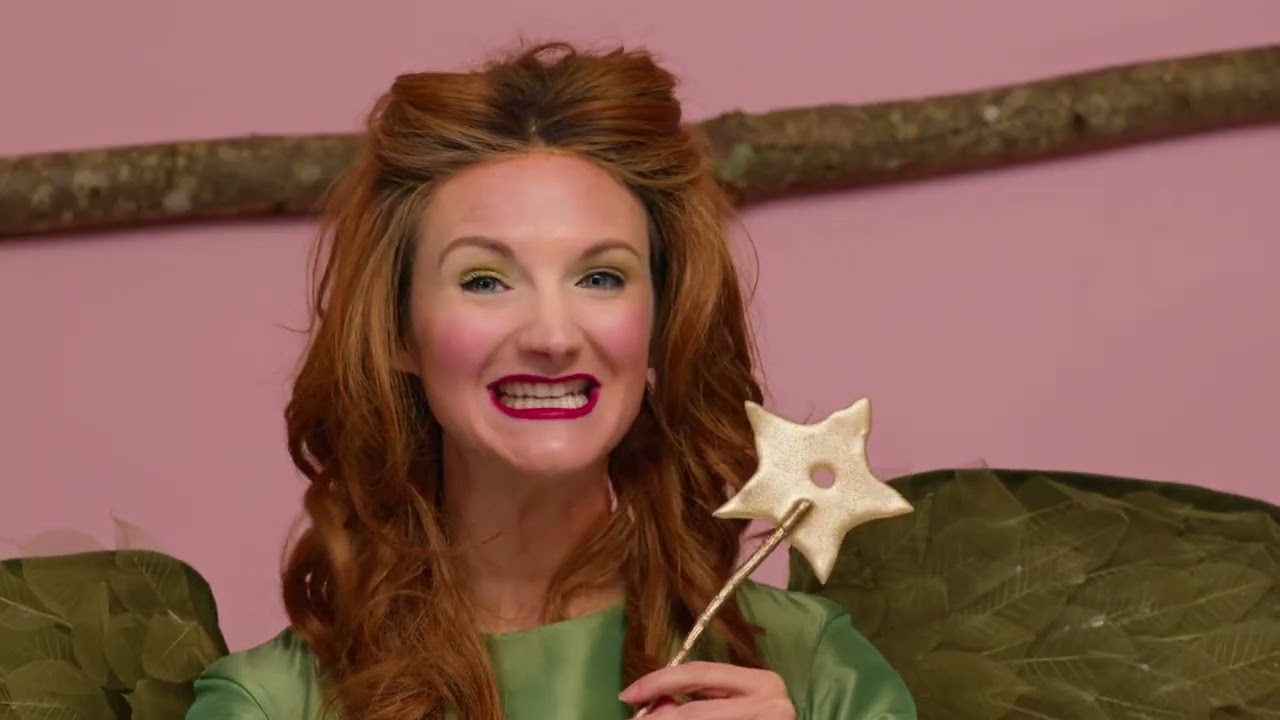
Video summary
The video introduces Fairy's House, a vibrant world where various animal friends gather to explore the joy of colors and play together. Upon welcoming viewers, Fairy highlights how nature is filled with diverse hues, inviting her companions like Chickadee, Monk, Bunny, Gnome, and Bee outside to observe their surroundings. They discover that elements in the natural environment, such as flowers, fruits, the sky, and even clothing silks, come in a wide array of shades including yellow, pink, brown, green, purple, blue, orange, and red. Through these observations, the characters learn to identify specific colors by matching them with objects around them, turning everyday moments into educational opportunities about visual perception.
As the friends continue their exploration, they engage in creative activities that further deepen their understanding of color theory through play and art. They hang up colorful silks arranged like a rainbow and sing a cheerful song celebrating red, orange, yellow, green, blue, and purple while expressing affection for one another. Later, the group visits other friends who are painting and drawing, noticing how they use different paints to create symbols resembling flowers, skies, oranges, and tangerines. This segment emphasizes that as children grow older, their drawings evolve from random marks into recognizable representations of things in their environment, illustrating a natural progression in artistic expression and cognitive development.
The narrative concludes with the friends realizing it is time to leave, marked by the cuckoo clock signaling the end of playtime. Before departing, they sing one final song about colors and reaffirm their friendship before promising to return soon for more adventures in Fairy Tales. The video then transitions into an educational explanation noting that recognizing colors serves as a primary visual marker for young children and is crucial for early childhood education. It underscores that while identifying colors might seem simple to adults, it represents significant milestones in language acquisition, memory development, and the ability to discern visual details effectively.
Ultimately, the story advocates for integrating color learning into daily routines without the need for formal quizzes or pressure on children. By simply pointing out objects like a red ball or a blue car during everyday interactions, parents can naturally help their kids build vocabulary and observational skills. The video suggests that drawing is another powerful tool for exploration, where initial scribbles eventually transform into meaningful images as children gain experience with the world around them. Through this gentle approach, learning becomes an enjoyable process rooted in curiosity rather than rigid instruction, fostering a lifelong appreciation for artistry and observation.
Read the full video transcript
Playtime, playtime.
Hello, I'm Fairy.
It's a beautiful day.
The cuckoo clock says it's time to play.
Let's find out if our
friends are time to appear.
Take it, Bee. Fly, fly.
Yes, you do.
I'm Monk. I can climb.
And you climb so well.
I'm Bunny. I love hopping.
Watching you hop makes me happy.
Gnome?
Where is Gnome? Where's my friend,
Gnome? Gnome is right here.
Welcome to Fairy's house.
Hello.
How are you today?
Thank you for sharing that with me.
Do you know what makes me happy?
Colors.
Do you like colors?
Oh, it looks like Chickadee, Monk, and
Bunny are coloring. Let's go see.
When I look around, I see so many
colors.
Chickadee color?
Yes, Chickadee. You're yellow. Yellow.
Oh, yeah.
Bunny,
your ears are pink.
And Monk,
your fur is brown.
Oh. Fairy?
Well, Chickadee,
my dress is green.
It's so fun finding so many different
colors.
Oh, wow. Gnome is wearing a lot of
different colors today.
What's your favorite color?
Oh, I like that color a lot.
Nature time. Nature time.
Box. Box. Nature.
>> Oh.
>> Let's go visit outside.
>> Please.
>> Of course, my friends. Let's go outside.
>> Nature is full of color.
All of the colors are found in nature.
>> Our basket of silks has lots of colors,
too.
>> Oh, silks.
Do you know what color
this is?
>> Yellow.
>> That's right, Chickadee.
Would you like to choose a silk?
Chickadee is having so much fun with a
purple silk.
>> Purple. Purple.
Purple. Purple.
>> That's right, Chickadee. Look all around
you and notice
the flower's purple and your silk's
purple.
They match.
>> Blue.
Blue.
Hey.
The sky is blue.
Just like my silk.
>> The sky is blue today. Sometimes it's
white. At night, it's black.
>> Oh, I love orange.
It's the color of my favorite fruit.
Um, is it a
No.
Um, is it a
No.
Can I get a hint?
You eat it and it's orange.
I know it's orange. Orange.
Orange.
Orange. Orange, orange, orange. Oh, an
orange.
I'm so glad I didn't say banana.
Well, I think talking about oranges has
magically made us
a snack.
Oranges? Thank you, fairy.
Oh.
I see one more color in the basket.
Do you know what color this is?
I know that one. It's red. That's right,
Monk. This is red.
Let's hang up our silks like a rainbow.
Ooh, lovely.
>> Wow.
>> I have an idea. Let's sing a song about
colors.
>> YAY!
>> I see colors. I see colors. What colors
do I see?
Red and orange and yellow and green.
Colors that we can see.
I see colors. I see colors. What colors
do I see?
Green and blue and purple, too. I love
them and I love you.
I love colors and I love you, too.
I bet our other friends would also like
to learn about colors. Shall we visit
them?
>> YAY!
>> Red and green and purple and blue. Let's
see what our other friends do.
>> Red!
>> Oh, they're playing so nicely together.
>> I think so, too.
>> Look at those toys.
>> Blue!
>> What do you think of those colors?
>> They're very pretty.
>> Yellow.
>> Yellow!
>> You see the yellow one?
>> I see it very well.
>> Very lovely.
>> Those are nice toys.
Oh, painting.
>> Painting very nicely.
>> Red!
>> You see it, yeah? You see the red color?
>> I see the
>> Oh, he's concentrating.
>> Yeah.
>> Nice painting.
>> It looks like a
symbol.
>> Like a symbol, yeah.
She's doing a great job.
>> Yeah.
Concentrating very hard.
Having fun.
>> Having a lot of fun. Oh, purple.
>> Purple.
>> Purple paint.
>> Yellow paint.
>> Hearts.
All happy.
Our friends are learning about colors.
>> My dear Fatty, may we please view an
uncle?
>> You want to see our friends explore
colors again, Bonnie?
>> Yes, quite.
>> Colors, colors, orange and lime. Let's
visit our friends one more time.
>> Red.
>> Oh, they're playing so nicely together.
>> I think so, too.
>> Look at those toys.
>> Blue.
>> What do you think of those colors?
>> They're very pretty.
>> Yellow.
>> You see the yellow one?
>> I see very well.
>> Yeah.
>> Lovely.
>> All painting.
>> Painting very nicely.
>> Red.
>> You see it, yeah? You see the red color?
>> I see yellow.
>> Oh, he's concentrating.
>> Yeah.
>> Nice painting.
>> It looks like a
symbol.
>> Like a symbol, yeah.
She's doing a great job.
>> Yeah.
Concentrating very hard.
Having fun. Having a lot of fun.
>> Oh, purple.
>> Purple.
>> Purple paint.
>> Yellow paint.
>> Hearts.
All happy.
Playing with our friends is so much fun.
Oh, it looks like Chickadee, Monk, and
Bunny drew pictures.
What did you draw, Chickadee?
>> Flowers.
>> Ooh, pretty.
Aw.
Wha-
What's that, Monk?
>> It's a blue sky.
>> Aw.
>> I know what that is. It's an orange.
>> Oh, my dear Monk, it's a tangerine.
>> It's clean-up time. It's clean-up time.
What a good idea, Cuckoo.
I see colors. I see colors. What colors
do I see?
>> Red.
>> And orange.
>> Yellow.
>> And green.
>> Colors that we can see.
Colors that can see.
I see colors. I see colors. What colors
do I see?
>> Green and blue and purple, too.
>> I love them and I love you.
>> I love colors and I love you, too.
>> We love you so, but it's time to go.
>> The Kika Clock says it's time to go.
It's been so much fun to learn and grow.
Thank you for coming. You're our very
best friend. We'll be back soon. You'll
see us again.
>> Here in Fairy Tales.
>> Colors are one of the first visual
markers that children pick up on.
Learning to label and identify colors is
a hallmark of early childhood education,
and it may seem simple or trivial to
adults, but it really signifies
important milestones in language
acquisition, memory development, and
visual discernment.
Labeling colors that you see with your
child is a great way for them to pick up
on learning colors. You don't
necessarily need to quiz them, but just
you know, oh, can you pass me the red
ball? Or look at that blue car.
Drawing, as they get a little older, is
another great way for them to explore
colors. At first, your child will just
enjoy the cause and effect of making
marks on paper, but as they get a little
bit older, they'll start to resemble
things that they're seeing in the
environment.