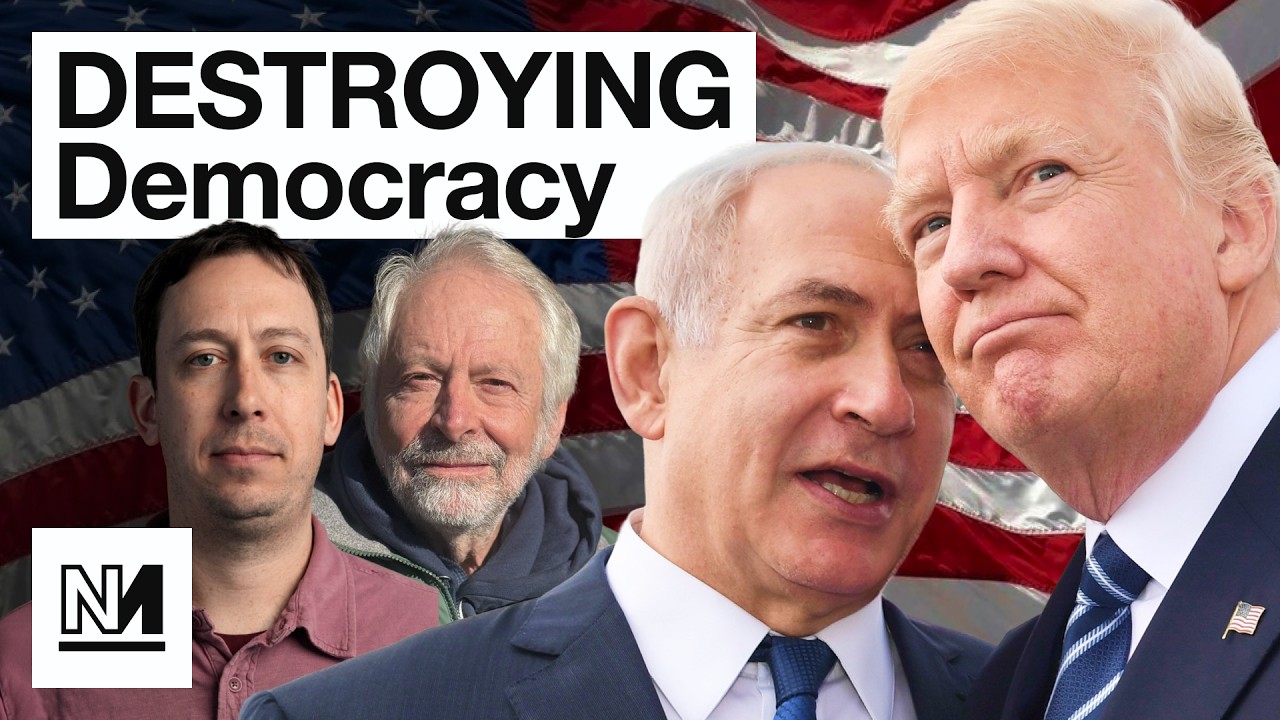
EXPOSED: How Israel’s Lobby Captured The US Government | With Eli Clifton & Ian Lustick
Watch on YouTubeVideo summary
The video introduces a new book by Eli Clifton and Ian Lustick that investigates how Israel's lobby interferes in US and British politics through groups like AIPAC, effectively subverting national interests to serve the Israeli state. The authors distinguish this organized lobby from American Jewish communities, citing polling data that shows Israel is a low-salience issue for most Jewish voters while noting that the Republican party has become disproportionately pro-Israel without a corresponding shift in voting patterns. They argue that the lobby conflates criticism of Israel with anti-Semitism to deflect scrutiny, a strategy they claim is becoming desperate as public support wanes. Unlike traditional foreign lobbies registered under the Foreign Agents Registration Act, the Israel lobby operates through US citizens and dual nationals who can make unlimited independent expenditures in elections, granting it unique influence unavailable to other nations.
Historical examples illustrate how presidents such as Truman, Ford, Carter, and Obama pursued policies aligned with national interests or strategic shifts away from the Middle East only to be thwarted by domestic pressure from the lobby. The discussion also debunks the argument that US aid to Israel is based on Cold War strategic necessity, noting that aid levels remained high after the Soviet Union collapsed despite the end of that specific threat. A significant portion addresses the "IH definition" of anti-Semitism, which the authors describe as a political tool developed to suppress criticism by classifying it as anti-Semitic; this definition has been adopted widely in the UK and US, often enforced through coercive measures like withholding federal university grants or deporting individuals for statements about Israel. Additionally, the transcript details how media coverage of Gaza is heavily slanted, omitting perpetrator identification for Palestinian casualties while distinguishing military from civilian deaths for Israeli ones, a distortion attributed to lobby influence.
The speakers further argue that the lobby operates effectively in the UK due to lower costs of political influence and weaker civil liberties compared to the US, where denying its existence ignores evidence found in mission statements and candid admissions by insiders regarding their influence over appointments and policy. The discussion highlights the integration of military infrastructure, citing the April 2024 killing of three British citizens in Gaza via an Elbit drone as a key example of defense industry ties, alongside cross-pollination between Israeli defense tech and American venture capital where Israel serves as a testing ground for technologies like AI and drones with minimal political repercussions. Regarding recent Democratic Super PAC victories, the hosts believe that extreme Israeli behavior will continue to mobilize both left and right wings, viewing Israel as a foreign entity rather than a "51st state," while comparing the lobby's current trajectory to the NRA where policy changes lag significantly due to massive financial expenditures in elections.
Finally, the authors estimate that pro-Israel spending could reach $250 million by the general election, arguing that these funds maintain the status quo and push debate into bureaucratized contexts like the Pentagon, though they acknowledge a breaking point where such influence becomes unsustainable is inevitable. They warn that the rise of billionaire donors following the *Citizens United* ruling and the lobby's shift toward controlling social media narratives threaten American freedoms and could lead to state coercion against critics in both the US and UK. Ultimately, the video concludes that while public opinion may eventually shift, the massive financial machinery currently deployed by the lobby ensures that policy remains resistant to change until a critical threshold of unsustainability is reached.
Read the full video transcript
There's a vital new book out and it's on
a topic our politicians and media class
really don't like us to discuss called
Israel's lobby. It explores how Israel
interferes in US domestic politics via
APAC and other groups. In this
wide-ranging interview with its authors
Quincy Institute co-founder and
investigative journalist Eli Clifton and
political scientist Ian Lustik, they
explain how the lobby has subverted
American national interests as well as
Britain's too to the interests of the
Israeli state. Now they joined me on
Friday and I began by asking Eli to
define what exactly they meant by
Israel's lobby.
>> So Israel's lobby is a popoly of
organizations Jewish, Christian and
otherwise uh who openly and explicitly
are advocating for US policies that are
beneficial for Israel, the state of
Israel. So in the book you're also like
very very careful to separate talk of
Israel's lobby from talk of you know
American Jewish communities and you
outline actually some of the significant
political electoral differences between
um you know the interests of the lobby
and and how how Jewish Americans vote.
>> That's right. So, and this is something
to be very clear that the lobby often
obiscates with and tries to suggest the
lobby tries to tell the lie that Jewish
Americans are synonymous with Israel's
lobby. And simply the data doesn't
support that theory. For starters,
Jewish Americans when you look at
polling about what issues uh determine
their votes, uh the polling shows that
Israel is a pretty low salience issue
for them. Uh, and that's consistent with
most voters in the United States. In
short, Jewish voters vote largely for
the same reasons that other Americans
vote, which is domestic issues that
impact them in a more immediate way. And
a lot of those are issues that cut
across different religious or ethnic
groups. Uh, but secondarily, there's
there's this other piece of evidence,
which is that the Republican party in
the United States has become more and
more synonymous with being pro- Israel
and with the Israel lobby. the
Republican party uh is now more
knee-jerk pro-Israel. It's very hard, at
least historically, to find in the past
20 years, to find much daylight between
the Republican party and its leadership
and Israel. And one would expect, were
Jewish Americans to be uh a part of the
Israel lobby in such a clear and
measurable manner for Jewish American
votes to shift to the Republican party.
But that has simply not happened. The
Jewish American vote is one of the most
consistent voting groups. They tend to
vote roughly twothirds of Democ for
Democratic candidates. Roughly one-third
associate with being Republican. Uh and
that has not changed over this time
period in which the Republican party has
become more pro-Israel. But I go back to
the point I was making earlier, which is
that when you look at what the APAC, the
American Israel Public Affairs Committee
or the Anti-Defamation League or a
variety of other pro-Israel
organizations are really trying to
emphasize recently in their messaging,
they are trying to claim that criticism
of Israel and criticism indeed of these
very groups is inherently anti-Semitic
because they are trying to conflate
Jewish Americans with the pro-Israel
lobby. And that is a very dangerous
argument to make. It is an anti-semitic
argument to make because it is claiming
that uh that Jewish Americans are are
hold dual loyalties or all of them hold
dual loyalties with Israel. Uh it's a
very very concerning thing we're seeing
right now and I think it it's evidence
of the fact that these groups are
largely losing the battle for public
opinion. So they're falling back on
trying to smear their critics as
anti-semmites. Yeah, I think it's very
clear that actually in a number of
electoral cases quite recently in the US
uh that argument is not working at all.
So you had obviously Zaran Mamani
winning in the the New York mayoral race
and now you have um Abdel Abdul Elsa and
Mitchkin Senate race where his his
Democratic uh competitor um Haley
Stevens was really backed 32 billion 32
million rather dollars of of Apac money
behind her. Do these kind did these sort
of changes in perception especially
amongst like DSA figures in the Democrat
party did that did that play any role in
the writing of the book at at this time
maybe I can ask you that I
>> actually we started writing the book
before that became as apparent but we
did start writing the book during the uh
what I call October 8th during the
genocidal campaign that developed in
Gaza after October 7th. So, we were
alive to the potential that this could
be a transformative moment and that it
was extremely important to get out an an
a new analysis of the Israel lobby, one
that updated the uh important analysis
that John Mirshimer and Steven Walt did
20 years ago because of the not only
because of the changes in the world that
made the lobby more dangerous, but
because in a world in which the lobby is
threatened, it can it becomes more
desperate and attacks and and damages
not only American national interests
abroad but American freedoms at home
something I think that British listeners
or viewers will be familiar with and
those are the things we did anticipate
uh I don't think we quite anticipated
how uh how strongly certain parts of the
Democratic party how swiftly they would
react uh to a message of criticism of
Israel uh but going along with what Eli
has said the we are very uh set on
making sure people understand we're not
talking about the Jewish lobby. That is
the way of the writing about the Israel
lobby in the past has been dismissed by
the lobby by misportraying
[clears throat]
it as claims about a Jewish lobby. We
are not talking about that at all. First
of all, polls are showing that most Jews
don't at all agree with the Netanyahu
government, let alone support Israel in
a way that would lead them to determine
their vote by their sentiments for
Israel. And uh what we can say, however,
and when Eli referred to a paniply of
organizations, there are many many
Jewish organizations and Christian
organizations that are involved in the
lobby. It's that is not the same
proportion as at the grassroots. The
lobby has increasingly become unmed from
grassroots Jewish opinion and relying
much more on a small group of
ultra-wealthy right-wing donors. And
this is something which is new. It was
not something around when Stephen John
wrote their book. And it's having
massive uh and and dangerous effects.
Yeah, I think our our audience will
really understand that distinction
really easily. You know, you can have
you can have um Jewish groups in the US
who are um advocating for their
interests as US citizens or you know
living in the US as you know part of the
domestic policy there. Um what you're
really talking about are groups,
individuals um of all kinds who are who
are lobbying not for US domestic
interests but rather for the interest of
a second a second state, its military,
territorial uh reputational
um interests. But I want to put an
argument to you that's often made about
um the idea of talking about the Israel
lobby which is that you know all
countries lobby for their interests all
all and especially if it's in the US you
know the one one of the most powerful
states in the world all countries are
going to be there lobbying for the
interests of their of their state but in
the argument in your book I think is
that uh the way in which this features
in American politics is particularly
insidious and particularly dangerous to
American democracy. Can you say a little
bit more about that? Ian, maybe I'll
start with you.
>> Sure. One of the things we we focus on
in the book is a warning that our first
president, George Washington, made in
his famous farewell address when he uh
left office. And he warned in detail
that the United States, as it was
constituted, was a government that could
handle factional mobilization
domestically with every group in the
country authorized and encouraged to
bring its selfish interests to the
political arena, knowing that it would
encounter
uh other groups opposed to its
interests, and the result would be a
kind of resolution of forces that would
keep the United States on a somewhat
even keel. even though it might prevent
us from doing wise uh wise things for
the future. But what he warned was that
this would not work in foreign affairs
because if he said there was a group in
the United States, a faction that was
quote passionately attached to a foreign
country that they would be able to exert
influence on American politics way out
of proportion of their importance
because there would be no natural lobby
against that faction. And so he said in
that because of that um politics must
stop at the wat's edge. We must not
allow foreign policy issues to be uh
enshed in factional disputes in the
United States. And he warned that we
should not be overly involved abroad. we
should that these kinds of passionate
attachments that could arrive or
passionate antagonisms would lead the
United States to make huge mistakes
abroad, distort our foreign policy,
distort our domestic politics. The
Israel lobby, which is much different
from other uh registered lobbies of
other countries, the Israel lobby, Apac,
for example, which is only one of many
organizations, is not a registered
agent. It's not registered on the FAR
act. It is based on a groups in the
country, Christian evangelicals, Jews,
others with passionate attachment to
Israel and against Israel's enemies. So
that is there's only one other case in
American foreign policy where this is
true and that is Cuba. And we see in
both Cuba and with respect to Israel
that American foreign policy is
distorted to way in a weird way to diff
be different completely from the
policies of its allies. Why those two
issues produce such distorted American
foreign policies because those are the
two foreign policy issues that feature a
passionately attached domestically
powerful minority
a faction. So both of them illustrate
what Washington was warning about.
>> Well, if if I can jump in here, one
thing that that means uh sort of where
the rubber hits the road as it were uh
and I think this is important especially
for uh your audience in the UK who might
not be quite as familiar with US laws
that are at play here, which is that you
can have foreign lobbies in the United
States that are registered. The money
usually comes from abroad. they are
being directed from abroad uh to
so-called U agents as they're often
referred to in in various legislation
about this who are Americans or uh US
residents who are uh acting at the
direction of these foreign principles.
That's typically how a foreign lobby
works. Now, traditionally the way that
Israel's lobby has worked is that these
are American citizens or dual nationals
who are funding and directing the work
that is going on inside the United
States uh to advocate for Israel. What
this means in our elections is that they
are able to give money to candidates.
They are able to to spend money on
so-called independent expenditures which
are to support or oppose a candidate
without coordinating with the with the
campaign. In doing so, they can give
unlimited amounts of money to those
sorts of causes inside our elections.
And that is something that other
countries are pretty much completely
locked out from because if you are
operating in that more traditional
manner that I described of a foreign
principal, a domestic agents inside the
United States and registering under the
foreign agent registration act, that
foreign money cannot be put into our
elections because you need to be a US
resident or a US citizen to be making
those sorts of expenditures. Israel's
lobby is in a unique position. So you
cannot compare dollars for dollars
exactly how let's say Qatar the Amirati
lobby is functioning uh or spends versus
Israel's lobby because Israel's lobby
has unique access to that marketplace of
influence over politicians
>> and that influence has only grown right
in in in recent years because now you
have a kind of bureaucratic system of
billionaires who are involved here as as
well. Um and you know I wanted to ask
you about about them uh but also about
the foreign agent registration act
because as you say you know there has to
be some distance between the Israel
lobby and the state of Israel itself
otherwise it would have to reg there
would there would have to be
registration in some way under that that
act. So what is the way in which
Israel's needs uh desires etc are
communicated through that lobby um which
means that it doesn't have to be
regarded as one that's doing
international sort of interference in
domestic politics.
>> Well let's let me give you an example
that's featured in our book. Uh at first
the Israeli uh foreign ministry and the
Israeli government tried to ignore the
boycott, divestment and sanctions
movement BDS but after the some events
uh the AI mara
massacre uh BDS became strong enough
that the Israeli uh government took it
serious started taking it seriously and
Ron Durmer who's often was called a
close adviser to Benjamin Netanyahu who
the Israeli prime minister often called
uh BB's mini me came to the United
States and spoke to American audiences
about how they were how American Jewish
audiences in in a speech in Cleveland
for example how do you engage with BDS
how should you respond and his argument
was do not engage with them do not argue
with them treat them as anti-semites try
to pass laws in uh different states
against BDS pass, which is what
happened. We we show how many states
almost 40 states have have laws almost
exactly written almost with the exact
language because the lobby coordinates
this. So that's an example of how pretty
publicly the Israeli government without
having to do much uh clandestine
communication guides what the lobby is
doing. uh and and the fact is that as
Israel has become extremely right-wing
in its policies uh partly as a result of
unconditional American aid that the
lobby secured
so the lobby has moved in that direction
also to stay in step it has lost support
as a result from Jewish and other
grassroots supporters but that doesn't
matter as much because it has gained
support from these small number of of
ultraalthy the right-wing Americans and
many of them who have Israeli and
American citizenship. So there has been
this process of Israel in a way being
the victim of the lobby's success
because it has produced a country. The
lobby has produced a country almost
unintentionally in which reasonable
candidates for office could not win
elections because they were warning and
of American pressure that never came.
where it is the right-wing politicians
who pandered to the fears and fantasies
of Israelis about being able to ignore
the Palestinians, keep all the
territories, settle wherever they
wanted, and still get American support
and protection constantly were proven
correct. And so we have the logical
extension of that is the most extreme
government Israel has ever had and
behavior that has led Israel into a kind
of pariah rogue state category. We call
it a crazy state using the definitions
that Israeli uh that that a prominent
Israeli analyst has presented.
>> You know, I think a very interesting
argument in the book is that actually uh
in terms of foreign policy, the presence
of the Israel lobby in the US has meant
that America just very often hasn't
acted in its national interests. Um, and
you know, an argument that you sometimes
hear and that, you know, at times maybe
I've been I've been amanable to myself
is that actually the reason that Israel
gets so much money, military money and
other other forms of aid from from the
US and the reason why it's protected in
the US as a state is that it it occupies
some essential uh foreign policy
national interest role. Um, that's
something in the book that you say is
not the case. Um, Eli, I wonder if you
could take me through through that
argument.
>> I mean, we present a number of of case
studies and examples in our book of
instances in which US presidents uh in
in agreement with their uh top foreign
policy adviserss and national security
adviserss uh had a pretty clear notion
of what they wanted US policy to be. In
the case of Truman, even in the
recognition of Israel, uh his foreign
policy advisers were advising uh not to
immediately recognize uh Israel in 1948
as a as a as an independent state. Uh
you have we have examples in the in the
Ford and Carter administration where
once again these presidents in
coordination with their with their top
advisers had had come to the conclusion
that it was in the interest of the
United States to uh work with the Soviet
Union to impose a peace plan on the
Israelis and the Palestinians. Uh and we
have more recent examples. We have Obama
in his first term uh saying that he
wanted to go big on the peace process uh
and that this was going to be his
signature foreign policy issue uh from
2008 to 2012. Uh and we have successive
presidents uh be they uh Obama to to to
Trump to Biden uh all talking about
wanting to pivot the focus of US
diplomacy as well as military planning
towards the Pacific and away from the
Middle East. And in every single one of
these examples, as we as we as we lay
out, they faced domestic political push
back, particularly from the lobby to
prevent them from pursuing these goals.
Now, we can have a debate about what
American national interest might be. But
in the book, we use that as the standin
when you have a president and basically
a consensus with their adviserss about
what they want to pursue for uh for
their own strategic and foreign policy
reasons. Uh again that can be debated
whether that's the were good ideas or
not but the point is they had a clear
direction they wanted to go and they
were thwarted uh for a variety of
reasons but one of the most clear ones
that comes out is the domestic political
pressure that was threatened or brought
to bear by Israel's lobby.
>> There's also one uh particular I think
uh item in the book that touches on your
question. There was an argument made by
a leading uh political scientist called
Israel America's 36 billion dollar
bargain in which he argued AFK Oransky
that uh not only was the aid to Israel
the massive aid to Israel in American
interests but we were getting much more
out of it than we spent because Israel
was such an important asset in keeping
the Soviet Union and communism from
expanding into the Middle East and But
he wrote that in the 1970s and 80s he
was writing about uh that actually
allowed us to test his argument because
if that were true then if the Soviet
Union disappeared and the cold war ended
then the amount of aid $3 billion a year
would drop because it wouldn't be needed
anymore. But when the Soviet Union
collapsed and the Cold War ended in the
early 90s, we saw no change in the
massive levels of aid that the United
States provided to Israel, military and
economic. That shows that that aid never
was a function of Israel's strategic
role. It was a function of a domestic
political uh uh faction that was able to
exert the kind of influence that Eli has
has described. Yeah, that was a really
um striking argument in the book about
the the the co the end of the cold war
because um you know what what nothing
what happened to aparate South Africa a
kind of bastion of um antis-siet
sympathy in in in Africa didn't happen
to Israel right you know the the west
sort of just moved out of South Africa
lost interest in it as soon as as as the
the cold war war came to an end um one
of the things that you you go go into at
length and you sort of put you know,
kind of put it as a tool in the arsenal
of of of Israel's lobby in the US is the
IH definition of anti-semitism. Now, you
know, here in the UK, there was a sort
of flurry in the late 2010s of adoption
of that of that definition. So, the
government adopted it, the major parties
adopted it. You won't find really a
public institution in this country that
hasn't adopted that definition. It was
not really part of any serious debate.
Um, obviously it's being it's adopted in
in the the US as well. How how did that
all all happen? And and and what was it
what was its function?
>> Well, that is a very intricate and uh
horrible story which we go into in the
book. And just as we can show that the
massive levels of aid to Israel were a
function of political pressure were
nothing to do with the content of the
argument that Israel was an ally against
the Soviet Union. Uh so the IH
definition and its acceptance by all
these groups in Britain and in the
United States was a function of
political pressure not a function of the
integrity or meaning of the uh of the
formula because the formula itself is a
hoax. It was developed in order
[clears throat] to deflect and and
promulgated in order to deflect and
suppress criticism of Israel as anti-se
by classifying it as anti-semitism.
Not only that, but the if you look at
the formula itself, anyone with looks at
it seriously knows it's not a definition
at all of anything because it starts off
saying anti-semitism
may be dot dot dot. That's like saying a
triangle may be a polygon with three
sides, but it might implying it could be
a polygon with four or five or six sides
or not even a polygon. So it is absurd
to think of the IH definition quote
unquote as something that was adopted
because this actually describes
anti-semitism. It doesn't. Even the
world's agencies of the World Zionist
organization reject uh used what is now
the the Jerusalem declaration uh declar
definition which is anti-semitism is
prejudice, hostility or discrimination
against Jews as Jews. That was the
traditional definition. And it was
abandoned when the Israel lobby and
Israel Hazbara a propaganda decided they
could no longer defend Israeli policies
in front of American or world audiences.
It was necessary to come up with a way
to make arguments disappear from the
public debate and that was to use the
anti-semitism card. That required a much
broader definition. Finally, I'd note
that the single individual most
responsible for the wording of that
definition, Kenneth Stern, who uh
developed it as part of the American
Jewish Committee uh decades ago, has has
repudiated it. He wrote a whole book
saying, "Nate, this was a big mistake.
Totally misunderstood. I completely
repudiated. It should not be used as a
definition of anti-semitism. It was a
formula for a technical uh ideas for how
to collect data."
None of that affects the campaign the
lobby has made to make people think that
if you don't accept this bizarre
definition which forces you to to uh
avoid criticizing Israel because
otherwise you would be anti-semitic and
which forces you to use a double
standard against Israel. Why is that
true? Because the definition, the
formula says you can't use you can't
call Israel a racist state, but you can
call other states a racist state. At the
same time, it says you can't use a
double standard against Israel. But it
says you must use a double standard
because you can't when you're thinking
about questions regarding racism. The
whole thing is a hoax. And the fact that
it's it's not known widely as that is an
intellectual and political
embarrassment. I
>> I think it's important to contextualize
the IH definition in the overarching
trends both in terms of public opinion
as well as how the lobby has responded
to it. And what that shows, I think, is
that the emergence of the IHR definition
or so-called definition uh comes
alongside a period of time in which
Israel's lobby faced a slow but steady
decline in public support. And in doing
so, the efforts that they made to to
respond and to rebut the arguments they
were facing change. It goes from trying
to engage with the arguments, maybe
deflect sometimes, but ultimately to
challenge the assertions that are being
made about Israel and about its
mistreatment of Palestinians or the fact
that Israel was uh continuing to expand
settlements or the fact that there
appeared to be less and less possibility
of the two-state solution either being
imposed or being implemented by the
parties in the region uh turns into
something else. And what it clearly
comes in and then that's where I think
the IH uh uh formulation uh very much
runs in parallel. This is an effort no
longer to engage with arguments but to
simply say any criticism of Israel, any
criticism of Zionism is inherently
anti-Semitic and therefore beyond the
pale and one cannot have that
conversation. One cannot discuss
Israel's behavior in a critical manner.
And one certainly can't try to mobilize
public support to take action in the
manner that BDS was was and is still
trying to do.
>> But isn't it sort of you know such an
indictment of in some way of like
American political power domestically,
political culture domestically that you
know something which seems so clearly an
affront to your your constitutional
rights to free speech could be so easily
accepted by by by by the government?
Well, it's actually gotten a lot worse.
And we've seen over the past uh year or
two, certainly during the second Trump
administration, uh efforts that are
really weaponizing uh uh the state in
ways that, you know, bringing the
coercive power of the government in ways
that civil society uh really can't uh
typically do. And the examples that I
that I would provide, uh a key one has
been the threat and the real suspension
of federal grant monies to universities.
Now, that represents hundreds of
millions of dollars in funding in some
cases to universities. And essentially
the the terms that the that the Trump
administration presented were that uh
these funds would be withheld until in
some cases the IH uh uh so-called
definition of anti-semitism was
implemented on these campuses or in
other cases uh they were even more
explicit that this was really about uh
trying to shut down campus criticism of
Israel. Again, these were not university
policies. These were simply that the
universities were allowing students or
faculty to voice these opinions. Uh and
the federal government was saying you
need to stifle this form of disscent. In
other cases, we've seen the federal
government tried to deport uh US per
legal permanent residents purely because
of these individual statements about
Israel, a foreign country 6,000 m away.
So I think the civil society costs, the
domestic political costs and the the
cost to our freedoms in the United
States are directly under threat by the
lobby particularly as it continues to
lose these public opinion battles. They
are falling back on more and more
coercive mechanisms to try to stifle the
scent. One of the things that you talked
about um in your answers there were was
the sort of declining um
you know popularity of a of Apac or of
the of of um Israel's lobby um in in
more recent decades and at the same time
you've seen two things though that have
sort of empowered it right so one is one
is the Supreme 2010 Supreme Court ruling
um against Citizens United allowing
unlimited funding uh to to to political
funding uh from private um individuals
and the emergence of this kind of
billionaire class with specific
political agendas including some of them
agendas around Israel. Can you say a bit
more about how that has changed things
in the last you know 15 years? So, as
we've been talking about, this trend of
diminishing public support for Israel,
uh, really did, you know, start it its
steady decline right around 1999 2000
with the the death of the Oslo Accords,
uh, and and really in effect really the
end of the of the peace process and the
possibility for a two-state solution.
Now uh uh Steve Walt and John Mirshimer
in their book talk about how this is
going to you know there's a steady
decline here and they anticipated that
our democracy would would sort of
effectively work in the context that as
you have this diminishing power and
influence and and and persuasiveness of
the lobby that other other factions
would rise up other uh organizations
that maybe were nominally pro-Israel or
that were peace or there were pro peace
organizations would step up pushing for
more balanced US policies. But what
happened is three years after they
published their book, uh this the the
Citizens United and Speech Now court
decisions came through which effectively
opened the floodgates to our campaign
finance system for the extremely
wealthy. What it allowed was for uh
individuals as well as corporations to
give effective to give unlimited sums of
money into these so-called independent
expenditures which are uh expenditures
that are cannot be coordinated directly
with a campaign or a candidate but can
be uh effective in boosting a candidate
for instance running positive ads about
them or attacking their opponent. Uh and
so you see this and this and this
unleashes hundreds of millions of
dollars in in each election cycle. Now,
uh, stunning sums of money come into our
elections. And from the very get-go, the
first post Citizens United election, the
biggest spender was Sheldon add, a
billionaire in the United States who is
explicitly pro- Israel. And what was so
interesting at the time is that he
actually was really concerned, it
seemed, that he would be misunderstood
as to why he was spending enormous sums
of money at that point to prop up the
primary campaign of N. Gingrich and then
in the general election trying to get
Mitt Romney elected president. uh and he
was out his adviserss were out there uh
as were the candidates he was he was
supporting saying this is about Israel
this is about a foreign country that's
why I am spending uh sums of money that
nobody has seen in American uh elections
uh until that date so it was very
explicit at that time and as we show in
the book nine billionaires have given uh
uh over $1.7 billion now into our
campaign system since 2012 and these
nine billionaires as we go through are
very explicit either through their
public statements business or through
through their philanthropy that they
prioritize advancing Israel's interests
in electing pro-Israel candidates uh not
just for president but in all of the
elections down down the ticket for the
for the house for the senate for
governors uh it's it's expansive where
their monies go to and again they're
very clear about what motivates it
>> and I wanted to ask about the media um
in in the US so you know the the media
in Britain especially since um oto
October 7th, 2023. You know, it's been
like it's it's it's been so incredibly
craven about reporting uh what is
happening in Gaza and very rarely, you
know, very often admitting to say who
has done something to the Palestinians.
Palestinians in Gaza, you know, die in
explosions or die, you know, die in
missile assaults, but it's never really
said who is launching those missiles,
who is causing those explo explosions,
who is causing that star starvation. Um
I imagine that that's been very much the
case in the media in the US as well. And
of course we've seen you know a kind of
I don't know there's there's there are
figures connected to Apac in all all
parts of the US media. You know you have
um Barry Weiss who's just taken over CBS
whose father I believe is connected to
Apac. You have Wolf Blitzer at CNN who
used to work for Apac. You have uh you
know Larry Ellison who is not uh himself
I don't think associated with Apac but
is certainly known to be a massive
billionaire uh donor of of of
pro-Israeli projects who's who owns
American Tik Tok now um does any of this
come under any scrutiny and and what are
its impacts in in the US? You're
absolutely right to notice the the
differences. Not all not many Americans
can see it. Uh because uh but it's true
the American media has been unbelievably
slanted in its coverage of the events in
Gaza since uh not October 7th, even
since October 6th, but certainly October
8th. You mentioned one way when Israelis
are killed it's very the attention is on
they were killed by Hamas terrorists who
attacked them when Palestinians are
killed an explosion occurred and some
and Palestinians died who was
responsible for this the active voice
and the identification of the
perpetrator is omitted and the reader
follows the story but doesn't realize
that if it had been a story about
Israeli casualties would have been
completely different. Another example,
when Palestinian casualty figures were
talked about, 20,000, 30,000, 40,000,
50,000 Palestinians dead, it was
reported that uh this is Hamas. These
are Hamas uh figures and they do not
distinguish between civilian and
military casualties. When Israel refers
to casualties, it first of all never
talks about Palestinian casualties. But
when it refers to its own casualties,
1,200 people killed murdered on October
7th. They do not distinguish between the
368 of those casualties who were
military and security personnel and
civilian. They just But the press never
reports the Israeli casualties as
reported without distinguishing between
military and civilian casualties. I
could go on and on about the way that
the press coverage, not just uh that
it's substantively slanted, but even the
vocabulary. We we report in the book,
the New York Times itself ordered its
journalists not to use words which like
slaughter or massacre, which they
commonly to talk about Palestinian
casualties, which they commonly use to
talk about Israeli casualties. So one of
the problems that our bush book is
designed to combat is the uh curtain of
uh misinformation or distorted
information that the media provides. I
can say that the only way to see that
the media in Britain and the United
States are have some value in
communicating what's going on is to look
at the Israeli media because the Israeli
media has zero virtually nothing about
Palestinian suffering in Gaza or hardly
any in the West Bank. It's as if the uh
Israeli public 95% of it operates in a
kind of solopscistic trance that does
not that that believes as it was put by
Melanie Phillips, a popular right-wing
commentator. She put it this way
recently. Is it possible that that the
entire world is wrong and
[clears throat] we alone are right? To
which she said the answer is yes. And
that is the mindset that overwhelming
majority of Israelis have been
socialized into because it's the truth
about what has been happening is so
shocking and the extremity of their own
government's behavior is very hard for
them to absorb in moments of siege and
suffering which they have been uh
experiencing. You know, I was just on
sticking with the media. Is there
anything to say about like I don't know
the struct the structural ways that um a
the Israel lobby in general has sort of
worked it way into the the the wheels of
power in media.
>> Well, I think that when you look at
where do they see the greatest problems
uh emerging for them, uh one of the
things they consistently point to, and
this goes all the way to, you know,
Benjamin Netanyahu himself saying it is,
uh social media. um and that they are
very much turning to, you know, tech
oligarchs, plureaucrats as it were, to
uh curtail the problems that Israel is
facing because of social media. Now, I
would just take a step back and say, I
don't know if it's the social media
that's the problem so much as the facts.
Uh because you have people like
political commentators Van Jones uh
being dragged for going out there and
saying, you know, oh, when I open up
TikTok, it's dead Gaza baby, dead Gaza
baby, dead Gaza baby, diddy, dead Gaza
baby, dead Gaza baby. and he blames the
tech platforms and the algorithms for
that was the point he was trying to
make. Um, now of course the obvious
rebuttal to that is maybe it's the dead
babies that are the problem here. uh
it's not the platform that is delivering
this to people, but the platforms have
at least over the course of the Gaza war
and probably predating that as well been
a way that uh people have accessed
information about Israel's actions in
ways that the mainstream media has in
the many ways that Ian just just laid
out here sort of tried to downplay or
sometimes just not covered at all. And
that's been a very vivid thing
particularly when you have these massive
civilian casualties going on. And I
think that that the Israel's lobby and
again Netanyahu himself is very explicit
that the solution here is to fix these
algorithms and to fix these social media
platforms themselves. And when he spoke
to a group of of social media
influencers here at the in New York uh
during the UN General Assembly last
September, I believe he spoke very
explicitly saying, you know, it's that,
you know, we're looking forward to the
sale of Tik Tok and, you know, and that
we have we have Elon Musk on our side,
referring to X. Um, and very much it's
very clear that he's gonna lean on the
Ellison. he's going to lean on Elon Musk
uh to try to curtail the images and the
messages that are allowed on these
platforms that have been frankly
mobilizing a lot of people in this
country and playing a role in that down
in dramatically accelerated uh decline
in public support for Israel. Now, I
don't think it's going to work. I don't
think you're going to stifle it by by
somehow tweaking an algorithm on these
platforms. uh but it doesn't change the
fact that this is where they're focusing
now and it's very much about controlling
the narrative, controlling the images
that people can access and controlling
uh the the the platforms themselves. I'd
like to add one more thing because we
cited in the book. There's a wonderful
book that came out from Britain by Adam
Johnson called How to Sell a Genocide
that has a remarkable content analysis
of press coverage in the United States
and in Britain of uh events in Israel
and Palestine. I recommend it very
highly. just on this issue of the media
and what can and can't be be said um and
the way that social media has informed
people uh to a far greater extent than
mainstream media has done. And I wrote
an article in October last year about
how it'll be an inevitable consequence
of Western liberal democracies
sustaining their defense, their support
for Israel um amongst populations which
have seen, you know, the one one of the
worst masses of war crimes at the very
least, you know, let alone the question
of the the war crime the greater crime
of of of genocide unfolding on their
screens dayto-day. and the contradiction
between the sort of the supposed values
of these liberal democracies and what
populations see their country supporting
in in in in in Israel and Palestine um
is going to create sort of boiling
points or points of of conflict where
governments will have to decide that
actually the liberal values will have to
go if we're going to if we're going to
stick to our our support for Israel.
Now, I know you're not neither of you
are are experts on the UK, although I'm
sure you're both incredibly
knowledgeable, but I wanted to ask you
about what you thought of some of the
effects here of that kind of tension and
whether you think that there is an
Israel lobby here. I mean, we don't have
anything like the campaign funding sort
of structures that you have in the US.
Um, so it would presumably have to take
a different form if there were. I don't
shock easily in this area, but I have
been shocked at how extreme uh the lo
the lobby that does exist in Britain and
the influence operations that Israel is
conducting through its supporters and
perhaps directly in Britain have
resulted in the mobilization of the
ferocious power of the state against
simple dissident uh as terrorists. This
is something which we have not yet seen
in the United States. the state
mobilized against American citizens
treated as terrorists because they
criticize Israel or protest treatment of
Palestinians. But we do see it in
Britain. And uh why and what what I'm
afraid of frankly is that that is partly
what the future could be in the United
States if there is not the response that
we are starting to see uh in defense not
only of American national interests
abroad but of freedoms at home
threatened by the lobby's conflation of
criticism of Israel with anti-semitism.
Also, it can in the endanger Jews. I'm
Jewish. So was Eli. We are very aware
that the witch hunt we describe in the
book and we call it an anti-semitism
witch hunt which is going on in Britain
as well uh is not like the 17th century
18th century witch hunts because there
actually are witches. There are some
quite a few anti-semites and when you
treat Israel as the collective Jew,
which is how the lobby treats it, then
whatever Israel does seems to be what
Jews do and that helps the anti-semites
spread their influence and make sense of
their otherwise wacky conspiracy
theories that figure the Jews is
responsible for all kinds of terrible
things in the world. So from our point
of view, we are fighting the real fight
against anti-semitism as well as trying
to express our solidarity and the
solidarity of of of ethically oriented
Jews toward Palestinian suffering.
>> Uh I I would just add that uh I think
it's first of all important to I know as
basic as this is, but to answer your
your your question, is there an Israel
lobby in in the UK? There there
absolutely is. There's BCOM, the British
Israel Communications and Research
Center. Uh there's been an excellent
documentary that I believe aired on Al
Jazzer uh that detailed the activities
of Israel's lobby inside the UK. Uh and
in particular the efforts to smear uh
politicians and activists uh obviously
BCOM has very good relations both in the
Labor and the Conservative Party. that
is uh something that that Israel's lobby
the United States seeks to pursue as
well is that they don't operate just uh
in one party or avoiding partisan lines.
Uh and I think very much the United
Kingdom has uh has has has an active
Israel lobby. And again the what's so
scary is to watch how they can function
in countries where actually the price of
influence is much lower. And in the
United States, the cost of influencing
elections, that marketplace has become
so big that it requires enormous sums of
money, which the lobby is rather
uniquely qualified and capable of
bringing to bear. But in a country like
the UK or elsewhere where the cost of
influence influencing elections and
influencing politicians is less, they
are certainly going to take advantage of
that of that opportunity. uh and in the
marketplace of ideas and especially in
countries where uh civil liberties are
not as extensively pro protected as they
are in the United States. The lobby will
find that to be a particularly easy and
useful uh environment to operate in. So
I think there absolutely is is the
Israel lobby in the UK. Uh and it's
something to watch very closely. Anybody
who denies that there is one is clearly
a part of it andor trying to uh really
uh conceal what's going on. Again, just
go look at what BCOM says they are
about. Look at what their mission
statement is. That's as much as one
should need. Uh, and the argument that I
I know used to be popular in the United
States that this this lobby doesn't
exist. It simply just doesn't pass the
smell test. When you go and look at do
these organizations exist and what do
they say that they're doing? Uh we in
the book as as you know uh show how
insiders in the lobby sometimes break uh
forget that the mic is on and talk very
very frankly with a kind of braggadocio
about just how much influence the lobby
has and how many politicians are under
their thumb uh with relatively crude
language which I won't use on air that
that reflects the inside beliefs of
those who governor lobby and how they
raise money. That is, they raise money
by telling donors just how much
influence these organizations have over
American politics over who will be
appointed to key posts in the State
Department and elsewhere. These are
quotations we have in the book.
>> Yeah, there's and those are like
absolutely fascinating quotations as
well and there's many of them. Um just
sticking on the UK for for one more
minute just is is that you know one of
the ways I think the Israel lobby
operates really effectively here is via
the integration of the military
infrastructure of the two countries. So
as you know Palestine Action, a group
that was prescribed as a terrorist
organization, many in this country think
ridiculously because all because you
know primarily what they were doing was
property damage. Um have you know their
their express aim was that they wanted
Elbit out of this country. Um and one of
the most striking examples in which I
think that integration or the role of
the lobby there um has affected things
here is that you know in April 2024
three British citizens were killed in
Gaza as part of the world central
kitchen convoy which was you know I'm
sure you remember a determined
um threepart strike on three vehicles
when one car was blown up the survivors
ran to the other car that was then blown
up the survivors of that ran to the
other car until all but One person I
believe was killed and three of those
people who were killed were British
citizens. Two of them veterans, former
servicemen and according to Heret's um
you know Israeli intelligence sources at
the time had said that the the the means
by which those those those weapons were
were delivered was an Elbit 450 drone.
We have not heard anything about how
that happened, why it happened. One of
the family members has been calling for
the British military to release
surveillance records that it has because
we've been flying surveillance planes
over Gaza throughout the the the the the
relentless assault by Israel on the
enclave. Um you know is that integration
of like defense industries weapon making
is that is that part of how the lobby
functions in in in this country?
>> Absolutely. And I would extend it also
into the tech sector. You know, when you
look at the cross-pollination between
the Israeli uh defense tech space and
the American VC companies and defense
tech as well, uh you very often see that
Israel is a place where these
technologies are developed. It's also a
place where these technologies can be
tested on human beings and that's
something that uh you don't really find
that many opportunities and it's an
opportunity if you are one of these
companies uh in order to battle test
your your your be it an AI system or a
drone uh or what have you uh and to do
so knowing that you will face uh very
very little political pressure or
repercussions uh if and when those tools
are used to kill civilians. I'm going to
ask you one last one last question that
takes us back back to the top where I
talked about these recent DSA victories.
You know, so we've seen people on the
left calling out Apac, drawing attention
to Apac funding for their other
Democratic opponents in in in in
primaries, but we're also seeing on the
right in the sort of online right people
like Tucker Carlson and Megan Kelly and
Candace Owens speaking endlessly about
the role of Apac in subverting
uh the American state and subverting the
national interest. Um, do you think that
we're seeing actually a an important
shift happening here or is it is it
potentially temporary?
>> My own view is that this is not going to
reverse. Uh, that on both sides of the
political spectrum,
the extremity of Israeli behavior will
not be able to be suppressed and
ignored. Now, there's an election in
Israel in October and Netanyahu may very
well not be the next prime minister. the
government that arises will present
itself as an important change, but on
this issue it really will not. On the
Palestinian issue, it will not be an
important change. there'll be some some
changes in style and but I don't believe
that that will actually change Israel
enough so that either the right-wing or
the left-wing mobilization that looks at
Israel more and more as another country
not as a 51st state that this will
continue. Uh it does not mean that
American policy will change as fast.
Just as the NRA had lost public opinion
long ago, it cannot win arguments about
why assault rifles should be uh freely
available. So it but it still prevents
laws from being passed that control
those assault rifles because it holds
the political class by the throat with
the political influence and money. That
is a technique that the Israel lobby is
moving is forced to move more and more
toward in addition to intimidating
debate
pushing
talk about Israel into the routine
routine bureaucratized context of the
Pentagon and the intelligence community
away from public uh examination. So, one
might think that the future of Apac
right now is the NRA today. Uh how long
will it take to change American policy
on guns? Well, it lags behind public
opinion, but public opinion is crucial
and it will be also on this issue in the
future.
>> Eli, any more optimistic take on that?
>> It's very clear where public opinion has
gone. Uh but there is still a really big
delta between public opinion and policy
and we are not yet seeing a change in
policy. I think the best explanation for
that or one of the best explanations for
it is the enormous sums of money that
are being poured into our elections by
the pro-Israel lobby. Uh and in doing
so, they are showing that the cost of in
a very literal measurable sense of
maintaining the status quo is going up
in every single election cycle. And all
I can say is I don't know where that
breaking point is, but there's got to be
a number where it just becomes
intractable. And remember these this
these these expenditures do not
guarantee that they win in every single
election. They win in some, they lose in
others. Simply being in the game is
costing them more and more money in this
midterm election. Uh they've already
raised over $160 million. They've spent
about 150 of it. We're still in the
primaries. Through the general election,
it's entirely possible they will spend a
quarter of a billion dollar. What that
means for the next election cycle, a
presidential election cycle, I think is
open to to pure speculation, but it's
going to be even more than that.
>> That was Eli Clifton and Ian Lustik
speaking to me on Friday about their new
book, Israel's Lobby. Now, I can't
really recommend it enough. It's a truly
thorough and fascinating read.