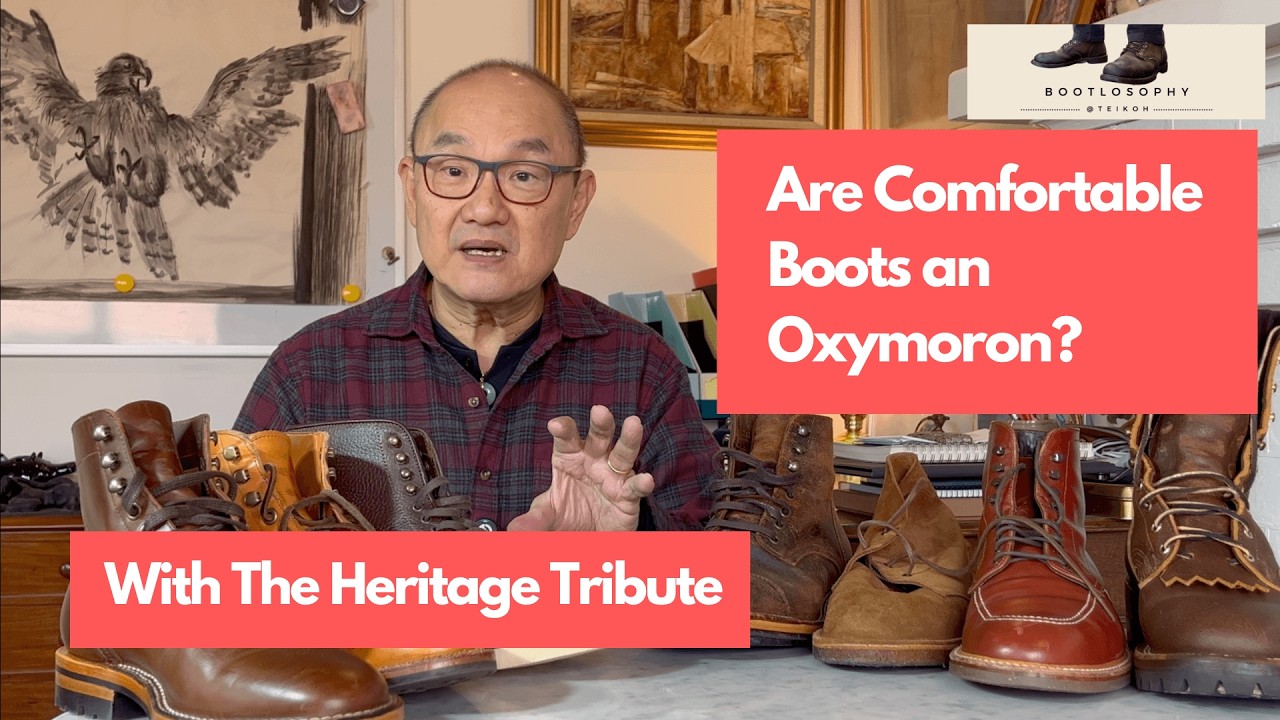
Video summary
The video explores the often-debated question of what truly makes heritage welted boots comfortable, challenging the initial assumption that they are inherently uncomfortable compared to modern foam-based sneakers. The host explains that while new leather boots feel stiff and cold initially, they eventually mold to the wearer's feet over time, unlike soft shoes where materials like polyurethane degrade quickly. A key insight introduced by guest Eli Aquino is that comfort is not just about breaking in a boot, but rather finding the right balance between the structure of the upper leather and the rigidity of the sole. If a boot has a very soft upper paired with an extremely heavy, rigid sole, the foot must work too hard to flex the boot, leading to pain; conversely, a structured upper that matches the stiffness of the sole allows for natural movement and integrated support during a stride.
Beyond the material balance, the video identifies four other critical characteristics that define comfort: proper sizing on the correct last, the specific type of leather used, the design of the sole, and arch support. The host emphasizes that no single boot fits every foot, noting that different lasts—such as those from Parkhurst, Grant Stone, or Alden—offer unique shapes that accommodate wide balls of the foot while gripping the heel. The choice of leather also plays a vital role; for instance, thin suede offers slipper-like comfort indoors, while thicker leathers like Horween's Spokane provide necessary support for outdoor adventures without pressing painfully against the foot. Additionally, design elements like toe caps can cause issues if they are too reinforced or poorly shaped, potentially biting into the toes before the boot is fully broken in.
Finally, the discussion highlights the importance of sole type and arch support as the final pillars of comfort. Wedge soles are praised for their ability to naturally support the arch, though the specific compound material matters just as much as the shape. The host notes that while some rubber outsoles can feel overly firm when new, certain designs with moderate height and stud patterns offer a comfortable blend of grip and flexibility. Arch support is presented as highly subjective; what works for one person may dig into another's foot, making it essential to find a last that matches the wearer's specific arch shape, whether through built-in layers in the sole or clever design features like cantilever bridges. The video concludes by advising beginners to start with brands they can try on locally or purchase from retailers with generous return policies, suggesting that once a comfortable combination of these five elements is found, wearers can confidently expand their collection within that brand family.
Read the full video transcript
So, we say on social media, "Man, these
boots are really comfortable boots."
But, really,
are they?
Are any boots comfortable?
>> [music]
[music]
>> How you going? Welcome to Bootlosophy,
and if you're new here, my name is Tech.
And so far, I have reviewed 170
pairs of boots.
>> [laughter]
>> Go and see my video library on my
channel for all the reviews.
I'm coming to you from Gallup, which is
Wotje country.
Kalyko Wotje Nungar Budja.
Yes, all of us serious boot collectors
have at one stage or another proclaimed
a pair of heritage boots as being really
comfortable.
In fact, I've done, you know, nearly
annual videos about the most comfy boots
that I acquired during the year or the
ones that I own, or I've gone through my
most comfy mock toes or most comfortable
service boots, whatever.
And yet, heritage boots, stitched boots,
welted boots, stitch down work boots
are tough. They're made the old way with
relatively thick uppers, and we also
pine for the unadulterated full leather
sole construction, which takes weeks to
break in.
And even after break in, the first time
you slip your foot into a cold boot in
the morning, and the leather is cold and
hard, and before your feet settle in,
is it really comfortable?
Most of us come into boots in our adult
life.
We wear sneakers or mall or shopping
center bought fashion shoes or just
comfy shoes.
Names like Ecco with squishy
polyurethane soles, fashion shoes with
foam and padding and cement construction
which bend at the ball as soon as you
buy them.
So, for most of us, when we try on our
first heritage style stitched welted or
stitch down boots,
you're lying if you said, "Wow, in
relation to the squishy shoes I've worn
all my life, these are so comfy."
Yeah, nah.
For most of us,
our first reaction, honestly, is
"What have I let myself in for?"
I love the look and feel of these boots
and intellectually, I've watched and
read that they need breaking.
But, really?
Will they ever feel like my soft squishy
sneakers?
And then, over time, we realize that
even our soft squishy shoes lose comfort
over time, don't they? As the foam and
the PU materials break down.
And eventually, they're cactus.
That's also roughly when we realize that
our heavy, initially uncomfortable boots
actually become more and more
comfortable.
Tell the truth. Never as comfortable as
a new pair of Ecco or other foam-based
shoe.
But, for the materials that last
forever, yeah, they're comfy.
But, tell the truth again, sometimes we
cheat and slip on a pair of Thursdays
with their Poron insoles and quietly
think,
"Yeah, I'll get away with it. I mean,
I'm wearing Goodyear welted heritage
style boots." And quietly, I appreciate
that Poron squish.
So, all that aside, what makes a pair of
heritage boots
comfortable?
I believe there are four main
characteristics, and I have a guest
presenter who has discovered a fifth.
So, what are they?
I think the first and foremost
characteristic that makes a boot feel
comfortable is to nail down the right
size in the right last for your foot.
Second is the uppers leather.
What is it and how does it adapt to the
shape of your feet and your ankles as
you wear the boot in?
And included in this characteristic of
comfort is the design and construction
of including any toe caps.
Third, I think is the sole type.
Are wedge soles inherently comfortable?
Well, yes, I think so, but they're not
suitable for all types of boots.
So, what other types of outsoles for
what use are also comfortable?
And then fourth for me is arch support.
And included in this is how some brands
build up this arch support. Or to
encroach once more into the last, how
they design the last to be comfortable
for some feet.
And the phrase some feet is incredibly
important because in my opinion, no one
boot can be the everything for all feet.
I know that what I find as some of my
most comfortable boots, others will say,
"Oh, they're terrible for your feet."
And my guest, Eli Aquino or the Heritage
Tribute from Instagram, he's added a
fifth consideration. The idea that the
structure of the uppers must match the
structure of the sole construction
so that they both match each other in
terms of either support or flexibility.
So, let's start with size and last
design.
I won't spend too much time on the size.
I mean, that is obvious. You buy a boot
that's too big or too small and your
feet will either get tired walking
around in a sloppy fit or be in real
pain with hot spots everywhere.
But the last is something that we
forget.
We like boots because of the look. I
mean, take a look at this Parkhurst Alan
boot in the 618 last.
To me, this last is just perfect for my
feet.
It's a combination last, meaning that
it's
narrow to a C or even B width in the
heel and in the waist, so that it grips
the back part of your foot.
And then it widens to an E or even a
double E width at the ball of the foot
before elegantly without really
narrowing too much into an almond shape
toe.
No one person's foot can fit into every
last. So, it is important to say that
this last suits my feet.
As do Grant Stone's Leo last and Alden's
True Balance last and Tricker's 4497
last.
None of these make me slip around inside
the boot. None of these
squeeze my foot anywhere.
And all of these give me a a wide ball
of the foot area for a reasonably wide
foot there.
So, I believe that lesson number one is
to know your size in the brand you're
looking at.
And despite how we like different
shapes, make sure that the last of the
boot you're looking at fits your foot.
Now, let me move on to the idea that in
order to be a comfortable boot, it needs
to balance the structure of the uppers
with the structure of the sole.
Here is Eli Aquino, who is the Heritage
Tribute on Instagram, and his take on
this issue.
>> Hi Take. Regards from the beautiful
Panama in Central America. And yes, I
live in Panama and I use boots all year
round as crazy as it sounds.
Okay.
Well, first off, my friend, huge thank
you
for inviting me to share my thoughts on
boot comfort. Um
it is a very complex topic that many um
uh boot lovers and enthusiasts have
talked about it online, including you
and and uh
um it got me thinking about a theory I
have on um why some premium heritage
boots end up causing absolute pain.
And um
we're not going to be talking about what
I consider is the king of comfort, which
is sizing. Sizing and and uh the and
choosing the right last,
um understanding the
uh three-dimensional
um shape of your foot. That's That's a
whole different story here.
I'm going to be talking about the queen.
And when I mean the queen,
I I intend to explain that materials,
the combination of materials, are very
important
for the comfort experience. I think
that's the queen
of comfort.
It's all about the ratio between the
upper leather and the soles.
So, to provide my
to prove my point,
I'm using my treasured Tricker's. So, we
have uh
four uh models here. Two of them are
made on the uh classic 4497S last.
And uh the other two, the monkey boots,
uh Ethan, are made using the 5402R
last.
So, let's look at this first pair
um built on a heavy rigid sole,
but featuring a very soft upper.
So, this is a commando sole,
Goodyear
commando sole, very heavy locked,
uh with a veg tan mid sole and uh veg
tan
um welt,
and cork filling, and uh wooden shank, I
think, and then the uh veg tan insole.
So, all of that is the bottom of the
boot.
Uh the upper is Castorino suede, olive
Castorino suede, beautiful stuff from
Charles F. Stead, outstanding.
Just gorgeous.
Um
but now, when I walk,
the soft off upper gives me zero
structural leverage
to bend
the boot,
right? So, my foot ends up pressing down
and fighting against that rigid sole,
completely unsupported.
Right?
So, the break-in is absolutely brutal on
this because and the and I'm trying to
explain
the mechanics of my of my stride and my
foot with the
almost disrespectful level of English
that I have, so I'm sorry.
I hope I'm I'm I'm making it clear. So,
I when I try to bend this, all the
pressure,
right, that it's unsupported by the
uppers, so my foot is trying to
accommodate that movement,
and so the pressure goes down,
and I feel
a lot of pain
uh when
when I'm walking
long periods of time boot, okay?
So, soft upper, hard
uh bottom.
Now, let's look at the second pair,
which features the
beautiful um acorn
uh antique leather. This is a stow boot
uh with a Dainite sole. This is an
absolute classic.
Beautiful boot, one of of favorite
boots, all right. So,
it's the same last in this case, same
concept.
So, it also has what I consider a pretty
heavy sole, which is a day night is is
not as heavy as the commando, but still
very hard with a mid sole at the welt,
the
um the cork filling, the shank, and the
um
leather full grain leather
insole.
Um now,
the the walking experience is different
though.
Um this
uh in this pair
uh with this
with the structured calfskin upper, when
I flex my foot here,
the firmness of the leather actually
helps force that heavy sole to bend with
my foot.
With my foot, sorry.
Uh it keeps the movement integrated
and feels incredibly comfortable.
Because when I'm trying to bend, when
I'm walking,
um
my foot feels supported. The energy
transfers to the sturdy upper and it
helps me leverage that movement.
Now, same concept here. This is the
monkey boot with a
very hard
um bottom and a supple, very supple sand
um
the suede.
It It's same thing. When I bend this, my
foot is trying to accommodate here and
trying to find help,
but it is not enough, so the pressure
goes down. And I still And And depending
of the movement of my um specific
stride,
I will have pressure points, and you
will have a different experience on the
pressure points as well.
Whereas with this one,
which features the beautiful
um
Richway
like
uh sole,
one of my favorite soles apart from uh
from leather soles,
this is a on on a very sturdy
um
kudu leather.
It's a whole different story.
I feel supported. Even though this is a
shorter
uh boot, when I bend, everything
supports the stride. Now, I have a a
special guest
just to further prove my point and is
the my beloved um Alden Indy in snuff
suede.
Now, this is a different his- story
here. This is a different story. This is
made with a snuff suede supple stuff,
but it has a softer construction and
selection of materials,
which are a little bit, you know,
um
out there, a polemic topic,
but still, they they have a leather kind
of mid sole here with a half uh commando
sole, like really
s- short, small uh bricks here.
Um it is very, very supple because it
has these uh
leather board or whatever people hate
that I love on the of these boot.
Um
and uh and so being soft, we being upper
and a soft bottom,
the striding
and breaking process
is very pleasant.
So, this is a comfortable boot right out
of the bat.
I mean, this is it's a comfortable boot
even looking at them
uh
from the website.
So, it it's a different story. So, here
we go.
Uh that's my theory, the ratio between
the upper leather and the soles make a
difference on the comfortable comfort
experience.
This is only my short and humble
experience. I I would love to know what
you think.
>> Thanks, Ellie. So, lesson number two,
does the support offered by the uppers
match the toughness of the soles? Or to
put it another way,
what are you using the boot for and is
the entire boot as a package made for
that purpose?
If it's meant to be a light casual boot
with, you know, very supple uppers
leather, but it's built on a super tough
multi-leather layered sole construction
with a heavy lugged sole,
you may find it uncomfortable.
And leading on from that, the uppers
leather themselves can dictate comfort
or discomfort. I mean, this Crown
Northampton desert boot,
it's made of the softest, I dare say
thinnest, unlined suede from Charles F.
Stead.
If you take a a look at how soft the
suede is,
and taking into mind what Ellie said,
you just know how comfortable this
leather is around your foot.
When you put these on, it's unlike any
other boot for indoor slipper-like
comfort.
But then, there's this
Nick's Overlander made from Horween's
Spokane leather, a derivation of their
Chromepak tannage.
This leather is not thin. It's nearly 4
mm thick. Yet, while it's incredibly
supple,
it also keeps its structure and is very
supportive.
In this uh turned-over roughout waxed
flesh version, it wraps around your foot
supportively, but never exerting any
pressure against any part of your foot.
No way I'd wear this around the house
and then, when I put my feet up on the
sofa to watch TV, say that, "Oh, this is
so comfortable."
But out for a bush walk, taking it where
it's meant to go, this is one of the
most supportive yet comfortable leathers
you can choose for adventure.
And as Ali says, it doesn't hurt that it
has the full PNW sole construction
package underneath to help with overall
support and comfort.
But then, the pattern of a boot, despite
comfortable uppers leather, could cause
problems.
Take this Parkhurst Richmond.
This is in waxy commander from CF Stead
and it has a real toe cap.
It's very interesting that I never have
a problem breaking in Parkhurst boots
except for two pairs. The first was, I
think I'm remembering, an old New York
made Richmond in double shot.
Lovely leather, but the celastic heel
counter
had been misplaced in the manufacture
and it rose a little above the heel into
my Achilles tendon.
And boy, did that dig into my tendon
until I was told to get a heat gun and
gently mold the heat cup into a kind of
back curve shape.
This is the second uncomfortable pair.
The Richmond has a lovely proportion toe
cap.
But in this case,
this is a sample boot.
Because it has a true second layer, I
find that the reinforced toe box bites
into the top right toes when I walk,
certainly before breaking in. It doesn't
bend a little in front of the toe cap
stitching
so that the edge bites into my foot. And
this is despite waxy commander being one
of the most balanced leathers between
support and suppleness.
On its own, you'd say it's one of the
most comfortable leathers you can use
for uppers.
So to summarize this characteristic, the
uppers leather and the pattern can make
a difference. And perhaps in reinforcing
Ali's point, you need to balance the
uppers leather with the use of the boot
and the balance of the whole foot.
The next characteristic of boot comfort
I want to discuss is the type of the
sole.
I've dealt with sole construction, but
what about the actual type of the sole?
I have always found wedge soles
comfortable, particularly in my work
where I sometimes lead and facilitate
management workshops and I'm on my feet
all day for, you know, up to two or
three days. I'm striding between white
boards on stage or all around the
convention room amongst the tables.
I've come to wear this pair of Louis
Vuitton Indiana boots for those sessions
because of the last, but also for sure
because of this wedge sole.
It's not as firm as a Red Wing rubber
wedge sole, but I find it quite similar
to Thorogoods.
I don't think it's uh rubber. I'm I'm
sure it's not rubber, but I think it's a
kind of polyurethane compound where it's
firm, but also giving.
So, it's not just the wedge shape where
your arch is almost naturally supported,
but it's also the compound.
Does that mean that the solid block heel
rubber outsoles are less comfortable?
No. Although I do find original Dainite
quite overly firm when new.
But in this Grant Stone version of the
studded uh outsole
uh that they put on their Diesel boot,
this one is the 10 Essex.
This compound of rubber they use and the
design of the studs and not being overly
high, combined with the all leather and
cork construction of midsole and insole,
I find incredibly comfortable.
So, add lesson number four. Be aware of
the type of sole that's under your foot.
Finally, I I want to talk about arch
support.
Let me go back to something I said at
the beginning.
Every foot is different and that affects
how you view or feel arch support.
I believe we all need it to some degree,
and that's why I personally hate
barefoot boots because they make me feel
like I'm walking around barefoot. Hello.
But, that's not a good thing for me.
I have slightly collapsed arches, and
while I find high arch boots
uncomfortable,
I find no arch support painful.
However, I have tried the high arch
support PNW boots in the 55 last,
and I didn't like it. I felt that the
high arch was digging too much into my
arches, and in PNW bootdom, I prefer the
HNW moderate arch as I have in these
Nicks Overlanders.
The way that PNW brands, and in this
case Nicks, build up the layers of
leather under your arch in this HNW
last, to me,
really fits the curve of my foot so
well.
There are no gaps between foot and sole,
and as I gradually mold my foot down on
these, that no gaps fit is becoming more
and more bespoke.
But, you can also achieve good arch
support with last design.
Now, I've spoken about last already, and
I've mentioned them much maligned Alden
Indy,
often maligned by people who hate the
price of it for what they see as
inferior materials,
but who have never put it on.
Almost everyone I know who's put it on
with no commercial ax to grind,
understand why it's so good.
The design of this boot, by a brand that
made orthopedic shoes, supports almost
any man's arch, no matter what shape
that arch is.
It does it by design.
The True Balance last, like the Parker
602 or 618, is combination, gripping
onto your heels and allowing room in the
ball of your feet.
The narrow waist
tucks in under your arch like like a
cantilever bridge supporting your arch
by supporting over empty air.
That's a hell of a design.
The insole material breathes and allows
your arch, whatever shape, to slip in
and then the Thomas heel helps to push
up into the otherwise yawning gap
between heel and ball.
So, lesson number five.
Arch support matters in comfort and be
aware of, whether it's the last, the
sole construction, or the design, how a
boot affects your arch.
So, to summarize the five
characteristics that you should look at
in mine and Eliaquim's personal
opinions,
if you want a comfortable boot, these
are
get the right size and make sure that
the last works for you.
Try to match the supportiveness or
suppleness of the uppers with the soles.
Three, choose the support or softness of
the leathers to see that they bind your
feet but feel good around your feet.
Four, choose the right sole type that
you find most comfortable.
And finally, five, choose the boot with
the right arch support for your foot.
In fact, that is the summary, you know.
Choose all the above components for your
feet.
Now, some of that advice is hard to
follow if you're new to boots, right? If
you live in the US, you're luckier.
It's easier to return online bought
boots to US brands from the US.
If, as a beginner, you live near a boot
store,
then start with brands that you can try
on, like say Red Wing,
uh Allen Edmonds, or Alden in the US in
particular.
Uh Tricker's, for example, say, or
English brands if you're in the UK. Or
here in Australia, RM Williams. Or if
you can, go and visit makers like
Wootten in Ballarat.
In some cases, living outside of the US,
you can buy through Amazon and
especially if you're a prime member, you
can get free shipping and free returns
on brands like
Thursday, Clark's,
Thorogood, Jim Green. I think even
Wolverine and even Allen Edmonds you can
get on Amazon.
Just check the return policies.
Once you find a brand that gives you
comfort, I think you can stick there for
a few models. Say you like a Jim Green
African Ranger that suits your feet,
then try a Jim Green Stockman or a
Numzaan next.
Research and join, you know, Reddit
groups and other Facebook groups to see
discussions about what fits like what
other boot and then you start to expand.
Ultimately, join the worldwide boot nerd
club and enjoy whatever you wear that
doesn't tear your feet apart.
>> [laughter]
>> And with that positive message, I hope
you like this video and I hope you will
SLC, subscribe, like, comment.
Take care out there. Come back soon for
my next boot video.
See you soon.