Video summary
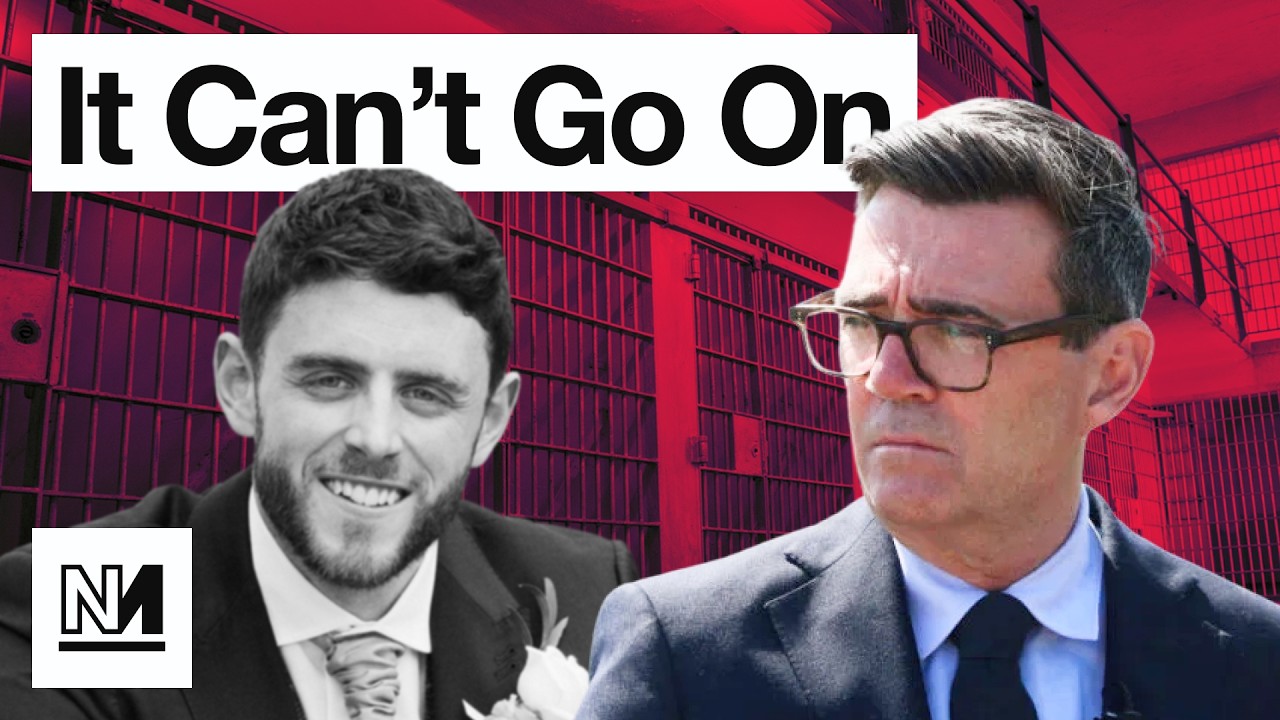
Britain's prison system is currently facing a severe crisis with the population nearing 90,000 inmates and facilities operating at 99% capacity. To alleviate this overcrowding, the government has introduced an early release scheme that allows prisoners serving sentences longer than four years to be released after half their term instead of the usual two-thirds mark. While serious offenders such as child sex offenders and rapists are excluded from this program, those convicted of manslaughter remain eligible for early release. This policy sparked immense public outrage following a specific case involving the killers of police constable Andrew Harper, who was dragged to his death in 2019 by teenagers attempting to steal a quad bike; two of the three defendants were sentenced for manslaughter and are now approaching their halfway point due to sentencing delays during the pandemic.
The controversy surrounding these cases has prompted Prime Minister Andy Burnham to announce plans for new legislation aimed at preventing early release for serious offenders like Harper's killers, while also exploring other measures such as repatriating foreign national prisoners and housing male inmates in women's prisons. A more significant issue highlighted is the legacy of Indefinite Public Protection (IPP) sentences introduced under Tony Blair's government starting in 2005. These unique sentencing powers allowed judges to imprison individuals indefinitely with only a minimum term, meaning there was no guaranteed release date even after serving their initial sentence. Although these laws were scrapped by David Cameron in 2012 due to concerns over uncertainty and injustice, thousands of people remain incarcerated under this regime, including cases where minor crimes like stealing cigarettes or laptops resulted in decades-long imprisonment without a clear end date.
The human cost of the IPP system has been devastating, with at least 94 individuals taking their own lives while waiting for parole that never came due to administrative errors and an understaffed parole service unable to accurately assess risk over such long periods. Experts argue that these sentences were often based on flawed assessments of dangerousness rather than actual criminal history, leading to horrific scenarios where innocent or low-risk prisoners faced life in prison without hope. The political landscape is further complicated by a cycle driven by high-profile tragedies; following incidents like the murder of Zara Aleena shortly after her rapist was released, public pressure forces politicians into increasingly tough stances on crime, resulting in longer sentences and stricter parole conditions that ultimately contribute to higher recidivism rates and an overburdened justice system. Ultimately, critics suggest that successive governments have prioritized appearing "tough on crime" over effective rehabilitation, creating a dysfunctional environment where prison populations swell not because of genuine necessity but due to political reactions to isolated catastrophes rather than sound policy reform.
Read the full video transcript
Britain's prisons are buckling at the
seams with a little under 90,000 people
currently serving custodial sentences.
That is a number that grows year on
year. It's constantly growing up going
up with the prison population just about
doubling since 1990.
That means our prisons are currently at
99% capacity. To address the problem of
overcrowding, the government has
introduced an early release scheme
meaning that from October, some 5,000
prisoners serving sentences of longer
than 4 years will be set free at halfway
point of their terms rather than the
usual 2/3 mark. Child sex offenders,
rapists, and groomers were excluded from
the program, but prisoners convicted of
manslaughter were not. That's been
particularly controversial because as a
result, two of the three convicted
killers of the 28-year-old police
constable Andrew Harper are eligible to
be let out early as part of the scheme.
Harper was killed in 2019 when three
teenagers attempting to steal a quad
bike drove their car at speed for a mile
dragging the police officer with it. All
three defendants were charged with
murder but were cleared of that charge
by a jury at trial. Instead, Henry Long
was sentenced to 16 years in prison for
manslaughter. His two co-defendants,
Jessie Cole and Albert Bowers, who were
both 17 at the time of Harper's killing,
were sentenced to 13 years each for
manslaughter. That sentencing happened
in July 2020 in the middle of COVID
meaning Cole and Bowers will have served
half their sentence by early next year.
The public backlash was immense at the
time and it still is. A petition to
block their early release has so far
gathered over 900,000 signatures and
today, Prime Minister Andy Burnham tried
to address the issue releasing this
statement online.
I spent recent days considering in depth
all of the issues involved and the range
of advice I have received. I've been
pushing for further progress. I have not
accepted that it is impossible to do
more. As a result, I've asked the
Justice Secretary to fast-track the
development of a plan for presentation
to Parliament early next month to create
more headroom within the prison system.
I'm increasingly confident that a more
focused approach along these lines will
allow us to reduce the number of people
released early and in the case of the
most serious offenders, like those
convicted of the killing of PC Harper,
prevent their early release altogether.
So, it sounds there's going to be an act
of Parliament that basically
stops certain people being subject to
early release. Now, in his statement,
Burnham mentioned three areas where he
thought pressure on prisons could be
eased, including removing convicted
foreign national offenders to their home
countries more quickly and housing some
male prisoners in some parts of the
women's prison estate. I'm not sure how
that will go down or whether it would
even be legal. Uh but the third option
that'll be looked at is not only very
credible, it's also a national scandal.
That's the matter of what Burnham called
the long-running injustice of people who
were given indefinite prison sentences
under the imprisonment for public
protection scheme. This is really
extraordinary. From 2005 onwards, Tony
Blair's government gave British courts
the power to jail people indefinitely
for a range of crimes, including
relatively minor ones. Uh most sentences
in Britain have a fixed term set by a
judge within a range set by law and
based on a number of intersecting
factors. Now, a prisoner may come up for
parole before the end of their term,
usually at the two-thirds mark. If they
get it, they're released on license
until the end of their term. But if they
don't, uh they're still set free when
they've served their time. There are
some exceptions, like whole life orders,
but on the whole, that's how the system
works. But imprisonment for public
protection jail terms were different.
They had no end dates, only [snorts] a
minimum term. Uh meaning there was no
date where their time had been served
and the person subject to it had been uh
guaranteed freedom.
Uh it was a bit like Kafka's trial. At
that point, a prisoner came up for
parole, but there was no guarantee
they'd get it. Uh they could go up for
parole time and time again and fail to
get it each time, meaning someone who
commits a crime normally carrying a
sentence for a few months or years could
find themselves incarcerated for
decades. And I shouldn't be talking in
the conditional because as you as you'll
see in a moment, this happened to some
people. Uh and if they were paroled,
they could be put on license for 99
years, meaning the potential to be
returned to jail anytime throughout
their entire lives. This sounds made up.
It's not made up. It's very real, and
frankly, it's reprehensible. It also
didn't apply to only adults. Children
could be sentenced under similar powers.
In 2012, coalition Prime Minister David
Cameron scrapped those powers, calling
the unclear, inconsistent, and uncertain
nature of such law
unwise. Uh and in 2024, David Blunkett,
the Home Secretary, who introduced the
law as a Labour Home Secretary, called
the sentences his biggest regret.
Frankly, he should be asking people for
forgiveness in my view. But that was
much too late though. Of the nearly
9,000 prisoners given indefinite
sentences during the New Labour years,
with over 2,000 people still in jail
under the scheme. And the cases of gross
miscarriages of justice are truly
shocking.
Take Martin Myers on the right here and
pictured with his twin brother.
He was handed an indefinite sentence
with a 19-month minimum term in 2006
after he tried and failed to steal
a cigarettes.
He served 18 years in prison.
When she was 22, Ronnie Sinclair was
jailed under an IPP after she was
arrested for robbery
following a drunken row at a friend's
barbecue.
She served 16 years in prison
for a crime that involved breaking a
plant pot and tearing up a betting slip.
Uh there's also Abdullahi Sulaiman who
was handed a minimum sentence of just
under 4 years in 2005 for stealing a
laptop.
He's still in prison.
21 years later
and he has no idea when he's going to
get out. For stealing a laptop, I'm not
a fan of people who steal laptops,
but dare I say that's
excessive.
Uh you can imagine the strain of never
knowing whether you'll get out of prison
years and years after serving the usual
sentence for your crime.
At least 94 people under IPPs have taken
their own lives. Utterly extraordinary.
Um and many people are still serving
sentences under a law that we scrapped
nearly 15 years ago.
In July, the UN urged the UK to end IPP
sentences warning of serious human
rights violations. And today uh lawyers
have written both to the Justice
Secretary Alex Norris and the High Court
to start a legal action over the
sentences.
Uh it shouldn't be hard to win, with the
former Supreme Court Justice having
already described the regime as {quote}
the greatest single stain on our
criminal justice system. Uh Dame Vera
Baird uh is chair of the Criminal Cases
Review Commission, the last port of call
for prisoners who've been denied parole.
On Newsnight, she explained what she
thought happened to the remaining IPP
cases.
>> What does that mean effectively to those
people who are still on IPPs? You'd like
to see those go.
>> Well, I think they need re-sentencing.
So, make no mistake. I mean, there will
be some people on IPPs rightly, you
know, who who are violent people who you
wouldn't want to release.
>> to their crimes, too.
>> Yeah, exactly. But also because that
it's about assessing dangerousness.
Yeah, that's been done probably quite
wrongly for young men who of course
mature
can mature quickly and change. But the I
think the real point is that
there are now ways in which we
understand these sentences don't work.
People do need to be let out. It needs
to be done more wholesale than just
coming to the CCRC where we will work as
fast as we possibly can. But there are 2
and 1/2 thousand to go. And of course if
you did get quite a lot of them out
appropriately then you have to look at
each of them in turn but re-sentence
rather than look at the whole question
is there a miscarriage of justice and so
on. That would be a lot quicker. And of
course it would contribute to emptying
the prisons.
>> So Michael, it's 2 and 1/2 thousand
people. It's more than 2,000 people.
We've got the prisons are full 99% full
with 90,000 people. So we're let's say
2,000 people were released. Okay, maybe
not all of them but
a good good chunk of them, right? You're
looking at freeing up I mean what 3% of
overall capacity and actually doing the
right thing. Why hasn't it happened
already?
>> Well, I suppose I I mean this is in a
way why
sort of
policy around this is is difficult
because
it's if you just do it on a whim, right?
It's very likely that someone will
commit a crime that's heinous and then
everyone will say why the hell did you
do that? Right? And And that's why I
suppose sort of the way the Andrew
Harper the PC Harper case is
is being discussed in the media. Feels
like we're kind of doing the same cycle
again which is you have outrageous case
criminal justice policy driven by that.
Um
Just to sort of go into some of these
IPP cases. So I only really looked at
Martin Myers in detail. So he had
threatened to knock someone out
while he was trying to steal their
cigarettes. That's why he got sentenced
but he had previous convictions for
dangerous driving, assault, theft, and
burglary. So the idea of these sort of
sentences would they be given to someone
who seemed kind of dangerous for
whatever reason. Um his case is
extraordinary though. So the parole
board and prison service made a bunch of
mistakes. In 2011 they said they weren't
releasing him because he was a sex
offender and he'd mis- misused drugs in
prison. He wasn't a fact sex offender.
This was like an administrative error,
but he couldn't read. So, he got his
cellmate to read out the letter for him.
The cellmate then thinks he's a sex
offender in the next few years in
prison, he's constantly getting beaten
up because sex offenders get beaten up
in prison. So, it's like it's it's
outrageous. It's a horrific case and I'm
sure that's sort of repeated among loads
of these people. In terms of how sort of
extreme cases drive this though, so sort
of looking Why did these IPPs get
introduced in the first place? Right?
Because normally a policy happens for
some kind of reason, even terrible
policy.
And this case was very much related to
the high-profile horrific case of
8-year-old Sarah Payne,
who was murdered in 2000. Now, the man
who murdered her had recently been
released from prison. Now, police and
psychiatrists both thought he remained
dangerous. So, they both thought he was
likely to commit
serious crimes, essentially against
children, but he had reached the maximum
term of his sentence. So, he was
released. Right? So, the the government
look at this and they say, "Well, this
is a high-profile horrific case.
Everyone is saying something must be
done, right? This innocent 8-year-old
child has been killed." Um and they
said, "Well, it
you know, at the moment, if someone's
done their time, you have to let Even if
you think they're likely to commit
another crime, even if they seem
incredibly dangerous, they've done their
time, they have to be let out. So,
that's why the IPPs come in. Then the
IPPs end up, you know, you got a bunch
of people just indefinitely sitting in
jail. A big problem is that the parole
service is under-resourced. So, you're
not in a position to be able to actually
make an accurate judgment whether
someone is safe or not. But,
that's you know, that's why all these
things are difficult because you just
need one high-profile case and then
everyone's suddenly like, "Actually, we
need to get much tougher again." I mean,
also in terms of the numbers of people
in prison, so this would be 2,000
people. Now,
you know,
I I imagine lots of those people should
and can be released. The much bigger
number of people in prison is the 13,000
people who are on recall.
And all the sort of NGO documents I've
been reading about this say this is a a
really big problem, which is that there
are lots of people who get
released from
from um prison but on license. So by the
way, this is also important to note
these, you know, PC Harper's killers, if
they get released, they'll be on license
for another third of their sentence. So
for a significant number of years.
And lots of people are getting recalled
not because they've done anything
particularly dangerous, but because
they've missed an appointment.
And so you've got this this cycle of
people getting let out, they've got
chaotic lives, they get brought straight
back into prison because they've they've
missed an appointment. This seems crazy.
Why are they doing this? Mad, right? But
then again, there's another high-profile
case. So in 2022, Zara Aleena, um many
people will remember this case, a young
young law graduate raped and murdered by
Jordan McSweeney. So sort of like
someone that you know, the most horrific
thing happened to someone with this
bright future. He'd been released on
license from prison just 9 days earlier.
And this is key, his license had been
revoked after he failed to meet
probation officers, but he was not
recalled to prison.
So again, there are a bunch of failures
here because the person was overworked,
and he should have been sort of called
high-risk instead of medium-risk. But
now you've got this situation where
everyone in the parole service is
basically like, well, if I've got any
doubt at all and they don't sort of come
to their meeting, I'm going to send them
back to prison cuz I don't want another
high-profile catastrophe.
And so lots of this is driven by
high-profile catastrophes. And I think
we do need to keep that in mind when
we're thinking about PC Harper's
killers, which is sort of very easy to
take a high-profile case and say this
means all the rules have to be changed.
Then all the rules are changed, and then
you end up with a bunch of
situations like this where people are in
prison for much longer than they need to
be.
>> So that's really intelligent commentary
and context for people watching and
listening, and it's really valuable. I
get all of that, Michael.
But I don't know any other criminal
justice system in the world that has
IPPs. I mean, I could be wrong.
Where you basically have this rolling
sentencing sort of strategy, and you
don't have a maximum sentence, you have
a minimum sentence. Now, if you were to
make the argument with regards to all
those cases, and that's why we should
have much longer sentences, that's why
we should have people in custody, you
know,
twice as long as they presently are. I
mean, we can make that argument, we can
have that conversation.
But IPPs in particular just seem insane.
I'm not in favor of IPPs.
I appreciate that. I think [laughter]
they were they were problematic. I'm
more saying my point is this. So, you're
saying that's a result of overreach by
government responding
misguidedly to public anger, which was
entirely justified, right?
But can't you do something where you
say, "Well, you know what? Okay, the
Home Secretary in certain circumstances
can do something like this." Rather than
having this whole sentencing regime like
IPP, which affects thousands and
thousands of people, you know, dozens of
people have committed suicide who were
in that regime.
It just seems like complete overkill.
And I suppose somebody like myself who's
rather skeptical of the Blair era would
say, "Actually, rather than just
responding to public anger, there was
something more cynical and ideological
going on on the part of people like
David Blunkett because they wanted to
look like they were tough on crime." And
actually, rather than being tough on
crime, they contributed to a deeply
dysfunctional criminal justice system,
which to me is the more interesting
interesting story here because we're
more people in prison in Western Europe
than any other country. We have higher
rates of recidivism than any other
country in Western Europe. We're still
very safe compared to the US, but you
know, compared to most Western European
countries, we have higher rates of
violent crime and so on. Also, rates of
lower, you know, and less important
crimes as well. We've basically
decriminalized certain things like
shoplifting and bike thefts in recent
years.
So, that to me seems like the biggest
story actually.
Successive governments trying to be
quote unquote tough on crime, but
actually making the problem much worse.
Well, if the argument is that they, you
know, so the prison population increased
from about 1993. So, it started under
John Major who said, "Prison works."
Um the idea was that cuz I mean, I often
you know, there's sort of
sometimes I think quite wishy-washy
liberal arguments with prison doesn't
work because people come out and they
reoffend. Well, well, it's still you
know, it's better than no prison, right?
For in in many of these cases. But, um,
you then end up with the situation where
sentences are constantly getting longer
because of public pressure. And I
suppose what I'm pointing out is that if
you think that
prison sentences were too long under New
Labour, right? David Gauke wrote a
review. So, about I think I think in
2023, which was basically saying there's
been too much political competition to
try and to to try and say we all think
sentences should be longer. So, you have
this ratcheting effect where if Labour
try and reduce sentences, Tories say
this is outrageous. If Tories try to
reduce sentences, Labour say this is
outrageous because there's always a
political opportunity here.
What's happened now, right? Is that
Labour are were were giving people early
release mainly because the prisons were
full, but they're also implementing the
Gauke review, which was an argument to
say we should have prisoners serve more
of their time outside of prison, um,
under, you know, serving some kind of
community sentence.
And what's happened is Andy Burnham, you
know, wants to be popular. He's looking
where the pressure is and he's saying, I
don't want to do any of this, right?
He's saying he's not just saying PC
Harper's, you know,
uh,
killers shouldn't get out immediately.
He's saying he doesn't want anyone to
get out early. He he he essentially
wants to abandon the Gauke review, which
was saying all of these problems
happened under New Labour.
And that's because there is, you know,
there is no incentive to have a more
liberal policy on this because public
opinion goes in one direction. So, the
point I'm making here isn't to justify
the IPPs. It isn't to say, um,
we should have early release. I don't
even really know. But, I suppose what
I'm saying is the way that the PC Harper
case is being talked about is very
similar to the kind of situation which
led to the introduction of IPPs.
>> So, you said that we're we're
sending people to prison for longer and
longer.
In the case of um Andrew Harper, so he
was he was killed by three people. One
of them is viewed as the the primary
agent in that manslaughter. They got a
slightly longer sentence. The other two
got slightly shorter sentences.
But, they got what was it? 15 years?
For manslaughter of a police officer,
that doesn't seem particularly long. I
think, you know, historically in the in
the '50s and the '60s, you would have
been hanged for that.
>> For manslaughter, I'm not sure. I mean,
I I don't know about
>> seem especially long.
>> know about that particular crime, but
what I do know is that on aggregate um
sentences for serious crimes got much
longer.
So, sentences for murder, for
manslaughter, for especially sexual
offenses, these have all got much longer
than they were in the '70s and the '80s.
I I I'm not in a position to be able to
tell you how this sort of catches up
when it comes to specific crimes, but
that's just a sort of fact.
>> particular case. And I think most
people would say, "Well, look,
this police officer was officer was
killed in 2019, so it's 7 years ago.
These guys were sentenced 6 years ago.
They could be out inside a year. The
idea of serving 7 years when you kill a
copper,
there's not many countries that happens.
There's not many countries, Michael. So,
but hold on. This This is the tension
This is the tension politically, right?
So, I'm sure statistically what you're
saying is entirely correct. But, it's
very hard when you're a politician, you
got people like yourself in receipt of
all the information saying, "Well,
actually, the sentences are longer than
ever." And then saying, "Well, hold on.
These guys killed a copper.
And, you know, they didn't seem contrite
when they went down. You can see the
video from it in in 2020. They're
basically laughing. Um
and they're out in 7 years.
But, that's the challenge for Burnham,
isn't it?
>> Well, no, it's a challenge. Obviously,
it's not easy. I I'm not I'm not saying
Burnham should really do anything
differently. I mean, he said, you know,
if you want to make this argument about
sending people to prison for for less
time, you've got to expend a lot of
political capital because it's a
difficult argument to make, right? And
Burnham has made a decision. I've got no
idea what he actually believes on this
issue, but he's made a
political decision that he's not going
to expend political capital on this
issue, right? He He He doesn't want to
be seen as soft on crime. Um he's said
quite explicitly he wants to spend
expend um political capital on social
care. I think that's perfectly
reasonable, right? If you want to say,
"Look, I don't think there's this We've
got reform job
you know, biting at our heels. Um the
the far right is insurgent. I don't
actually think now is the time to expend
capital on prison reform. I I think
that's fine. I think that's a legitimate
argument. Um I'm going to do it on
social care or something else instead."
I suppose my concern is if
the left or anyone, journalism actually,
because I think journalism doesn't have
the same pressure as as politicians. If
journalists are on the one hand saying,
"God, I can't believe they came up with
this
overly authoritarian
um sort of sentencing guideline."
>> The IPPs.
>> Yeah, these IPPs. I can't believe they
did this. Or I can't believe that the
prisons are so full because New Labour
was authoritarian on crime. And at the
same time, isn't it bloody outrageous
that they're letting out PC Harper's
killers? Because the reason we have more
people in prison is because of the kind
of storm we're seeing when it comes to
PC Harper's killers, right? The The The
two things can't be separated.
>> And that's why we call Michael Walker
the sober judge.
>> Yes, thank you. I love that.
>> Sober judge. You don't have to like it.
You don't [clears throat] have to like
>> Often they don't. [laughter]
But you know what? A couple of months
later they think, "My goodness, Michael
Walker was right."