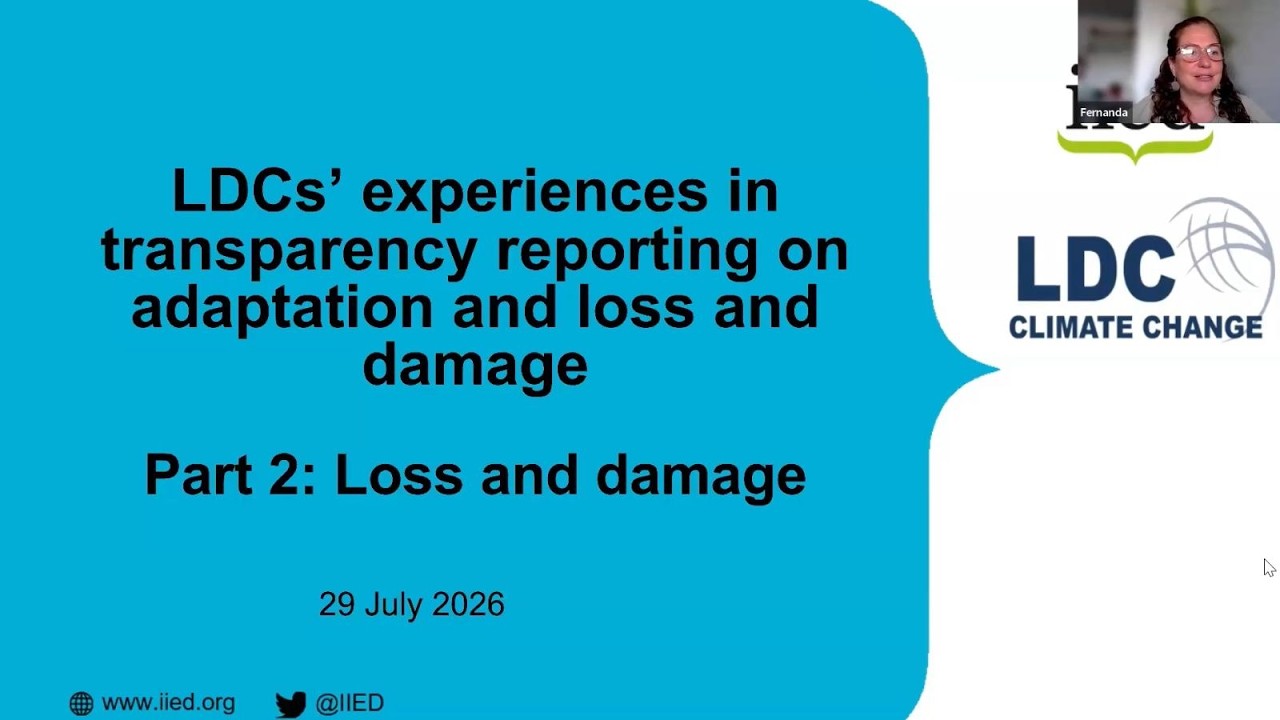
Expériences des PMA en matière de rapports de transparence, 2e partie : pertes et dommages
Watch on YouTubeVideo summary
This second webinar focused on the experiences of Least Developed Countries (LDCs) regarding transparency reports, specifically addressing the optional but crucial section on loss and damage associated with climate change. Hosted by Fernanda Alcobé from the International Institute for Environment and Development, the session aimed to provide concrete examples and encouragement for LDCs that have not yet included this data in their Biennial Transparency Reports (BTR). The primary objective was to demonstrate how voluntarily reporting losses can help vulnerable nations better articulate their needs, mobilize financial and technical support, and build a more realistic picture of climate impacts beyond standard greenhouse gas inventories.
Three experts from Madagascar, Zambia, and Malawi shared their national contexts and challenges. Experts highlighted that while loss and damage reporting is optional under the BTR framework, including it allows countries to document both economic losses—such as agricultural failures due to droughts or floods—and non-economic impacts like biodiversity loss, cultural heritage destruction, and human displacement. In Zambia, for instance, severe weather events have damaged critical infrastructure and reduced hydroelectric production, while also causing conflicts between communities and wildlife migrating during extreme conditions. Similarly, Madagascar emphasized that integrating this data is essential to capture the full reality of climate vulnerability in an island nation facing intense cyclones and coastal erosion.
Despite these clear benefits, all three countries faced significant hurdles in compiling comprehensive reports due to fragmented institutional systems, a lack of standardized methodologies for quantifying non-economic losses, and insufficient historical data series. The panelists explained that information is often scattered across various ministries and agencies without harmonized databases, making it difficult to distinguish climate-related impacts from other socio-economic factors or to track trends over time. To address these gaps, the nations are developing national frameworks aimed at improving coordination between stakeholders, establishing centralized monitoring systems, and creating standardized templates for future reporting cycles that will eventually cover a wider range of sectors including health, tourism, and energy.
The session concluded with practical advice for countries beginning their first transparency reports on loss and damage: start early even without perfect data, involve all relevant institutions from the outset to ensure coordination, and do not fear imperfection in initial submissions as they serve as vital starting points for institutional strengthening. The experts also discussed the potential role of citizen science approaches at the community level to gather reliable local data where official records are limited, particularly regarding non-economic losses that are hard to quantify monetarily. Ultimately, the webinar reinforced that while reporting on loss and damage requires overcoming substantial capacity and funding constraints, it is a necessary step for enhancing global transparency and ensuring vulnerable countries receive adequate support under international climate agreements.
Read the full video transcript
Hello,
thank you all for being with
us today.
We are about to begin this
second webinar on the experiences of
the least developed countries in
presenting transparency reports
on adaptation. On the one hand, there is
loss and harm. On the other hand,
today we will be talking about the
latter.
I will begin by introducing myself.
My name is Fernanda Alcobé. I
work in the climate diplomacy team
.
I work for the
International Institute for Environment and
Development. Welcome. We are
delighted to co-organize this series with the
PMA group.
As I mentioned, I work for
the International Institute for
Environment and Development and
we are delighted to be organizing this
two-part webinar series with the
LDC group
on preparing good
transparency reports. Last week,
we welcomed Ambassador
Suarez Barbosa,
Chair of the LDC Group, who
inaugurated this cycle
and the session on
adaptation reports.
As I said, today we are
going to talk about
loss and damage reports.
As you know, reports
come from transparency. are the only
instruments that
allow the country to provide information
to better understand, act and
support
the actors involved to avoid,
minimize and combat the losses and
damage associated with
climate change.
This cycle aims to offer ideas and
concrete examples to the other countries that
are here today. That's why
we're recording this season. We
also wish to encourage all
those who have not yet sent their B
and especially their section
on harm, prejudice
and adaptation.
Today, we welcome
extraordinary experts from Malaysia,
Madagascar, and Zambia.
I encourage them to turn on
their cameras now
and I will now feature them
on my screen.
I will be the moderator of this
panel. Today
we welcome Yamikani Idriss who
comes from Mala and who is the
chief negotiator for the group of
least developed countries.
He is busy at the moment, he will
join us a little later. That's
why I will be the
moderator during this panel. We
welcome Alenain,
she is the head of the database service
for monitoring and evaluation at the
national office for climate change and
RDD, plus everything at the Ministry of
Environment and
Sustainable Development. We also welcome
Gamboué Santongé,
who is the senior
green economy officer at the
business development department of the Ministry of
Green Economy and Environment
in Zambia.
Finally, we welcome Annie Mapangare. He is
the chief economist in the
disaster management department
.
She comes from Malaoui and she was
part of the team responsible for preparing the
Mala BTR report and she notably
worked on the section devoted to
losses and damages.
We encountered some
difficulties with Gamboué.
I think he's been disconnected. We'll
try to find him. Perfect. Thank you
so much.
While we wait for Gaboué,
I suggest we begin our
questions with the linear. Thank you for being
with us. Thank you Annie for being with us as well
.
First question.
We will be discussing the
loss and damage section in the BTR. This
section is optional in the BTR,
meaning that
information on
losses and damages does not necessarily have to be provided in the BTR.
So why did Madagascar
decide to include this information and
what is its objective in doing so?
Thank you very much, Father Landard.
Hello everyone. As
Fernanda said, my name is Alena, I
come from Madagascar.
I work at the National Office for
Climate Change and REDD+.
I was also part of the team
that worked on Madagascar's first BTR,
which was sent in March
2026.
So, thank you very much for inviting
Madagascar to participate in this webinar.
It's a pleasure to be with you
today.
Before answering the question,
I would like to provide you with a
general overview of the context on the island of
Madagascar.
Madagascar is one of the countries most
vulnerable to climate change.
We are already facing
stronger tropical cyclones,
floods,
droughts and coastal erosion. And
these phenomena lead to great
economic losses but also
non-economic impacts which include
loss of life, health problems, and
damage to the biodiversity of
ecosystems.
Thus, it is this reality that
encouraged us to integrate loss and
damage into BTA number 1.
Loss and
damage reports are optional under the
BTR, but Madagascar believes it is
crucial to include this information.
Indeed, this allows us to present
a more complete, more realistic picture
of the climate impacts affecting
our country. As a least
developed country, Madagascar considers the BTR
a valuable opportunity to make
a separate report on loss of
damages in relation to dating,
to document economic and
non-economic impacts, to identify
missing data and to strengthen
national systems.
The interpreter
apologizes; the speaker cannot be heard
.
The interpreter apologized, the speaker's sound cut out
credible information about
Lena. We
can no longer hear you.
That is why we did not hear
the last part of your
intervention, the part that
allowed you to give more
explanations on the losses and
damages and the importation of this
type of information for your country.
Could you repeat the end of your
answer? I apologize, my connection isn't
very good.
As I said, as a
less developed country, Madagascar sees
the BTR as an opportunity to present
a separate report on loss and
damage,
and credible information on
loss and damage can help
Madagascar put forward its
needs and mobilize support on
the financial, technical, and
capacity-building levels.
Thank you so much.
It is indeed important to see
all the advantages of reports, which
are not just a burden, since
these reports can present
opportunities to meet the needs of a
country. I see that Gamboué has
joined us. Welcome.
Can you hear us? Can
you hear me, Gambou?
Of course, I hear you.
Of course,
I'm on my phone
but I can switch to my
laptop.
No problem.
We know that the connection is not
always optimal.
And now
we listened to Alena who
explained why it was important to
submit loss and
damage reports. Why is it important
to include this section even though it
is optional?
We turn our attention to Zambia.
What losses and damages has
Zambia
faced? Were you able
to present information on all
the losses in the BTR?
Thank you so much.
Indeed, due to
the slow pace of
development, Zambia is suffering
economic and
non-economic losses and damages.
These repercussions have affected our
livelihoods, our ecosystems, our
infrastructure and the well-being of the
population.
What are the main
economic losses in Zambia? They will
initially focus on agriculture.
We have had poor harvests in particular
due to droughts and
prolonged flooding.
The government had to declare a state of
national disaster due to these
drought episodes.
This
has also affected
the resources available to us.
This also has repercussions in
the energy sector with a decrease
in hydroelectric production due to
low water levels in reservoirs.
Infrastructure has also been
affected by the floods, including
bridges, schools
and health facilities
which have been damaged by
floods and storms.
There are also
negative consequences for forestry,
biodiversity, and tourism, with a
decline in tourism revenue due to the
decline in wildlife populations
and the decrease in
water flow at
tourist sites such as
Victoria Falls. During periods of
severe drought,
we also see
non-economic losses.
These losses are difficult to
quantify in monetary terms, but
they are nonetheless significant.
These include
human losses due to flooding and conflict
with wildlife. There are other
extreme weather phenomena.
Because under those conditions, we know that
animals tend to move
towards communities. And this,
therefore, leads to conflicts.
Losses have also been recorded in
cultural heritage and
sacred sites. Community displacements have been noted,
particularly
in areas affected
by flooding. We were
also able to identify a loss of
traditional knowledge and
indigenous practices. We
can also cite a loss of
biodiversity, particularly
threatened plant and animal species.
Agriculture has also been severely
affected due to the testing episodes.
The farmers have lost a lot.
The demand places a lot of effort on the
local population and those
practicing agriculture.
These people find it difficult to turn away
from this activity because they have
practiced it all their lives.
Now, we will ask ourselves whether all
these losses were properly declared in the
report in the interest of
transparency. The answer is no.
We are a developing country
and I can say that not all losses
and damages have been fully
reported.
Like many
developing countries, Zambia's first report
focuses primarily on greenhouse gas inventories
, projects undertaken
in implementing
nationally determined contributions,
adaptation measures, and the
necessary support received.
It should be noted here that
loss and damage reporting is
still in its early stages for the
following reasons.
There is not yet a
standardized national database on this
subject.
It should be added that
historical data on climate losses
are scattered and fragmented between
different
institutions. Many non-
economic losses are not
regularly monitored.
Economic losses are often only
reported following a
major disaster.
This shows us the
existing shortcomings.
Excuse me, Gamb is intervening, Fernanda.
Could you please move closer to the
microphone so that the
interpreters can hear you better
? Sorry to have interrupted you.
I would also like to point out that
the report therefore only provides
partial information, relying
mainly on
available disaster statistics,
assessments, adaptation
to sector reports and
national communications.
It is now appropriate to mention the
main challenges encountered when
reporting losses and damages.
Several obstacles
hinder
the implementation of a comprehensive
loss and
damage reporting system in Zambia. First and foremost, we have
limited data availability, and
an absence of
long-term historical data series.
We have a lack of
reference information and
inconsistent sectoral data collection. In
Zambia,
we have institutions that
work on issues of loss
and damage.
Information is scattered and
perpetuated among various
institutions, including the Disaster
Management and Mitigation Unit
, the Zambia Meteorological Service
, the Ministry of Agriculture, the Ministry of Health, the
Water Resources Management Authority
, and the Statistics Agency of Zambia.
So all these institutions
are entities that fall under
different
realities and these given sets
are often not harmonized.
We also know of limitations
in terms of methodology. There is
currently no
nationally recognized methodology for
quantifying partridges in relation to climate.
Furthermore, it is difficult to
distinguish losses of
climatic origin from other
socio-economic factors.
Finally, the guidelines relating to
the assessment of non-economic losses
are limited.
Furthermore, we have
limited capacity and few experts trained
in assessing losses and damages.
limited expertise in
economic assessment and climate attribution
and insufficient institutional coordination
. We also face
constraints in terms of funding.
Resources are insufficient to conduct
comprehensive assessments.
Funding is limited for
data collection and
monitoring systems after a disaster.
We also have faulty tracking systems
.
There is no centralized system for
managing information related to
loss and damage. The integration
between
disaster risk reduction systems and
climate monitoring systems is limited.
So, what could I
recommend now? Excuse me for
interrupting you again, Gambouet.
I invite you to keep
the intervention on the recommendations
for the first set of questions.
This would allow us to move on to Annie,
if you agree, and we
would hear your recommendations in
the next section. Does it
work for you? Yes, no
problem. THANKS.
Thank you for these comments. It is also
important to emphasize that this is
the first time that countries have
reported their information on
losses and damages.
They will face many challenges
until methodologies have been
developed.
This is indeed a work in
progress. And one of the challenges you
mentioned is related to
institutional arrangements and the
difficulty in having a
monitoring system in place.
We have seen that in Malawi there is
a specific service that
deals with loss and
damage issues and it would therefore be
interesting to learn more about it.
What were these
institutional arrangements at Mala? How do
you work with other
stakeholders to obtain this
relevant information? Annie,
perhaps you could explain to us
how
things are going in Malaysia. THANKS.
Hello Fernanda, thank you for this
question and thank you for the invitation as
well. Please excuse the slight
delay. Hello everyone as well
.
So indeed, we have a disaster
risk management department in Mala
. In terms of institutional arrangements and
provisions at the
national level,
Mala has
a disaster risk management committee in place
. This is a
high-level entity
that includes secretaries responsible for
providing political guidance.
So, there's a sound problem with Annie.
The interpreter cannot hear.
We also have
technical committees on
disaster risk management and at the
district level, we then have
district committees for
disaster risk management. They ensure
coordination of activities related to
loss of damage and
disaster risk management.
And we lost blood again.
It seems we have lost,
unfortunately it would appear that she was
experiencing connection problems.
I see her back.
Sorry Annie, we lost track of time
for a few seconds. Are you
there? Yes, I think I'm
reconnecting.
THANKS.
We therefore have these
institutional arrangements at different levels, from the
national level, to the district level, and
even to the community level.
At the community level, therefore at the
grassroots level,
we have volunteers and
local disaster risk management committees.
In the event of a rapidly evolving situation,
the information is consolidated. So
at the local level, there is a report
which is made at the district level and this
last level submits the information
to the department of disaster management affairs
.
Malawiou has therefore adopted an approach
at both the national and
district levels. This is a
cluster approach.
So this consists of a
multi-sectoral coordination mechanism put in
place both at the national level and at the
district level. It brings together
government bodies,
agencies,
development partners, the private sector,
civil society organizations,
international NGOs and local NGOs.
This group is responsible for collecting and
synthesizing information from
the districts.
These institutional arrangements
allow Malawians
to collect and report
information regarding losses
and damages. There is a
proper flow of information between the
different levels.
There is also a possibility of
documenting the impacts of disasters.
These institutional arrangements have
also been established,
thus
complementing what already exists on the
ground. They allow for coordination
in terms of loss and
thank you very much. It is quite
interesting to see that information
is being transferred from communities to the
upper level of the country. This is truly an
exemplary example.
I turn to NAFTA, which has already
finalized the reporting process, and we
know that this is the first time for
Madagascar, as for many of your
countries. What were the main
difficulties and needs
identified for monitoring,
reporting, and recording
losses and damages?
And what do you plan to do before the
next BTR? Thank you so much.
Thank you very much for this question.
In reality, the report submission process
helped us identify
several important shortcomings.
Firstly, Madagascar does
not yet have a
fully harmonized system for
monitoring and reporting
on losses and damages. That's
our first difficulty. On the other
hand, information is very often
distributed across different sectors
and institutions.
On the other hand, data collection
after climatic events
is not always consistent.
That is why we have
missing information,
and this information is very
important because it mainly concerns
economic partners such as
the impacts on health,
ecosystems,
culture, and livelihoods.
It is therefore very difficult
to assess the extent
of the climate impact and to compare
the different impacts over time.
Another difficulty is
our limited technical capacity for
assessing slowly evolving phenomena
.
There are other difficulties, notably
our limited technical capabilities. It
was also difficult for our
team to assess
slowly evolving phenomena.
To fill this gap,
we plan first
to strengthen national
climate and socio-economic databases
. We also plan
to improve coordination between
institutions
and develop clear procedures
for collecting, proving, and sharing
information.
We need technical capacity
at both the national and local levels.
We also need to better integrate
climate risks and
losses into
sectoral and territorial planning.
What is very important is
international support in terms of
financial, technical and
capacity building.
This support is essential for us.
We consider this first BTR as an
important starting point. to
build a
stronger and more reliable national system over time.
So what are our main
difficulties
and
what are our difficulties
and the solution we wish to
implement to improve
the use of the BTR as a side.
Thank you very much, Lalina. We can see
that you have an
institutional arrangement, a framework, a system because that is
important, but it remains a
difficulty. I think this is a fairly
common difficulty for these
new sections.
And now, I turn my attention to
Zambia
in its BTR. The zombie wants to
develop a framework for breakthroughs and
harm. Can you
explain to us what this framework would look like
and whether it will provide
information on future BTRs?
How do you envision it?
THANKS. Please
, could you
speak louder or closer to the microphone
because we can't hear you well? Is it
better now? Of course,
that's true.
Zambia has proposed a framework for
loss and damage, and the objective
is to implement a
structured national system to assess,
monitor,
report and respond to
loss and damage caused by
climate change. In this
context, we are still quite in the preliminary stages.
It has been read so
far,
but it is still being
written.
As I said,
with this case, we hope to address
several problems. First, we
want to establish a
common national approach to identify and
assess the losses and damages that are due to
climate change. Second objective: to improve
coordination.
Third objective: to standardize
methodologies for measuring
economic and non-economic losses. We also
want to strengthen evidence-based
planning and
investments
to target resilience and recovery. We
wish to support access to
international climate finance,
particularly emerging financing mechanisms
for loss and damage.
We also wish to fulfill our
reporting obligations
under the enhanced transparency framework,
particularly for the BTR. This is how
we wish to structure
our framework into seven chapters.
The first part focuses on
governance and institutional provisions.
Chapter 2,
methodology for assessing
losses and damages.
We want to expand the
existing methodology.
Chapter 3,
data collection and
information management.
We also need to
establish a
centralized national database on losses and
damages,
and we hope that we will be able to
organize the
database through this framework. We
also need to standardize
report templates and indicators.
This is chapter 4 on MRV, tracking,
notification and verification.
We need to create indicators to
monitor
loss trends over time. We
also need
regular reporting procedures that
are adapted to the
national dating monitoring system.
Chapter 5 focuses more on
sector-specific assessments.
The sectors are as follows.
Agriculture, water resources,
energy,
forests, health,
infrastructure, tourism and
human settlements.
Chapter 6.
Evaluation of economic and non-economic losses,
and we will therefore differentiate between
economic losses and
economic losses. Final chapter:
financing and recovery.
We need to implement
mechanisms to identify
funding needs. We must also provide
guidance on
linking national budget assessments
,
disaster
insurance recovery planning, and
international climate finance opportunities.
What will our contribution be to the future
BTE?
One of the main objectives of the framework
is to improve the quality and
consistency of information available
for future BTRs.
Thus, these frameworks aim to generate standardized
national databases
on climate-related loss and damage
.
Another objective is to
report on
economic and non-economic losses
using agreed national methodologies
.
strengthen transparency
by documenting assumptions,
methodology and data sources;
accompany the presentation of adaptation reports
to make them more effective by
showing how one of the
climate impacts has evolved over
time and how interventions
reduce vulnerability.
Finally, the last objective is to provide
evidence to inform
national
adaptation planning, NDCs and other
reports
submitted under the
United Nations Convention on
Climate Change.
What is our situation?
What are our difficulties? As
seen in Zambia's first BTR
,
the country is still in the process
of finalizing this framework and
loss and damage reports
currently rely on
information from multiple
institutions.
There are difficulties because the data
is fragmented, the methodologies
are not consistent, and
the economic losers have not been
sufficiently assessed.
As drafted, this framework is a priority
for
improving future transparency reports
.
Thank you so much.
So we talked about your case,
your methodology, all the challenges and
difficulties in the
report presentation.
And now
Annie, let's
move on to actions to combat
loss and damage.
In the Malaoui BTR, you
presented several projects implemented
by the country for losses and
damages. Can you
tell us more about the main measures
you are currently implementing and
what the main areas are where
you need more support to
move forward and deliver the
next BTR reports? The
floor is yours.
Thank you, Fernanda.
Indeed, in the first BTR
of the Malaoui, several projects were
mentioned. These are projects that have been
implemented or are being
implemented on the subject of loss and
damage
and on the projects that have been put
forward. 50% focuses
on everything from providing
immediate humanitarian assistance after
an extreme weather event
by activating
provisional funding.
The other projects aim to put in
place systems and frameworks.
As for the main measures
we are
implementing,
there is, for example, the implementation of a
federated disaster risk management fund
to be able to proactively set aside
funds and
rebuild
critical infrastructure in the event of a disaster.
Another measure is to invest in
early warning systems, and we are
installing
automatic weather stations
and, at the community level, we
are installing early warning systems
.
We are also putting in place
systems, frameworks,
pilot projects for preventive action
and as we know, it is necessary to take
anticipatory measures before
disasters
and to ensure that people
who live in disaster-prone areas are safe. To
ensure their safety, we
are building
evacuation centers, which are
shelters for
temporary living.
At the district level,
we have set up
emergency centers for coordination in case
of emergency.
These infrastructures are put in place
in areas exposed to
disasters. What are the
key areas requiring increased support?
Most interventions have
primarily
focused on areas exposed to
extreme weather phenomena.
However,
the national multiple risks assessment
carried out in 2025 predicted that
other areas would be exposed to
extreme weather events in
the near future. Nothing is being done
to combat
climate change. Therefore, they should try to
extend interventions to other
areas that currently appear less
affected by the effects of
climate change in order to prevent and
minimize losses and damages
in these other areas.
We need an effect to maximize the
number of interventions in these areas.
We want to anticipate, prevent and reduce losses and damages
in these
areas and in these zones more
specifically; additional support
is needed
to make the
trust fund dedicated to
disaster risk management fully operational through
start-up funding.
Uh, to develop the information system
on disaster risk management
. We also want to
strengthen preventive measures.
We want to develop and strengthen
early warning systems at the
community level. As a country,
moreover,
we are
developing standardized operational procedures
in English and a framework
adapted to the local context for
post-disaster needs assessment
.
Thank you.
Thank you so much.
It seems that a lot of work
still needs to be done, but it
's good to see that you are very
well organized on your end.
Let's now move on to the final
session of this webinar.
As mentioned earlier, one of the
objectives of these webinars,
last week's on adaptation and
today's, is to
encourage
other countries, particularly LDCs, to
include the section on loss
and damage in their reporting as
part of transparency. Based on what
you have learned during your
own report-making process
, what advice would you give
to a country that is just beginning to
prepare its report? What
advice could you
give them? La linea, if you agree
to start. Thank you, Fernanda.
So if I had one piece of advice to give,
perhaps my first piece of advice would be
to start early.
If possible, all
key institutions should be involved from the outset.
It is not advisable to wait until we have
perfect data. You
can start using
the
available data. You can
use the best
available information and clearly explain
what the shortcomings were
in the
report presentation and how
the system can be improved step by step.
So, I recommend that you don't
wait until you have perfect data.
Furthermore,
it is important to develop
expertise at the national level.
Yes, hire an
external consultant.
However, I believe that the report, in
terms of transparency, should
help strengthen institutions for
future reporting.
We need to involve the
national teams in the system.
Finally, I would advise you to allow
sufficient time for the exam and
validation.
The first report
may not be perfect, but it will be
an excellent starting point
for greater transparency and
future
climate action. THANKS.
Thank you very much, Lalina.
Indeed, there is no need to be afraid to
start this reporting. Gambo, what
would the report be, sorry, what
advice would you give to a country that is
starting its report? THANKS.
I would recommend that they work on
coordination.
It is indeed important to
understand who does what and who should
do what.
This is essential.
This also makes it possible to know who has
what information.
The information
may be available, but it
may be available in other
formats. Some people may
not have this
information available when reporting. This is
an informational statement that is being
made. The information must be
able to be used and declared.
We also need to work on
capacity building.
So, we know that there will always be
people who are further ahead
on certain points. That is why
we need to develop this program
which allows
each other to know what
needs to be declared.
When we talk about non-economic losses,
we need to be clear about what we are
talking about.
It should be easy to insert this
information into
report submissions.
We also need to work on
existing assessments.
This type of assessment can be relied upon,
particularly in the field of
agriculture. There may be other
evaluations underway, organizations,
sorry, evaluations that are
more organized. We need
this assessment to see how the
loss and damage component
has been addressed and/or included.
Information may already have been
collected; it will
now be necessary to identify it,
and this information should constitute
a starting point for collecting
data. These are the tips
I could give to a new
country starting its reporting. THANKS.
Thank you very much, Gamboisé. Annie,
what advice would you be
able to give?
Thank you, Fernanda. I
believe that most of what I
wanted to say has already been stated.
Coordination is a key point.
It needs to be repeated.
Existing institutional arrangements
at the national level must be used to
ensure coordination
with key
stakeholders. Regarding the reporting of
losses and damages. Based on
our experience in Malaysia, the
information is available.
However, they appear at the level of
different services, different
agencies, different departments. It is
therefore necessary to bring together
all these stakeholders, all these
agencies that play a key role in
reporting, and this will allow us
to collect the
relevant information.
Even though reporting
in this area is optional, I believe
it has been quite positive for
Mala. These losses and damages must be reported
. This also helps us
to take stock, to
assess the progress made as a
country.
This allows us to know what
initiatives are underway and to identify
gaps. This allows us to know at
what level we need
additional support. This exercise, in
general, will help the country
to identify gaps and needs.
This is a process that will
also strengthen coordination
between institutions and
stakeholders.
At the international level, the inclusion of
this section is essential and
ensures the availability of adequate data and
information on loss
and damage in order to support
global dialogue. This also helps
to improve transparency and
strengthen collective understanding
of the challenges faced by
vulnerable countries. That's all I
could say on the matter.
Thank you.
Thank you very much, Annie.
Thank you for these perspectives
and thank you also for your
encouragement
towards that country. Thank you to all
three of you. Thank you for your contributions
and answers.
We have a question that was
asked
by
a participant. I'm going to read it to you and
we'll see who can answer it.
Annie, you've shared some
experiences, but I think the three of you
could answer.
A person wishes to know if the
least developed countries use data
provided by citizens or from the
general public for monitoring, given
that monitoring loss and damage
is voluntary.
This person was wondering if any
countries use a
citizen science approach for this monitoring.
I don't know if any of you
would like to answer.
So, are you using a
citizen science approach for
monitoring? Do
you use
information from the public to
report losses and damages?
Can I answer? Yes,
go ahead.
Within the
framework we are developing,
I have indicated that systems can
sometimes be biased
and it is important to see how
data is collected. Some
areas are broader, more extensive,
and require fairly
advanced technology to access information.
This information
is sometimes information that
needs to be obtained quickly.
This then constitutes an emergency situation.
We have not yet begun to
use such a citizen science approach
for
monitoring.
We do of course have to apply to the
public and also to certain
government departments and
ministries, particularly with regard to
data relating to loss and damage, but
we use the information
available in the context of
preparing the annual
transparency report. THANKS.
Thank you Gambouis.
We have very little time, but if
anyone else would like to add to the
answer to this question, please do so.
Laina,
thank you for this question.
Citizenship can play an
important role in collecting data on
harm loss, particularly
when official data is
limited.
In Madagascar, this data is already being
used in
local assessments.
However, they are not fully
integrated into the system in relation to
the report, even under the heading of
transparency.
We want to ensure that this
data is
reliable and well-founded.
In the future, we might be able to
develop this citizen-based approach
, particularly at the community level,
and I am thinking in particular of the case of
non-economic losses.
Thank you very much,
we are now coming to the end of our
webinar. I would like to
thank you all. Thank you for being with
us today. I know
you are very busy. Thank you
for sharing your experience with
us. We appreciate it greatly. I would
also like to thank the two
interpreters who provided
the interpretation to and from
English and French. Thank you for
being there. We hope that all
LDCs will be able to
report
on losses and damages during the
next BTR cycle. Thank you and see you
soon at the next webinar.
Bye.