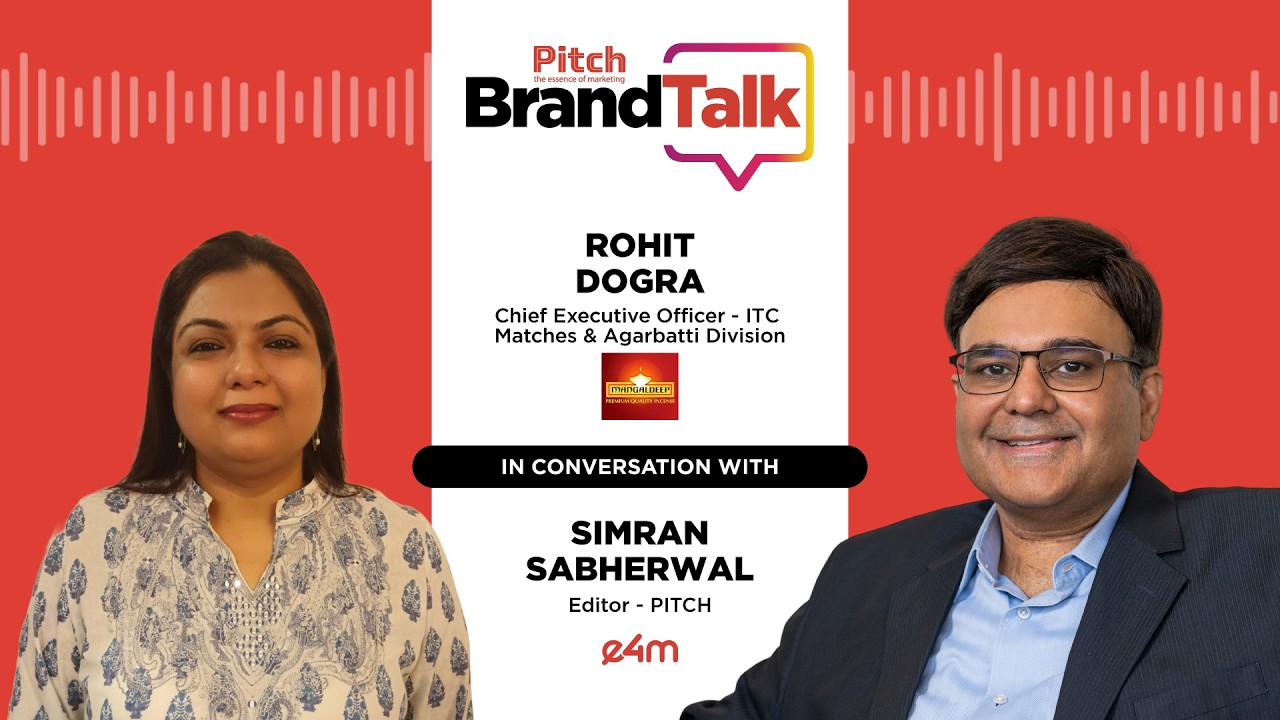
Exclusive: Pitch BrandTalk– Rohit Dogra, Chief Executive Officer - Matches & Agarbatti Division, ITC
Watch on YouTubeVideo summary
Rohit Dogra, the CEO of ITC's Matches and Agarbatti Division, reports that his brand has achieved significant milestones one year into his leadership, having transitioned from being the market leader by volume alone to also becoming the largest brand by value in India. The division is currently growing at a rate nearly double that of the overall industry, with both premium and popular portfolios performing exceptionally well across various formats and fragrance types. This sustained growth trajectory validates ITC's strategic "big bets," which include expanding their presence in new categories while maintaining strong performance in established segments like Anushri for mass markets and Sense for premium consumers seeking unique olfactory experiences.
A key focus of the interview is the evolution of marketing strategies, particularly regarding channel distribution and media mix adaptation to digital trends. Dogra highlights that e-commerce and quick commerce have become substantial opportunities where ITC commands market leadership shares, especially in their premium portfolio which initially targeted urban consumers with specific offers. While traditional mass media remains crucial due to the category's high household penetration of nearly 95%, the company has adopted a nuanced approach by combining TV scale with digital targeting to reach diverse consumer cohorts effectively. The strategy involves tailoring media investments based on product portfolios and city-specific objectives, ensuring that spending aligns with whether they are pushing mass brands or premium innovations like their new "Dazzle" matchbox line.
Innovation remains central to ITC's growth story, driven by a commitment to quality differentiation rather than just price hikes in stagnant categories like matches. The company has introduced superior carbonized matchsticks that last longer and do not break easily, offering a better consumer experience at higher price points while maintaining volume leadership through their mass segment. Beyond product improvements, the brand is heavily investing in experiential marketing during major festivals like Kumbh Mela and Deepotsav to create meaningful engagement for devotees who cannot physically travel to these events. Additionally, ITC leverages its CSR initiative involving visually impaired individuals as fragrance evaluators not only to fulfill social responsibility but also to gain unique market insights that drive innovation in scent discovery and product development.
Read the full video transcript
[music]
>> Hello and welcome to Pitch Brand Talk.
I'm Sunil Subramaniam.
I have with me today Mr. Rohit Gupta.
He's the CEO of Matches and Agarbatti
Division at ITC. Rohit, hi.
>> Hello.
>> Rohit, it's been a year since you took
over and I had the opportunity to
interview your predecessor before you
took over, Gaurav. And the statement
what he told me and what's uh what
really stayed with me was that ITC
Mangaldeep is the largest agarbatti
brand in the country by volume by
volume, sorry, and number two by value.
How has that changed a year on? What's
been the growth like?
>> Uh so we're growing almost double uh as
compared to the industry. We're
maintaining that track. Uh so we've
gained shares.
Uh we still are the largest brand by
volume. Um we are also now the largest
brand by value.
>> Okay.
>> And um and therefore uh the trajectory
which was there, it continues.
Whatever we had put out in terms of our
big bets, they are working fine. And
uh whether it is from a premium
portfolio perspective
or our popular portfolio,
all of those are growing very, very
well. And uh we are now growing our
presence across formats,
across fragrance types. So the story has
been good. Uh we've kept the pace. It'll
continue.
>> In terms of your growth in terms of
percentage, if you could share
something, what are we looking at in the
growth of the overall market and the
growth that ITC has seen?
>> So the market typically grows at about
uh 8 to 9%. Uh that's what the value
growth has been.
Uh
uh we see our growth in terms of value
to about uh 16, 17%. So that's what
we've
uh maintained.
Um in terms of volume, uh we had a
volumes we have had a different pace of
growth.
We've grown volumes as well ahead of the
industry. So, that's the ballpark that's
the number. And from a volume as well as
volume value as well as volume
perspective, we have kept pace in terms
of growth.
>> You've been a lifter at ITC and you've
moved across all the verticals, beat
tobacco, foods, and now at agarbatti.
So, any learnings that you have gotten
from the other category which you've
been implemented in this category
because at the end of the day, agarbatti
in India is associated with spirituality
and prayer, right? So, anything that
you've been able to get in from the
other categories here?
>> I think from an FMCG perspective,
the
the toolkit remains almost similar.
>> Similar.
>> Uh, there are category nuances, there
are category truths, uh, there are
discovery of how the consumers interact
with the category, why they buy.
Uh, there are consumer entry points
which have to be discovered and
therefore your offers and portfolios
crafted accordingly.
The toolkit remains the same. So, it's
not as if that I will have a learning
in one part of the business that I will
be able to deploy here very very
differentially.
We have a 5-year business plan.
And there is no discovery which happens
every year because we have a continuous
plan which is in deployment.
Uh, there are interesting things which
are happening in other categories in
terms of premiumization. That was
happening in agarbatti as well and we
had this business also had been
started that initiative ahead of the
industry and that's which is really
giving us dividends.
Uh, similarly in terms of channel, in
terms of your channel deployment,
similar experiences in other categories
as well which we have also kept pace
with.
So, just to put it in a nutshell, was
there something different that I was
able to do here as compared to what I
was doing in the other categories?
Well, there are certain channel specific
objectives which I've been able to drive
a little differently, but as I said, we
have a five-year plan.
We do that very comprehensively and we
cover all the points and all the
learnings which are coming in the other
categories are also given to this
business on an ongoing basis.
>> Now, you know, you mentioned that there
were some bets which have paid off over
the last years which you
ITC have
taken, premium being one of them. So,
could you please just elaborate on that?
And also now you mentioned,
you know, about the channel changes that
you have made in kind of redistribution
of the channel. Could you just
kind of elaborate on that?
>> So, e-commerce and quick commerce are
key opportunities which are there
for the entire industry.
While it was very very nascent a few
years ago, I think it's it's it's become
very very substantial. We are market
leaders in e-commerce.
And quick commerce as well. And all the
major platforms we have commanding
shares.
What we've seen is that
premium has been the first,
you know,
portfolio which really has been
addressed very well by these channels.
Because they address a certain type of
consumer and mainly they started off
being very very urban.
Their focus was on urban markets and
there was a certain type of consumer who
was looking out for specific offers.
I think they've done that very well in
terms of creating that reach. We have
been able to write that reach with our
premium products and that has made the
difference of from the premium
perspective.
In terms of
what we've been able to do over the last
one year is build upon that
trend.
Build upon the initial work which is
there, create more and more offers for
the premium consumers.
Uh that is giving a that is giving So,
what happens is that when a certain
channel really goes fast, the overall
portfolio mix changes.
Uh it changes the uh the uh profile and
the whether whether it's the uh you
know, profitability pool, whether it's
investments, it changes the profile of
the
uh focus of the business really.
So, I think we have been able to do that
well and uh that's the difference over
the last year that uh we are seeing.
But, that's also led by the
uh the growth in these channels. Now,
having said that,
uh even e-commerce and quick commerce
are becoming more
uh addressing a larger market. So, they
are looking at a larger portfolio
themselves because in terms of now they
are pretty much uh well distributed,
they are increasing their reach across
the country,
going to smaller towns as well. So, we
see that now that uh not only premium,
there are other offers which are
beginning to work from those platform
perspective. So, that's Yeah.
>> Price points.
>> across price points.
>> Now, I just want to take this question
further and come to your marketing
spends, right? How has that been
evolved? A lot of money is now going
being diverted from or rather
redistributed towards digital and
e-commerce, quick commerce platform?
[clears throat]
And what is the role of traditional
media then to you?
>> Uh first point is that the days of one
tentpole communication and one large
campaign, those are over.
Um uh
but there is a rule that for especially
agarbattis a very widely penetrated and
distributed category.
This category has almost 95%
penetration uh at an annual level into
household. So therefore the
role of mass media cannot be negated.
>> Correct.
>> So what we do now is a good mix of mass
media
and exploitation or working on the
digital platforms.
Now
it helps us one is in terms of reaching
out to the right consumer. In terms of
being able to target the right consumer.
It's very interesting because it's a
multitude of
smaller opportunities of reaching your
consumer.
And what you find is as per the cohort
different parts of the media mix works.
And that is exactly what we're doing.
It's a good mix that we're deploying.
So traditional media is there. We do use
TV. That's scale.
And
there are markets where our deployment
is quite intensive so far as mass media
is concerned. But we supplement that and
digital is increasingly becoming a large
part of our spend and our clay. And this
is not only from
marketing from a top level perspective
but also from the commerce channels
which is on the platforms, on quick
commerce platforms.
There is because in themselves they are
from discovery to purchase. I mean they
are channels which fulfill all the parts
of the
consumer's journey.
We find that we are doing a lot of work
on those platforms and spending on those
platforms as well.
>> But if you were to just say like right
now say so it's a 40% is going towards
digital, 30 towards TV. Is there a way
you could just give me an idea about
that?
>> I would because in terms of when you
talk about I would rather break it down
by portfolio. So if you talk about
portfolio in premium
a large chunk of it will be digital.
If you were to talk about our mass
brands, which are very widely penetrated
the large mass brands which are for
example Anushri.
Uh the most of the spending will be
going in mass communication. And so it's
a mix which is there.
As they say horses for courses, here we
will decide basis of the objective what
media mixes to be taken.
We will also decide basis of a certain
city into portfolio.
>> Okay.
>> What is the mix of media that we'll
take, whether it's digital, connected
TVs, and your
mass communication, print, press, and
everything. So it's it's it's it's a
nuanced answer. I can't give you a
specific number.
>> Now even if I were to look at your
overall portfolio, if you could just
explain to me is mass that continues to
be the largest uh
uh
is in terms of value, is it the largest
driver of is the largest uh
or is it the premium? Premium would
definitely be the largest driver of
growth in terms of percentage, but in
terms of volume is mass still the
biggest driver?
>> Mass is still the biggest driver.
Uh even in mass there is a lot of
interesting things happening in this
category.
Uh there is a lot of innovation coming
into mass as well as mid popular as we
call it, popular and mid popular. There
is a lot of work which is getting done
by us as well as competition in that
specific area.
Uh yes, premium is over indexed in
growth in terms of growth by you can say
4x, 5x in terms of what the growth is of
the overall industry.
But
the critical mass of this industry,
which is popular segment and uh the
mid popular segment, they're also
growing at a very decent clip.
>> I just want to confirm the size of the
market. The agarbatti market is
estimated
as we were speaking earlier is 1.4
billion and as per estimates it's
supposed to reach 2.2 billion by 2024
and uh the matchbox category is around
300 to 350 million, right? How much of
this is still unorganized?
>> Mhm, see it depends on state-by-state.
It is there is a lot of variation in the
unorganized versus
>> South will be more organized.
>> Correct and more consolidated. The urban
markets are more organized, more
consolidated. But
ballpark figure around 30 to 40% is
still unorganized
at the national level. 30 35% you can
take as an index.
Um
and
in terms of the large national players,
the consolidation is different by
different markets.
As I said, yeah.
>> The one reason about the unorganized
sector which I would like wanted to ask
you is last month there was a
notification put out against
you know which called for
which said that mosquito repellent
agarbattis were seen as a health hazard.
And then in December of last year the
Bureau of Indian Standards
uh they had you know come out with new
standards for safer product and
responsible practices and sustainability
as far as this industry is concerned.
This is a new initiative taken by the
government and BIS.
So what are your thoughts on that and
what is ITC Mangal Deep doing on this
front?
>> See I would separate out these two.
The on the mosquito batti which are
regulated
under specific
regulations, we are not part of that.
We
do not have
uh
the battis which have chemicals which
have mosquito repellency and are
synthetic or chemical.
Um
I just as a comment I think it's a good
step to regulate that because there in
that industry also, which is different
from our industry. There are a lot of
local players who might not be accessing
the right
ingredients. But, that is nothing to do
with the agarbatti and the incense
industry. The agarbatti and incense
industry, which is on devotional puja,
>> Correct.
>> those needs are fragrances, which are
traditional fragrances. Largely, there
is no issue in terms of the health
hazard or what you claim from the
mosquito battis and which is there.
Uh BIS put up uh it's very welcome step
that we BIS taken in terms of
uh
giving the industry standards.
Uh
ITC has been following that standards
earlier on as well. We have applied
those standards to ourselves before this
our fragrances in terms of their
compliances.
Uh when the BIS standards came up, uh
we welcomed them and we will ensure that
everything in our value chain, while it
is already conforming, we will go for
certification of BIS and that will be an
encouragement to the rest of the
industry as well.
Uh so, these are welcome standards. Um
there are good provisions in terms of
from a consumer point of view, giving
the best quality to the consumer. I
think these are great and we should be
as an industry working towards
delivering BIS standards. Uh what is
envisaged in that into our packaging and
into our products.
>> Just a while on the matchbox category,
where price point has been a big
challenge and this is probably one of
the few industries which has not seen
price points rise since I think the turn
of the century. But, ITC had taken a bet
and you doubled the price point from one
to two, as well as launched a premium
matchbox at the price point of 10 with a
nice name also, ITC Mangaldeep Dazzle.
Really nice, cool name. And I saw the
packaging which was also really cool.
So, how is this paid for you, and where
do you see this industry evolving?
Because the one of the as
we talk about spirituality, right? You
need to use
a matchbox to light it. I don't think so
we as Indians would use any other thing
other than a matchbox to light your joke
or your other buddy.
>> Yes.
>> So, how are you seeing this industry
evolve?
>> Uh
so,
we did not just increase the prices to
rupees two. What we are offering in our
rupees two is a differentiated consumer
experience.
Ours are one, the quality of the splints
that we put into the matchboxes is of a
much superior
offer which is there versus the rupee
one brands which are there.
Secondly, what we do is that we offer
longer sticks.
>> We appreciate the fact that consumer use
it not just for ordinary purposes.
Somebody would be using to light a diya.
Somebody would be using it to light
agarbatti or dhup.
Then we have given a longer matchstick.
>> Okay.
>> Which last longer. Second thing, the
important point is that it is
carbonized.
Which means that the stick does not
break. And therefore, what we are
offering at rupees two
is not just double the number of sticks
or it's not just same thing at the
rupees two. We are offering better
quality.
With a
with a stick experience which is going
to be very different as compared to the
end.
That is being us a significant amount of
dividend.
Uh the industry is not growing.
But what we find is that we have grown
almost
it's it's high uh
uh
I mean, I would say that it is
double-digit growth that we are seeing
so far as the value-added portfolio is
concerned, which is really a great
uh
uh way to go in the industry. It's
Industry is stagnant. We have grown on
the rupees two price point with the
differentiated offer of home lights.
Now, so far as Dazzle is concerned,
uh
we find that there are interesting
consumer feedbacks which are coming in
terms of how they use matchsticks.
>> Okay.
>> And in terms of the urban consumers,
where they're looking for
differentiation in their experiences.
And this is true for all categories.
In matches, we tried to understand what
that is. And for that, we crafted
Dazzle. In fact, hopefully this year you
should see a lot of interesting things
coming from Dazzle.
Uh we should really uh push that. And I
think that's a very, very interesting uh
space that is there. Niche,
but going fast. And
uh we are encouraged by the feedback
from our uh partners in e-commerce as
well.
So, Dazzle is a platform that we should
build upon in the future.
>> And similarly, innovations in the other
beauty space?
>> The innovations are there. Uh see,
innovations are there.
Uh this is a primary uh fragrance
delivery mechanism. So, there are lots
of innovations that we are doing in
fragrances,
um which is one aspect. Two is in terms
of the product format. That is something
that we have been working on in terms of
giving the uh innovations in terms of
the product formats.
And also from the point of view of
usage. On which occasions you use them?
And therefore,
there could be consumption occasions
like gifting, for example. That is an
innovation which we are doing. So, it's
not just about the So, their format
could be a
uh innovation. Your fragrance is an
innovation. And occasions of consumption
is also an innovation that you could uh
how you treat it on the channel, or
which channel you go to. Your channel
choices and what you do on them could
also to innovations.
Activation is also an innovation vector
for us and that is something that we
keep on trying to do something different
uh where we can get a more relevant and
meaningful consumer engagement and that
is also a point of innovation for us
when it comes to
our consumers.
>> I'll just come back to the activation
but let's talk about sense, right? Your
sub-brand sense. How is that doing
because that with that you also enter
into a new space which combines
spirituality, meditation but you're
bringing in global fragrances into
India. So, how has that fared and plans
for that?
>> Uh
so, it is something that we are highly
focused on.
Uh it is
uh doing very handsome
uh much higher than the rest of the
portfolio.
Uh it gives us uh we had a belief that
consumers are looking out for a
perfumistic different kind of
experiences
and that has been
uh we are very encouraged by the
consumer response to the same insight
that we had and it's uh growing
uh at a very very fast clip.
Um I think the uh if I were to put a
number to the overall consumer spends uh
on this category, we should be upwards
of 160 170 crores only on this.
>> Okay.
>> And
uh and that is something that is growing
very very fast.
Uh
we are continuing to uh
Uh so, from a mass and from a popular
perspective, there is our mainstay is
the clean one.
Which is a scent three in one which is
doing very very well uh in terms of
distribution
as well as in terms of repeat from a
consumer purchase point of view.
Uh we've taken this to our premium
offerings as well in scent cones and
sticks which are there deployed very
successfully so far as quick commerce is
concerned and e-commerce.
Uh we shall be working in terms of
broadbasing this portfolio.
Uh
I think our
uh our brand tagline
Dil Se Karo Baat Bhagwan Ke Saath, and
which
brings in that
you know, bit of individuality in my
devotion. I think scent is playing that
role for us
in making that real for the Indian
consumers. And Indian consumers are
evolving, and that's one bit which is
which is encouraging us, and we've kept
pace with the Indian consumers through
the scent portfolio.
>> Aroma Aroma therapy is
>> Not there exactly, but yes, from a
different experience altogether, scent
does it for you.
>> So, taking that talking about experience
further,
45 years back we had while we had the
Kumbh Mela and the Jagannath Puri,
brands were not really involved as
involved as what we have seen in the
last 5 years, right? The number of
brands
on ground engaging and activations has
kind of really increased manifold. In
fact, ITC Mangal Deep also won a Gold
Effie recently in the category ITC
Mangal Deep Ka Mahakumbh campaign where
you won it for brand experience. Now, we
were speaking on experience, what How do
you see the importance of experience and
spirituality,
and how are you working to build on it?
Because I would not, you know, 10 years
back also, I would not see this category
as a category which is around built
around experience.
So, how are you going about building it?
>> Uh
So, see experience because it's a it's a
uh experience of fragrance, and
therefore, if you were to really,
you know, do justice to that as as a
as a entity which brings these offers to
the consumers.
Um,
moving beyond traditional, moving beyond
the normal rose, mogra, and so on and so
forth, into the other territories that
we've gone into, and there we are seeing
a lot of success.
I think experience is a key part, and
therefore,
that has been the key learning that has
been there with us. If we continuously
work on consumer experience,
how we can improve that, I think we are
on the right path as a business.
Uh now, coming to these large festivals
which are there, these are the I mean,
that's the ultimate manifestation of
your, you know, devotion that you make
the journey.
These are
mass gatherings. I mean, the way India
turns up for these mass gatherings,
there is a lot of devotion, and there's
a lot of, you know, you are committed to
that.
Creates that environment where
if you have a meaningful idea, the
engagement can be of a very different
nature.
Our objective has always been that it's
not just about participation, it's also
about how we can create meaning behind
that engagement. So, whether it was
Kumbh Mela this year, we did the
Deepotsav in Ayodhya.
>> Okay.
>> Our objective is not to just,
you know,
put up our brand merchandising and all
of that. We actually make it relevant.
So, the idea was that if you're not in
Kumbh,
if you're not in Deepotsav,
what can you do to be a part of that?
And that is something that we understood
that there are a whole lot of people who
might not be able to go there for
whatever reason.
But how can you make it accessible?
Which is what we did, and therefore,
that created that engagement. Obviously,
we did a lot of activation in the
locations as well to create engagement.
That works from creating that brand
trust, from creating that,
you know, that
Mangaldeep stands for devotion. It just
helps us reinforce that point in a very
culturally
context is something very from a brand
standing point of view, it works for us
in long term.
>> Uh what are your plans for the festival
season? How are you looking at it?
>> So, we have specific offers coming up
this season.
Uh there are lots of interesting things
that the consumers will be seeing.
Uh apart from that, we have a very large
trade activation which has already been
deployed, uh which will see
um us
take the distribution forward for our
portfolio.
Um you know, it's always higher,
stronger, and better, so we try to do
that, and so that that is already in
play.
Uh in terms of our activations, we have
activation ideas so far as this festive
season is concerned, which will again
uh be brought to bear. And apart from
that, with our channel partners,
we have specific plans how do we make it
big this season.
>> Finally, you know, I saw your last
campaign, which was six cents campaign,
and this is one of the This campaign
actually, when I saw it, it brought a
smile to my face, which is something
which I can't say about a lot of ad
campaigns, where you are kind of
highlighted the message of, you know,
the visually impaired, and how important
they are part of your fragrance testing
team.
Now, I just What was the genesis of this
campaign, and uh
this I just also want to understand is
it part of your marketing initiative, a
CSR initiative, and how do you see such
initiatives also helping you
build brand ITC Mangaldeep?
>> Uh for us, it's a a CSR initiative. It
It is
It's an idea which
came about in '21, 2021, when we
started.
Uh a lot of people only see impairment,
but we saw an opportunity there in terms
of being able to tap into
uh
uh capabilities which are often
extraordinary nature.
>> Correct.
>> And that's what the film is actually
about.
>> Correct.
>> We use the lens of friendship to and a
simple discovery of that
uh you know
what we call as a superpower internally,
which is being able to discern and
I think it's a
So,
where you see impairment, we see
an opportunity to use a capability which
is of a different nature.
Now, that has
uh what we wanted to show was that since
2021, that has been the mainstay in
terms of our being able to offer newer
better and winning fragrances to the
Indian consumers.
The the film was just to tell that story
that you know, we felt it is a
compelling story that we want to share
with the Indian consumers.
Uh where
these 200 Now, there are about 200 of
these evaluators who are there with us.
These
uh folk are really making the difference
for us in the market.
It's It's something to inspire everybody
else as well that if you do this
I mean, go beyond
and look for interesting capabilities
which are there. You might find a new
vector of innovation, which we have in
six sense. And that has worked very well
for us
in in terms of being a part of the
business.
In terms of giving us insights on a
regular basis.
Uh
discovery of new things which is there,
being there to evaluate, you know, uh
how we stand versus competition, what
new we are offering, whether it works or
not.
I think it's been a key capability that
we've built over the last few years.
Uh while it is from a CSR perspective,
but for us it is giving value of
a different nature. So, far as the
business is concerned, we just wanted to
share that story.
>> One last
question because you just said
competition.
Um
one of your competitors, big
competitors, they've been very
aggressive when it comes to marketing
and they've also gone in the uh sports
direction. They've had the former MS
Dhoni as their ambassador. They've tied
up with an IPL team also and sponsors
for some of the
cricket tournaments. Would you also be
looking at that kind of route? Not just
not talking cricket, I'm talking about
sports sponsorship overall or any big
ticket
say sponsorship on TV, OTT, such
anything like that?
>> Mangaldeep has a certain set of
consumers. We have a certain we believe
that we are
who we connect to and how we connect
with them.
Our audiences are
obviously while this is the overall
incense industry, Mangaldeep also caters
to a certain audience. Certain type of
people like Mangaldeep for whatever it
offers and there is a profile of
consumers which we cater to.
We typically
do our associations. We typically
work in terms of sponsorships or whether
it is media presence.
Looking at those guys in mind in terms
of who are we catering to and therefore
how do we build this brand? We have an
an insight and there is a certain
direction that we want the brand to
take.
There is a direction that
the competitor that you were spoke
speaking about has taken. We find that
our activations,
our associations are of a different
nature because of the brand that we are.
So we don't rule out anything. I mean
from a reach perspective, from you know,
connect with the consumer.
Our objective is always to be
contextually
to find the best connect.
Our brand is about
Dil Se Karo Baat Bhagwan Ke Saath.
We are about being a partner in your
spiritual journey. being a partner in
your spiritual journey. We are being a
part of your prayer.
>> Thank you Rohit for your time with
>> Thank you. Thank you so much.