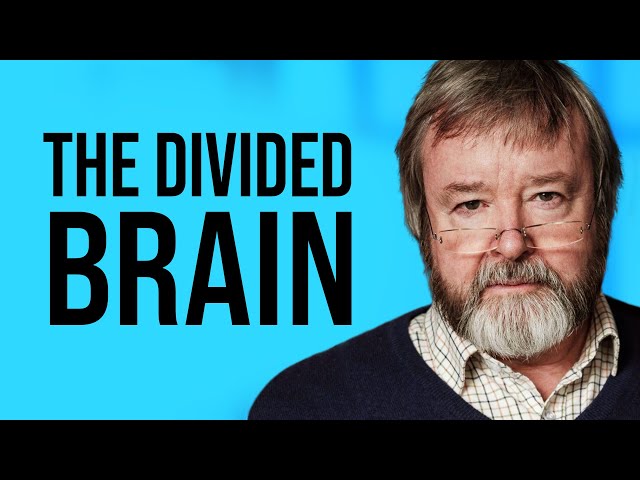
Everything You Know About the BRAIN is WRONG! Here’s How the Brain ACTUALLY Works | Iain McGilchrist
Watch on YouTubeVideo summary
Dr. Iain McGilchrist argues that a fundamental misunderstanding of human nature stems from an oversimplified view of brain function, specifically the popular notion of "left-brained" versus "right-brained" personalities. Drawing on research into split-brain patients who underwent callosotomy to treat severe epilepsy, he demonstrates that while cutting the corpus callosum—the bridge connecting the two hemispheres—can stop seizures, it reveals a profound duality in consciousness rather than simple specialization of tasks like math or art. The left hemisphere operates with intense focus on specific details and utility, often creating an "intentionally designed ignorance" to manage immediate survival needs by grabbing objects or solving problems quickly. In contrast, the right hemisphere maintains a holistic view of the world as it is presented in reality, attending to context, relationships, and meaning simultaneously. McGilchrist emphasizes that both hemispheres are essential for life; one must focus on details while remaining aware of the whole environment to avoid becoming prey or missing collaborative opportunities with others. The core philosophical argument posits that these two modes of attention represent a necessary synthesis rather than an antagonism between reason and emotion, science and faith, or mechanism and spirit. McGilchrist challenges the mechanistic worldview prevalent in modern culture, which reduces reality to static fragments and ignores the implicit nature of existence—a concept he links to physicists like David Bohm and Nicholas of Cusa. He asserts that while the left hemisphere deals with explicit representations (like diagrams or lists), it cannot comprehend flow, motion, or paradoxes such as Zeno's Achilles and the tortoise without destroying their dynamic quality into static points. True understanding requires a progression from right to left engagement followed by a return to the right, allowing one to re-embrace reality in its fullness rather than leaving with "meaningless fragments." This holistic approach is crucial for addressing existential crises, as relying solely on the atomistic view leads to destructive behaviors and a loss of wonder. McGilchrist further explores the intersection of neurology, philosophy, and physics to argue that science does not disprove spirituality but rather reveals its necessity when properly understood through epistemology—the study of how we know anything. He cites data showing that many top physicists are religious, suggesting that deep engagement with fundamental laws often leads to a sense of awe or the divine, contrary to popular stereotypes. The discussion distinguishes between knowing facts (savoir/wissen) and experiencing reality directly (connaître/kennen), arguing that profound truths like love, art, and morality belong to the latter category which is transrational rather than irrational. He critiques Jerry Coyne's "Faith versus Fact" by pointing out that avoiding epistemology renders such arguments invalid, as one cannot claim objective facts without first understanding how knowledge is constructed in the mind. The cosmos itself is described not just as an orderly system but as a beautiful whole where differentiation unfolds from unity and then returns to it, mirroring processes found in nature and human consciousness alike. Ultimately, McGilchrist calls for a societal awakening away from the arrogance of believing we can control or fully explain everything through reductionist methods. He highlights research indicating that social cohesion, connection with nature, and spiritual practices yield health benefits far superior to medical interventions like stopping smoking or exercising alone; these effects are not utilitarian but intrinsic to human well-being. The current cultural trajectory toward micro-control and competition is unsustainable because it ignores the collaborative aspects of life and the implicit connections binding us together. He urges listeners to cultivate humility, compassion, and a sense of awe, recognizing that happiness often arises when one sinks their own aims into those of others rather than pursuing them directly. By integrating these insights from science, philosophy, and spirituality, individuals can break free from destructive cycles and live in accordance with the true nature of reality, which is paradoxical yet coherent, implicit yet becoming explicit through our engagement with it.
Read the full video transcript
[music]
Dr. Iain McGilchrist, welcome to the
show. Thank you for joining me.
Oh, it's a pleasure, Tom.
Dude, I am really excited by your work.
I I'm obsessed with the brain. So, in
the early days of my career of
transitioning from feeling completely
lost and hopeless in my life to
realizing that just because I was
underperforming that day in my early 20s
did not mean that that had to be forever
the thing. What really gave me hope was
learning about the brain and brain
plasticity,
specifically. And that work led me to
V.S. Ramachandran, who I've actually had
on the show and just shaped by his work
in ways that I I can't convey. And now
encountering your ideas, which really
take the form and function of the brain
and
I don't know if you would say make
predictions as much as explain the
world, but for somebody like me who's so
far behind you in terms of research, it
it has this predictive quality of, you
know, my own thoughts and feelings, but
also societal movements. And in the
book, The Master and His Emissary, and
your new book, The Matter With Things,
you seem to really take the form and
function of the brain and spell out
some of the pathology that we're all
living through. And I find that idea
really interesting. And I want to start
with split-brain patients, which I think
will help us understand the difference
between the right hemisphere and the
left hemisphere, and the massive
confusion that people have by
oversimplifying the idea of what the
left and the right brains, as people
call it, do.
So, first, if you don't mind, just
defining what a split-brain patient is.
And then the idea of being able to
interrogate one hemisphere and then the
other and the differences that we see.
Yeah, sure. Well, the split brain brain
procedure
callosotomy as it's called
was
a technique devised in the 60s in
Caltech
to apply to patients whose lives were
effectively unlivable because of
epilepsy, severe epilepsy. And one of
the ways it was positive that you might
be able to make life more livable was to
stop a seizure spreading right across
the brain. If you cut the divide between
the two halves of the brain, you might
be able to do that. For those who are
not familiar with looking at brains, I
should point out that your brain is
deeply divided down the middle like a
walnut.
And there's only a commissure at the
bottom, the corpus callosum, that
connects the two Well, there are a
couple of other small commissures, but
effectively that's it.
[snorts]
And so the the brain works well as a
whole, but it's also quite clear that
the two parts need to be distinct as
well as working together.
Anyway, this procedure gave the
opportunity to enterprising
psychologists to find out a little bit
more about the differences between the
right and left hemispheres. And one of
the most
Really fast, before you go into that,
one thing one thing that I want to
understand is the corpus callosum is
passing what in the case of a seizure?
Electrical impulses? Like what what is
going on that that is passed?
Exactly that, electrical impulses. A
sort of electrical storm.
Instead of the the properly
massively complex coming and going of
stimuli that are correctly following
some kind of
uh
direction, you're just getting a massive
storm of electricity. It's like, you
know, blast the system.
And so people, you know, in the in the
worst cases lose consciousness
completely.
And sometimes people were having these
seizures more often than they were not,
actually. So, you can imagine their
lives were simply not livable.
So, it was a brave experiment.
And do do seizures start on one side
more frequently than the other? Like, is
this a it starts in the right hemisphere
and goes left or
They can start
from they usually, but not always, do
start from a focus. And that focus can
be in either left or right hemisphere.
And it it may be something that is just
an abnormality that's there from birth
in the way the brain was formed, or it
may be the result of some other uh,
in insult to the brain, as we say, that
has caused a problem in an area, and it
begins to act in a in a strange way,
giving off these rhythmical discharges.
Um,
and so, the point of the split-brain
procedure
problem that when you send out Sorry, is
the problem when you send out the
electrical impulse, the reason the next
one catches on fire is it has to do
something with that impulse, or is the
impulse saying, "You should specifically
be firing"?
Well,
you if you if you can imagine that
normally the connections between neurons
are
very cleverly gated. I I This was
something that fascinated me when I
started learning uh, in medical school.
Because the brain takes a lot of trouble
to be able to communicate very fast. So,
some nerve fibers are coated in myelin,
which is a white sheath, which makes it
the white matter in the brain. And most
of the long tracks that are really
connecting things,
uh, are
fast transmission.
And yet, you know, while it takes next
to no time for that to go from one end
of a neuron to the other, then there is
this clunky process where there's a gap
called the synapse between the the nerve
and the next nerve. And when the impulse
arrives at the end of the nerve, it
triggers the release of a
neurotransmitter, which then has to pass
across the gap, triggering something on
the end of the other neuron, and and
starting to send another signal. And I
used to think, "Well, this is very odd.
I mean, the brain's trying to do stuff
quickly, and it's actually managed to do
that down a nerve, but it's got this
clunky business of
gating. Either it will or it won't, and
it can be blocked or it can be enhanced
or it can be partially transmitted or or
wholly transmitted. So, you've got some
sort of control all the time at all
these billions of uh
synapses, trillions of synapses. So, uh
the answer is that when when a nerve
gets a stimulus from another nerve, it
will respond appropriately, but not
under these circumstances. Because
you've just got masses of nerve fibers
all together being overwhelmingly
excited. And so, you get inappropriate
excitation.
So,
um
I mean, by the way, a very, very little
of my research is based on what we learn
from split-brain patients, although it
is very interesting. Because you can
just find out a lot of different
the reason that I'm starting here,
just to explain the reason that I'm
starting with split-brain patients is I
don't think most people understand the
the real nuance of what you talk about
in your book and the way you lay it out
and will understand will be coming into
this interview with a deep understanding
of of what the hemispheres do, why they
are separated, what the purpose of the
corpus callosum is, what we learn by
snipping it, and, you know, getting into
the story of all this to really make
your work
accessible to a broad audience, I think
is is when we get into interrogating the
left hemisphere and the right hemisphere
and like the the pathology that have It
is so weird and so fascinating. I think
it will immediately open a gate to
people to say, "Your brain works some
kind of way. Like it has a form and a
function that you take for granted. You
don't realize that you're
misinterpreting the world." And this is
like my sort of core life thesis is
people mistake
emotion for objective truth.
And
as you begin to understand the brain,
you begin to realize how that comes to
pass.
And so forgive me cuz I know for you
this is like 101 or even pre-101, but I
think it'll help.
Well, we we can we can come on to your
last
supposition later cuz it's a very
interesting one.
Uh
but something that may not strike people
as very significant, but is and what I'd
like to say at this stage is that
everything that exists, not just
in the brain, but in physics, in the
world at large, in nature,
depends on a combination of division and
union. That just to be wholly unified is
not good. Just to be wholly divided and
atomistic is not good. There needs to be
the synthesis of union with division.
And I sometimes put it like this, it's
not that it should be either or. And
it's not that it has to be both and. We
need both
either or
and both and. Now, that might seem a
long way from what we were just talking
about, but it isn't. Because one of the
basic misunderstandings is that as it
were, these
uh brains are either war with one
another or are actually cooperating to
do the same thing.
They're They're doing either of those
things. They do compete and they do
collaborate. Actually, this is just like
the rest of nature. Although we've been
sold this story that nature is red in
tooth and claw and it's all about
competition and the rest of it. Most of
the history of the evolution of life is
to do with collaboration, which includes
at times competition. And so you see
competition, but you also see staggering
cooperation. And the cooperation and the
competition together make what I would
call collaboration. Now, the the two
hemispheres of the brain collaborate.
And
in order to do so, they have to be
different
but able to talk to one another. It's no
good having a team in which they both do
the same thing cuz then you've suddenly
lost the point. And it's no good having
one where they just both go off on their
own. So,
when they started cutting the corpus
callosum, what on earth is going to
happen to these people?
And
the interesting answer is that very much
less than had been anticipated. In other
words, people were surprisingly normal.
And that's partly because there were
lots of other ways in which the brain,
certainly by the time you're at the age
when you would have had this procedure,
you'd be a young adult probably. At that
stage, your both sides of the brain have
been stocked with information from the
other part as well.
But in the immediate aftermath of the
operation, there were some famously odd
instances like somebody
um picking up a book with one hand and
the other one closing, taking away and
putting it down. Or a woman going to a
cupboard to get a dress out and reaching
with her right hand and her left hand
coming over, taking the dress and
putting it back on the hook. So, clearly
there were two different kind of views
of of life going on here. And one of the
more robust uh
differences actually is can be put in
this way that it's like
two different approaches to the world.
In a way rather like two different
persons, two different personalities.
So, that one character prefers this kind
of thing, the other character prefers
another.
But, what it is not is what was often
said at the time, which was
that the left hemisphere seemed to be
rational and a bit cold, uh but it
leaves it with reliable, a bit like a
boring accountant. And the right
hemisphere was way off its head
somewhere, um uh creating wonderful
pictures, but really needing anchoring
down cuz it was a bit pink and fluffy
and didn't know how to get on with the
business. Now, that is just completely
untrue. And even a slightly more
sophisticated idea of that which
lingered for a long time, which was that
like maths and reasoning go on in the
left hemisphere, and pictures and
emotions go on in the right hemisphere.
These are also completely wrong, okay?
Because both hemispheres do everything
in some way. But, it's all about that in
some way. It's the how, not the what.
So, they they do the what of the same
things, but they do the how of them
completely differently.
Now, why is that?
Well, I don't know any better
explanation than the one I put forward
in that book, um which is that every
animal, every organism that we know of
has to do two competing things to stay
alive. It has to eat, and it has not to
be eaten.
And actually, that's more difficult than
it sounds because in order to utilize
the environment, manipulate it for your
own good, like get something to eat,
pick up a twig to build a nest, or uh
you know, whatever it might be, you need
to pay a certain kind of already
committed attention to some very
perspicuous detail, highly focused but
very narrow beam attention.
If that's the only attention you paid,
then you quickly end up being someone
else's lunch
instead of getting your own because all
around you there are other things going
on. Some of them,
as we say, as I have said, competitive,
so a predator, but some of them,
you know,
collaborative, like this is my mate. I
need to keep an eye on her, make sure
she gets some food, too, my little ones,
whatever it is. So, however you look at
it, you have to have these two different
ways of being in the world at once, and
this is what the hemispheres make
possible for us.
Because attention is much more
significant than
it sounds.
I I It took me a while.
You call attention a moral act.
Yes, I do.
And that's because it
I'd be curious to to understand, does
that tie into this more mechanistic stay
alive thing or or is that going to
sort of prematurely for where I want to
take the conversation open us up into
a much broader place?
We can go there, but but we if you want
to talk about the nitty-gritty side
first briefly, then
Yeah, I think
Yeah.
[laughter]
Let's stay nitty-gritty for a second.
Okay.
Well, I think the point there is that we
attention
is, as I say, something that sounds like
one of those
cognitive functions that people talk
about. A cognitive function. I love it.
It's basically like a not very efficient
procedure that a computer would do
better.
But a computer can't attend at all.
Attending, it can do all sorts of
things. It can't conceivably attend
because what attending means is a way of
disposing your consciousness towards the
world. It's the how of your
consciousness. Now, if you are in a
certain frame of mind or you have a
certain purpose in mind or you just a
certain kind of person or it's just one
of those days, you may have a very
driven manipulative attitude in which
you see things as stuff to get, to grab
quickly, hoard, use, you know, whatever.
But you may on another day actually
think, "This is madness. This is no kind
of a wisdom. Actually, there's a a whole
vibrant living world there that I need
to be connected to and listening to. And
it is speaking to me and I need to speak
to it." So, I'm going right from the
most nitty-gritty to the
[laughter]
the most philosophical, if you like. But
what I basically realized quite early is
that how you attend to something changes
what there is in the world. At least the
the weaker claim is what there is for
you in the world.
We may get but we might have a lot of
time to get there to the point where I
can explain that I believe that it
doesn't just make a difference to what I
find in the world but to what actually
exists as well.
Um to a degree.
Yeah, that that's big and and we will
certainly get to that but one thing
before we go off the corpus callosum and
splitting it, I like to ask because this
if this is true, this feels
extraordinarily revelatory to me which
is that there was a split brain patient
and one half of the brain and you even
said I heard you say that you can think
of the different hemispheres almost as
having their own personalities and in
the split brain patient that I'm
thinking of,
one half was devoutly religious and the
other half was devoutly atheist
in the same brain.
That that's what
And what I would like to know, can you
verify?
Yeah, that's one of Ramachandran's
patients. Um and and Ramachandran is one
of the the the the great neurologists, I
think, because unlike so many, he's able
to see beyond the wiring diagram. You
need to know that, but he's not shy of
seeing that this actually has something
to do with living human beings. Now, I
can tell you an awful lot of
neuroscientists don't think that.
[snorts]
And so
I mean, I came to science from a
background in the humanities,
philosophy, literature, you know, art.
And I then studied medicine, went into
the neurology psychiatry interface. And
so [snorts] I approached medicine right
away as about human beings and their
lives, not just about mechanisms. But an
awful lot of people
were very good at the technical side.
Perhaps I I then never trained with
patients or only experimentally.
And they kind of see the mechanisms as
very interesting in the abstract and
what you'd see down a microscope or with
a particular investigation, but they are
very uncomfortable about
uh about [snorts] applying that to real
people. And he says, "Mike Gazzaniga is
a lovely guy and I respect him greatly,
but we interviewed him for a film about
my work called The Divided Brain." And
he [snorts] he's a man who's, you know,
mainly lived in in the world of the lab.
And he said, "Um you know, he takes all
these findings from neurology and then
applies them to real living people in
the world. And I'm not comfortable with
that." And I'm thinking, "Oh my god,
[laughter]
you said it." Uh but anyway,
um
he then says,
"The brain's just a machine, get over
it." Well, my 1,600 pages that's just
about to come out is
devoted to the idea that that is just
nowhere near sophisticated enough an
approach, but we may get there later.
So, the trouble is we're dotting around
a lot and I don't know where you want me
to go quite [laughter] next.
Cuz think I think going into that is
Let's let's go into that. So, why So,
now that we understand that there are
these very profound implications to the
way that the brain is split. And I'm
going to sort of recap what we just went
over, and then we'll go into
um why our sort of current under
understanding, if we're taking a
mechanistic look at this, is is wrong.
So, we've got this brain, it's split in
half. Nature did not do that on
accident. In fact, if you look back just
an obscene amount of time through the
evolutionary tree down to like worms and
nematodes and all that, they all have
split brains that are asymmetrical. So,
this was something that we happened upon
very early. Your thesis on why we ended
up there is because the these the how of
of it all. Uh the great example you give
is that you have to both focus in on
something very specific. How I can grab
this branch, how I can get this seed,
but also more broadly to make sure that
I'm not eaten. And so, I think that will
land for everybody. I think they're
going to really understand that.
Yeah.
But there are other deep complexities,
and as we begin to think about how much
information is that the two hemispheres
are really working together, and you go
to great lengths in the emissary, and uh
his
the master and his emissary, um you go
into great detail about how what ends up
happening is the emissary, so the
hyper-focused, really looking at
something specific, but in danger of
losing track of the whole,
because of its layer of intentional
designed ignorance, unfortunately begins
to think of itself as the master. And
like, I I know more. I don't need all
this nuance. I don't need all this
holistic view. Like, come on. It's It's
a branch, you grab it, it's a seed, you
eat it. And because of that, there's a
tendency for that to run away with
things. And so, we have this competition
and collaboration between the two that's
really finely tuned, very sensitive to
perturbation, and we're going to get
into what those perturbations are and
how they go pathological. But, okay. So,
now we have this grasp of all right, we
have a mind it's intentionally divided.
One side can be religious, the other
not. One side can grab the dress, the
other can put it away. So, we know
there's there's like this inhibitory
signal that's often going between the
two. So, a lot of what's happening in
the brain is ah
I've got it. Back off. Let me deal with
it.
And
as we begin to take in that richness,
the complexity,
we now realize that we have to extend
our understanding. So, now I want to
understand because it's very easy to
grasp the mechanistic. It is very easy
to get excited when a neuroscientist or
anybody gives you an atomized view of
the brain and says, "The left does this,
the right does this." And yay, everybody
feels like they understand.
Yeah.
What's really going on? If that atomized
view isn't accurate, what's really
happening? Especially with the we're
creating the world as much as the like
there is a physical reality.
Let me ask you a question. Do you know
the difference between someone who
crushes big goals in their life year in
and year out and someone who can't seem
to get ahead?
What is up my friends? Tom Bilyeu here.
In my opinion, there are seven
strategies that you must use in order to
achieve any goal. The more of them that
you can take action on, the greater the
chance that you'll achieve your goal. I
say that the difference between someone
who is an overachiever and someone who
fails to hit their goals is that the
overachiever does everything they can
possibly do to be successful. I said a
second ago that there are seven
strategies you must use to hit any goal.
I'll be teaching them later this month
on a live workshop called how to make
any goal stick. Great news is, [music]
it's a process it can be taught and you
can deploy it in your own life and you
can register for this workshop by going
to this link. I'll tell you though right
now quickly what they are. First,
extreme [music]
clarity and focus. The average person
fails to achieve their goals not because
they didn't put in effort but because
they don't actually know what it is that
they're trying to accomplish. They're
not focused on exactly what they want.
Second, massive excitement [music] and
motivation. There are two things that
motivate us, pleasure and pain. Most
people don't properly leverage pain and
negative emotions which [music] means
that they're only half as motivated as
they could be or at least they're only
using half of the tools of somebody else
that [music] finds their way to success.
Third is desire.
Fourth is massive [music] pressure and
this goes back to that idea of negative
emotions. If you use it the right way,
fear of failure can actually be a very
useful thing.
[music]
Fifth, coming up with the right
strategy. Sixth, avoiding the trap of
overthinking rather than taking fast,
aggressive action. [music] And finally,
evaluating your progress, building grit
and adjusting your course. That loop is
critical. In fact, that last part is
what I call the physics of progress.
[music]
If you fail to do that, you will never
make progress. All right, these are the
seven steps that I'm going to walk
through in much greater detail on my
live workshop how to make any goal
stick. So, go to the link on your screen
or click the button below to [music]
register. All right, my friend. I will
see you soon. Take care and be
legendary. Peace.
Yeah, yeah.
Yeah, I used the image of the person or
the personality on Craig Good Authority
because
um there's a researcher called Onur
Güntürkün in Germany who won Germany's
most prestigious prize for science which
is basically all about the differences
between the two hemispheres. And he uh
he wrote in Die
that I was right to see this as
effectively two personalities that
have different ways of thinking. But
when you come to imagine daily life,
what is the truth about
something quite simple like where I
live? I'm surrounded by mountains. This
mountain, is it just a lump of rock?
Well, you could say that.
Uh, is it, um, a beautiful shape that
can be drawn? Is it a marvelous example
of columnar basalt formation? Uh, is it,
um,
a means of somebody getting wealthy by
exploiting it? Is it the home of the
gods as it was to the Picts uh, who
lived under it? Uh, you know, what what
which is the truth? And the answer is
all of these things have a type of
truth. And it's no good saying, "Oh,
well, it's just really a lump of rock."
Because that's just to jump into a
certain very subjective point of view.
It sounds subjective, but it's really
just a very narrow point of view in
which everything that you know about
that mountain, everything you
experienced with that mountain has been
cut off so that you can say it's just a
lump of rock. Now, it's that mentality
that I want to get away from and beyond
because it's not sophisticated, it's
destroying the world because we
misunderstand who we are and what the
world in which we live is because of
this
uh, allegiance to the left hemisphere's
take. And you alluded to the story of
the master and his amanuensis. And this
is a story where the master is the right
hemisphere and the amanuensis is the
left hemisphere. And in that situation,
the master knows the big picture and
just wants the amanuensis to go and do a
particular job. But exactly because it
knows so little, it thinks it knows
everything. Now, in most of the cultures
of the and tribes therefore to depose
the the master.
And so you do get this rebellion. And in
every culture that I've looked at around
the world from the circumpolar regions
through uh, China, India, um
the uh
native uh peoples of America and all the
rest, you find stories which are myths
about this antagonism between
two beings that are related. They're
like brothers or they they have a
a relationship, but the one that knows
least thinks it knows everything and as
a result of that civilization goes to
ruin. In fact, I actually found that
there is a phrase in the I Ching that
says precisely this, which is wonderful.
And also in the Secret of the Golden
Flower. So,
what what I say about attention is that
it changes the world and it changes you.
So, the kind of attention you pay
customarily changes who you become. And
and that has moral implications for you
and for the world. So, how we attend
And I'm not the only person who said
this. I think Simone Weil, who you know,
people
probably know the French philosopher of
the last century said something very
similar
to that.
Um but anyway, there we are. So, where
would you like us to take the story
next?
[snorts]
Yeah, so the I I want to dwell on this
idea of
um co-creation. I don't know if you
would use that word, but the idea so I
love the quote and I've heard you say it
and I've used it many times, which is
that it doesn't matter what you look at,
it matters what you see.
And in that statement implies that you
can choose to see something else. And
that in all of your work, I would say
that there's an underlying idea that we
can choose, perhaps through great
effort, but that we can choose to either
over index on the left or begin to swing
back to the right. So, we can either let
the world be created by the emissary,
which your thesis is basically what
we're doing right now. Um or it can we
can swing back to the right and and take
this more holistic view.
So, one of those ideas is easier to
understand. I think most people are
going to get this idea of holistic
versus hyper-specific, the the sum total
of a mountain versus the ability to
extract or from it, right? So,
extracting or is the left hemisphere,
wants to know what's usable, how do I
grasp it? The you can have a uh
communion with nature by being on the
mountain. You can see a vista that
leaves you in awe by climbing up the
mountain. You can get in better health
by scaling the mountain. You could have
a picnic on the mountain with someone
that you love. All of those things are
part of the whole and certainly get lost
in the exploitation. Yeah, I think
people are going to take to that very
easily.
Um
and I think is is is amazing language
for people to understand some of the
cultural difficulties that we're having
right now, which we will get to. Uh but
the part that I think is more difficult
is that
you're very clear to say there is
objective reality, but you're also very
clear to say, but there is also
co-creation going on.
In the mind and the outside world
together sort of shaping each other and
creating this this whole. Help me better
understand that.
Yeah. Uh which is a very important point
and it's related to two things I just
wanted to
gloss when you were talking there. That
um one is that
we could get carried away with the idea
that somehow this
uh
beautiful communion with the mountain
was a little bit airy-fairy, but I'm not
talking about that at all. I'm talking
about
a really much more sophisticated
philosophical understanding of what uh
environment is. It it and interestingly,
the the emotional brain is
as much the left hemisphere as the
right. It specializes in anger,
irritability,
uh and uh doesn't like being crossed.
And so it's not a cool customer, and it
is less rational than the right
hemisphere. Get that. It it It certainly
helps us reason, but the reasonable
conclusions about reality need to be
formed by the right hemisphere. In the
absence of the right hemisphere, we're
really into the territory of delusions,
hallucinations, and all the fascinating
psychopathology that you were hinting at
earlier. And I write a lot about that in
this new book. So, yes, there's that.
But the other thing is that we shouldn't
think of it as an antagonism, because
that would be the left hemisphere's way
between the unified picture and the more
differentiated, divided picture. It is a
union of the unified picture with the
more differentiated, divided picture.
And I see the whole business of the
cosmos,
um you may say, "Well, how can you use
that phrase?" But that would take me
another talk, but I see that there's a
drive. There's something that drives
this cosmos.
Uh there's no question of that. It's
It's doing something. And what it's
mainly doing is differentiating. So, if
you imagine a complete ball of
everything the same, it goes out like
some amazing flower that is unfolding
and showing all these things. It's not
destroying that flower. It's not taking
it apart. It's unpacking it and
unfolding it.
So, in a phrase that David Bohm, the
philosopher and physicist, used, this is
an implicit
world, and it nature
is the business of
beginning to make it more explicit, but
nonetheless taking it back into the
realm of the implicit in the end, so
that that's not lost. Can I just say
something about that, because
a very key point is that the implicit is
not somehow the explicit that we haven't
been clear enough about.
[snorts]
The clarity is illusory when we're
explicit. It comes from the fact that
we've cut away almost all the meaning
from something and are just left with
one little idea. When we
are dealing with with the things that
are most profound to us, to love, to uh
feelings for nature, to religion, to the
things that move us and make us morally
motivated, these things are not easy to
put into a simple phrase. And that's why
we have the greatness of art. That's why
we have poetry and narrative and myth
and drama and music and great buildings
and and these express these things in an
implicit way. If you say, "Well, what
does it really mean?" then I'm reduced
to kind of a handful of platitudes,
which don't really help you at all
because now you've lost it. You had to
be in communion with that thing and not
something else that I'm paraphrasing. It
The easiest way to think of this is it's
like humor. You know, you tell a joke
and [snorts] if somebody says, "I don't
get the joke." and then you explain it,
they go, "Oh, huh huh."
Uh because once you've explained a joke,
it's completely gone dead. So,
implicitness is very important. And let
me give you a very practical example,
which I'm afraid I often use, but there
you go. I think it's because it is very
helpful. Anyone who has ever played a
musical instrument knows this sequence.
You think, "That's a really great piece.
I want to play that." So, [snorts] you
sort of bond with it and you try to play
it. So far, we're in the realm of the
right hemisphere encountering something
new because the left hemisphere deals
with things in a way, "Oh, I see. It's
familiar. It goes into that box or
category." Whereas when it's still new
and unique, the right hemisphere is is
is encountering it.
[snorts]
And then some part of you says, "Yeah,
but if I'm going to make any headway
with this, I've really got to practice
that difficult passage at bar 24 or
whatever it is. And I see at this point
we get a return to the tonic or you
know, whatever it might be.
Um [snorts]
but then that helps you
be a much better performer. But when you
go and perform it, when you go out onto
the stage, you must forget all of that.
Cuz if you even think about it for a
fraction of a second, the performance
will have gone. So that doesn't make it
a waste of time this business of
explicitness. It's creative in its own
way, but only as an intermediary phase.
So that I often talk about this
progression from right to left and back
to right again.
What I mean by that is that you begin
with the engagement. You then send stuff
to the left hemisphere to get unpacked a
bit, and then you take that unpacking
back into a whole. And if you don't, and
at the moment we go from right to left
and then stop there, you're left with a
heap of meaningless fragments. Because
if you're constantly paying piecemeal
attention to things because you want
them and grasp them and manipulate them,
not to understand them, then you end up
with a world that is just a heap of
atomistic fragments
that seem static and dead. Whereas with
the left hemisphere, you see that
they're never actually static and
they're never actually dead. They're
living, flowing, changing, and
ultimately interconnected.
But just to round this off, it's not
that I think we should just go, "Oh, all
is one."
That's true up to point, but it's
importantly half of the story. The other
half of the story is all is many.
And that's why we have this
thing in Oriental philosophy of the one
and the many.
And as I say, you don't become more
whole by getting rid of the parts. You
get more whole by bringing the parts
together with the whole and make you
know, so that in Bohm's terms, you are
making what is implicit explicit and
then re-embracing it in the
implicit.
And interestingly, there is a 15th
century
uh actually scientist, I mean, he's
probably one of the first modern
scientists,
um discovered some things that were only
proved in the 19th century, but he was
also theologian
and I think one of the great thinkers of
all time called Nicholas of Cusa. He's
sometimes called Cusanus, which is his
Latin name.
But uh he's worth finding out more about
for any listeners. Uh but he actually
had already seen this process that is in
a way embodied in the brain, is also
embodied in physics.
And this structure,
what's exciting me about my new book is
that I use three main pathways to
examine
what is the world and who are we.
One is neurology.
One is philosophy, and one is physics.
And from these three starting points,
around if you imagine the globe, and
they're far, far apart from one another.
As you as we say drill down, as you get
closer and deeper, you find the same
pictures and the same patterns coming.
They're not neurology and theology
are not
at war with one another. They are seeing
the same realities just at slightly
different levels and in different ways.
Okay, you you have to take us in deeper.
That is so fascinating. So, one, why
those three? Be please be very specific.
Uh and then two,
in from the left side of my brain, it
really does feel like they are at war.
It it feels often super jarring when I
find a scientist who is deeply
religious.
And I would love to better understand
your take on that.
Well, yes. I mean, just an interesting
aside on that. Um
a book-length study has been made of all
the Nobel Prize winners since 1900 when
the prize was instigated.
And uh
they're asked about their religious
beliefs amongst other things. And anyone
who says that they were ever at any time
an agnostic even doesn't count as being
religious.
Well, when you look at these people over
the last 100 years or more, what you
find is that those in the humanities
uh
a good third of them say, you know, that
that they they have no no time with
religion. As you go into science, the
heart of the science, the more religious
people become. So, biologists at
something like only 7.
6% or 7.8%
uh fall into this uh atheistic category.
Um
and then when you come to chemistry,
it's uh I think six something, and in
physics, it's 4.
8 or something like that. So, 95.2%
of all the really top physicists
um
were religious. And and I've looked at
their lives and read their stories.
There's no question about this. When you
get into the realm of physics, you have
to be a bit of a dumb chuck not to think
that there's possibly something in this
idea that the world may be divine.
Uh and there's nothing in science that
tells us that it isn't. Science doesn't
deal with that kind of thing. There's a
chap called Jerry Coyne who got famous
for writing a book called Faith versus
Fact.
[snorts]
And he starts, I think, on page one by
saying, "I'm not going to go into
epistemology, you know, which was the
the study of how we know anything.
I'm just going to say a fact is a fact,
and if it's not a fact, then it isn't
true."
[snorts]
And I sort of feel like saying, you
know,
"Okay, mate, but if you're going to
really stay clear of what he calls the
murky waters of epistemology to that
extent, why waste your time writing the
book? Because it's
[laughter]
it's only possible to write it if you
start to understand what understanding
is and where it comes from." So, the
answer to why those three,
there are three things that have always
fascinated me, but I can't pretend in
any way to be in any way to be a
physicist.
Um what I do, though, is I'm fairly
cautious with the physics. Um I rely on
about eight or 10
highly respected physicists and what
they say, and I have a little group of
what I call friendly physicists with
whom I exchange ideas before I publish
them and say, "Am I being an idiot
here?" And uh
usually, thank God, they say, "No,
you're not." So,
[snorts]
but it and and and I don't base anything
on the physics. So, it's like I base it
more on the philosophy than anything and
the neurology and neuropsychology. And
then I just show, "And look, the physics
shows just the same picture that we've
been looking at."
So, that's why those three things,
because if you want to know about a
human being, the brain is a pretty
central place to start. You know, there
was a neurosurgeon called Wilder
Penfield, who's a Canadian neurosurgeon,
and he was operating on uh brains in the
'50s. And he was one of the first people
to realize if you stimulated the cortex
of the brain
uh at operation, which you can do with
the patient conscious, because
uh the brain is not has no pain sensors
at all. You can do anything to the brain
and it you don't it doesn't hurt.
[gasps]
So, at operation, he would stimulate
different areas of the brain, and they
would say, "Oh, I can hear the voice of
my sister saying something or other,
we're out in the garden when I was 10"
or whatever, you know. So,
anyway, what I'm really That's beside
the point, what I'm really interested in
is his remark that the business of
neurology is to understand man himself.
Now, Schrödinger, you know, famous
physicist, um also said in some lectures
given in Cambridge in the 1950s, he
began by saying, "No specialized
knowledge is of any use unless it
contributes in some form to answering
the big question, who are we?" And in
fact, he says it in Greek, uh cuz he's
quoting Plotinus, third-century Greek
[snorts] philosopher.
Tenes ta hemas. So, there we are. So,
that's a very good place to start.
Philosophy, as it
sometimes merges with theology, is a
very good other place, but I allow the
philosophy to speak before even touching
on theology at the end of the book
because
I think people are very, um
easily put off by
mentioning even certain things because
I'm afraid very sort of simplistic
stereotypes have been fed to us that,
you know, as I say, the world is a
mechanism that only simple people
believe there could be anything divine
or sacred in it. And so on. So, I I get
there by degrees, and the last
substantive chapter, which is pretty
much book length, is called the sense of
the sacred. And I explore really whether
it is
rational or not to accept that there
probably is something that is divine or
sacred.
I don't very much
To to really meaningfully have that
conversation, what we're going to have
to define what what is divine, what is
sacred. So, I'll give you my
interpretation of
spirituality. I'm not sure what the
right word's going to be,
and that'll be sort of our grounding
mechanism. So, I'm not religious,
meaning that I don't subscribe to any of
the, the written down traditions. It
don't have to be.
Because I am
right, I agreed, and because I am,
uh,
at least partially aware of the just
massive nature of my ignorance, um,
I have to conclude as I look at how
little I understand about the world and
that I can't even conceive of, you know,
what this would be without time or time
being an arrow or, you know, any of
those things, that there's something I
don't understand. And once I recognize
there's something I don't understand,
then I can certainly can't claim to know
everything. And so, it seems
self-evident to me that
the, you use the word cosmos, I'm far
more familiar when people say universe.
I don't know if you use them inter, uh,
interchangeably or not, but that the
universe was created by something I
can't comprehend. And if that's what
we're calling the divine, then I
understand it. But if we're talking
about a specific religion and a man in
the sky, I start to lose you.
Well,
of course, um, we're not talking about a
man with a beard sitting on a cloud.
[laughter]
There's so much to say about what you've
just said.
Um,
the first is that I think it's, it, it's
an area where it's wise not to think you
know everything. Um, William James, a
great psychologist, a far greater man,
in my opinion, than his brother, the
famous novelist, um, one of the greatest
philosophers and psychologists that ever
lived said, uh, "Ignorance is a sea and
knowledge is a drop in that ocean." And
that was, you know, 100 years ago, but
really, the more we learn, the more we
understand what we don't know. And what
that's what the great physicists are now
saying. They've always said that.
Basically, the greatest scientists,
people like Einstein, didn't pretend
that that we know everything. He said
the world would be a lot better if we
all recognized there's a great deal to
be modest about. We don't really
understand anything of the basics here.
Um, he didn't want to be branded as
religious, but he was also annoyed when
he was wheeled on to say, uh, you know,
Einstein says the current be, uh,
anything that we would call divine.
But your thing we first have to define
terms is
it looks a very reasonable,
uh,
thing to say. And of course it [snorts]
gives the way that in the west we've
been trained. You know, everything is a
problem. We start with a proposition. We
then work through certain things. We
then conclusion, preferably with an
equation, and either God does exist or
God doesn't.
But
the very words exists, I mean, uh,
some people will will love me for saying
this and some people will just think I'm
I'm, you know,
yeah,
lost lost lost the plot.
But the important thing is that we don't
know exactly what God is. If we could
define it, we'd have got it wrong. And
this is not just me. This is what all
the great
minds of
the religious traditions, of the
mystical traditions, and indeed in
philosophy have said.
You know, about this we cannot know, and
that is its defining feature.
At least we can't know in the sense of
the word
savoir in French and wissen in German. I
I need to make this distinction because
in most languages other than English,
there are two words at least for know.
And we only have the one and it causes
so much confusion in philosophy.
One is knowing by experience, and the
other is knowing the fact that. So, I
know that Paris is the capital of
France. That is savoir, and in German
that's wissen.
But I also know Paris because of the
time I once spent there living there and
getting to understand it. And that is in
French connaître and in German kennen.
And these are quite different ideas.
Now, you can come to know God perhaps,
but only by abjuring all your knowledge.
[laughter]
Uh your your knowledge in the sense of,
you know, reasoning is not going to help
you with this.
Except [snorts] that you can use
reasoning, which is very important thing
to be able to do, to show the limits of
reason. And that's not at all
controversial. Um probably one of the
greatest mathematicians and philosophers
that ever lived, Pascal, said reason is
very feeble indeed if it can't see that
there are many things beyond reason.
[snorts]
And everything that is beyond reason is
not irrational.
It may be transrational.
So, for example, um
my experience of Schubert's C major
quintet is not irrational. It's not
against reason. It's just the reason
can't help with it. It's an experience
that is very, very deep and very, very
real. And that anybody who opens
themselves to it and has enough
understanding of that kind of music will
experience it. So, it's not in any way
um
false or irrational. It's transrational.
And
one of the problems is that we've argued
ourselves into a box whereby the bit of
our minds that understands least and can
express least in words
is the one that does all the all the uh
like well, not express least in words,
but has the drive to express things in
words and therefore expresses the least
amount of that reality.
[snorts]
Um so, that's that's where the problem
starts. So, at the beginning of my
chapter, I say, you know, all the
traditions that I've looked at, they
have some sense of
the universe, as you would prefer,
as
not just chaotic, random, and
meaningless.
As something orderly, we can't
necessarily grasp the order, but we can
sense the order and know there is order,
and also beautiful and complex.
[snorts]
And there's just no question about that
because you know, unless you're a
half-wit. I mean,
if you if you if you if you look at
science, if you if you read you think
philosophically, you can see that even
if you don't understand all these
processes, it's not just an irrational
heap of nothing. There's something going
on here that is complex, beautiful, and
orderly.
And physicists describe this, and
philosophers describe this. Now, in most
other languages, there is a different
term for this. So, for in China Chinese,
it's called Li.
And um
in uh
in other traditions such as the Hindu
tradition, it's called Rita. Um long
before Islam actually in uh the what is
now the Islamic world, it was called
Allah. Um and so on. You can go on with
these words that describe this thing
that has form. Uh when
Heraclitus, one of my favorite
philosophers, one of the first Greek
philosophers, and I don't think there's
ever been a greater Greek philosopher,
[snorts]
um used the term logos, not in the way
way that it got later used to mean a
sort of logical thinking. But he says
the logos is so deep that the soul
cannot encompass it. So, he's talking
about something that has to be
approached in a spirit of a a degree of
humility, a degree of openness, and and
then see what comes of that.
Um and so I start right away by saying
and in the Western tradition, this is
called God. But oh dear, what a lot of
trouble that little word God causes cuz
it immediately sets up all these ideas
that now we've got a word for it, we
know what it is. And I don't think it
exists. I think it doesn't. It's all in
a book. No, no, no, no, that was just
written by people, you know. And you get
into these stupid disputes. And [snorts]
in a way, both the psychology and the
philosophical position
of hardline atheists and hardline
fundamentalists is almost exactly the
same. They're Mr. Right, entirely left
brain. It's all in a book. I'm right,
you're wrong. There's a whole set of
rules and procedures that must be
followed, you know, and there's no room
in here for uncertainty, for the subtle
that is in fact the realm that this
divine, whatever it is, inhabits.
[snorts]
And so, I always think the argument is
not between atheists and believers. It's
between the atheists and the
fundamentalists on one side and on
rational people on the other who mostly
say they don't know. But if you ask
people, "Do you believe in God?" in this
country, cuz we're we're rather heathen
compared with America, something like
11% of people only say they do. But if
you ask people, "Do you think that the
scientific materialist account is
enough to encompass reality?" 90% of
them will say, "No."
So, it's that kind of thing I'm talking
about. And [snorts] I can't really
condense it satisfactorily for the
purposes of this, but I did spend a lot
of time. It cost me great pains to
express it rather carefully in this new
book.
[snorts]
Because I don't think, you know, some
people said, "Leave that out. You've
written about time and space. You've
written about um
purpose and value. You've written about
reason and intuition. You've written
about it science and imagination. Why
spoil it all by bringing religion or
anything like that smacks of it in at
the end?" And I thought, "How strange a
reflection that is on the world in which
we live." Most people since time began
thought that this was the really key
thing. And now we're saying, "Anything
but I don't want to go there. Don't
trouble my pictures of the world. So, I
thought no, I will create some people
who will just go, "Oh, he's a faith head
or something." By the way, I'm not. I
mean, I I don't go to church or anything
like that. I I I am enormously
interested in the rich spiritual
literature of so many traditions around
the world. And again,
although superficially they seem you can
find differences, yes, but effectively
what they are trying to get at and what
they convey is very much the same thing.
So, I want to ask a question that I know
runs the risk of forcing you to put a
point on something where the whole point
is to not put a point on it, but at some
point it's interesting you and I both
share a passion for Taoism. At one point
I actually considered myself a Taoist.
If you had asked, I would say that I am
Taoist.
I I think I'm a Taoist. It's a good
that's really interesting. So, we'll
definitely have to discuss Taoism. So,
there's a really cool, in fact, I think
it's the first line of of the Tao Te
Ching, which is the Tao that can be
named is not the eternal Tao. And
it gave me the chills just to say that.
So, there that's very interesting and I
love it and like over enough time you
can sort of crack someone open in into,
I would say, what your your opening them
up to is openness itself, but you go to
great lengths to explain all of this
stuff.
Why does it matter?
Why does what matter?
Why does it matter to include
uh religion? Why the making sure that
people take a holistic view? Like there
you talk about the cosmos having a
drive, which I find utterly fascinating
and actually hope we get a chance to
talk more about that. But as the cosmos
has a drive, you have a drive. And I
would like to understand what What
driving you, why you want people why you
couldn't because you might sell more
books if you never talked about whatever
God is, right? But you don't care about
that. It's somehow important to you to
to include it and I'm just curious
what's driving you.
What is up, my friend? I'm Bill Yu here.
Every week inside Impact Theory
University, I get to mentor and coach
people just like you on how to achieve
their biggest goals, reach their
potential, and live an extraordinary
life. One thing that I hear again and
again from my students is that they're
more focused and motivated than they've
ever been in their lives to achieve
their goals, but [music] when they work
harder and harder to be successful, they
don't actually see immediate and fast
progress, at least not at the rate that
they want. They tell me that they feel
stuck, overwhelmed, or like they've been
working and grinding so hard for so long
without anything to show for it. And I
get it and if that sounds familiar,
first off, you're not alone. That is
where [music] basically everybody is at
one point in their journey or another.
Now, second of all, I'm hosting a live
workshop later this month before
Thanksgiving and I want you to go to
this link or click the button on your
screen and get yourself [music]
registered. When you do, I'll teach you
the same thing that I teach my students
inside Impact Theory University so you
can actually take action towards your
goals and have confidence and certainty
[music]
that the work you're putting in is
actually going to bring you results.
It's free to join. I don't often [music]
do live teachings like this. So, if
you've ever wondered what it's like to
get coaching from me, join me and let's
get to work on your goals and dreams. I
promise they are achievable, but it's a
process. You have to [music] learn the
process. I'll also be giving a bonus
class on how to become unstoppable to
everyone who registers. We're going to
take that idea out of this sort of airy
concept and really make it tangible so
that you [music] actually can't be
stopped. I got a whole thing around it.
Trust me, you're not going to want to
miss it. All right, guys. Click the link
on your screen and reserve yourself a
seat until I see you in there. Take care
and [music] be legendary. Peace out.
No, I I I
I would be giving the wrong impression
if I
if I said that I know
anything about what God is or um am a
believer in whatever. But it would also
be equally wrong, equally wrong to say I
dismiss this or I don't believe it. It's
an area where you see, the thing is we
now think belief
is a matter of propositions because
Western philosophy for 300 years has
gone into this extremely sterile
analytic mode. Um
which it wasn't prior to that and has
become less since with the emergence of
phenomenological philosophers and so
forth and Wittgenstein and many others.
But setting that aside, the word belief,
its root is love. It is is cognate with
belief in in in German.
In Shakespearean English, the word leaf
meant my dear, my dear one, my dear
lord, my dear whatever was the one's
leaf lord, one's leaf uh husband, wife,
whatever it was, friend. So
it's about and even the word glauben in
German, which is the word for believe,
is related to love, lieben. So uh
initially
belief is not about believing six
impossible things before breakfast. It's
about a a disposition of your mind
towards the world and that's why I think
it's so important because we started
from
attention. And indeed, one of the primal
things about all the religious
traditions and all the good practices is
about paying attention to the world,
stilling your own
monkey mind as they they call it, you
know, your own little chatter about it
and opening yourself to the possibility
of learning something and becoming just
a little bit wiser. Now, if we don't do
that, we're lost. And in fact, I think
it's through being
over arrogant, over confident that we
know everything, can fix everything, and
understand everything.
First of all, anyone who knows the
literature on this knows that people who
are like that are not very intelligent.
There's only called the Dunning-Kruger
effect, which means that effectively
the more stupid you are, the cleverer
you think you are and vice versa. So,
that that's a problem. But,
what I'm trying to say is we we want to
get away from this to an idea of a
disposition of ourselves towards the
world. Because if we can face these very
dire practical
problems that we have now, the
destruction of nature, the devastation
of the lives of indigenous people all
around the world,
and and dismantling apparently of our
own tradition in the worst way, what,
you know, what would good come of it if
we could carry on living and we'd still
be the unhappy, spiritually sterile,
destructive people that we are because
we just repeat history. So, we need a
wake-up. We need a spiritual awakening.
Not in some sort of ghastly
evangelical football arena way. I mean
about thinking that there's more to the
world than I know. And this is
the three really key things are not to
lose a sense of wonder or awe.
Because so easily you can think that a
description of some process
either explains something or even worse,
helps you understand it. Often it
doesn't even explain it, never mind help
you understand it.
[snorts]
So, we need to be able to keep away from
this
way of reducing our understanding,
keeping ourselves open to awe and
wonder, keeping ourselves with a little
humility about what our intellects can
actually do,
and having compassion for people who
disagree with us. Now, in the world I
see, all I see is black and white
positions, hatred,
um you're one of them.
Can we have an adult conversation? There
are degrees of right and wrong here. You
know, I would love to live in that
world. I would love to live in a world
where we don't just see that we rape
nature in order to get what we can and
then leave a dying world to our children
and our grandchildren. And then I'm a
grandparent. I worry about this stuff.
So, no, I really think it's very
important that that we we wake up
effectively. And that's why I didn't
want to cut this chapter out because
it it it would be like sort of playing
um
[snorts]
the whole of some wonderful Bach fugue
and then just stopping before the last
bar of resolution, you know, it'd just
BE WHAT?
[laughter]
SO,
[snorts]
THERE WE ARE. AND IT'S
I LOVE THAT. I I think that that's
that's really insightful.
Nobody needs to be frightened of being
asked to sign up to any kind of
religious proposition at all. I'm not
asking anyone to sign up to anything.
I'm asking people to open their minds,
you know?
And and, you know, cosmos, by the way,
cosmos is a Greek word which means not
only orderly but beautiful. It means the
beautiful and the orderly. And it's been
reduced now to the word cosmetics. So,
when people put cosmetics on, they're
beautifying themselves. But the word
cosmos comes from the idea of a single
beautiful whole.
And I think that is a more useful
image. All images are only metaphors.
All stories are myths, including the one
that we're all just machines. They're
all just myths and stories. It's which
myth and which story are you going to
pin your soul to, pin your life to, and
live according to? That's what matters.
And I would say that the picture we've
been offered is
um
intellectually shoddy. I mean, the idea
that it's just all mechanism, you know,
no, it is not. There's far more there.
Even
[snorts]
the most basic science will tell you
there's far more there that can be
accounted for in this purely mechanical
way.
And the idea that we're just these
competitive monkeys who want to kill one
another and and take power from one
another. This is not true either. This
is a terrible thing to tell people cuz
if you believe these things, you behave
worse. So, we know, for example, the
study was done on
um populations of people who believe
that um everything is just pre-
predestined by physics, you know, if you
could know the position of all the atoms
in the universe, you could predict
everything including, you know, what I'm
saying to you now and the feelings that
are going on in in in your mind. Um
that that's absolutely insubstantial.
I mean, it might have been a nice myth
in the 18th century, but we know, I
mean, physics has completely killed that
one. But people who believe it
are less moral
than people who don't.
And
I didn't realize until I'd almost
finished the book. I'd done a lot of
research. Some of it's in the master and
his emissary
on the importance of societal cohesion.
It's in the last chapter where I talk
about how the effects of belonging in a
community of people who are, you know,
living together in a give-and-take sort
of way within a sort of compassionate
relationship.
They their health of mind and their
health of body is staggeringly better
than that of people who don't.
And the effects of very striking. So,
the effects
are as much as on stopping smoking,
um reducing your blood pressure, going
to the gym four times a week. That's
just social cohesion. Then I started
looking at the literature on the
relationship to nature, which I'm sure
you know. And this this has become a big
research area. And time spent in nature,
opening oneself to nature, it has a
myriad benefits on one's emotional
state, uh diffusing anger, on making one
feel more stable and settled. And it
induces a sense of purpose in life, a
sense of meaning in what is going on.
The whole process, in other words, is
exactly the one I was describing of
opening oneself and attending to
something other than you.
Which is why, as I say, it's not all
made up in here. There is something out
there that we need to contact. And then
[snorts] anyway, to cut a long story
short, I hadn't really thought about the
effects of religion on people.
And it is staggering because it's
stronger.
It's stronger than the effects of nature
and it's stronger than the effects of
societal cohesion, and they are very,
very strong. The effects on health and
happiness, physical health, whether you
likely to have a heart attack or, you
know, what
some cancer, things as simple as that.
And on the other hand, you the your your
frame of mind, your peace of mind, your
anxiety levels, your anger levels, all
of these things are affected by it in a
very positive way. And I had no idea
about this, and I didn't go looking for
it. I just thought, well, I better look
that one up and see. And it it's
absolutely extraordinary. I include that
in this new book just in an appendix
because I'm not arguing that people
should
should think of becoming Oh, I better
become religious then. It
It's like stopping smoking. No. No, you
don't get it.
[laughter]
And you shouldn't [snorts] meditate
because it's good for your blood
pressure or make you a better
stockbroker. The thing is, you do it
because it is useless, because it is
valuable in itself. It can't be
utilized. And we now live in a world in
which what can't be utilized is thought
of as useless in the negative way. But
the Greeks actually thought that
everything that we we
felt was most important in the world was
useless. It couldn't be utilized. It was
beauty. It was dignity. It was the
encounter with nature. It was leading a
moral life. It was these things that
we've seemed to have lost sight of that
were the useless things.
Uh
and the paradox, of course, is that if
you don't seek them for their own value,
they will bring value to your life. If
you seek them because you think it'll
bring something to you, it won't do. And
most of the structure of what I call the
cosmos is paradoxical in this way. I
mean, I [snorts] the first two chapters
of part three of the book
are on the coincidence of opposites and
on
um the one and the many, which is
another kind of paradox.
[snorts]
So, I start with the idea that paradox
is something that is basically what the
left hemisphere doesn't understand. It
just doesn't compute. And often the
reason is that the left hemisphere has
seen the world in a very strange way.
Let me try and be very
um practically uh uh concrete about
this. So,
in philosophy, one of the most
well-known and fascinating paradoxes is
Achilles and the tortoise.
And I I apologize if if everyone knows
what it is. I'm just going to describe
it very briefly. Achilles was famous for
being the swiftest runner.
And he
was challenged to a race by a hare.
Uh by tortoise.
And the tortoise
said, "I can I can go where you can
never reach me. You You You'll never win
the race."
And Achilles kind of laughs and says,
"Okay. Okay.
I'll do it. But anyway, I'm going to
give you a head start." So, he gives him
gives the tortoise, you know, 100-yd
start.
And the the the uh Zeno, who invented
the paradox, explains that in fact the
tortoise was right.
Because Achilles first has to get to
where the tortoise starts from. But the
by the time he gets there, the tortoise
has moved on. So now he's got to go to
the place where the tortoise has now got
to. But by the time he gets there, the
tortoise has moved on. And you see where
this is going. He can never actually
catch up with, never mind overtake the
tortoise.
Now we all know that he can actually
bypass the tortoise in two or three
strides. So that kind of thinking is
clearly mistaken, but we can't see why.
And what I've done [snorts] in this book
is try and give people an insight into
what the world looks like when the left
hemisphere deals with it. And one of the
first things that it does, and this may
not sound that important, but I hope it
will do because you're a Taoist, is it
stops flow.
Flow is not present to the left
hemisphere. Flow is appreciable by the
right hemisphere.
What the left hemisphere substitutes for
flow
is something like an old cine film, a
lot of themselves absolutely static
pictures.
And it then looked backwards at
something. So I often say the right
hemisphere is the world as it presents
is.
The left hemisphere is the world that it
is represented, literally present
afterwards, when of course it isn't
actually present at all.
So it's it's just an image. It's an
afterimage. It's like a a diagram. It's
not the actual experience.
And so to understand motion, you have to
get out of the left hemisphere state.
Bergson,
a philosopher I very greatly admire,
said, "When you move your arm from A to
B,
it's true that in retrospect you think
that it passed through a point halfway
in this arc. Let's call it X.
But it didn't actually go to point
t u v w x or anything. It didn't go to
any point at all. It went straight
through the movement. And afterwards,
the movement is then represented in two
dimensions, fossilized, no longer
moving, on a chart, and you can go there
is the point. And it's similar to the
problem of how do you get from a point
to a line? Well, you could have lots and
lots of points. No, you can't, because a
point has literally no extension at all.
And if you put a load of them, a million
of them, an infinite number of them
together, if they've got no extension,
you can never reach a line. If you think
of
like a pencil point, you're cheating,
because the pencil point has already got
some extension.
But what you can do is after you've got
the extension of a line, you can look
back at it and say, "There's point A or
B or whatever in it." But that's because
you have destroyed extension. The
extension's no longer there. Instead,
there's a mental map in the left
hemisphere
dead, and it can be dissected. So, this
is why there are paradoxes. And I look
at about 30
So, one thing I I want to get into
Sorry, yeah.
What's the way out? How do we shift at a
societal level back to a more holistic,
integrated, right-left view?
It's a very reasonable question, and a
very good question, and a very difficult
question.
Um and you'll probably expect me to say
what I'm going to say, which is that
first of all, we have to be careful not
to be um submitting ourselves to the
desire of the left hemisphere, which is
"Panic! Things are out of control. We
need eight bullet points. Yes, eight.
And if you can do those eight bullet
points, it'll all be fine. But we must
enforce them and make sure that by law,
nobody depart." No, that is never, ever
going to save us. What instead we need,
because I can't say this more
clearly, because it's so important. It's
the how
that matters, not the what.
And that is also true of what you say.
It seems to me that we should live in a
world where there is virtually nothing
that you can't say.
It's how you say it.
If you blatantly say it in order to
cause violence or something, then okay.
But if you don't,
you know, we need to sort of go back
from this world in which everything is
micro-controlled and take a few risks.
You know, life is risky. From the moment
you're born, you're dying. You know, get
real. That's the moment none of us gets
away from.
Um so, I would say
we need to think about how we look at
the world. And lots of people write
about what we might do, and I I'm not in
any way
um knocking the value of that. It's It's
essential. But it's only a part of the
story, because as I can't keep saying,
if we only do certain things, but don't
change the way,
the how in which we relate to the world
and to one another, and as I would say,
to the cosmos,
it's no good, because we won't break out
of this. If we survive at all, we won't
be able to keep it up for long, because
we'll just fall back into the same
problems. But to me, almost more
important is we won't deserve to
survive. You know, I have an unpopular
vision that actually life is not just
about getting pleasure. I love loads of
things in life that give me enormous
pleasure. My family, my friends, my
music, good food, nice wine, my garden,
uh you know, hundreds of things. I'm not
some ghastly old Puritan. But I do think
I do [snorts] think that we've lost the
idea that there's a bit more to it than
that. As Wittgenstein said, you know, I
don't know why we were born, but I'm
pretty certain it wasn't just to have a
good time. And having a good time is not
a bad thing. But, of course,
once again, it's one of those things
that tends to come better if you're not
focused on it. The more you focus on, "I
must have a good time. I'm going to be
happy."
the less easily it comes because
happiness is famously elusive. And
famously, people find happiness often by
sinking their own aims, their own needs
in those of others. So, it's [snorts] a
very complex picture. But, what I've
I can only do a little bit. I mean, I'm
only one person, and I've
only got a few years left.
[snorts]
Um so, the little thing I think I can do
while I've got time is what has
practically killed me is writing this
book because it's
a demon has taken me up and said, "Write
this book." And at to begin with, I
thought it was going to be a shorter
book. And it said, "No, no, you haven't
finished yet. No, we're going there,
there, there, there." And I just have.
And all I can say is I've done my best
shot at, as it were, taking the reader
by the hand and not arguing with the
reader, not going, "Listen, it you're
irrational. If you see it like this, or
if you look at the brain like this." I'm
not saying that. What I'm saying is,
[snorts]
"Come with me
because I think the way we tend to see
things now is not the full picture. And
I want to show you something that's
beautiful. And what's more, I think when
I show it to you, you will not be
surprised cuz you will know it
somewhere
already. You will recognize it."
A lot of people who've read my book have
said to me, "You know, you've changed my
life. But, it's only because you opened
my eyes to something that I knew all my
life.
But, I didn't know how to say it. I had
no words for it.
And you've given me that
confidence. So, what what I really want
to do is give people a taste of I'm not
talking down to them. It's a it's a you
know, be prepared for some strenuous
stuff, but I try to make everything
um so that any, you know, college level
person can read it without any special
inside knowledge.
Um so
and I try to explain and it that's why
it, you know, takes me pains and a long
time to write is I try to make things
that are really quite difficult to say
fairly simple. But what I want to offer
is that That's my answer to your
question, what do we need, what can we
do? I I can only say uh here's my book.
And at the end I quote from a German
poet called Angelus Silesius that says
reader, surely this is enough. But if
you want more, then you yourself go and
you
be the book and you be the life.
And that's, you know, that's basically
my message.
That is a phenomenal place to wrap this
up. Um I do want to read a brief quote
from you that I think really um says
exactly what you just said uh in a
beautiful way. Here it is.
There are four main pathways to the
truth: science, reason, intuition, and
imagination. Any worldview that tries to
get by without paying due respect to all
four of these is bound to fail.
And with that
Dr. Iain McGilchrist, thank you so much
for joining me today. Your work is
unbelievable. I'm so grateful that
you've taken the time to put all of that
into words uh so that the rest of us can
use it as an orienting mechanism. It's
truly breathtaking. Thank you so much
for joining me today.
Totally enjoyed it, of course, and thank
you very much for inviting me and giving
me a platform.
Of course, where can people find you if
they want more with you?
Um if So, Google my name, uh the first
thing that will probably come up is
channelmcgilchrist.
Um, and even if you don't know the
spelling, you'll probably get get there.
Um, that's one of the good things about
Google. But, [snorts]
channelmcgilchrist, um, has a large, um,
open area. You don't have to become a
member. If you're interested, there's a
lot of other material that members get,
but we have a lot of stuff that's there
for public browsing, and you can learn
more about my thinking, my work. You can
see little video clips, and there's all
about the new book, including a few
reviews I've already got of it. A
quarter of an hour's talk by me trying
to explain what the book's about, and
even, um, rather nice CGI image where
you can look into a book that hasn't yet
been made, but it
it [snorts] it's using the typeograph
pages. So, it's actually quite quite
nice. So, that's where to go. Uh,
channelmcgilchrist.com.
Thanks.
Amazing.
Hi guys. I know that you will be blown
away by further engagement with his
work, and speaking of things that will
blow you away, if you haven't already,
be sure to subscribe. And until next
time, my friends, be legendary. Take
care.