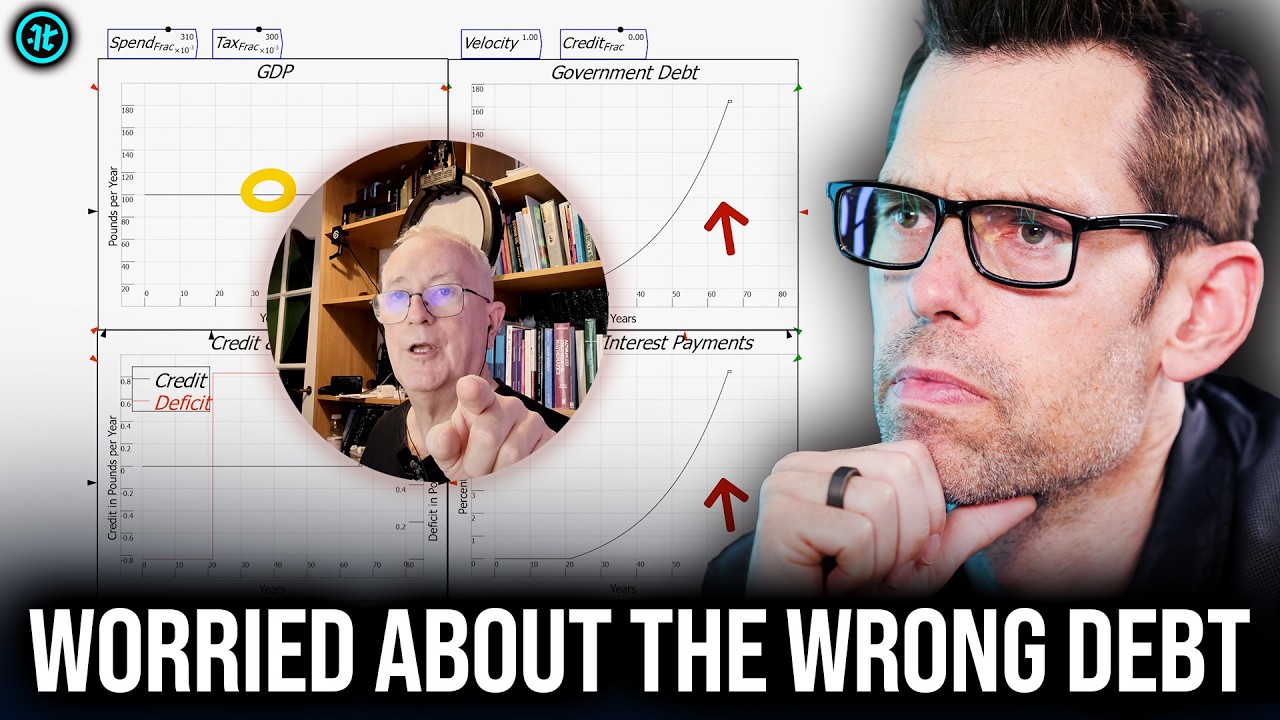
Video summary
The central argument presented in this discussion challenges mainstream economic narratives that fixate on government debt as the primary threat to financial stability, instead highlighting the often-overlooked dangers of private sector indebtedness. Economist Steve Keen is introduced as a key figure who correctly predicted the 2008 crisis by understanding how banks create money through double-entry bookkeeping rather than merely intermediating existing deposits; when loans are issued, new money enters the system and boosts GDP, but paying off debt destroys that money and contracts economic activity. This endogenous process of money creation means that focusing exclusively on eliminating private debt can inadvertently trigger recessions, a phenomenon observed in both the 2008 crisis and Japan's stagnation after 1989, whereas government deficits actually serve to inject necessary liquidity into an economy where banks are destroying funds through loan repayments.
Critics of this perspective often rely on outdated "loanable funds" theories that fail to account for how debt dynamics directly influence the money supply, leading institutions like the Government Accountability Office (GAO) to misidentify the true sources of economic instability. While psychological factors such as interest rate sensitivity and inflation risks from recent events are acknowledged as valid concerns, the core lesson remains that ignoring the mechanics of private debt creation causes economists to miss impending crises entirely. The discussion emphasizes that understanding how money is created and destroyed within the banking system is essential for grasping why current economic models frequently fail to predict or prevent downturns caused by deleveraging in the private sector rather than fiscal deficits.
Beyond the technical analysis, the video touches on the surprising reception of Steve Keen's ideas despite his controversial reputation among some viewers who believe he has contributed significantly to societal damage through flawed philosophical outcomes; nevertheless, his ability to remain honest about betraying logic for specific conclusions continues to garner attention and debate. The host concludes by hoping that these insights have expanded the audience's understanding of economic cause-and-effect relationships before transitioning into promotional content featuring an episode from Jeff Snyder at Euro Dollar University, which breaks down recent CPI data in response to viewer requests. Ultimately, the segment serves as a reminder that while psychological reactions are real, the fundamental mechanics of debt and money creation must be prioritized when analyzing macroeconomic health and avoiding future financial collapses.
Read the full video transcript
Steve Kaine is an economist. Uh he
starts out actually was a a tennis
player who could have potentially gone
pro. Uh and is also a very left-leaning
like with Marxist. He loves Markx. Uh so
Marxist views thinks Markx is the best
economic mind ever or certainly of his
day. Uh that one I I don't have teased
out well enough. And so you know me, I'm
violently opposed to Marxism and I'm
learning a lot from this guy. And so
this is where always seek
disisconfirming evidence because you've
got to find the holes in your own game.
So anyway, economist, very left-leaning,
uh very much um somebody who believes
that Markx had the right ideas but had a
conclusion he wanted more and so ended
up breaking his own train of logic. I
respect Steve Keane for that
dramatically that he can go, okay, here
are the parts that I like about this
thing. Here is where this goes off the
rails. Uh I don't think he covers it in
this video, so we're probably not going
to talk about it, but he can actually
point to you the moment where Markx ends
up going off the rails, the thing that
he gets very wrong. Um so, uh really
really a fascinating thinker. Um
don't turn off to him even if he seems
like maybe he's partisan. I think that's
the wrong interpretation of him. I think
this really is somebody who's trying to
actually identify what makes the economy
work. And so I doubt this will be the
last video that we do with Steve Keane.
We were trying to get him on the show.
Okay. So, economist who ends up being
one of the people that predicts 2008
coming. He gets a lot of credit for
that, but he didn't get wealthy because
he doesn't play in the stock market at
all. Um, he knows that we move in these
booms and bust cycles. He thinks he has
a better explanation for it, but doesn't
want to be in the markets. Uh, I think
partly it's philosophical and I
unfortunately I think he's wrong about
that. I think that's a huge mistake.
Anyway, okay. So, that's Steve Keane.
He's now going to try to explain why
economists keep getting the economy so
wrong, why they fail to see problems
coming. He sees a massive problem coming
right now, uh, which he and I both see
the same problem coming, but he's
pointing to a thing to pay attention to
that was just not on my radar in this
way. I've already done a deep dive on on
private debt, so it's on my radar, but
not in this way. Uh and I think this is
going to be a loadbearing pillar in my
view going forward. So uh strap in.
>> Nations are drowning in debt. The world
could soon owe more than it earns.
>> Our [music] national debt is now larger
than our entire annual economic output.
>> There's going to be a government debt
crisis in the near [music] future. And I
want to go through now and show why
these warnings are completely wrong.
>> Meet Steve Keane. He's the worldclass
professor and [music] famously predicted
the 2008 global financial crisis years
before it happened. Now he's lifting the
hood on the GAO's terrifying debt
projections to show the glaring
mathematical blind spot the mainstream
media completely missed. The USA
currently has $ 31.5 trillion in public
debt.
>> And that is
>> so first of all that number is now 39
million and approaching 40 million. Uh
so it's grown a lot since um that number
came out. And so what's really
interesting is to see one of the things,
one of his philosophies, not
philosophies, one of his core beliefs is
that the economic textbooks are written
by people that have one glaring
fundamental misunderstanding of how
economies actually work. And um as we go
through this, I'll help fill out some of
the the gaps in what he explains because
the first time he went through this, I
was so dizzy. My first reaction was this
is idiotic. I spent hours researching
this from a position of this guy's
obviously wrong. And let me just put
together the best argument as to why
he's wrong. And the more I went through
it, I was like, wait, wait, hold on.
actually. Uh so the the core
misunderstanding that he's going to be
getting into is that the federal
government and the Fed um have to be
understood that the way that they end up
creating money and injecting it in into
the system is very different than the
way that um loaning money that already
exists
uh works. And so if you map banks as
being an intermediary that simply loan
deposits out to people, you will never
be right about the economy ever. If you
understand that the way that banks
actually do this is that banks create
money in the act of loaning it. And so
now you need to watch the the private
debt as it grows and shrinks and forget
about government debt, which is a
totally different phenomenon. uh then
you'll be able to actually understand
where things are going. Okay, I'm going
to leave that there for now. I don't
expect people to understand it yet. This
is going to get more clear as we go.
>> Simply sounds boring. In fact, if you
get this wrong, [music]
you make up myths about the economy. So,
you have to understand this is a serious
warning. There's only [music] one
trouble. It's based on completely
mythical, completely facious visions. So
the government accountability office has
just published a report uh to Congress
telling the Congress that unless there's
urgent and sustained action to improve
the fiscal outlook for the economy,
there's going to be a government debt
crisis. Okay. So the important thing to
anchor yourself with is the punchline is
going to end up being he agrees that
there is a crisis coming. He even agrees
that there's a debt crisis. He just does
not agree it's a government debt crisis.
Okay? going back to this idea of when
the government creates money that that's
again they're creating money out of thin
air error. Uh and so you end up we're
going to have to get into the math of
this and I believe he does that in a
minute. So just know when the government
creates money it ends up being good for
GDP. He's going to show the math, okay?
And I'll slow it down. I'll walk us
through that. But for now, just put in
your mind government creates debt that
improves GDP. So basically people's
lives are getting better. Again, we'll
go into that more. If you think that
banks are a part of that system, you're
right. If you think banks are simply
loaning out deposits, you're so wrong,
you will forever be confused about the
economy. That's that's what you need to
understand right now at this part in our
journey.
>> Debt as a share of the economy is
projected to grow at an unsustainable
rate. I mentioned government debt there
because they don't mention that whether
it's government or private. They simply
talk about government debt as if that's
the only form of debt, which is
something that neocclassical economists
in general do all the time. And I want
to go through uh and now and show why
these warnings are completely wrong
because economists do not understand
money. Ridiculous because everybody
thinks economists are experts on money.
But fundamentally they don't include
money in their macroeconomic models and
their arguments about money are based on
fellacious concepts of how money is
created. But let's see what they're
warning the uh the government of in
America right now. And this is the same
thing that the is being told to the
British government to the Australian
government to the Spanish governments
all around the world are being told
government debt is dangerous you must
reduce it. So the government
accountability office has said that uh
government debt will reach 106% of GDP
according to their projections by 2029.
It'll grow twice as fast as the economy
over the next 10 years. And they claim
in 30 years time it'll hit 250% of GDP.
So it's unsustainable for government.
It's unsustainable for debt. And here
they are just by leaving out any word
all they're thinking of is government
debt. it over the long term it's
unsustainable for government debt to
grow faster than the economy grows. This
is the projections they they're making.
>> Uh a really important thing to say here
is that um they are right. So if the um
debt grew faster than the economy, you
really are going to be in trouble. What
he's going to show is that that isn't
what ends up happening once you take
into consideration how money actually
works. Remember, we have a math formula
that's coming that's going to talk about
how GDP is um based on the amount of
money in the system and how often it
turns over. And if the only way to get
money into the system is through
government debt, which by the way is
true, then you find yourself in a
position where the only way to grow the
economy is to either speed up the
velocity of money, and I'm going to
leave that alone for now, just because
it'll get overly complicated. But for
now, there's there's only two variables
in his mental model. Okay? So his mental
model says that GDP is the amount of
money in the system times how many times
it turns over. Okay? So if I've got a
dollar, how many times it does it move
through the economy. So I buy something
for a dollar. Person that I paid that
dollar then buys something for a dollar.
Okay? So that would be two. So that
would be two turnovers. The actual um uh
velocity, it's known as velocity of
money. The actual velocity of money, how
many times it turns over right now, I
believe in the US is 1.8. I can't
remember if he talks about that here,
but that that just is a a true number.
And so it's usually somewhere between
1.8, maybe 2.2, somewhere in there.
Okay. So now you're you're you've only
got two variables. If you want to
increase GDP, you can add more money to
the system, government debt, or you can
increase velocity, get people to to buy
more stuff and move that dollar around
faster. Okay? If you understand that
much so far, you will understand if if
you have that mental model, then anybody
saying that government debt is going to
be a problem is nonsensical because you
can't bring on government debt without
increasing GDP. So the government debt
is a function of growing GDP in his
mental model. Okay. If he ends up being
right about that, then of course it
makes no sense to say as government debt
grows that we create a problem in the
economy. Okay? If if you've got that
much so far, you're in good shape. All
right, keep going.
>> They're projecting forward what they
think is going to happen to government
debt over the next 30 years. And you can
see there've been rises and falls in
government debt as a percentage of GDP
from 1900 till today. But they simply
project continued growth. And notice the
ratio of government debt to GDP is
rising exponentially.
>> Okay, so another important thing to
note, what he's saying is they're
modeling out something that's ahistoric.
We just don't see that. It does not go
up up up up forever. We have like all
these ups and downs. So already he's
saying their projections. And by the
way, he's a a big believer in that the
climate is going to be a catastrophe.
And I think he's ironically making the
same mistake there where he's taking
these models that just go up forever.
Um, and not looking at the all the
fluctuations that we see historically.
Anyway, I digress. He's pointing out
here that history looks nothing like the
forward projection. So, we should
automatically have an alarm bell that
goes off that says these are fake
numbers
>> to go almost totally vertical unless we
do something about the level of
government spending. And equally,
because you pay interest on government
debt, they're making the same uh
projections about what's going to happen
to interest payments. So, they're saying
the historical high was right back in
the early 1990s when interest payments
were 3.2% of uh GDP. Now, they're at the
same level and they project them to
triple over the next 30 years. So, this
is a serious warning. There's only one
trouble. It's based on completely
mythical, completely facious visions how
money is created in a capitalist
economy. And this is not something
specific to the government
accountability office. This is something
that all economists learn when they're
at university. So this is an extract
from Manu's textbook on macroeconomics.
And just to read it through, when the
government spends more than it receives
in tax revenue, the resulting budget
deficit lowers national savings, the
supply of what they call loanable funds.
And fundamentally, you can regard that
as the money that's in your bank
accounts because that's the money you
have available to lend out to somebody
else. The supply of loanable funds
decreases. When the government borrows
to finance a budget deficit, it crowds
out firms that would otherwise borrow to
finance investment. And what they've the
simple supply and demand model that Manu
uses to illustrate his argument argues
that a budget deficit reduces the supply
of loanable funds because it takes funds
that households would have lent to firms
and instead it goes to the government.
So that is the mindset that all people
who accept mainstream neocclassical
economics have in their heads and the
people who staff the government
accountability office are all
predominantly economists. They learn
this stuff, they think it's correct. Now
the trouble is it's not. They learn what
they get taught at university which uses
supply and demand diagrams as you saw in
the extract from manure. But banks don't
draw supply and demand curves to decide
how much money to lend to you. They use
double entry bookkeeping. And that is
something which instantly sounds boring.
You know double entry bookkeeping men's
accountants and all this dreadful dull
stuff. In fact, if you get this wrong,
you make up myths about the economy. So
you have to understand double entry
bookkeeping to know how banks actually
operate and how money is created in a
capitalist economy. So what double entry
bookkeeping does first of all is
classify all financial claims is either
financial assets or financial liability.
>> The one misspeak that he did there is
that it it isn't either or. It is both
an asset and a liability always and
forever. So you end up with matter and
antimatter. And this is a a big part of
his argument is that what he's saying is
people do not seem to understand that
when you create debt, you create this um
you have both a liability and the asset.
And so if you were to pay off that debt,
then you lose both the liability and the
asset. And so they just zero out. And
people are not thinking about the fact
that as you pay off debt, that money
ceases to exist. And so if he's right
and GDP is a function of the amount of
money in the system times the velocity
of money, how many times it turns over,
pulling money out of the system is going
to slow your GDP. So that's where
understanding this matter antimatter
thing is very important because I if you
understand that they they cancel each
other out then you understand why he's
saying that this growing isn't a problem
because they cancel each other out and
pulling it out of the system becomes a
problem because they cancel each other
out because they affect directly your
GDP. All right, we'll return to the show
in just a second, but first I want to
talk about the dozen loginins that are
standing between you and a clear answer.
Your money is likely to live in dozens
of different places. A banking app, four
[music] credit card portals, a brokerage
login, a loan serer you check maybe once
a year. Each one tells you a sliver of
the story, but none of them tell you the
whole story. Monarch fixes that. Every
account, [music] card, loan, and
investment get synced into one clean
dashboard. [music] Spending, net worth,
debt payoff. The bills that hit every
month all in one view. It connects over
13,000 institutions, [music]
so setup is fast and secure. It's the
clear, complete picture, sitting on top
of the [music] accounts you already
have. Start your free trial and get 50%
off your first year using code TB50 for
50% off Monarch Core tier. Click the
link in the description and again use
code TB50
to save 50%. [music] Right now your
company is sitting on the answers to
your biggest problems. The data exists,
the patterns exist. You just can't get
to them fast enough. That's what
Netswuite Next solves. Netswuite is the
AI powered business management suite
trusted by over 43,000
customers. And Netswuite Next is their
next massive leap. AI built into
everything. It automatically surfaces
customer insights throughout your day
before you even think to ask. AI agents
work alongside you to handle routine
work and solve problems. And it's
customized for a wide range of
industries. Whether your company earns
millions or hundreds of millions, this
is where your business meets AI. For the
first time ever, you can try Netswuite
next for free. If your revenues are at
least in the seven figures, just go to
netswuite.ai/
theory. Built for every industry, ready
for every boardroom. And now, let's get
back to the show.
>> Transactions twice on each line. Once is
a credit entry and once is a debit
entry. That's what makes accounting very
hard to learn. But you also record all
transactions from two perspectives
between the creditors and the debtors.
So each transaction requires at least
two of what I call godly tables in ravel
to show the overall dynamics. Now my
side of economics which is goes right
back to Joseph Schweda back in the early
1900s and even earlier back into
disputes between uh different schools of
economic thought back in the 1800s. My
side has been saying that that's wrong.
Okay, banks are not intermediaries.
Banks create money by creating debt. And
that argument has only been made by
critics of the economics for decades.
But in 2014, the Bank of England
actually came out and said the critics
like me are right and the textbooks are
wrong. He is 100% correct. So I didn't
even know that neocclassical
economists think of banks as
intermediaries. There are actually
people, it might even be Ben Bernanki,
don't quote me on that, but there was
like a really big economist who was like
the right way to think about a bank is
that they take a little bit of money for
delineating between who's worthy of
lending money to and who's not. Uh, and
while that is a role that they play, the
reality is that they're part of the
central banking system. And so when they
create a loan, they are creating money
out of thin air. That money didn't exist
and now it exists. And now banks are
held accountable in terms of they have
to have assets on the book that match
the um solveny rate if you will like
they need to have more assets than they
have liabilities otherwise they're
insolvent. Um so they have rules on them
like that which is exactly how a bank
can end up failing is they find
themselves having to write off enough of
their assets that their liabilities
become more than their assets. Um
but it is very important to understand
that part of it if we're going to um
begin mapping how neocclassical
economists get themselves in trouble
because they're thinking of the bank as
simply an intermediary of deposit money
which would not create new money which
would therefore not affect GDP. Uh
whereas if it is what it really is and
and I I'm shocked to hear that anybody
argues this, but um because we have a
federal uh central banking system, when
a bank creates that new loan, it it
they're not pulling from deposits. Okay,
that's a very important thing to
understand. They are not pulling from
deposits. They have a license from the
Fed to just create that money. And so
poof, it now exists. reserves are
determined by the amount of notes that
people want people want to hold or need
for their transactions and the amount of
notes and reserves that banks want to
hold given the level of interest rates
in the economy. It is not chosen or
fixed by the central bank as is
sometimes described in some economics
textbooks. So this report was published
called money creation in the modern
economy and it opened with the statement
that money creation in practice differs
from some popular misconceptions. Banks
do not act simply as intermediaries
lending out deposits that save his place
with them and nor do they multiply up
central bank money. So it's criticizing
two models that economists use to
purportedly describe the monetary
system. One is called loanable funds.
The other's called the money multiplier.
The Bank of England said both of those
models are wrong. And when you put this
model together, you find that there's no
particular impact of private debt on the
economy. Well, if this video has alerted
you to the fact that what you thought
you knew about e-commerce,
you'll thoroughly enjoy the free book
bundle that has been requested by over
5,000 people already. It's worth $50,
but it's free right now. Click in the
link in the description or go to steve
keen.com and click on the black button
and fill in your information. About 60
seconds, you'll get the free book
bundle. And after that, if you want to
study with me personally and use my
proprietary software, Revel, there'll be
an invite to join that course as well.
So this is showing the conventional
model that banks are just intermediaries
in ravel. And what I have is that there
are two types of depositors in this
model. There are savers who lend out
money. There are borrowers who borrow
that money and then use it for other
purposes. The debt that's created
through the banking system is not an
asset of the savers. It's an asset of
the banks. And it's quite easy to go
through and modify this in ravel. If the
if the textbook model was right, then
you would be correct to ignore private
debt. But it's not correct. And I can
easily modify that and say it's not true
that debt is an asset of the savers and
it's not true that the savers lend the
money and that the interest is paid to
them. It's the banks that own the debt
and it's the banks that earn the
interest income. So I can rapidly amend
that. And now I'm just going to say I'm
not using the textbook model. So to
simplify my presentation here, I'm just
pretending that banks instantly spend
their interest income. In the real
world, they take time. That would make a
more complicated model and I just want
to focus on the essence of the reality
that if you say that banks are not money
creators, then you can ignore private
debt in your models of the economy. But
as soon as you realize that banks
actually create money, that creates
additional demand. And you cannot ignore
the banking sector when you're looking
at the macroeconomy. So, I've just
changed that one detail.
>> So, the one thing I think he gets a
little fast and loose on, so it'll be
interesting as I research him more to
see if he brings me around to his side
or not, is this idea that um the
interest of the money doesn't cause the
demand. And I do think that the interest
rates do have an effect, which is partly
why uh the Fed comes in. Now, I think
that Jeff Snyder is correct that the Fed
is far less leading than they are
reacting. But if you make money money
more expensive, people will borrow less
money. Like simple as because they're
going into it assuming that they're
going to have to pay this debt back. Now
Keen has a whole thing around debt
jubilee, but when people borrow right
now, they know they're going to have to
pay it back.
>> And so at a minimum, they're going to
have to make those interest payments. So
as interest payments go up, and you can
see this in the housing market right now
today, as interest rates go up, people
borrow less money. So
>> I haven't quite been able to figure out
why he's dismissive of that. Um I don't
know if it's he's just gotten so used to
trying to simplify simplify. Um that
he's sort of forgotten that there's a
very real psychological impact to all of
this. Um look at Japan. I've talked
about that many times before. You break
their psychology with the bubble
bursting in 1989 plus some uniquely
cultural elements for them and they just
stop spending. No matter how much you
try to stimulate the economy with um
cheap interest rates, they're just like
I don't want to owe anything.
>> Uh and so they won't borrow. So that
that's a psychological play. Um, so
yeah, there I will say that a more
sensible way to read that is that if a
bank sees, uhoh, the economy is
beginning to drag, if we lower interest
rates, that will stimulate demand unless
there's some other psychological
principle at play and we can begin to
push people forward. So, um, take that
into consideration.
>> And I'm going to start with zero
lending.
And of course, with zero lending,
nothing happens. Well, let's say there's
lending now uh you know one $1 per year
type lending. You get a rising level of
money in the b in the borrower's
accounts. The l the loans create
deposits. The private debt ratio rises
but nowhere near as much as it did in
the previous simulation and GDP is
rising.
>> For anybody that's not looking at their
camera b or their screen basically what
you're seeing is in this scenario
because they are creators of money what
you see is all these things moving in
tandem. So remember the foundational
thing that people are reacting to is if
your debt grows faster than your GDP uh
you have a problem. And what he's
showing is when you start modeling this
accurately that it's money creation the
debt itself is driving the GDP. So you
you can't get these out of lock step
economic activity and GDP rises. Now
that's completely missed by the
mainstream. They they they ignore the
level of private debt. Now, if you have
at the same time a lending goes
negative, which I'm showing now, then
JDP falls.
>> God bless him. He's explained this so
many times in so many different videos
that you really do have to sort of
aggregate everything he says. Um, I
think he does end up explaining the math
of this later, but it would be very
helpful right now. So, I'll remind
everybody of the formula that we were
talking about before in his mental
model. Um and I I need to research this
more if to find out if this is a
universal model but in his mental model
um GDP is simply the calculation of the
amount of money in the system times the
rate that it turns over. Uh and so given
that obviously if you start putting less
money into the system then GDP is going
to start coming down. Now, one thing
that would need to be tracked is um
if you just slow the rate of lending, is
that fine? Because here, I believe for
those numbers to be true, you would have
to assume that loans are actually being
paid back. And that's the destructive
force. So, as the loans are paid back,
you change that math equation on the GDP
because it's money in the system times
velocity. And so, now as people pay the
debt back, because you're thinking of,
well, I borrowed money from Drew. I paid
Drew that money back. That money still
exists. It's just not in my pocket. It's
now Drew's pocket. What he's saying is,
"No, [ __ ] That's not how this
works. This is central bank money." And
so when they loan you money and you pay
it back, it ceases to exist. It stops
being an asset for the bank. It just
goes away. And so that money is is
destroyed as it gets paid back.
>> Um, okay. So given that
that's how we if you really want to
understand these numbers why they start
ticking down you have to understand that
classical economist do unfortunately do
then you ignore the extent to which the
economy's operation depends upon the
level of credit creation by the private
sector. So you can see in this very
simple model private debt goes up so
does GDP private debt falls so does GDP.
This is being ignored by the mainstream.
So their advice about the private
banking is completely wrong. Then
because banks lend, they create money as
well as creating debt. That money turns
over and causes more macroeconomic
activity. So you can't ignore private
debt and understand the macroeconomy.
But that is what all mainstream
economists do and they continue doing it
even after they got caught by surprise
by the global financial crisis which was
caused by private money lending. They
didn't see it coming. They ignored the
whole thing. They didn't see the damage
that was going to do. And now they're
continuing to advise us if as if they're
experts on the monetary system. So by
ignoring private debt and obsessing
about government debt, you'll see that
they this is the line they worry about.
They're ignoring this one. They ignored
it back at the time of the global
financial crisis, which is here. They're
still ignoring it today. They refuse to
learn from history. Now, why do they
refuse to learn from history? Because
history refutes their theory. And
unfortunately, the way that academics in
general behave, particularly those in
the social sciences, is they ignore
evidence which contradicts their their
belief system. They ignore anything that
challenges their paradigm. Now, I've
been publishing this chart for 20 years.
Okay? And I've only have one or two
economists ever even try to understand
what's going on. And in the mental model
that economists have, which they call
loanable funds, that's true because
banks don't lend money. In the real
world, they do. You take a look in the
real world, and this is the pattern you
see between credit and unemployment.
They've
>> Oh, man. Pause, pause, pause. Yeah,
you've got to look at your screens. This
is one of the charts I was waiting for
to come up. So, uh, private credit as
mapped against employment, and they are,
like he said, effectively just mirror
images of each other. So, as private
debt goes up, people have more money,
which means they're paying companies for
more stuff, which means that companies
can employ people. As private debt goes
down, people have less money, and
therefore they're buying less from uh
different stores. And so, those stores
can or companies can afford to hire
fewer people. And so, if you want to get
people spending again, then you've got
to put money back into the system uh via
this private debt mechanism. And then,
people will start spending more again,
and jobs will come back. Now, this this
is ultimately going to be a um like
blocky, overly simplistic breakdown of
um how the economy works. Obviously,
there for anybody paying attention, you
know that COVID caused a 30% spike in
six years uh of inflation. So, inflation
is very real. He doesn't address any of
that here. He's I feel like he's got
sort of PTSD. he's been screaming into
the void for so long trying to get
people to listen to him and nobody will
listen. Um that there's, you know, maybe
some frustration, some anger, and he's
not walking through some of the more
nuanced stuff about like, okay, uh
obviously inflation matters. We're
creating a problem for ourselves right
now. The amount of interest that you
spend on government debt is extremely
destructive, which is why people keep
paying attention to it. And so he's not
talking about it here. He's talked about
it elsewhere. the way and this this will
be an oversimplification that I don't
think you would like um but I think it's
it's pretty close to accurate. So his
philosophy would go something like this
um you want to build up government debt
quite literally forever. You never want
to pay it off quite literally as a
matter of principle.
>> Do not don't worry about paying off your
government debt. It's adding money to
the system. And just like private money
adds money to the system. Uh you you
want to do that. So government debt is
actually running your deficits and
everything are creating new money. That
new money goes to your GDP calculation
and it's causing the money to go up. Now
I will say if you don't then follow on
to his thing which is he wants debt
jubilees and I would assume he wants
them on like a consistent schedule and
so every I don't know if it's once debt
reaches a certain level
every so many years but like at some
point you do and one specific
prescription that he's given people is
give everybody a $100,000 check but that
$100,000 check has extremely tight
restrictions on it. So you if you have
debt, you must put it towards debt. Um
if you are uh if you're a non-debt
holder, you must invest it in companies
and those companies must pay down their
debt. But that way you get equity in
companies and all that stuff. Pretty
pretty interesting. And he was saying
one of the reasons that the actual
borrowing of money is is so important,
the non-m money creation side of it is
that it it goes in a truly capitalistic
way into the companies that will then
innovate and all that. So it without the
debt jubilee, what he's saying is crazy
because your interest levels will just
rise to the point where it's it's a
patent absurdity uh and you run into
trouble. And so I want to be very clear,
the way the economy is set up right now,
you can't just do this.
>> But what he's trying to do is get people
to understand how all of this works so
that we could start migrating to a
system that recognizes this like
basically economy good when money going
in via debt, economy bad when money
coming out via paying off the debt. And
so this is why even if you look at
Japan, this is why when they get into,
oh [ __ ] I need to pay off my debt.
>> Uh the economy stalls because he's
saying you're not putting new money into
the system. You've got to put new money
into the system. And so uh I don't know
the Japanese situation well enough, but
marrying this to that, I have a feeling
it's going to play out something like
this. Part of the reason that Japan
struggled for as long as they did was
all their money sought returns
elsewhere. So the money wasn't actually
inflationary inside of Japan. It was
being invested outside.
And so now part of the reason um that
Japan may find that all of this
inflationary thing actually pulls them
out of that rut even though the
inflation is terrifying is that it's
causing Japan to pull their money back
locally. Uh first of all because they
can actually get a return on it. So
it'll be interesting to see how those
dynamics play out. I haven't researched
that one yet enough so these are just
early thoughts. But it's very very
interesting when you start seeing this
relationship between private debt and
the health of the economy. Again though,
I want to just state emphatically,
this system is sinister. We should not
be in this system. This system right
now, the way that we're doing it is kind
of like what we do with healthare where
it's like we do a good thing on one side
and then a bad thing on the other. So on
healthare we socialize the [ __ ] out of
it and then we um let the free market
control part of it. And so when you have
a guaranteed payer in the government,
everything just gets more expensive and
it completely deranges. So you either
need a free market system or you need a
single health pair. You can look at
other countries to see if single
healthare works out better. I would say
it solves some problems better. Like no
one's going to be at the bottom floor,
but if you want like something done
quickly or done by the best of the best,
you're going to come to America. So it
trade-offs. Um same idea here. It's
like, yes, we let people rack up debt
and that lets the economy run hot and
everybody's loving life when it's
working well, but the second that they
get scared and they start paying things
off, then they create their own problem,
you get a 2008 and it just blows up in
everybody's face. Now you've got to stem
check everybody to death to get the
economy working again. But because we
don't do jet debt jubilees in any
meaningful way, you get this
inflationary effect flywheel, it gets
crazy, completely runs a muck. And the
last thing I'll say, and we don't need
to play more of this, but um is you do
run into a moral hazard. And so there if
everybody knows, oh, every 10 years this
is all going to get reset, then I'm just
going to spend frivolously. And I know
that it's going to get reset and I'll
basically spend right up to the 100k,
maybe a little bit more. It's it's going
to be paid for. And so that's where the
behaviors just start to become unhinged.
So it is important. That's just one of
the reasons it it is important that
economists know what Steve is talking
about, but boy, you couldn't broadcast
that because people are going to get
super weird with what they do with debt.
>> But to your point, it were it would then
sim stimulate the economy in a very
different way. For example, if I know
that in 8 years $100,000 going to be
cleared out, I'm going to go bigger on a
house. I'm going to go bigger on the
car. I'm going to buy land.
>> And guess what that will do to the price
of everything?
it you so you're saying because I'm
spending more it would make things more
expensive
>> of course
>> I was going the other way where then it
would then boost GDP earnings record
earnings record profits people I would
be more think let's go back this is
brilliant so you're getting on to the
complexities of why you can't just go oh
cool Steve let's just pump more money
into the system
>> so uh the cost of things is always a a
ratio between how many of that thing
people want and how much money is
available to buy it
>> and so you're 100% % right. If real
wages are growing, meaning I'm actually
getting richer, I can buy more stuff,
I'm in a great place.
>> If nominal wages are growing and I can
buy less, I I'm getting more dollars,
but I can buy less stuff,
>> then people, even though their money is
going up, and this is what we have
today. Nominal wages are up, but real
wages are down. And so it doesn't matter
that people are quote unquote making
more money, they feel poor because they
are poor. And so it if you could do it
in the perfect ratio and this is where
the economy gets so complicated that um
people just sort of check out. But um
you always want innovators out there
creating a new thing,
>> making things cheaper and then we can
flood the system with money to eat all
of that innovation. Now I think that's
evil. I think things should be getting
cheaper over time and people should just
manage their money. But if we decide we,
hey, we want to be fast and loose and
let's just lubricate all these wheels
and let's just get crazy, rack up debts,
run forever wars, [ __ ] it, be completely
unconstrained.
>> It's a choice. It's the one we've made.
So that's where we are today, whether we
want to be or not. But um that's why you
have to be careful because what ends up
inevitably happening is at such a
delicate balance between the actual rate
that people can innovate. And so, um, to
to really drive home how wrong that can
go, um, 2008, we [ __ ] go crazy and we
bail everybody out.
Wasn't really a big deal. We didn't get
insane inflation. So, everybody goes,
"Look at that. There was all this slack
demand in the economy." And the second
we had money flowing into the economy,
baby, they just meet demand. This is
fantastic. It we were just missing
money, like actual money. And the second
people had the money, then uh factories
rev things up. They make more stuff.
People buy it. They they already wanted
these things. The economy could already
produce them. We just didn't have the
money. Now that we have it, boom, good.
And that's why, God, 2008, I mean,
shitty. If you lost your house, but
everybody that got bailed out wasn't a
big deal.
>> Then COVID comes and people go, "Hey,
remember we have all this pent-up
demand. No worries. [ __ ] flood all
the money." You had economists
screaming, "This is way more money than
we need." And they were like, "No, no,
no. Good, man. There's all this slack
demand. Like, you're just going to build
it up. It's going to be cool. And then
prices jumped by 30%.
>> Because there wasn't slack demand. So
now you had more money chasing the same
actually had more money chasing less
goods. That was the real catastrophe of
COVID is you
>> put more money in and broke the ability
to make this stuff because ships weren't
going anywhere. People weren't going to
work. And so you have this like insane
catastrophe of the 30% inflation, the
phase shift as Jeff Snyder calls it,
that's still causing people to have a
much shittier life today than in 2019.
>> And so all of those things have to be
reckoned with, including like what
happens to people's psychology. So
because that will either cause them to
spend more or less, take on more debt or
less based on just where they think
things are going. And that diffuses so
widely. It's not like if you're
listening to this, you're not one of the
people we have to worry about. You'll be
sensible. You'll figure it out. But like
the vast majority of humanity just goes,
"Oh [ __ ] I've got a bunch of money.
Pokemon cards have been going up. [ __ ]
it. YOLO." Like if people don't remember
the uh GameStop thing during co, that
[ __ ] was wild. NFTTS wild. Like it was
just it was like a a totally different
universe. And now understanding
macroeconomics and looking back on that,
I'm like, "Oh my god, I couldn't see any
of it when it was happening." Um, so the
economy is extraordinarily complicated
to to tie this all up in a bow. I think
Steve Keane uh is on to something with
the fact that neocclassical economists
are not paying attent. not modeling uh
money creation
as if banks are part of the central
banking system that creates money from
nothing and destroys it when it gets
paid back [snorts] and instead are
thinking of it as um I give the bank
money and the bank loans that money out.
So when the money comes back to me, I've
now got my principal back plus interest
and now the economyy's grown and it's
all good. And nobody stops to think,
well, wait a second, where did the money
come from on the interest?
>> Yeah,
>> it comes from deficit spending. It's so
crazy. I remember talking about this
probably a year ago. I did a whole deep
dive about money only comes into
existence via debt, but the the two
things just didn't connect for me. And
so, it's so interesting and we'll we'll
do more Steve Keane videos in the
future. And you'll be able to hear from
himself how he feels about Markx.
[ __ ] loves him. Uh it is so
fascinating to me that somebody who
reveres a thinker who I think has done
more damage to society maybe than any
human ever to live uh and is very on his
side from a he's a brilliant thinker all
that but to Steve's credit he does say
but he had an outcome that he wanted to
achieve from a philosophical standpoint
and he betrayed his own logic to get
there. So he he's honest about that but
I just I'm shocked that he still has a
positive veilance. Anyway, that's for a
future date. Uh, man, do I hope that
this added a ton of value because this
uh he is really expanding my connective
tissue with the cause and effect of the
economy. I think this is going to be
very important to my entire economic
worldview. I hope that it is similarly
enlightening to you guys. Uh, we'll
spend more time with him. Just super
super important ideas.
>> You some people want you to say your
your sign off
>> be legendary.
>> Oh, really? That that's like we want to
make sure that's
>> request. That was a Somebody said remind
him, Drew.
>> All right, everybody. Until next time,
my friends. Be legendary. Take care,
everybody.
>> Jeez.
>> Let's go.
>> Everyone in the chat saying, "Say the
thing."
>> Say the line, Bart. [laughter]
>> That's funny. If you like this
conversation, check out this episode to
learn more.
>> This is a guy named Jeff Snyder. His
YouTube channel is called Euro Dollar
University, I believe. Uh it'll
certainly come up on screen in a second.
and um he's doing a breakdown of the CPI
that we just saw.