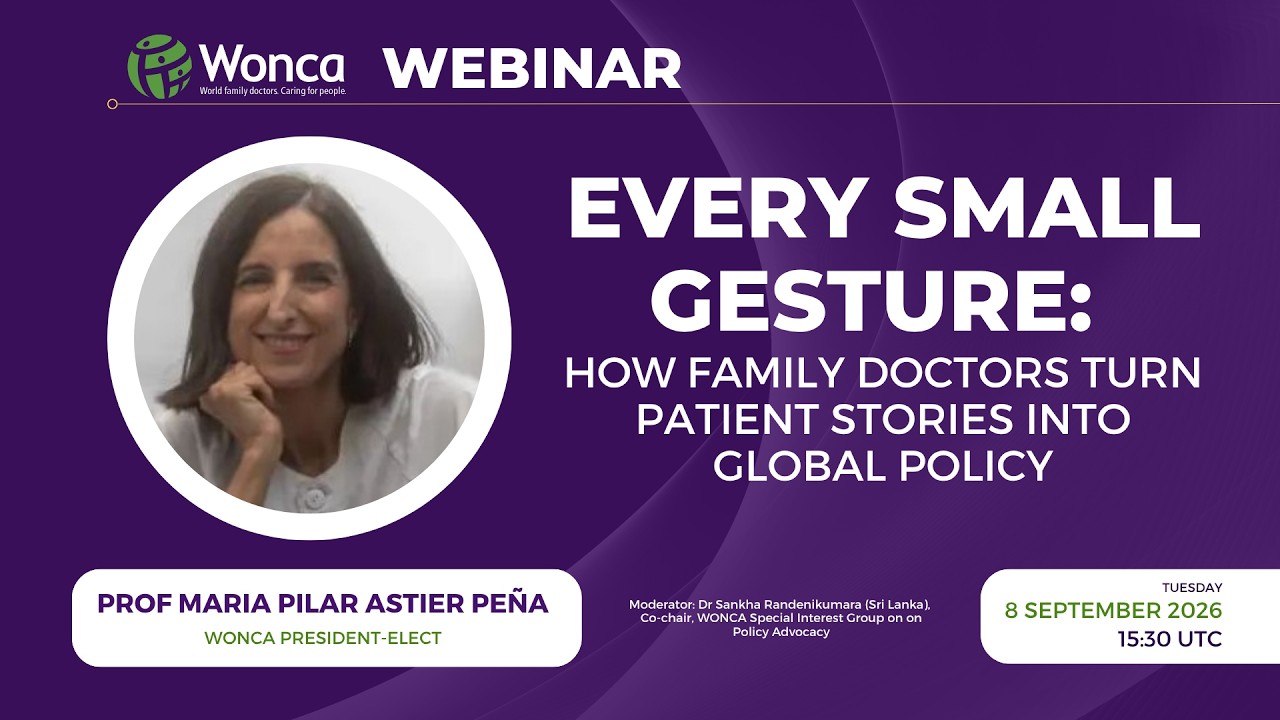
Every Small Gesture: Turning Patient Stories into Global Policy | Prof Maria Pilar Astier Peña
Watch on YouTubeVideo summary
Professor Maria Pilar Astier Peña, the President-elect of WONCA World, presented a compelling framework for transforming individual patient stories into impactful global policy through four distinct case studies. She defined doctor advocacy not as an extracurricular activity but as actions deeply rooted in clinical practice that promote social, economic, educational, and political changes. This approach is supported by established frameworks such as the 1986 Ottawa Charter, the Canadian Medical Association's stance on responsibility, and WONCA Europe's core competencies, all of which link individual patient needs to broader community health outcomes.
The presentation illustrated this journey with specific examples, including a Spanish neighborhood where health professionals collaborated with community leaders to secure funding for a new health center despite political instability, and a national initiative in Spain that shifted the culture from blaming individuals for medication errors to fostering organizational learning. Another case highlighted the ongoing effort by a coalition of over eight countries to achieve European Union-wide recognition for family medicine as a specialty, emphasizing the need for standardized curricula. Additionally, advocacy efforts at the World Health Assembly aim to position family doctors as essential for managing non-communicable diseases within universal health coverage, moving away from fragmented care models that lead to poor patient outcomes.
Effective advocacy relies on strategic pillars such as the use of epidemiological data and relational humility built on trust, while also navigating challenges like varying national training programs and the long timelines required for multi-year campaigns. Kim Alen Spina from the Philippines further enriched this discussion by highlighting how local evidence, contextualized to daily practice, was crucial in securing government support for residency training programs and expanding practice-based training during the pandemic. His experience underscored that while international evidence exists, legislators specifically request data that reflects local realities, reinforcing the value of gathering community-specific information to support policy changes.
The overarching conclusion encourages family doctors to anchor their advocacy efforts in clinical realities, build broad coalitions across political cycles, and persistently pursue structural improvements to enhance population health. By combining clear problem definitions with evidence-based solutions co-designed with communities, medical professionals can identify policy windows and drive meaningful change. Whether through strengthening primary care in Pacific Island nations or addressing the global burden of non-communicable diseases, the collective effort of family medicine practitioners is vital for advancing equitable healthcare systems worldwide.
Read the full video transcript
Uh hi dear colleagues, greetings from
Wonka special interest group on policy
advocacy and uh welcome from around the
world to our first webinar uh in this
year. um uh probably in the last bionium
we had many webinars and I have to uh
always acknowledge our previous my
previous co-chair professor Amanda Ha
for giving leadership and being very
active with me in the uh special
interest group and making it one of the
most active special interest groups uh
in Bona um for for this year after a
little break with regard to the
webinars. We are back today uh with a
very important guest. We are here with
the Wonka
uh
president elect professor Maria Pilah
Astia Pñena um who is here with us now.
Welcome uh Pillar to this uh webinar and
thank you very much for uh accepting our
invitation.
So good morning, good afternoon, good
evening colleagues and wherever you are
joining us from. Thank you for spending
a part of your day with the Wonka policy
advocacy special interest group webinar.
A special thanks uh to Sanka for his
invitation to participate in this
webinar.
>> Thank you. So so welcome everyone. Um
and uh today uh just before starting our
webinar proper just to uh address some
of the housekeeping rules um um you can
uh post any of the questions you have on
our chat box and uh we will answer them
after the at the end of the talk and uh
we have Spanish translations
today. Uh we have uh Anna Perez uh our
young doctor lead from Ibra America
region who's always with us always say
yes when I ask her um as the Spanish
translator. So you can uh just go to the
translations and switch on your Spanish
translations if you want to listen to
this in Spanish. And um so after the
after the talk you can of course uh ask
any questions we will allow you to even
talk because we have a smaller group as
usual so it's not a problem. So thank
you dear friends for joining and uh
today webinar is about
uh okay I I'll say the topic it says
every small gesture how family doctors
turn patient stories into global policy
most of us or many of us
have stories to tell and we have done
some changes little small changes in our
practices
and some of them would be the first step
uh to go for a bigger policy change. So
we will listen to uh uh Pilah today
about that. uh to introduce Pilah. I I
know that she doesn't need much of
introduction but let me tell about her
uh from her uh bio.
Professor Maria Pila Aopena is a
specialist in family medicine, family
and community medicine and preventive
medicine and public health with a PhD in
medicine and more than two decades of
clinical experience in the Agon public
health service
spanning both rural and urban primary
care setting. She also has seven years
of experience in hospital management.
Pila is currently a tenureant professor
at the University of Saragoa and a
researcher at IIS Aragon.
Her academic and research interests
focus on healthcare quality, patient
safety, health systems and primary care.
She has provided international
leadership in quality improvement and
patient safety in primary health care
and had held executive positions in
leading Spanish scientific societies
including Sika and SIM FYC.
Dr. Pena has made significant
contributions to Wonka Europe and Wonka
world through her involvement in several
working parties and special interest
groups. Her leadership roles within
Wanka include chair of the Wonka working
party on quality and patient safety.
Wonka WH leers officer that was the last
term I if I'm not mistaken and finally
now as the president-elect of Wonga
world and in the next two years as the
president of WA her extensive clinical
academic research management and
international leadership experience has
established as a prominent voice in the
advancement of quality patient safety
and primal care globally.
Uh I got to know pillar in Korea in 2018
in SE seal
uh WKA and we both served as
what is that I can't remember this
tellers
>> yes
>> in the WKA election so I was this teller
for Southeast Asia and Pil was seller
for Europe so that's the first instance
I saw and from that in that point
onwards for last eight years I have
associated her closely and I have served
in the executive with her and I know how
great leader she is. So Pilah over to
you to talk about your experience how
you the small gestures were converted
into larger policy changes over to you.
Thank you.
>> Okay. Thank you very much Sana for your
nice words. It's true. We met we met
first time in 2018 in SE Korea. That
that's good memories for us too. I'm
going to share the screen. Please just
uh let me know if the screen is um
properly presented. So
are you able to watch my screen?
>> Yes. Lovely.
>> If you can go it. Thank you.
>> Wonderful. So as you mentioned before my
talk is called every small gesture how
familiar doctors turn patient histories
into global policy and I speak from two
perspective as you mentioned before I've
been trained first in public health and
then in family medicine. So it gave me a
dual lens. Public health teach me to
zoom out to see patterns.
Environmental drivers in equity gaps
across the whole population
and family medicine teach me to thin
to sit with one person reality inside a
10 minutes consultation.
So today I want to show you how that
film lens micro to macro interact for
the benefit of the patients.
So I'm going to introduce a definition
who might frame all the lecture.
What's a medical doctor advocacy role?
Erns W and Fedric define doctor advocacy
as the action by doctors to promote
social, economic, educational and
political changes that emlarate the
suffering and threats to human health
and well-being that doctors identify
through their professional work. and
expertise.
That means is based on the knowledge of
the reality
is anchor advocacy directly in everyday
clinical practice not as a
extracurricular
add-on for the motivated.
You do not need a mandate to start. You
need a patient encounter that'll show
you the gap.
Sarah Dobson and colleagues give us some
vocabulary.
Agency is working with the system on
behalf of one patient and activism
change the system changing the system
itself for the benefit of the
population.
So every case situation I'm going to
show you today began as an agency and
Google app into activism.
That's the same escalation for all the
four cases. The first will be local, the
second national in Spain, the third
European and the four globally.
So
three frameworks h from different
decades coverage exactly the same idea.
The World Organization in 1986
launched the Otawa chapter in health
promotion.
Names advocacy is one of the three core
strategies for health promotion to build
political, social and economic
conditions in favor of the health of the
populations.
Then in 10 years, the Canadian Medical
Association
state the health advocate or doctors as
their
responsibility to use their expertise,
our expertise and influence to advance
the health and well-being of individual
patients, communities, and populations.
not to chosen between the bed size and
the population but all together.
Then in 202
and then renew in 20 and 11 and in 20
and 23 we have the family medicine core
values
of WKI Europe that is stated that our
own disciplines names community
orientations
is one of the six core competencies
requiring us to reconcile the health
needs.
of a person
with the healthiness of the community
they live in. And we are the advocates.
And moreover, in 2019,
we have some scientific evidence that
links
structure advocacy training
to a stronger professional identity and
lower burn out also among family
doctors. And nowadays, no major body
treats this as an option.
not the same thing policy advocacy and
lobby. So today we are going to talk
about advocacy. Advocacy means the
journey at the end in some of the cases
we will have a big success but in other
is still going on. So time is also a key
issue on policy advocacy
and we consider also the levels of
influence the levels of change in this
turn patient communities and healthcare
professional histories into global
policy.
Every global health policy begins with
an individual patient history inside our
consultation room
by recognizing
recurring patterns at the primary care
level. Family doctors can scale these
human experiences outward
using quality improvement techniques,
community partnership,
national colleges, and global coalitions
as levers of change. And ultimately
you turn daily clinical observations
into actionable data that requires to
reshape healthcare system worldwide. So
I want to introduce you a key concept on
this journey. What is the notion of a
policy window? A key issue on the policy
advocacy journey. Policy change only
happens when three elements get
together.
Clearly define a problem from our clinic
encounters,
a practical evidence-based solution,
co-design it with the community
and the political will or funding or
support to it that lead us in time to
the success of our proposal.
As family doctors, our advocacy role is
to keep pragmatic solutions ready so we
can push them through the moment that
the political window open. And this is
what I'm going to explain to you based
on my own experience.
Community orientation is not just a line
in my curriculum.
For me it has been a working method.
Practice one consultation,
one coalition,
one campaign at a time. What I'm going
to share with you is not theory. It's
the patient consultations turn into four
different campaigns.
Local, national, European, and global.
The same method apply four times four
scale. So we are going to jump into the
local one. So here is my health center
and the neighborhood.
And then in my consultation an elderly
patient with several chronic conditions
arrived at my clinic.
She was active in the local resident
association and she brought me a piece
of news that no health planner had
flagged that thousands of new apartments
were going up in our neighborhood
and no one square
would reserve for a primary health care
center in a Spanish primary care system.
Every health center is set up in a
neighborhood of around 5,000 to 25,000
inhabitant. So when the population
increases a lot, we need to set a new
health center.
What the patient said to me is that over
10,000 new citizens was were be arriving
into the health map and hadn't been
updated nor planet. So the neighbors
start protest.
They had been on and off for several
months and even one and two years.
So we need to act. The street protests
run from 2015 to 2018 without traction.
So we need to move from patient to a
former case. So then health
professionals
with family doctors and the community
leaders
made an evidencebased health report to
the ombbudsman.
policy leaders didn't pay attention to
the protest, but we needed to find a new
independent
real
policy
member that may help us. So, we went to
the regional man and present
a document with the health needs and
assessment and demographic progressions
at that time.
And that links the strategic pilot
community legis
legitimacy
plus institutional
great evidence take to an independent
oversight body when the direct political
channel has sto
neighborhood representatives here the
coordinator of the health center and
here the ombus man and we finally get
our
health center
in the region.
Four year later the health center of
bario Jesus opened the door.
The ombbudsman identify suitable public
land. construction began and after these
four years across at least one change of
regional government the center opens the
15 March 2023.
So we have some key messages with this
policy advocacy journey.
Stay with the community process across
political cycles.
Back community passion with hard needs
assessment and epidemiological
epidemiological data as the health prof
health care professionals of the of my
health center. we did with the community
and then direct political channels
and use independent institutional
alliances as the ombbudsman to address
local advocacy until the end.
So regarding the policy window we found
we have a specific problem new housing
increased population and lack of new
primary care services
people neighbors citizens were aware and
we needed a feasible solution planning
for a new pren
but we didn't have political will we
need support from independent
civil society stakeholders as the ombus
man and the support of the health care
professionals in the prenare team and
all together make these policy windows a
reality and the new health center built
in four years.
We can also talk about now to climb
another level to national policy.
A medication error cause harm and my
colleague the doctor wanted to apo a
apologize and participate in a root
cause analysis
to do the right thing. be honest,
apologize, and take part in a root cause
analysis so it never happen again.
However,
legal council warned that the apology
itself
might be used as evidence in a legal
proceeding against the doctor.
So we were with my colleague in a legal
liability on one side,
psychological safety and non-punitive
reporting in the other side
and in Spain a lack of national
regulations
guaranteeing patient safety in
addressing these situations.
It means that fear not only silence
doctors
but also prevents the ent system from
learning.
So we decide to move from a personal
experience
to a national issue and start working on
this topic to
try not to happen again for any other
health care professional.
We were aware that when an adverse event
occurs, there is a first victim that is
the patient and the family which deserve
by the ontology and medical ethics an
apology.
We have professionals became second
victims because we do not want that to
harm patients.
We we want to pl plan the care and sort
it out in the best way possible and a
third victim that is the healthcare
organization would lose the trust of the
population.
The global action plan on patient safety
2021 2030
involves all governments and stakeholder
on its strategic o objective
high re reliable systems to build
together high reliable systems and
health organizations that protect
patients daily from harm.
But to get that situation we need
transparency to speak up, openness and
no blame culture. So we can learn from
mistake, we can analyze them and we can
express to the patient our eology.
So we decide to response
structurally
and then we unite different scientific
societies among family doctors ones as
well partner directly with the health
ministry legal experts and regional
health directors
to draft national guidelines in 2019.
The message was tailored for an audience
of doctors, nurses, health professionals
who needed an actionable legal
framework, not a moral appeal.
The comit
is to shift the legal framework from
individual blame to organizational
learning.
We are now aware on the global patient
safety report 2024
that 13% of countries had enacted
nonpunitive gas culture incident
reporting laws as of 2024.
So that means many countries do not have
these guarantees to be able to address
properly when things go wrong and we
need to express an apology and study the
situation and make improvements
to avoid happening it again.
So in the meantime, legislative changes
are taking place. We develop
recommendations jointly with the
ministry of health, with legislators
and also with healthcare organizations.
We launched this book about
recommendations on the analysis of
patient safety incidents with harm.
how doctors and nurses and health care
professionals should behave and how to
learn from demiscate through cost root
analysis anonymize.
We also launched in Spanish National
Health System some papers to address
what health organizations were doing to
try to promote no blame culture and to
increase patient safety cultures among
health care professionals.
We are still on the way. We have no
finish because we have not
get the patient safety low. However, we
did some steps and we are still working
with the health ministry in this issue
and is one of the strategic objective of
the patient safety national strategy in
Spain 2025 2035.
So our policy advocacy journey is still
going on. And what was the policy
windows we found to launch this
strategy, this campaign? first to
realize through a situation, a case
study that we have a lack of legislation
and we have no sorry law, no patient
safety law, but we could develop some
recommendations for health care
professionals with the Ministry of
Health and Legislature. Well,
legislative changes are taking place
and we have the support of the World
Health Organization, the support of the
global action plan on patient safety
2023 2030
and the every two years assessment that
the world organization
do
with the countries.
We can move now to the European region
and what happens in the European region.
With the Wonka Europe policy advocacy
working party, we identified that a
family doctor fully trained in one
European country can move to serve a
rural underserved community in another,
but then her his specialization vanish
at the border because family medicine in
the European Union is not in the panel
of professionals qualification
directive.
So we need to campaign for that and we
need to campaign together.
Wy Europe, the organization of family
doctors
in Europe and also
the WH Europe support this process.
So we start the need for the recognition
of family medicine as a specialty in the
European Union with the context that the
specialty of family medicine is
recognized at national level in many
European member state. However, within
the European directive 2005,
family doctors are listed separately and
medical specialists are included in
another annex.
So
we think that this is clearly an issue
to highlight the relevance of high
qualification for family doctor and the
recognition at European level. So we
join forces from the wonky Europe
networks from UIO from W from European
forum of primary care.
We all together committed to improving
family medicine in Europe. We need at
least 11 countries to submit a proposal,
a request to the European Union to
recognize family medicine as a
specialty.
As today more than eight countries have
already submitted documentation
in the core European curriculum for
family medicine is being developed with
h the working party of policy advocacy
and u at European level. We are not yet
there but the coalition
building method is a transferable
lesson.
No one country advocacy voice was loud
enough alone but altogether we can get
this new achievement
and what was a policy window for this
case study.
We detected a specific problem. The lack
of recognition of family medicine
specialty at the European level,
a physible solution to request to
European Union to
recognize the specialty and we needed at
least 11 European countries requesting
this
recognition.
And what was the political will and
resources?
We had the government commitments to
strengthen primary health care services
within European health systems. We had
reports from the WHO Europe office
recognizing the relevance of welltrained
and qualified family doctors within
prenare teams to offer a qualified
prenan.
This case study is not yet in. However,
this is our policy advocacy journey. We
want to share with you and analyze what
are the weaknesses and what are the
strengthenings. The strengthenness to be
together to build a big coalition. The
weakness that it takes time. It takes a
lot of small meetings with different
countries. It takes time to support the
countries to upload the documentation to
the EU platform and then have the final
recognition. So time is also a key issue
in a policy window.
[sighs] And now we just go a bit
uh to we just go to another level that
is a global level
taking the message of for the world
health assembly and what message? Well
the global message is really relevant.
We have patients at our own consultation
room with
multiple chronic conditions and multiple
medication. In my case, Maria and all
the patient arrive overwhelmed with
diabetes, with COPD, hair failure,
depression.
14 medications a day, each prescribed by
a different hospital specialist, each
following regulous evidence-based single
disease guidelines and each guidelines
blind to the other three. The advice
sometimes was contradictory.
The risk of dangerous track interactions
was constant
and there are hundreds of that type of
patients in jaw consultations daily.
So this is the global pattern behind the
epidemic of NCDS. Our patients live with
multimobility.
Our guidelines, funding streams and
specialist trainings are still organized
around isolated diseases.
But as we all know the case of primary
care
services research most based on barber
staff studies show that population
served by a strong person center prenic
care have better health outcomes lower
cost and greater equity than those
relying on fragment specialist le
disease silot care. However, we also
know that continuity with a family
doctors for more than 15 years might
help to increase survival to reduce
hospitalizations and emergency care. And
when it comes to specific diseases,
diabetes,
high blood pressure,
COPD, you have better results when a
family doctor is coordinating the care.
So we need to advocate for the role of
family doctors in dealing with NCDs.
So this is the other policy advocacy
journey that won't started. We take the
message to the white house of say
assembly.
The message that family medicine is the
safest most trusted way to guide NCD
patients
from first diagnosis to compassionate
end of life care.
the labor via the official of the world
health assembly statements as wa w
solations
Dr. Abibana Martine Bianke Dru and
myself had been advocating with Dr. Anna
Stadal about Wonke inc um position on
highlighting the role of family doctors
and currently we have been stepped up
and through the Wonka NCD working
special interest group and the creation
of the NCDS fellowship. We are trying to
generate evidence of the role of family
doctors with NCDS and convincing through
our messages at the World Organization
that the role of family doctors is
essential in the universal health
coverage and premier care services along
the world.
And what was the policy windows we found
out? The first was the impact of NCD's
ben of care. There has been different
United Nations high level meetings focus
on NCDS in mental health. So we have a
specific problem that covers all over
the countries around the world. But also
we have visible solution to address the
burden of care of entities and make
possible for a safer health care
reorienting
health systems to primma health care and
strengthening family doctors and
multidisiplinary teams to address NCDs.
So a qualified family doctor who can
have a capacity of resolutions through
prescribing controlling symptoms and
signs in using
test and diagnosis tools at the point of
care my health to accompany
patients with chronic conditions along
the time till the end in a safer way.
And what was the political will our
resources? We had different reports from
W, OECD, World Bank that it was really
effective and safe investing in primary
care systems and investing in qualified
family doctors working within
multidisiplinary teams.
So here we are. This is a policy
advocacy journ not not finished. We
invite you all to address this NCD's
policy advocacy
message on the role of family doctors as
well as the patient safety
regulations in your countries to ease
the possibility of a no blame culture of
a patient safety culture and to be able
to apologize freely.
about our own mistakes in the practice
and also committed with you to work on
the recognition of family medicine
specialists in your countries as we have
highlighted through these four examples.
So what is the myth across the global
pren advocacy literature and my own
experience as I express now it rest on
two pilots that have to work together.
The first piler is strategic
and evidence.
Use epidemiological
and health need evidence.
Know exactly who your target audience
is.
Map the loca the political window of
opportunity in every case.
and deliver a message any policy may can
repeat in one sentence.
Family doctor role in NCDS
no blame culture for all health care
professionals
that's our key messages that we need to
learn a qualified family
doctor recognition
in every country and the second pillar
is relational.
We need to lead with humility rather
than authority.
Share ownership of the campaign with the
community they to bring them together
with us and with the PAC team
build alliance sometimes with people who
don't naturally agree with us. However,
we think they might help us if we
explain and clarify our message, our
will and commit to the long game. That
is crucial because as leader I've
learned that trust builds slowly
but is spent quickly
and many of the policy advocacy journey
takes a lot of time.
Much of them we can start and contribute
to but we need to join more people join
young family doctors who take the lead
and help pass to get the final
achievement along the time.
Well, sit back with me and look at what
these four very different cases actually
have in common.
Because this is where the research and
the real world history get together.
A patient history that makes an abstract
static impossible treature. That is key.
The entry point research calls issue
framing.
The evidence ledger it onto emotion
and needs assessment, a guideline, a
comparative outcome study.
So the campaign survives contact with
skeptical policy makers that we might
find along the way and even policy maker
that change along the time because the
policy cycle change it if the policy
advocacy journey lasts for many many
years
and then persistence
multi-year followup across Because
political turnover, every campaign here
took years. So we need you. We need one
that made the first step up, then
another who will take the lead and
follow the journey and involve young
family doctors that at the end will get
will reach out with our h challenge get
a reality.
>> [snorts]
>> So we think that family doctors are
ideal health policy advocate.
We look in parallel and that's is key.
Clinical training and health policy
work.
Evidence-based medicine is
evidence-based policy. We need to
support the policies and the evidence.
Seeing the big clinical picture while
tracking small details is exactly what
connecting a policy vision to it detail
next steps requires. So we know to do
that we already appreciate the social
root causes of poor health.
We don't need convincing that solution
must address health and health care
together.
The health and the services.
We are also comfortable with complexity,
ambiguity, uncertaintity
which is what changing a health system
feel like because is tedious and often
unexplored territory. We need to
navigate and we are used to navigate it
in our own consultations.
We are trained to narrow a consultation
down to the real question that is also
key which is the same skill narrowing a
unravel policy problem to its core to
the essential
essential area we have to go for. We
already work in teams and know the
stakeholder buying matters. We know how
to involve to bring together people on
the same will on the same goal on the
same challenge
and our care is anchored in relationship
on trust relationship with our patients
and trusted relationships are the
currency of policy work as well of
policy advocacy work.
We have learned patient helping patients
change their lives along the time. We
are compounding the patient until the
end which turns out to be exactly the
patience we have to have with the policy
work.
stepping up over policy cycles and be
persistent
to get the results of our demands, our
challenge, our transformation project to
improve the health and the well-being of
our population.
So let's finish with some
family doctor advocates kind of
checklist just some tips uh to have in
in your consultation room.
Look into your consultation room as a
policy advocacy journey as well.
Anchoring in clinical reality
with patient histories that reveal the
structural gaps we have. How many
patients and countries put in evidence
what is the structural gap of the health
system that is not addressing the
reality of the health needs of the
population.
build a case with evidence-based health
data. We have the
training to build this report to join
people to join civil society with our
evidence-based health data that back
their challenges that back their goals
and we can be adaptable strategy for
years of followup.
We need to build broad coalitions,
family doctors, penicare teams, civil
society, other scientific societies,
legal expert, governments, all these
stakeholder we need to merge together.
And then practicial leadership. We are
not a solo leadership. We know how to
hand campaigns with younger colleagues,
with civil society, with any key
stakeholder we need on board.
And remember, the value beyond the
numbers is priceless
and the long-term health gain is amazing
for the whole population.
So I think this is really relevant and
personally three things have carried me
through and I invite you to consider
patience persistent and perspective
global perspective linking to locally
roots.
So
thank you for listen and remember that
every campaign starts with a small
gesture.
A patient who trusted you with an
inconvenient truth
and then and a decision for your part
not to let go but to start shorting out
the gap. invite you to start with the
Wonka
special interest policy advocacy
support, the Wonka regional policy
advocacy groups that might been
supporting you. And now we can share
recurrent patient frustrations in the
chats and describe in a single sentence
if if you find the gap, if you find the
deficiency, if you think of it as a
policy advocacy opportunity
erh to improve the health and the
well-being of the population. So thank
you very much for your
presence here and listen to the this
conversation.
Muchas gracias. Uh thank you very much
Pilah. What a lovely presentation that
was and uh I just u if I uh go through
your presentation I uh noted down few
things. I loved that you started with
some theory
the the the commonly used words like
policy, advocacy and lobbying which is
very important. I think people even who
have joined for the first time and who
have no idea about what policy and
advocacy is and uh thank you for uh
going through the the journey advocacy
journey policy advocacy journey starting
from local advocacy
then through regional to global advocacy
and I really love this concept of the
policy window and uh then uh I love the
comparison of the family medicine and uh
the the journey of policy advocacy and
about your two pillars. I think uh very
important thing was about
finding out the political window and
also sharing the ownership with the
community. I think that was the great
idea. And finally uh thank you for that
family doctor's advocating
family doctors uh sort of checklist of
advocating which is also important. So
very thank you very much. Um Pilah for
that interesting presentation. Um
colleagues before uh forgetting I'm just
posting the link to Wonka special
interest group on policy advocacy web
page which also could be uh found on
Wonka website when you go to the groups
if you miss it from here but we can just
open it and keep it and join the policy
advocacy group for more webinars more
news and more resources. Um so while
thanking you um do you have any
questions this the time to get the
answers in the meantime uh there was one
comment or I would say suggestions that
uh which has been or less the policy
framework and experience from European
Union could be offered to the Americas
to initiate regional family medicine
specialty recognition. I think a very
good idea
>> completely supporting it. Yeah, I I
think that um the the process in in
Europe might be an example for other
regions to guarantee a process on
recognizing family medicine in different
countries in a region because the
mobility of family doctors in in the
different world regions are quite
frequently and then it would guarantee
that we develop a common curriculum of
family medicine residency programs in
countries and having a recognition and
will ease the recognition in other
countries. That might help family
doctors to improve by comparison and to
push the government on investing in uh
qualified family doctors uh residency
programs that led a high level primary
care health services.
and colleagues. Of course, the meaning
of these webinars
uh is to share and learn from each
other. So, we don't need to reinvent the
wheel rather we can learn from the
others how the how we could advocate. Uh
so definitely this would be a really
realistic
uh suggestion and you can try that and
I'm sure that pillar would help you.
>> Yes. and also all the members of the W
working party of Wonki Europe on policy
advocacy also are leading together this
project. So any of us can help address
any doubts or any comments that might
help uh other regions to advance their
for sure
>> and I can see that Raquel is here. Kim
is there. Uh,
>> wonderful Raquel. She's one of the
leaders of the Wonka Europe Policy
Advocacy Working Party. So, great to
have you here.
>> And Kim is the WHO lean of the Wonka
executive. She's has also joined.
>> Yes, Kim is is now doing the NCD's h
policy advocacy role. So, thank you Kim.
we you you take the lead and and we are
just h improving and and making the
message h in everywhere assembly.
>> Um we have a question um
April has uh raised his hand. April
[snorts] over to you.
>> Oh yeah, sorry. C can I ask the
questions right away or I should write
it down on the text chat? Okay. So um
thank you Zanka and thank you uh
professor Pina for for the uh wonderful
presentations and sharing. Uh I just I
just curious about um I'm from Indonesia
by the way. I'm I'm curious about um
what is the main issues that in in in
the regions uh based on your experience
uh the issues on not recognizing the uh
family medicine as a special what is the
uh three biggest issues for example or
even one uh that that we can that can
enlighten us in a way that even in in
the uh European Union that has
uh
strong history of uh good uh practice of
family medicine and strong example in a
way in the educations of of uh medicine
still struggling to find that uh
recognitions and
uh consensus.
So yeah, thank you very much.
>> Thank you for your question. um th this
situation in my um well it comes from
many years ago when uh the family
medicine residency program were not so
common in in the European Union. So it
was easier just to have general
practitioners. So um without specialties
that leads
doctors being contracted in different
settings. However, as we are qualifying
family medicine and the way we are
working now with a high capacity of
resolution, dealing with chronicity and
dealing with complexity and
uncertensity, this um improve the
qualification and improve the results.
So we are focusing mainly on to offer a
high quality perman services in all
Europe and we are just highlighting that
the way all European citizens deserve a
high quality premier healthcare service
through a qualified family doctors in
every country. So we are just moving
through the positive part and making the
message for the European Union that way
and also to the governments because uh
the governments are the ones who have to
ask to European Union to recognize
family medicine specialty on the
European directive.
>> Yeah. Uh thank you for for for
clarifying that. Uh but the questions
remain is about uh how I mean what
issues does the European Union uh policy
makers
for not um
recognizing such uh you know uh long
history of roles uh uh provided by by
the family physicians and the training
that you have provided uh because we're
talking about about a union, right? So
there is examples on one countries or
even more than uh five countries for
examples and
uh of I I I appreciate the the hardship
of you your advocacy but I I'm just uh
still curious on on
what makes this uh policy maker so
strongheaded that needs those efforts so
hard for for for uh your team to you
know with the with the efficacy. So uh
but I I I I uh I really uh appreciate
the the uh you know the story that you
share because it's really new for me to
to understand that because in my opinion
I I I look up a lot with uh uh to
European countries and uh it's it's
still um you know has spinning sometimes
to to notice that oh you still haven't
been recognized. as as as you should be
as you deserve. Meanwhile, here uh in
our regions also but uh yeah I need you
to enlighten a bit about why this uh
policy makers the politicians are so
strongheaded
>> that requires you to do that.
>> Well this is the first time that
countries will require the recognition
of the specialty. So they didn't ask
before. So we are just grounded this
situation the we have um different
family medicine residency programs that
last from two years until six years. So
the the training programs are quite
different along Europe and they contend
also. So at the same time we are just
asking for the recognition for the
government part. We as the 1K euro
policy advocacy with other stakeholders,
we are just defining a common curriculum
and competencies for family medicine
that will helps um policy makers at the
European level to know uh the role of
family doctors in primary healthcare to
recognize a high level competency
program and then to the to guarantee
that every European citizen and deserve
a well-trained family doctor. So that is
the the the three key elements of our um
challenge of our policy journey. But
it's true that we we knew that in 2018
when
it was um the the Astana declaration
family medicine as a specialty were not
there h in the declaration. So the that
one of the coy that h seems to be have
an effect was that was not recognized by
the region by the European region. So
then we start to make a campaign once we
have been recognized that um although in
most of the countries of the European
Union there was a kind of family
medicine training program that was
different in content and different in
length. um at European level erh we
hadn't the recognition so then we start
the the journey
>> okay so yeah
>> thank you very much
>> very clear very clear thank you very
>> thank you thank you
uh because I think u even though it's a
union European Union it's it's it's not
similar the countries are not very
similar as you told I mean the the needs
are different the systems are different
so it's not easy but but we really
appreciate what you have done and but
the the continuous trying to change
things do we have any questions and same
time we have to
um yeah okay um regarding
uh the recordings okay yes we we have
recorded the the webinar and uh of
course we I'll show you now uh yes to
show you that uh
uh Wanka special interest group on
policy advocacy has a uh playlist a
special playlist on uh Wanka YouTube. So
if you go there you can see not only
this soon we will also post this soon
but we also have the other webinars we
did for last two two two years you can
see them and different stories and all
all of them like experience of our
speakers so you will really appreciate
that. Uh so let me also share the link
of the sorry uh link of the uh YouTube
playlist here and Kim would you like to
elaborate on your what you have told
it's quite
>> yes I I would I would like just Kim to
talk about what she she has postant
>> yeah you know I think it's really
important to know and apologies I cannot
be on camera right now but I think it's
really good to know that there are some
member organizations who actually meet
with their government or meet with
legislators either at a state level or
at a national level and I know that for
um for example the AFP we have the
family medicine advocacy summit which is
a 3-day conference
that's held in DC and Washington DC and
we talk about the issues that are
important
Um each year there's usually three to
five topics that get brought up and that
we have to go to talk to legislators and
then we go maybe you know 15 20 people
per state uh maybe more sometimes 30 um
we'll go to all the different
legislators that work for that state in
DC and we meet with them um individually
we have a whole day on the hill as they
call it Um, and it's a really good way
to understand how we can advocate as
family physicians for our patients, more
importantly for our specialty and for
those who are coming after us. We know
that the future of family medicine is so
bright and general practice throughout
the whole world. And we want everyone to
understand what it is very clearly. And
that's part of why it's so exciting to
hear about uh the work being done in
Europe. Um I think that it's really a
model for the rest of the world to
understand how we can better advocate
for our specialty and for ourselves. And
a lot of it also comes down to funding
as um primary care physicians. often
times um in different countries of the
world um payment reform is is needed and
necessary to be able to attract the best
and brightest medical students to our
specialty. And so being able to go to
our legislators and say we need to
provide for more residency training
spots for our family doctors. We need to
have more um scholarships and grants and
funding for teaching health centers and
for um medical school loan repayment for
those that go into primary care is a way
that we can really help our future
generations of family doctors. So um I
encourage you to reach out to your
member organization to see if they have
something like this and maybe uh
spearhead something if if there isn't
one you know to talk to the leaders
about is it possible um I know that in
our state of California we have an all
member advocacy summit which all member
advocacy meeting which occurs usually in
March or April each year and we do the
same thing we have three days where we
meet together and the last day we go to
the the capital to meet with
legislators. It's a really wonderful
meeting and I invite you all to come.
>> Wonderful. Kim I Alen Spina also talk
about Philippines and it's really very
relevant the relationship that they have
with the Ministry of Health and Social
Health Insurance Corporation. Can you
say some words Elen to all?
Hi everyone. Good evening, good morning
or good afternoon. Um I I just would
like to share that uh in in our country
in in the Philippines, we actually had
um support from our ministry of health
way back in 2013
um to establish family medicine
residency training programs in all the
governmentowned national
government-owned hospitals. And because
of that um program that we had, so that
the department of health issued um uh a
department order mandating that all
hospitals that they own and operate must
establish residency training programs in
family medicine. And it has expanded in
2021 in the middle of the pandemic that
they are now requiring all the doctors
to the barios which are employed by the
DO to undergo
um the practice-based training program
that that we have and every time there
is a new leadership in the ministry of
health and in our social health
insurance corporation, it is a practice
for our academy to uh have a visit with
them, a cortisy call so that we could um
advocate for uh our specialty. But one
thing that we learned especially during
um the advocacy work that we were doing
uh in the runup to the passage of the
universal healthcare law is the lack of
local data. So it is something that we
feel that we really need to to work on
and and this um webinar is is very
helpful for me because it uh showed us
um it reinforced what we actually are
doing here in our country. So thank you
par and thank you to the SI. Thank you
Shanka for organizing this.
Okay, your your example is also really
relevant.
>> Thank you. Uh and thank you for joining.
I think it's late night for you. And uh
regarding this uh evidence part, I was
just wondering
would uh uh Barbara Star feels fields
work uh be useful because she has shown
lot of evidence and I know that
Philippines has longstanding
uh uh connection to the the USA as well.
So probably you can uh use those
evidence as well. Um actually that was
what we were carrying. We were we were
bringing a lot of of data like Barbara
Starfield's work but what our
legislators was actually asking for was
the local evidence.
>> Local evidence. Oh, I think that's what
Par was saying earlier that it's the
patients that we see in our day-to-day
practice because it's very
contextualized and these are the data
that we really need to gather and and
really document and um I I I think it is
something that that we can do in in the
Wonka regions like um for us in Asia
Pacific we're we're very diverse but I
know that in other countries like for
Malaysia
uh Indonesia like in in Indonesia Inda
uh is a national leader and she's in the
ministry of health and in Malaysia also
like uh I think Husni before was working
closely with the ministry of health and
uh even Brian in in Taiwan. So we all of
that and um I I I think it's high time
for for all the member organizations of
Wonka in in a specific region to to copy
what the European uh Wonka region has
done in in coming up with that. So um I
I think it's it's something that we can
do as an organization as well. Yeah. Um
just to share also uh we have what we
have uh what we call now as the
Philippine Pacific initiative or pill
pack and it's really about primary care
strengthening in the Pacific island
countries and this is being spearheaded
by the Philippines with whipro and so we
are active there and uh just to share
pillar I attended that meeting and I was
wearing my my hat as Wonka APR and I
told the regional director that um that
we are very in Wanka is very keen on
expanding um into the other Pacific
island countries because at the moment
we only have Australia, New Zealand and
Fiji in that part of the world. So we're
hoping to to help um primary care uh
strengthening and um organize the
primary care doctors in like in Papa
Newu Guini, in Kibbash or in uh Micronia
and in those countries in the Pacific
Islands. Thank you.
>> Thank you. Thank you. And I think it's
high time to not only be advocates but
also to be in be in the policy makers uh
good. So I mean some of our colleagues I
know that recently uh Peru's uh our
colleague Sophia Kuba uh became the the
deputy health minister in Peru. So there
are instances where we can breach that.
Um so if we are in the the the policy
maker situation the the things would be
much easier.
So yes totally agree with you. Mhm. We
we we really support Eileen on their
work with the Wanka and the Pac Asia
Pacific region and supporting the
Pacific Island on a on advancing in
family medicine. That's and primary
care. That's really relevant but and
also congratulate on the work you are
doing regarding uh promoting research
among family medicine residency programs
and medical students that we saw in the
APR conference in in Iloilo and also the
year before
in Busousan. So you are doing an amazing
work that it will h bring to you the
data you need to back the um health
assessment the local health assessment
to guarantee a success on the advocacy
journey on primary care and family
medicine.
>> Thank you. Thank you very much. So I
think uh we we have almost uh spent uh 1
hour and 15 minutes or more than that 20
minutes probably. So yes it was an
interesting discussion. So thank you
very much dear all for participating
from around the world despite it's late
night some of you and thank you very
much Pilah. Uh we were honored by your
presence and accepting my invitation. So
thank you very much for that.
and Anna much gracias
a
uh you have been always uh telling yes
to me whenever I asked. So thank you for
that. Uh so dear colleagues uh thank you
all for joining and wish you all a good
day. Uh gracias to particip
Thank you very much S. Thank you very
much Anna and all your all the attendees
all members of
Thank you very much.
>> Thank you. Thank you. Thank you much.
Gracias. See you all.