Eurekas 2026 submission: Niel L - Solar Power Isn’t The Whole Answer
Watch on YouTubeVideo summary
The video argues that achieving future-ready homes requires a fundamental understanding of thermodynamics rather than relying solely on technological shortcuts, as every residence functions essentially as an energy system where total supply must equal usage plus waste. Using the typical Yuko home as an example, the transcript breaks down annual energy needs into 3,000 kilowatt-hours for daily technology use, 2,000 for electric vehicle charging, and 2,500 for heating, while acknowledging that another 2,500 kilowatt-hours are inevitably lost through walls and windows. This results in a total requirement of exactly 10,000 kilowatt-hours per year, establishing the ultimate sustainability goal as supplying this entire amount exclusively through solar power generation.
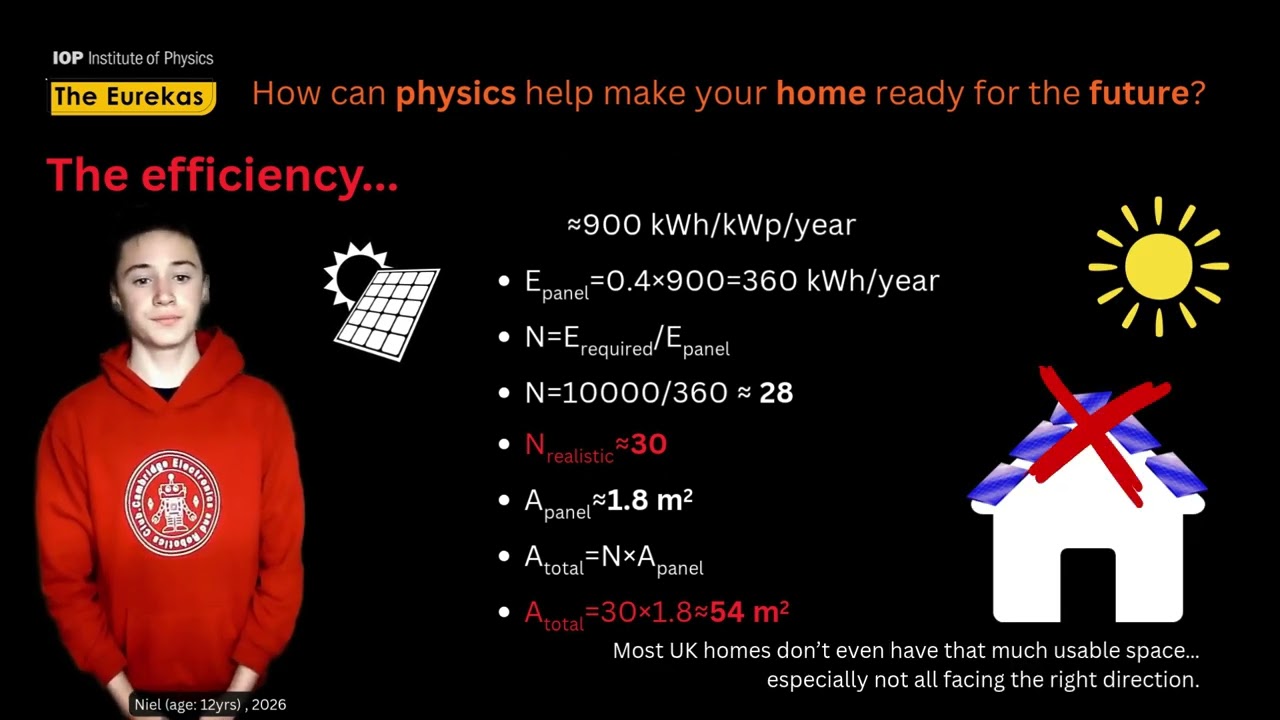
However, the transcript highlights significant physical and geometric challenges that prevent this ideal scenario from being easily realized with current technology. While generating 400 kilowatt-hours annually per typical panel suggests a need for about thirty panels covering roughly fifty-four square meters to meet the demand, most houses lack the necessary south-facing roofs required for optimal production. Beyond spatial limitations, there is a critical timing mismatch between energy generation and consumption; solar power peaks during summer days while actual household demand spikes at night and in winter, creating an imbalance that cannot be resolved by panels alone without substantial battery storage solutions to bridge these gaps.
Consequently, the video proposes a revised physics-based strategy that prioritizes efficiency over raw production capacity before considering generation methods. The approach is structured into three clear steps: first, reduce overall energy consumption; second, eliminate waste through better insulation and design; and third, only then focus on generating power to meet remaining needs. This shift in perspective moves the conversation away from asking how much can be produced toward determining exactly how little is actually needed, emphasizing that physics operates based on what works rather than aesthetic appeal or technological novelty.
In conclusion, relying exclusively on solar panels as a complete solution for home energy sustainability overlooks complex realities regarding geometry and temporal distribution of power needs. The transcript asserts that there are no shortcuts in thermodynamics and that the path to true sustainability involves minimizing demand first before attempting to supply it entirely through renewable sources. By acknowledging these constraints, homeowners can develop more realistic strategies that align with physical laws rather than idealized concepts, ensuring their energy systems function effectively regardless of how cool they might look on paper.
Read the full video transcript
Future ready homes start with
thermodynamics. Your house is simply an
energy system. There's no shortcuts. The
total energy supplied will always equal
the energy used plus the energy wasted.
Look at the typical Yuko home. Every
year you need 3,000 kW hours for daily
tech, 2,000 to charge your car, and
2,500 for heating. Factor in another
2,500 kwatt hours lost through walls and
windows. And you need exactly 10,000
kwatt hours. The ultimate sustainability
goal is supplying it all through solar
power.
Can we actually generate 10,000 kwatt
hours? A typical panel here gives us 400
kwatt hours a year, which means we need
about 30 of them. That's 54 square
meters of solar panels. The physic
works, but the geometry doesn't. Most of
our houses don't have the required
southacing roofs. But solar has a
massive timing problem. We generate peak
power during the day and in the summer,
but our actual demand spikes at night
and winter. To balance this equation, we
don't just need panels. We need serious
battery storage. So, here's the ultimate
physics strategy. First, we use less.
Second, stop wasting it. Third, then
generate it. The real question is, how
much can I produce? But it's how little
do I need? Because it physics doesn't
care what looks cool. It only cares what
works.