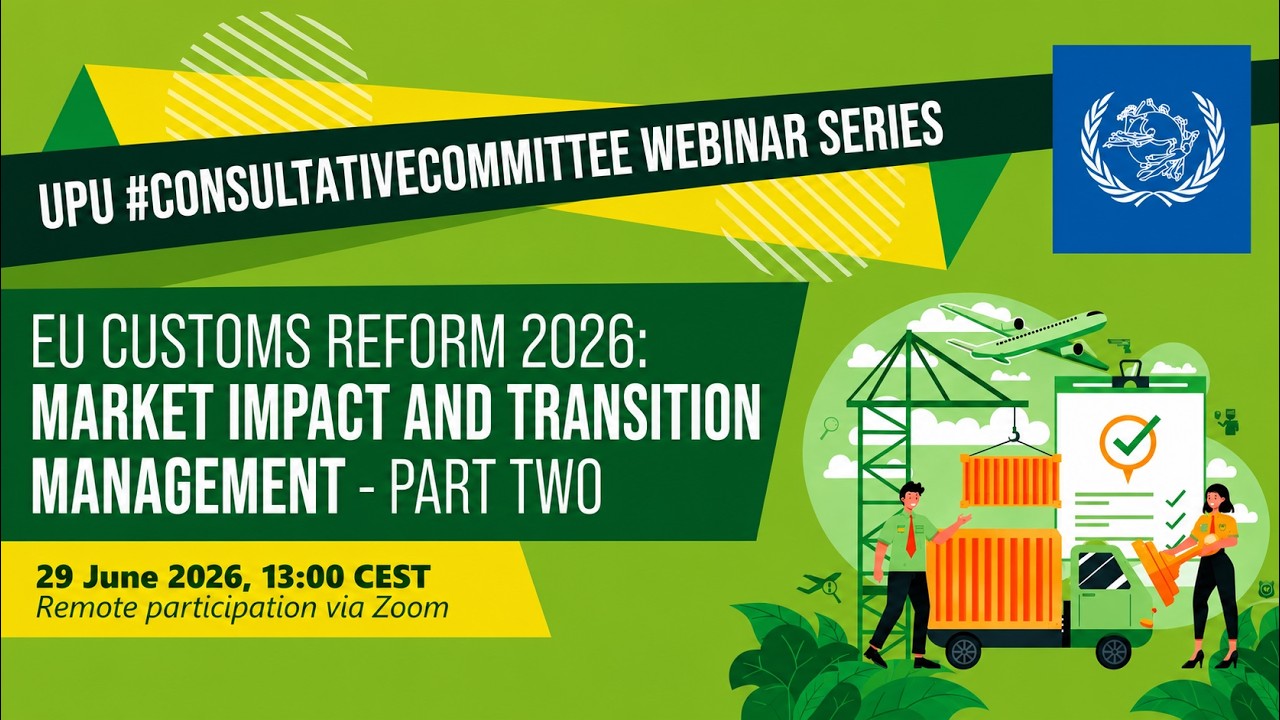
EU Customs Reform 2026: Market Impact and Transition Management
Watch on YouTubeVideo summary
The EU Customs Reform set to take effect on July 1, 2026, introduces significant changes for cross-border e-commerce, primarily through a temporary €3 simplified duty for B2C distance sales under €150 and new requirements for Product Identifiers (PIDs). While most designated operators will focus on Delivered Duty Paid (DDP) flows, certain goods such as gifts under €45 and items over €150 will continue to follow existing regulations. To manage this transition, industry stakeholders are actively monitoring regulatory developments in both the EU and US, exploring operational solutions, and preparing for the enforcement of PID requirements which aim to improve item-level traceability and risk analysis starting in November 2026.
To support these complex changes, various technology providers are adapting their platforms to ensure seamless integration with new data elements like EORI numbers and PIDs. The UPU Technology Center is modifying its modular solution to handle DDP requirements for both US and EU destinations, while certified providers like Boxy are leveraging orchestration layers to automatically manage line-item filtering and compliance with minimal system changes. Additionally, the International Post Corporation has highlighted the success of its Postal Delivered Duties Paid (PDDP) collaborative tool, which saw usage surge following similar reforms in the US, emphasizing that clarity on total landed costs is a key driver for consumer loyalty and operational efficiency.
Beyond technical adaptations, the reform addresses critical logistical challenges such as address quality and fragmented supply chains that complicate data transfer between postal operators. Solutions utilizing AI to validate addresses against government records are being deployed to reduce delivery failures and financial losses caused by poorly drafted or non-existent addresses. Although some legal uncertainties remain regarding the status of recent VAT amendments and the application of free trade agreements to low-value consignments, the consensus is that IOSS will remain essential for postal operators due to its cost advantages and established collection rules.
The industry is moving forward with a clear implementation timeline, allowing operators two weeks to several months to connect via standard frameworks or new third-party programs before the full rollout. Despite initial concerns about halted mail flows, it has been clarified that outbound mail to the EU will not stop because C2C items under €45 remain exempt and higher-value items follow established declaration processes. Ultimately, successful adaptation requires treating product data as a strategic asset rather than backend detail, ensuring that operators can navigate the new landscape with improved margins and customer satisfaction while maintaining compliance across evolving global trade regulations.
Read the full video transcript
impact and transition management.
I'm grateful to the UPU International
Bureau to host this second part.
You will see today again that knowhow
and technical expertise are readily
available
uh within the UPU consultative committee
to advise and help posts
implement solutions
between tax and duty experts. We call
them solution providers or even
operators. We call them volume
providers. The consultative committee
members have all been aware of this
change for more than a year now.
Please use the check function for
questions.
uh those questions will be collected by
the international bureau in the
background and uh I will then have the
opportunity uh to ask those questions to
the presenters. Kindly note translation
is available into Spanish and French and
you can switch on that translation
accordingly um um in the webinar
service lines. And with that I would
like to uh open the panel. Uh please to
the panelists again uh my remark is uh
please um stay within the time allocated
to you. This is for our panelists 10
minutes. Um there will be a presentation
by the customs group um following my
short introductions and I would like to
give the floor now to the customs group.
Please. Floors is yours.
>> Kristoff, I hope you're online.
>> Yeah, all good.
>> Kristoff Pereira. Yes, Kristoff. Very
good to see you. Please, floor is yours.
>> Thank you very much, Walter. Uh, ladies
and gentlemen, dear colleagues, uh, good
afternoon, good morning, good evening.
So I would like to briefly introduce the
recent work uh which has been carried
out by the UPU customs group in relation
with uh in relation to the AU customs
reform.
In particular, I will refer to the
webinar jointly organized by the
European Commission uh
and UPU of course on June 2nd and
summarize the key messages and the
follow-up actions.
So the AU customs reform uh will enter
into force uh in two days on July 1st
2026. It introduced a temporary
simplified customs duty of€3
per item mainly targeting B2C distance
sales uh goods before below 150 euro.
In terms of collection, uh most
designated operators will prioritize
iOSs flows with a DDP model while some
will still handle nonioss items and
collect duties from the address C.
It is also important to note that
certain items remain unaffected such as
gift below 45 and also goods above €150
for which uh customs duties will be
calculated with at Balorm method. Next
slide please.
Yeah. So on June 2nd, the customs group
in collaboration with the European
Commission organized a webinar on this
reform, the event gathered around 280
participants, sorry, confirming the
strong interest from the postal
community and due to the time
constraint, not all questions could be
addressed and consolidated
Q&A will be shared with the GD tax suit
for follow-up.
All materials including recordings,
presentation and FAQ are available on
the UP website and in parallel postrop
also been actively engaged through
dedicated FAQ sessions and share the
documentation.
Next slide please.
So uh beyond the webinar now the customs
group continues to work uh and on
several key questions.
This includes monitoring regulatory
development particularly in the European
Union but also in the US exploring
operational solution and developing
proposals for regulatory updates.
So since the last meeting several expert
team sessions have been held focusing
notably on emerging requirements and in
the implementation of the electronic
advanced data.
So the next customs group meeting will
taking place uh on July 8.
Next slide please.
So to conclude, I would say that the AU
custom uh the AU customs reform
represent a major change for our sector.
While important progress have been made,
further clarification and coordination
will be essential in the coming month.
especially we have a deadline on October
2026
uh where the European Commission would
like to review the current guidelines.
So there is still a possibility
to uh influence the legislative part of
the AU customs reform. So I would
therefore encourage continued dialogue
between operators, regulator and
stakeholders of course. Thank you very
much Walter for your uh invitation and
thank you very much for your attention.
I remain available of course for any
questions.
Thank you Kristoff in particular also to
uh keep to the um timeline. Uh of course
um the consultative committee and its
solution providers and volume providers
um are available um um as observers uh
to the customs group for any kind of
questions and helps. And if there are
questions in the background, the
international bureau is already
collecting those questions and I will uh
bring them to your attention um in the
course of this webinar. Thank you
Kristoff.
>> Thank you.
>> And and with that I would like to move
to the UPU technological uh perspective.
Um I have the pleasure to welcome Lati
Matata and also Davis EPSC um from the
postal technology center. Uh, Latte, the
floor is yours. Thank you.
>> Thank you. Thank you very much, Walter.
Just to make sure you can hear me well.
>> Yes, we can hear you. Thank you.
>> Excellent. Okay. So, uh, greetings to
everybody in this webinar. Um, if you
were in the first webinar earlier um
last earlier this month, we are just
giving you an update on the progress
made uh with additional information. So,
next slide, please.
Next slide. Thank you. So, first of all,
as always, a reminder on the overall
technology strategy for this cycle. We
like to put it in a single diagram where
we try to capture all the actors, all
the business processes. What we have
added for your attention is uh who is
using which particular technology uh
that comes from the UPU.
In particular, I draw your attention to
uh the solution for customs processing.
As of today, it is used by 179 postal
operators. The network itself uh postnet
for the transfer of data between all
actors stands at 229.
Additionally, we are pleased to have our
wider postal sector players slowly
adopting our solutions and platforms.
From a career point of view, we have 35
and from a postal business partner point
of view, we have seven of which I will
give more uh information. Now, what you
have in terms of the uh for your
attention are the red dots. Uh these are
all the changes and actors we are
implementing to support uh the DDP
solution. Next slide, please.
So similar to the previous webinar, we
like to present the customer journey and
process. Now if you look at it as
layers, at the top layer is the customer
experience. How you interact with the
post of origin. So that first uh layer
in blue that's if you are an origin
post, these are the activities you will
do to provide a DDP service to your
customer. The second layer or the third
layer is the PTC IT tools, the
technologies that have been adapted to
support this service. And then the next
layer is now what we call the third
parties. Essentially
um any commercial or non-commercial
entity or personal operator that is
helping us um implement the requirements
for DDP in that jurisdiction destination
jurisdiction. So in the case of the US
we have spoken about that extensively
and now we are adding on to this model
the destinations for European Union and
then finally at the bottom so it's it is
marked US CB CBP which is our uh US
customs uh and border protection uh
authority. However, we are building a
solution that would then support any
customs authority of destination. Now
what we are adding to this particular
slide if you just click once
is the necessary changes that we have to
make to the solution to make it uh
support first from the US point of view
the incoming regulations that were just
updated last week and further updates
will come uh this week and in addition
of course we are adapting it to support
uh the EU do. Now the first point I
would like to highlight here is we are
trying to as much as possible reduce the
impact on the sending post on the
customer and of course on our on our
destination posts. This is always our
objective with the intention to build a
truly global BGP solution. So if I start
at the third layer uh which is the PTC
technologies we will be adapting our
solutions to capture all the requested
additional elements.
When we go to the fourth layer now the
third party
we have some specific requirements from
the European customs code related to how
to implement a DDP for the 27 EU
destinations. So there's some work to do
here. Additionally,
sorry.
Additionally, the European Union require
requirements
expects the destination UDO to be the
one to pay the local customs um on the
duties and taxes requested in advance
and then to collect all those uh
payments from the origin post.
in terms of moving data to the third
party. So currently we provide a
manifest with some basic information
additional data elements are now going
to be transferred
and then finally with regards
specifically to the United States
additional organizations will be
involved in evaluating
the the the risk or the review of the
postal item based on the data provided.
So I do understand we are focusing on
the European Union mostly today.
However, the US updated requirements are
coming uh very uh quickly and in
parallel.
Next slide please.
So as a reminder so this is a new slide.
Uh we have I'd say uh now a mature
product. We have been growing in terms
of its flexibility. If I start first on
uh the footprint, we as mentioned we do
have 179 users of the solution. We do
have the technology more and more widely
deployed for especially from a customerf
facing point of view. And if a postal
operator does not have CDS, we provide
central APIs. So the requirement to have
CDS is not a must. We do provide an API.
um gateway for you to access the
necessary information to offer a DDP
service. It is highly modular for the
experience. Now different components of
the solution have been used by different
posts. So um we have a now onboarding
process which allows you then to adapt
um to your own specific uh origin post
requirements and use the parts that make
sense to you. I also want to point out
that this solution is volume based. So
there's no flat fee. It's purely volume
based. And most importantly uh we are
looking at the settlement aspect. The
work to have to adapt the UPO clearing
solution uh has started and we hope to
have a working solution by the end of
this year
on service providers. So earlier this
year we did highlight uh this month
sorry we did highlight that we are
making progress to certify
um our providers for the DDP or the
landed costs and various other lookups.
Now I'm pleased to say we have seven as
listed there and we are open to
continuously onboard newer third party
and commercial providers for the
service. So you're welcome if you're
interested to do this uh you're welcome
to contact the PTC at the same time for
our postal operators this means we bring
for you choice. Finally on payments
method in the previous slide we showed
the three ways you can do this so I'll
not repeat this but the most important
point is we provide uh payments options
depending on the customer profile. So we
handle all cases.
Next slide please.
Now I think we are all aware that uh
starting off with the US and uh I hope
not with the EU there has been impacts
in terms of volumes. So we thought we'd
be good to uh to bring to your attention
what we do see at the PTC.
On the left is uh a graph which shows
the weekly volumes uh starting um from
the middle of uh the start of last year.
Uh the line in red is what you should be
paying attention to and the drop there
you see was as a result of the
implementation of the uh the US
executive order. Um the good news is of
course with the roll out of the DDP
solution we are slowly recovering or
we're seeing a slow recovery in volumes.
Now it's important to also say that this
uh statistics you're seeing here are
only related to the postal operators who
are using the UPO DDP solution. So as of
this moment 51 postal operators so it's
not the entire network which brings me
to the right as just a snapshot of our
dashboard showing uh what is happening
on the network. We have three qualified
parties now who are providing this
service and we hope again to add more
and more um providers. Uh 51 postal
operators are using our solution and we
see about uh 21,000
declarations on a daily basis. We always
do uh remind you that we have a
dedicated page for this uh activity. We
try to keep it update updated. um we
will be updating it now with the
implementation for the EU as we go
forward. So I just want to remind you
that this is a centralized point from
the PTC's perspective where we keep you
up to date. Next slide please.
So this is my last slide uh for our WPS
uh who are in the call our CC members.
First of all, this is all for your
advantage by getting certified by the
PTC against its uh UPU technology. Most
importantly, you get access to the
entire network. It's not just to one
particular postal operator. You get a
certificate uh signed by yours truly.
You will also be listed on the UPU
website under the second link where we
will highlight a contact point, a
description of your service. So we
invite you to contact the PTC to
continue on this certification journey
and we'll be happy to answer any
questions you may have for postal
operators. Uh the whole objective is
that first point we want to make sure
that uh first of all the trust of these
service providers is strengthened. The
interconnection or the interoperability
with our technology is secure and
stable. And then finally uh from a
postal operator perspective we give you
choice. You will have a competitive
landscape of operators from whom you can
choose and change based on your
discussions and negotiations with these
service providers. So with that I will
stop and I'll be happy to take any
questions as part of the Q&A. David and
I. Thank you.
>> Thank you Latte. Message well delivered.
Thank you very much indeed. Um without
any further ado, I would like to move to
the short presentations of our
consultative committee members um on the
on their um particular market
perspectives.
First one um will be boxy um J Scoffield
the co-founder and chief digital officer
of Boxy. Um sir, the floor is yours.
Welcome.
Please unmute yourself.
Thank you. Thank
>> Thank you.
Um yeah, I'm ready to start. You can put
the next first slide up. Uh Box C just
introduced we're one of the certified
EPU providers. Um we you know been
providing this service through to the
US. So, it's been working um pretty
smoothly now and now we're preparing for
the new changes. And this is about the
um uh EU, the changes that we're
preparing for for the EU. Um
you know our systems built to make it
easy you know take care of a lot of the
comp complicated complex issues and uh
design you know uh the
paying the three collecting the three
euro duty uh making sure the uh line
that they're applied to line items and
uh and also managing the uh payments. Uh
we can go to the next slide.
So Box C what we do is we're just an
orchestration layer is the best way to
look at it. Um we work with multiple uh
parties all around the world. Uh
multiple brokers around the world. U u
all those you know everything that's
needed for to cross a border for
e-commerce shipping.
Um, as I say, we're vendor neutral, so
we have multiple different uh providers.
Uh, you could connect to any of those
you'd like to use or u, you know, we
have ones that are set up. Um, we can
always, you know, we're always changing,
always keeping, you know, uh, integrated
with different, uh, um, um, pro customs
authorities if need to be. um uh the P
different uh designated operators um
even on the commercial side as well and
we're constantly integrating with
everything that needs to be uh
integrated with. So whenever things
change um it's just a matter of using
our service rather than having to
integrate on your um uh next slide.
So with uh the um changes coming to the
EU, which is just only a few days away,
we've you know prepared for that. Um
we're always managing, you know, all the
data that comes through and making sure
that data is needed to um um you know,
clear customs and to um
make sure there's no problems or things
get held or that sort of thing. Um,
again, you know, I think the big thing
is a $33
um customs duty that's based on the um
um each line item. So, if there's two
items that are the same, uh it's just
only €3 rather than each being €3. So we
automatically
filter that and make sure those things
are done um as when they're when the
data is coming through. Um also we're
preparing for the product identifier and
you know all the rules that are coming
through because this is actually
you know more of a acceleration of what
was planned in 2028.
So these we've always been planning for
this. So this is you know the um um all
these things are being planned as we
move forward. So this will also you know
kind of what we do is make sure you know
that's all in place um so it's a smooth
move over to that. Um
we can also help with you know how to
deal with those PIDs and everything
those sorts of things. We do that
already in the US for
uh what they call the PGA or or partner
governmental agencies
um you know deal with those sorts of
numbers and the supplier number or
manufacturer ID. So this is something
that's kind of the technolog is already
there and ready to um use for the EU as
well. Um
we can go to the next slide.
uh this is you know how we you know
we're working
we're collecting all this data and and
and in partnership with PTC especially
with the UPU uh they send us all the
data that's needed um you so we work
very closely with them so it's always
you know uh it's been working very well
for the US um and you know
how we look at it for the U will be very
very similar is they will pass on that
information to us and we can uh send
that to the parties at the u the
destination.
Um
how our system is now
there really won't be any needed changes
from a any of our clients or anyone
using our system. The PD the DDP
workflow will work the very same as it
does for the US. It will just be for the
EU. There'll be different uh data
elements required and and uh and and the
payments s process will be a little bit
different but generally speaking from a
user's point of view they will just
still send the data the data will come
through and we'll take care of those
processes. Um
we will also you know when we get that
data you know as well as we're working
on for commercial uh e-commerce
clearances as well. So a lot of times
we're already set up to do the um
basically the automated the data mapping
of what how things should be clearing in
postal and and clearance in and EU
countries. So any changes that comes up
or things that happen we're prepared
for. You know we can bring a lot of
um processes that is kind of in the
commercial side onto the postal side
when needed when required. So um we'll
make that transaction see transition
easy and when that um uh any changes
that come up such as the PIDs and things
like that it's prepared for um we'll
also do a lot of validate pre-clance
validation so we'll we can check again
this is kind of from the commercial side
of things but this is something that we
can also offer you know as needed on the
postal clearances is um uh validating a
lot of this information from the
uh sender. Um, you know, we do have, you
know, you can use apps, uh, where a lot
of this information is is collected
early on and, you know, it can make sure
that the the sender is putting in the
right information before it even gets
started and then um um restricting
anything maybe prohibited or uh things
like or restricted or needs more
information that sort of descriptions
and things like that. Uh this also kind
of relates a bit to the US as well. Um
those that is changing uh um as we move
along um as those changes are coming on
along as well. Uh next slide.
Um here we you know we manage the uh
collection we can manage the collection
of and payment of the duties to the to
the uh customs authorities uh around the
EU. Um again we can do the collection
directly from the uh sender um and or
just the um um provide the designated
operator what the duties will be and
what needs to be collected and then bill
and then we will pay the um um customs
duties for the destination country as
well.
um
on the we also monitor a lot of these
things. Make sure everything's paid.
Make sure the bond any if any uh customs
brokers are required in in uh in in in
any of these countries. Uh you know each
country is a little bit different. I I
think cuz um you know you can see I
think in some of the earlier slides uh
each country has different ways they're
handling it um the uh whether some are
the declarant or the representative uh
we will take care of all those things in
countries where um the designate
operator will handle you know be the
representative or handle those sorts of
things we can adapt to that or in
countries where there's um um um there
needs to be a representative or or a
declarant we can take we'll manage that
as well and then I think in some of
these things and that comes with the
filtering or the uh part of our system
is you know it will there's any
operators that will not do DDP we can
also catch that early on as well um
can also do the calculations as far as
making sure everything is is um
manage right as far as uh if some of the
senators already have their own ISS
number uh we manage that as that or if
there needs to be an ISS you know
representative for some customers um all
the different ways that can be done we
already handle that and are prepared to
handle that for any things that comes up
through here and as far as pricing,
we're just very straightforward and and
transparent. So, it's just a per fee and
and um and that's that's all there is to
it. Uh next slide
and that's the end here. Uh Tonnie is uh
I think many of you probably are
familiar with her so or know her. So
always reach out to her and and with any
questions and I can answer any questions
as well because we work together.
>> Thank you very much indeed. Uh message
very well delivered. Everybody knows
Tony uh she is the vice chair of the
consultative committee very well known
always present uh in burn. Thank you
very much indeed. Um the IB collects the
questions in in the background already.
So um under agenda item four five we
will we will address those questions
accordingly. Um I would like to move uh
to the next presenter um which is uh
Roses lovehati
um of as project. I know I'm trying
hard. Yeah. Um rosters love very good to
have you here uh on board. Uh the floor
is yours. Thank you.
>> Yeah. Good. Uh good afternoon everyone
and thank you for having me here Walter.
It's uh it's interesting times and
everyone is very much uh looking forward
to the 1 of July to to to see what
happens. Um can we have our presentation
on then? Yeah. Okay. Can we go to the
next uh
um
sorry my throat is a little bit sore
today. So uh just a few words about ES.
We are the leading provider of the
automation for e-commerce. Our main
business is IOSS and uh basically what
I'm going to be talking today about is
IOSS and the three Euro duty how it will
work in the new um setup which is going
to unfold um in a few days and some of
the issues which are still open and they
might affect both the postal operators
and uh non-postal logistics service
providers who operate on the parcel
market. Can we go to the next slide
please?
So general rules again we a lot of
things have been said about the three
duty. I will not go very deep in there.
So of course it is only applicable to
the u distance sale of goods goods
imported from third countries. So
technically B2C I will come back to that
a little bit later as well. So it's u
applicable to the sales below 150. So
it's basically the area where ISS
uh used to be and still is applicable.
So um the big difference for everyone is
that the U duties pay is payable at the
national customs unlike it was initially
introduced within the IOS scheme when
the VAT was collected by the
intermediaries like us and uh paid
directly to the um
u EU member states. So now we have a new
segment of collection and that's
national customs.
Uh
we tried to talk to tax that this um uh
function would be still transferred to
to the EU to to ISS intermediaries but
the decision was very much set on uh
transferring this um to the national
customs. So it's how it's going to be.
So um and the
one final thing which is very important
for our discussion today is the role of
the IOS uh number holder at customs or
presumed role as it is explained into
the uh the the
explanatory notes which were provided by
tax. Can we please go to the next slide?
So what we expected when uh the whole
thing was unfolded in uh February. So
initial expectations were very grim. We
expected that there will be a lot of um
dropouts from the IoSS scheme and that
the uh commercial activity will take
over without the use of the ISS.
Well, of course, our expectations were
based on uh lack of uh um legislation
which is in abundance nowadays and then
uh we had to presume a lot of things but
uh from our perspective now we can see
that iOS registrations are actually
rising and very quickly. So we have
twice as many registrations this month
uh this month uh compared to the the uh
previous month. So it actually shows
that the uh IOSS scheme still stays on
and it will still play the active role
in the uh parcel business. So um
a few words about the commercial
carriers. Uh so we are in contact with
many. So of course everyone gets um
prepared. So uh they will provide
solutions for free euro uh collection
and payment with lended costs. Almost
every uh commercial carrier we've spoke
we've spoken to so far they are
uh offering these services. Now some of
the offers will be very um inexpensive.
So that will create a new market
situation for everyone who is uh uh in
this business. So um when it comes to
the postal operators of course uh well
PDDP probably will be the most reliable
solution for the um delivery of
low value consignments in the postal
world. But um it actually has quite a
few setbacks which are from the
perspective of our customers might um
change their mind from using postal
world. I will come back to that later
preparedness. So since our customers are
mostly e-commerce operators
so we are basically integrated to their
stores. So we know what happens in the
store and we are in the pro. So, so we
apply our landed cost very often and we
know how the process of calculation and
collection happens. Uh, I can tell you
that um most of the e-commerce platforms
have not prepared properly for the
change. Uh, some of them are taking the
last minute steps. For example, Shopify
published um information on the three
euro just two days ago. So technically
Shopify will be providing the
calculations. We don't know if the
calculations will be correct or not.
Uh but we hope it will um it will work
somewhat. So postal operators I don't
want to stop here on this um uh
particular uh point because it has
already been presented. um and as I said
commercial um solutions um they will be
competing with postal operators very
much and then specifically on the level
of um non-supported countries again I
will come a little bit later on the
reasoning for that
so um in in in in my understanding that
the um IOSS is is is here to stay
whether three euro duty or not and the
um we will still deal see the the the
whole situation unfolding in in the next
month and we expect that the uh from the
1st of July it will not be a very um
clear and uh
precise picture of what is happening. We
are preparing to support our customers
as much as we can but there will be a
lot of aspects where there will be
misunderstandings and uh probably a lot
of delays in the deliveries to the
European Union. So can we go to the next
one please?
So the main challenges so
um as we see it because again our
perspective is from the uh um IOSS
intermediary so it might be a little bit
um off key for solution providers and
for volume providers but still probably
is very interesting for you to hear.
First three euro duty in segmented
supply chain. What we call a segmented
supply chain is when the basically the
merchant as our customer normally
uh does does not support the whole or
control the the the supply chain. So in
the process of postal delivery there is
originating postal operator there is the
destination postal operator and then the
data money and um a responsibility is
transferred in between them that creates
essentially a problem because if you
compare the situation to the Chinese
marketplaces they usually control the
supply chain. So technically they
actually know where every single parcel
will come through customs in the
European Union. That makes the situation
formemes in the UK in the US much less
um clear and uh probably they would be
very much affected negatively of the
whole by by the whole change.
Second thing it's the place of
collection. This is um this is a problem
which was uh basically fixed. The date
is wrong here on the 16th of June. So
just a few days ago. The problem is that
we as iOSs intermediary were responsible
for VAT. VAT is to be collected at the
play of at the moment of the sale. But
technically uh 3 u uh 3 duty is
collectible at a later stage and in a
different place and even uh at the
moment of the sale we cannot be sure if
it's going to be 3 or€6 or 9. We don't
know that we can presume but we don't
know. So technically there was a problem
since the U VAT since the duty is part
of the VAT base for the customs
purposes.
So um the question was whether we have
to collect somehow the U VAT on three
euro and so we asked our uh DJ tax to
clarify this on many many occasions
and finally on the 16th of June
amendments were published to the VAT
commerce notes which clarified the
situation very much in favor of IUSS. So
uh the situation goes now like that.
This is very important specifically uh
since everyone is building their own
landed cost calculation. So VAT for iOSs
items is not collectible on the 3 duty
while it is still collectible on the
situation with special arrangement or
normal um imports. So technically if an
item goes as IOSS
uh it will be less expensive by
approximately
uh well the duty so to say will be less
expensive by 20%. This is the new
development that will probably uh give
uh additional incentive to the USS uh um
registrations.
Uh but one important note here is that
this um
um
solution was published as an amendment
to the uh VAT e-commerce note. So it's
not technically legal document. So you
has not been able to implement this
legally entirely legally. Of course it
will be it is still a document published
by the European Commission. it will be
used but that creates a lot of questions
technical questions on whether it will
be fully accepted by the uh customs and
by the uh local tax authorities. So it
needs to be still u seen.
Um so and final question that might be
uh interesting here to discuss is the
VAT on the future to handling fee which
is probably will be introduced in
November.
Um the current decision is there will be
no VAT on the two handling fees. So it
will be considered as a service provided
by customs.
Uh and then it's not uh subject to the
VAT. So that's um something that needs
to be known especially for those who
actually create their own landed cost
calculations.
So let's go to the next one.
So this is the one of the most
interesting um things which is
happening. The question is whether the
free trade agreements will be applicable
for the uh B2C um
deliveries. So unfortunately this is the
old version of the presentation. I hope
that the new one will be sent to you.
But um again the um situation goes uh as
such that um the available legislation
including the um customs guidance the
the amendments to to to
delegated act the amendments to the
implementing act treat agreements in
terms of application towards the the the
the B2C uh low value consignment
differently.
Uh my opinion is that it is applicable.
I mean the free trade agreements uh can
be applied provided that H1 uh custom
declaration is used and that the um uh
proper HS codes are included with the uh
the supplementary documents for the uh
origin of the goods. Again, this is
something that remains to be seen. Um,
we will probably see um
further deliberations of these cases uh
in in in in the uh European Court of
Justice because um well, you can
actually check it yourself. I piled up
this uh table specifically for the
participants to have a look and make
their their own mind on that. But this
is something that um makes it very uh
strange in the way how the the whole
legislation was built. It was built
hastily it seems and without due
consideration to detail.
Uh let's go to the next
slide. So and uh it's probably the final
one for me. So um for postal operators
um as I said uh we believe that IOSS
will be one of the essential components
for the postal operators to handle the
uh the DB type of a solution.
Uh not only because ISS makes it less
expensive to the end customer but also
because the VAT is not to be collected
at the um customs if ISS is used. that
rule still stays. Um, so VIP as we heard
still will be probably used by some of
the postal operators. This is also for
for for some destination and this is
what I see from uh my communication with
postal operators and we expect that the
situation will progressively change over
time. Um
and again in the long run we still are
uh waiting for the final implementation
of VA rules and then uh as we expect in
2028 the rules will change again and
then uh the uh duties however they will
be applied they will be collected
through the IUS intermediaries.
Well next one please.
So that is it.
>> Thank you, Ros. Um very interesting uh
market insights. Um I'm very happy that
we are recording um this webinar to the
benefit of all our participants and we
will share that um after the webinar.
But uh we are a little bit pressed uh
for time. So I'm moving straight um to
hurac. Thank you Ross's love. Um hurac
Martin Palmer, co-founder um of
hurricane. Uh Martin, the floor is
yours, please. Thank you.
>> Should a couple of minutes here, Walter,
all being well. Um, good afternoon. I'm
Martin Palmer from Huracan and a proud
member of the consultative committee.
I'd like to talk about the EU product
identifier or PID and what it means in
practical terms for postal operators in
the wider parcel ecosystem.
This is an important topic because PEG
sits within the EU low value import
reform for consignments up to 150 euros
mainly in BTOC distant sales flows but
has had far less coverage than below uh
value threshold removal and has the same
dates of implementation.
In simple terms, the aim is to improve
item level traceability and give customs
authority better product data for risk
analysis.
What Hurricane does. Uh before we
actually get into PID, let me uh briefly
explain where Hurricane fits in.
Hurricane Commerce turns commercial
product data into customs ready data by
classifying goods, calculating landing
cost, screening for compliance and
automating the customs data that moves
with every parcel. In other words, we
work at the uh point where product data
compliance and operational execution all
come together.
This is an important topic because that
makes pit particularly relevant because
this is fundamentally a data quality and
data organizational challenge and not
just a customs formality as such. Next
slide please.
At a high level, PID is not one brand
new code issued by an authority. In
practice, it is a bundle of identifiers
that already exist in commercial product
data. If you can go back to the previous
slide, I'll let you know when to change,
please. Typically, that means the
merchants product code, the
manufacturer's part or model number, and
where available a standardized
identifier such as a G10, EN, UPC or
ISBN number.
The challenge is not registration. It is
capture structure and consistent
transmission
pins are not required for B2B VAT
registered recipient recipients or
shipments with an intrinsic value of
€150 or above just to make things a
little bit uh more complicated for us
all. Next slide please.
In the EU reform context, PID is a set
of item level identifiers used for low
value imports into the EU. It has three
parts. the MPID which is the merchant uh
product identifier usually the seller
skew nit the non-standardized identifier
usually the manufacturers's part uh part
or model number and the SPID the
standardized identifier such as G10 ISBN
uh numbers where one exists
next slide please
the reason the EU has introduced PI is
straightforward
Customs authorities want a more stable
way to link declared items to actual
products so they can improve compliance,
safety, and forward screening.
This matters even more now that the low
value environment is becoming more
controlled and more datadriven.
The wider implication is that
marketplaces, hosts and carriers will
need far stronger catalog governance,
better info detail and tighter data
transfer disciplines.
Next slide, please.
In practice, a PID is built from
existing commercial master data. The
merchants uh skew becomes the M PID. The
manufacturer's part or model number
becomes the NS PID and any recognized
standard codes become the S PIP.
So the important message here is you do
not need to apply for a PID from an
authority. You can build it from data
you already hold and make sure it flows
into the customs declaration process. Um
obviously a lot of the people that are
are on the call today are transporters
one way or another of of these
commodities. So it's our customers uh as
such will need to provide this
information for us to to transport.
Next slide please.
PI is not is also not a single EUwide
number format. the standardized element.
So the ISBN codes for example uh the
SPID is the most structured because it
can be an existing format as an ECN,
ISBN or a similar code.
By contrast, the merchant and
manufacturer identifiers are often free
form alpha numeric values and used in
commercial um backend uh systems. The
operational focus should be less on
inventing a format and more on the
importance of data capture, validation
and consistency.
Next slide please.
PIN is not filed through a separate
portal there. There isn't a new channel
or a new stream as such to transport
this data. It is captured in the sellers
or platform cataloges and shipping
workflows and then passed through
invoice data or API connections into
carrier and postal messages. Um
companies, sellers, uh uh manufacturers
etc are being asked to show this
information on the uh commercial invoice
for example and any other supporting
document.
From there, it will support pre-arrival
filing and load value customs
declarations processes.
For posting carriers, the real question
is not where to file the PID, but how to
ensure that the right item level data
moves cleanly through existing
electronic flows.
Now,
I guess an important point to make here
is whereas what we're talking about with
the uh 3 fee being at a HS level, um
obviously five t-shirts, for example,
could all have different skew numbers.
So each one of those t-shirts would then
require their their their own uh P ID
even though it may be the same HS code.
If it's a different skew number then it
is a different PIN as such.
Can we go to the next slide please?
The times are tight um but very clear.
Um a voluntary system starts on the 1st
of July, so on Wednesday. Um alongside
the EU removal of the low value customs
exemption and operators are already
being encouraged to have their PIDs um
data flowing so systems and data quality
can be stabilized.
Um it it has been so poorly communicated
this whole process that I I would be
very surprised to see too many companies
um already being in the place that
they've got this data uh available to
flow through the system and then from
November so only really about four
months PI enforcement begins for inscope
low value shipments into the EU. The
transitional window is short and
obviously the time to prepare is three
months ago but um obviously we're we're
talking about it now as such. So if we
move on to the next slide please
what should operators do now? First
update sender portals and APIs to
capture the skew model or part number
and the standardized code where
available.
Second, map that data through invoices,
messaging and declaration outputs with
field level validation and exception
handling.
Third, train operational and customer
service teams, run pilot traffic with
selected merchants, and monitor fill
rates and error rates.
At an executive level, this should be
treated as data um as part of a data
governance program and not just a change
requirement for for for customers.
Um I I I think it's also important to
just mention here that um the the the
standardized references for example,
they won't be available for for anything
uh everything. But if it's a book then
you may have a skew, you may have a
model or part reference number and you
may have an ISBN number in the case of
books. All three pieces of information
will be required.
Next slide please.
So just to close PI PID is not about
entering uh inventing a new identifier.
It's about making existing product
identifiers usable, reliable, and
transferable across crossber data
chains. For personal operators, the
organizations that do best here will be
the ones that treat product data as
strategic operational asset, not just
back back office uh details. Thank you
very much,
>> Martin. Thank you very much indeed. Uh
thank you, Harry Kane. Um from our
perspective uh the consultative
committee this again was a very good
example of how um consultative committee
members share knowhow to the benefit of
designated operators. Thank you Martin
for that. And with that I would like to
move um to um our colleagues from the
international post corporation. Chris
the floor is yours. Thank you.
>> Hey Walter, thank you so much. And I
just start with a sound check. You can
hear me. Okay, I guess.
>> Perfectly. Thank you.
>> Awesome. Well, first of all, thanks uh
so much to the UPU for putting on this
webinar and a specific thanks to you and
to the consultative committee for
allowing IPC to join. Uh you can go on
to the next slide if you want. uh
International Post Corporation. Of
course, our mission and goal in life is
to support postal operators in growth in
crossborder e-commerce and to provide
solutions that help them uh get through
the things like the storm of the UCCC in
order to continue to grow. You can go to
the next slide.
I'll try to get some time back for you.
But I I think for those of you who may
not be aware of uh who IPC is, we're for
the posts and by the posts. Uh 35 years
in business in terms of leading uh the
growth of solutions for the postal
sector
where shareholders are the post
themselves. So we're a postal
collaborative that's not forprofit.
um 24 different designated operators are
the essential owners of IPC and guide us
and help us along the way. We have more
than 50 services that are used by the
posts. Many those have to do with
customs duty and tax and then we connect
those services into more than 200
different posts and carriers around the
world. So quite good reach and and just
as it's always helpful to say upfront if
you ever want to get in touch with IPC
we're open to any post of any size
around the globe who would want to
connect to one of our services.
You can go to the next slide.
I I think you know one of our goals is
to try to stay ahead of the curve. I
liked what Martin said about you know
having to have this discussion three
months ago. It's completely true. Um,
we've been trying in our technology
buildout specific to e-commerce to
anticipate market trends and try to work
through the different regulatory
impacts. Our our PDDP, so our postal
delivered duties paid product that I'll
talk about today. It's actually going on
its sixth or seventh year in the market,
far longer than I've been at IPC. And I
do think it's important to state upfront
one of the things about delivery duties
paid before it became a regulatory
imperative
uh it's been a customer imperative and
it is shown to be quite a loyalty driver
in the market. You know customers tell
us time and time again that what they
really value is clarity to total landed
cost when they're making a purchase. So
when I buy my shoes I I live in Belgium.
When I buy my shoes from the US or from
the UK, I want to know exactly how much
it's going to cost to get those shoes to
my door. And I usually don't want any
kind of surprises that that can ruin my
day at the doorstep. And that's how you
really do kill customer loyalty. Um that
comes across time and time again in the
IPC research. So we do our crossborder
shopper survey. Um we're nine in 10. So
90% of respondents and this is the
number one driver in terms of importance
when buying cross border tell us clear
information around delivery charges
before placing an order is is important.
So number one factor the second factor
no doubt is uh low customs duties. So
almost the same amount 84% tell us low
customs duties are a big driver uh in
terms of crossber. So I think no more
pertinent discussion than uh the one
we're having today. You can go to the
next slide.
And to solve challenges for the
customers and for the postal operators
that we serve, we've launched our postal
delivered duties paid product. It's an
intoin solution for duty and tax
collection for the postal world. Uh
which includes both tracking and
reconciliation and reporting
technologies to make life easier on the
posts. You can go to the next slide.
This is a slide that I I simply can't
update fast enough because of the the
growth that we've seen in terms of our
PDDP usage coming off the back of the US
uh dimminimus removal in in August of
2025.
Um I think as of this morning we're now
up to 44 posts who are on the PDDP
solution with more than half of those
using our our US application. Uh 11
million shipments at the time when I
made the slide. I'm sure this is 12 or
13 million by this time, but you know 12
or 13 million shipments into the United
States post dimminimus. That was one of
the big wins to helping the post win
back and win more on that lane. Uh and
then I think posts have already started,
you know, from as early as February to
have discussions with us around the UCCC
changes that were coming up. uh many of
the more proactive ones have already
started to implement the technologies to
be able to support uh as as Martin said
the data capture and the different
elements that are coming uh on Wednesday
morning. We we've already seen a 200%
increase for example in terms of the non
USPDP numbers. So quite a robust system
and if you go to the next slide I'll
kind of walk you through how it works.
So I I can tell you really 50,000 foot
view uh around the journey of a PDDP
shipment. Uh one slide back, I'm sorry.
A and very simple. You can you can think
of this as uh me again buying my shoes
in Belgium from a United States website.
Uh the e buyer is going to make a
crossber purchase. So duties, taxes,
fees can all be collected by the
merchant. Uh that way the the funds are
remitted up front. the e-eller. So that
that guy who's shipping the package to
me, he's going to create a PDDP shipment
using one of the the designated
operators outbound products. Uh so it
could be let's say postal PDDP
the sending post or even a third party
today as we now have allowed technology
partners to join the party in PDDP. He's
going to upload transactional data to
our PDDP server and open a PDP record
that that's now visible across the globe
to the PDDP postal operators who
participate. So they can see that
there's a PDDP shipment in the network.
The destination post will recognize that
there's an incoming PDP. He knows that
the duties and taxes have essentially
been agreed to be prepaid.
Shipment is customs cleared. Doesn't
have to have any, you know, notification
to recipient to collect money. It's much
smoother, much faster through customs.
Destination post will then update the
actual duty and taxes paid uh to be able
to then invoice the sending post. And at
the point where they invoice the sending
post, that's when the transaction is
closed. The sending post will pay the
destination post outside of the PDP uh
mechanism. So very simple for post to
implement. You can go to the next slide.
Specific to the UCCC changes that are
coming on Wednesday, we've beefed up our
PDP technology so that we're ready to
support volume in uh many of the markets
in Europe in 2026 and beyond because I
think as we've learned today, it does
not stop on Wednesday or July 1st. The
changes will be continuous. We've
developed a new transactional API, so a
V2 API for PDDP and all of that
documentation if you're interested to
join is fully available. That includes
capture for the extended data set, the
PIDs, uh, that Martin had referenced in
his presentation as well as this new
concept of a third-party declarant. So,
we can capture and input their Eori so
that the posts have access to all of
that information. And then of course
that's all backed up by our PDDP
framework agreement in the government
governance. So we ascribe liability. Uh
we handle power of attorney support. Uh
we do a lot of different kind of agenda
that help the post manage the ins and
outs of PDP. I won't go into the uh ins
and outs of the technology map. That's
not my my forte. But I will say that
we're also working closely with David
and Latia and the UPUP PTC team on
looking at how we might launch
interoperable solutions between the UPU
and IPC's PDDP product. I'm sure we'll
get there in a future webinar. You can
go to the next slide.
There we go. Multiple ways to connect
into IPC's PDDP product. Um, just so you
guys know, it's not a one-sizefits-all
shop. We also like to give our postal
operators uh choices. I won't go through
all of the detail on this slide, but
essentially you've got three paths
today. Um, the first is the IPC PDP
standard approach. So there you would
sign a framework agreement and a DX
session. They all use the same
transactional API. They all use the same
PDDP reporting. Um, you can also go via
Prime if you're a member of the Prime
network. We have a special alliance with
the Prime network. So, you can access
PDP via that alliance. That's a
different uh memorandum that you'd need
to sign, but again, most of the things
on the back end are the same. And then
as of Friday, so you can change the uh
the coming soon to recently launched. Uh
we've added a third-party technology
provider program. So some of the larger
thirdparty technology providers in the
market like Azonos can now create PDPs
on behalf of an outbound post. In that
case, you'd contract with them and they
handle a lot of the development work. So
different uh means and methodologies for
differentiz posts who want to connect to
IPC uh because it's not a
one-sizefits-all solution.
You can go to the next slide.
Just check my time here. uh if you want
to get up and running and I I'll cover
this one very quickly. I mean the most
important thing I if you want to be
ready to go is to clearly communicate
the desire to IPC you can contact me
directly if you like. There are a couple
of light NDAs to sign before we can
share kind of the detailed more
technical information. Um after that we
would connect you into our API gateway
so that you can begin development. We
always get asked how long does it take
to code PDDP? If I'm a postal operator,
I can tell you our world record is two
weeks for a very motivated post or in
the US changes. It usually varies
between a couple weeks and a few months.
Um you'd align with our import partners
and then we'll help you out on on go to
launch. And I think that the last slide
and I'll close it there is just the uh
core contact information and if you want
to find out more you can write us uh via
our help desk or again contact me
directly and I think Walter it's back to
you.
>> Thank you. Thank you Chris. Um and again
um very good for all the participants in
the webinar. There is choice there are
solutions there are um companies and
providers ready to go. Um, and I'm I'm
very eager to hand over as fast as
possible to Kristoff. Kristoff from Easy
Tech. Um, the floor is yours, please.
>> Thank you very much, uh, Walter. Thank
you very much. And and thank you for all
the UPU team to give us the opportunity
to to speak uh today. Uh, we are very
very glad to to take the the the word.
Now um let's go to the the next slide.
So today we will speak about address
validation because like it has been said
previously by my uh colleague and
partner um uh with the address it's the
different change here concern mostly B2C
there is a real B2C um uh engagement
here and then we saying B2C means that
uh uh you can have some address uh
problem because um everything will be uh
will be managed by the the person that
will order online. So this is the the
subject of today the custom bottleneck
uh from our perspectives and the tax
it's really the address and we are here
to speak about address relability
validation for minimal cost and we can
go to the next session.
Who are we to speak about this? So easy
techch international we are we are
specialist in the sorting and track and
trace. For the sorting we are working
with some private and public post uh
with the sorting machine for the mail
and also the parcels. And we also have
an entity for track and trace and locker
connected locker uh to automatize the
last mile delivery.
We are also specialist so in cutting
cutting edge innovation to optimize uh
through uh AI and software the different
logistic flow and we can go to the next
slide.
So the problem that we we will speak
about today is with Kristoff. Uh here it
is and Christoff I let you the mic for
explaining the the numbers.
>> Yes. Thanks. In order to clarify the the
problem we want to share two figures.
The first one is five 5% of the B2C
delivery addresses don't exist on
official catastro plans or worldwide
database
again but uh you know it just keep in
mind that the we talk only about the B2C
market and that's very very important on
this market that the end user who write
uh his own uh postal address with
potential human errors and it explains
the second figures 25 25% of poorly
draft address generate geocoding errors
that impact deliveries. So an valid
address impacts custom declarations and
delivery fails as well.
>> Uh Eddie let you explain the
consequence.
>> Yeah, exactly. We identify four
consequences and the first one is the
loss of margin because in fact no matter
where the parcel is ahead if it can be
delivered it's still cost to you the
terminal dues custom fees everything
that has been explained by uh all my
friend before. So for a parcel that
never reach out its destination it's
it's quite expensive. So it's brutal
loss of margin.
Second one is the loss of confidence
because when a parcel fails to be
delivered the shipper has paid for
logistics and custom fees uh and all
this for nothing and uh generally the
first reaction is to blame the carrier
never himself. On the top of that uh
legally uh an undelivered parcel means a
full refund to the end customer. Someone
has to absorb that lost and it's rarely
the shipper. Mhm.
>> In third position, uh it concerned the
branding. A consequence on the branding.
When the delivery fails, the recipient
never blame himself for the wrong
address. He blames the e- merchant every
single time. And then the number back
this up, it's 70% of purchase decision
are directly influenced by logistics.
That's why today we we try to make a
focus on the address because it's very
important. There is a studies from the
fever at the French Distance selling
federation confirms it. Trust in the
delivery chain is a make or break factor
for online sales. One bad deliver one
bad delivery experience. It's one lost
customer and possibly forever. We all uh
like when the when everything is going
smooth with our parcel that we are
waiting
and uh for you post the your competitors
don't necessarily handle bad addresses
better than you do. That's a very
important important thing. But they
invest he in the recovery. They call the
recipient. They send messages on
application. They even ring at the
neighbors. Whatever it takes to find the
recipient and the and complete the
delivery at any cost and the perspect
perspect.
This concern uh has actually reached uh
the highest level of uh of our industry
because uh just as a reminder in the at
the 28th UPU World Postal Congress in
Dubai uh my colleague Gora was there and
the erosion of national post share in
the parcel delivery market was formally
acknowledged. It's a ch shared challenge
and addressing it starts with the
quality of the data uh that you are
entering in your network. And that's why
we want uh we we wanted uh today to
present you something about this because
my conclusion of this of this slide is
that you didn't create the problem but
you're paying for it anyway. Uh whether
it's your fault or not, when a shipper
submits a bad address, you're you're the
one paying the price.
These addresses are never validated
upstream before they even enter in the
network. And yet you national post are
the one left holding the consequences.
So you didn't create the problem. You
are paying for it anyway. And we can go
to the next slide. Um very quick uh why
uh we are speaking about all of this
today? Because uh easy techch
international uh has made a partnership
with certain group to uh uh put in place
uh AI based solution directly integrated
in CDS that allow all the post to
validate and correct the address uh the
the address and we will present you this
in a few minutes. Let's go to the next
slide. uh very very quick why uh me uh
and Kristoff are here today to introduce
this because uh from my part I'm working
from 10 years uh in a software logistic
project for mail and and parcel
optimization
um and my colleague uh up Kristoff you
can introduce yourself
>> yes quickly as well I'm the CEO for
short group solution I support partner
on our solution it could be setup it
could be dayto-day use more uh thanks to
my professional experience I was
purchase director for fak and care for
doing around 25 years I also know very
well the B2C transfer but yes let's move
forward to on the solution
so uh the aim of the solution we are
introducing today is to enable address
validation directly on the UPUCDS
platform like I said it's AI based
solution it works on for the addresses
of 200
140 countries with 99% of validation
quality and 200 API requests per second.
So very powerful um API. It's a UPU
certified. We will explain this later
but you can find this directly. The aim
is to solve all the address problem
because now with the with all the change
that uh that my friend explained before
uh the the cost for every uh bad address
will will be absolutely skyrocketing
and we can go to the next slide.
So uh just a quick screenshot to show
you where you can find this new tab on
on CDS app. It's directly on the CDS.
You have a tab naming address validation
provider when you can directly uh copy
past a token that will allow you to
access this uh service and we can go to
the next slide.
Maybe Christoff it's your turn here. No,
>> no, it's yours. It's yours. You can move
forward.
>> Perfect. Thank you. So while the other
stop at uh verifying the structure and
the other stop at verifying the
existence of the country, the city and
the street. Um we with the our address
address validation solution we verifying
the structure but we also validate the
address against the government records
and if the address is invalid we provide
the reason for the rejection. This is
another strong point about the branding
and your brand image. Uh because that
means that you can provide the specific
reason of the rejection
and by saying that you can upgrade your
quality service by bringing the proper
justification to your customer
and we can go to the next slide.
So to to summarize, thanks to to this
option in your um CDS platform, you will
fix problem described in the beginning
of of this presentation.
Yes, you will improve a customer
satisfaction. You will transfer
responsibility to shippers. You will
handle less after services. You will
optimize your your margin.
Uh and also you are going to to earn
market share. uh but I would like to
focus on uh the two last advantage uh
the first one uh but we can't next slide
perhaps because I we can't show yes
>> perfect so for the the last two
advantage first zero investment there is
no development cost at the solution as
it is an option already integrated into
the cedus platform and uh the valid
address for free. Uh you have to
understand that unlike our competitors
only invalid addresses are invoices. If
you submit um one 10,000 addresses and
only 50 are invalid, you will only pay
for the the 50 unvalid ones. And that's
very important, I think. Next slide.
Yes, we have it. So uh uh just back you
could go back.
So to to summarize you have just to to
send an email to to us you will reserve
the token and immediately your IT team
will be able to activate the service
into the into the CDS platform that as
simple as it is. So thanks for for your
attention.
Thank you very much indeed. Um Kristoff
and Hedi um again um a different angle,
different um consultative committee
member very much focused on one of the
major aspects on quality of service that
is addressing with a UPU certified
certified by the PTC um application um
to the benefit of designated operators.
Um obviously very powerful. Thank you
very much indeed uh for that. Um we have
still 7 minutes to go and um I'm uh
looking for the support now of my um
consultative committee um secretariat
for the questions and answers. Um
unfortunately we had a little technical
problem in in the background. Um I know
that uh the customs group and also the
PTC have been answering uh a lot of
questions already um in the background
but um I'm waiting now for the support
um of the um consultative committee in
the background um for for questions for
Mr. Palmer um regarding uh um
pre-arrival filing. Uh what about uh the
recipient's address? Uh do you verify um
the delivery? Um is that already
enshrined uh also in uh the product of
uh of hurricane?
Please. Uh a short a short uh answer to
that question.
>> If I understand that correct, Walter,
are we talking about address validation?
>> Yes, please.
>> Yeah. And we hurac is not a supplier of
address validation services.
>> Thank you. Um
are we expecting the UPU CN form
template to change um to include product
IDs?
That's a a question directed uh to the
UPU perhaps uh one of the co-chairs of
the customs group or
um could you answer that please?
So I guess Kristoff is not online
anymore. Kavier, are you online? Please,
please take the floor.
>> Hi but thank you for giving me the
floor. uh and I'd like to maybe if you
could repeat the question is related to
the product identifiers and that's
whether
>> they will be taken up in regulations or
in standards or so what is the the
question exactly
>> the question is are we expecting the UPU
CN form template to change to include
the product ID
>> and no we're not expecting the CN forms
to change these uh customs declaration
forms that are agreed between the WCO
and the UPU. Uh we do have a
consultation process open with the WCO.
Uh but we do not expect them to change
before November. The WCOPU contact
committee will take place on 4th and 5th
of November. Uh and this is just one of
the many items that will be discussed. H
the current um position of most of the
stakeholders involved is that as the
number of data elements increase uh it
may make more sense to uh start
considering
um some of these data elements to be
provided electronically. uh rather than
on the customs declaration form where
there may not be sufficient space uh to
print on a on a paper form or a label
and place this on the uh physical item.
Thank you V.
>> Thank you Javier. So uh much much more
work to be done uh also on UPU level. Um
earlier there was a comment about free
trade agreements. So I guess this is um
directed to Rosislo. Um are these going
to be honored on H7, H6, H1 clearance
for low value goods? Um
>> all right.
>> Smaller than €150 or will the€3 be
applied regardless of customs clearance
type when they are low value
consignments smaller than €150? Ros
>> as as I said this is a very much open
question for the time being but if you
ask from the perspective of a merchant
or operates through the um postal
operators just work with the presumption
then it's not because first of all it's
only if the H1 declaration is used which
is rather unaccessible for postal
operators yet on the customs level and
then the the the whole approach as I
stated in in in my presentation is very
much um um
the discussion item so far. So uh for
the time being I would answer this is
not available to you but you have to
monitor the situation and probably in a
couple of months if and when it comes
through the uh uh through the um uh
court system in the European Union it
might become possible to do it. uh yet
the position of the customs that I've sp
I've spoken so far is that it's not
going to be uh honored if there is the
uh distant sale of uh goods. So as much
as I can say now, sorry.
>> Yeah, thank you very much. Um, of course
the consultative committee and close
collaboration with the PC customs group
uh will monitor uh the ongoing
developments for sure. Um, one last
summary question. If the sending post
does not have a signed agreement with a
European designated operator or third
party for delivery duty pay,
does that mean sending countries will
not send outbound um of the um affected
create criteria around €150
to EU member countries uh from the 1st
of July 2020. 26 onwards.
Um that's a very valid question. Perhaps
Ravier uh you might clarify that
question and that fear um of uh stopping
mail being sent because one of the main
focuses of the UPU is to keep mail
flowing. Kavier please.
Um sorry could you elaborate on the
question because I
>> there seems to be yes there seems to be
a fear by designated operators that uh
if they have not established an
agreement with European designated
operators for delivery duty paid um or
any other third party for handling these
items that they might have to stop
outbound into the European Union. Is
that a fear which is valid or um um does
the UPU um act prevail?
>> Um well maybe let me first clarify that
not all um European Union countries are
requesting the use of DDP or requesting
the
um the signing of a bilateral agreement.
So I think that that that's the first
point that needs to be clarified. And
the second point is that um most of the
European Union's designated operators
that are requesting the use of a DDP
tool um they are um requesting it for
IOSS items. So these are items from
commercial senders that um I I believe
um are already paying BAT into the IOSS.
Uh so the European DOS at destination um
feel unable to process those items or
some of the European DOS at destination
are unable to process those items unless
it's within a DDP scheme. But for all
other items uh most of these European
dos are able to process them with a
deliver that place solution or a similar
arrangement. Uh there's this post Europe
table that we shared uh the link to at
the beginning of the webinar. Please
review that it includes for each country
their specificities. And maybe just one
last word on this response is that in
all cases
um the European designated operators
have requested us to communicate that um
C2C items under 45 are exempt from these
requirements. So there's no need to stop
all traffic to to Europe. uh the C2C
under 45 are exempt from these
requirements. There are also the the
there's the special case of items over
€150 which are also not processed and
not subject to the 3 fee but they are
subject to a an H1 uh full customs
declaration but they they already are so
there's no change there. So for those
items that you are sending over €150
today uh with the current process, you
will be able to continue doing that
afterwards.
>> Thank you.
>> Okay. Thank you, Van. Sorry if I
extended my no. No, this is
>> this was very important because it
brings us back to the whole deck of this
webinar which will be shared uh with all
participants. Kavier was kind enough to
mention certain links which will be
updated as the situation develops. Um
ladies and gentlemen, I would very much
like uh to thank today for sharing all
that information, all that insight from
different angles. I'm very grateful to
the consultative committee members to
have done that. And uh please bear with
us. the secretariat will reach out to
you and share both the deck and uh the
recording uh later today or in the
coming days. With that, I would like
also to thank uh the CC team in the
background for all their very very valid
work um putting together the webinar. I
would like to thank uh the interpreters
and thank you for participating. Thank
you very much. Till the next time. Thank
you. Goodbye.
Thank you everyone.
>> Bye-bye. Thank you.