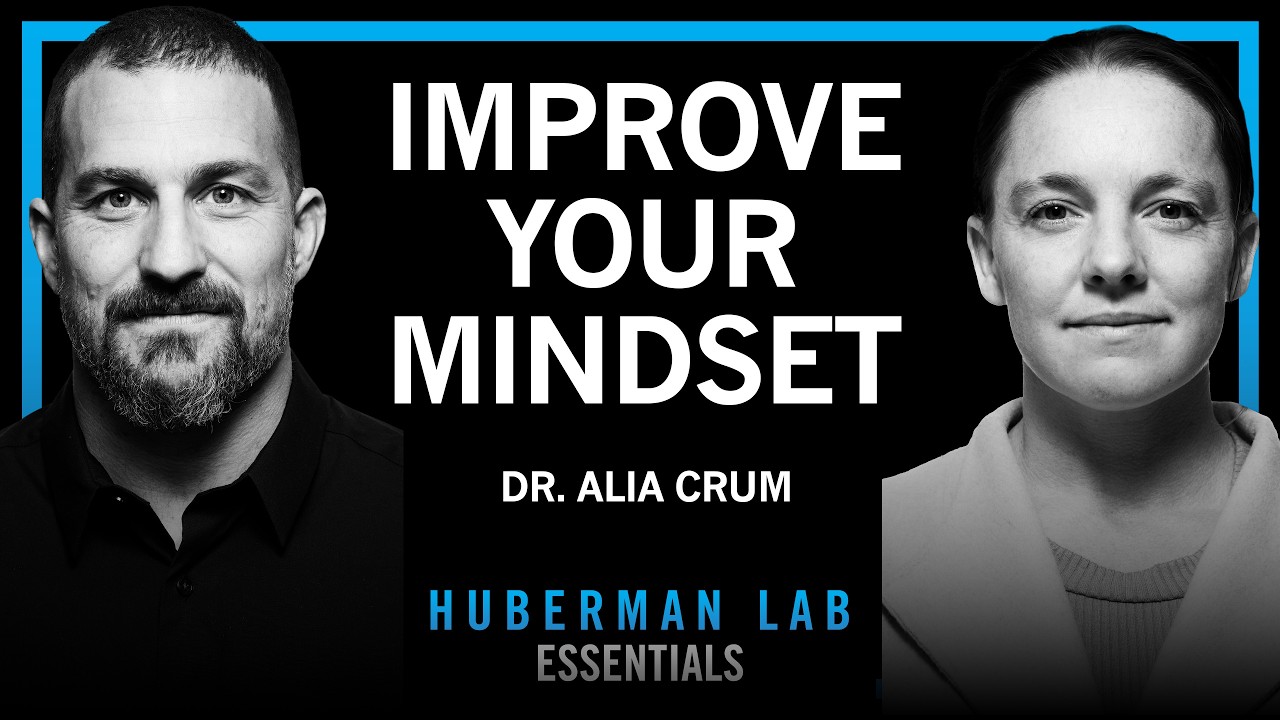
Essentials: Science of Mindsets for Health & Performance | Dr. Alia Crum
Watch on YouTubeVideo summary
In this episode of Huberman Lab Essentials, Dr. Alia Crum defines mindsets as core beliefs or assumptions about specific domains that orient our expectations, explanations, and goals. While often associated with Carol Dweck's work on growth versus fixed intelligence regarding ability, the concept extends to various aspects of life including stress, food, exercise, illness, and symptoms. These mental frameworks simplify complex realities by constraining what we consider relevant, thereby shaping motivation and behavior. Crucially, Dr. Crum emphasizes that mindsets are not merely motivational tools but also physiological drivers; they influence how our bodies prioritize resources and respond to situations regardless of the objective truth of those beliefs. A pivotal example provided is a study conducted at Yale involving milkshakes with identical nutritional content (approximately 300 calories) labeled differently for participants as either high-calorie indulgent shakes or low-calorie sensible diet shakes. The results revealed that when participants believed they were consuming the "indulgent" shake, their ghrelin levels—the hunger hormone—dropped three times faster than those who thought they were eating sensibly. This demonstrated a counterintuitive finding: believing one is eating healthily can leave the body feeling physiologically hungry and slow down metabolism, whereas viewing food as indulgent triggers better satiety signals and metabolic adaptation. Similarly, research on hotel housekeepers showed that simply reframing their physically demanding work from "tedious labor" to "good exercise," without changing any physical behavior, led to significant health improvements like weight loss and reduced blood pressure within four weeks. The conversation shifts extensively to stress, challenging the prevailing public health narrative that frames it solely as a debilitating force harmful to productivity and relationships. Dr. Crum explains that while adversity is negative in itself, the body's response to challenge can be enhancing if viewed correctly; for instance, adrenaline spikes during stressful events like skydiving have been shown to raise testosterone levels, facilitating growth rather than just survival. Her lab conducted a study with employees of UBS during the 2008 financial crisis where viewing stress as an opportunity to enhance performance led to fewer physical symptoms such as backaches and insomnia compared to those who viewed it as crushing or debilitating. This enhancement occurs because an "enhancing" mindset shifts motivation from avoidance (freaking out or checking out) toward utilization, encouraging individuals to learn from adversity and deepen connections with others. To leverage stress effectively, Dr. Crum proposes a three-step approach: first, acknowledge that you are stressed; second, welcome the feeling by recognizing it stems from caring about something important; and third, utilize the physiological response to achieve your goals rather than trying to eliminate the sensation entirely. This reframing treats stress as a neutral signal of engagement in goal-related efforts, allowing individuals to access innate "superpowers" like narrowed visual attention that improves information processing speed without needing specific training for relaxation responses. The overarching conclusion is that mindsets act as portals between conscious thought and subconscious physiological processes; by consciously reprogramming assumptions about domains like health or adversity, we can fundamentally alter our biological outcomes and performance potential.
Read the full video transcript
Welcome to Huberman Lab Essentials,
where we revisit past episodes for the
most potent and actionable science-based
tools for mental health, physical
health, and performance.
I'm Andrew Huberman and I'm a professor
of neurobiology and ophthalmology at
Stanford School of Medicine. And now, my
conversation with Dr. Alia Crum. Great
to have you here. Great to be here.
>> Yeah. Just to start off, you know, you
talked a lot and worked a lot on the
science of mindsets. Could you define
for us what is a mindset and what sort
of purpose does it serve? We define
mindsets as core beliefs or assumptions
that we have about a domain or category
of things that orient us to a particular
set of expectations,
explanations, and goals. I can distill
it down for you. So, mindsets are an
assumption that you make about a domain.
So, take stress for example, the nature
of stress. What's your sort of core
belief about that? Do you view stress as
enhancing, good for you, or do you view
it as debilitating and bad for you?
Those mindsets, those core beliefs,
orient our thinking. They change what we
expect will happen to us when we're
stressed, how we explain the occurrences
that happen or unfold when we're
stressed, and also change our motivation
for what we engage in when we're
stressed. It's sort of distilling down
those core assumptions that really shape
and orient our thinking and action.
>> Mhm. I've heard you say before that
mindsets simplify life in some way by
constraining the number of things that
we have to consider. Um
and it sounds to me like we can have
mindsets about many things as as you
said. Uh many people are familiar with
our colleague Carol Dweck's um notion of
growth mindset that if we're not
proficient at something that uh we
should think about not being proficient
yet, that we are on some path to
proficiency. But, what are some examples
of mindsets um and how early do these
get laid down, or do we learn them from
our parents? Yeah, sure. So, I think
it's important with with Carol Dweck's
work, a lot of people kind of get
focused on growth motivation and all
these things, but her work really
originated from thinking about what she
called as implicit theories or core
beliefs about the nature of intelligence
or ability. Right? So, do you believe
that your baseline levels of
intelligence are fixed, static, set
throughout the rest of your life, or do
you believe that they can grow and
change? The reality is, as it always is,
complex, and it's a bit of both, and
it's all of the things. But, as humans,
we need these simplifying systems to
help us understand a complex reality.
But, they're not inconse-
inconsequential, right? They they matter
in shaping our motivation, and as she
has shown, if you have the mindset that
intelligence is malleable, you're
motivated to work harder to grow your
intelligence. If you have the mindset
that it's fixed, why work harder at math
if you don't think you're good at it?
What our work has aimed to do is to
expand the range of mindsets that we
are, uh, studying, focused on, and also
understand and expand the range of
effects that they have. Uh, so, I
mentioned, you know, mindsets about
stress. We've also looked at mindsets
about food and healthy eating. So, do
you have the mindset that foods that are
good for you, healthy foods, are
disgusting and depriving, or do you have
the mindset that healthy foods are
indulgent and delicious? Generally,
people, at least in our culture in in
the West, have this view that stress is
debilitating, healthy foods are
disgusting and depriving, and those
mindsets, whether or not they're true or
false, right or wrong, they have an
impact, and they have an impact not just
through the motivational mechanisms that
Dweck and others have studied, but as
our lab has started to reveal, they also
shape physiological mechanisms by
changing what our bodies prioritize and
prepare to do. We've looked at mindsets
about exercise. Do you feel like you're
getting enough, or do you feel like
you're getting an insufficient amount to
get the health benefits you're seeking?
Uh mindsets about illness. Do you view
cancer as an unmitigated catastrophe,
or do you view cancer as manageable?
We've looked at mindsets about symptoms
and side effects. Do you view side
effects as you know, a sign that the
treatment is is harmful, or do you view
side effects as a sign that the
treatment is working?
Again, these are sort of core beliefs or
assumptions you have about these domains
or categories, uh but they matter
because they're shaping, they're
synthesizing and simplifying the way
we're thinking, but they're also shaping
what we're paying attention to, what
we're motivated to do, and potentially
even how our bodies respond. I'd love to
talk about this notion of how our
mindset shaping how our bodies respond.
And maybe as an example of this, if you
could share with us this now famous
study that you're you've done with a
milkshake study. Certainly. Yeah, this
was a study that I ran as a graduate
student at Yale University. I was
working with Kelly Brownell and Peter
Salovey. Peter Salovey had done a lot of
work on really coining the term
emotional intelligence, studying that.
>> president of Yale. He's now the
president of Yale, yes.
>> So he's done well. He's he's done well
for himself, and for the university and
society. I had come in doing some
previous work on mindsets about exercise
and placebo effects in exercise, and I
really occurred to me that there was a
very simple question that hadn't been
probed yet. And that was
do our beliefs about what we're eating
change our bodies' physiological
response to that food, holding constant
the objective nutrients of that thing.
So, that question might sound outrageous
at first, but it was it's really not
outrageous if you're coming from a place
of having studied in depth placebo
effects. So, placebo effects are this
robust demonstration in which simply
taking a sugar pill, taking nothing,
under the impression that it's a real
medication that might relieve your
asthma, reduce your blood pressure,
boost your immune system, can lead to
those physiological effects even though
there's no objective nutrients. And we
have more evidence on placebo effects
than we have for any other drug because
of because of the clinical trial process
in which all new drugs and medication
are medications are required to
outperform a placebo effect. So, we have
a lot of data on the placebo effect. But
anyways, going back to this question, it
was like, all right, we've moved from,
you know, medications solving our health
crises to behavioral medicine solving
our health crises, increase people's
exercise, get them to eat better.
To what degree are these things
influenced by our mindsets or beliefs
about them?
So, to test this question, we ran a
seemingly simple study. This was done at
the Yale Center for um clinical and
translational research.
And we brought people into our lab under
the impression that we were designing
different milkshakes with vastly
different metabolic concentrations,
nutrient concentrations, um that were
designed to meet different metabolic
needs of the patrons of the hospital,
right? So, you're going to come in,
you're going to taste these milkshakes,
and we're going to measure your body's
physiological response to them. This was
a within subjects design, so it was the
same people uh consuming two different
milkshakes two different time points
separated by a week. And at one time
point they were told that they were
consuming this really high fat, high
caloric, indulgent milkshake. It was
like 620 calorie, super high fat and
sugar. The other time point they were
told that it was a low fat, low calorie,
sensible sort of diet shake.
In reality, it was the exact same shake.
It was right in the middle. It was like
300 calories, moderate amount of of fats
and sugars. And we were measuring their
bodies gut peptide response to this
shake. And in particular, we are looking
at the hormone ghrelin. And medical
experts call it the hunger hormone.
Rises in ghrelin signal, you know, seek
out food. And then theoretically, in
proportion the amount of calories you
consume, ghrelin levels drop signaling
to the brain, "Okay, you don't you can
you don't need to eat so much anymore.
You can stop eating." And also revving
up the metabolism to burn the nutrients
that were just ingested.
What we found in the study was that when
people thought they were consuming the
high fat, high calorie, indulgent
milkshake, their ghrelin levels dropped
at a three-fold rate stronger than when
they thought they were consuming the
sensible shake.
So, essentially their bodies responded
as if they had consumed more food, even
though it was the exact same shake at
both time points. It was, to my
knowledge, one of the first studies to
show any effects of just believing that
you're eating something different on
your physiology. The second piece was
really important as well, and especially
for me, this was one study that really
transformed the way I think about how I
approach eating. And that was the manner
in which it affected our physiology
was somewhat counterintuitive. So, I had
gone in thinking
the better mindset to be in when you eat
is that you're eating healthy, right?
Like, you know, it makes sense. Like
placebo effects, think you're healthy,
you'll be healthy, you know? But, that
was a far too simplistic way of thinking
about it. And, in fact, it was the exact
opposite. When these participants
thought they were eating sensibly, their
bodies left them still feeling
physiologically hungry, right? Not
satiated, which could potentially be
corresponding to the slower metabolism
and so forth. So, if you're in the
interest of maintaining or losing
weight, what's the best mindset to be
in? It's to be in a mindset that you're
eating indulgently, that you're having
enough food, that you're getting enough.
Um, and at least in that study we showed
that has a a more adaptive effect on
ghrelin responses. It's really
remarkable. I it raises a question that
um, I just have to ask. You've got
people who are strictly plant-based, um,
you've got people who are omnivores, you
got people who are carnivores, you have
every variation, you have intermittent
fasting, also called time-restricted
feeding. And, it seems like once a group
kind of plugs into
uh,
a particular mode of eating that they
feel works for them, for whatever
reason, energy-wise, mentally, maybe
they're looking at their blood profiles,
maybe they're not. Each camp seems to
tout all the health benefits and how
great they feel. Could it be that
mindset effects are involved there? It
does matter what it is, and it matters
what you think about that diet, and what
others around you in in our culture
think about that diet, because those
social contexts inform our mindsets, our
mindsets interact with our physiology in
ways that produce outcomes that are
really important. So, let's not get
dualistic and say, you know, it's either
all in the mind or not in the mind.
Let's also not be unnecessarily
combative and say, oh, it should be all
plant-based or, you know, keto or
whatever. It's all of those things are a
combined product of what you're actually
doing and what you're thinking about. If
you believe in it, if you don't, if
you're skeptical or, you know, in some
cases you think you should be eating a
certain way and then you don't live up
to that. It might have a even an adverse
effect because of the the stress and the
anxiety associated with that. Yeah,
there was a paper a year or two ago
published in science um
science magazine about brain regions
involved in psychogenic fever that if
people or uh you can actually do this in
animal models too, think that they are
sick you get a genuine 1 to 3° increase
in body temperature 3 1 to 3° Fahrenheit
increase in body temperature which is
pretty pretty impressive. Yeah. Um and I
guess plays into you know symptomology
generally. So I I'm a believer in belief
effects. Well, it's also I and I'll just
say that you know, the term that we use
in the in our field is nocebo effect for
that which is sort of the placebo's ugly
step sister. You know, it's when
negative beliefs cause negative
consequences. So you are told you will
have you know, it's it's very well
demonstrated that when people are told
about certain side effects, they're far
more likely to experience those side
effects.
Love uh for you to tell us about um
the hotel worker study.
>> Yeah, no, I think that this is a really
good example of this phenomenon, right?
That the total effect of anything is a
combined product of what you're doing
and what you think about what you're
doing. And we found a group of people
who were getting a lot of exercise but
weren't aware of it. A group of hotel
housekeepers. So these are women working
in hotels who were on their feet all day
long pushing carts. It was clear that
they were getting above and beyond at
least the Surgeon General's requirements
at that time were which were to
accumulate 30 minutes of moderate
physical activity per day.
But what was interesting was when we
went in and surveyed them and asked
them, "Hey, how much exercise do you
think you're getting?" A third of them
said zero. And the average response was
like a three on a scale of zero to 10.
So it's clear that even though these
women were active, they didn't have that
mindset, right? They had the mindset
that their work was just work, hard,
maybe thankless work that led them to
feel tired and and, you know, in pain at
the end of the day. But not that it was
good for them, that it was good
exercise. So what we did was we took
these women and we randomized them into
two groups and we told half of them that
their work was good exercise. This In
this case it was true, factual
information. We oriented them to the
Surgeon General's guidelines. We
oriented them to the benefits that they
should be receiving. And then we had
measured them previously on their um
physiological metrics like weight and
body fat and blood pressure. And we came
back four weeks later and we tested them
again. And what we found was that these
women, even though they hadn't changed
anything in their behavior, they had
benefits to their health. So they lost
weight, they decreased their systolic
blood pressure by about 10 points on
average. What this reveals is that we
have to be more thoughtful in how we go
about
motivating people to exercise or
teaching people about the benefits.
Uh our current approach is just to
basically tell people
at large, you know, here's what you need
to get. The intention with that is to
motivate them cuz, you know, public
health officials think, well, if I just
tell people you need to get more
exercise cuz it's good for you, they'll
do it. We know now that that doesn't
work, that these these guidelines are
not motivational, they don't change our
behavior. And what our work adds to that
is that not only is it not motivational,
it also creates potentially a mindset
that
k-
you know, makes people worse off
than they were without knowing about the
guidelines. I'd love for us to talk
about stress, because um your lab has
worked extensively on this. Could you
tell us at some point about the study
that you've done about informing people
about the different effects of stress?
Um but also uh if there's an opportunity
some takeaways about how we could each
conceptualize stress in ways that would
make it um serve us better. Great. Yeah,
so I had you know, I'd come off the
heels of doing some research in exercise
uh and diet. The obvious next thing to
think about was stress, right? The
public health message
was very clear, right? That stress was
bad, right? Unmitigated and harm harmful
on our health, our productivity, our
relationships, our fertility, our
cognition, you name it, right? Uh the
messages that were out there
by and large oversimplified
messages focused on the damaging
consequences of stress. But as you know,
if you actually dive deeper into the
literature on stress and the origins of
stress, what you find is that, you know,
the literature like most literatures is
not so clear cut. And in fact, there's a
large amount of evidence to support the
fact that the experience of stress,
meaning encountering adversity or
challenge in one's goal-related efforts
uh
does not have to be debilitating. And in
many cases, the body's response was
designed to enhance our ability to
manage at those moments, right? So, some
research showing that stress narrows our
focus, increases our attention, speeds
up the rate at which we're able to
process information. There was some
research out there showing this
phenomenon of uh physiological
toughening, the process by which the
release of catabolic hormones in the
stress response recruit or activate
anabolic hormones, which help, as you
know, build our muscles, build our, you
know, neurons to help us grow and learn.
Uh and there was a whole body of
emerging research on uh post-traumatic
growth or this phenomenon in which even
the experience of the most traumatic
stressors, the most chronic and enduring
stressors,
could lead not to destruction, but in
fact to the exact opposite, to an
enhanced sense of connection with our
values, connection to others, sense of
um joy and passion for living. My work
since then has been not to try to argue
that stress is enhancing and not
debilitating, but try to point out that
the true nature of stress is a paradox.
The true nature of stress is manifold
and complex, and lots of things can
happen.
But to question what's the role of our
mindset about stress in shaping our
response to stress. So, some work had
already been done looking at your
perception of the stressor, right? So,
do you view a stressor like a
challenging exam or a health diagnosis
as a challenge or a threat? And that had
shown pretty convincingly that when you
view stressors more as a challenge, less
as a threat, that your brain and body
responds uh
more more adaptively. What our question
was was to take the sort of
psychological construal one step higher
in abstraction, so not just the
stressor, but the nature of stress,
right? Do you, you know, at at that core
level, do you view stress as something
that's bad, is going to kill us, and
therefore should be avoided, or do you
view
stress as uh natural and something
that's going to enhance us? And so, we
set out to design a series of studies to
test the extent to which these mindsets
about stress mattered.
And we found in a number of
correlational studies that that more
enhancing stress mindset was linked to
better health outcomes,
better well-being, and higher
performance. So, then we set out to see
if we could change people's mindsets.
And in our first test of this, we
decided to do so by creating these
multimedia films that showcased
research, anecdotes, facts about stress,
all true, but oriented towards one
mindset or the other, right? So, you can
imagine one set of films showed
basically the messages that were out
there in the public health context. The
other showed, "Hey, you know, stress is,
you know, stress has been linked to
these things, but in fact, the body's
stress response was designed to do this.
Did you know it could do that?" And we
had
empowering images like LeBron James
making the free throw in the final
minute versus missing it.
>> people saw a video that basically made
it seem like stress will diminish you,
crush you, reduce you, or a video very
similar, stress will grow you, bring out
your best, and maybe even take you to
heighten levels of performance that
you've never experienced before.
Exactly. And our question was,
does orienting people to different
mindsets change how they respond to
stress? So, this study was done in the
wake of the 2008
financial crisis. We worked with UBS, a
company, financial service company that
was undergoing pretty massive amounts of
layoffs, so these employees were
stressed about being laid off. They were
taking on more pressure. It was just a
tough time. And we randomized them into
three conditions, and this was all
pre-work before getting a training on
stress.
But the three different conditions, some
watched no videos, some watched the
stress will crush you videos, and some
watched the stress could enhance you
videos. And what we found was that just,
you know, it was a total of 9 minutes of
videos over the course of the week led
to changes in their mindsets about
stress, which led to changes in their,
um,
physiological symptoms associated with
stress. So, people who watched the
enhancing films had fewer back aches,
muscle tension, insomnia, racing heart,
and so forth. And they also reported,
uh,
performing better at work compared to
those who watched the debilitating
videos. Now, interestingly, we didn't
make anyone worse with the debilitating
videos, which is which is good. We had
We had told that, uh, the IRB we didn't
expect that because that message was
already out there. That's what they were
already seeing. That wasn't new to them.
Uh, it was more this enhancing
perspective that
turned out to be inspiring. People get
this wrong sometimes. They think that
I'm saying
that a stress is enhancing mindset means
you should like stress. That's not what
we're saying, right? Having a stress is
enhancing mindset doesn't mean the
stressor is a good thing, right? It
doesn't mean that getting diagno- a
cancer diagnosis is a good thing or
being in object poverty is a good thing.
These are not good things.
But the experience of the stress
associated with that, the challenge, the
adversity,
that experience
can lead to enha- enhancing outcomes
with respect to,
uh, not just our cognition, but our
health, our performance, and our
well-being. How does that work, right?
Well, it works through a number of
different pathways. One is that it
changes fundamentally what we're
motivated to do. So, if you, you know,
just imagine we're stressed about
something, and you think that stress is
bad,
then what's your motivation, right? Your
motivation is to well, first you get
worried about the stress, right? And
second is your reaction is typically to
do one of two things. It's either to
freak out and do everything you can to
make sure that this doesn't affect you,
you know, negatively or to check out and
say, "Oh, it's not a big deal. I'm not
going to deal with it." I you know,
you're basically in denial. So, people
who have a stress is debilitating
mindset and we've shown this in our
research tend to go to one of the other
of those extremes. They freak out or
they check out. Why? Because if stress
is bad, you need to either get rid of it
and deal with it or or it needs to not
exist, right? If you have a stress is
enhancing mindset, the motivation
changes, right? Then the motivation is
how do I
utilize the stress to realize the
enhancing outcomes? What can we do here,
right? To learn from this experience to
make us stronger, fitter, um, you know,
have better science and treatments for
the future, deepen my relationships with
others,
um, improve, you know, my priorities and
so forth, right? So, the the motivation
changes. The affect around it changes.
It doesn't make it easy to deal with,
but what we've shown in our research is
that people who have a stress is
enhancing mindset have more positive
affect, not necessarily less negative
affect. Um, and it potentially changes
physiology. We we have a few studies
that show that,
uh, people who are, um, you know,
inspired to adopt more enhancing
mindsets have more moderate cortisol
response and they have higher levels of
DHEA levels, um, in response to stress.
We had a guest on this podcast. Um, he
actually is a he's a PhD scientist who
runs the UFC, um, performance training
institute. His name is Duncan French and
his graduate work at uh, UConn stores
was very interesting. It was in exercise
science and physiology. What he showed
was that, um, if you could spike the
adrenaline response, I think they did
this through first-time skydive or
something like that. That
testosterone went up. Now, this spits in
the face of everything that we're told
about
stress and testosterone levels, right?
So, it turns out that at least in the
short term
that a very stressful event
can raise anabolic hormones. And I think
that people forget at a mechanistic
level that adrenaline is epinephrine and
epinephrine is derived biochemically
derived from the molecule dopamine. If
you look at the pathway and you even
just Google it and go images, you'll see
that epi- adrenaline is is made from
dopamine. And dopamine and these
anabolic hormones have a very close
They're sort of close cousins. They work
together in the pituitary and
hypothalamus. So, it makes sense that
one could
leverage stress toward growth. But
what's again remarkable to me is that
all of these brain structures that
control dopamine, epinephrine,
testosterone and estrogen, they're all
thought to be in the subconscious,
meaning below
um our
our ability to flip a switch and turn
them on or off. And yet, mindset seemed
to impact them. So, I I
All that's to say that there's a
clear mechanistic basis by which this
could all work. The way I think about
mindset is that it's Mindsets are kind
of a portal between conscious and
subconscious processes.
They operate as a default setting of the
mind, right? So,
if you know, if sort of programmed in
there, you have stress equals bad,
that's been programmed in through our
upbringing, through public health
messages, and through media, and other
things. And it kind of sits there as an
assumption in the brain. And the brain
is then
figuring out how should it respond to
the situation. And if the assumption,
the default, the programming is stress
is bad, that's going to through our
subconscious trigger all the things
that's like, okay, well, I need to like,
you know,
rev up the things that protect me versus
rev up the things that help me grow.
Just talking about this, right? For your
listeners, they're now invited to
bring their stress mindsets up to the
consciousness and say, what is my stress
mindset? How do I Am I thinking about
stress? Can I reprogram that? Can I
start to think about it as more
enhancing?
That takes a little bit of a conscious
work potentially, but then once you do
that, it can that can kind of operate in
in the background influencing how your
body responds and you don't have to say,
okay, I'm stressed, I better tell my you
know,
anabolic hormones to go That that that
doesn't work that way.
>> No. Um, but these mindsets can help with
the translational process.
How should uh
we, the listeners, think about stress?
Is there a a short list of of ways that
we can leverage stress to our advantage?
Yeah, and that's an important important
nuance in your language, which is people
have by and large come from a place of
how do you manage stress? How do you
cope with it? Which implies
how do you fight against it? And yeah,
the real challenge is how do we leverage
it? How do we utilize it? How do we work
with it?
And yeah, I have a lot of thoughts on
this. The first and most most important
thing is to
clarify our definition of stress. The
stress mind negative stress mindset is
so insidious
that now people define stress with its
negative consequences.
So, the first step is to decouple that
and to realize that stress is a neutral,
right?
yet to be determined effect of
experiencing
or anticipating
adversity in your goal-related efforts.
So, let me unpack that a little more.
You can be in the midst of it or you
could just be worried about something
happening. That's one aspect. Second is
adversity or challenge, so something
that's working against you. But, the
third piece is critical and that is in
your goal related efforts.
What that means is that we only stress
about things we care about and we don't
stress about things we don't care about.
So, then the question becomes, okay, if
that's true, how can I better utilize
or leverage or respond to the inevitable
stresses that we're going to experience?
We've developed a three-step approach to
adopting a stress is enhancing mindset
and briefly it's the first step is to
just acknowledge that you're stressed.
The second step is to welcome it because
inherently in that stress is something
you care about. And then the third step
is to utilize the stress response to
achieve the thing you care about
not spend your time, money, effort,
energy trying to get rid of the stress.
Does that make sense? I think
>> Makes sense and I and I love it as
somebody who's laboratory studies the
physiological effects of stress. The The
effects that impress me the most are for
instance
the narrowing of visual attention that
it then um drives a capacity to parse
time more finely which then drives a
capacity to process information faster.
It's It's almost like a superpower.
Right. And what I like so much about
that framework is that the stress
response is very generic. We unlike the
relaxation response, we don't actually
have to train up the stress response.
So, we all kind of get this as a as a
freebie.
And then it sounds like it's a question
of what we end up doing with that.
>> Right. Treat yourself like a scientist.
Look at your life. Look at your
mindsets. See what's serving you. See
what isn't. Find more useful, adaptive,
and empowering mindsets and and live by
those. What are the mindsets that you
try and adopt uh on a regular basis? The
guiding light for me has been
an undercurrent of understanding that
our mindsets matter. I think I got that
very clearly and deeply as a child both
through my experiences as an athlete.
You know, I know many of your listeners
are athletes. Any athlete knows that you
can be the same physical being from one
day to the next, one moment to the next,
and perform completely differently just
depending on what you're thinking. I was
a gymnast growing up, and if you can't
visualize, if you can't see something in
your mind, then you have no chance when
you get up there on the balance beam,
right? And I also my father was a
martial artist, a teacher of meditation,
so this kind of mind-body work was baked
into me from an early age. And I think
what I've done recently is to try to
understand it scientifically,
and more importantly, to figure out how
can we how can we do better with this,
right? How can we you know, we're all
talking about AI taking over the world
and technology this and all the
personalized medicine that, and it's
like we have done so little, relatively
so little with the human resource, our
human brains,
that the you know, the the potential
for which is so great, and we've done
almost nothing. You know, take the
placebo effect. We know a lot about what
it is. We've done almost nothing to
leverage that in medicine consciously
and deliberately. So my what keeps me
going, what gets me through the hard
times, is just that burning question of
what is going on here, and what more can
I do with the power of my mind?
Well,
I and millions of other people are so
grateful that you do this work. It's so
important and it's truly unique. Where
can people find you, um, ask questions,
find your papers, learn more? Yeah,
well, all our papers and materials and
interventions are housed on our website,
mbl.stanford.edu.
Uh, we also have a link there to that
takes you to Stanford Spark, which
stands for social psychological answers
to real-world questions. We have a lot
of toolkits on that website,
including a toolkit for this rethink
stress approach of acknowledging,
welcoming, and utilizing your stress. We
will provide links to all of those for
our listeners and viewers. Thank you so
much for taking time out of your
exceedingly busy schedule to talk to us
about these ideas. I learned so much.
I'm going to definitely think about what
is the effect of my mindset about blank
in
every category of life and and really
just, on behalf of all of everybody and
and myself, thank you so much. Yeah,
thank you. And I guess I just want to
end by saying I think this work is
really the tip of the iceberg of what
can and should be done. And so I really
invite your you, your listeners, and
all, you know, anybody who's inspired by
this work, if they want to share stories
or
want to partner on a collaboration, to
please reach out.
>> Great. Well, in the comment section on
YouTube is a great place to do that as
well.
Um, you will hear from them. Great.
Thank you so much, Ali.
>> Thank you.