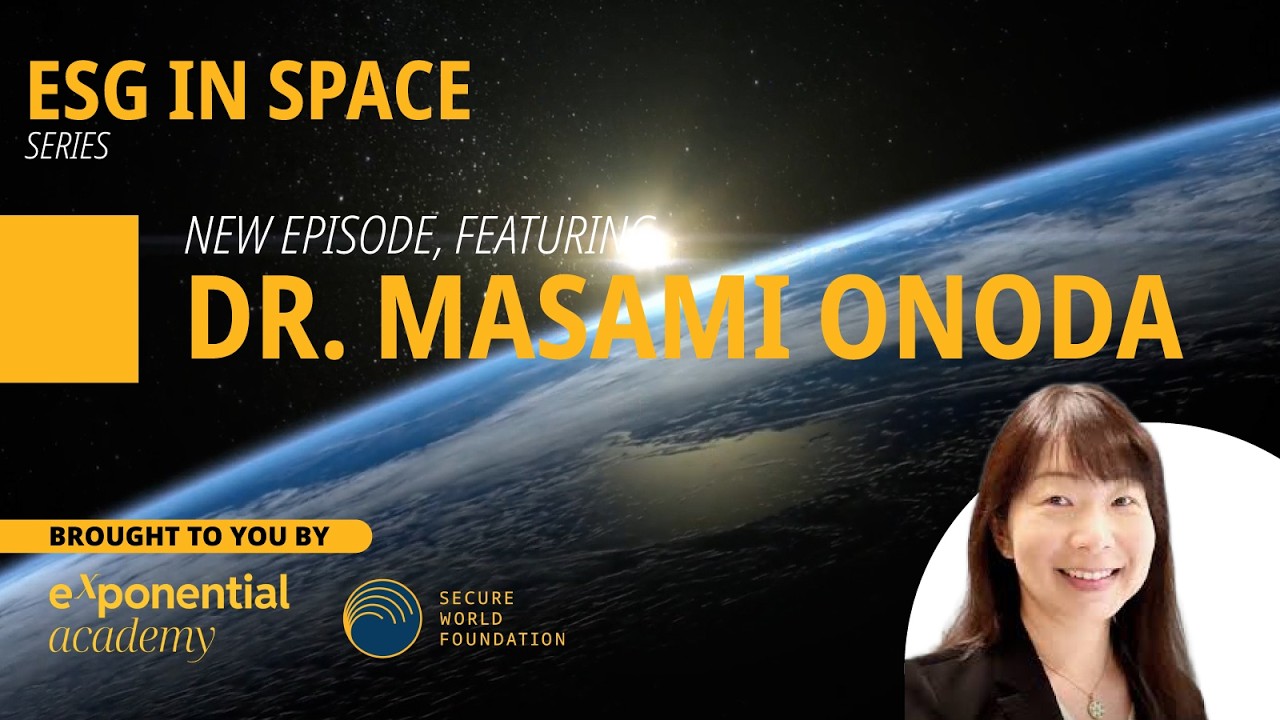
Video summary
Dr. Masami Onoda of JAXA outlines Japan's unique position in the global space economy as an early pioneer that transitioned from academic-led research to a comprehensive "whole-of-government" approach. Unlike many other nations where military or purely scientific agendas dominate, Japan established its space policy at the cabinet level decades ago, elevating it to national priority and concentrating civil, security, industrial, and R&D components within JAXA as the single core agency. This centralized structure allows for agile decision-making that closely aligns with high-level government strategy, enabling Japan to execute ambitious missions such as landing on the moon's surface despite having a budget significantly smaller than those of NASA or China.
To stimulate further growth in this sector, Japan has launched a bold $6 billion Space Strategy Fund over ten years, managed by JAXA through public-private partnerships known as JSparcs. This initiative is designed to double the size of Japan's space economy within five years by fostering collaboration not only with traditional aerospace firms but also with non-space industries like automotive manufacturing, robotics, and even toy companies. Dr. Onoda highlights how this inclusive model leverages adjacent sectors' strengths in precision engineering and innovation to solve complex challenges, such as developing a pressurized rover for lunar exploration involving major brands like Toyota and Honda, thereby creating new economic value streams beyond traditional satellite launches.
A central pillar of Japan's vision is the commitment to sustainability through active debris removal technologies that demonstrate responsible stewardship of space resources. By partnering with industry to capture large rocket stages before they become catastrophic hazards, JAXA aims to prove that commercial entities can safely operate alongside government assets while adhering to emerging regulations. This pragmatic approach involves creating specific rules and guidelines for orbital operations hand-in-hand with technological demonstrations, ensuring that safety protocols evolve in tandem with innovation rather than hindering progress.
Looking toward the future of space governance by 2040 or 2050, Dr. Onoda envisions a framework built on a combination of bilateral agreements and unilateral standards that gradually coalesce into multilateral best practices. Recognizing the difficulty of reaching universal consensus among over eighty nations with diverse value systems, Japan advocates for early movers to set precedents through concrete contracts before broader international rules are established. Ultimately, this strategy seeks to balance technological advancement with ethical responsibility, ensuring that space remains a sustainable and inclusive domain where commercial interests serve humanity's long-term benefit without compromising the safety of the orbital environment.
Read the full video transcript
Hello and welcome to a another exciting
episode on how do we advance the space
economy. My name is Nishan Degrain. I'm
one of your hosts today.
>> And I'm Mickey Sod. I'm the other host
>> and we are so excited to have Masami
Onard Onor Onoda here to join us for
this podcast and we'll be introducing
Masami in just a moment. But first some
context why we are so excited to have
Masami. It's not just her individual
perspectives but also the role that Jaxa
and Japan has played in the space
economy. Japan has been one of the
pioneers in the space space economy.
Back in the 1950s and 1960s in the early
days of the space race, whereas the US
and the Soviet Union were racing for
rockets and landing on the moon and
satellites, Japan developed its own
rocket program. And what was interesting
there was that a lot of the the Japanese
approach stem from academia rather than
the military side. And that has in many
ways guided a lot of the Japanese space
program. And Japan has constantly and
continued to play an innovative role
with recent missions such as the slim
moon sniper which landed within a 100
meters of its target on the moon which
is incredibly pioneering and the
Hayabusa mission to take a sample from
an asteroid and return it back to Earth.
That has really advanced science.
There's an incredible amount of fresh
and innovative missions that JAXA has
undertaken. And what's also interesting
about Jackson Japan is that unlike a lot
of other space industries, they've taken
a all of industry, all of government
approach. They have these public private
partnerships called JSparks, so I'm sure
Masami will talk about which are these
partnership into academia and industry
and the launch of this new $6 billion
space strategy fund, which we're really
excited to discuss and see how that will
be deployed and how that could stimulate
the the space economy. So, we're
thrilled to have Masami join us and
maybe Mickey can give a little bit of an
introduction to Masami and her
incredible background.
>> Yes. Yes. So, I'm so happy to welcome
Dr. Onoda to our podcast. And so I think
Masami and I met when she was at the DC
office and then she was the director of
Washington DC office for six years
starting at 2018 and she played a a very
important role to represent Japanese
government and JAXA but being a liazison
role and had maintained relationship
with NASA and other governmental
agencies. She also played a key role in
Japan joining Ultimus Accord and many
other accomplishments. last year July
she then got appointed to a the
headquarter in Tokyo as a director of
Jaxa's international relationship and
research department and I'm so thrilled
for her like very significant role in
not only for Japanese government and
JAXA but as a leader in international
space industry as well. With that again,
thank you so much for joining us.
>> Thank you Mikisan and thank you Nishan
for having me here. My name is Masami
Onoda and thank you for the kind
introduction to both of you. It's just a
pleasure to be here since I was in
Washington DC. Now I have so to say gone
global. Now I have to deal with Asia,
not just the US, not just the Americas,
Asia, Africa, Latin America, of course,
Middle East, uh Europe. So it's it's a
very exciting job and a very dynamic
world and times. So very much looking
forward to this podcast today. Thank
you.
>> And that brings me to our first
question. As you you've mentioned, your
role now is a a global role. Obviously
many nations and in the last 25 years or
so Jaxa and Japan has gone from when
there was only a handful of nation
states running space programs to now
over 80 nations with active space
programs. How does Japan or JAXA
differentiate or distinguish its
position in this more crowded world
where Japan is now one of a significant
nation state but obviously not with the
same budget as a a NASA or the Chinese
space agency. So how how does Japan see
itself within these kind of
proliferation more space nations?
>> Yes, we do have our national flagship
launcher, the newest one called H3. So
we just had the last final launch, 50th
launch of H2A carrying a greenhouse gas
observing satellite just a month or so
ago. Now we have switched to our new H3.
Therefore we have our own capability to
launch also build satellites. That was a
long effort for the first several
decades for Japan when we tried to
foster our space capabilities and of
course we learned a lot from our
international partners the so-called
space fairing countries at that time and
now as you say there's just an
exponential um growth of of numbers of
actors numbers of countries that wish to
join and I think Japan has a very unique
role where we have started out from
civil space development R&D and there's
a very strong component of in civil
component in our space industry as time
passed 2008 was when we had established
our basic space law so that allowed a
whole of a government approach where
decision- making for space policy was
elevated from uh the science and
technology
um agency to the cabinet level. So the
space policy headquarters is led by the
prime minister Ishiba at the moment and
the cabinet members. So it's that that
level of policy priority that Japan
space policy is led. I think that's one
more unique point where that allows JAXA
also to be the single core space agency
of Japan and so everything from security
industry and civil is now concentrated
for the technology to JAXA where we
undertake a very broad wide range of
space programs also space policy and
governance structure is very unique as
well that we have a R&D
component, a civil component and the
security component, industry support
component that's all concentrated and
focused in one core space agency. So it
allows us to have a very agile space
program and to carry out the space
policy very closely with the highest
level of the government. So all all in
all we are very proud to be just
recently the slim lander landing on the
moon that was the that made Japan the
fifth country in the world to land on
the surface of the moon. I think that
also symbolizes where Japan is in the
space technology level and and we are
very proud to be working with
international partners going forward.
>> Super. I always think about this duality
right where like one thing is what is
Japan's role in space which we just
talked about but also how does Japan see
space industry as a driving force in
Japanese economy too. And so I think in
a way the symbolic gesture may not be
the right word like but a a space
strategy fund which is very sizable and
a bold move for Japan as a nation right
is sort of like a a symbol of like how
Japan sees space industry like its role
as well its effect on our economy too.
So for our audience, if you can explain
a little bit more about the space
strategic fund and then what is what are
you excited about the strategic fund? If
you can tell us a little bit about that
that would be wonderful.
>> Of course, Mickey. So the space strategy
fund is uh in Japanese yen, one trillion
yen over 10 years. That's about 6
billion US over 10 years. It has been
allocated all uh already two billion in
24, two billion for 25 and next year
hopefully also a sizable amount out of
that six billion over 10 years but we're
still in the third year. So I think
receiving already maybe more than half
of it in the first three years is is a
very good sign. So that that shows a
strong support by the government. So
several ministries have put their money
into this pot of the space strategy fund
for JAXA. So the money is managed by
JAXA. It comes to JAXA first. We put out
a call then select the the awardees and
then we have contracts and then we
evaluate and the contracts can go on for
several multiple years. Um so we are now
in the second round for this. The first
round we had 22 themes uh ranging from
space transportation, satellite, space
exploration and also crosscutting
technologies and then we have different
themes for this fiscal year too and now
that summer has ended I think the calls
have gone out and we're in the selection
process and hopefully another round next
year and also we are discussing how to
encourage international partnership
through this so that each country can
support their own industry But maybe the
space agencies can cooperate in
information sharing about their
initiatives and industry and also uh
facilitate cooperation partnership
between the industry that they
respectively support. So to have kind of
a space agency space agency government
to government and businessto business
all type of effective synergy of of
industry support. So that's what we're
looking at right now. In uh Japan right
now we have about 100 space startups and
also maybe about 180 to 200 space
companies all in all including non-
startups and of course as you know we
are said to have more than 600 billion
space economy worldwide. Japan goal
currently it's estimated to be 27
billion US dollars or so. We want to
double this in the next five years or
so. So that's the goal of the
government. And so to support this
doubling of the Japanese space economy,
the space strategy fund is meant to play
a large role. And
again, as I said, this very strong
support for industry that's shown in
this quite substantial amount of budget
that's invested into the space industry
through Ojaxa. We are so thrilled to be
part of it. Of course, money has to be
used wisely. I used to be asked what's
the best way to support funding to
industry used to say right amount at the
right time. That's very crucial. And too
much at the wrong moment is the worst
thing you could do. Too much or too less
of course. And I think to use this money
wisely is is our challenge. And we are
very humbled I guess to be given this
role to manage the space strategy fund
and we'll see maybe in a few years how
this has turned out but hopefully we can
contribute to supporting the industry.
We have hired a lot of people also from
the finance sector to support us
managing the funds and we're doing our
best to be a good partner for the
industry.
That's fascinating because I mean you
know not just the size which of you know
is in itself incredible and very
innovative that it's a public private
partnership not just a handout by
government or like another funding of
missions. I think the way that it's also
being deployed is interesting and what
struck me when we were preparing for
this podcast is how many non-space
companies were also engaged as well. I
think that's something that makes Japan
particularly unique. We hear a lot about
how do you engage the space companies
but Japan has managed in a way to engage
a lot of industries to find a use of
space you know almost kind of the use of
good for space and so maybe you could
explain a little bit more how Japan
succeeded in reaching out successfully
to non-space companies to be part of
this kind of broader mission
>> of course so space strategy fund started
just last year but we have been doing
industry relations industry engagement
for the last 20 years or so. This kind
of effort is not done overnight. It's
been a very long effort that's kind of
blossoming right now, but been a long
time working on industry promotion.
That's what we called first. Public
private promotion also was the way we
called it in the beginning since JAXA
had concentrated on science and
technology. 20 years ago, I tried to use
the word industry in a document and I
was banned from doing that. They said,
"Oh, no, no, no. This is me. It's not,
you know, our ministry next." Now, it's
just ridiculous to say that. Uh, you
cannot talk about space without
industry. But 20 years ago, who would
know? And then we tried to work with the
many non-space companies because there
were not many space companies back then.
There was only the Mitsubishi and NEC
and IHI and all of that but not not the
Astros scale not the ISP space not the
Infosella or Interstellar of all of
these. Forgive me if I forget to I I
won't be able to mention all the 100
startups but it doesn't mean that I'm
partial to any of them. The way how do
you foster space industry is uh you have
to work with non-space
companies. Um early examples were
construction companies of course
entertainment companies like uh Sony
wants to work with us. We worked with
Takarati a toy company for actually one
of the rovers that was deployed from
Slim. That was the one that Soraku was a
kind of transformer type of a small this
small um very small robot that took a
selfie of Slim on the surface of the
moon which um allowed us to uh find out
that it was it had landed actually
upside down but that's another story. So
we worked with all of these different
companies and it's been a long effort.
We had a we now have a group uh uh
called the space de business development
uh department in JAXA that has been
carrying out a program called J-Spark to
work with many different companies that
was even before the space strategy fund.
It's very exciting also to be able to
work with a range of these non-space
companies. We also have the space
innovation hub that does a similar
thing. So there it's not just a strategy
fund. Of course we do have programs uh
of JAXA itself
>> and Mami. I think what's also
interesting is that the space economy
has become increasingly crowded. We see
a lot more nation states enter the space
with a range of different value systems
as well as the private sector some of
which are more experimental. What are
some of the values that Japan wants to
bring into the space economy? Especially
ensuring the sustainability and
inclusiveness of the space economy for
future based nations who may want to
enter into this arena.
>> The Japanese government places very high
priority on sustainability. A safe and
sustainable space environment is vital
to our continuing space programs and
development of the economy that we
talked about and this cannot be done
without demonstrating
uh technology in as a space agency. We
really feel the responsibility to be
able to demonstrate the technology that
we can tackle this problem and so that
we are partnering with the industry uh
to demonstrate. So we call it the
commercial removal of debris
demonstration CRD2 program. The first
phase just finished. We did an
approached a second stage of our H2A
rocket to monitor it and then in the
space 2 we will actually try to remove
it. So a second stage of a rocket a
heavy rocket is a big chunk of at the
moment space debris. If if it collides
with another space debris or space
object it will be shattered into many
pieces of catastrophic really space
debris event will happen. if that
happens. So we really want to tackle
this by one way effective way of doing
that we see is to remove a large space
debris if not possible to remove all of
them at once. So that's what we're
trying to do demonstrate this technology
in partnership with industry and it's
you know kind of gets all three goals in
one stone kind of throw and industry
technology demonstration and
sustainability. We really try to lead
this area and please watch our COD2
program how our active space debris
removal technology demonstration will
unfold in the future coming years.
>> But does it and it also shows kind of a
unique approach to Japanese leadership.
I think for other organizations it would
be more about the rule setting but it
seems as if this is a partnership this
experimentation to actually go out and
demonstrate. And I think that's also
kind of a novel aspect of Japanese
leadership on a particular kind of space
problem which I think is fascinating to
solve. I'm tapping into Japanese
strengths and the style of leadership
but like a strength as in precision
robotics and all that too and also uh I
I think there are room for different
style of leadership but like lead by
example and also by demonstrating that
shows that care this precious
environment
is for everybody to use and I think
that's very admirable in my opinion.
Yes, absolutely. Because this technology
actually is a heritage from our
rendevous technology which is with the
ISS HTV cargo transportation vehicle
approaching the ISS
this and being captured by the robotic
arm. This is the same rendevous and
approach heritage technology that we're
using for this capturing in space debris
active debris removal. We do try to use
our heritage technology for solving the
current challenges and also for to the
point Nishan pointed out rules and
technology demonstration hand in hand is
very important actually to make this
happen we could not give a license to a
commercial partner to carry out
rendevous and proximity operations
without a rule for that. So we did the
cabinet office set up rules and also
guidelines to make the this kind of
technology demonstration in orbit
possible. So regulation really has gone
hand inhanded with the industry and the
technology the innovation they wanted to
carry out. So I think this also is a
very good case of working with industry
to solve sustainability challenges.
>> Fascinating. And I think the focus on
private public partnership as well as
whole of government or whole of economy
approach is very unique and and as you
mentioned like rover right or nonspace
company or I would like to say adjacent
companies are involved in the space
program like say for example I could see
how automotives right Toyota or Honda or
mobility companies
are al and robotics is what you know
Japan's known for. So Jaxa and Japanese
government and tapping into the Japanese
strength to play a role in this space
economy too and I think that's very
interesting that the JUX playing a
catalytic role in involving um private
sector as well.
>> Thank you. Yes, absolutely. So you
touched upon a very important point. We
had our prime minister Kishida visit the
US in 2024 to witness the signing of an
agreement with NASA and the Japanese
government to uh cooperate on the
development of the pressurized rover
where Jackson cooperates with Toyota,
Honda, MHI and other Bridgestone and
other companies that we all know that
are originally not necessarily space. Of
course, this is a huge investment for
Japan too in turn that the uh US
government agreed to provide two flight
opportunities of Japanese astronauts to
the surface of the moon. Now this is was
a highlight of the state visit of Prime
Minister Kishida back then. And of
course later on our prime minister
Ishiba also has endorsed with the
meeting in February with President Trump
this initiative and also it's in the
presidential budget request also on the
NASA side. We are very excited that we
have this very historic and hopefully in
the future few years becoming also even
more historic as we build the rover
Toyota rover have it drive a Japanese
astronaut driving it together with maybe
a US or maybe another astronaut on the
surface of the moon. This will be
groundbreaking and nothing that anybody
has seen before. The government leading
this kind of innovative programs at the
risk level, investment level that is
very difficult for the private industry
to carry out and to raise excitement,
morale and willingness to invest to keep
investing in this type of very important
space technology that would benefit us
in for generations. This is one of the
very important role of the government at
the moment and when that goes in tandem
with something like the space strategy
fund or the other initiatives that I
just mentioned I think this is the best
way to make the space economy work and
that's the model that Japan is pursuing
at the moment.
>> So this is interesting and you know
maybe I'll ask a question to back up. I
mean, if you were to look at the future,
this the turtle rover with a Japanese
astronaut, what side of the road will
they be driving on in the moon?
And because that question gets into the
fact that as Japan, we're surrounded by
this emergence of 80 plus space nations
and the private sector now coming in and
we have the outer space treaty that was
originally developed. But do we have the
right governance mechanism? Do you
determine which side of the road on the
moon the rover should be on? I mean,
what is your vision of what a
sustainable space economy could look
like in 2040 or 2050?
>> I love that segueing into the rules of
the road. So um we haven't got that far
yet to decide which side of the road
that we will be driving on the moon yet.
But of course this um governance is
a challenge for all of us when many
countries not just a few are heading now
to the lunar surface and then beyond and
also a proliferated
um LEO low earth orbit geostationary
orbit um and maybe in the near future
ASUS lunar orbit. We all need rules of
the road as you say and that's what we
are just trying to start discussing
internationally
I think we we really have to speed up
this conversation um and dialogue to
enhance it to concrete rule making of
course that's a challenge though in many
ways because there are many different
interests and it's no different from
even if there are no borders in space
It's not really different from the
negotiations we have on Earth. What
happened though for a very rare and one
only single case of rulemaking
legally binding
instrument that exists internationally
for the surface of the moon is the
agreement that I just mentioned and
that's the agreement between a treaty
level agreement for Japan that was the
framework agreement that was signed
between the US in Japan in on in January
2023 and under that was the pressurized
rover implementing agreement that was
signed in 2024. This is as far as I know
the only legally binding and bilateral
instrument
that was signed between two countries
and this is legally binding instrument
to be signed for the rules of the
surface of the moon is not easy.
Therefore, it hasn't been it hasn't
happened really and to the detail that
we need for program planning. This is
very rare. Why start here is I see in
the coming years jumping maybe to the
conclusion of all the people keep asking
what will be the governance model for
the future at least in the near future.
I think it will be a combination of
these bilateral contracts and agreements
because it's too difficult as we see at
the moment to reach a legally binding
rule regulation if not for a unilateral
one set forth by one country that might
be possible but even bilateral is very
difficult multilateral is much much more
difficult. I think we will start out
from maybe unilateral or bilateral and
then the combination of those providing
a web of governance and then that
gradually forming into bre best
practices and
in the future multilateral rules that's
how I see it might evolve in reality
there it may not be the ideal path
forward but I think that's what's
happening in reality and those who can
do
first or second or third I think bear a
huge responsibility therefore in setting
forth these rules
>> fantastic well now that's a very
aspirational and kind of visionary sense
and it shows that the importance and
weight of those whether the first second
third fourth mover those early movers in
really setting the precedent setting the
right value systems which could you
determine the future we see this on
planet earth with how the Arctic is
governed versus Antarctica the different
value systems and treaties that have
been set up. And so I think what you've
said forms the basis of the next you
half century of of civilization in
space. With that, we're probably coming
to the top of our podcast. And so you
Masami, I'd like to thank you on behalf
of Mickey and myself. I think you know
some of the takeaways from this
discussion is just the unique role that
you know yourself, Jaxa, Japan can play
in this very complex set of negotiations
and part stakeholders who involved in
the space economy. You know, it's what's
interesting is Japan's role from an
early pioneer in space through to
continuing to innovate do pioneering
missions that haven't been done and as
Mickey mentioned the adjacencies with
the precision manufacturing, the focus
on sustainability and also the
partnership approach has been a very
unique and novel approach and that's
something which I've certainly taken
away from this discussion. So on behalf
of Mickey and myself, thank you Mami for
for sharing your wisdom and insights
with us.
Thank you so much.
>> Thank you. It was a pleasure.