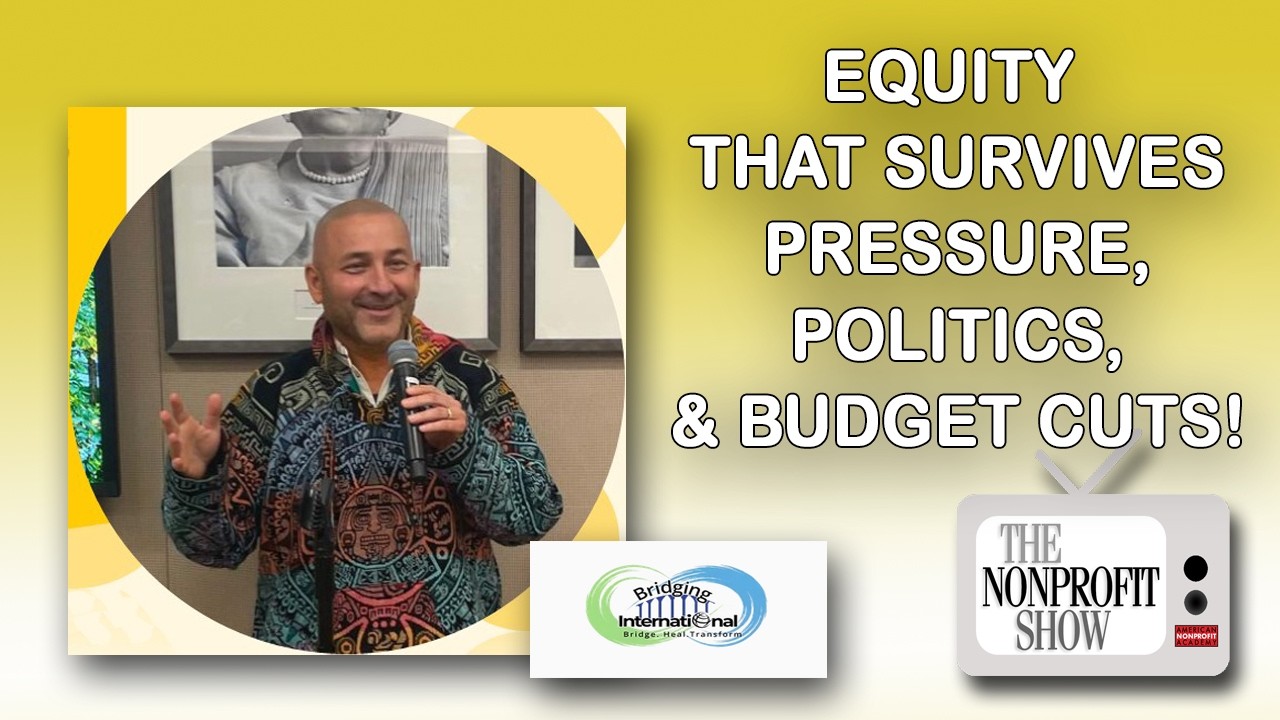
Video summary
The core subject of this conversation is moving beyond superficial statements about fairness to implement genuine equity within nonprofit systems. The guest, Bernardo Ruiz, clarifies that true equity does not mean providing identical resources to everyone; rather, it requires giving individuals exactly what they need based on their unique circumstances and historical barriers to achieve success. This concept is illustrated through a powerful analogy of a foot race where runners from different backgrounds start at varying distances due to systemic obstacles like poverty or language gaps. The discussion emphasizes that equity must be embedded into the very DNA of an organization, including its strategic plans, job descriptions, compensation structures, and daily operations, rather than being treated as an optional add-on or merely a slogan posted on a website.
However, simply having policies in place is insufficient if they are not actively maintained and enforced by accountable leaders who value them above financial convenience. The dialogue highlights that many initiatives fail because organizations treat equity work as expendable during budget cuts or when political pressure mounts, often reverting to the status quo where systemic oppression goes unchallenged under the guise of neutrality. A crucial strategy discussed is shifting from external validation and performative campaigns to internal, sustainable changes that address health disparities and well-being regardless of current political climates. Even if an organization cannot publicly use specific terminology due to regulatory threats or public backlash, they can continue advancing equity by focusing on outcomes like eliminating gaps in healthcare access for marginalized communities while framing the work around universal benefits such as creating healthier environments for everyone.
To sustain this difficult but necessary work against "equity fatigue" and cynicism, leaders must adopt an adaptive approach that holds steady even when facing political headwinds or budget reductions. Research cited from Harvard suggests that organizations which maintain their commitment to equity see longer employee retention rates and a healthier working environment because the culture is built on trust and dignity rather than division. The conversation also touches on the importance of proximity, noting that bringing diverse groups together breaks down historical divisions created by policies like redlining and fosters mutual understanding. Ultimately, the goal is for leaders to recognize that benefiting every person in their community—including those historically privileged—is essential for true self-actualization, ensuring that no one feels left behind or blamed for systemic failures they did not create.
Read the full video transcript
[music]
Hey everybody, welcome back. It's
another episode of the nonprofit show.
Today we're really leaning into a great
conversation. Our guest today, Bernardo
Ruiz, is going to be talking about
equity and how we can actually look at
equity that moves the systems of our
nonprofits, not just statements, but
actual operational movement. And we're
really excited to to bring you into this
conversation. Welcome, Bernardo.
>> Uh, good morning, Julia. Thank you for
inviting me. It's a pleasure.
>> It's wonderful. Hey, today I'm joined by
the amazing Tim San Antonio, who's had a
really busy week, couple of weeks. Um,
and uh, we'll we'll jump into that in
just a second. First of all, I want to
make sure that I express our gratitude
to our major sponsors. include
Bloomerang, American Nonprofit Academy,
Stamping Boutique, Your Part-time
Controller, Third Sector Company, JMT
Consulting, and Intuitit QuickBooks. As
I mentioned, um I'm Julia C. Patrick,
CEO of the American Nonprofit Academy.
Tim San Antonio is one of our fabulous
co-hosts.
You have had a really busy couple of
weeks. Really briefly, Tim, talk to us
about what's been going on in your
world.
>> Yes. So, I'm actually it's kind of
exciting to help sync this up with
Bernardo's expertise because ultimately
we're establishing a new type of peer
learning network around an educational
gaming system that I've been uh playing
and testing since December with now
hundreds of organizations. So, we had
our first public launch last week and
now we have over 50 people part of this
learning network that includes Julia. Uh
so, we're going to start to plan both
virtual and in-person games. So, if
you're in Phoenix, watch out for in
October. Uh, and and why I'm really
jazzed about Bernardo, you kind of I was
even looking at the document that you
sent over the systems check. A lot of
things come down to alignment. A lot of
things are making sure that people have
a seat at the table when it comes to
generosity. So, I'm really excited about
this talk because it's all about making
sure that people feel, hey, I'm welcome
here. And so, uh, we're all working
toward those things. and and so uh
Julia, thank you for asking. Uh things
are going great and I know we'll have
more time to talk about that another
time.
>> Well, we're very proud of you and we're
very very proud and honored to be a part
of it. It's
>> a good week.
>> Yeah,
>> it's a very good for for our whole
environment and across the nonprofit
sector. Bernardo J. Ruiz, he is the
chief equity officer and the founder,
lead consultant at Bridging
International. Um, you can learn more
about Bridging Inter International
International at their website, bridging
international.org.
Um, Bernardo, before we get started in
this conversation, can you define
what equity means? Because I feel like
there are a lot of different definitions
out there and we use this word, but
sometimes we're not really accurate.
Help us level set.
>> Absolutely. And uh this is a very common
question. People think that equity means
equality, that we provide the same
things to everybody to be successful and
to self-actualize. When in reality,
equity really means that we provide
people what they need and the
opportunities that have been denied
historically and currently for them to
be successful and self-actualize.
Equity also means that our
organizations, our nonprofit
organizations do not decide the outcomes
of the people that work with them or
that they serve, but they are designed
in collaborative partnership with the
people they impact and in a way that we
provide services and opportunities to
meet their specific and unique needs to
be successful.
>> Okay. So, I always think, and tell me if
I'm wrong, I always think of like people
that are lined up to go on a foot race
and maybe they're on a track, but then
everybody that's lined up, maybe
somebody is in a wheelchair, maybe
somebody doesn't have track shoes, maybe
somebody doesn't speak the language and
understands that when the the, you know,
gun goes off, you run. Is is that a fair
assessment of equity? I'm serious.
>> Okay, that's a beautiful analogy, Julia.
Uh, if we see that, we can see that our
white siblings would start at the start
line
>> and when we have our indigenous, black
and other people of color, we start like
miles behind that start line
>> and then we have obstacles through the
course.
>> Yeah.
>> So, you are uh absolutely right. That's
a beautiful analogy. We use it a lot
that um because of the systemic
oppression that has been built and baked
into our beautiful nation, we have had
uh opportunities for a certain group of
people that have been denied by law to
many other people in this in this
nation.
>> Right. Right. And I think um one of the
things that's so pernacious about it is
that you just become accustomed to it.
you know, as a white woman of privilege,
it's it's something that I don't even
know. I don't even observe, right?
Because it's just like,
>> yeah, that's a veryation.
>> It's really dreadful.
>> Yeah.
The
ideology of
supremacy was built into our laws
practice and procedures in a way that it
would become ubiquitous for us that we
would not notice that we're swimming in
the same polluted water or we're
breathing the same smoky air. Uh and so
we don't really notice it. We um think
that it's part of who we are. And if
people are not achieving what they need
to achieve or that what they want to
achieve is their fault. they are either
lazy or they are not
>> right
>> um astute enough or they don't really
want to achieve what the systems have
actually created barriers for them to
achieve
>> right okay so then let's lead with this
question for you and that is how do we
look at equity from just like a
statement to actually putting it into
our system because it seems to me a lot
of people you know are like oh you know
I believe in equity and then that's it.
They might put it on their website or in
their social media.
>> Yeah.
>> Yeah. A lot of people do that and they
think that by doing that we're are
really advancing racial equity and
that's just a manusc
uh Harvard research says is that if you
only have conversations and training it
will move the middle so long in a short
period of time but then it will actually
regress and revert to the systemic
inequities that are present. What we
have found out is that equity must be
baked into the walls of the
organization. It must be part of the
policy development and policy revisions.
It must be part of the strategic plans.
It must be part of job descriptions and
it must be part of the compensation that
happens within organizations. And the
most important thing is that people must
be accountable for those things to be
implemented because a lot of things
policies are written. But there is not
an honor or a set of honors throughout
the organization that would help move
equity forward and advance social
justice. And so that's why a lot of the
uh policies just stay in binders or in
the websites.
>> Yeah. or or they get thrown out the
moment that a quarter doesn't work out,
>> you know. Absolutely. Financially, and
and uh it can have a much even more
damaging effect on the morale of the
people who were staying there regardless
of their position or their their
privileges. If the perception is from
the leadership that this is something
that can be dispensed with is not a core
value, it is just a nice to have, then
it's not equity at that point.
>> Absolutely. You mentioned something that
is extremely crucial uh Tim uh having
racial equity or or equity embedded into
the values of the organization and then
being a valuedriven group of people that
make him come alive through their daily
actions, their roles and
responsibilities
is what makes equity sustainable. is
really part of the DNA instead of an
afterthought or instead of just a
statement that is said once a year by
the CEO or is published in their
website. Um, with this political
climate, a lot of great organizations
have been moving from away from the
external validation to the internal
systemic ways that we can continue
advancing equity uh through their
institutions.
Yeah, it's frightening because it's such
a uh we're and we'll we'll talk about
that even more about the political
climate and what happens. Um so when you
talk about these policies and you talk
about you know understanding how we're
going to change it seems to me to your
point you know we do a lot of things
about policy AI policy security policy I
mean vacation policies and we do all
these things and then they do just sit.
How do we as an organization
make sure that we craft a policy, but
then
we keep it up front? Like what does that
look like? Is that a poster on the wall?
Is that in an email signature line? Like
how do we keep the message moving
forward?
When I was working for Seattle public
schools um many many years ago as the
director of equity and race relations,
we came up with a policy um educational
and racial equity. And what we did, we
did a marketing plan that really had
very targeted interventions throughout
the year. uh we said you had to live in
another city not to know that Seattle
public schools was making the racial
equity policy come alive. So we had we
had it published uh we had board
meetings that were televised that talked
about the policy. We actually went to
every single one of the 101 schools to
talk about the policy and what that
would look like to be implemented in the
classroom possibly impacting every child
that comes into our care. And then we
also created racial equity teams within
schools that were the internal
consultants for their uh staff to
provide the support people needed to
make that policy come alive. Uh
unfortunately a lot of uh organizations
just create policy they talk about it at
a meeting maybe at a town hall and then
they forget about it.
>> Yeah.
>> When in reality like you said it must be
part of daily conversation. We created
some cards that people had on the tables
for the conference room to ensure that
the conversation was guided through the
lens of advancing educational justice
for each and every one of 65,000 kids
that came into our care.
Wow. So, you're really living it. You're
not just talking about it and pulling it
forward. I think that's a an interesting
aspect of trying to communicate any new
idea, right, Tim? I mean, it's so hard
to get to the point where you have a new
idea, but that's only half the battle.
You got to carry it down the field.
>> Yeah. I one of the books that helped
influence me in my approach here because
I'm a systems thinker, too, Bernardo.
And so I think that uh it was called
living the brand.
>> And so when you think about your
nonprofit's brand, your organization's
brand, and this extends out into any
type of entity, um it's not the logo,
it's not the words, the mission
statement, it's not even the programs,
it's the people, and it's the people
executing and bringing those things to
others in their communities. And so when
you create something and you have it
where you can't leave the Seattle metro
area without knowing about it, it's
because it's not one person doing that.
It's a lot of different people
understanding and and creating and
manifesting that into importance and
then and then the stories come too. Um,
I'd actually be be curious, Bernardo, if
you have a story to share where you're
proud of like that light bulb going off
for maybe even cuz I think a lot of
times when we talk about equity,
automatically some folks uh uh
especially folks that look like me and
Julia might go, "Yeah, but that's not
for me. That's to help other people."
And it's like, "No, no, no. We get a lot
out of this, too. Everybody benefits."
So, I'd love to hear kind of the story
when that started to click for someone
who on face value and it's not about
also like centering the white person to
make them feel comfortable. I want to
make that very clear. It's what when did
you start to kind of see this is really
good. This is really going to work.
>> Yeah. We uh had several opportunities to
work with Dr. John Powell at UC Berkeley
and he brought the concept of targeted
universalism
that shows that if we meet the specific
and unique needs of the most
marginalized, oppressed and
discriminated against human beings in
the United States, we will raise the
water for all boats. We realized that
when that happens, when we meet the
needs of people who have disabilities,
who are experiencing homelessness, who
are experiencing foster care, who are
experiencing medical issues, and who are
black, indigenous or people of color,
then we find the strategies to help
every single person in a beautiful
nation. That includes our white
siblings. And that's what a lot of
people don't understand that when we
benefit each and every person then we
benefit our beloved community.
>> And like you know Dr. Martin Luther King
said we're not free until everyone is
free. And so just because privileges
were given to our white civilians since
inception of this nation to create that
division and oppression that doesn't
mean that they're not oppressed.
in, you know, Martin Luther King letter,
uh, the Birmingham jail, he was really
calling for other people to unite
because they were being oppressed in
different ways than racially, but they
were still being marginalized. And so
once people recognize that, then they
see that equity is actually improving
the well-being of each and every human
being by honoring, valuing, and
dignifying their humanity. And then we
as a nation can selfactualize
>> much of the the work
>> much of the work that I like to focus on
is around the importance of identity and
generosity building trust. That's what I
work at at the Aspen Institute. That's
what we talk about a lot on this show.
And I think the thing to draw out of
that is that like we all have our own
unique identity
>> but there are also things that connect
us as humans uniquely. And it's and it's
kind of finding those those common bar
you know those common threads is is
really what this work is about. So love
that.
>> Absolutely. And the more um people can
work with each other uh there is uh
research by Dr. Robert Livingston at
Harvard University that says that
proximity actually elevates and advances
equity. And we have been in a nation
that historically has had red lining in
our neighborhoods and has separated
people by policies, practice and
procedures which has strengthened that
division and that sense of people not
really being worth um their humanity.
>> Right. Right. It further separates and
makes it easier not to address this.
When you think about the nonprofits that
you look at across this nation, why do
they fall short? And what are some
things that we could be looking at
internally to decide to help uncover
while why we are having these
initiatives? We might start out
thinking, okay, we're going to really
tackle this, but then it falls. It falls
flat. It doesn't really move forward.
What are some things Bernardo that you
see?
>> It fall flat for several reasons. Uh the
first one is that they are not budgeted
adequately and there are not leaders
assigned to be accountable and
responsible for the implementation of
those
>> initiatives.
>> And what happens is also it is an
afterthought. It's not really baked into
the strategic plans. It's not baked into
job descriptions. is not baked into
performance management systems within
organizations. And so people still see
it, oh, this is not what we do every
day. This is a nice thing to do. And
because I'm a very nice human being, I
don't have to do anything else because
I'm not racist when we don't have to
have racist people to maintain a racist
society. And so there is a book by
Eduardo Silva titled racism without
races that it states that we have
created policies, practices and
procedures historically and currently
that sustain systemic oppression and we
don't have to have people that are
racist or that have a lot of bias or
anything to maintain those systems. And
so um that's a part of it. The the other
part is that sometimes we don't have the
leadership courage to hold it steady
when the going gets rough. We have seen
organizations that call us to work with
them that had hired uh consultants for
many years but something has stopped
along the way. So they have spent a lot
of money, a lot of time, people have
become cynical about engaging around
racial equity because they haven't seen
tangible results. So what we do at
Bridging International, we design uh
strategies and strategic plans that are
targeted to advance equity in
meaningful, intentional, strategic ways
that holds ownership throughout the
organization and that is budgeted
adequately to do the work.
>> Right. So, let's switch over to another
thing that's like been thrown into the
mix of all this because the things that
you're talking about, we've had
Bernardo, we we've been seeing this um
you know throughout our communities and
our institutions. Now, we have this
incredible political change where you're
actually um involved in you can lose
your funding. you you have all of this
pressure from an administration where
equity has become a dirty word. How do
we deal with this? Do we just wait until
there's a new there's a political shift
or do we fight back? I mean what what
are your what what's your wisdom
along these lines?
>> It really depends on the context. uh we
actually had to uh sunset racising to
equity which was organization we were
part of for 11 years because we were
being targeted. We lost contracts that
were for nonprofit organizations that
would lose money themselves if they
continued working with us. We had a very
large contract with the Y USA and the
the federal government threatened them
that they would take away hundreds of
millions of dollars if they continue
working to advance racial equity. So
depends on the context and uh to the
credit on on the Y USA they stopped
working towards advancing equity
outwardly and they focus more internally
and so we actually continue the work in
terms of supporting 16 associations
across the United States for them to
build systems within their programs and
services to advance equity. So what we
have seen is and we have many medical um
organizations that we serve that they
have been prohibited from using uh
equity words. And so what we do is we
frame it in a way to creating health
environments and eliminating gaps that
thwart the health and well-being of
people throughout their communities. And
so what we have been seeing is a shift
from outward equity to more internal
ways of advancing it. And within the
organizations that we have been working
uh they have created plans or strategic
ways to eliminate health disparities
across black, indigenous and other
people of color or with people with
disabilities or people who are part of
the comm community LGBTQ plus IA to
spirit community.
interesting. In some ways, maybe this
will result in a strengthening of some
uh organizations internally. Is that
fair to say that?
>> That's completely fair to say. What we
are we have seen is that organizations
that are that have kept their commitment
and they can call it whatever else. If I
call water dust but I pour it on my
head, I still get wet. And so if we call
it whatever we need to call it in order
to advance it, you know, I'm not a
police
um person to say you should use these
words or you should not use these words.
>> Okay.
>> Um what we have seen is that uh we're
preparing the leaders from when the
political environment is conducive to be
also externally strong in the language.
So we are setting the foundation within
organizations
to set the walls and the pillars uh
strong enough to sustain equity once we
have a more politically inclined
environment to say this publicly without
having
uh repercussions that could be really
impactful for organizations and personal
lives.
Yeah,
>> I'd much rather have
uh a private conversation that leads to
long-term institutional change in an
organization versus a really polished
performative campaign
>> that goes away the moment you know
>> some senator
notices it on X, right? Like a lot of
this stuff is also the outrage machine
that that is is manipulating
>> a lot of people who who you know if they
actually had a conversation about the
implications they'd be absolutely
agreeing with the vast majority of what
we end up talking about and want to put
forward.
>> Absolutely. Yeah. We we've seen that um
very tangibly with organizations and
ensuring that this goes beyond a
performative intellectual conversation
to tangible actions and outcomes is what
sustained the work. I have been called
to serve in organizations that have had
meaningful beautiful conversations and
people have cried and people have co but
then those conversations died and when
they bring me in to support them they
always ask me what would be the tangible
outcomes that we'll see three to five
years from now because that's the bottom
line. How are the organization how is
the organization going to change to
better serve their people and the uh
clients coming to their care?
>> Yeah. So let's we don't have a lot of
time left but um this has been such a
hard and it continues to be a hard topic
for our nonprofit leaders. How do we get
them through this equity fatigue when
they're still charged to do their work
and they still are passionate about
their mission, but it's just such a
negative and honestly a fearful
environment. What are some things that
we can do so that we we help our leaders
keep leaning in?
Yeah, Ronald Hyetsz at the Kennedy
School of Government at Harvard talks
about adaptive leadership and holding
steady and uh he talks about leaders
that sustain the organizations through
transformational change in the long term
and they uh have realized in their
studies that they have leaders that are
not flip-flopping. When they get a
little bit of political pressure, they
say, "Oh, no, we're not going to do
this." is but they continue being firm
and also they see that um leaders also
maintain
uh budget line items for this work in
the face of budget cuts
>> and that's that's a huge issue that
sometimes it goes away like that's
that's an expendable thing that can go
away right
>> and then people get cynical and say you
see this is not a priority because we
kept these other things that were core
for the organization to continue
functioning. But when it comes to
equity, we're willing to cut it and not
advance it. Also, when it gets really
hard for executives that want to
unintentionally or inadvertently
maintain the status quo because they
benefit from it.
>> Um, that's when people get burned out
and say, you see, their commitment is
not strong enough. These two shall pass
and we just need to ride the wave
because there's going to be another
initiative. And that causes burnout and
cynicism. And also what we realized from
that uh those studies at Harvard is that
organizations have sustained this work.
Actually people stay organizations
longer and they state that they have a
healthier working environment as a
result of their continuous and
sustainable implementation of this work.
>> Right. It's so important and it's uh I
feel like Tim this is just like core to
who we are in the nonprofit sector.
>> So it's so disturbing that this is is
being challenged.
>> I think it's a people thing. It's a
systems thing, right? nonprofits,
you know, I've had jobs where, you know,
you would think things would be more
equitable, you know, based on the
mission or things like that or I've
worked with organizations, uh, you know,
with that. And so, um, at least for me,
like I think we have a higher standard
that we might want to have, but we're
not immune from these types of issues,
unfortunately, because it's a larger
systemic thing. It's just like it's hard
to go out into the broader world and you
see, you know, companies getting railed,
you know, by social media influencers
and designated campaigns and a little,
you know, small grassroots nonprofit or
why, you know, why or somebody's going
to look at that and go, "Well, they
yelled at Target. I don't want to get
yelled at on the internet for doing
these types of things." And and the
reality is is that uh Bernardo, as
you've indicated, the more people see
the work, the more people talk about it,
the more people see the benefits that
are very obvious, not only in research,
but in practice, um they're going to
feel more confident. They're going to
know this is going to be a thing that
benefits me. So, uh platforms like this,
Julia, to kind of showcase those
stories, I you know, Bernardo, this is
one of the first times I've been exposed
to your work because of this platform.
And and that's great, right? like that's
the type of thing that's going to help
keep it going in my opinion. Uh where I
do Julia I do believe that we could be
leaders for the broader society on how
it could be done and Bernardo it's
people like you that are going to help
shine that way.
>> Yeah. Really amazing. Well, this has
been a fabulous conversation. Uh
Bernardo
>> goes by so quick.
>> It it has. I I mentioned this to you
Bernardo and Tim in the green room. It
goes by fast and it really has. Bernardo
J. Ruiz. He is the chief equity officer,
founder, and lead consultant at bridging
international. You can check out
bridging international.org. And you can
learn more about Bernardo, his work, and
what we should be thinking about when we
look internally at our own organizations
before we ever go out to serve our
community. I think it's really powerful
work. Bernardo, thank you. I'm just
delighted that you could join us on the
nonprofit show. It has been my pleasure.
Thank you for having me.
>> It's been a lot of fun. Um, I want to
make sure that I identify this picture
that Bernardo's team sent over because
he's actually speaking at Harvard in
this image and [snorts] uh sharing his
knowledge and his wisdom to the broader
community of leaders there. So,
>> and looking amazing by the way. Like I
was just waiting to ask like what is
that beautiful
>> like fabric?
>> What are you wearing? Basically.
>> Yeah.
>> Yeah. So that's part of our cosmology is
um people erroneously call it the astic
calendar when it's a solarium and it
showcases
um our ways of being how to behave in
community to strengthen our beloved
group of people and so um yeah I got I
got that in Mexico and I work with pride
um because it's part of who I am.
>> I love it. That's magical. Well, again,
what a great conversation uh with both
of you today and we need to have this
conversation continue. Uh it's a very
very important thing and I think we
learned so much from Bernardo Ruiz
today. So, thank you. Thank you so much.
Again, I want to thank our partners and
they include Bloomerang American
Nonprofit Academy, Staffing Boutique,
your part-time controller, Third Sector
Company, JMT Consulting, and Intuit
QuickBooks. These are the folks that
make it possible so we can have
conversations like we've had today with
Tim San Antonio and Bernardo Ruiz. Um,
as we end each and every episode of the
nonprofit show, we leave you with this
message and it goes like this. To stay
well so you can do well.
>> [music]