Equipment Showcase: Thermocompression Molding | ASU Core Research Facilities
Watch on YouTubeVideo summary
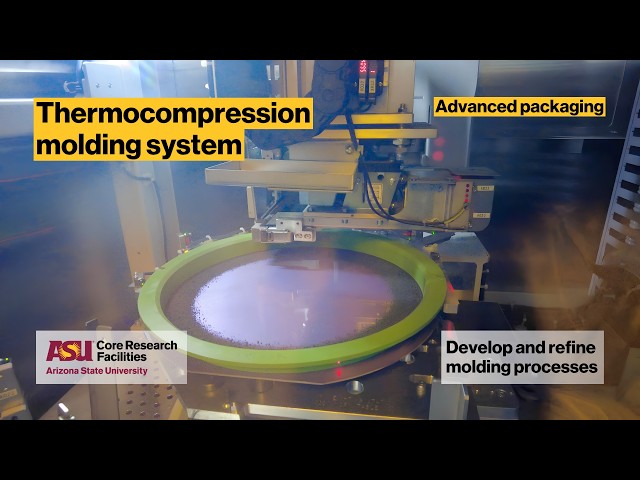
Advanced semiconductor packaging requires more than just precise component placement and interconnection; it demands robust protection capable of withstanding the rigorous demands of handling, testing, and ongoing process development. Thermo-compression molding systems address these needs by encapsulating semiconductor components within a protective package using controlled heat and high compression force. This specific technique is essential for creating durable and reliable structures that can support the complex geometries and diverse materials increasingly utilized in modern advanced packaging technologies.
By leveraging high-force processing and superior component encapsulation capabilities, researchers are able to develop and refine molding processes suitable for a wide variety of semiconductor package designs. The ability to manipulate these variables allows teams to explore innovative packaging approaches while simultaneously evaluating process performance under different conditions. This flexibility ensures that the manufacturing methods remain adaptable as industry standards evolve and new materials are introduced into production lines.
The ultimate outcome of this technology is a unique capability to produce high-quality molded packages directly within a research environment, providing teams with the necessary tools to bridge the gap between experimental concepts and practical applications. This setup enables researchers to move promising prototypes closer to industry-relevant standards without leaving the lab, effectively accelerating the transition from theoretical designs to real-world solutions. Such an environment fosters innovation by allowing for rapid iteration and optimization of packaging strategies before they are scaled up for mass production.
For those interested in further exploring these advanced capabilities, additional information is available through the Core Research Facilities website. The integration of thermo-compression molding into research workflows represents a significant step forward in ensuring that semiconductor packages can meet the escalating performance and durability requirements of next-generation electronics. Ultimately, this approach not only enhances the reliability of final products but also empowers researchers to push the boundaries of what is possible in semiconductor design and manufacturing.
Read the full video transcript
Advanced semiconductor packages need
more than precise placement and
interconnection. They also need
protection that can withstand the
demands of handling, testing, and
[music] continued process development.
Thermo-compression molding systems like
this provide that protection by
encapsulating semiconductor components
within a molded package using [music]
controlled heat and high compression
force.
This process helps create robust,
reliable structures while [music]
supporting the complex geometries and
materials used in advanced packaging.
With high force processing and component
encapsulation capabilities, researchers
can develop [music] and refine molding
processes for a wide range of
semiconductor package designs.
The result is a unique capability for
producing high-quality molded packages
in a research environment, giving teams
the tools to explore [music] new
packaging approaches, evaluate process
performance, and move promising closer
[music] to practical, industry-relevant
applications.
Discover more at cores.research.asu.edu.