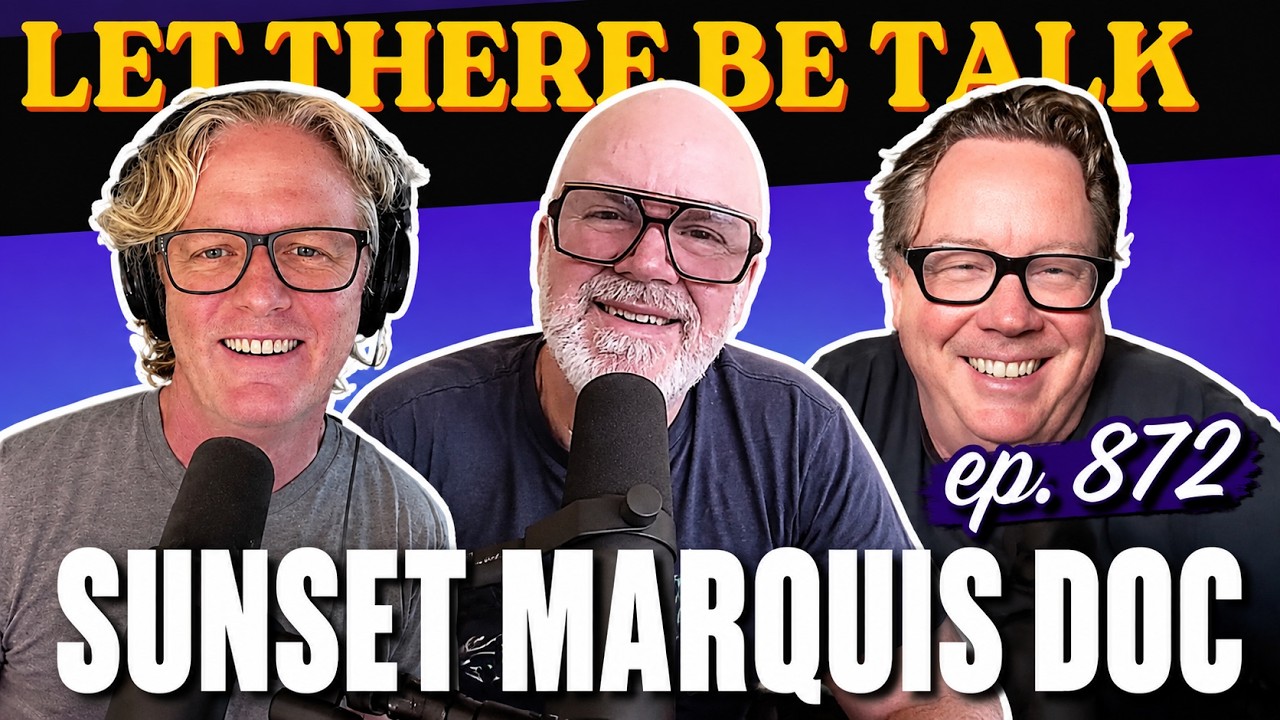
Ep 872 : Tyler Measom and Craig A. Williams directors of the brand-new Doc If These Walls Could Rock
Watch on YouTubeVideo summary
The documentary *If These Walls Could Rock* is helmed by co-directors Tyler Measom and Craig A. Williams, who share a deep personal connection to the legendary Sunset Marquee hotel in Hollywood. Tyler, originally a musician from San Francisco who transitioned into comedy after the city's music scene declined following the 9/11 attacks, had his life trajectory altered by a偶然的 encounter at the Whiskey Bar within the hotel. This meeting introduced him to the vibrant community of artists and comedians that defined the venue, effectively shifting his career from rock performance to stand-up comedy over the next seventeen years. Craig Williams, an aspiring screenwriter and former member of a hair metal band in his teenage years, initially viewed the Sunset Marquee as an unattainable mythological space reserved for rock stars like Guns N' Roses and Aerosmith. However, his path changed when he wrote a book about his experiences on the Sunset Strip, which led to his collaboration with Tyler and eventually the creation of this documentary.
The film explores the unique history and atmosphere of the Sunset Marquee, founded in 1963 by George Rosenthal as the first all-suite hotel in America with a specific vision for artists to gather and form a community. Unlike modern hotels that prioritize isolation, the Marquee was designed laterally, encouraging guests to walk through shared spaces like gardens, pools, and restaurants rather than taking elevators directly to their rooms. This design fostered an environment where famous figures such as Bruce Springsteen, Billy Bob Thornton, and Dave Grohl could interact casually in hallways or share meals. The directors highlight how the hotel served as a sanctuary during eras when long-haired musicians were often barred from other accommodations, effectively acting as a haven for counter-culture icons like Iggy Pop and The Rolling Stones. The narrative also touches on the hotel's financial struggles and legal battles with California, revealing that the Rosenthal family sustains the property not solely through hotel profits but by leveraging their broader real estate empire, including vineyards and film studios.
A central theme of the documentary is the preservation of the hotel's authentic vibe against the pressures of modernization and corporate chains. The Rosenthal family has invested millions into renovating the property while strictly maintaining its character as a private club rather than allowing it to become a generic resort or a chain like Raffles. The film features interviews with long-time staff members, including bartenders and valets who witnessed decades of rock history, as well as anecdotes about legendary moments such as Bruce Springsteen's pivotal decision-making night in his room and Green Day repeatedly trashing their rooms before being banned. The directors emphasize that the hotel's magic lies in its ability to bring people together face-to-face, a value they argue is increasingly rare in a digital age dominated by Zoom calls. Ultimately, the project serves as both a celebration of Los Angeles' rich rock history and a call to action to protect family-owned businesses that define the city's cultural identity.
Read the full video transcript
All right, thanks for tuning in to
another episode of Let There Be Talk.
Fantastic guests today. Two guys here.
Introduce yourselves.
>> I'm Tyler Misum.
>> I'm Craig Williams. We are the
co-directors of the film If These Walls
Could Rock.
>> It's uh I just finished the film and uh
I have a a really unique history with
this hotel. I don't know if you guys
know, but I'm a comedian now. And uh for
25 years before I became a a comedian, I
played music.
And I grew up in San Francisco area and
played music there. And then do hit the
first wave and destroyed San Francisco.
It was it was just it was death. So I
play the Viper Room and it's sold out.
And I tell my band, I'm moving to LA
tomorrow. This is uh weeks after
September 11.
And I moved to LA.
And the reason I'm telling this story is
my life has completely changed from the
Viper Room, the Comedy Store, and the
Sunset Marquee. What happens is I go to
the marquee to see the studio. I'm going
to track some vocals there. And I hear
there's a studio in the basement. So I
get there at night and there's a [ __ ]
red rope and it's madness outside and I
go, "What the [ __ ] is going on here?"
And now I've grown up in rock and roll
and I know all the hotels, but I wasn't
aware of this one. I mean, I know all
the rock hotels. You know, you had the
Riot House, of course. San Francisco has
the Phoenix Hotel. you know, New York,
the Paramount, but I never knew the Sun
Sunset Marquees. So, I show up there and
there's this blonde wiry guy. He's all,
"Hey, man, what's going on?" His name's
Jay Davis. And I go, "What's happening?"
He's the manager of the Whiskey Bar. And
so, I I meet him and we hang out for a
few weeks. He goes, "I run comedy
shows." Fast forward 10 years later, I
do one of his comedy shows and now I've
been doing comedy for 17 years. So those
three venues, the comedy store, the
Viper Room, and the Whiskey Bar
completely changed my life.
>> Yeah. It all at the marquee. So because
of this random meeting you had at the
Whiskey Bar at the Sunset Marquee, it
you changed career paths.
>> Well, he invites me to a comedy show.
I'm blown away because I loved comedy,
but I hadn't watched it since I kind of
dropped off around the Chris Rock era
and uh Chris Rock and Martin. And so I
go to one of his shows and they're
famous. They're at this place called
Dublin's which is right up the street.
>> Oh yeah, I remember that.
>> So I go there and there's these insane
comedians. I'm like, "What is this? This
is amazing."
And um and slowly my music career
started winding down and then I did a
movie with Ice Cube and with some
comedians and I decided I'm going to
start and I call Jay and and and that's
years later. But anyway, I'm watching
this film and I'm just looking at that
era is really the Paris Hilton, the you
know the influencer start, the Lindsay
Low Hands and and all of that. And I'll
tell you this, the first night I was
there, I was taking a piss in the
bathroom, and the guy left of me is
Mickey Ror, and I just go, "Oh my god."
First of all, this guy is my all-time
favorite drugstore cowboy uh or sorry,
um Barfly
and uh Diner. And he' done all these
films that I love. The Pope at Greenwich
Village. He hadn't done The Wrestler.
That was a few years ago. But anyway,
he's standing next to me and I go, "Oh,
[ __ ] Mickey Roor." He goes, "Rock
bottom." And I go, "Oh, [ __ ] He's
drunk." And I go, "What's happening?" He
goes, "You know, I once had an all gold
Mercedes and I crashed it." [laughter]
>> Oh my god.
>> Anyway, I had to give you my opening of
that place. I started hanging there
quite a bit. I would see Bono in that
outdoor little side bar there off the
bar, the smoking area and uh Sean Penn
and you know Chris Robinson and all
these people, Lenny Kravis. It was
insane.
>> You know, you kind of summed up the
beauty of the Sunset Marquee. It it it
really is this unknown spot in Hollywood
that is the place where everyone is. And
I'll tell you, every time I go there,
and we go there often, I will meet
someone. I mean, Craig and I were there
for lunch the other day. We're sitting
next to filmmakers. The filmmakers chat
us up. Two days later, she contacts me.
We just, it's this place where people
commune and get together and meet. And
that is really the theme of the entire
film. The owner, the founder, George
Rosenthal, founded this hotel on the
hope that artists and people could come
together and meet and be a community.
And by God, in today's world, when
there's less and less of that and we do
things like Zooms and calls and we don't
get together, at that hotel is more
important than ever.
>> He wanted to party with Playmates, too,
just to be clear.
>> Yeah. Yeah, there's that.
>> At at what point are you guys both uh
did you grow up in LA?
>> I'm an LA native. Um I I was born and
raised here. actually fourth generation
Angelino, very proud Angelino, which is
kind of how I got this gig uh writing
the book about the Sunset Marquee Hotel
was I got a lot of LA history. I know a
lot about the strip and that whole
world.
>> And what about you, Tyler? Where'd you
grow up?
>> No, I mean I I grew up for the most part
in in in Utah, oddly enough, which is a
whole different Mormon, ex Mormon, no
longer Mormon story. I've been here in
LA for five years now.
Funny thing about Utah, I do comedy
there and whenever I'm, you know, out
eating at uh like a restaurant or
something before I do the shows, there's
always somebody will open their
conversation with formally of the
church. I'm like, I I get it, dude.
[laughter] I didn't ask.
>> Everyone there is either trying to prove
how Mormon they are or not Mormon they
are. It's it kind of separates the two.
Yeah. Now, Craig, did you go to the
marquee back at when it was the whiskey
bar booming?
>> I really didn't. And I'll tell you why.
Uh, Dean, it's because I wasn't cool
enough to go there and get in there. I
mean, at the at the time that the
whiskey bar was really going off, um, I
was like an aspiring writer, aspiring
screenwriter, and I wasn't poser enough
to to try to pose there. But it actually
goes back to my teenage years when I was
a teenager growing up out there. I uh I
was in a hair metal band as a
15-year-old, 16-year-old. I was like a
nerdy honors kid and decided that my
ticket to cool was to form a a hair
metal band with my other nerdy honors
friends. And we did it within a year. We
were selling out shows at the Roxy and
the Whiskey and the Trouidor and we were
partying at hotels more like the Travel
Lodge, you know, on Highland and
Hollywood Boulevard.
>> Of course,
>> we wouldn't think of going to the Sunset
Marquee. Like, it was just
mythologically cool. and you knew that
that's where Guns and Roses was hanging
out and the Black Crows were hanging out
and Aerosmith was hanging out and we
were [ __ ] nerds. There's no way we
would think about going there. Needless
to say, I didn't become a rockstar, but
uh I did become a writer and uh becoming
a writer finally gained access to this
hotel and next thing you know, I'm
interviewing Slash and Steven Tyler and
Chris Robinson and [ __ ] Ringo, you
know? It was just like um I got access
into this world that uh I'd always
wanted access to. So,
>> you know, don't you Craig wrote an an
incredibly hilarious book uh called Mom,
Have You Seen My Leather Pants? about
his uh his his adventures on the Sunset
Strip. And that's how we initially met
is a friend of mine said, "You have to
read this book." And uh I was doing a
series for Paramount. I directed a
series called uh uh I Want to Rock. And
it was about the Sunset Strip era and
people who went to the Sunset Strip to
try and make it. And uh I read that book
and we interviewed Craig and then he
came on as a consultant/p producer and
we totally hit it off. And then next
thing you know Craig says, "I wrote a
book about the Sunset Marquee. We should
make a documentary about it." And I go,
"What's that place?" I read the book. I
didn't have the same kind of experience
you did, Dean, at the Sunset Marquee.
Um, but uh immediately after reading the
book, I was like, "Yeah, [ __ ] Of
course, we have to do this documentary.
Do I get to interview a [laughter]
Beetle?" Because there's only 12
Beatles. How many do I get to interview?
And uh uh five years later now we
finished the film. Is it five? Three.
Feels like five, but three. [laughter]
>> It's been magical. Yeah. And here it is.
But yeah.
>> Well, I'll tell you. Um, it's funny
because in the '9s I knew about the
whiskey bar at the Paramount.
So, it's interesting not to have known
about the Sunset Marquee as deep in rock
as I was, but you know, it was always
the um holy grail was the Chateau
Marmmont. You know,
>> that was like, oh, the Chateau, you
know. So, when I first went there, and
I'm telling you, it was madness. You
guys show it in the uh film, you know,
cars out front, the [ __ ] line, people
are drunk. I saw I don't know if you had
at the end of Aloma,
they have those pylons that come up at
night so you can't go down the road. I
saw a guy burn rubber up, didn't know
they were there, and plowed into those
in front of all of us at 2 am. Just
>> It was [ __ ] That place was nuts. I
mean,
>> yeah.
>> I mean, way, way more nuts than any
place in LA as far as rock stars per
square footage. It was a box. And I
never even knew the hotel existed except
[laughter] for going down to the studio.
>> And that's kind kind of the problem. We
cover that in the film that the the
hotel was, you know, the hotel was
launched in 1963
>> and the whiskey bar and there was we
have footage in the film and you'll
literally see the lobby of the hotel
filled, packed, and it's a big room. And
that's not even the bar, that's the
lobby. And then there's outside and this
is just people pouring all around. And
it kind of was at the detriment to the
hotel because people couldn't get to the
hotel or didn't want to get to the hotel
because at that period the whiskey bar
was king.
>> Did you ever were you ever uh privy to
interviewing those two dicks that were
the door guys, the rope guys?
>> I forget their names. I think one was
Adam.
>> We didn't we weren't privy to interview
the rope guys. Um, you know, we did want
to get that kind of bird's eyee view if
we could. So, we did interview a
bartender
uh named Mia who was there for a long
time. And of course, we interviewed
Randy Gerber as well,
>> right?
>> Um, but no, we we we didn't have the
opportunity. We interviewed a valet as
well named Peter. He's in the film. I
think he's been he's been there forever
and he's got,
>> you know, stories that you can't even
include in the film because they're just
they're
>> too scandalous.
Well, here's a here's a question uh have
for you guys. Of course, of course,
George opens it in 1963. He he helps
open the Playboy Club on Sunset. He
wants somewhere to stay. He's getting
divorced. He builds this hotel. It's the
first all suite hotel in America. Um
quickly it catches on with rock and
rollers. And what I don't think people
don't understand is in the ' 60s, '7s,
and 80s, if you had long hair, you
couldn't stay at hotels. That's just how
it was. You couldn't even go to
Disneyland if you were a man with long
hair up until about 76, I believe, or
something. It was crazy.
>> So,
>> these places were sanctuaries, and it's
amazing to see how it catches fire. the
first wave of this thing through the 70s
up into the 80s and you know with people
like Iggy Pop and uh you know the Stones
I mean the [ __ ] Stones in there you
know and then it kind of dies off. Now
my question here is when I start going
it they have the whiskey bar and they're
cleaning it up but then they just have
the outdoor area but there was this
prince of like Dubai that I met in there
and he goes I'm staying in the bungalow
next door come over and it was like if
you're looking at the hotel it was to
the left there on the street and it was
a [ __ ] palace. Now eventually they
build all this other [ __ ] in the back.
Now, what I wanted to ask you was, did
they own that land? Because it it's huge
now.
>> Yeah. They didn't actually initially own
that land. So, it backed up to what was
essentially like a strip mall, right?
Like classic LA development [ __ ] that
had a gay bath house. Um, it was Roman
themed. Um, an abortion clinic.
>> Wow.
>> Um, just all these like very um West
Hollywood type of businesses that were
adjacent to the property. and it was cut
off by, you know, the garden and there
was a wall and the Rosenthalss for years
had been trying to get this property
because they had this dream of, you
know, expanding it onto this onto this
lot. Um, probably I think in the early
80s they had that and they weren't able
to do it until 2007.
>> Well, they run into this lawsuit with
California. Now, I'm watching it very
carefully, but I kind of miss what
happens now. George, does he do
something bad where California, you
know, goes and sues him for billions of
dollars? What does he do?
>> Well, this there's a reason it's not in
the film. It's kind It's a bit tedious,
[laughter]
>> right?
>> It's a bit financial and bookkeeping as
opposed to rock and roll.
>> I I I kind of got to that. And what's
funny is it's almost like um the Beatles
documentary, you know, the last one
Peter Jackson did. Uh I I do a bit about
it on stage where I'm like, "Wait,
George just quit the band. What What
happened?" And you back it up like nine
times like, "Wait, he they're eating
toast and then he quits. That's what
just happened with me." I go, "Hey, wait
a minute. All a sudden he's in trouble.
What happened here?" You know,
[laughter]
>> it's a fair question. Um it it ties into
this company called Executive Life
Insurance that George Rosen was on the
board of. Um, [groaning]
>> can we get back to the rules?
>> And then there was [ __ ] then they all
[ __ ]
>> Okay. All right. [laughter] So, we'll
skip on that. I get it. Now, my next
question is it [ __ ] completely is run
down and and there's two things I want
to address right now. Uh, when I first
started going there, it was chaos. And
now when I go there, it is this haven of
vibe. When you walk through the door and
then you go to the back restaurant,
you're just in there going like, "Oh, I
I'm I'm Billy Bob Thornton. I want to
move the [ __ ] in here and just become,
you know, a tenant, man. It is unreal.
It's a jungle. It's it's peaceful.
There's rock photos everywhere.
>> Yeah. you know, the the the the the
Sunset Marquee came around in 1963 and
as we mentioned in the movie, that's
really the birth of rock and roll as we
know it in many in many many ways. You
know, that's and the hotel has really
paralleled with rock and roll. At first,
it was kind of rundown and crazy and
party place and now that I don't think
rock and roll has the kind of party and
debauchery that it used to have. The
marquee now has evolved in that same
manner. It is a place and it is magic. I
I there is something magical about that
place and it it has to be when a it's
built on the premise that people can
come here and be themselves and enjoy
themselves and you can be an artist and
you can be creative and you can have a
good time and that feeling has has
stayed with that hotel in management and
the people who work there and the
ownership since its birth. Uh, but also
when you have that many artists and
people, there's something in the walls.
I mean, Nancy Wilson says it's almost
like a museum. There just has to be
something there. Joe Elliot says, "Is
there something in the walls here with
all of the people that have stayed here
and written great songs and and the air
kind of changes, but it is beautiful. It
unlike look most hotels, you go in, you
walk through the [ __ ] lobby, you go
in a elevator, and you go up to your
room, you know, and that's it. The
marquee is is lateral. You you walk
through the lobby, you walk through the
hotel, the pool area, the multiple pool
areas, you walk through the restaurant,
you walk through the gardens, you walk
to your room, which is, you know, a
place away. And if you sit long enough,
you will see someone famous there.
>> So, there is the opportunity to see
people and to communicate. And I was
there once not too long ago and I'm
literally talking to Jean Simmons and
Billy Corgan comes up. He's It's like
they're walking to through the halls of
the high school and they're like, "Hey,
Billy, how you doing, Jean?" "Oh, I've
got to go record this thing." And I'm
just sitting there watching it all
going, "I can't believe I'm seeing
this." But that's what happens at the
marquee.
>> Yeah. You know, even now they have the
um Morrison Hotel photography gallery
there and they'll have big uh theme
nights and I'll go and it'll just be
like all of a sudden you're just back in
2001,
you know, it's just full lobby there of
rock stars, photographers, you know, and
it it's I think that the older you get
and you're into rock and roll, you enjoy
fine things and peace and quiet after
the madness of your show, which is what
it is now for me because I do comedy
every night and it's crazy on stage and
then I go back to the hotel and I just
want to chill with friends and that's
the best time hanging with oh [ __ ] I ran
into Slash and we talk the old days and
it's it's it's amazing and also we're
alive.
[laughter]
I think that's a big I think that's a
big part of it for sure. The
>> they're survivors and the hotel is the
same way. You know, it could have died.
It could have closed down. It could have
been sold to a big chain. Um but it's
still these this family that still owns
this place and you know, it's the it's
Mark Rosenthal's namesake. It was named
after him. Like uh it's it's a family
member. You know, they're they're very
uh protective of it and want to maintain
that vibe. And you know, as Tyler talks
about, you will go there and see just
Moresy [ __ ] sitting at the table,
people watching. But
they are very protective of that as
well. So that if they see somebody who's
there, you know, you can see the guy at
the next table getting excited, holy
[ __ ] that's right there. And they jump
on that before it even happens. You
know, they know it's it's like a private
club, you know, where everybody is taken
care of. And and I think that makes
people feel very comfortable.
>> Also, a key key thing to this, and I I I
love this more than anything,
familyowned. Okay. So, we've got the
Whiskey, Roxy, Trouidor,
uh The Rainbow, The Comedy Store. Okay.
These are all still familyowned.
>> Yeah. and and and the [ __ ] show that is
going down on Sunset right now. To have
these familyowned businesses still makes
me want to support them more than ever.
And uh I got to tell you, I've never
stayed in the Sunset Marquee and I'm
dying to go there for a couple days and
just soak it in and do some podcast
around the pool, you know, cuz the
original idea was to do my show at the
Sunset Marquee because it was called
Poolside with Dean Del Rey. And I came
up with the idea because I came down
there hoping to interview Joe Elliott of
Death Leopard. And I go, "Oh, the show's
called Poolside with Dean Del Rey." and
I pitched it to them, but I never got to
Mark, you know. So, then it became Let
There Be Talk, but that was the gold of
this uh podcast. The the goal of it was
to do it there.
>> Oh, cool.
>> Well,
>> well, we should have done that.
>> Oh. Oh, it it I mean, I could still do
episodes there, which would be cool if I
hooked up with Mark because Yeah. I
mean, I'm the show is bigger than ever
now. People quit podcasting and they all
come to me. the rock and roll, you know,
so it's it can be done, you know, but uh
>> you know, and then the standard came and
that was redhot for years and now that's
gone, but it's going to be hot again.
But the Sunset Marquee has just solded
on.
>> Yeah. And it is what they want it to be.
You know, I think that they don't want
to be the standard. They don't
necessarily want to, you know, they want
it to be the place where Slash can kind
of hide out and feel safe and
>> Yeah.
Now, uh, quick question. Have you guys
ever been to the Phoenix Hotel in San
Francisco?
>> I've not. No.
>> No. No.
>> Is that our sequel?
>> Well, it's Well, I think that it might
have just was going to close,
unfortunately.
So, I don't know. Google that and see.
But, you know, Andy Warhol designed the
pool and it's very similar. The square
around the pool and strictly rock and
roll.
>> Yeah. I'll tell you there are so many I
just finished the Led Zeppelin book and
there are so many instances of them
talking about particular hotels of
course uh they were riot house people
they have stayed at the marquee but
their key time was at the uh the Hyatt
House
>> but they mentioned that Seattle hotel
crazy [ __ ] went down I forget the name
of it but that was a very rock and roll
hotel right on the water
>> yep
>> uh
>> that's the fish one
>> great stories the fish one but my
favorite story of that is that they what
they staying there once and they didn't
trash a room. And the manager said, "Why
didn't Zeppelin trash a room?" And they
go, "Oh, they're just tired. They didn't
do it." And the manager of the hotel,
said, "Man, just one time. I'd love to
just trash a room." And Peter Grant,
their manager, just hands over the key
to his room and he goes, "Have one on
Led Zeppelin." And the manager, goes up
and [ __ ] trashes his own hotel room.
Amazing. So,
>> rock and roll.
>> Rock and roll. hotels are uh just so
[ __ ] cool. And what really makes them
cool is the staff and that's what they
really cover in this thing. Hey man, the
maids were going in, the cocaine was
laying around, the dudes were naked, the
weeds still there, they didn't touch
anything, they didn't snitch anybody
off. And yeah,
>> it was even interesting when George said
they were talking about that what was
that Garden of Allah before. That was
his inspiration. I've never heard of
this hotel, Garden of All. And he said
that these Hollywood early silent film
stars were smoking weed and doing drugs
way before rock and roll was even
invented. So
>> yeah, that's the place where they could
hide to do it because they had to hide
that even more than they do now,
obviously.
>> Of course. But it it
>> that was like Rock Manovv and F. Scott
Fitzgerald and
>> silent film stars.
>> Yeah, Greta Garbo was there quite a bit.
Chaplain hung out there. It was it was
it anyone who's interested in LA
history. The Garden of Alla was a a
block. It was a city block of villas. It
was quite remarkable. And of course now
it's a
>> I think it's a Ralph.
>> I think it's I think it's a Ralph. I
think it's [laughter] a Ralph. I tell
you, man, you know, the things uh like
the Sunset Marquee and the Comedy Store
and um the, you know, the whiskey and
the rainbow, it makes me so proud to
live in Los Angeles. I I love this city
uh more than anything. And I love when
people are like, "Fuck those guys." I'm
like, "Oh, yeah, yeah, yeah. Please
don't come out here." You know, because
the more they say that, the more I I
support and fight for Los Angeles and
support these familyowned businesses
because, you know, you take this [ __ ]
away.
>> What's the Why live in LA if it's all
gone? There's nothing to do. It's just a
bunch of dumb buildings. Uh and then
you're like, "Yeah, well, you know, used
to be over here, the Viper room, and
then over here was this and that." If
there's nothing, you can just go live in
Oklahoma, you know.
>> So, we need to fight for that kind of
cool [ __ ]
>> Yeah. Agreed. Agreed. And fortunately,
Mark Rosenthal, he loves the Sunset
Marquee. It is not going anywhere. It
will not be a Ralph's or as Morrisy says
in the film, a Dairy Queen,
>> a Goodwill or Dairy Queen.
>> We don't know what Morrisy has against
the Goodwill, but uh you know, he
doesn't he doesn't want it to turn into
that. Okay, question. They get into this
trouble. The hotel is totally turned
into a [ __ ] like flop hotel. There's
there's holes in the wall. There's
cracks all over. The place is decrepit.
They win against California. Where do
they get the money to redo this place?
Because it is incredible. Do they get a
loan somehow? What happens?
Um, I think one of the keys to the
Sunset Marquee is that it doesn't
actually make money. I don't think it's
profitable at all. The Rosenthal family,
>> Mark says it's profitable, but it's not
it it's definitely not the time and
energy that he puts into it.
>> Yes. Right.
>> Yeah. I mean, they have a number of
other businesses. Uh, real estate is is
mostly what they make their money off
of. You know, all the wineries up in
Malibu, the Rosenthal Vineyards, those
are all theirs.
>> Wow.
>> So, they they have a number of
interests. film studios. All the Raleigh
studios are theirs.
>> Oh [ __ ] that's theirs.
>> Yeah.
>> So, that's primarily where they make
their money. Um, he's not a big fan of
uh taking out loans to have to, you
know, do something like this. Um, so,
you know, they they find the money
elsewhere from other parts of the
business to throw into this and and
refinance and and all that.
If you go to the marquee today, uh you
will see that they are now doing a major
rehaul of the older villas.
>> I saw that there it is. It is under
construction. It's a $30 million rebuild
of this hotel. And we've walked through
it. It's going to be remarkable. But
with the same ideals that the hotel
carried, it is still I mean, look, they
do things right knowing their clientele.
One of the best things about the marquee
is they have the best blackout drapes of
any hotel I've ever stayed in. And the
rock stars say that all the time. I
mean, if you are going to stay up and
party till 3 in the morning, there's
nothing better than a dark hotel room.
Uh the new rooms they're doing are
completely utterly like concrete
soundproof.
>> Wow. you know, so they they think of the
they know that their clientele wants to
keep this hotel, but they also are
making some beautiful renovations to it.
>> If anything, they're nervous about
having a film like this that talks about
the debauchery and uh rockousness of the
place because they're like, "That's not
what we are anymore, and we don't really
want people to think that that's what we
are, but you know, the story needs to be
told. There's so many so much great
history that's happened here that it it
felt really necessary get it out there.
>> But on the flip side, Kelly Osborne says
she doesn't want the film to do well
because she doesn't want the film to
ruin the place.
>> Uh you know, Billy Billy Bob says he
doesn't, you know, he doesn't want
people like he says, what do you say?
The Plastics Corporation. He was like,
that's all this hotel needs is the
Plastics Corporation having conventions
here.
>> Question. the original rooms around the
pool. The original Sunset Marquee. Um,
how many rooms was it originally?
>> I think it's about 144.
>> Wow. Wow.
>> It's actually pretty pretty decent size,
you know?
>> Yeah. It's three stories.
>> Yeah.
>> And then when did the bungalows in the
front come into the mix? Because when
I'm there, those were like private, you
know, giant bungalows you could rent.
>> Yeah. That's where, you know, the the
heavy hitters started staying for
extended periods. Like that's where
Billy Bob's living for two years is in
one of these massive villas. And it's
hard to explain. I mean, they are
they're not hotel rooms. They're they're
houses. I mean, these are
>> houses.
>> They were the John Barrymore estate
actually back in the in the 20s. And so
they just became available and George
bought one and then bought the next. And
it was like Monopoly, you know, he just
like moved his way up the culdesac. I
think that's the other important thing
here is that this is a residential
street. It's on a culde-sac. It's it's
surrounded by residential property. Um,
and you would never know it's there in a
million years. And then you have all
these
>> just killer villas. I mean, they're
they're beautiful 1920s style uh that I
don't think you find anywhere else in
the world.
>> Well, when I went into the one the Dubai
Prince had,
>> I was like, "What the [ __ ] is this?" It
was just this palace.
>> And he's Oh, yeah. come on in. And he
just had [ __ ] guns and money laying
around and [ __ ] and I was like, "This
place is insane." You know, he was like
a younger Dubai Prince and he was JUST
LIKE ROCK AND ROLL.
>> YEAH. That's Billy Bob talks about that
guy. He talks about he said I was
underneath him for like six months. He
>> was under.
>> Yeah. Yeah.
>> And and you'd go to the marquee and
you'd be like, "This guy's going to
party and he's going to pay for
everything." You know, you're dead
broke. you [laughter] know, he's just
got shitloads of booze and oh my god,
it's just
>> Yeah.
>> I mean, that small time, like I said,
that [ __ ] building and the Viper Room
and the Comedy Store have changed my
life. You know, I played the Hollywood
Bowl with Bill Burr last year and the
and the LA Forum and the, you know, the
uh Madison Square Garden and and I think
about it. It's just these three [ __ ]
places and 300 mile drive that changed
my whole trajectory of life. You know, I
I thought I was done playing rock and
now here I am comedy 17 years later.
>> Yeah. And look, not to not to diminish
what you're saying, but we hear that all
the time. There's so there's so many
people who their lives changed at this
place because they had the random
[ __ ] meeting with the guy at the bar,
the lady at the restaurant, whatever it
was, and it totally changed the
trajectory of their lives.
>> Oh my god.
>> Not to mention, people have met their
mates there. I mean, there was a a
deleted scene that we never finished of
multiple people uh who met their wives
or husbands at that place.
>> Mark Rosenthal included.
>> Dave Gro met his wife there. Um Richard
Mark's first date there. Harry
>> Con. There's also people that lost their
wives because there
>> it's possible. Yeah, it's possible.
Those aren't as widely talked about, but
yes. Very likely.
>> Including including George Rosenthal.
>> Oh, yeah. Exactly. [laughter] Um, George
93 now, still alive. I mean, uh, I saw
he's still alive in the film, but I just
wanted to make sure he was still, you
know,
>> he is still kicking and he still calls
Mark multiple times a day to talk about
some deal or another and where are we
going to get the financing for blah blah
blah and it's [ __ ] sharp physically.
He's just having a hard time. He's got
some back trouble and things like that.
And
>> right,
>> you know, when you're a guy like that,
you know, he's he's has a similar vibe
to like Hef, you know, and once he
starts deteriorating physically, like
he's a little self-conscious about being
out in public. Doesn't want people to
see him with the shaky hands or
whatever. But
>> yeah,
>> you know, that guy uh talk about a vibe.
I mean, the place really is a reflection
of hanging out with that guy. Yeah.
>> Well, anybody that supports rock and
roll
just gets it, you know, uh, all the way
down to Jimmy Ivan. I mean, the history
of him bringing the Born to Run acetates
there. E Street Band staying. Bruce goes
upstairs, plays it, throws it in the
[ __ ] pool. Then they got the Time and
Life in the lobby. He throws those in
the pool and it becomes the best record
he's ever [ __ ] made, you know, in my
eyes.
>> And, uh, that Bruce's influence of the
marquee. I mean that he talks about it
all the time. He talks about him and Tom
Petty would hang out there. Just all
these things we couldn't do. There's a
great recording of of him playing at the
whiskey and it's one of the
[clears throat] greatest moments. It's
on his album. God, I forget the name of
it.
>> But that was the day when he was at the
marquee and he he talks about it in his
book how he was on the cover of life and
and and time, right? and he looked at
the two and he went up into his room at
the Sunset Marquee. And this is a
turning moment for for Bruce Springsteen
when he just goes, "Do I want this?" And
I just imagine him sitting in his hotel
room at the Sunset Marquee, sitting at
the edge of his bed thinking, "Do I want
this? Is this what I want? Is this what
I want out of my life?" And then of
course he goes, "Yeah, of course this is
what I want. This is what I signed up
for." And that night he goes to the
Whiskey and it's one of the greatest
[ __ ] shows of all time.
>> Oh, no. The Roxy.
>> The Roxy. Yeah, the Roxy show with Bruce
Springsteen.
>> Well, I got that on bootleg. It's
insane.
>> Yeah, it's amazing. And I forget the
song, but he goes on this diet tribe
right in the middle about his father
didn't want him to be
>> Oh, yeah.
>> Come on. Help me out here, Craig.
>> I'll get to it.
>> Except I mean, that's a pivotal moment,
man. There's some great black and white
photos of him also at the end of
Altaloma and uh sunset and he's just
looking down sunset and this black
leather jacket and it's just [ __ ]
>> Oh yeah, it's great shot.
>> Yeah, great shots, man.
>> Yeah, there's a other stories that we
didn't, you know, just have the time for
with him.
>> Of course.
Didn't he uh he helped Bob Seager write
his seinal record that I can't think of
the name of
>> at the hotel
>> Against the Wind. He said every night
they would meet they'd meet for
breakfast him and Bob Seager and then
they'd go off and record their albums uh
and then they'd come back and compare
notes. And that was the Against the Wind
album. Um
>> isn't it crazy that they had no room
service till like the 90s or something?
>> Yeah. You would you would pick up your
phone and order from Green Blat's Deli.
>> Yeah. Which is [ __ ] gone.
>> Which is gone.
>> And it's my all-time favorite deli on
the planet. And it's gone. You know,
>> I hop. I don't know.
>> Yeah. And and you know, Magic Castle's
hanging in there. That's another
classic.
>> Yes. Absolutely. [laughter]
>> Well, okay. August 14th, you could see
it at the Sunset. Uh it was the Sunset
movie theaters.
>> Landmark Sunset. Yep.
>> Yeah. That's in the strip mall there,
right? The old Paul or uh what's his
name? Uh what was it called? Sundance
Theaters, right?
>> Yeah. Right across Chatau.
>> Yeah, there it is. And then it's on
Amazon and what? Apple.
>> Yes, sir.
>> Yeah, Apple TV. Not the streaming
service. You It is Apple Apple Digital,
formerly known as iTunes. Um which you
can purchase the film for $6.99. I'll
tell you, it is worth it.
>> Oh, it's great.
>> It's worth it. And if you want to uh buy
it off of our website, if thesewalls
could rock.com, it's only $5.99 on our
website. And when you do that, you get
bonus materials. And let me tell you
these bonus materials. We interviewed
like we interviewed Billy Bob Thornton
for
>> what? Four, five hours.
>> Like he just went and went and went and
went and he gave us gold. And it was
unfortunate that we couldn't obviously
put it all in the film, but what we did
is we had extras. We had bonus scenes
that we created. So, we have another 15
minutes of a Billy Bob interview. 10
minutes of Jean Simmons, 10 minutes of
Sharon Osborne and Kelly Osborne. Um,
who else did we have?
>> That guy Morrisy.
>> That guy Moresy. So, if you buy it off
our website, A, you don't give money to
the corporate overlords of Amazon and
Apple.
>> Great.
>> Uh, B, you you get the bonus content for
free. And I got to tell you, it is it is
worth it. Those edit interviews are
>> remarkable.
>> Did Bruce just give you the music
>> uh for Born to Run?
>> Yeah,
>> we actually we were able to fair use
that clip because it was short. Um Okay,
cool.
>> You know, Bruce, we actually finished
the movie. We pre premiered the movie.
>> Um and then Bruce after trying to get
Bruce for about two years to be in the
film, he finally said, "Yeah, I'll do
it. I'll do it on this date."
>> Um and you know, we unfortunately
weren't able to be there. uh you know he
did it on the heels of another uh
another interview and so we had to
reopen the film and recut and re-edit
and remix and everything but Bruce was
worth it. film done with the film again,
Dean about a month ago and we learned
that uh Miranda Lambert has a new record
coming out and her first single is
called Sunset Marquee and it's all about
the Sunset Marquee and it's like this
cool country disco song that we uh had
to open up the film again and have that
credit song.
>> Um so never heard before single by
Miranda Lambert is in the song.
>> That's killer. Is the studio still open?
>> Studio is still open.
>> So great. So great, man. I love that
place. You talk to Mark, tell him I want
to stay two nights and I'll interview
him there.
>> Okay.
>> It'll be great to interview him in that
damn place and walk around, you know.
>> Yeah.
>> Yeah, we'll mention it. Absolutely.
Team, do you can you contact Kim and uh
we'll see if we can make that happen.
>> I can't even tell you how much I love
the place. it
>> when they reached out to have you guys
on. I said yes before I even I was just
like yes. It's like yeah it's a
documentary on the sunset. Yes.
[laughter]
>> You know you you epitomize the sunset
marquee in a way. You just epitomize
that gumption and that Hollywood
dreaming and that communication and
connection. I mean isn't that what
you're doing with this podcast? You're
connecting. You're telling people about
things. your that is that is the Sunset
Marquee
uh in a nutshell. So, we're grateful
that you had us on. We're grateful that
the Sunset Marquee had a smidge to do
with your
>> uh career and that it comes back that
you can have us on talking about the
movie because look, you're this is a
great film. It's not just about rock and
roll. It's a beautiful father and son
story. Um, it's about community and
communication. And there's a moment in
there when Dave Gro talks about the
importance of artists getting together.
And I am convinced of that. We are
artists. And and he said something. He
said, you know, sometimes it's just good
to get together face to face
>> and I don't think we have that enough
anymore. So
>> no, you know, the the the you know, my
whole thing is uh I'm not a get off my
lawn Clint Eastwood. [ __ ] this. But I
went to see The Odyssey a couple nights
ago and I'm in the theater with tons of
people and I was like, "Yeah, man. [ __ ]
your vertical uh TV ideas, you know?
Sure, whatever. For some, you know, for
some dumb stuff of like a guy riding a
wheelie and crashing. Yeah, that's funny
[ __ ] But not for art, man. You know,
not for art." And uh and that's the bean
counters that are pushing that, you
know, pushing it to this. And I like
this, you know. So that's what this is.
Anytime I see something that is historic
with rock and roll and Los Angeles, I'm
in.
>> Well, it's almost like they're they're
afraid of us to get together and
>> that.
>> That's what they are. they are because
you know when the gatekeepers lose
control
uh then they they don't can't pay their
multiple mortgages. So
>> that's right.
>> Thanks for doing the show, guys.
>> Thanks for having us, Dean. Love it.
>> Email me.
>> And uh I told Bill Burr about it. He's
dying to see it. And uh
>> and I'll be telling everybody about it
obviously when this comes out in uh two
weeks. I'll drop it in a couple Mondays
from now.
>> If uh you want to share a link with
anybody, we can definitely help that out
for you and we can
>> Is there an Instagram for it?
>> Yeah, of course.
>> If these walls could rock.
>> Great. And I'll tag the clips on your
Instagram and collab with you and you
guys can uh accept the collaboration.
>> Send you an email right now, Dean. We'd
love to see you at the Sunset Marquee.
>> I'm in on that.
>> Throw a TV out [clears throat] of a
hotel room.
>> Oh, [ __ ] yeah. Oh, man. Before we go,
how about Green Day?
>> Yeah. I mean, imagine being Green Day.
You're [ __ ] You're like a teenager
and somebody gives you a bunch of money
and you're now you're sitting in a bar
and [ __ ] drinking with Jeff Beck or
whatever.
>> Yeah. Painting the carpets green and and
making Oh, man. They those guys were
[ __ ] out of out of control. There's a
there's a in in the uh in the
administrative office of the Sunset
Marquee, there's a poster of uh Green
Day and on it uh I think it was Billy
Ray signed uh uh Sunset Marquee. Billy
Joe uh uh sorry for the And then it just
dot dot dot.
>> Yeah, they booted him out like, "Okay,
you're you're kicked out for 30 days,
then they come back, they [ __ ] up again.
You're kicked out for 90 days, they come
back, they [ __ ] up again." [laughter]
I Matt Sorum, the drummer for Guns and
Roses, he tells a story about hanging
out with them and going into one of
their rooms.
>> Yeah.
>> And taking all of the furniture and what
did he put it on the ceiling?
>> Glued it to the ceiling or something.
>> Yes, he glued [laughter] it ceiling.
Hilarious.
>> All of the furniture glued it to the
ceiling. So, yeah. Rock and roll.
>> All right. Thank you guys.
>> Thank you, Dean.
>> I'll see you.
>> All right. Have a good one.