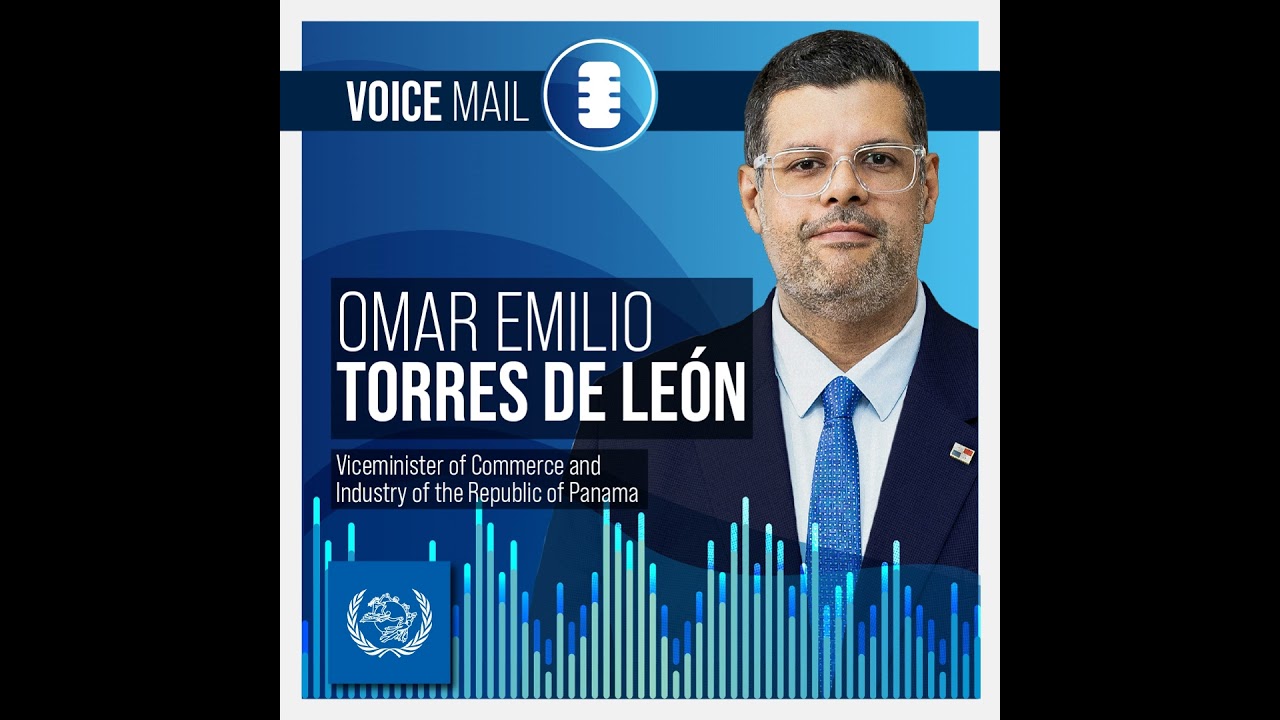
Ep 45: Making location simpler - Panama’s georeferenced postcode system
Watch on YouTubeVideo summary
The episode features Omar Torres de Leon, Vice Minister of Commerce and Industry of Panama and former Director General of the national postal operator, Correos y Telegrafos de Panama (Codel), who discusses the launch of the country's new georeferenced postcode system. Reflecting on his personal history with the postal service, which began in childhood visits to collect mail with his grandmother, Torres de Leon highlights his professional journey through organizational restructuring and transformation. He notes that when he assumed leadership in 2024, the organization required a deep modernization to keep pace with evolving economic realities, particularly the growth of e-commerce and last-mile delivery operations that were already occurring despite the lack of a standardized addressing infrastructure.
The primary inspiration for this initiative was to create a technology that seamlessly integrated into existing daily life rather than disrupting it, ensuring the system was easy to use, access, and share for all citizens. Recognizing that traditional street names only covered urban areas effectively, the project leveraged maps and technology from Panama's National Institute of Statistics and Census (INEC) to cover the entire nation, including rural zones and special districts. The resulting system is uniquely designed for Panama's specific cultural and geographical context, where addresses often combine text descriptions with numbers to pinpoint locations. By adopting a georeferenced approach, the system aims to standardize how Panamanians answer the fundamental question of "where," making communication more efficient and embedding digital addressing into the national culture.
Beyond its immediate benefits for postal delivery, the new system is envisioned as a versatile infrastructure that will support various sectors including emergency services, healthcare distribution, and cross-border e-commerce. Torres de Leon emphasizes that the success of this technological rollout depends heavily on integration; the codes must be easily accessible and compatible with existing platforms used by ambulance services, government agencies, and private app developers. He warns that if the technology is difficult to integrate or adopt, it will fail, so the focus remains on creating a clickable, user-friendly tool that encourages widespread adoption across different industries and applications.
Looking toward the future, Torres de Leon expresses high expectations for the system to evolve continuously alongside real-life changes and technological advancements. He views this launch not as a final product but as the kickoff of an ongoing process that will gradually make Panama more connected and easier to navigate. The ultimate goal is to normalize the use of these geo-referenced codes in everyday dialogue, replacing complex verbal directions with precise digital coordinates. Through sustained collaboration with international partners like the Universal Postal Union and regional organizations, Panama hopes to set a precedent for how postal services can lead national transformation by prioritizing the user experience and fostering a more integrated society.
Read the full video transcript
[music]
>> This is voicemail, the Universal Postal
Union's podcast covering the wonderful
world of mail. I'm your host, Ian Kerr.
[music]
We're joined in a moment by Mr. Omar
Torres de Leon. He's Vice Minister of
Commerce and Industry of the Republic of
Panama, and we're going to talk about
Panama's new addressing system.
>> [music]
>> Joining me on the line is Omar Torres de
Leon. He's Vice Minister of Commerce and
Industry of the Republic of Panama, and
up until recently was Director General
of Correos y Telegrafos de Panama,
Cottel, the Panamanian postal operator.
Omar, welcome. Let's start with a
question we ask all of our guests on the
UPU Voicemail podcast. What is your
first memory of the post?
>> Well, thank you very much. First, thank
you very much, Ian, for having me here
on the podcast and to the UPU crew
that has been very kind to me during
this journey with Correos y Telegrafos
de Panama. So, yeah, well, my first
memory, I'm going to be truly honest
with you, is with my grandmother. I
remember every Saturday morning we used
to have una casilla, right?
A place
in the postal service that we go every
Saturday morning. So, every Saturday
morning
and the weekend basically started with
my grandmother doing some running some
errands,
and the first or second errand was to go
to the postal service and make sure if
there was [clears throat] something
there to collect. So,
this is my childhood I'm talking about.
So, that is my first memory for sure.
So, I was a user. I was a an early user.
And in my family, as in every Panamanian
family, or at least most of them, we
were users of the postal service. So,
that would be my first memory for sure.
>> Can you tell us a little bit about your
professional journey then to becoming
CEO of Codel? And in that leadership
role, what was what excited you the most
about the organization's future and the
opportunities that lie ahead for it?
>> Well, I've been a consultant most of my
professional life. So, and I and I had
work in HR a lot. I had work in several
I have been very lucky, to be honest.
And
in my professional career, and I had
the luck of working in a lot of
organizational restructurations.
That is something very particular about
my profile, that I would say
you don't really study for that. That's
something that just develops in your
career. And once you've done one,
then you get the second, and then you
get the third, and it's something that
that you become good at, not just for
academic reasons
and because of my background, but
because there's something
that organizations need. So, I've been a
consultant most of my life, and I've
worked in several
uh
restructurations and deep and profound,
you know, transformational
organizational transformation. And that
was the case for Correos de Panama. We
we really needed a transformation when
this administration started. Of course,
the position of director is that changes
in every government. So, in July of
2024, when the current administration
started,
I was designated to be the director, the
CEO, or the first person in charge
of Codel, which is Correos y Telegrafos
de Panama. It's a direction
subscribed to the Ministerio de
Gobierno. And
I think the future looks good.
Um
when I first started
my first assessment, it was a that it
was an organization that needed a
transformation. We knew that before we
started, of course.
Um, but it needed a deep transformation
and that was a job and that was what it
what we needed to do and
and I think the future looks good. I
think that that transformation is, of
course, an ongoing process and it is not
a short process.
But we've been very lucky. We've had a
lot of uh help from the UPU. We had lots
of help from UPAEP, which is the the
regional organization. And mostly, I
would say in my experience,
every country that we reach out for
something and and every help we needed
uh with our, you know, fellow Latin
Americans and even with with with some
other postal services that are not from
Latin America, they were very kind to
help. They were very open to share
knowledge, to share possibilities, I
would say. And that is something that is
still happening.
>> In Panama, you have a fairly
well-developed physical addressing
system,
but Panama recently launched its
national geo-referenced postcode system,
which is a a major step in modernizing
the the nation's addressing
infrastructure. So, as commerce and
digital services and logistics continue
to evolve, what inspired this initiative
and what challenges
was it designed to address for citizens
or or citizens, business and and and
even postal operators across the
country?
>> Well, there was a lot of challenges. I
would say the first challenge is that we
were doing it in 2026, which is a little
late to the party, but again, we
received lots of help. Uh the UPU was
key for us and a team of consultants of
the UPU was really key
and it was a big driver for us to make
it happen. So, you mentioned that we
have a fairly well-organized way of of
naming the streets. We do have that.
But, only in the
urban area. And of course, we needed to
provide technology and we needed to
provide a way to cover the whole
country. And to cover the whole country,
we needed a better way to define how are
we going to locate each other. So, our
strategy was very simple. We wanted to
provide a technology for every
Panamanian that was easy to use,
easy to access, easy to share, that is
very important, and optimized to make
sure that
this was not going to be something just
to have. This was designed to be
something to use, to be embedded in our
culture, and to be and to make sure that
it was alive, and it was useful, and it
was in our real life. And that also, and
this is part of the challenge, and that
is also one of the best we did. That's
one of the things we did to reborn our
postal service. To make sure that every
step we give, every strategic position
we take, and every project we develop,
it was put on the user. It was taking
the user first. So, we developed a
strategy and we took the decision to
make it geolocated for several reasons.
The first one for sure is, again,
because it's made in 2026.
And second, because real life happened.
Because we didn't have postal codes, it
didn't mean that we do not have
e-commerce. It didn't mean that we do
not have last-mile operations. So,
people, again, the economy it's
evolving, and people is even if we have
postal codes or not, last-mile
operations were happening, e-commerce
was happening. So, we have to make sure
that we were going to make it easier,
not that we were going to make it
harder, or that we were going to provide
a technology that is not going to be
flowing with what's already happening.
So, we took the decision to make it
geolocated and I have to mention that
INEC, I N E C in Spanish for Instituto
Nacional de Estadística y Censo, which
is the National Institute for Statistics
and Census, they had maps and they had
some technology that we could use and
they were so nice to share it with us
and to collaborate with us to make it
happen. So, two elements. First,
geolocated is because
this technology
it was designed to be included in what
was already happening and to make sure
that it was an upgrade to what was
already happening.
And second, because we had the
opportunity. So, we had the chance
because of what INEC was already doing.
So, I think that's it. It's because it
was a seized opportunity with what the
government already had and optimized to
make sure that this was going to make
life life easier to what was already
happening.
>> So, tell us a little bit about the
actual system itself. How the
georeferenced postcode system works and
maybe what makes it different from some
of the other postcode or postal code
systems that are used in other parts of
the world. Obviously, you've mentioned
it's 2026. Anyway, [laughter] that's our
first year. Tell us a little bit about
how it works and then what it's what its
unique features are.
>> There are some unique features. The
first feature and very important for us,
especially for starters and for a
kickoff of the system, again, this is
not new technology or this has this are
not postal codes are not new ideas. So,
we had to make it in a way that even
being something not really new, the
technology and the on the way that it
was going to be used and that it was
designed for,
it was flowing with what already
happening in real life, right? In the
practice. So, it is not very unique. I
wouldn't say it's absolutely new. I
would say it's a collage of ideas that
was already
out there in different countries. And
most of all, it was designed to make
sure that every point it's easy to
locate.
I wouldn't say there's something unique
about it, but I would say it's very well
designed
for what is unique about Panama,
which is
how houses are in Panama, how buildings
are in Panama, how buildings are in not
just in the urban area, but in the in in
the country area, in the special zones
we have, in the delivery methods we
have, in the culture we have. Again, I
wouldn't say it's unique. I would say
it's uniquely designed for us.
>> You've mentioned there about the
diversity of addresses
>> Right.
>> that you have.
Um it might be diversity of geographies
as well, all kinds of things like that.
So, it it's a a system or a project
that's has nationwide coverage. So, how
did you approach that challenge of
designing a system that will be able to
support users across the entire country?
And do you see any long-term benefits
from the project as well?
>> Well, I see short-term benefits
immediately. And in the long-term,
I'm going to be truly honest with you.
In the in the long-term, I have high
hopes and I have high expectations of
what it can happen. Again, this is an
infrastructure that as a country we
started using in 2026 when e-commerce is
not something new. And and we're not
discovering e-commerce and we're not
discovering last-mile operations. We are
basically making them easier.
But in the long-term, I think and one of
my visions about it is that in the
long-term it is going to be very
embedded in our culture.
It's going to be more in our language,
you know, in our in the way we dialogue
as Panamanians, it's going to be easier
to find each other. Which was always the
idea. How do we answer the question,
"Where do I send you this?" Or, "Where
do you want to receive this?" So, that
question, I believe in the future, will
be answered in a shorter way. We have a
lot of I would say very Panamanian ways
to answer those kind of questions. And
now we're looking for a much more easier
way and for a much more, I would say,
normalized way
to have those dialogues. So,
I believe in the future, I see Panama
more connected,
easier to connect. I would say more
included in the e-commerce. Big
platforms are already using postal codes
for delivering and, you know, all of
that. And I definitely do not see this
as the last version of it. I would say
this is the first version. This was the
kickoff.
It was it was fairly well done, but as
every technology, it is needed for it to
be evolving
and for it to be changing with what's
happening in real life.
>> It's easy for us in the postal sector to
think about an address purely being
something that we in the postal sector
need. We need an address to deliver a
letter or a parcel.
But we we we're quickly disabused of
that notion, aren't we, when we see that
governments use it, emergency services
use it, e-commerce relies upon the
addressing systems. So, how do you see
this new geo-reference postcode system
supporting all those different sectors
that rely on addresses?
>> Oh, in a lot of ways. In a lot of ways.
You mentioned before that we have a
fairly well
developed way of urban names and and
street names. But the truth is that just
works for a small part of the country.
So, across the country, we have problems
with directions. And there there's been
a lot of I would say there's been a lot
of intentions and notions to try to
change that and notions to try to change
that.
And this is another one of them. Again,
something I've said a lot of times and I
will never get tired of saying it is
that our direction in the globe, you
guys in the UP knows this very well,
has two elements, a text
street 95 93 a text and then numbers.
And in different parts of the world
the numbers say or the numbers represent
an area and the text a a particular way
to find that area or vice versa in
another countries
the text is just to narrow an area and
then the code it's to particularly find
a point. It It It works in different
ways in different parts of the world.
Again, since we did it in 2026, we tried
to make it in the shorter and most
efficient way possible. So, the number
will take you to a point particular. But
again, we need to now and and something
that we're working on in Panama is to
develop a law, a new law of how are we
going to locate each other now
considering that we have postal codes
that are geo-referenced. This brings me
a little bit back to your previous
question. This is already involved. This
is already being part of what's
happening in our country and I think
that has a lot of different
implications. Lots of it. You mentioned
health, you mentioned distribution in
general for the government. So,
I think that in the future
and and maybe in the short future, I
mean in the in the near coming future, I
would say that a geolocated system for
Panama is just very beneficial and
naturally it will be getting into the
way we answer to the most simple
question, which is where are you right
now or or where should I send you this
or or where should I go pick it up? Or
where should I go drop it off? So, in
any way, in any matter that that
question needed to be answered needs to
be answered, the postal code, when it's
geo-referenced, it is a good answer to
that.
>> You mentioned a number of times it's
evolving when in the early stages of
this and there's a lot of learning as to
how people use
the the the address.
>> [gasps]
>> What would you say are some of the
lessons so far
that would be valuable for other posts
who are looking to strengthen, whether
it's
digital identification and geolocation
of delivery points, or knowing where
citizens are and those sorts of things.
Are there Are there any sort of early
lessons that you think would benefit
other posts?
>> Integration, integration, integration.
That that is it. You have to make sure,
and that is something I know the current
postal director is working on, you have
to make sure that for every platform
available, this is an easy technology to
access and to integrate to your
technology and to your project. So, as
this is, I would say, property, maybe
that is the right word, I'm not sure if
I'm using the right
law term, but it's property of of
a responsibility of the postal service,
it is actually something, a technology
that you put out there so people use it.
So, a failure would be if people if if
nobody wants to integrate with that.
That would be a failure.
If you make it easy to integrate and and
if you make it easy for,
I would say,
I'm just going to drop a a
a possibility. If an ambulance service,
for example, that is developing an app,
I'm just saying something out loud, I'm
I'm crazy idea out loud, that is
developing an app that will track you
and you click a button and an ambulance
will be there,
this technology should be available for
that, right? Should be available for
that to happen,
to be integrated in those kind of
projects.
So, I believe the success of this is
very attached to how easy it is to
access this and how easy it is to use
it, I would say as a clickable
technology for people and for
and for people that does projects, for
people that does apps, for people that
does everything that has to do or
anything that has to do with somebody
locating something. That is it. If you
are somebody who's trying to make sure
who's trying to to do a project or to do
a development and technology or
application that is somebody trying to
find a place, the postal codes when I
geo-reference are very useful to that.
>> Let's go back to something you mentioned
earlier which was about transformations
and dealing with change and how a lot of
your professional career has involved
people and teams and transformation.
What you were talking about here is a
big transformation, especially for for
your a postie and you've been delivering
for 30 years and you've always delivered
and you've been able to interpret those
addresses and you know everybody is,
here's a new system. So, how do you
prepare teams and how do you bring
people along whether it's everybody from
the postie at the front line who's
actually doing the work through to
stakeholders or ministers or whoever it
might be, how do you get everybody on
side with a new development like this?
>> Well, that's one of the biggest
challenge of throwing out new
technology, not just postal codes, but
that's just one of the biggest challenge
of any innovation technology in the
world. I am aware that the
person that is being the director right
now is very focused on make sure that
the postal codes are the new way of
postal codes in Panama. He's making sure
that he can make contact and influence
a lot of institutions so they use it now
as the official way of again, answering
the question, where do I send you this
or where do I drop this off?
So, a lot of integration with what is
already happening in Panama with what is
already our culture and our last mile
operations.
>> So, that sounds like a continuing
transformation and it's a really
important thing.
>> Yeah, it's a lot.
>> In this age, especially when we're
talking about things like cross-border
e-commerce, making enabling that through
to the local services that you just
mentioned. Omar Torrijos de León, Vice
Minister of Commerce and Industry for
the Republic of Panama. Thank you very
much for joining us on the UPU voicemail
[music] podcast today.
>> Thank you, Ian, for having me. And thank
you to the UPU team for being so nice to
us and for being such [music] a
strategic partner for this project to
happen.
>> [music]
>> You've been listening to Voice Mail, the
official podcast of the Universal Postal
Union. Subscribe to the podcast on your
favorite podcast platform and you get
each episode downloaded to the device of
your choosing [music] as it's released.
My thanks to the team at the UPU for
their help putting together this
episode. I'm your host, Ian Kerr, and I
look forward to [music] your company
next time on Voice Mail, the podcast of
the UPU.