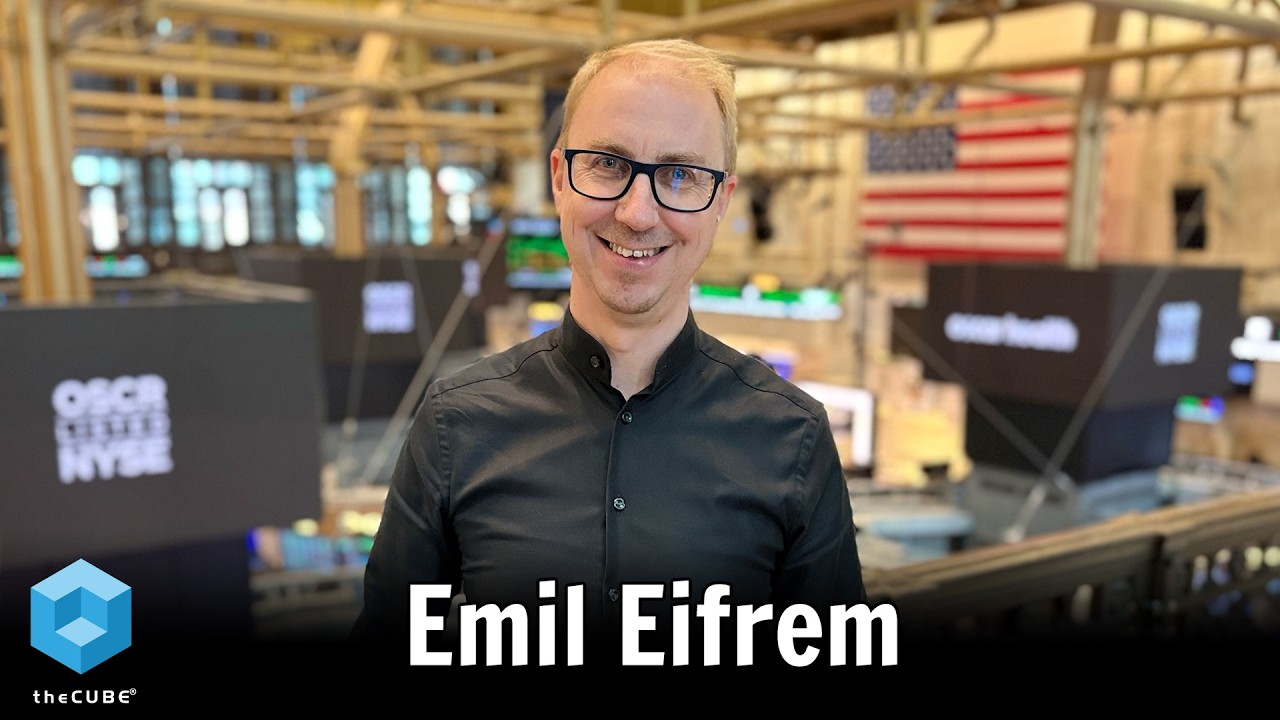
Video summary
Emil Eifrem, CEO and founder of Neo4j, discusses the transformative convergence of graph technology and artificial intelligence, describing it as a "match made in heaven" that is reshaping how organizations handle data. For over two decades, Neo4j has championed the idea that information should not be forced into static tables but represented dynamically through nodes and relationships, mirroring the real world. This approach laid the groundwork for major systems like Google's Knowledge Graph and Facebook's social graph, technologies that are now democratized and accessible to enterprises of all sizes. Eifrem emphasizes that while AI models possess immense raw intelligence, their true potential is unlocked only when provided with rich, contextual information about a specific domain, a capability where graph databases excel by connecting disparate data points instantly.
The core argument presented is that the current bottleneck in AI development is not model intelligence but rather the ability to provide accurate context at the right time, which directly impacts reliability and reduces hallucinations. Eifrem explains that giving AI agents the correct context is essentially an information retrieval problem solved historically by search engines like Google using PageRank algorithms. By leveraging graph structures, enterprises can achieve similar ranking accuracy within their own internal data ecosystems, allowing agents to navigate deeply connected webs of information with lightning speed. This capability elevates data practitioners who can implement these solutions, turning them into strategic assets that drive business value and solve complex problems that were previously difficult to address with traditional database methods.
To overcome adoption barriers such as the complexity of data modeling and querying, Neo4j is integrating advanced AI capabilities that allow users to interact with their data using natural language instead of requiring specialized knowledge of SQL or ontology design. The company introduces concepts like business-facing ontologies, which act as a bridge between human intent and technical data layers, enabling agents to understand terms like "customer" or "credit card" across various database sources. Furthermore, Neo4j is launching new offerings like Virtual Graph, which allows organizations to run graph analytics directly on their existing data lakes without moving data, significantly accelerating deployment times and making it easier for companies to build a unified "company brain" that enhances decision-making and operational efficiency.
Read the full video transcript
Palo Alto studio connection Silicon
Valley and Wall Street. I'm John F co
here with Dave Volante my co-host
here at the cub's NYC studio of course
of our Peloto studio connecting Silicon
Valley to Wall Street. This is our New
York Stock Exchange wired program MC
wired program and community with the
cube. Of course, we've been covering the
mixture of expert series. Of course,
graph talks in time with Neo4j. And
we're here with the CEO and founder MLFM
is a friend of the cube. Great to see
you. Thanks for coming on. Been a while.
>> Great to be here, John.
>> We've known each other since 2007 when I
mean Facebook was just starting to talk
about social graph and they would have
events. Um, but such a great success for
your company and your team. Um, graphs
are now infrastructure, data is
infrastructure, AI needs real time. You
guys have been great success. So, first
start with some of the momentum of what
you guys have. Obviously, you're in town
for the graph talk. I'll be hosting a
bunch of interviews from a lot of graph
practitioners who are leading the market
by the way, but get into what the
momentum is you have right now.
>> Yeah, you know, like you mentioned,
we've known each other for a few years
now, 20 years. So, we were, I think, 25
when we got to or something like that.
Four, four years.
>> Uh, and it's been an like just fantastic
journey, right? We started out by
saying, hey, there's got to be a better
way to represent information and work
with data, not force it to be squeezed
into square and static tables. The world
is dynamic. The world is always
changing. Figuring out how things fit
together felt like a worthwhile,
important place to pursue in terms of
using data. So that's how we started.
Right here we are now 20 years later,
hundreds of millions of dollars of
revenue, billions of dollars of
valuation and all that kind of stuff.
But really what's exciting now is what's
happening with graphs and AI. And
honestly, Don, it's like this match made
in heaven.
>> I mean, it's computer science match too.
Recursive nature of the graphs. AI
speaks graph, math is graph.
>> It's exactly right. And I think what's
happening is that the graph
representation of data, so organizing
your information in nodes and then
relationships between them and key value
properties on both ends up being this
very information dense or knowledgerrich
way to represent your data. This is why
in 2012, 5 years after you and I met,
Google launched their knowledge graph.
And this is the thing that we now take
for given when you search for New York
City. Yeah, on Google you're gonna get a
side panel with information about New
York and then you can click through to
the mayor. You can click through to it.
It's in the state of New York State,
which is the country of the US. That's
all on the back end powered by their
knowledge graph. They call it the
knowledge graph just because it's this
amazingly rich way of representing
information, right? And so that is this
heavenly match with the stochastic
transformer-based AI models which really
is a 1 plus 1 equals at least three and
we see that happening up and down the AI
stack and I'm very happy to talk you
through some of the key technical
patterns and use cases. Yeah, I want to
get into I want to get into the tech,
but I also want to keep zoomed out
because a lot of people who are seeing
graphs now for the first time are like,
"Oh, magic's happening." But there's a
lot of people who have worked hard over
the years to to get here. And we I
mentioned Facebook at the beginning. You
mentioned Google a few years later. If
you remember the social media evolution,
social graph was the concept. We all use
LinkedIn. Some people still use Facebook
and others. Uh but that was based on
graph concepts. And the power that came
out of those monster companies,
specifically Facebook, is now available
to every company. So most people think,
oh, Facebook has this graph. They were
highly efficient in targeting uh with
advertising obviously, but they own the
data. But now that it's opened up, it's
become democratized.
You guys really drove that. Talk about
that impact of the market because that
you like you said the AI world is now
going AI native. Everyone I talk to
that's AI native have multiple databases
and a graph I won't say overlay but I
think that's the wrong word but graph
connected
talk about that dynamic because now
everyone could have the power of
Facebook
>> right
>> and done done right basically
>> yeah yeah yeah and I think maybe the
first 101 15 years of this company was
taking what is in Silicon Valley you
have a generation of remember web 2.0 0
was the term right at the time right so
this is call it Facebook and LinkedIn
but also some web web 1.0 companies like
eBay and PayPal, you look inside of the
machinery of them, it's all based on
graph technology, right? But if you're
in the enterprise, outside of Silicon
Valley, it was very hard or or at small
startup, it was very hard to get access
to that technology. We democratized
access to that. We gave the same
platform that Google was built on like
on tap for the big financial services,
the big telecom companies, the big life
science companies, right?
>> A lot of people talk about AI as being
bad and there's bad narratives out
there. Oh, it's going to kill us, the
Terminator, Skynet. But if you think
about like where we are from a tech
perspective, there are the giants that
built the AI generation besides the, you
know, the algorithms that came out to
make AI work were pioneers. Uber, Neo4j,
they had to build the stuff from
scratch, right? So, but there was a lot
of work done. So, this is building on
the shoulders of those giants. This is
this next era. There's a lot of work
that's gone into it. Okay, that's known.
So, there's a lot of domain body of work
done to that's in the AI era. So, now
explain why that's important when people
start thinking, okay, how does AI work
better? How do I get contextually
relevant information as context? How is
it safe? because people just don't
understand that it's it's there. They
think two kids in a dorm room started AI
and it's going to take over the military
complex and kill everyone which you know
technically war games is a scenario but
we don't know but it's kind of a
fantasy. Talk about the the reliability
and the efficacy of where the AI
generation is. Yeah, at this point if
you look at the current generation of AI
models, but even the prior generations
like even like the ones released, call
it a year ago, which feels like stone
age these days, right?
>> Honestly, they're phenomenal. The
intelligence in those models is just it
if that's all that we did as a society,
it would take decades to just diffuse
that technology throughout the world and
we would get a ton of value from it.
When I look across our customer today,
customer base today, we're not
bottlenecked by model intelligence,
we're bottlenecked on what context do we
give the models. It's that classic thing
of the model is like a PhD in some like
narrow area that goes into work every
day and has to teach and learn
everything from scratch, right? Because
they don't know anything about your
company, right? And so the game now is
about how do we give that model the
right contextual information? And this
is where everyone is circling around the
same thing. It turns out that context,
what is context? Context is my context
is how I relate to the rest of the
world. I grew up in Sweden. I'm the CEO
of Neo Forj. I have three young kids.
I'm married to Meline. That's I drive a
Volvo stereotypically since I'm Swedish.
Volvo, of course. right? You know, so
that is my context. It's very graphic.
It's like how I relate to the rest of
the world. So, everyone is converging on
this approach to giving the AI models
the right information at the right time.
>> I said on the cube, you got to feed the
beast. Um, in a way, you got to feed the
AI and but it's you don't know the
context. Static web was, you know,
database, search it, results. That was a
search paradigm. We're not living in a
search par but we are living in a
discovery paradigm now with agents
explain this because search and
discovery has been one of the categories
go back to the early days of the web
search engines had a discovery mechanism
keyword get results whatever click on a
link navigate to a page now with AI you
still need that discovery layer but you
need it fast and accurate talk about
that piece because people see agents
going off the rails hallucinations they
might not understand that there actually
there is a solution Yeah. So, let's tee
off of what we just said, which is the
real game here is giving the super smart
AI models the right context at the right
time. If you think about that, that in
computer science is called IR or
information retrieval. It's a retrieval
problem, right? And so on some level, it
is let's say that you're a human being,
you contact customer support. Let's take
the classic AI enterprise use case,
customer support, right? So, John
contacts some like provider of yours,
right? And you say, "I need help with my
Wi-Fi." Let's say your Wi-Fi isn't
working. And you describe it. Say, "This
is the one that I bought." Or maybe the
system knows it already because it knows
who you are. Right? And it says, "These
LEDs are flashing yellow and my Wi-Fi is
shaky." Right? Okay. The agent has to
take that natural language that you
typed in or that you said over voice. It
needs to go from that intent to let's
find the call it top 10 documents across
my entire corpus of support documents
inside of this company. Give that to the
model at the right time to answer that
question. Now if you think about that
problem it turns out if you take a step
back as humanity we've solved that
problem before. The problem is the same
as you log into a search box on the web,
you search right, find me the top 10
blue links and you and I are, you know,
sadly old enough to remember that there
was a world pre Google where Alta Vista,
Leas, Yahoo, Exite.
>> Yeah. Yeah.
>> These days people don't even know those
names. So there's tons of search
engines, right? And
>> except for Yahoo basically.
>> Exactly. And one of the problems was
people called it the Alta Vista effect.
You search for a result and you're going
to get a million results, but the top 10
best ones were maybe on page 99 or 433.
Right. Then Google came along and they
said, you know what? I'm going to search
exactly to your point. But then I'm
going to rank the search result based on
what?
>> Based on the graph. That's the page rank
algorithm. How the documents are are
linked on the web. So that exact same
approach is what the enterprise is now
using to get the reliability of the
retrieval and this
>> and the results of page rank by the way
the ranking technology called page rank
created massive wealth for Google
obviously we know the search they
created the whole ad for online but what
does it mean for enterprises because
this comes up a lot I've done a lot of
interviews with some of your uh
practitioners as well as other graph
enthusiasts they're all having an
experience of almost like a superpower
but they weren't in the organization
pecking order and now they're moving the
needle on the business and they're being
elevated up because they just discovered
it's like a caveman discovering fire.
It's like they get pushed right to the
top. This is where you start to see the
grass. Why is that happening? Why?
>> Yeah, it's spot on. Although I'm not
going to describe my customers as
cavemen. So that was Oh, the wheel. The
wheel was revolutionary.
>> Yeah, fair enough. I'll take that I'll
take that part of the analogy. Right.
So, so the key thing here is what's
called accuracy. And accuracy is the
inverse of hallucination. Like the
higher accuracy that you have in your AI
system, the fewer hallucinations you do,
right? And there's a threshold that
people talk about as the escape velocity
for accuracy. And when people use graph
as part of their agents, they reach this
escape velocity where it actually works
in production. And that's the key thing.
Every single big organization right now
is on this AI transformation journey.
But if their agents can't retrieve the
right data at the right time, they'll
never have accurate enough answers for
it to be able to be used in production.
So that's the superpower that our
champions get by using graphs as part of
their agenda.
>> And by the way, it solves a lot of hard
problems they've been grinding on in
other mechanisms.
>> All right. talk about the impact of the
AI infrastructure because you know a lot
of database a lot of software you know
especially you know control layer
software or connective tissue whatever
you want to call it glue layer people
call it was kind of constrained by the
fact that you need a lot of compute so
now you were in an era where the new
architecture on whether you have an AI
factory you unlimited capabilities from
a horsepower standpoint you now have
engines that can pump out tokens okay
which is now currency
>> those tokens have changed the game on
how data is interacted. How has that
affected graph specifically because this
is where I think the AI connection to
the computer science of of AI with data.
>> Yeah. So there's two sides to that coin.
The first one we've talked about which
is how graphs in Neo forj are embedded
in our customers AI systems to help them
become better. We've talked a lot about
accuracy. There's also an explanability
and government sorry governance and
transparency angle that is really
relevant and important too but we can
get to that in a moment. So that's one
side of the coin. The other side of the
coin is if you look at graph technology
there are basically two big areas of
friction to adopt graph technology. The
first one is how do I get my data in
there and how do I model my data. Let's
say you have lots of data unstructured
or it might sit in your snowflake or
your datab bricks or your Oracle data
systems. How do you get it into the
graph? That's the first one. The second
one is how do you query it? Right? So
there's a query language now called SQL.
It's the first sibling to SQL that has
been standardized by ISO ever. Right? So
SQL was invented 40 years ago
standardized as the one universal
database query language. GQ SQL the
graph query language is the only sibling
to that which is just pretty phenomenal
right but it's a new language you have
to learn it well it turns out that AI
helps with both of those problems and a
modern AI model can look at your
unstructured data and create a knowledge
graph out of that from scratch right
without any any human manual
intervention and then how do you query
it well these days you don't need to
type you speak English to it right so
that that that barrier to adoption has
been just completely collapsed and
that's a huge part of what's driving
momentum for Neo forj right now.
>> You know what's interesting? You brought
up SQL structured query language. People
don't know the acronym that has been the
standard for querying databases. And I
want to tie this to intent because one
of the things that we've learned here on
the cube and we see successful companies
doing is they've changed the intent
equation. Give an example. I used to do
a lot of SQL queries when I was in doing
co-op work in the in the 80s. You have
to think about the business logic
formulation first. Then actually
construct the query. The query then is
my query to the databases. I need a
report you know. Okay. Now I create the
logic. Then the query goes in. So I have
to formulate the query. Sometimes
they're huge queries. Now that intent is
in the logic of the AI. So I just say I
want the top sales by region or whatever
my ask is. It does the logic on the
other side. that wasn't possible.
Explain this because this is like like a
gamechanging shift in user experience
but also technical implementation.
>> This one is huge. In order to pull this
one off at enterprise scale, you require
a technology that is absolutely
fundamental which is ontologies. And
ontologies have been around forever.
Aristotle talked about
>> I did one in 88. I did one in 88.
Taxonomy by hand.
>> Yeah, exactly. Tom Gruber coined the the
most common definition of ontologies for
computer science in 1993 at Stanford. Um
he then went on to co-found Siri by the
way the same same Tom Tom Gruber but
really the company that has popularized
this in modern times is Palunteer right
and they started talking about ontology
being their secret sauce right and what
an ontology does it's a graph model so
it is exactly 101 what we've been doing
for 20 years and a businessfacing
ontology is the key asset here and what
it is is it takes the world of your
company. Let's say you're a financial
services institution. You have
customers. The customers have bank
accounts. They have credit cards
connected to them. There are
derivatives. There are pair like all the
concept that exist in your universe and
how they relate a business facing
ontology because it turns out that a key
part of your job as an enterprise data
architect today is that you have to
design the world that your agents think
in. And your agents think in the
terminology of the business. They think
customers, they think credit cards, they
think accounts, they think insurance
plans, that kind of thing, right? And
then you require a technical ontology
which is all my data sources the
physical data layer in my enterprise. I
have an Oracle database over there. I
have a snowflake database over there.
And then a mapping between the two. So
all of a sudden you know that a customer
first name maps to that Oracle database
with a column called F_name. The agent
wouldn't know that F name is the first
name of your customer. But with these
key ontologies to connect them, you can
do exactly what you said. Your agents
can interpret intent and map that to the
data that they need.
>> And the graphs make it faster. So talk
about the how think about graphs. It's
almost like picking a fork in the road.
Like you can say, okay, down this lane
is a series of graphs, but it makes it
very efficient. Um the word recursion
comes up a lot in graphs. I mean, graphs
are nodes with an arc connected to
another node and there's data in these
things, right? So, like that's computer
science principle 101. You traverse the
nodes and you go see what's in there.
So, take us through why that works in AI
now that you have intelligence
>> and horsepower. You have compute and and
all the GPUs and all the vector embeds
and all the other data.
>> So, the key secret sauce here, if you
take, we talked before about the
knowledge graph of describing all the
key concepts and how they relate and all
that, you can take that data structure
and you can store it in anything. You
can put it in S3 buckets. You can put it
in Oracle, Postgress, whatever you want,
right? But what a graph database is like
Neo forj, it's written from scratch.
Again, we've been at this for 20 years
now, right? And we've taken every single
layer in the stack of the database and
we've optimized it for exactly what you
said, which is traverse this deeply
connected web of information at
lightning speed. So we are frequently
because it's perfect.
>> It's called the knowledge graph
basically these days, right? Exactly.
And it is frequently not even a thousand
times, but a million times faster than
if you put it in a classic relational
database, which is great at many things.
It's just not great at traversing this
deeply connected data that an agent
requires in order to answer
>> and they and they're bounded by latency,
too, because their accuracy is only as
good as the most best data possible.
>> That's exactly right.
>> All right, let's talk about your
momentum in the company. Obviously,
great success. Love the tech angles. I
think every companies wants their own
data mode. They want a palunteer-like
environment. All the smart money and
smart people are using graphs with other
databases. Talk about the momentum in
the company. You mentioned the re some
of the revenue figures. Can you quote
the numbers? Can you share some of the
momentum where you guys are at and
what's your focus now?
>> Yeah, so we're we're here at the New
York Stock Exchange. We're not yet a
public company, so we don't we don't
disclose our our numbers publicly.
Suffice to say, we're hundreds of
millions of dollars of revenue. And just
to give you a sense of the momentum,
like 2026 is off to a flying start in Q2
of this year. So, we're we're recording
this in midepptember. So, our last
quarter was was Q2 of of of this year.
We generated about as much revenue in
just that single quarter than all of
2025 combined. Right. So, that just
gives you just a flavor. it is really
taking off and there's this widespread
recognition that AI and graph is this
again match made in heaven.
>> Talk about the community that's
developing around graphs. I think this
is super fascinating um because the
people who are doing graphs were early
adopters because they saw the value and
it's almost like they are discovering
the superpowers and it's spreading. Talk
about the how that's spreading in the
community and what you guys are doing
about it.
>> Yeah, one of the things that I love
about this company, of course I'm
extremely biased being the founder the
founder, right? But but one of the
things is that we've always had this
practitionerled adoption where the
people who do the real work. They find
us. We're open source. We have now in
the cloud world, we have a free tier of
our cloud offering. They self on board.
They fall in love, right? And they can
build it themselves, right? And so we
only ever sell into people that are just
champions. We never sell. just start top
down, push it down into into the org.
Now, we of course at this scale, we also
engage with the real technical
leadership of the global 2000,
>> but it's based on this foundation of the
people who actually sit there doing the
real work wanting to choose to work with
Neoforj
>> and making it easy.
>> Making it easy, I know, is always hard.
Take talk about the ease of use feature.
How are you guys making it easier?
Because, you know, we want to get our
graphs going in our company. Every
company I talk to is trying to figure
out the brain for their company. They're
all come to the realization that okay,
we need a company brain. We need a
Google page rank. We need to have a
palenteer. We have data that's valuable.
How do we protect it?
>> Yeah. Yeah. And a brain like even the
human brain is physically a neuron
connected through another neuron through
signapses. It's physically a graph,
right? And associatively, we we think
associatively which is also a graph,
right? Yeah. It comes back to what we
talked about before. the fact that we
now have AI. I spend most of my time
thinking about how will this how can Neo
Forj help my customers AI applications
become better. But it's also a massive
superpower for us internally as
architects of our own product because
all of a sudden we have a way of making
it so much easier to get data into the
database and then query in pure English,
right? And those two things is the main
building blocks
>> and no one really has to give up
anything to use Neo4j. They can still
use their data links. They can still use
everything else. You just connect into
it.
>> Well, and the other thing is we've also
done a lot of investment in we we
actually are tomorrow at at our event
we're talking about a new product
offering called virtual graph which is
super super exciting. What virtual graph
does is it's the entire Neo Forj product
platform. So all of the tools, all of
the solutions running on top of it. We
can talk about Graphware later if you
want to as an example of the solutions
running on top of Neo Forj, all of this,
all the AI capabilities, but it sits
right on top of your snowflake or your
data bricks. So you don't have to move
your data. It uses in the weeds
technically it's called predicate
pushdown queries, right? So it runs all
of this directly on your pabyte data
lake with minutes to get started, right?
And so that's really exciting.
>> That's really on boarding fast. All
right. Well, great to see you and I know
you got to go. I really appreciate your
valuable time coming on the cube. Uh
it's been a couple years. Um we have a
lot of your team members on and you got
a great team and again graphs are just
the beginning. People starting it'll be
standard fastest ISO standard on the
database piece. Congratulations. Um and
we'll we'll we'll talk more later.
>> Thank you.
>> Pleasure.
>> All right. Founder and CEO of Neo4j.
Again, the graph database is turning out
to be the the heart and soul, the
connective tissue, the brain of
organizations. And there's benefits. AI
is highly compatible. You don't really
have to get rid of your other data and
databases to really make it happen. Of
course, the results are fantastic with
AI. I'm John Furry, your host of the
Cube. Thanks for watching.