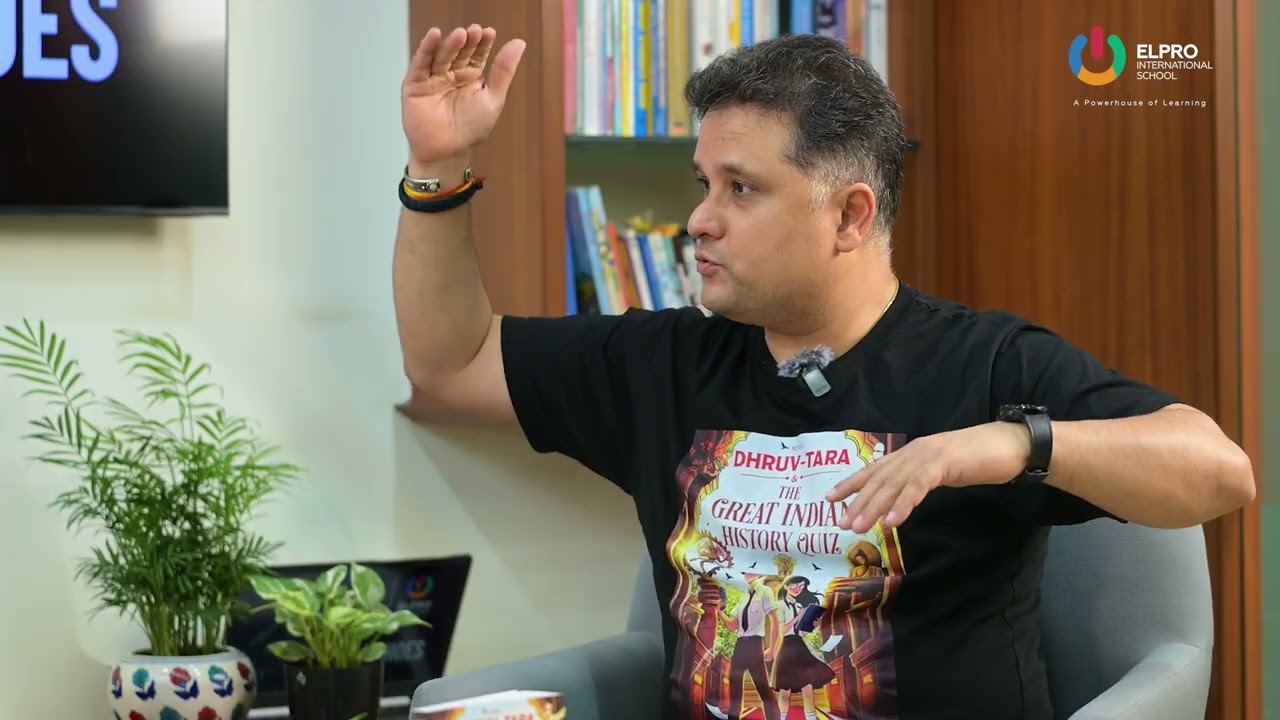
Elpro Echoes Ep. 01 | Amish Tripathi on History, Storytelling, AI & India’s Future
Watch on YouTubeVideo summary
In this episode of Elpro Echoes, author Amish Tripathi joins the podcast to discuss his transformative journey from a successful career in finance to becoming one of India's most celebrated storytellers through works like *The Great Indian History Quiz*. Mr. Tripathi reflects on how he chose an unconventional path by leaving behind traditional options like medicine or engineering that were common for graduates in 1990s India, driven instead by his curiosity and a desire to explore new perspectives. He emphasizes the importance of asking better questions rather than simply seeking right answers, noting that true learning comes from engaging with knowledge humbly while remaining open to expanding one's understanding through dialogue and research.
The conversation also delves into the profound impact of artificial intelligence on education and critical thinking. Tripathi warns against relying too heavily on AI as a crutch, using the analogy of choosing between riding a bicycle versus being carried by a motorized vehicle; while both aid movement, only active engagement strengthens one's capabilities. He argues that deep reading remains essential because it fosters unique insights and personal growth that automated summaries cannot replicate. By strengthening their own "brain muscles" through direct study and reflection, students can develop the individuality needed to compete in an increasingly connected world without losing their sense of self or cultural roots.
Furthermore, Tripathi highlights the vital role history plays in grounding individuals and nations alike, comparing it to the foundation of a skyscraper that ensures stability as structures grow taller. He cautions against disconnecting from one's heritage and family ties, pointing out how young people in some Western societies often turn to superficial digital connections instead of seeking support from loved ones when facing challenges. For Indian students navigating global communities, he advocates for a balanced approach: maintaining strong roots through cultural rituals and historical knowledge while embracing diverse insights from around the world. This equilibrium allows them to build resilient futures that are both locally grounded and globally aware.
In his rapid-fire segment, Tripathi shares personal reflections on what truly matters in life as one ages, shifting focus from ambition-driven destinations to the value of relationships and shared experiences along the journey. He reveals how he now prioritizes family, close friends, and meaningful connections over mere success or financial gain, urging younger listeners to cherish their loved ones before it is too late. As a final message for future generations, Tripathi celebrates India's resurgence as a global power after centuries of decline, encouraging students to embrace this pivotal era with confidence and creativity. He concludes by reminding everyone that identity provides courage, inviting the audience to keep questioning, discovering, and creating echoes that inspire others.
Read the full video transcript
[music]
Hello and welcome to Elpro Echos, the
official podcast of Elpro International
School. We at Elpro believe that
education doesn't only come from
learning what's written in the books,
but from exploring new ways of thinking,
discovering new perspectives, and
challenging other people. That's exactly
why we created Elrochos, a platform
where people and students can have
meaningful conversations. Our very first
guest is someone who has transformed the
journey of history into a very
fascinating one. His latest book, the
great Indian history quiz encourages
readers to know more about history and
it's not just a collection of dates but
a fascinating journey of thinking. Mr.
Amish Praati, it's an honor to have you.
>> Thank you so much,
>> sir. We're delighted that you've joined
us today. Most people choose paths that
are already walked. You've chosen
something different. You left a
successful career in finance behind to
tell stories that have moved millions.
What inspired that?
>> Pra
um so much of the choices of life are
defined by what atmosphere you're
growing up in.
>> Absolutely.
>> Okay. I'm 51 years old.
>> The India I was growing up in there were
very few opportunities. Uh we were very
poor in those days. Right. We've chosen
socialism as our economic policy.
Socialism is always a disaster
economically. U so when I got out of
college in the mid 1990s there were very
few options yeah
>> MBA medicine engineering CA is
>> nothing else right
>> so we were forced to kind of restrict
ourselves but you guys are growing up in
an India but there are so many
opportunities the world is your oyster
man you know uh India was poorer than
three American car companies you know
40 years ago
>> today we're the fifth largest economy on
earth, right? Very soon we'll be the
third largest economy. What that means
is you guys have so many opportunities.
Grab them, right? And when you do well,
India will do well as well.
>> Yeah.
>> Be confident. Just
>> just jump because you live in a
wonderful India.
Sir, at ELT we're grateful to
[clears throat] have an uh environment
and teachers where they encourage us to
ask more questions
>> and seeing you, you have a history or a
journey in being a writer, a diplomat
and a thinker and it seems that your
greatest weapon is your curiosity.
>> So in your experience, what changes a
perspect a young person's perspective
more? Always learning to have the right
answers or asking better questions?
Actually both of them are actually the
same if you think about it because you
learn better answers because you ask
better questions right so see how it
works is you must be a questioning
person but you can either ask those
questions from a place of ignorance
where you're just doing it for ego
harassment I'll ask some question but
actually it's not coming from knowledge
but if you have knowledge then you ask a
smart question
>> and when that person answers then you
learn something then you become even
smarter Then you ask smarter questions.
Then you become even smarter. So the key
thing is this. Learn as much as you can.
But never believe that you know
everything that there is to know. You
are an expert now and you don't need to
ask questions. No matter how smart a
person is, they should always ask
questions to those who they think are
smarter.
>> Right. That's how you learn. But ask
questions from a place of knowledge,
>> not a place of ignorance.
>> Yeah.
>> Yeah. So to add to that um we our
generation is growing up in the
generation of AI. Um it it literally
gives us what we ask for
>> at your fingertips. Yeah.
>> So do you think that AI will or might
change the way we think or learn?
>> It's 100% going to change the world.
It's 100% going to change your life.
>> Mhm.
>> The problem is we don't know how it'll
change. Right? That's if anyone tells
you they know exactly how AI will work
out, they're lying. Okay. This is the
biggest invention ever made by humanity.
There's just a few things that are clear
to me. Okay. One, remember that AI is a
machine. It is not a human being and it
is driven by just to force you to just
stick to it. Okay? So, it's a people
pleaser in a way. So, I know there are
some kids, not you guys, you guys are
too young, but college kids who ask
relationship advice from AI. That's a
serious thing to do. Or they think of AI
as a friend. It's not your friend. It's
a machine learner. Okay? So, be clear on
that. Second,
use AI as a tool, not as a crutch. I'll
tell you what I mean by that. Okay? You
can use a bicycle to move faster because
if you're on a bicycle, you'll always be
faster than running by yourself. Or you
can use a motorized, you know, two-heer,
right?
>> Yeah.
>> Imagine if you stop using your legs at
all. You don't walk at all. You are only
on your motorized two-wheeler all the
time. 6 months later, your leg muscles
will become weak because you haven't
used it. But if you get on a bicycle,
that's also a two-heer, but you're using
your legs, right? You're actually
strengthening your legs. So use AI like
a bicycle, not a motorized two-heer. Use
it as a tool to make your mind stronger.
Don't use it as a crutch. Like if you if
you have some submission to put in and
you just say, and you submit it, you're
using it like a crutch. It's not
strengthening your mind. But if you use
it like a tool, these are my ideas. What
do you think? And expand some of these
ideas. Give me the research for these
ideas, but I will write it myself.
You're using your mind then. And you're
using it as a tool. Then it'll be much
better for you.
>> Yeah.
>> Okay.
>> So connected to that, we know that AI
can summarize anything and everything we
want. If AI can summarize a book in
simply like 5 to 10 seconds, then why
should a student still spend days
reading one? What does the experience of
deep reading give us that technology
simply can't?
>> Because deep reading gives you your
insight. AI gives you a general insight
which everyone else will have. Then how
are you unique? How you compete with
others? If you have the same insight
that everyone else has, then you're not
unique. Imagine if you're running a 100
meter race and everyone out there is at
the same speed. No one has any
advantage, right? So if you're all
depending on AI, all you're absorbing is
the AI's insight. Then how are you
different? So you have to make your own
insight. For that read yourself. The
point I made earlier, you have to
strengthen your own muscle. Your brain
is also muscle. You have to strengthen
it. Best way to strengthen it is to use
it, right?
>> Yes.
>> That's the way to approach it. Uh at
LPRO we have uh people coming in from so
many different backgrounds. We have um
uh CBSC, IB and Cambridge all under one
roof. So um conversations about um
Indian heritage and
global communities is something that we
navigate on a daily basis. Um how do we
how do us young students how do we young
students stay on that path stay with the
heritage and also be confident uh in
terms of global perspectives
>> it's a balance beta uh
you must learn from everyone around the
world cuz everyone has been blessed with
some insight which could help you right
there's a lovely lovely Sanskrit line
ano badra yu vishaha let noble thoughts
come to me from all corners of the
Right? Our ancestors had that approach.
Knowledge can come from anywhere. Learn
from anywhere. But
>> do not lose your own grounding. Cuz if
you lose your own roots, what happens to
a tree that has no roots. What happens
to you know any any plant anything which
has no roots? It'll die. Right? So you
need your own roots. But let knowledge
also come from all corners of the world.
Have a balance of both. Right? So the
rituals that you do, the fact that you
read Indian stuff keeps you rooted. But
the fact that you read other cultures
will help you sore. Yeah.
>> Yeah.
>> So many students think that why does
history deserve so much attention when
the future seems to be changing so
quickly.
>> Yet you spent years bringing history
alive for modern readers. What do you
think history gives us that other
subjects simply can't?
>> History gives you to the point I to the
point I made earlier. History gives you
roots.
>> Okay. It gives you a sense of connection
to your ancestors. uh it gives you your
grounding from which you can build the
future. It's a bit like to draw a
simile. Uh have you ever seen a building
being constructed?
>> Yes.
>> Yeah. So a tall building first they'll
build the foundation. Right. Why do they
build the foundation first?
>> It's the base.
>> Exactly. If there is no foundation, the
building will not stand. It'll fall.
Right. The foundation is what gives it
the grounding. The taller the building,
the deeper the foundations, right?
>> Yeah. Because taller buildings need much
deeper foundations. It's the same way
with you guys. You guys are building a
bigger future, you need much deeper
foundations, right?
>> That's what makes your building strong.
If you if you're only focusing on the
future and you don't have any roots,
then you have the problem that happens
in some western countries. You find many
of the youngsters in western countries
are totally
disconnected.
You know there's a lot of
unfortunate things that happen. Why is
that? Because there's no foundations,
right? If they have a problem, they
don't have deep connections in their
family, their parents who they can go
and ask for help. They turn to
Instagram, right? But the Instagram guy
is not your friend,
>> right? Your real friends are actually
your foundations. your mother, your
parents, your siblings, your close
friends, you need this to build a good
future.
>> Yeah.
>> So,
>> it's the same thing with history.
History does that for you at a national
level. What is done for you at an
individual level is done for you at a
national level through history. It
grounds all of us Indians to our past
>> so that we can sort.
>> So, sir, uh just a few questions and
then we'll be moving on to the rapid
fire. This a short three question
session. So um your shift trilogy and
the Ramchandra series it's it's based on
mythological fiction right so now you
have written uh about the Chola tigers
as well so does writing on history limit
creativity because it has to be written
on the factual basis
>> yeah you're right yeah so
you have it's it's a bit like you're
coloring a book but the borders have
been set right yeah you're right you're
right uh you know if I'm not writing on
history or epics then there are no
borders. I can write whatever I feel
like. Right? You're right. But in some
ways it's challenging but in some ways
it's even more it drives you even more
that I have these restrictions. I have
to figure out somehow to make it all fit
and make it an interesting story. So
that challenge itself makes it
worthwhile if that makes sense.
>> Yeah. So like how does a typical day of
work look for you? And are you reading
any books?
>> I I am reading all the time. Mhm.
>> I read at least five to six books per
month, but I mainly read non-fiction.
Okay. Right.
>> So, do you like reread or annotate or
something like that?
>> Yeah. Yeah. Because most of my reading
is non-fiction and all of that actually
then goes, you know, into my books to
build as you said the boundaries, right?
So, for example, this book through Tara
and the great Indian history quiz, all
the historical facts in it are all real,
right? So, and look, I mean, your
teachers also have to like the book,
right? Your parents also have to like
the book otherwise they'll not let you
buy it. Right? All the historical facts
are all referenced. There's a long list
of references at the end of the book
chapter wise. Every historical fact
there's a proper primary source or a
scholarly secondary source reference.
But the story around it of dhu tara
that's all fiction. Okay. Uh that's fun
for you guys. You can have fun with the
story but through it you learn
historical facts. historical facts are
all referenced which is what I get in my
reading.
>> Okay.
>> So,
>> so we have one final section. That's the
rapid fire. No overthinking allow.
Instinctive answers and really quick
answers.
>> Oh my god. This year is quite strict
here. Serious questions. Very.
>> How do you two work together? [laughter]
She's very strict.
>> Okay. Tell me.
>> So, yeah. Books or conversations?
>> Books. [snorts]
>> Sorry. I like conversations. But yeah,
but yeah, books. Yeah.
>> Uh, if not a if not a writer, what would
Mr. Mr.
>> Banker? I was a banker. [laughter]
>> Uh, one final one.
>> Um, if is there something that school
taught you that life later on proved
wrong? [snorts]
>> Yeah. You know, when I was young, this
is okay. Sorry, this will have to be a
slightly longer answer.
uh in school, college and my banking
job, I actually believed that the
destination is more important than the
journey that I have to succeed no matter
what. Right? I was very ambitious.
Right? By the time I started writing my
first book, I realized actually the
journey is more important than the
destination. You have to enjoy the
journey otherwise if you're if you're
just you know every day is a torture but
somehow you're trying to justify it
because I'll become CEO sometime and
I'll make money then the that journey is
not worth it right
>> but now that I'm 51 I realize actually
neither the journey nor the destination
is important what is truly important is
the company the people who walk with you
right and then you're at this age you
realize man the only things that matter.
My family, my close friends, you you
guys are too young for it right now. But
when you grow old, you'll realize this
is the only thing that matters. Bakisab
is there. Destination journey, it's all
important. Truly matters those people
really close to you who make life worth
it. Yeah, that's what I've learned.
>> So when you guys go home, hug your
parents. Okay? And if you have siblings,
hug them too. Trust me, this is all that
matters at the end of the day.
>> It does.
>> Okay.
>> Mr. Amish Praati, thank you for being
the first voice on our podcast. You
reminded us today that we our identity
gives us courage and on behalf of every
student, we would like to thank you.
>> Thank you. Thank you.
>> Thank you.
>> So um one final thing sorry [laughter]
we would just like you to give one
thought for the future generation that
would stay with us.
You are living.
You guys are the luckiest generation
because you are living in the age when
India will come back to a rightful
position. Right? We had a bad few
centuries. We were we were the
wealthiest most powerful nation on earth
for centuries. Then we had a bad few
centuries. Foreign invaders destroyed. A
lot of it is our fault as well. But we
are coming back now and you guys will
see it happen. What a time to be alive.
What a time to be Indian. Enjoy the
journey.
>> Thank you for watching Elro Echos. Until
next time,
>> keep questioning,
>> keep discovering,
>> and keep creating echos [music] that
inspire.